Specs are compiled from manufacturer listings and verified buyer reviews and can change over time — please confirm the key details on the product page before buying.
If you are building a bag for the worst day, the answer is simple: buy a filter that keeps working when the power grid and the water plant do not. That means a hollow-fiber or absolute-micron filter with no moving parts, no batteries, and a lifespan long enough that you stop thinking about it. This guide covers nine filters that survive in a pack, and it explains in plain words what each one is actually good at.
This guide is built by comparing the manufacturers’ published specifications and the patterns across verified customer reviews, so you get each pick’s real strengths and trade-offs instead of marketing spin.
Every pick here is checked against verified owner reviews, so you know which survival water filter fits your kit before you spend anything.
Top Picks

How To Choose The Best Water Filter for Survivalists
You are not buying a filter for a weekend hike. You are buying the thing that still works after a storm knocks out the municipal supply for a week. That changes what matters: no batteries, no fragile parts, and a cartridge that keeps producing clean water long after you stop counting.
Start with the micron rating, not the percentage
The micron number is the size of the holes the water passes through, measured in micrometers. A 0.3 micron absolute filter catches bacteria and protozoa, and that word “absolute” means the pore size is guaranteed rather than averaged. Look for absolute ratings when a manufacturer prints them, because a percentage claim alone tells you nothing about how long the filter holds that performance.
Decide how you will push the water
A straw is the lightest option — you drink straight from the source. A squeeze or gravity bag lets you fill a bottle for a group. A hand pump generates pressure when the water source is shallow. An electric pump removes the effort but hands you a battery dependency. For a bug-out bag, the straw and the gravity bag win on reliability because there is nothing to break.
Check the lifespan before the flow rate
Lifespan is measured in liters or gallons, and it is the number that decides how many resupplies you get. A 4,000-liter filter and a 360-liter filter both work on day one; they part ways on day ninety. Flow rate matters too, but treat it as a comfort spec — a fast filter you enjoy using gets used, and a slow one gets left behind.
Side-by-Side Comparison
| Model | Best For | Filter Type | Rated Capacity | Weight | Amazon |
|---|---|---|---|---|---|
| LifeStraw Personal (2PK)★ Best Overall | Grab-and-go bug-out bag | Filter straw | 4000 liters | 1.6 ounces | Amazon |
| Sawyer SP160 Gravity SystemBasecamp Pick | Basecamp gravity refills | Gravity bag with MINI filter | 1 gallon reservoir | — | Amazon |
| Sawyer SP129 SqueezeBest for Backpacking | Backpacking with bottles | Squeeze pouch | 100000 gallons | 71 g | Amazon |
| Timain 6 Pack Mini Straws | Group kits and caches | Filter straw | 1000 gallons each | 1.5 ounces | Amazon |
| Platypus Quickdraw 1L | Fast ultralight refills | Squeeze reservoir | 1 liters | 3.36 ounces | Amazon |
| Practical Survival 6-Piece Kit | Family and group hydration | Gravity bag system | 1800 Gal | ≈1.5 lbs | Amazon |
| Purewell Hand Pump | Shallow and murky sources | Hand pump | 793 gallons | 1 pounds | Amazon |
| Survivor Filter PRO X | easy volume filtering | Electric pump | 360 liters | 14.1 ounces | Amazon |
| GRAYL GeoPress 24 oz | Fast purification bottle | Press bottle | 65 gallons per cartridge | 15.9 ounces | Amazon |
Detailed Reviews
1. LifeStraw Personal Water Filter 2PK
Our pick — 4.5+★ from 126,000+ verified ratings; the strongest balance of quality and price.
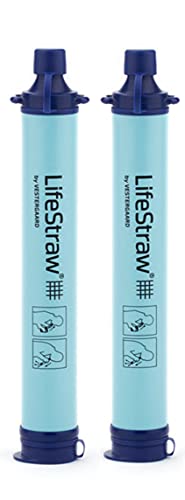
A 1.6-ounce straw with no parts to break — dunk it, drink, and forget it.
Four thousand liters is the number that makes this the default survival filter. That is 1,000 gallons of clean water from a straw that weighs 1.6 ounces, which means it disappears into a pack pocket and stays there until you need it. You drink directly from the source, so there is no bag to fill, no hose to prime, and no pump handle to snap in the cold.
What it removes is the reason survivalists keep buying it. The microfiltration membrane pulls out 99.999999% of waterborne bacteria, including E. coli and salmonella, plus 99.999% of parasites like Giardia and Cryptosporidium. It also takes microplastics down to 1 micron and reduces turbidity — the muddiness of the water — down to 0.2 microns. The claims are tested to protocols from the US EPA, NSF, and ASTM, which is a higher bar than most straws bother with.
The two-pack is the real selling point for a survival kit. One goes in the vehicle bag, one goes in the house kit, and you are done shopping. The crowd is behind it too — 4.5+ stars across a review pool well past 100,000+ owners, with the body build quality the thing people praise most, and function close behind it. The honest catch is the drinking effort: you draw water through a straw, so a long pull takes real suction, and a muddy source will slow it further. That is the trade for having zero parts to break.
What earns it the top slot
- 4,000 liters (1,000 gallons) of rated filter life from a 1.6-ounce straw
- Removes 99.999999% of bacteria and 99.999% of parasites
- No batteries, no pump, no moving parts to fail in the field
- Two-pack covers both your house kit and your vehicle bag
Where it asks for patience
- You supply the suction — drinking takes effort, not a squeeze
- Silty water slows the draw further
- Not built to fill a bottle for a group in one pass
Reach for this if: you want one filter per kit that needs no assembly, no power, and no maintenance plan.
Look elsewhere if: you need to fill containers for several people — a gravity bag does that better.
2. Sawyer Products SP160 Gravity Water Filtration System
Hang the 1-gallon bladder, walk away, and come back to filtered water for the whole camp.
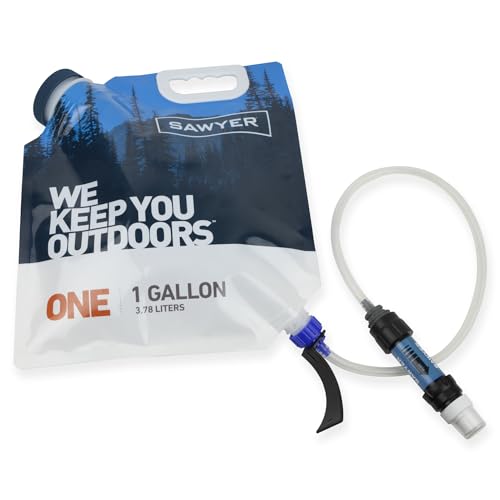
Where the straw on the previous pick makes you work for every swallow, this one makes gravity do it. You fill the 1-gallon wide-mouth bladder, hang it from a branch or a truck rack, and the water passes through a dual-threaded Sawyer MINI filter on its own. The filter is rated 0.3 micron absolute — the pore size is guaranteed, not averaged — and every MINI unit is individually tested three times before it ships.
The filter itself weighs just 2 ounces and fits in your palm, so the whole system breaks down into a bag and a fistful of hardware. The dual-threaded design is the detail that makes it practical: the cap threads onto the filter so you can switch the flow on and off without a clamp. The kit includes the MINI filter, the 1-gallon bladder, a cleaning plunger, a cleaning coupling, and a gravity hose with adapters.
The fix-it crowd rates the build quality highest here, with function right behind it, and the recurring honest note is flow rate — gravity is patient, and a full gallon takes time to pass through a 0.3 micron filter. A few mention durability and filling as the mild friction points. Plan your water around it rather than standing over it, and this becomes a camp workhorse.
Group refill math: one gallon of reservoir beats any straw when you have three or four people to hydrate, and the 2-ounce filter means the weight penalty is basically the water itself.
Plan around the drip: set it up before you cook, not when you are already thirsty. The dual-threaded cap lets you shut the flow off cleanly between uses.
The verdict: a camp and cabin filter that earns its place by doing the work while you do something else.
Fair warning: if you expect a fast pour, gravity will feel slow — this is a set-and-walk-away tool.
3. Sawyer Products SP129 Squeeze Water Filtration System
Squeeze, fill, move — a 2-ounce 0.3 micron filter that threads onto any 28 mm bottle.
This is the filter that made squeeze systems the default on long trails. The 0.3 micron absolute inline filter weighs 2 ounces, fits in your palm, and threads onto standard water bottles with 28 mm threads. You can filter straight into your mouth, into a bottle, or run it in a gravity setup when you stop for the night. The kit ships with two reusable 32-oz BPA-free collapsible pouches, a drinking straw, a set of inline hydration pack adapters, and a mesh bag.
The production claim is the part that matters for a survival purchase: every squeeze unit is individually tested three times to performance standards before it leaves. The filter removes bacteria, protozoa, cysts, sediment, and 100% of microplastics. Maximum flow rate is 1.7 liters per minute, which is a working pace rather than a trickle.
Pack weight is what buyers talk about here — the pouches roll flat, and the whole setup replaces a bulky pump. What wins people over is the build, with effectiveness close behind, and the speed of a squeeze setup draws steady praise too. The catch worth naming is durability: collapsible pouches are soft by design, so treat them as consumables over years of hard use. Compared with the Quickdraw below, this one’s 1.7 liters per minute runs behind that system’s 3 liters per minute when squeezed.
Why backpackers keep buying it
- 0.3 micron absolute filter at 2 ounces
- Threads onto standard 28 mm water bottles
- Two 32-oz collapsible pouches pack flat
- Works as a squeeze, a straw, or a gravity rig
The real wear point
- Soft pouches are the first thing to go after hard seasons
- 1.7 liters per minute is a work pace, not a gush
- Needs a source you can reach or scoop from
Best fit: the backpacker who wants one small filter that handles bottles, mouths, and gravity duty.
Not the fit: someone who wants a rigid container that shrugs off years of abuse.
4. Timain Mini Water Filter Straws 6 Pack

Six 0.3 micron straws, one per kit, so six people are covered when the water goes bad.
Buying filters one at a time leaves holes in your plan. This box puts six hollow-fiber straws on the shelf at once, and each one is rated to 0.3 micron — fine enough to pull 99.9999% of E. coli and the smallest microplastics out of surface water. You can drop one in the house kit, one in each vehicle, one in the range bag, and still have spares.
At 1.5 ounces and 7 inches long, a straw fits in a jacket pocket, a backpack side pouch, or a gym bag without being noticed. Each one is rated for up to 1,000 gallons with proper use and maintenance. The components that touch water are made of food-grade materials that meet strict food contact safety standards, and the body is built to be leak-proof and broken-resistant for outdoor conditions.
The bottom of each straw is tungsten steel, and the maker says it will mark or break glass — a second job for a tool already in your bag. That is an unusual extra, and it is the sort of thing that makes a six-pack worth keeping around.
Why the six-pack logic works: survival gear fails by being in the wrong place. Redundancy is a feature, and six identical straws mean you stop rationing your only filter.
Go this route: if you are stocking several kits at once and want one purchase to cover the house, the car, and the pack.
Think twice: if you need to fill a bottle or a canteen — a straw drinks from the source, not into a container.
5. Platypus Quickdraw Ultralight Water Filter System

Three liters a minute when you squeeze — roughly double the Sawyer SP129’s 1.7 liters per minute.
Speed is the whole pitch. Squeezed, the Quickdraw pushes 3 liters per minute; hung in a gravity setup, it settles to 1.75 liters per minute. Set that against the Sawyer SP129 above at 1.7 liters per minute and the gap is real — you are filling bottles in roughly half the time with the same effort.
The ConnectCap threads the clean side of the filter directly onto any 28 mm water bottle, including smartwater, select Cnoc bags, and soda bottles. That means the filter becomes a bottle accessory rather than a separate rig. The hollow-fiber element is individually tested and meets the NSF and EPA P231 protocol, removing 99.9999% of bacteria and 99.9% of protozoa. Cleaning needs no tools — a shake or a backflush restores flow and clears debris.
Weight is the other reason it sells: 3.36 ounces for the system, with a 1-liter reservoir that packs down small. That is heavier than a bare straw but far lighter than any pump. Owners describe the fill as taking minimal effort and the filtering of bacteria and protozoa as doing exactly what it claims. The honest limit is the reservoir size — 1 liter is a personal supply, not a camp supply. Compare that with the Practical Survival kit’s two 6-liter bags below if you need volume.
The case for paying up: flow rate is the spec you feel every single time you refill. Three liters per minute turns a chore into a five-second pause.
One number to keep in mind: 1 liter in the reservoir means one person, one fill. Groups should look at a gravity bag instead.
Pick it when: you hike fast, refill often, and want the filter to attach straight to the bottle you already carry.
Pass when: your plan involves keeping several people hydrated from one source.
6. Practical Survival Gravity Water Filtration System 1800 Gal

Two 6-liter bags and an 1800 Gal filter core rated for a 10-year life cycle.
The capacity is the headline. Two oversized hanging bags hold 6 liters each, so one fill covers a basecamp or a whole household for the day. The high-capacity core is rated to clean up to 1800 Gal, and the maker lists a filter life cycle of 10 years with an EU spare part availability of 10 years alongside it.
The setup is deliberately dumb, which is what you want in an emergency. Fill the dirty bag, hang it, connect the filter and the clean bag, and let gravity move the water. The built-in port fixtures join securely to standard screw-top bottles, so you can decant straight into what you already own. Everything weighs approximately 1.5 lbs and fits in a hanging bag or backpack, which makes it portable enough to move but heavy enough that it is a camp tool rather than a pocket tool.
It removes over 99.99% of waterborne bacteria such as E. coli and Legionella, and parasites such as Giardia and Cryptosporidium, filtering microplastics down to 0.3 micron. Maximum flow rate is 0.6 gpm. What buyers praise is the build quality and the speed of setup — it works quickly and goes together without a manual. That 0.6 gpm also tells you to hang it early rather than waiting until you are parched.
Strengths for a household plan
- Two 6-liter bags for group or family volume
- 1800 Gal core rated with a 10-year life cycle
- Setup in about a minute with no pump or power
- Ports fit standard screw-top bottles
What to plan around
- 0.6 gpm means a slow gravity drip, so start early
- 1.5 lbs is a camp weight, not a pocket weight
- You need something to hang it from
Made for: a family or a small group that needs a lot of clean water with no power and no pumping.
Not for: a solo hiker counting ounces — this is a basecamp and home-prep system.
7. Purewell Water Hand Purifier Pump
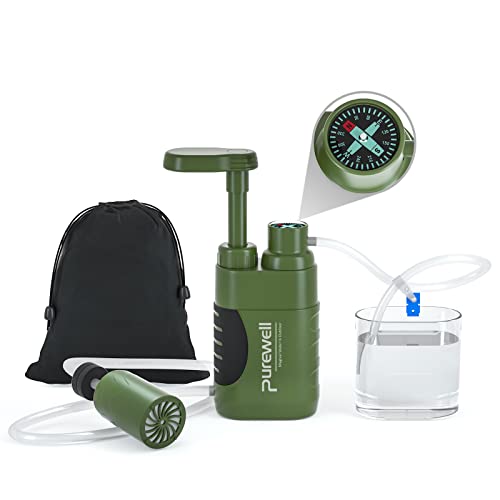
A four-stage hand pump with a carbon stage, a compass on the lid, and no batteries to run dry.
A pump makes sense when the water is shallow, murky, or hard to reach — you drop the tube and generate the pressure yourself. This one passes water through four stages: a high-performance medical-grade hollow fiber UF membrane, activated carbon fiber, a coconut shell activated carbon rod, and medical-grade PP cotton. The carbon is doing real work here, pulling at taste, odor, and chemicals that a plain fiber straw leaves behind.
It is rated to 793 gallons, weighs 1 pound, and runs without electricity, turning rainwater, lake water, and river water into drinking water. The rubber on the sides and bottom keeps it stable while you pump, and the shell is made of food-grade material. The handle diameter was upgraded to 15mm, and the transparent lid doubles as a drinking cup. A compass sits on top, which is a small but genuinely useful extra when your plan goes sideways.
Owners describe it as compact and light enough to carry in a small day pack, and the pump works well and assembles easily. The honest note is effort: the pump takes real strokes, and some find it difficult to operate over a long session. That is the cost of a carbon stage and a 0.3 micron rating — a higher-pressure filter needs a pump behind it.
The carbon advantage: the four-stage stack targets taste and chemicals as well as pathogens, so water from a stagnant ditch does not come out tasting like one.
Effort is the honest tax: this is a hands-on tool. If a long pumping session sounds like a deal breaker, the electric PRO X below does the same job at the press of a button.
Suit it to: the prepper who wants a carbon stage, a built-in compass, and zero battery dependency.
Look elsewhere: if you want water without arm work — a pump is a workout by nature.
8. Survivor Filter PRO X Electric Portable Water Filter

Tap a button and watch the water move — no pumping, no squeezing, no straw suction.
If the pump above sounds like work, this removes the work entirely. The PRO X runs on any plug, a mobile charger, or AA batteries, and the maker ships a charging cable, a bag, filters, tubes, and a manual in the box. You put the intake in a water source, press the button, and it moves 500ml (17oz) per minute.
The three-stage 0.3 micron purifier removes 99.999% of tested virus, bacteria, and parasites, plus 99.5% of mercury and 93% of lead and other heavy metals, per NSF/ANSI standards. At 14.1 ounces it is light for an electric unit, and it is rated to filter up to 360 liters (95 gallons) on a battery charge. The rating holds down to a lower temperature range of 32 °F, which matters if you store it in a cold vehicle.
Reliability is where owners land after quality — it performs as described, sets up easily, and fills a 10-gallon container quickly. Speed is a listed plus in owner feedback rather than a complaint. The obvious catch is that 360 liters is the shortest filter life in this group, so a long-term plan needs spare cartridges. Compared with the Purewell pump above at 793 gallons, you are trading lifespan for a button.
The effort trade: 500ml per minute with zero arm work is a real comfort upgrade over a hand pump, and it matters most when you are filtering for a group or filtering while injured.
Choose it for: group filtering, vehicle kits, or anyone who wants clean water without physical effort.
Know the limit: 360 liters of filter life means cartridges are part of your long-term budget.
9. GRAYL GeoPress 24 oz Water Purifier Bottle

Fill, press, drink — the bottle that purifies a full 24 ounces in 8 seconds.
Most filters remove bacteria and protozoa. This one goes after viruses as well — rotavirus, norovirus, and hepatitis A are named alongside E. coli, salmonella, and dysentery, with Giardia, cryptosporidium, and amoebae on the protozoa side. It also filters out sediment and microplastics and adsorbs volatile organic compounds, PFAS, chemicals, pesticides, herbicides, heavy metals, flavors, and odors.
The method is dead simple: fill the outer cup from any spigot, hotel sink, murky river, lake, or well, press the inner cup down through the cartridge, and drink. There is no setup time, no pump, no hose, no straw, no batteries, no chemicals, and no waiting. That makes it the pick for travel and for a car kit, where you may be filling from a tap you do not trust rather than a stream.
Capacity is 24 fluid ounces, and the replaceable cartridge is rated for 65 gallons (250L). It weighs 15.9 ounces, which is a bottle weight, not a pocket weight. What owners praise most is quality, with functionality close behind, and the water tastes good coming out. The honest catch is the push: the press-down action takes arm strength, and a few find it hard going. Owners also compare it favorably to Sawyer systems on less cumbersome handling, but leakage comes up as a noted concern, so keep it upright in a pack.
Where it beats a straw: virus removal in a bottle you can fill from a sink is a different level of protection than a straw that only handles bacteria and protozoa.
The 8-second claim, honestly: the speed is real, but the press is the cost. If you have wrist or shoulder issues, pump or straw designs ask less of you.
The right call for: travelers, road-trippers, and preppers who want virus-grade purification in a bottle they can fill anywhere.
The wrong call for: anyone who wants to fill a large container — 24 ounces is one person, one drink.
Know the Specs
Micron Rating and the Word “Absolute”
The micron number is the pore size water passes through, measured in micrometers. A 0.3 micron filter catches bacteria and protozoa; a 0.3 micron filter catches viruses as well. When a maker prints “absolute,” the pore size is guaranteed rather than averaged, which is the rating to look for in a survival purchase. A percentage claim without an absolute rating tells you less about how the filter holds up over its life.
Filter Lifespan in Liters and Gallons
Lifespan is the total volume a cartridge will clean before it needs replacing, and it is the number that decides how long you can go without resupply. In this group it ranges from 360 liters on an electric pump to 4,000 liters on a straw. Multiply your daily drinking volume by the number of people you plan for, and compare that against the rated capacity to see how far one cartridge actually carries you.
Flow Rate and Why You Feel It
Flow rate is how fast water comes out, measured in liters per minute or milliliters per minute. A gravity system tends to be slow and patient; a squeezed reservoir is fast. The practical effect is psychological as much as physical — a filter that fills a bottle in seconds gets used, while a slow one gets avoided until you are desperate. Match the flow rate to how you will actually use it in the field.
Form Factor: Straw, Bag, Pump, or Bottle
The form decides your whole water plan. A straw drinks from the source and needs no container. A gravity bag fills containers while you do other things. A hand pump reaches shallow or murky water and lets you pressurize it. An electric pump removes the effort but adds a power dependency. A press bottle purifies a set volume fast. Pick the form first, then compare the specs inside that form.
Common Questions
Will a 0.3 micron filter remove viruses from stream water?
How long does a survival water filter last before I need a new one?
Can I use a gravity filter in freezing weather?
Do I need a pump if I already carry a filter straw?
Is a squeezable pouch filter better than a gravity bag for backpacking?
How do I clean and store a hollow fiber filter between trips?
What is the difference between a water filter and a water purifier?
Why do some gravity filters have such a slow flow rate?
Can an electric water filter run on batteries if the power grid is down?
How many filters should I keep in a bug-out bag for a family?
The Bottom Line
For most people building a survival kit, the water filter for survivalists winner is the LifeStraw Personal 2-Pack because 4,000 liters of filtration in a 1.6-ounce straw with no parts to break is the definition of gear that still works when everything else does not. If you want to hydrate a camp or a family without pumping, grab the Practical Survival 6-Piece Kit and its two 6-liter bags. And for virus-grade purification from a hotel sink or a murky river, the GRAYL GeoPress is the one to reach for.
The honest nudge: the LifeStraw holds the highest score in this group at 4.8, with the Sawyer SP129 close behind at 4.7 across a much smaller review pool — but the straw’s rated capacity and pocket weight are what make it the safest first purchase you can put in a bag today.
How we choose
We do not accept paid placement. Every pick is matched to a real buyer and a real use-case; we do not hands-on test units.
Sources
Specifications: manufacturer listings and product documentation. Review insights: verified customer reviews, as of November 2026. Pricing: not shown on this page (it changes often); check the current price via the retailer link.
As an Amazon Associate, Tactical Gear Guy earns from qualifying purchases. This does not affect which products we feature.