Specs are compiled from manufacturer listings and verified buyer reviews and can change over time — please confirm the key details on the product page before buying.
Your iPhone shoots great video but captures audio that sounds distant and echoey. A wireless lavalier mic fixes that in one step: you clip a tiny transmitter to your collar, plug a receiver into your phone, and your voice arrives clean and close instead of distant and echoey. The catch is the connector: iPhone 15 and newer use USB-C, older models use Lightning, and only some kits include both. Below is the shortlist of kits that get the connector right, ranked by what each does best.
This guide is built by comparing the manufacturers’ published specifications and the patterns across verified customer reviews, so you get each pick’s real strengths and trade-offs instead of marketing spin.
The quick answer: the DJI Mic Mini is the pick most people should buy, because two transmitters and a mobile receiver let you record two people at once with noise cancellation built in. Each pick below lists its range, battery life and connector fit, so you can match one to your iPhone without guessing.
Top Picks
How To Choose The Best Wireless Microphone for iPhone
Most wrong-kit purchases come down to the connector, not sound quality. The deciding factor is the plug on the receiver and whether your iPhone’s port accepts it. Confirm the connector first, then compare range, battery life and transmitter count.
Start with the connector, not the microphone
An iPhone with a USB-C port — the 15, 16 and 17 generations — takes a USB-C receiver directly, with no adapter in the way. Older iPhones with a Lightning port need either a Lightning receiver or the bundled Lightning adapter that some kits include. Skipping this check is the single most common reason a mic gets sent back, so read the listing’s compatible-device line before anything else.
Decide how much range you actually need
Range is the distance the mic can stand from the receiver before the signal drops. Shooting at a desk or a kitchen counter needs very little; roaming a stage, a field or a large studio needs more. Published figures for these kits run from 70 feet on the compact end up to 328 feet, with one reaching 300 meters.
Two transmitters or one
A two-transmitter kit lets you clip a mic on two people at once — an interview, a co-hosted podcast, a two-person vlog. A single-transmitter set is simpler and usually cheaper. Most of the picks below are dual kits, because two mics cost little more than one and cover the second-person situation without a second purchase.
Watch what the charging case really delivers
The case figure is total runtime across recharges, not a single clip’s life. A kit that runs 6 hours per charge and reaches 42 hours with the case means the case refills the mics several times before it needs the wall. For a full shooting day, the per-charge figure matters more.
Side-by-Side Comparison
| Model | Best For | Receiver Connector | Wireless Range | Runtime With Case | Amazon |
|---|---|---|---|---|---|
| DJI Mic Mini (2 TX + 1 Mobile RX)★ Best Overall | Most people, two-person shoots | USB-C | 300 m | 11.5 hours max | Amazon |
| ZealSound Mini Wireless LavalierLongest Case Life | Long sessions on a tight budget | USB-C plus Lightning adapter | 328 ft / 100 m | 33 hours | Amazon |
| BOYA V30Charges Your Phone | Long shoots, phone stays charged | USB-C | 328 ft | 36 hours | Amazon |
| TXTUNE Mini Clip-On Mic | Close-range vlogging and interviews | USB-C plus Lightning adapter | 70 ft | 24 hours | Amazon |
| SmaFun TwinCast S2 | Cold-weather and long-day recording | USB-C and Lightning receivers | 328 ft | 48 hours | Amazon |
| Insta360 Mic Air | Discreet on-camera wear | USB-C | 300 m | 10-hour battery | Amazon |
| Hollyland Lark M2 | Phone and camera shooting | USB-C and camera RX | 300 m / 1,000 ft | 40 hours | Amazon |
| MAONO Wave T5 | Voice tuning and EQ control | USB-C, Lightning and camera RX | 300 m open area | 40 hours | Amazon |
Detailed Reviews
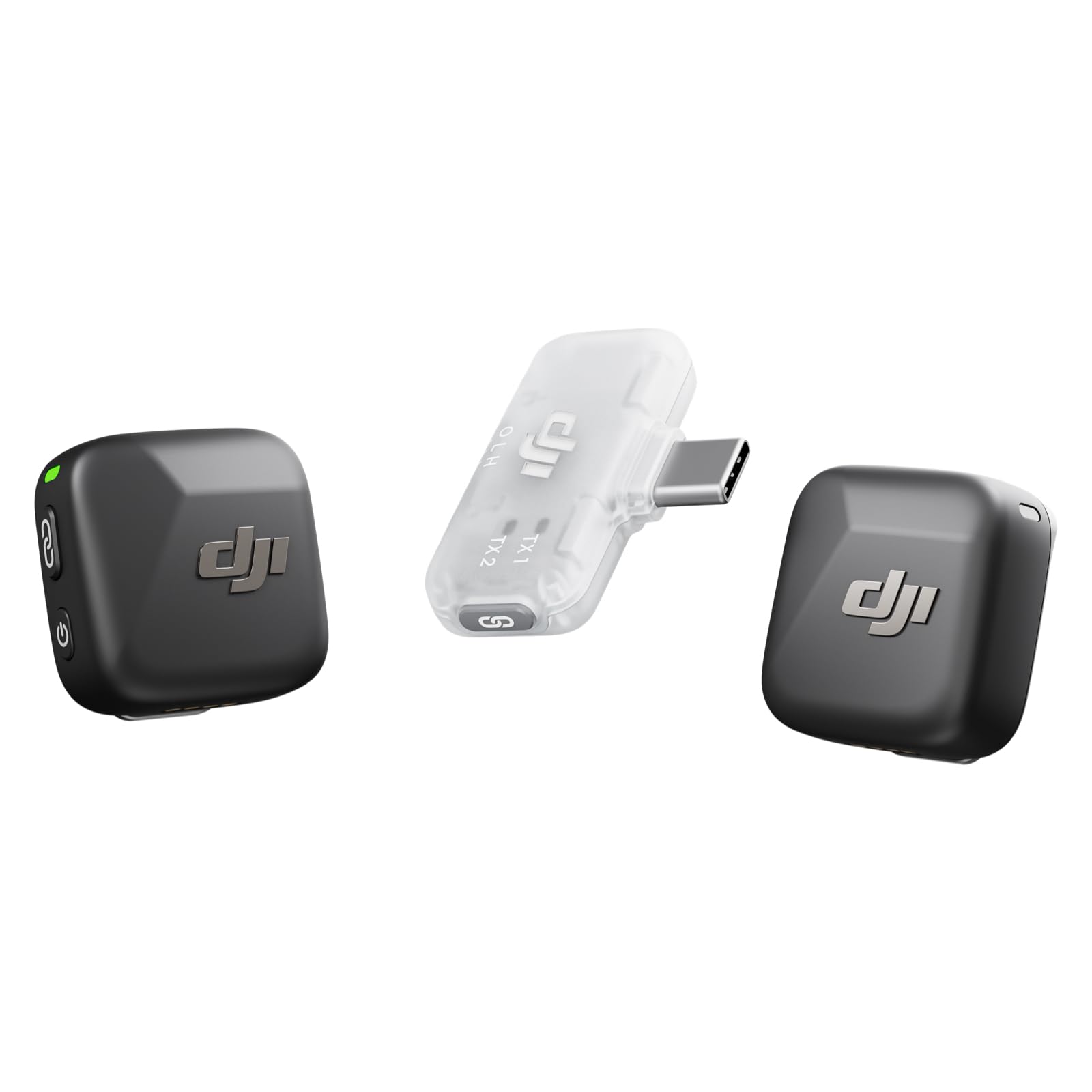
1. DJI Mic Mini 2 TX 1 Mobile RX
Our pick — 4.5+★ from 27,000+ verified ratings; the strongest balance of quality and price.
Two transmitters and a phone receiver, small enough that your guests forget they are wearing one.
If you host interviews or film two people at once, this kit covers it from the start. You get two DJI Mic Mini transmitters (TX — the clip-on mic that picks up the voice) plus one Mobile RX receiver (the piece that plugs into your phone). Each transmitter weighs 10 g, so it disappears on a shirt collar. The receiver is USB-C, which plugs straight into an iPhone 15, 16 or 17 with no adapter in the chain.
You can walk a stage or cross a field while your voice stays locked in, because the manufacturer’s own spec lists 300 m maximum range — the widest reach on this list alongside the two picks that quote the same distance. Noise cancelling comes in two levels — Basic for a quiet room and Strong for a street or a crowd — so you can record in a noisy place without the background taking over. Automatic limiting pulls the volume down if you shout into the mic, which stops the loud parts from breaking up.
Runtime is the honest trade-off. Two transmitters plus the mobile receiver run for a maximum of 11.5 hours, which covers a heavy interview day, but the ZealSound kit next on this list is rated at 33 hours and the Caiord set reaches 42 hours with its case. There is no charging case in this package either — the box includes a clip magnet, a carrying pouch, a charging dock and a splitter charging cable instead. Buyers report the sound quality and the fact it works the moment you plug it in, and the crowd verdict backs that up at 4.5+ stars across 27,000+ ratings.
Why it earns the top slot
- Two transmitters ship in the box, so a two-person interview needs no extra purchase.
- 300 m maximum transmission range keeps audio steady in busy outdoor settings.
- Two noise-cancelling levels, Basic and Strong, plus automatic limiting that drops the level on loud input.
- 20 dB audible noise and 94 dB audio sensitivity, quoted in the manufacturer’s specs.
- Plug-and-play with no app, and it pairs with iPhone 17/16/15, Android, PC and tablet over USB-C.
Where it gives ground
- 11.5 hours total with both transmitters running is the shortest endurance figure on this list.
- No charging case — the set relies on a charging dock and splitter cable instead.
- The receiver is USB-C only, so a Lightning-port iPhone needs a separate adapter.
Made for: anyone filming two people at once who wants the biggest range and the most forgiving setup in one box.
Think twice about: a multi-day shoot, where the 11.5-hour maximum against the Caiord’s 42 hours will have you packing the charger each night.
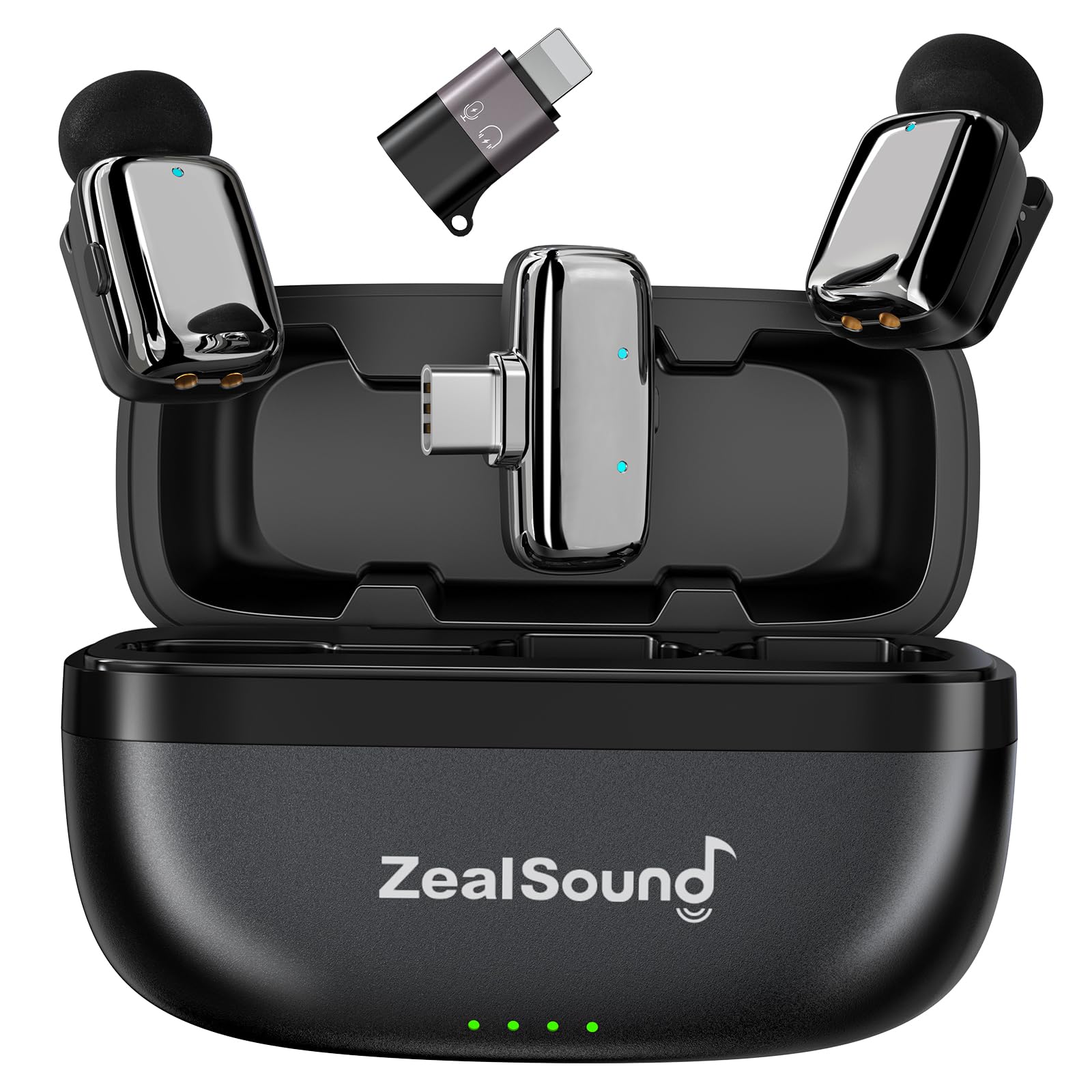
2. ZealSound Mini Wireless Lavalier Microphone
A charging case that swallows two mics whole and keeps them fed for a three-day trip.
The number you should care about here is 328 ft — 100 m — of open line-of-sight transmission. That figure nearly doubles the Caiord kit’s 165 ft, and it does it while the microphone itself weighs 5 g (0.18 oz), small enough to vanish behind a lapel. The 360° omnidirectional pickup means turning your head or leaning off-axis doesn’t drop your voice. Audio is captured at 48kHz/24-bit, the same format the pricier Studio-geared options quote, so the tone reads full rather than thin.
Battery is the selling point that will decide it for travel shooters. Each transmitter runs up to 6 hours per charge, and the charging case stretches the whole set to 33 hours across multiple sessions. When a mic runs down, the maker quotes a fast recharge of about 40 minutes. Controls sit right on the hardware: double-tap to mute, triple-tap to add echo, and a volume dial on the receiver, with LED indicators so you can see mute and battery state in one glance.
Noise reduction is where you need to set expectations. It starts in Noise Reduction Mode automatically and you press the transmitter to switch to Normal Mode, and the foams help with wind and breath noise. That same noise handling is the aspect the review pages treat most cautiously — useful outdoors, less loved when you want a completely natural indoor tone. A 4.0+ star average with 500+ ratings puts it solidly in the recommended pile, just not the top of it. The included Lightning adapter also makes it a genuinely useful pick if you are still on an older iPhone.
Best-fitting buyer: wedding and travel videographers who record many short sessions across a long day and want a 33-hour case to carry it, plus the Lightning adapter for older phones.
Set expectations on: the noise reduction, which is effective rather than invisible — flip to Normal Mode indoors for the most natural voice.
Reach for this if: the charging case run time and the bundled Lightning adapter matter more to you than the DJI’s extra range.
Look elsewhere if: you film in an echoey room and want the adjustable multi-level noise control the MAONO offers.
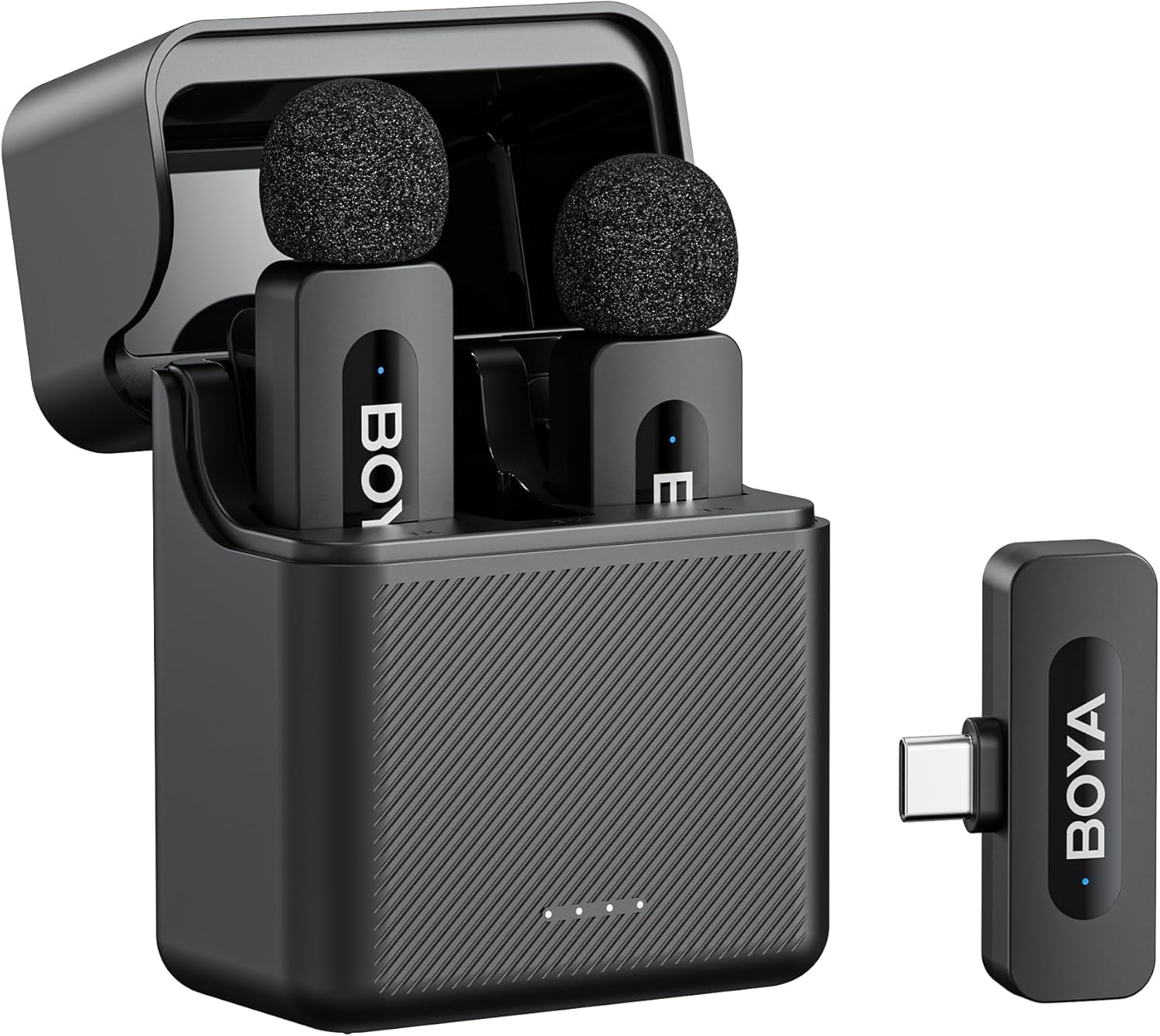
3. BOYA V30 Wireless Lavalier Microphone
Hear your take back through the phone speaker without unplugging a single cable.
Most kits force you to pull the receiver out to hear your recording. The V30 lets you play it back straight through the phone’s built-in speaker, which sounds like a small thing until you are checking take four in a hot car. Then there is the charging trick: the receiver carries a USB-C port so you can keep the iPhone topped up while you film, no competing for the one port.
Transmission runs 328 feet on 2.4GHz, matching the ZealSound set and comfortably out-reaching the shorter-range options. Each transmitter holds a 95mAh rechargeable battery rated at 9 hours of use, and the charging case lifts the whole mobile kit to 36 hours. Audio is 48kHz/16-bit with an 80dB signal-to-noise ratio and 120dB maximum sound pressure level, so sudden loud moments stay clean. A 10.5 g clip and a 360° rotatable mount keep it comfortable on a collar through a long interview.
The one-click noise cancellation plus the dense foam windscreen is aimed squarely at outdoor and street work, and owners mention clear audio that makes a noticeable difference over a bare phone recording. The catch worth naming is that the receiver is USB-C, so this is one for an iPhone 15, 16 or 17 rather than an older Lightning handset. Secondary note: at 36 hours in the case it sits between the ZealSound and SmaFun endurance figures rather than ahead of them.
The real perk: phone charging and playback pass-through from the receiver, so a long interview doesn’t end because the iPhone drains.
The catch: USB-C receiver only — a Lightning iPhone needs a separate adapter.
Pick it when: you’d rather not unplug to review a take and your phone is the only device recording.
Pass when: you still shoot on a Lightning iPhone or need a mic that pairs to a camera.
4. USB C Mini Clip on Mic
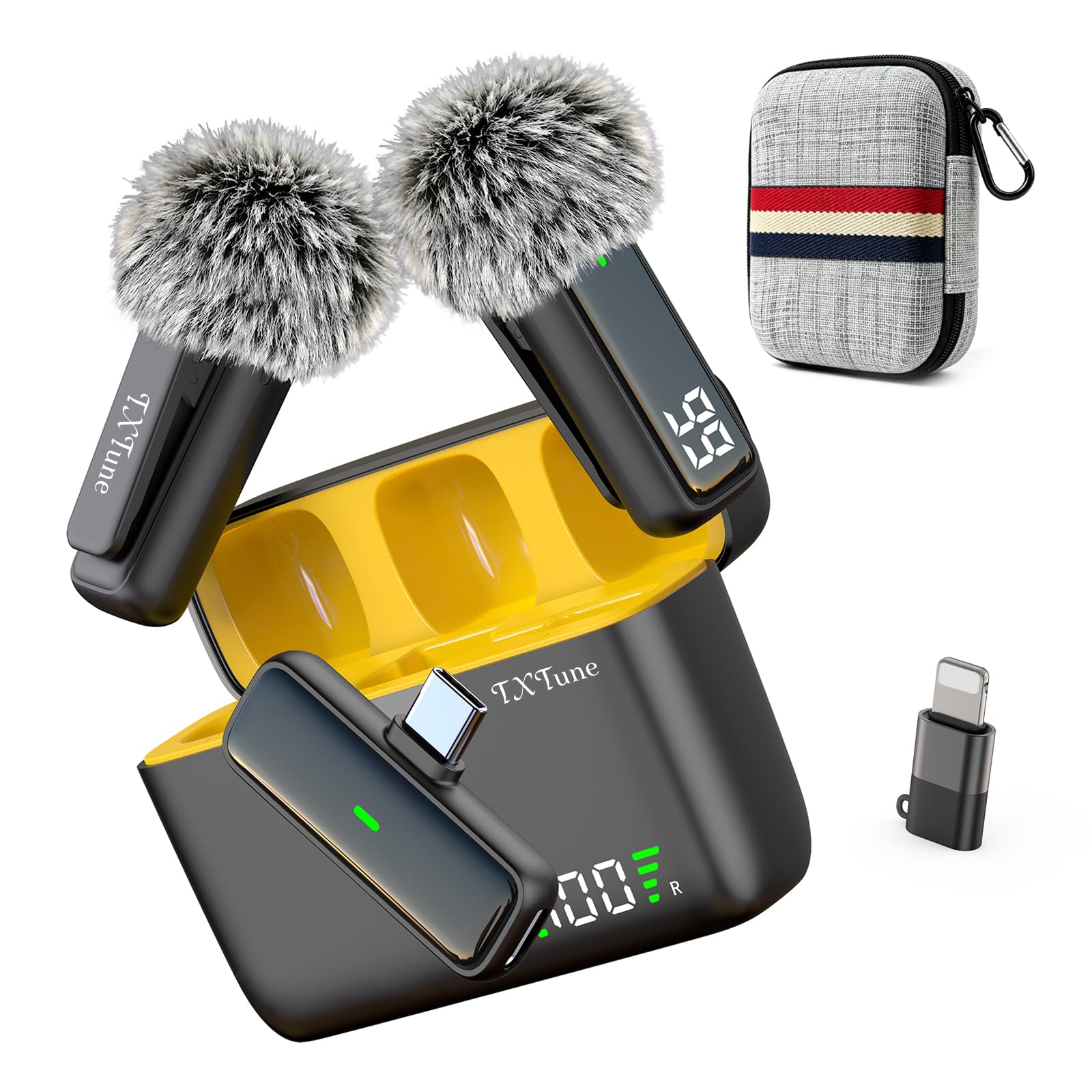
A 9 g clip that vanishes on a shirt and a receiver that keeps your phone alive.
TXTUNE’s transmitter weighs 9 grams, light enough that a t-shirt collar stays flat. The kit leans on a built-in DSP noise reduction chip (a small processor that filters steady background hum) plus furry windshields, which are the better tool for outdoor interviews where wind is the enemy. Audio reaches the receiver over 2.4G wireless with the low latency you want when lip-sync matters.
The receiver does double duty: it takes the USB-C plug from your phone and also passes charge back through while you record, so a two-hour street shoot doesn’t die at the hour mark. Each mic runs up to 6 hours per full charge and the case stretches that to 24 hours — the shortest case figure in this group, though a digital power indicator on each mic lets you see the countdown before you go live. A Lightning adapter in the box opens it up to iPhone 14, 13 and 12 as well as iPads.
Range is the figure to weigh: 70 feet, roughly a fifth of the DJI’s 300 m and a quarter of the Hollyland’s 1,000 ft. In a living room, an office or a small studio that is plenty, and the price-to-performance story clearly lands with a 4.5+ star average across 700+ ratings. Two aspects get mixed feedback: connectivity and noise cancellation. Pairing with the phone is a one-button press, but treat the 70 ft limit as real and stay near the phone when the shot allows.
Why it holds a slot: 9 g per mic, phone charging pass-through, and a digital battery counter you can check at a glance — all in a compact everyday kit.
The compromise: 70 ft of range and 24 hours in the case, both the shortest figures on the list.
Good fit for: indoor vlogging, kitchen tutorials and office interviews where the phone sits within sight.
Wrong fit for: stage or field work that has you striding away from the phone.
5. SmaFun Wireless Microphone
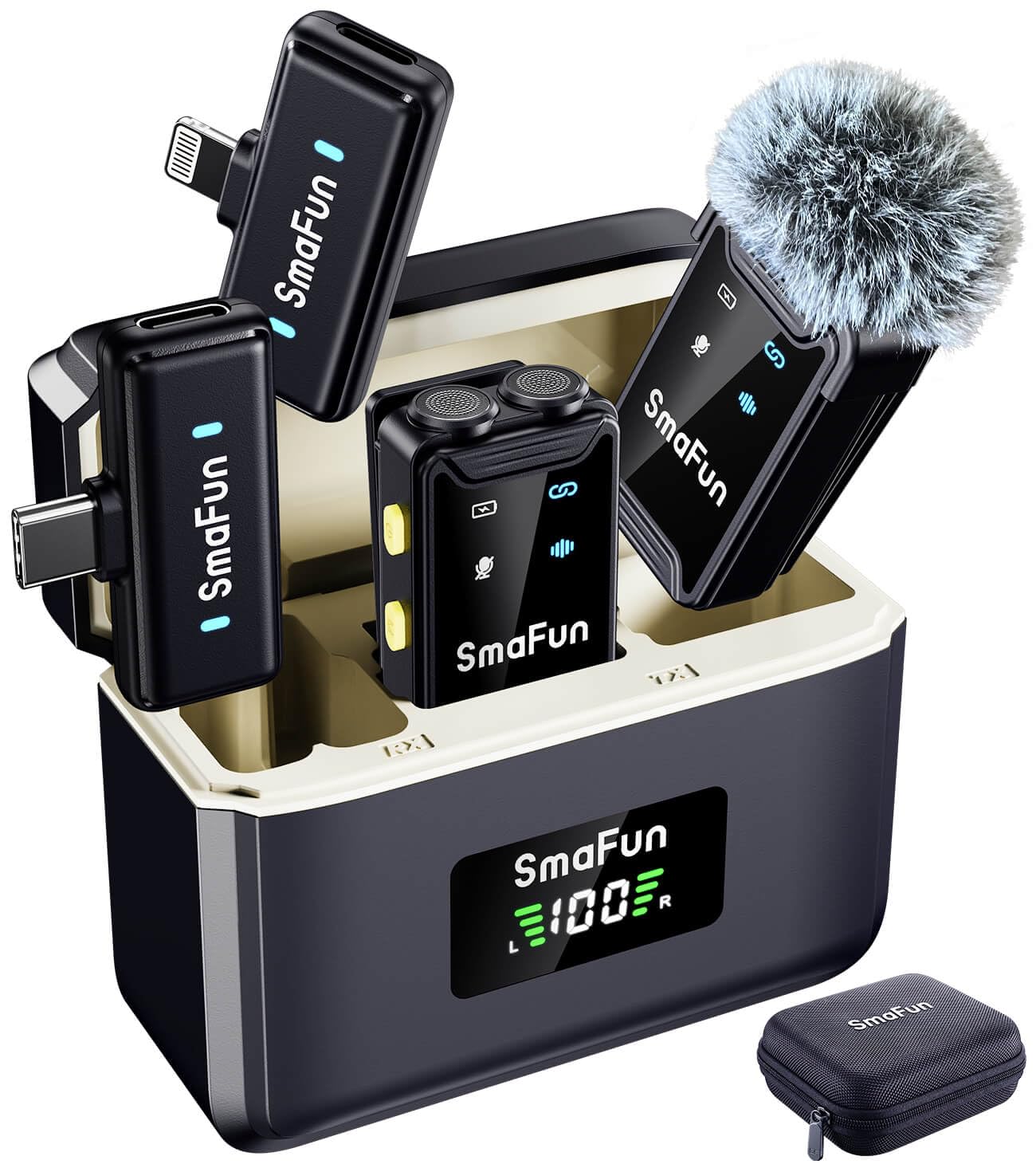
Two mics, two receivers, one case — the box that covers every phone in the drawer.
SmaFun ships the TwinCast S2 with two transmitters, a USB-C receiver and a separate Lightning receiver. No adapter to lose, no dongle in the chain — you grab whichever receiver matches the phone you’re holding. That is the single most useful thing about this kit for a two-phone household or a creator who switches between an iPhone 15 and an older iPad. Audio is 48kHz/24-bit with omnidirectional pickup, and the transmitters are paired at the factory, so powering both on connects them automatically.
Battery is the strongest figure in this whole lineup. The set runs up to 48 hours with the charging case, and the maker says the case fully recharges the entire set twice, with each recharge taking under 1.5 hours. Each mic captures 6 hours of continuous recording on a full charge. Distance is quoted at 328 ft, and the kit uses 2.4GHz automatic pairing.
What wins people over is the sound — crisp and clear, and it connects to gear like the DJI Osmo without fuss. The recurring gripe is the same one every high-capacity kit runs into: how long the battery really lasts between charges. Some get days out of it and some find it drains quickly, so plan a top-off before a full-day event. The hardware is plastic by spec, and the microphones are the lighter, everyday build rather than a battle-hardened one, which is fine for interviews and vlogs, less so for rough handling.
What puts it on the list
- Both USB-C and Lightning receivers in the box, no adapters to lose.
- 48 hours with the charging case — the top-end endurance claimed here.
- Factory pairing so the transmitters connect the moment they power on.
- 48kHz/24-bit audio, 328 ft of transmission, and two transmitters for interviews.
Honest limits
- Reported battery endurance swings from buyers who love it to buyers who find it drains fast.
- The all-plastic chassis is an everyday build, so store it in the case between shoots.
Best matched to: a two-phone household where one iPhone uses Lightning and the other USB-C, and where 48 hours between sockets matters.
Skip if: you want a metal-bodied kit that shrugs off being tossed in a bag without a case.
6. Insta360 Mic Air (1 TX + 1 RX), Noise Cancelling, 300m Range

A whisker under eight grams, worn three ways, with the same reach as the DJI.
Insta360’s transmitter weighs 7.9 g, and its mounting is the reason to choose it. You can clip it, magnet it against a shirt, or hang it as a pendant — no fiddling with a clip when you want the mic out of frame. The receiver is USB-C and plugs directly into an iPhone 15, 16 or 17, so no adapter. Audio is captured at 48kHz, and noise cancelling plus a bundled windshield are aimed at outdoor work.
You get near the top of the list for open-ground shooting, because the reach matches the DJI at 300 m stable wireless range. The button on the transmitter triggers video start and stop remotely, so you can film yourself with the phone on a stand. Battery is the item to weigh: 10-hour battery life, tested with the receiver and noise cancellation off — that is real endurance for a day’s work, but the SmaFun’s 48-hour case and the Caiord’s 42-hour case will outlast it across multiple days.
The scene everyone loves is control from a distance: owners appreciate that recording starts and stops from far away, plus the compact size and effective noise reduction. What gets mixed feedback is the magnetic mount — fine for seated interviews and walking shots, not built for active sports. It’s a one-transmitter kit, so if you often film two people at once the DJI and Hollyland kits cover more ground from the start. At 4.5+ stars across 600+ ratings it earns its position, most of all for anyone who hates a visible clip on camera.
what separates it: The mic disappears from the frame at 7.9 g with magnetic, clip or pendant wear, and 300 m of range matches the DJI.
Where it gives ground: a 10-hour battery figure against the multi-day case capacity of the SmaFun and Caiord sets, and one transmitter rather than two.
Right choice for: solo creators who care how the mic looks on camera and want to start recordings from across the room.
Not right for: active-sport shooting — the magnet mount is best indoors and for normal walking shots.
7. Hollyland Lark M2 Wireless Microphone
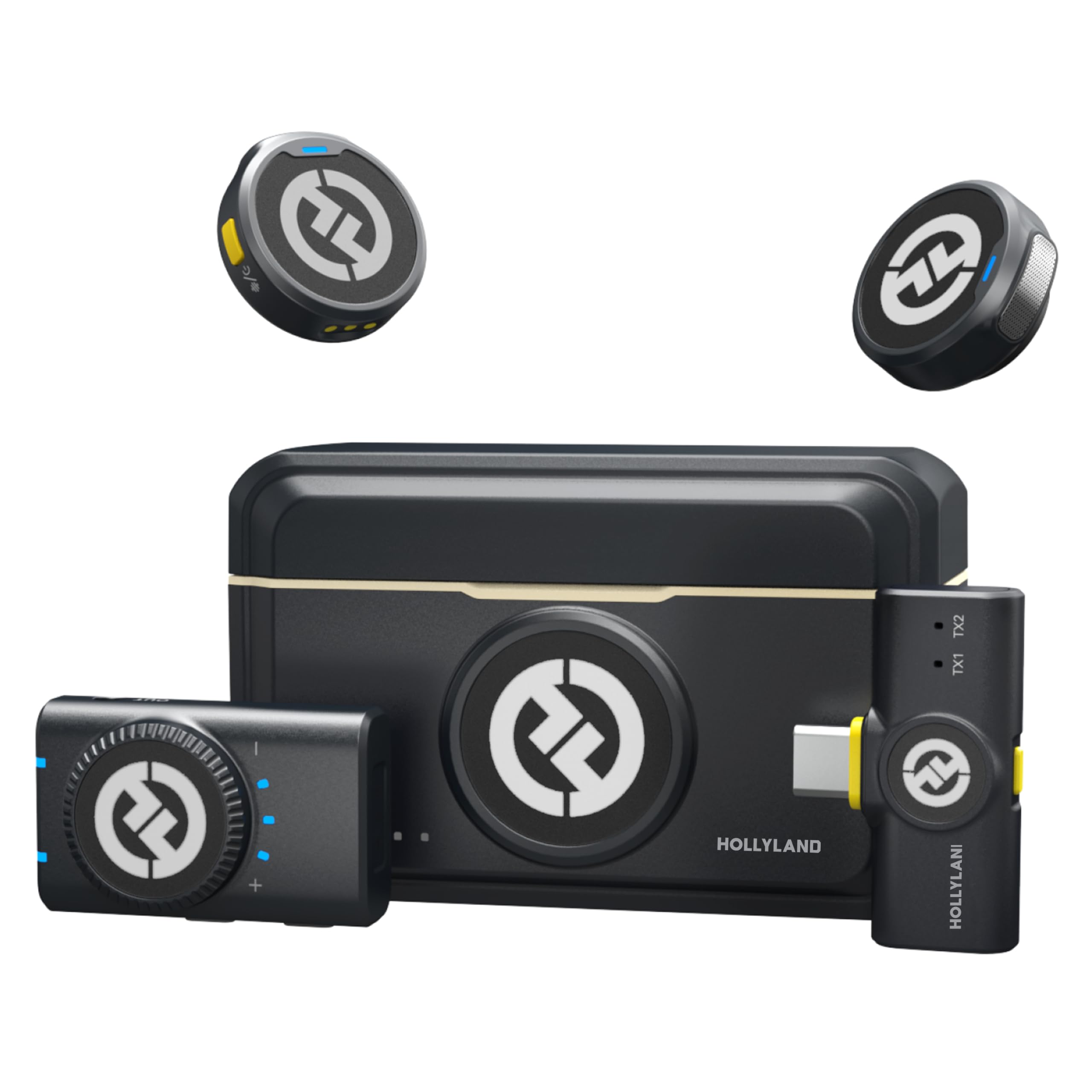
A phone mic today, a camera mic tomorrow, with 40 hours of case power feeding both.
The LARK M2 ships with two transmitters, a camera receiver (RX — the box that plugs into a camera’s 3.5mm jack) plus a USB-C receiver for your phone. That is the point: the same set works on an iPhone today and a mirrorless camera tomorrow, so the kit doesn’t become a spare when you upgrade gear. Each transmitter weighs 9 g and it quotes up to 1,000ft of line-of-sight range, roughly 300 m — the same distance-class claim as the DJI, Insta360 and MAONO picks.
Audio is a professional build: 48kHz/24-bit with a 70dB signal-to-noise ratio and a 115dB maximum sound pressure level, so a recordist capturing a loud environment stays clean. Control is all on hardware — one-click noise cancellation on the transmitter, a knob for volume on the receiver, and three LEDs showing level. The camera receiver allows mono or stereo recording, switchable, though that mode switch only works when it’s connected to a camera through the 3.5mm jack. The set pairs the moment you unbox it.
You get 10 hours per transmitter with noise cancelling off, and the camera version reaches 40 hours with the case, each charge taking under 2 hours. Phone-camera hybrids are the balance, and the review pages back the reliability: buyers describe it as a professional-level device that lifts the quality of phone video, with the pairing instant and steady at 100-meter distances. Two things to weigh — it’s a step up the price ladder, and if you shoot iPhone only, you’re paying for a camera receiver you may never use.
Why it leads the premium tier: phone and camera receivers in one kit, 48kHz/24-bit with a 70dB signal-to-noise ratio, and 1,000ft of line-of-sight transmission.
Know before you buy: the mono/stereo switch requires the camera receiver on a 3.5mm jack, and the camera RX is wasted if you only ever film on an iPhone.
The one for: shooters who split time between an iPhone and a camera and want one mic set for both.
Overkill for: a pure iPhone workflow — the camera receiver adds cost you won’t use.
8. MAONO Wave T5 Wireless Lavalier Microphone

Four voice presets and 14 noise levels you actually control from an app.
Where most kits give you an on/off noise switch, the Wave T5 gives you 3 modes and 14 levels, adjustable through the Maono Link app. A dedicated ENC chip (an onboard processor that separates voice from background noise) works with an algorithm to strip out machinery, traffic and café chatter. Audio runs a true 48kHz/24-bit with an 80dB signal-to-noise ratio and 120dB maximum sound pressure level, so loud moments arrive without clipping.
The creative controls are what set it apart. Four one-tap voice filters — Vocal Enhancer, Brightness, Warmth and Magnetic Radio — tune your voice before you ever touch editing software. A long press on the mute button also fires the phone’s photo or video shutter, which makes solo shooting far less fiddly. And the receiver carries a Type-C port so you can charge your phone while it records; the receiver itself doesn’t need charging.
Reach is quoted at 300 m in open area and 100 m when the transmitter is behind your back or in a pocket, thanks to frequency-hopping that resists dropouts. Each transmitter lasts up to 9 hours, and the compact case delivers 40 hours total. The box includes three receivers — USB-C, Lightning and camera — so it covers basically any device you own. Reliability and connectivity draw the most mixed feedback here, so pairing needs care: if the blue light flashes slowly, power-cycle the transmitter and wait for the rapid flash on both ends.
Standout capability: 3 noise modes with 14 levels and four voice presets, controlled from the Maono Link app, plus three receivers for USB-C, Lightning and camera.
The catch: pairing needs the blue-light dance to succeed, so give yourself a minute to set it up before the shoot.
Choose it when: you want to shape how your voice sounds and shoot across phone, camera and computer with one kit.
Choose simpler if: you’d rather clip, plug and press record without app-based tuning or pairing steps.
Know the Specs
Sampling Rate and Bit Depth
You’ll see figures like 48kHz/24-bit and 48kHz/16-bit. The 48kHz is how many times per second the mic samples your voice — a fast rate that captures consonants cleanly. The 24-bit or 16-bit is the depth of each sample, and more bits means more room to capture quiet detail before it turns to hiss. A 48kHz/24-bit kit keeps your voice fuller and more natural, which is why the top-tier picks here quote that format.
Signal-to-Noise Ratio
Signal-to-noise ratio (SNR) measures how much louder your voice sits above the mic’s own background hiss, in decibels. Higher is quieter. The picks here range from 60dB to 80dB, and in plain terms the higher figure means a cleaner, less fuzzy recording when you’re not talking loudly. It’s the number that decides whether your quiet moments sound intimate or noisy.
Transmission Range and 2.4GHz
The receiver and transmitter talk over 2.4GHz wireless, and published range runs from 70 ft on the compact end up to 328 ft and 300 meters. Treat range as a line-of-sight figure — walls and bodies shorten it. The 100 m-behind-your-back figure some kits quote matters more in practice, because that’s the distance you actually hit when you turn around with the mic on.
Maximum Sound Pressure Level
Sound pressure level (SPL) is how loud a sound the mic can take before it distorts, quoted in dB. The picks here handle up to 95dB, 115dB or 120dB. Higher means a singer, a shouting presenter or a live crowd won’t break the recording. For a normal speaking voice this matters little; for a performance or an outdoor event it’s the spec that prevents a ruined take.
Common Questions
Will a USB-C wireless mic work on an iPhone with a Lightning port?
Do I need to install an app to use a wireless lapel mic?
Can I record two people at once with one kit?
How far can I walk from my iPhone while recording?
Is a 48kHz/24-bit mic noticeably better than a phone recording?
Does the charging case battery figure mean per-charge runtime?
Can I charge my phone while the mic receiver is plugged in?
Will these wireless mics work on a computer or camera as well?
Does noise cancellation ruin the natural sound of my voice?
How do I know when the mic’s battery is running low?
The Bottom Line
For most people, the wireless microphone for iphone winner is the DJI Mic Mini because it puts two transmitters and a USB-C receiver in one box with 300 m of range and two noise-cancelling levels. If long days between sockets are your reality, the Caiord 2 Pack stretches to 42 hours in its case and covers both phone connectors. And for anyone who splits time between an iPhone and a camera, the Hollyland Lark M2 is the one to reach for, with a camera receiver and a USB-C receiver in the same kit.
One last honest nudge: the DJI Mic Mini holds the higher score and comes with two mics, but if a 42-hour case and the bundled adapters are what get you through a shoot week, the Caiord is the better-matched buy for your day.
How we choose
We do not accept paid placement. Every pick is matched to a real buyer and a real use-case; we do not hands-on test units.
Sources
Specifications: manufacturer listings and product documentation. Review insights: verified customer reviews, as of November 2026. Pricing: not shown on this page (it changes often); check the current price via the retailer link.
As an Amazon Associate, Tactical Gear Guy earns from qualifying purchases. This does not affect which products we feature.