Specs are compiled from manufacturer listings and verified buyer reviews and can change over time — please confirm the key details on the product page before buying.
You want a station whose outdoor sensor actually talks to the indoor screen — not one that drops the signal every time it rains. The short answer: buy on transmission range and sensor battery life first, then worry about the screen. Everything else is decoration.
This guide is built by comparing the manufacturers’ published specifications and the patterns across verified customer reviews, so you get each pick’s real strengths and trade-offs instead of marketing spin.
Below you will find nine stations sorted by how far their sensor reaches, how much they measure, and how easy the display is to read from across a room. Here is the honest route through the best wireless indoor-outdoor weather stations for a home setup you will actually glance at every morning.
Top Picks


How To Choose The Best Wireless Indoor-Outdoor Weather Stations
The whole point of a wireless station is that the sensor sits outside and the screen sits inside, with no cable between them. The distance that signal must cross, and how reliably it crosses, decides whether you get a usable station or a screen full of dashes.
Start with transmission range, not screen size
Range is the maximum distance the outdoor sensor can transmit to the indoor console, usually quoted in feet or metres in open air. If your sensor goes on a back fence, a shed roof, or a barn, buy range with headroom. Walls, trees, and metal roofs all cut that number down, so a station rated far beyond your actual gap is the safer bet.
Decide which readings you will actually use
A basic sensor measures temperature, humidity, and wind speed. A fuller array adds wind direction, rainfall, UV, and light intensity. Be honest about your use: a gardener cares about rain totals and sun exposure, while someone watching storms mostly needs wind speed and barometric pressure. You pay for the extra sensors, so only buy the ones you will read.
Check what happens when the power drops
Most consoles run on a plug-in adapter with battery backup, and the outdoor sensor runs on its own batteries or a small solar panel. Look for the backup battery count and whether the sensor is solar-assisted. That combination decides how often you are out in the yard with a screwdriver.
Side-by-Side Comparison
| Model | Best For | Sensor Array | Connectivity | Transmission Range | Amazon |
|---|---|---|---|---|---|
| AcuRite Notos (01604A2)★ Best Overall | Everyday home monitoring | 3-in-1 | Wireless | — | Amazon |
| La Crosse Technology S77925-INTBest Value | Budget color forecast screen | Temperature & humidity sensor | 433 MHz | — | Amazon |
| Raddy UV7Best Display | UV and light tracking | 7-in-1 | Wireless | Up to 300 ft | Amazon |
| VEVOR YT60234 | Long-run solar sensor | 7-in-1 | Wi-Fi | 150 m | Amazon |
| La Crosse V21-WTH | App-based home tracking | Temp/humidity + wind sensors | Wi-Fi | Up to 400 ft | Amazon |
| Sainlogic SA9 | Data hoarders and gardeners | All-in-one | 5GHz/2.4GHz Wi-Fi | 443 ft | Amazon |
| Ambient Weather WS-1965 | Smart-home integration | All-in-one array | Wi-Fi / 915 MHz | — | Amazon |
| Sainlogic 5GHz AI Forecast | Large-display forecasting | All-in-one with rain gauge | 5GHz/2.4GHz Wi-Fi | 135 m / 443 ft | Amazon |
| ECOWITT Wittboy Pro HP2564 | Expandable multi-sensor setups | 7-in-1 haptic rain sensor | 915 MHz / Wi-Fi | Up to 300 m in open space | Amazon |
Detailed Reviews
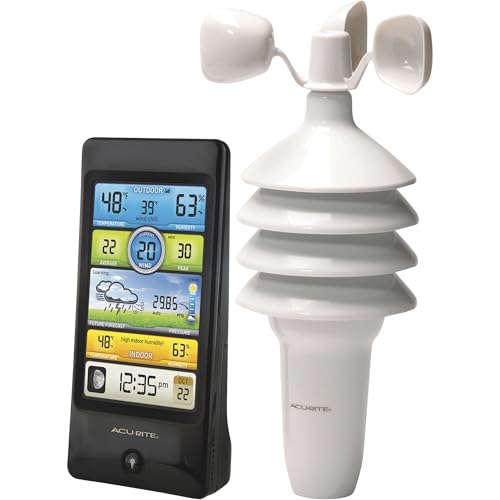
1. AcuRite Notos 01604A2 Weather Station
Our pick — 4.5+★ from 550+ verified ratings; the strongest balance of quality and price.
A 3-in-1 sensor station that refreshes wind every 18 seconds and runs a claimed two years on one sensor battery.
If you want a straightforward outdoor reading without a phone app in the middle, this is the one to start with. It measures temperature, humidity, and wind speed from a single wireless sensor, so you mount one unit outside and you are done. The console is electric-powered with an optional battery backup, and the maker rates the sensor battery at 17500 hours — about two years of maintenance-free running, so you are not climbing up to swap cells every season.
Wind is where the AcuRite puts its effort. It tracks current wind speed, average wind speed, and peak wind speed, all refreshed every 18 seconds. That gives you a real read on gusts instead of a single stale number. Daily and all-time high and low records are stored on the console, so you can look back at the coldest morning of the week without opening anything. The 7.5-inch-high display is a full-color LCD with an adjustable dimmer, which makes it usable on a bedside table or across a kitchen.
The honest caveat is calibration. A recurring theme in owner feedback is that temperature can read 1-2 degrees below actual and wind speed can drift, while the display itself divides opinion — readable to some, less so to others. Treat the first week as a settling-in period and compare it against a local official reading before you trust every digit. Score-wise this sits at a strong 4.5+ stars, and it is our top pick because it nails the basics — one sensor, real gust data, long battery life — without asking you to configure Wi-Fi or download an app.
Where it earns the top spot
- Peak, average, and current wind speed refreshed every 18 seconds
- 17500-hour sensor battery rating means roughly two years between battery changes
- Full-color LCD with adjustable dimmer for day or night viewing
- Daily and all-time high and low records stored on the console
Weigh these before you commit
- Temperature can read 1-2 degrees below actual per owner reports
- No Wi-Fi or app upload — readings stay on the console only
- Wind speed accuracy gets mixed feedback from owners
Reach for this if: you want a no-app, no-Wi-Fi station with true gust tracking and a two-year sensor battery.
Think twice if: you need your data uploaded to Weather Underground or a phone app — this one is a standalone console setup.
2. La Crosse S77925-INT Weather Station
A color forecast screen with an atomic self-setting clock in a 5.43-inch-tall frame.
This is the entry point for anyone who mainly wants to walk past a screen and see the forecast without squinting. The color display shows dynamic forecast icons with trend arrows, alongside indoor and outdoor temperature and humidity. It records high and low values and auto-resets them daily, so yesterday’s cold snap clears itself. Dew point and heat index views are there too, and the console sits just 8.98 inches wide and 1.14 inches deep — genuinely shelf-sized rather than a wall panel.
The other half of the appeal is the clock. It is an atomic self-set clock that locks to the correct time and handles daylight saving automatically, with seven time zone settings and a 12- or 24-hour mode. For a station that lives in a kitchen, that removes the annual fiddling most people forget about. It runs on the included 5V power cord with a constant adjustable backlight, and it takes 3 AA alkaline batteries as backup if you lose power.
Where owners split is readability and reliability. Some read the screen from across the room with no trouble, while others find it hard to see at an angle — so placement matters more here than usual. The recurring honesty note is that a small number of units have stopped working after a day, which is a rare-but-known failure rather than the norm. At 4.0+ stars it is a sensible budget pick for a bedroom or kitchen where the screen is viewed straight on, and a poor match if you need to read it from a steep angle.
What it does well: a color forecast screen with daily auto-resetting high/low records, dew point and heat index views, and an atomic clock that fixes itself for daylight saving.
The angle problem: visibility off-axis is the most-divided point — budget for a straight-on mounting spot, not a high wall shelf.
Fits best in: a kitchen or bedroom where you view the screen roughly head-on and want a self-setting clock built in.
Look elsewhere if: you need to read readings from a sharp angle, or you want wind and rain data — this sensor covers temperature and humidity only.
3. Raddy UV7 Weather Station
The 12-in-1 sensor that measures sunlight itself — UV index and 128 klux of light intensity in one unit.
Most stations stop at wind and rain. This one adds optical sensors that read light intensity up to 128 klux and a UV Index from 0 to 15, with a five-level exposure indicator. If you grow anything — a vegetable bed, a greenhouse, a row of seedlings — that is the data that tells you when shade cloth goes up. The outdoor sensor combines temperature, humidity, wind speed, wind direction, rainfall, UV, and light intensity in one unit and transmits up to 300 ft, which covers a backyard, garden, or rooftop mount.
The screen is the standout piece of hardware: a 5.12-inch VA panel with wide viewing angles, four brightness levels, and an automatic night mode that dims itself after dark. Timekeeping runs off the atomic clock with daylight saving handled for you, and there are two independent alarms with a 5-to-60 minute adjustable snooze. Moon phase and tide trend readings round out the daily display. Power comes through USB-C with AAA battery backup.
What you should know before buying is scale. This can monitor up to five locations, but only with one multi-combination sensor plus three optional remote sensors sold separately — the extra zones are not in the box. It is also the newest listing here with the smallest review base, so the long-term reliability record is thinner than the older stations on this list. If the UV and light readings are why you are shopping, few rivals pack this much into one sensor array.
Sunlight, measured: UV index from 0 to 15 plus light intensity to 128 klux makes this the pick for gardeners tracking sun exposure, not just temperature.
Screen comfort: the 5.12-inch VA display with four brightness levels and auto night mode is easier on the eyes at 2 a.m. than a fixed-brightness panel.
Buy it for: UV, light, and rain data in one 300 ft sensor, viewed on a wide-angle VA screen with automatic night dimming.
Know the catch: the five-location monitoring needs three extra sensors you buy separately — the base kit covers one zone.
4. VEVOR YT60234 WiFi Weather Station

Built for the far corner of the property — a 150 m sensor run with a solar panel feeding rechargeable Ni-MH cells.
If your sensor has to reach a barn, a chimney, or the far edge of a farm, range is the whole purchase. This one transmits up to 150 m and runs off a 4 x 3 in solar panel on sunny days, with rechargeable Ni-MH batteries taking over at night or in cloud. That means no frequent battery swaps on a sensor you may not want to reach twice a year. The 7-in-1 sensor reads wind speed, wind direction, temperature, humidity, rainfall, and light, and the housing carries an IPX6 waterproof rating — protected against heavy rain, which is the condition that matters most for something living outdoors.
The console side is a 7.5-inch HD screen with four dimming steps from 100% down to 0%, so you can kill the glow at night. When the display is on its adapter, data flows over Wi-Fi to Weather Underground and WeatherCloud so you can check the yard from your phone. Note the maker’s own catch: the adapter must stay plugged in for Wi-Fi and internet time sync to work. Unplug it and you are back to a local screen only.
Connectivity is the dividing line in owner experience. Plenty get it onto Weather Underground inside an hour, while others fight the setup and give up. At 3.5+ stars this is the lowest-rated pick on the list, but for a user with a genuinely long sensor run and a taste for tinkering, nothing else here reaches 150 m. Mount it away from TVs, signal towers, and high-voltage lines, since interference is the usual cause of a flaky link.
Why the range sells it
- 150 m transmission covers a large yard, farm, or rooftop run
- Solar panel plus rechargeable Ni-MH batteries cut battery swaps
- IPX6 housing holds up in heavy rainfall
- Wi-Fi upload to Weather Underground and WeatherCloud from the console
Where it asks for patience
- Wi-Fi setup is the most-divided point — some connect in an hour, others struggle
- Adapter must stay plugged in for Wi-Fi and internet time sync
- Lowest rating of the nine at 3.5+ stars
Right for: a long sensor run across a farm or large property where 150 m of reach is the deciding spec.
Wrong for: someone who wants plug-in-and-forget Wi-Fi — plan on a patient setup session.
5. La Crosse V21-WTH Weather Station

Reaches 400 ft to the sensor, then pushes readings to your phone through the free La Crosse View app.
This is the station for someone who checks the yard from the office. The outdoor sensor transmits up to 400 ft, and the console adds Wi-Fi so it can stream AccuWeather data, UV index, sunrise and sunset, thunderstorm chances, air quality, and precipitation percentage. Through the free La Crosse View app you can track the home’s weather and historical data remotely, with customizable alerts and notifications. from the start it runs as a standalone station with six forecast views, and the seasonal foliage scenes change with the calendar.
Wind data is tracked as current and top wind speed, paired with indoor and outdoor temperature and humidity in Fahrenheit or Celsius. The advertised outdoor temperature range is a genuinely wide -40°F to 140°F, which is a spec you will appreciate in a hard winter. Recorded high and low values carry a time and date stamp, and there is a comfort meter on the screen. Add-on sensors for rain and water leak detection are sold separately if you want to expand.
The catch on this one is wind reliability. The recurring note in owner experience is that the wind sensor sometimes never registers info at all, which undermines the feature it advertises. Indoor temperature readings hold up well and the screen is easy to read, but at 4.0+ stars this is a middle-of-the-road pick. It also needs the 5V adapter for everything except data retention — the 3 AAA batteries are backup that preserves data, not a way to run it. If you want remote app access more than perfect anemometer readings, this is a fine fit.
The app angle: Wi-Fi plus the free La Crosse View app turns the console into a remote monitor for alerts, UV, and forecast data you can check anywhere.
Fair warning: wind speed registration is the weak link — if the anemometer is your main reason for buying, weigh that.
Choose this for: a 400 ft sensor run and remote app monitoring with customizable alerts.
Pass if: reliable wind speed is your priority, since the wind sensor can fail to register on some units.
6. Sainlogic 5G&2.4G WiFi Weather Station
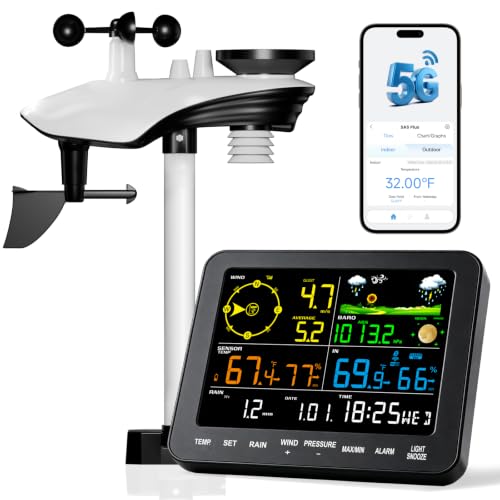
Stores two years of weather data locally and exports it to Excel — no subscription required.
This is the pick for a grower who wants a record, not just a glance. It stores up to 2 years of weather data locally with no subscription fees, and you can export it to Excel to analyze temperature, humidity, and extreme weather records. The outdoor sensor reaches 443 ft, so a garden, ranch, or farm mount is well within range, and the connection between console and sensor settles in a few minutes.
The sensor accuracy is the selling point for precision work. A Swiss sensor chip delivers temperature accuracy of ±0.2°C and humidity accuracy of ±1.8%RH, which is the kind of stated tolerance that matters in a nursery, greenhouse, or wine cellar. Indoor and outdoor temperature and humidity, barometric pressure, wind speed, wind direction, rainfall, moon phase, and forecast trends all live on one system. It connects over 5GHz or 2.4GHz Wi-Fi and links to the Inercom app, Weather Underground, and Alexa for remote checking and smart-home routines.
One honest limit: display size is the most argued-over feature, so the screen splits opinion even as the readings earn praise. The console takes 3 AA batteries and ships with an adapter, and the ABS housing is built for garden and farm duty. With 4.0+ stars and a deep owner base, this is a data-first station that rewards someone willing to use the export and app rather than just look at the glass.
The precision spec: ±0.2°C temperature and ±1.8%RH humidity accuracy from a Swiss chip is why greenhouse and cellar owners pick this one.
Data that lasts: two years of local storage plus Excel export means you can chart a season of extremes without paying anyone.
Made for: gardeners, greenhouse owners, and data collectors who want two years of exportable records and tight temperature tolerance.
Not for: someone who only wants a glanceable wall display — the screen is the most-debated feature here.
7. Ambient Weather WS-1965 Wi-Fi Weather Station

The station that can trigger your lights or sprinklers when the conditions hit your set numbers.
For a connected home, this is the natural fit. The all-in-one sensor array measures temperature, humidity, barometric pressure, wind speed, wind direction, and rainfall, and it pushes fresh readings to the console every 16 seconds. From there, you can set alerts, access your data remotely, and even program your home based on weather conditions through IFTTT, Google Home, Alexa, and more. Connecting to the Ambient Weather Network is an optional setting if you want to share hyperlocal conditions.
Two pieces come in the box: the all-in-one sensor array and one color LCD display. The array uses a 915 MHz radio link to the console, and the unit measures a compact 1 inch deep by 4.13 inches wide by 6.13 inches tall, so it disappears on a shelf. If you have been eyeing a weather-triggered routine — close the blinds at a wind threshold, kick on a fan when humidity climbs — this is the station that speaks that language.
Buy with the wiring in mind, though. The most-divided area in owner feedback is connectivity and reliability: some get a strong Wi-Fi link and steady performance, while others struggle to connect or see the device fail. Screen size is also the weakest-rated aspect of the whole package, so do not buy this for a huge readable panel. It rests at 4.0+ stars, and the Smart Home Label fits it for exactly one reason: no other station here wears smart-home automation this openly.
Why it suits a connected house
- IFTTT, Google Home, and Alexa support for weather-triggered routines
- All-in-one array refreshes readings every 16 seconds
- Compact 4.13-inch-wide housing sits unobtrusively on a shelf
- Optional Ambient Weather Network sharing
Budget your patience for
- Wi-Fi connectivity and reliability are the most-divided points in feedback
- Screen size is the weakest-rated aspect of the package
- Wireless range from sensor to console is not stated
Pick this when: you want weather data to drive your smart-home routines through Alexa, Google Home, or IFTTT.
Skip the idea if: you need a big, easy-to-read wall panel — screen size is the soft spot here.
8. Sainlogic 5GHz/2.4GHz WiFi Weather Station
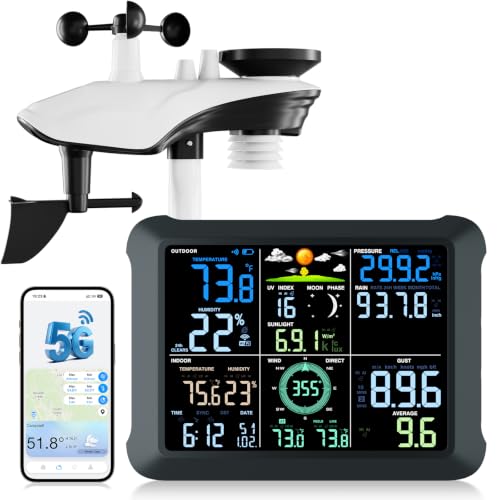
An 8.5-inch wide-angle screen fed by a 443 ft sensor and a rain gauge with a built-in bubble level.
If your problem is that you cannot read the display from the couch, this is the answer. The 8.5-inch LCD supports wide-angle viewing and lays out temperature, humidity, rainfall, wind speed, air pressure, and moon phase in separate, organized sections. The console runs on 5GHz or 2.4GHz dual-band Wi-Fi, and the outdoor sensor reaches 135 m / 443 ft, which covers a large backyard, farm, or a property with multiple buildings without dropouts.
Rainfall is measured precisely: ±1 mm accuracy for rainfall under 15 mm, and ±7% accuracy above 15 mm. A built-in bubble level helps you mount the gauge perfectly horizontal, which is the detail that prevents skewed totals. The Swiss chip delivers the same ±0.2°C temperature and ±1.8% RH humidity accuracy as its Sainlogic stablemate, and the app refreshes all environmental data every 5 minutes. You can view up to 2 years of history as charts, or export to Excel with up to 30 days in a single export.
The AI forecast piece adds 24-hour and 7-day forecasting with radar integration, plus instant app or email alerts when temperature, humidity, or pressure shifts. App connectivity is real but fiddly — Wi-Fi setup is where feedback turns mixed, and the included directions are the single most-criticized part of the package. At 4.0+ stars this ranks near the top of the list, and it makes the most sense for someone who values a large readable panel and historical rainfall records over a five-minute out-of-box experience.
The rain detail: ±1 mm accuracy below 15 mm and ±7% above it, with a bubble level to keep the gauge flat — a level you need for trustworthy monthly totals.
Readability win: the 8.5-inch wide-angle LCD beats the compact consoles for across-the-room viewing, especially when you want rainfall and wind at once.
Best suited to: a large-property owner who wants a big screen, dual-band Wi-Fi, and detailed rainfall history.
Be ready for: a less-than-clear manual and a Wi-Fi setup that takes patience.
9. ECOWITT Wittboy Pro Weather Station HP2564
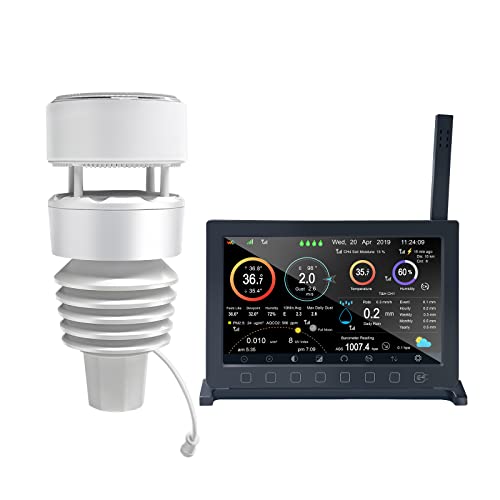
One integrated sensor, then room to bolt on soil probes, pool thermometers, and leak detectors.
This is the station for someone who wants a weather hub, not a single display. The WS90 outdoor sensor collects temperature, humidity, wind direction and speed, light and UV levels, and rainfall in one integrated unit, then sends it to a 7-inch HP2560 TFT display console. From the console you view live data, or check everything on the WS View Plus or Ecowitt app after Wi-Fi configuration. It meets an IPX5 waterproof standard and uses thermal insulation materials in the housing.
Two specs make it different from everything else here. First, the rain sensor is a haptic type at the top of the sensor that detects rain volume by sensing the strikes rather than tipping a bucket — it does not vibrate itself apart in harsh weather. Second, the console pairs with a very long list of Ecowitt sensors you can add over time: up to 8 × WH51 soil moisture sensors, a WH31 thermo-hygrometer, a WN36 pool thermometer, a WN34 thermometer, up to 4 × WH41 or WH43 air quality sensors, a WH55 water leak detector, a WH40 rain gauge, a WH45 air quality sensor, and a WS68 anemometer. Transmission runs up to 150 m with obstacles and 300 m in open space, so a large yard or small farm fits comfortably.
The catch the maker itself publishes: haptic rainfall can drift under certain wind and raindrop-size conditions, so if precise per-rain data is critical, add the WH40 gauge alongside the WS90. Battery life is also one of the softer-rated aspects in feedback, and value for money divides opinion at this price tier. At 4.0+ stars it is a specialist pick — buy it for the expandability and the app/server data, not for the last word in rain accuracy from a single sensor.
Room to grow: the HP2560 console pairs with soil moisture, pool thermometer, air quality, and leak sensors — up to 8 WH51 probes alone.
The rain caveat: the haptic sensor measures rainfall in detail, but the maker notes it can drift in wind — add the WH40 gauge if exact totals matter.
Built for: the tinkerer who wants a 7-inch TFT console and a hub that grows into soil, pool, and air-quality sensors.
Hold off if: you need pinpoint per-rain accuracy from one sensor or want the strongest battery life on the list.
Know the Specs
Transmission Range
The maximum distance the outdoor sensor can send readings to the indoor console, quoted in feet or metres. Open-space numbers shrink once walls, trees, or metal roofs get between them. A bigger number than you need is safety margin, not waste.
Sensor Array
How many readings come from the outdoor unit. A 3-in-1 covers temperature, humidity, and wind speed; a 7-in-1 adds wind direction, rainfall, and often light or UV. More sensors means more mounting and more batteries.
Wireless Frequency
The radio band linking sensor to console, such as 433 MHz, 915 MHz, or 2.4 GHz Wi-Fi. The sensor-to-console link is a short-range radio, while Wi-Fi is what pushes your data to a phone app or a weather network.
Power and Backup
Consoles usually run on a plug-in adapter with battery backup, and the outdoor sensor runs on batteries or a small solar panel. The backup battery count and whether the sensor is solar-assisted decide how often you service it.
Common Questions
How far can a wireless weather station sensor be from the indoor display?
Do I need Wi-Fi if I only want to read the screen?
How long do the outdoor sensor batteries last?
Is a haptic rain sensor as accurate as a tipping bucket gauge?
What does the 5GHz and 2.4GHz Wi-Fi label actually mean?
Can I add more readings to a station later?
Why does my temperature read a couple of degrees low?
Do these stations work with Alexa or Google Home?
How precise is the rainfall measurement on a home station?
Will a weather station clock handle daylight saving automatically?
The Bottom Line
For most buyers, the wireless indoor-outdoor weather stations winner is the AcuRite Notos (01604A2), because it does the basic job cleanly — one sensor, gust-accurate wind every 18 seconds, and roughly two years on a sensor battery without an app in the way. If you want to grow into a connected setup, the Ambient Weather WS-1965 adds Alexa and IFTTT routines. And if you need a long sensor run across a farm or large yard, the ECOWITT Wittboy Pro reaches up to 300 m in open space and keeps expanding with add-on sensors — a nudge worth taking if you plan to add soil or pool probes later.
How we choose
We do not accept paid placement. Every pick is matched to a real buyer and a real use-case; we do not hands-on test units.
Sources
Specifications: manufacturer listings and product documentation. Review insights: verified customer reviews, as of November 2026. Pricing: not shown on this page (it changes often); check the current price via the retailer link.
As an Amazon Associate, Tactical Gear Guy earns from qualifying purchases. This does not affect which products we feature.