Specs are compiled from manufacturer listings and verified buyer reviews and can change over time — please confirm the key details on the product page before buying.
Overheating is the fastest way to ruin a summer night in a sleeping bag. A bag rated far colder than the weather traps you in a pocket of stale, clammy air, and you end up half-zipped, half-awake, flipping the thing off at 2 a.m. The fix is to match the bag’s comfort rating to the night you are actually camping in, then keep the weight down so you are not hauling a winter sack up a summer trail. That is exactly what this list sorts out for you.
This guide is built by comparing the manufacturers’ published specifications and the patterns across verified customer reviews, so you get each pick’s real strengths and trade-offs instead of marketing spin.
You will see how each bag handles warmth, packed size, and real-world comfort, so you can pick one that fits your trip. Below is my shortlist of the warm weather sleeping bags that actually make sense for hot-weather camping.
Top Picks


How To Choose The Best Warm Weather Sleeping Bags
The single most common mistake in warm-weather camping is buying a bag rated colder than the trip. A 0°F bag on a 60°F night turns into a sweat box, and you sleep worse than if you had brought a blanket. You want a bag whose comfort temperature sits close to the coolest night you expect, not the coldest night you can imagine.
Start with the temperature rating, not the brand
A bag rated 40°F is built for nights that dip toward the low 40s and stay there. On a summer trip where lows hover near 55°F, a 40°F bag gives you a margin of warmth without cooking you. Look for the comfort figure the maker publishes, because the extreme number is a survival threshold, not a sleeping temperature.
Then decide between down and synthetic fill
Down packs smaller and lighter for the warmth it delivers, which is why bags listing 650 fill power or 850+ fill power are the ultralight favorites. Fill power means how much space one ounce of down lofts into — a higher number means more warmth per ounce. Synthetic fill costs less and shrugs off damp better, but it generally weighs more and stuffs larger.
Check the packed size against your actual bag
A summer bag is only as useful as the space it leaves in your pack. Read the stuff-sack dimensions, not just the weight, because a lightweight bag that stuffs into a long tube may still crowd a small daypack. If you are carrying your kit on your back all day, packed weight and stuff-sack size decide as much as the temperature rating.
Look for a real ventilation system
Warm-weather sleeping is about venting heat as much as trapping it. A two-way zipper that opens from the bottom lets you stick your feet out when the night turns muggy. A draft tube along the zipper is the flip side — it stops cold leaks on the cooler nights of spring and fall, so you get one bag that spans three seasons.
Side-by-Side Comparison
| Model | Best For | Temperature Rating | Weight | Packed Size | Amazon |
|---|---|---|---|---|---|
| OneTigris Bushcrafter’s Sleeping Bag★ Best Overall | Tall campers who want room to roll | 46.4–59°F | 3.1 lb | 7.8″ x 16.5″ stuff sack | Amazon |
| Kelty Mistral Synthetic Camping Sleeping BagLightest Value | Value-focused three-season camping | 40°F | 2.6 lb | 76″L x 30″W | Amazon |
| Coleman Sun Ridge 40°F Sleeping BagBest For Tall Sleepers | Simple car camping on a budget | 40°F | 5 lb | 75 x 33 in | Amazon |
| Coleman Biscayne Warm-Weather Sleeping Bag | Tall sleepers who want to vent | 40°F | — | 81 x 39 in | Amazon |
| Agemore Cotton Flannel Sleeping Bag | Indoor and dorm-room comfort | 50–68°F | 4 lb | 90″L x 35″W | Amazon |
| Kelty Cosmic Synthetic Fill 40 Degree | Backpacking with a real temp rating | 40°F | 2 lb 6 oz | 15 x 8 in | Amazon |
| Naturehike Ultralight Backpacking RDS Down | Ultralight summer backpacking | Comfort 42.8°F | 1.3 lb | Φ4.7″ x 10.2″ | Amazon |
| Naturehike 40-12℉ Ultralight Down | Warm-nighters who want foot room | Comfort 40.4°F | 2 lb | 13.8″ x 7.1″ | Amazon |
| Sea to Summit Spark Ultralight Down | Grams-counting summer touring | 45°F | 13.6 oz | 77.2″L x 30.5″W | Amazon |
Detailed Reviews
1. OneTigris Bushcrafter’s Sleeping Bag
Our pick — 4.5+★ from 350+ verified ratings; the strongest balance of quality and price.
A roomy mummy for tall campers who hate feeling boxed in.
Most warm-weather bags squeeze you into a tube. This one takes the opposite approach, sizing up to 6.8 feet by 2.7 feet so you get extra-wide sleep space across the whole night. The 46.4~59°F (8~15°C) rating is aimed straight at spring, summer, and fall nights, which is the temperature band most of us actually camp in.
The outer shell is a 300T pongee fabric — a tight-weave synthetic that shrugs off splashes — with a 190T pongee lining and 7oz polycotton filling inside. Practically, that means a bag that handles a damp tent floor and dries fast after a wash. YKK zippers with an anti-snag design and a cord-stopped hood keep the cold out without a wrestling match at bedtime. It stuffs into a 7.8″ x 16.5″ tube-shaped sack and weighs 3.1 pounds, light enough to carry on a short hike and still fine strapped to a car-camping tote.
What wins people over is the build quality — it is the most-talked-about strength by a wide margin. Warmth and comfort follow close behind, and buyers routinely note it runs warmer than a comparable Coleman model. The honest catch is the fit: some find it roomy, some find it too small, so measure your height and shoulder width against the 82.6″L x 33″W spec before you commit. Zipper feel is the other split opinion, so treat it gently on the pull.
What earns its keep
- Stretches to 6.8 feet, so taller campers fit without curling up
- 300T pongee shell with splash resistance and a fast dry after washing
- Anti-snag YKK zippers and a cord-stopped hood for easier night-time exits
- Packs into a 7.8″ x 16.5″ stuff sack at 3.1 pounds
Where it asks for care
- Sizing feedback splits between roomy and too small
- Zipper durability draws mixed notes, so pull the slider straight
Reach for this if: you are a tall or broad camper who wants a wide-cut bag for three-season trips at 46.4~59°F.
Check the tape first: the fit lands differently for different bodies, and the 33-inch width is where that shows up.
2. Kelty Mistral Synthetic Camping Sleeping Bag
A 2.6-pound sack, alongside the 5-pound Coleman Sun Ridge.
Weight is where this bag separates from the pack. At 2.6 pounds it stands against the Coleman Sun Ridge at 5 pounds, and that difference is what your shoulders feel on the second mile of a hike. For a warm-weather bag you are carrying rather than dragging out of a trunk, that matters more than any trim detail.
The filler is Kelty’s Cloudloft synthetic, stitched in an offset quilt pattern so the insulation stays evenly spread instead of bunching into cold spots. Both the outer shell and inner liner use 68D recycled Teffeta polyester with a PFAS-free DWR treatment — a water-repellent finish without the flagged chemical class. Dual locking zippers and a draft collar round out the details that make a 40°F bag behave on a cool spring night. The regular cut measures 76″L x 30″W.
Comfort and value are the two things that come up again and again in owner write-ups, and the temperature performance holds up across all seasons except winter, which is exactly the job a warm-weather bag signs up for. The narrower 30-inch width is the trade-off — this is a trimmer cut than the Coleman Biscayne at 39 inches wide, so broad-shouldered sleepers should picture that before ordering. It is the lightest pick here among dedicated three-season synthetic bags.
The weight story: at 2.6 pounds it is the bag to carry when pack weight is the deciding number, and the offset quilt stitching keeps the Cloudloft fill spread even rather than lumped at the feet.
One thing to weigh: a 30-inch shoulder width is snug for bigger frames, and that is the main reason to look upward to a wider cut.
Best for: campers who carry their kit and want a light 40°F synthetic bag with a sensible quilt pattern.
Look elsewhere if: you are built broad — the 76″L x 30″W cut leaves less shoulder room than a wide Coleman.
3. Coleman Sun Ridge 40°F Sleeping Bag
A no-drama car camper rated to 40°F with a draft tube that earns its name.
This is a straightforward bag built for sleeping down to 40°F without fuss. The Thermolock draft tube runs along the zipper to stop body heat leaking out, and the Fiberlock construction keeps the insulation from shifting into lumps after a few washes. For a summer of car camping and backyard sleepovers, those are the details that keep a basic bag working season after season.
Weight is the honest trade-off. At 5 pounds it is the heaviest bag on this list, next to the 2.6-pound Kelty Mistral. That is fine if the bag lives in a trunk or a tent, and less fine if you plan to carry it up a ridge. The 75 x 33 in size fits sleepers up to 5 ft. 11 in., which puts it at the smaller end of the group next to the wide 81 x 39 in Coleman Biscayne.
Buyers describe it as roomy and comfortable, and warmth is the other consistent note — it handles above-freezing nights comfortably. The ComfortCuff trim around the opening keeps the fabric soft against your face, and the Roll Control fasteners with a QuickCord no-tie closure make packing up quick. A 5-year limited warranty backs a bag that is priced like an entry model.
Where it shines: the draft tube and Fiberlock fill together give you a stable, draught-free 40°F bag that survives machine washing without clumping.
The catch: 5 pounds is a lot to shoulder, and the 5 ft. 11 in. max height leaves tall campers reaching for something longer.
Made for: the car camper or tent-sleeper who wants a simple 40°F bag with a real warranty behind it.
Skip it for: backpacking trips, where 5 pounds becomes the first thing you regret.
4. Coleman Biscayne Warm-Weather Sleeping Bag
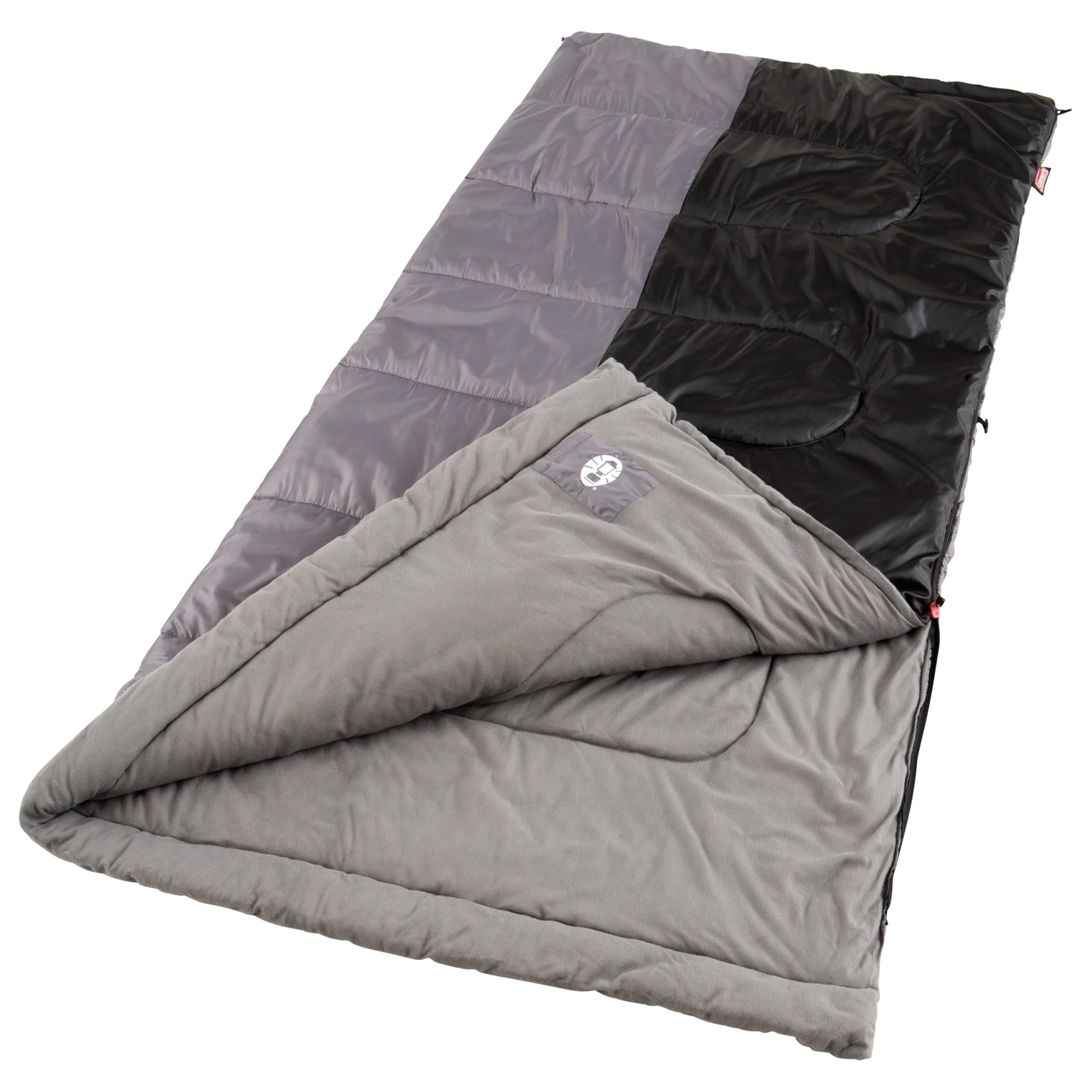
The big-and-tall bag with a bottom-opening zipper for muggy nights.
Warm-weather sleeping is as much about venting heat as trapping it, and this bag’s bottom-opening two-way zipper is built around that idea. The two-way zipper opens from the bottom, so you can vent your feet when the tent turns stuffy. That single feature is what makes a 40°F bag workable on a summer night that drifts toward 60°F. The no-snag zipper and included stuff sack keep the whole routine quick.
Size is the headline. At 81 x 39 in it is roomier than the 75 x 33 in Coleman Sun Ridge, and the big-and-tall cut fits campers up to 6 ft. 4 in. You can even zip two bags together for double the room, which makes it a useful option for couples who want one shared sleep space. The Thermolock draft tube still runs along the zipper for cooler spring nights, and machine washing keeps it simple between trips.
Buyers single out the size and length first — a real advantage for lanky campers. Quality for summer use holds up, and the temperature rating is reported to be accurate. Where opinions split is the zipper: the two-way function is well-liked, but durability gets mixed notes, so treat the slider with a steady hand. The fasteners that lock the bag as you roll and the no-tie cords make packing it away easier than the size suggests.
Why it lands on the list
- 81 x 39 in fits campers up to 6 ft. 4 in. with room to move
- 2-way zipper opens at the base for real ventilation
- Zip two bags together into one double-wide sleep space
- Thermolock draft tube and machine-washable build
Worth knowing before you buy
- Zipper durability gets mixed feedback, so pull it slowly
- The generous dimensions make it bulky to pack
Pick this one if: you are tall and sleep hot, and want a bag that opens up at the bottom to let heat out.
The trade-off to accept: that extra 81 x 39 in frame takes up more room in a packed vehicle.
5. Agemore Cotton Flannel Sleeping Bag
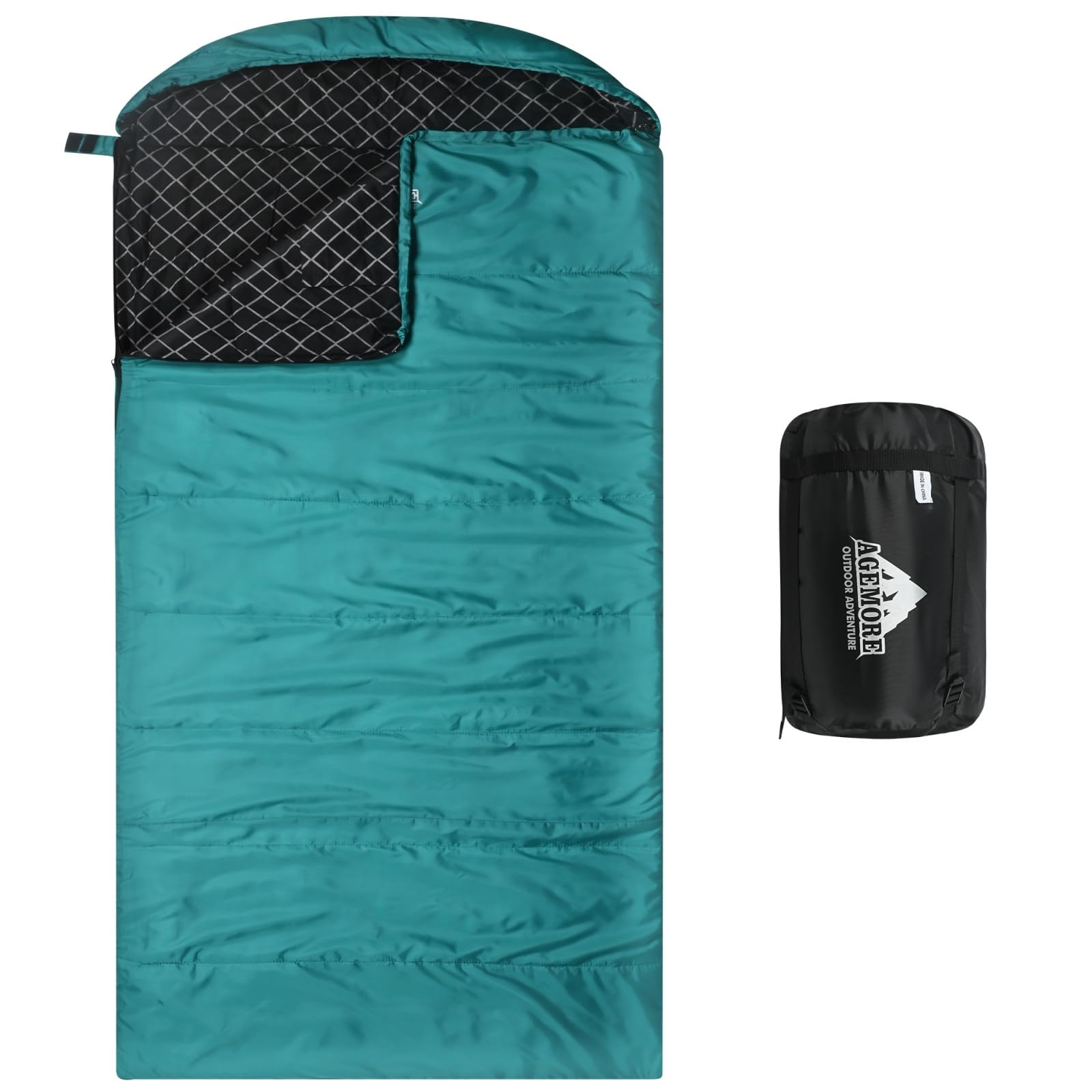
A flannel-lined envelope for indoor nights and dorm-room comfort.
Cotton flannel against your skin is a different feel from slick nylon, and that is what this bag sells. The lining is 100% cotton flannel, soft and breathable for warm nights when synthetic fabric feels clammy. Comfort is rated at 15℃/59℉, with a working range of 10℃–20℃ / 50℉–68℉, which makes this a true summer and indoor bag rather than a shoulder-season one.
Space is generous: 90.6″ x 35.4″ including the hood, with a width that beats the 76″L x 30″W Kelty Mistral for room to move. The reverse two-way zipper lets you zip yourself in from the inside and opens at the base for breathing room, and two bags can be joined into a double. A 210T polyester rip-stop shell handles dampness, and the compression sack with strap packs it down for throwing in the car. At 4 pounds it stays lighter than the 5-pound Coleman Sun Ridge, though not by much.
Comfort, warmth, and roominess are what come through from owners, including enough length to cover an XL twin dorm mattress cleanly. The recurring caution is the zipper, which some find snags, so run it gently. A handful also find the fill thinner than expected — it is a warm-weather liner, not a cold-night bag. Keep that in mind and it does its job indoors and out.
The flannel difference: 100% cotton flannel lining against 210T rip-stop polyester outside gives you a soft-to-touch bag that is breathable on warm nights and easy to wipe down after use.
Set expectations: the 50℉–68℉ range is warm-weather only, and the fill reads thin to some owners, so treat this as a summer and indoor bag.
Suits you if: you want a flannel-lined bag for summer camping, dorm rooms, or a guest bed that feels soft rather than slick.
Know before you buy: the zipper needs a gentle pull, and the fill is a warm-weather layer, not a cold-night insulator.
6. Kelty Cosmic 40 Degree Sleeping Bag
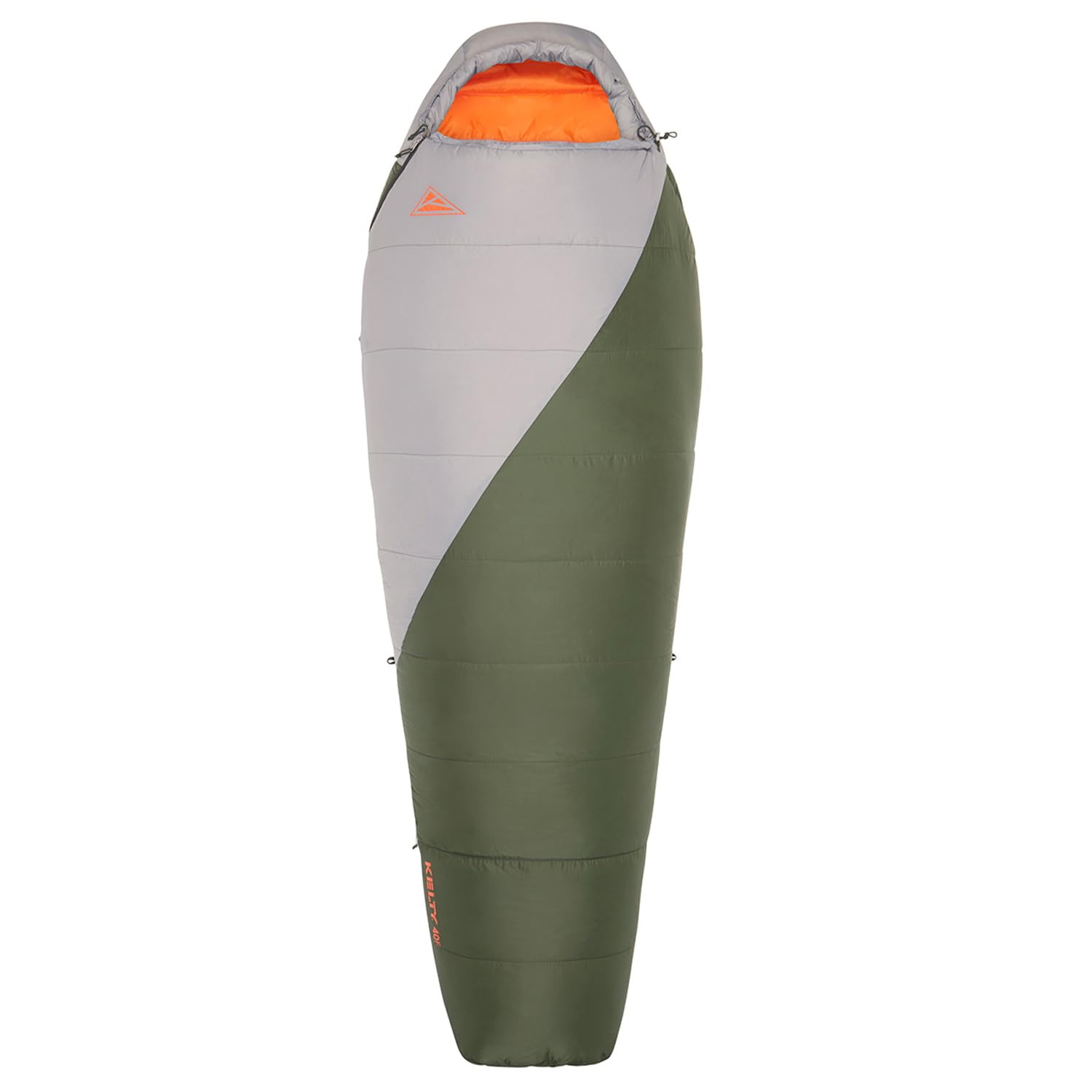
A 40°F trail bag that stuffs to a 15 x 8 inch bundle at 2 lb 6 oz.
This is the pick for the camper who walks in rather than drives in. The 40 Degree temp rating pairs with a total weight of 2 lbs 6 oz and a fill weight of 24oz, so you get a real trail bag without a winter-sack heft. The non-compressed stuff size is 15 x 8 inches, and the integrated compression sack squeezes it tighter still, which is how it reaches minimalist pack standards.
The shell is a 20D Nylon Taffeta with a 50D Taffeta liner, and the fill is Cirroloft synthetic — a synthetic insulation that keeps its loft in cold and damp conditions, so you still get even coverage when the tent fogs up. A natural-fit spacious footbox gives your toes room to wiggle, and a stash pocket on the outside of the bag holds small overnight essentials. Regular size fits sleepers up to 6ft, with length options ranging to fit sleepers 5’8″ to 6’6″.
What keeps this bag in the running is its quality and warmth, with lightweight and value close behind. The fit runs snug for some bigger frames, so if you are broad, weigh that against the tailored cut. Compare it with the Coleman Sun Ridge, which runs 5 pounds, against the Cosmic at 2 lb 6 oz — the whole reason it holds a spot for trail use.
What makes it a trail pick
- 2 lb 6 oz total weight, with a 15 x 8 in non-compressed stuff size
- Cirroloft synthetic fill keeps loft in cold, damp conditions
- Spacious footbox and external stash pocket for small essentials
- Length options cover sleepers from 5’8″ to 6’6″
The fit note
- Snugger cut than a wide Coleman — bigger frames should size up if the chart allows
Go with this: if you backpack and need a 40°F synthetic bag that packs to 15 x 8 inches.
Think twice: if you want a wide, loose fit — this one is tailored for a snug night’s sleep.
7. Naturehike Ultralight Backpacking RDS Down Sleeping Bag

At 1.3 pounds, the weight of a water bottle, this down bag nearly disappears in a pack.
For pure carry weight, nothing here touches this bag. The CW295 size tips the scale at 1.3 lbs / 565g, stowed to a Φ4.7″ x 10.2″ cylinder you can pull out of a pack one-handed. That combination of 650 fill power duck down and 20D400T insulated nylon is what gets a summer bag down to that number. The 295g down fill leans on an individual down channel design, so the fill stays distributed instead of sliding to one end overnight.
Temperature is where you need to read the fine print. The comfortable range is listed as 42.8℉–51.8℉, with an extreme of 32℉–42.8℉. That makes it a genuine summer-and-spring bag, not a shoulder-season one. The recommended size check matters too: CW295 is the short size at 74.8″L x 28.3″W, while CWM400 is the medium at 78.74″L x 31.50″W, so match your height to the chart before ordering. The YKK two-way zipper joins two bags and vents from the bottom, and a lint-free Velcro closure keeps the neck sealed.
The down is RDS certified — the Responsible Down Standard, which traces the origin of the fill — and the shell carries a water-repellent treatment to keep moisture off. Warmth and weight are the two things owners talk about most, with quality and compactness right behind. The compact and non-compression storage options suit both. It is a strong summer and spring bag, and the fit runs short, so tall sleepers should step up to the CWM400.
Why it earns the weight crown: 1.3 lbs / 565g packed into a Φ4.7″ x 10.2″ tube, with 650 fill power down and individual channels to hold the loft steady all night.
The one caution: it is a 42.8℉-comfort bag at heart, so a frosty spring night will have you layering up — and the short size will not fit taller campers.
The right call for: summer and spring backpackers who count grams and want RDS-certified down at 1.3 pounds.
Not for you if: you sleep cold or camp in shoulder season — the 42.8℉ comfort figure is the limit here.
8. Naturehike 40-12℉ Ultralight Down Sleeping Bag

A mummy top with a rectangular foot end, for sleepers who want their feet free.
The clever part here is the shape. The upper body is mummy-cut to hug the head and hold warmth, while the lower half is a rectangle you can move in or peel open to expose your feet. That hybrid solves the classic warm-weather complaint: a mummy bag you cannot kick loose when the night turns muggy. It weighs 2 lbs (910g) and packs to 13.8″ x 7.1″, so it is still a genuine backpacking bag.
Inside is 650 fill power duck down with RDS certification, the same standard that traces where the down comes from, and a comfort rating of 40.4℉ (4.7℃) that puts it squarely in three-season territory. Two sizes are offered — 82.7″ x 29.5″ regular and 86.6″ x 33.5″ large — so taller sleepers have a real path to a proper fit. The 400T 20D ripstop nylon shell is water-repellent, and YKK zippers mean the closure will hold up to repeated use. A storage bag and compression sack both ship in the box.
Buyers report it keeping them warm down to 50°F and being a solid three-season choice. Roominess and packability come up too, and the compression bag has enough room to re-stuff without a fight. Comfort and value both land well for cold nights. It is heavier than the 1.3-pound Naturehike above, but you get more foot room and a more flexible shape in return — a fair swap for anyone who sleeps hot at the feet.
The case for the hybrid cut
- Mummy upper body seals warmth while the rectangular foot end lets your feet breathe
- 650 fill power RDS down, comfort rated to 40.4℉ (4.7℃)
- Packs to 13.8″ x 7.1″ at 2 lbs (910g)
- Two sizes covering 82.7″ x 29.5″ and 86.6″ x 33.5″
Where to set expectations
- Heavier than the ultralight Naturehike below its spot, though it offers more foot room
- The mummy top still hugs close at the shoulders
Fits best for: warm-nighters who want down warmth without a sealed mummy around their toes.
Consider the lighter bag if: shaving weight beats foot room on your trips.
9. Sea to Summit Spark Ultralight Down Sleeping Bag
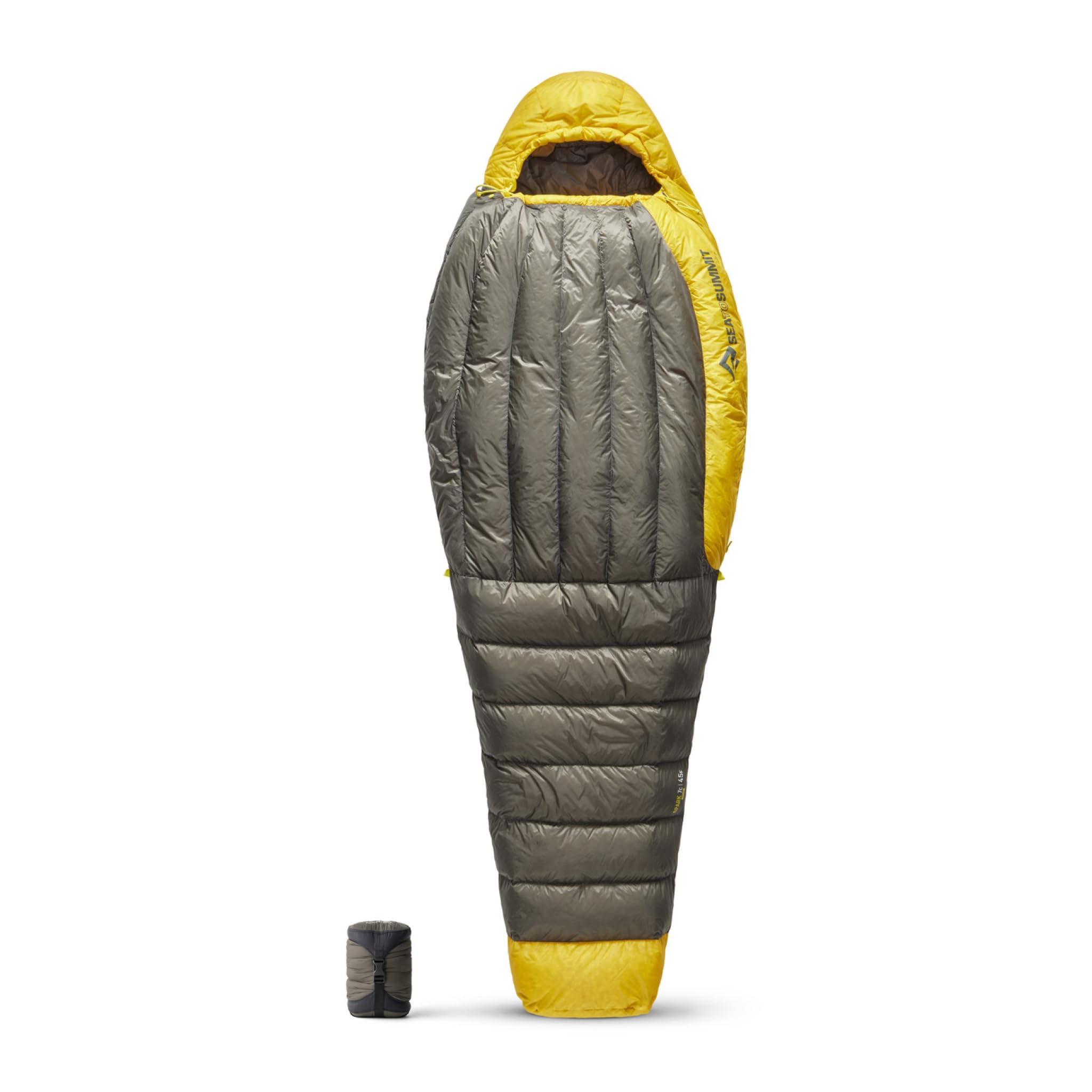
A 13.6-ounce warm-weather bag built for bike packers who count every gram.
At 13.6 ounces, this is the lightest bag on the list — lighter than the 1.3-pound Naturehike and well under the 5-pound Coleman Sun Ridge. The engine behind that is 850+ fill power down with a non-PFC Ultra-Dry treatment, which means the down keeps its loft when it picks up moisture instead of collapsing. Fill power measures how far an ounce of down lofts, so the higher number is why this bag stays warm at such low weight.
The shell is a 10D nylon with a PFC-free DWR that keeps the hood and footbox water resistant, and a breathable 10D nylon liner runs against your skin for all-night comfort. The contoured mummy shape leaves room for a natural sleeping position, and YKK #5 zippers run snag-free. Sewn-through baffle construction is what trims the weight further. Rated to 45°F (7°C), it is a purpose-built warm-weather bag for backpacking, bike packing, and touring rather than a cold-night tool.
The responsible down certification traces the fill’s origin, and a lifetime guarantee backs the construction. The honest limit is the temperature ceiling: 45°F means warm nights only, and a cold snap will send you reaching for a layer. It also carries the highest price on this list, so the value question is whether you tour by bike or foot often enough to justify the grams saved. If you do, nothing here packs smaller for the warmth.
The gram-counting case: 13.6 ounces with 850+ fill power down is the lightest warm-weather option here, and the non-PFC Ultra-Dry treatment keeps the loft working through damp nights.
The fair caveat: 45°F is a warm-night-only rating, and this is the premium-priced pick on the list.
Worth it for: bike packers and gram-counting hikers who tour warm-weather routes and want the lightest 45°F down bag going.
Not the pick if: you camp through cold snaps or want one bag to span all four seasons.
Know the Specs
Temperature Rating: Comfort vs Extreme
A bag’s rating comes in two numbers, and they mean very different things. The comfort figure is the temperature at which an average sleeper stays warm through the night — for the Naturehike down bag that is 42.8℉–51.8℉, and for the Coleman bags it is a straight 40°F. The extreme figure is a survival threshold, not a sleeping temperature, and if you judge a warm-weather bag by its extreme number you will end up cold. Buy for the comfort rating and match it to the coolest night you expect on your trip.
Fill Power and Insulation Type
Fill power tells you how much space one ounce of down lofts into — 650 fill power is a solid everyday down, and 850+ fill power is high-loft premium down that traps more warmth per ounce. That higher number is why bags listing it can hit ultralight weights like 13.6 ounces. Synthetic fill, such as Kelty’s Cloudloft or Cirroloft, does not use a fill-power number at all; it is measured instead by how it holds loft in damp conditions. Synthetic tends to weigh more and pack larger, but it shrugs off moisture and costs less than down.
Packed Size and Trail Weight
Two bags can weigh the same and still pack very differently. A bag’s total weight includes the shell, fill, and zippers, while trail weight is what it adds to your pack once compressed. The Kelty Cosmic lists 2 lbs 6 oz with a 15 x 8 inch non-compressed stuff size, and the integrated compression sack squeezes it smaller still. If you carry your kit, read both numbers — a light bag stuffed into a long tube can still crowd a small daypack.
Zippers and Ventilation
Warm-weather bags live or die on how easily they let heat escape. A two-way zipper opens from the bottom, so you can stick your feet out when the night turns warm — that is the whole point of the Coleman Biscayne’s bottom-opening design. A draft tube along the zipper works the other way, keeping body heat from leaking out on cooler spring nights. YKK zippers are the standard for a reason: the brand’s anti-snag designs keep you from wrestling the slider at 3 a.m.
Common Questions
What temperature rating should a warm-weather sleeping bag have?
Is down or synthetic better for summer sleeping bags?
Can I zip two sleeping bags together?
How much should a warm-weather sleeping bag weigh?
Will a 40°F sleeping bag keep me warm at 50°F?
How do I wash a warm-weather sleeping bag?
What does fill power mean on a down sleeping bag?
What is an RDS certified down sleeping bag?
Should I buy a mummy or rectangular warm-weather bag?
Do I need a sleeping pad under a summer sleeping bag?
The Bottom Line
For most campers, the warm weather sleeping bags winner is the OneTigris Bushcrafter’s Sleeping Bag because it spans 46.4~59°F with a roomy 6.8-foot cut and anti-snag YKK zippers, which is the warm-weather range most trips actually land in. If carrying weight is what decides your setup, grab the Naturehike Ultralight RDS Down bag at 1.3 pounds and 650 fill power. And for bike packing or fast touring where every gram shows up on the scale, the Sea to Summit Spark is the one to reach for.
The one nudge worth making: the OneTigris holds the highest score among the three-season bags here while still offering the widest cut, so start your shortlist there before you branch out to the ultralight down options.
How we choose
We do not accept paid placement. Every pick is matched to a real buyer and a real use-case; we do not hands-on test units.
Sources
Specifications: manufacturer listings and product documentation. Review insights: verified customer reviews, as of November 2026. Pricing: not shown on this page (it changes often); check the current price via the retailer link.
As an Amazon Associate, Tactical Gear Guy earns from qualifying purchases. This does not affect which products we feature.