Specs are compiled from manufacturer listings and verified buyer reviews and can change over time — please confirm the key details on the product page before buying.
You want your iPhone screen on a wall, not in your hand, and you want it there without hunting for a dongle. That is the whole job of a wireless projector for iPhone, and the picks below do it through AirPlay, Google Cast, or a built-in smart TV system. The list starts with the LYNCAST 1200 ANSI Google TV projector, the crowd favorite at 4.5+ stars across 400+ ratings, because it pairs a 1200 ANSI lumen picture with Wi-Fi 6 mirroring that keeps your phone’s video smooth.
This guide is built by comparing the manufacturers’ published specifications and the patterns across verified customer reviews, so you get each pick’s real strengths and trade-offs instead of marketing spin.
Below you will find eleven projectors sorted by what they do best, from 200-lumen budget minis to a 2500 ANSI lumen daylight unit and a battery-powered outdoor model, so you can pick the one that matches your room and your phone. Every pick here connects to an iPhone without a cable, through AirPlay, Google Cast, or a built-in Roku TV or Google TV system.
Top Picks

How To Choose The Best Wireless Projector for iPhone
The first thing to settle is how your iPhone will actually talk to the projector. Some units use Apple AirPlay (Apple’s own wireless mirroring standard), some use Google Cast, and some only mirror through a third-party app. Check that the pick you want lists the method your phone uses, because a projector that only casts from Android is useless to you.
Brightness decides when you can watch
Brightness is measured in ANSI lumens, a standardized rating of how much light the lens throws. A dim-room projector might sit around a few hundred lumens, which is fine after dark. A brighter unit like the LYNCAST at 1200 ANSI lumens can hold a picture with some room light on, which matters for a daytime match or a kids’ afternoon cartoon.
Native resolution versus “supported” resolution
A native 1080P projector actually draws 1920 x 1080 pixels. A projector labeled “4K supported” only accepts a 4K signal and then displays it at its own native panel resolution. For iPhone mirroring, native 1080P keeps text and menus crisp, so read the spec carefully instead of trusting the big number on the box.
Focus and keystone: the setup you do once or every time
Auto focus and auto keystone correction (the feature that squares up a slanted image) are the difference between a two-second setup and five minutes of fiddling. If you plan to move the projector between the bedroom and the backyard, prioritize a model with automatic adjustment and a rotating or gimbal stand.
Side-by-Side Comparison
| Model | Best For | Brightness | Native Resolution | Smart System | Amazon |
|---|---|---|---|---|---|
| LYNCAST 1200 ANSI Google TV★ Best Overall | Brightest all-rounder | 1200 ANSI lm | 1920 x 1080 | Google TV | Amazon |
| Boldever Roku TV 1080P MiniFastest Focus | Fast auto focus | 200 ANSI lm | 1920 x 1080 | Roku TV | Amazon |
| HP MC425Runs On USB-C | USB-C power banks | 200 ISO lm | 1920 x 1080 | Android TV | Amazon |
| YOWHICK Smart Projector | Giant 400-inch screen | 350 lm | 1920 x 1080 | Netflix built-in | Amazon |
| Aurzen D1R air Roku TV | AirPlay + ceiling viewing | 300 ANSI lm | 1920 x 1080 | Roku TV | Amazon |
| Aurzen BOOM Air Google TV | Portable Google TV | 300 ANSI lm | 1920 x 1080 | Google TV | Amazon |
| WiMiUS G1 Google TV | Contrast and sound | 580 ANSI lm | 1920 x 1080 | Google TV | Amazon |
| HAPPRUN 2500 ANSI Google TV | Daylight viewing | 2500 ANSI lm | 3840 x 2160 | Google TV | Amazon |
| NEBULA Mars 3 | Battery outdoor use | 1000 ANSI lm | 3840 x 2160 | Android TV 11.0 | Amazon |
| HAPPRUN Roku TV Mini | Budget portability | — | HD | Roku TV | Amazon |
| TMY 1080P Mini | Low-cost streaming | 200 lm | 1920 x 1080 | Netflix pre-installed | Amazon |
Detailed Reviews
1. LYNCAST 1200 ANSI Google TV Projector
Our pick — 4.5+★ from 400+ verified ratings; the strongest balance of quality and price.
The one that stays readable with the lights on, not just after dark.
Brightness is where this pick separates itself, and the gap is not subtle. It puts out 1200 ANSI lumens while the TMY 1080P Mini further down this list manages 200 lm, a 6.0x difference in measured light output. In practice that means you can run an afternoon match or a backyard party with some ambient light and still see faces, instead of waiting for full dark. The 15000:1 contrast ratio (the spread between the darkest black and brightest white it can draw) keeps dark scenes from turning into a grey mush.
For your iPhone, the connection is the part that matters day to day. Wi-Fi 6 (a faster, less crowded wireless standard) handles screen mirroring for iOS, so your photos and videos arrive without the stutter that plagues older single-band units. Licensed Google TV sits inside the box, which means Netflix, Prime Video, and YouTube launch from the projector itself when you would rather not mirror at all. Dual 36W speakers with Dolby Audio save you buying a soundbar, and Bluetooth 5.4 lets you pair headphones for late-night viewing without waking the house.
Setup is genuinely hands-off: auto focus, auto keystone, screen alignment, and obstacle avoidance all run together, so the projector frames a rectangle around a wall outlet or a hanging picture on its own. The picture can stretch up to 200 inches. The catch is a small one but worth knowing before you order: the smart remote needs two AAA batteries, and they are not in the box.
What earns it first place
- 1200 ANSI lumens holds a picture with room light on, well clear of the 200 lm budget units here
- Wi-Fi 6 mirroring plus licensed Google TV means you can cast or stream without a dongle
- Auto focus, keystone, alignment and obstacle avoidance run together for near-instant setup
- Dual 36W Dolby speakers remove the need for an external soundbar
What to weigh first
- Remote ships without the two AAA batteries it needs
- Bulkiest of the mid-range picks here, so it stays mostly in one room
Made for: anyone who wants one projector to do casting, streaming, and sound without extra gear.
Think twice if: you need a pocket-sized unit that lives in a backpack — this one wants a shelf.
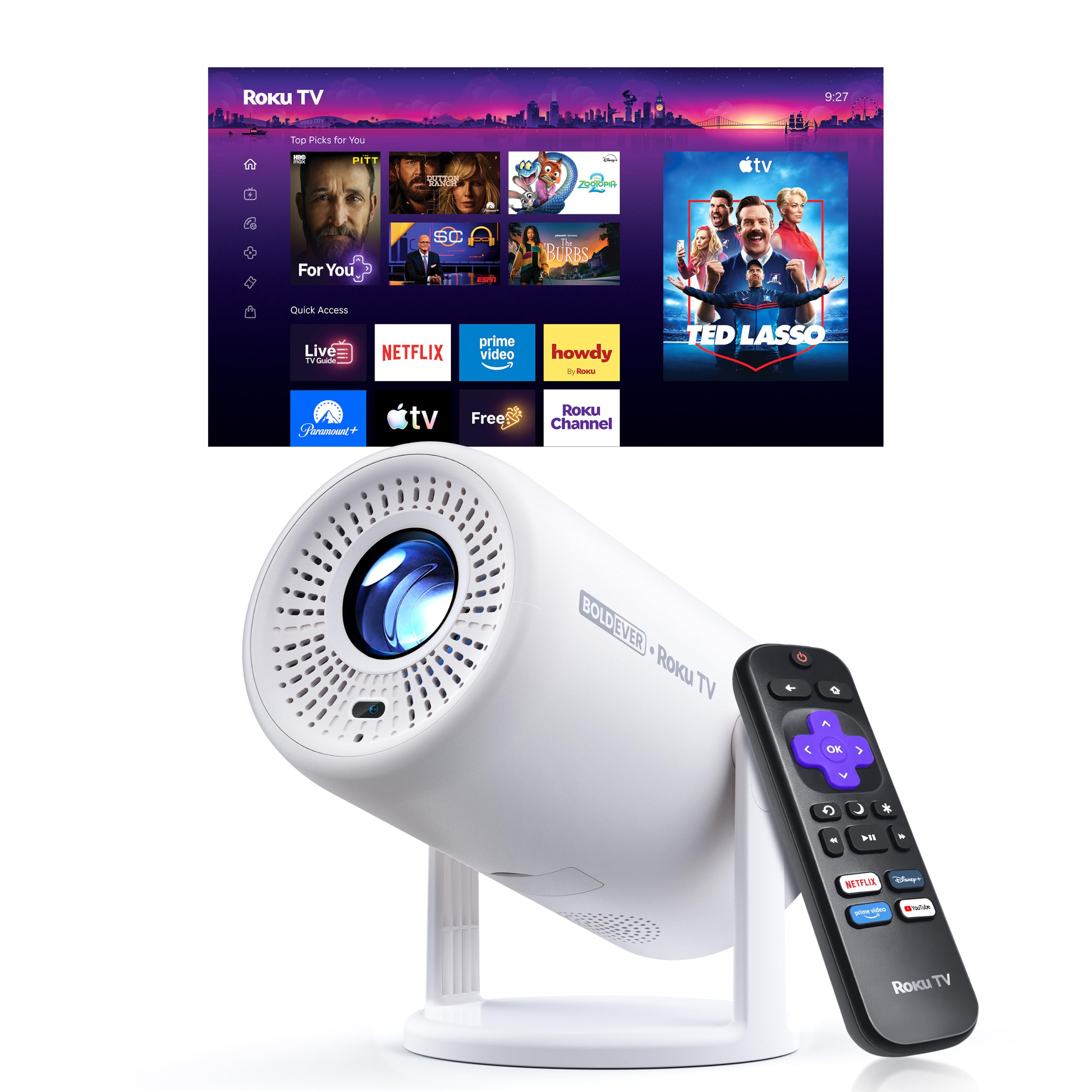
2. Boldever Roku TV 1080P FHD Mini Smart Projector
The iPhone-first pick, because AirPlay is built in rather than bolted on.
If you own an iPhone and nothing else, start here. Boldever builds official Apple AirPlay straight into the projector, so you mirror, cast, or stream from your phone, iPad, or Mac with no third-party app sitting in the middle. That is a cleaner path than units that lean on a mirroring app, and it works the moment both devices are on the same Wi-Fi.
Focus is the other headline. ToF (time-of-flight, a sensor that measures distance to the wall) completes autofocus in under 2 seconds, and the maker notes that traditional ceiling projectors can take up to 10 seconds. Combined with auto keystone, you set it down, power it on, and the rectangle squares itself up. Roku TV handles Netflix, Disney+, YouTube, Hulu, and the Apple TV app on its own, so the phone is optional once you are set up.
The honest limit is 200 ANSI lumens. This is a 200 ANSI lumen projector, and the maker is upfront about it — no inflated numbers, but also no daylight viewing. It shines in a dim room or after dark, where true native 1080P (not 720P stretched) keeps text sharp even on a large screen. What wins people over is the combination of real 1080P, sub-2-second focus, and a 1.6 lb body that slides into a backpack.
Picture honesty: a genuine native 1080P panel and a stated 200 ANSI lumens — sharp in low light, dim in daylight. Six picture modes let you switch between Vivid, Standard, Eco, Movie, and Sports for different content.
The small print: Roku needs a free account and an internet connection to activate, and the remote takes two AA batteries that are not included.
Go with it when: your viewing happens after sundown and your phone is an iPhone.
Look elsewhere if: you want a picture with the curtains open — the HAPPRUN 2500 ANSI pick handles that job.
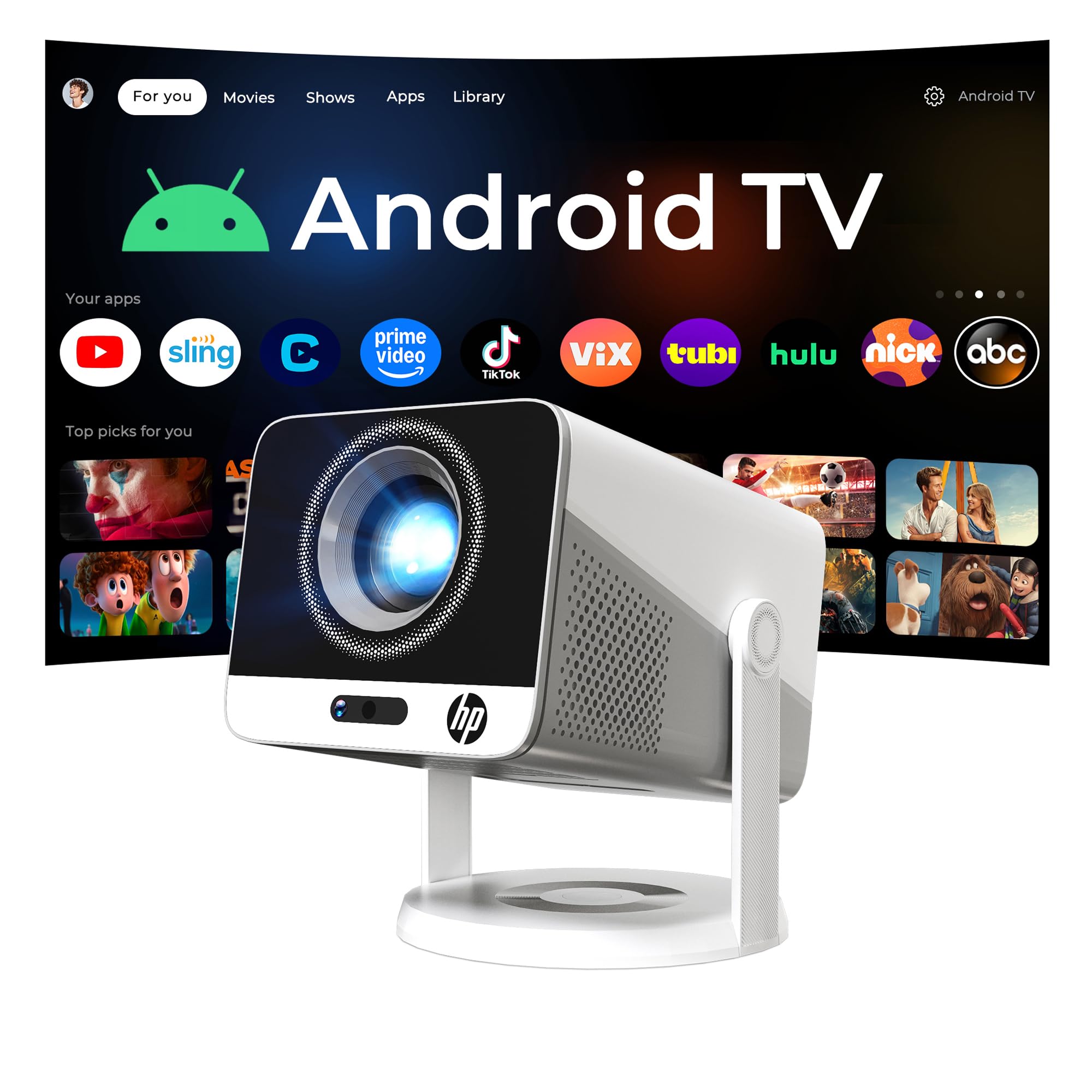
3. HP MC425 Projector with Apps
A camping projector that borrows power from the battery brick already in your bag.
The feature that changes how you use this projector is the USB-C PD 3.0 power input, rated at 20V / 3.25A. Plug it into a power bank rated 65W or higher and it runs off-grid, which turns a tent wall or a garage door into a screen. It draws 55W in operation, so a bank below 65W will not carry it — that is a hard floor, not a suggestion. The 90° rotating body lets you aim at a slanted ceiling or a wall with no extra stand.
Inside you get Android TV with Netflix, Prime Video, YouTube, Disney+, and Tubi preloaded, so casting from your iPhone is optional rather than mandatory. Auto focus and auto keystone square the picture in seconds, and the short-throw 0.8:1 ratio (a measure of how close the projector sits for a given screen size) means it can fill a wall from a short distance. The 200 ISO lumens and native 1080P FHD keep it a dim-room performer with 4K support on the input side.
HiFi dual stereo speakers with Hi-Res Audio cover the sound for casual nights, and Bluetooth 5.4 pairs headphones or a soundbar when you want more. Ports include USB-C, HDMI, and a 3.5mm headphone jack. The compromise worth naming: at 200 ISO lumens you are watching with the lights low, and the remote needs two AAA batteries that ship separately.
Why travelers like it: the power bank compatibility and 90° rotating lens make it the easiest unit here to set up somewhere without a wall outlet.
Where it stops: dim-room only, and it needs a 65W-or-higher bank to leave the house.
Pick this for: camping trips and bedside ceiling viewing where a power brick is your only outlet.
Not your unit if: you want a bright daytime picture or you only own a small power bank.
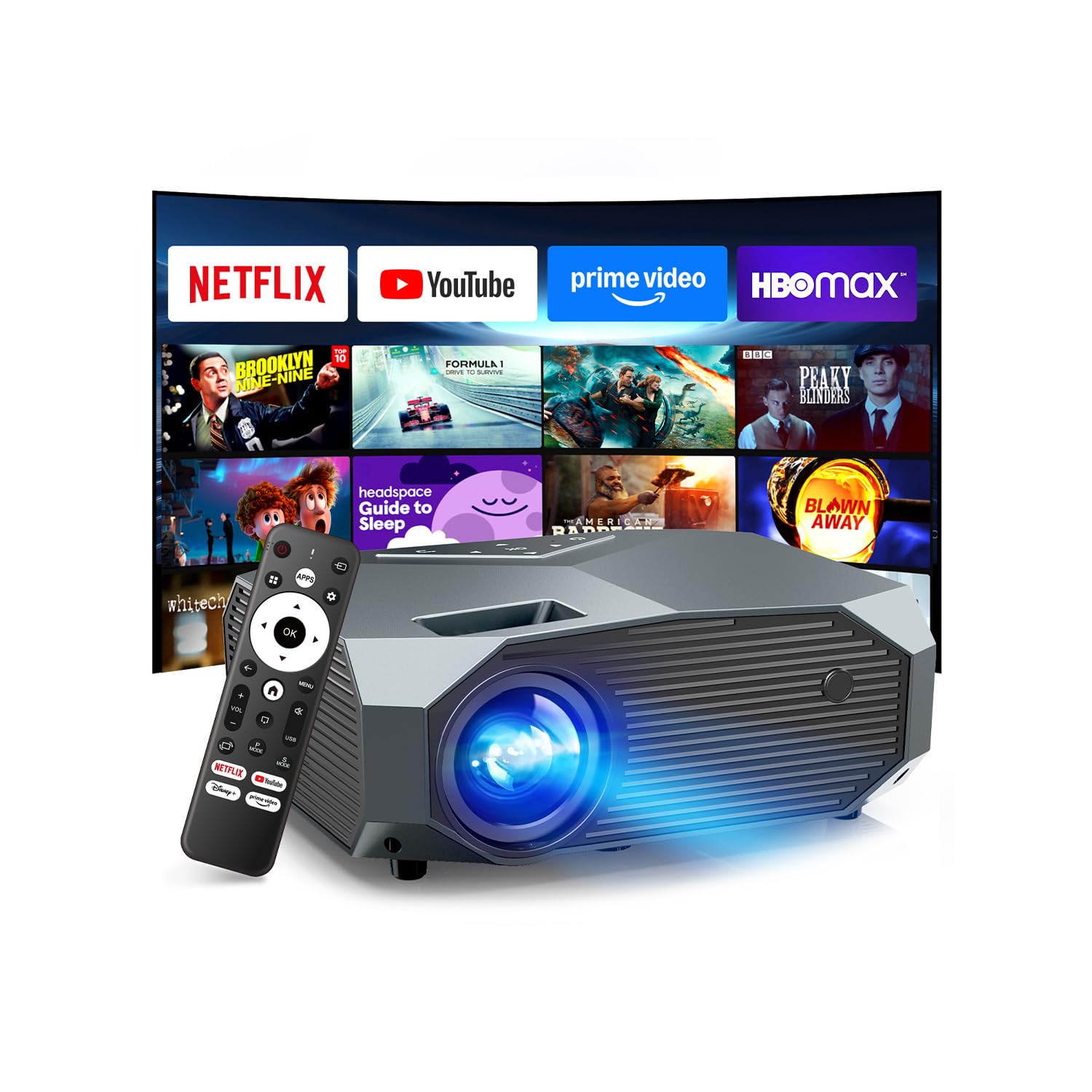
4. YOWHICK Smart Projector with WiFi 6
Four hundred inches of screen, and a zoom that resizes it without moving the box.
Big is the point here. The YOWHICK throws a display from 40 to 400 inches across a projection distance of 3.6 to 29 feet, so you can go from a bedroom wall to a full backyard sheet without swapping hardware. The 50%-100% zoom lets you shrink or grow the image from the remote — handy when the perfect throw distance does not land on a blank patch of wall.
Brightness sits at 350 lm with a 1000:1 contrast ratio and native 1920 x 1080 resolution, which puts it in the dim-room bracket but above the smallest mini units. Netflix, Prime Video, and YouTube are reachable through the home interface without a streaming stick, and it is HDCP 2.2 compliant for 4K HDR playback from compatible sources. Your iPhone connects over Wi-Fi 6 or 2.4G dual-band, and the built-in speaker plus Bluetooth 5.3 lets you push audio to a soundbar or use it as a speaker.
Setup relies on ±15° keystone correction and scaling, plus a sleep timer so it shuts itself off if you drift off. The trade-off is that this is not an auto-focus unit, so expect a manual focus step when you set up. It also needs a dark or dim room to look its best, like every projector in this brightness class.
The reason to buy: a 400-inch maximum screen and remote zoom give you more image-size freedom than any other pick in this lineup.
Set your expectations: 350 lm needs low light, and focus is manual rather than automatic.
Right for: backyard movie nights where maximum screen size is the goal.
Wrong for: a brightly lit living room or anyone who refuses to touch a focus dial.
5. Aurzen D1R air Roku TV Portable Projector
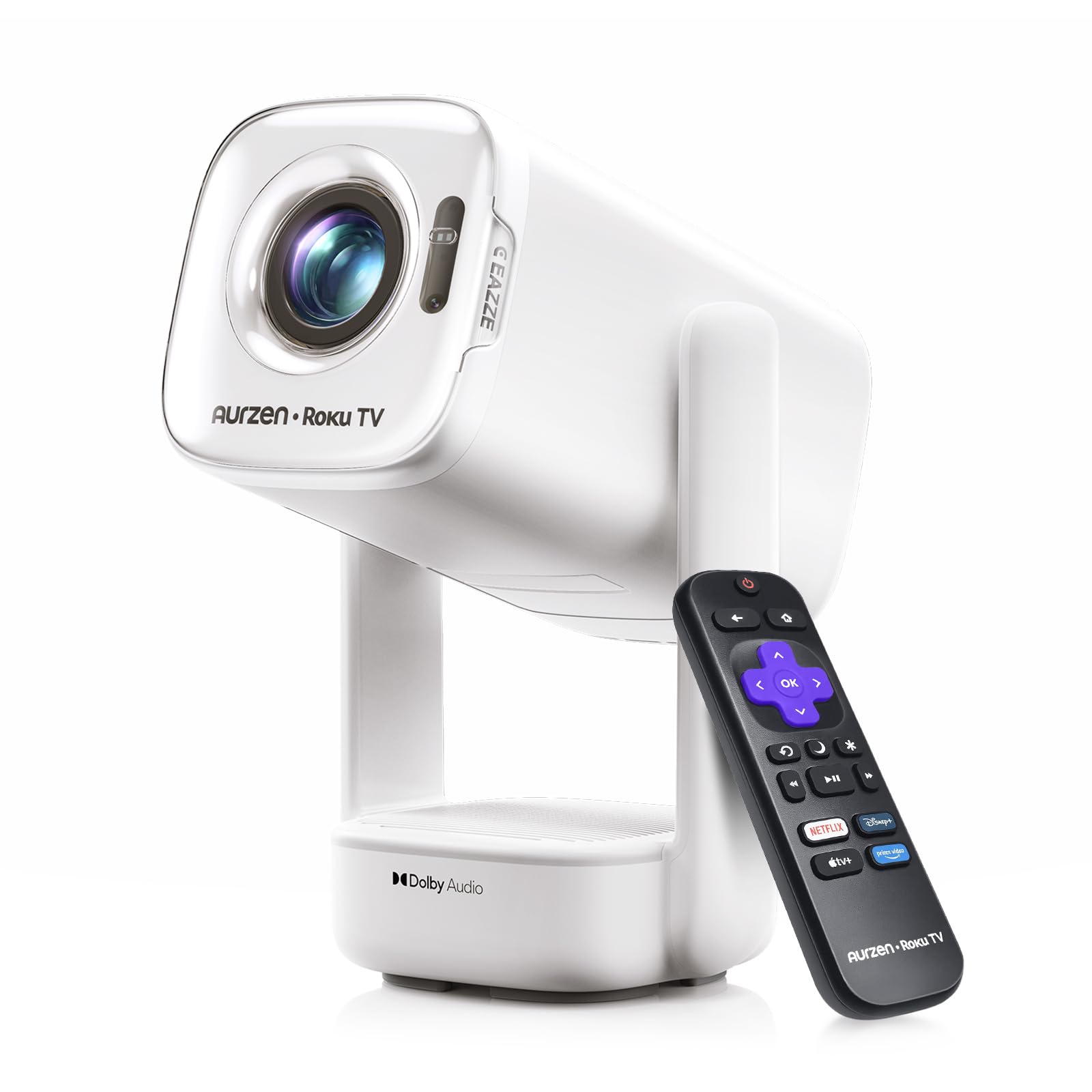
A gimbal stand and a bottom-mounted cable, so the ceiling shot actually works.
Ceiling projection is where most portable projectors fall apart: the cable sits on the side, catches the stand, and drags your careful aim off target. Aurzen solves it with a bottom power design that keeps the cable out of the rotation path, paired with a smooth-damping gimbal stand that holds its angle instead of sinking. Point it up at the ceiling above the bed and it stays there.
Native 1080P, 300 ANSI lumens, and six picture modes cover the picture, and the maker is transparent about use: dark or dim rooms, blackout shades for daytime, 80 inches at about 7.26 ft for the best image. ToF autofocus and auto keystone handle the setup. AirPlay mirroring plus built-in Apple TV means your iPhone connects through Apple’s own path, and the Roku TV system brings Netflix, Prime Video, Hulu, YouTube, and 500+ live channels. A Roku account and internet connection are required to activate, and creating one is free.
The dual 5W speakers sit in the base rather than the body, which gives them a larger chamber and cuts vibration. It weighs 1.18 kg (2.60 lb) and runs on a 65W+ USB-C PD source — a wall charger, laptop charger, or power bank — so it moves between rooms easily. The catch: there is no HDMI cable in the box, and the power source and E-Marker cable are not included either. Fan noise runs 29-35 dB at one meter depending on mode.
Why it earns a place
- Gimbal stand plus bottom cable routing is built for ceiling and wall angles
- AirPlay mirroring and built-in Apple TV suit an iPhone household
- Base-mounted 5W speakers with Dolby Audio reduce vibration noise
- 65W+ USB-C PD power lets it run from a bank or laptop charger
Before you commit
- No HDMI cable included, and the 65W+ power source is separate
- 300 ANSI lumens is a dark-room number
Suits you if: you watch from bed and want the picture on the ceiling.
Pass if: you expect a cable and charger in the box — neither is included.
6. Aurzen BOOM Air Google TV Portable Projector
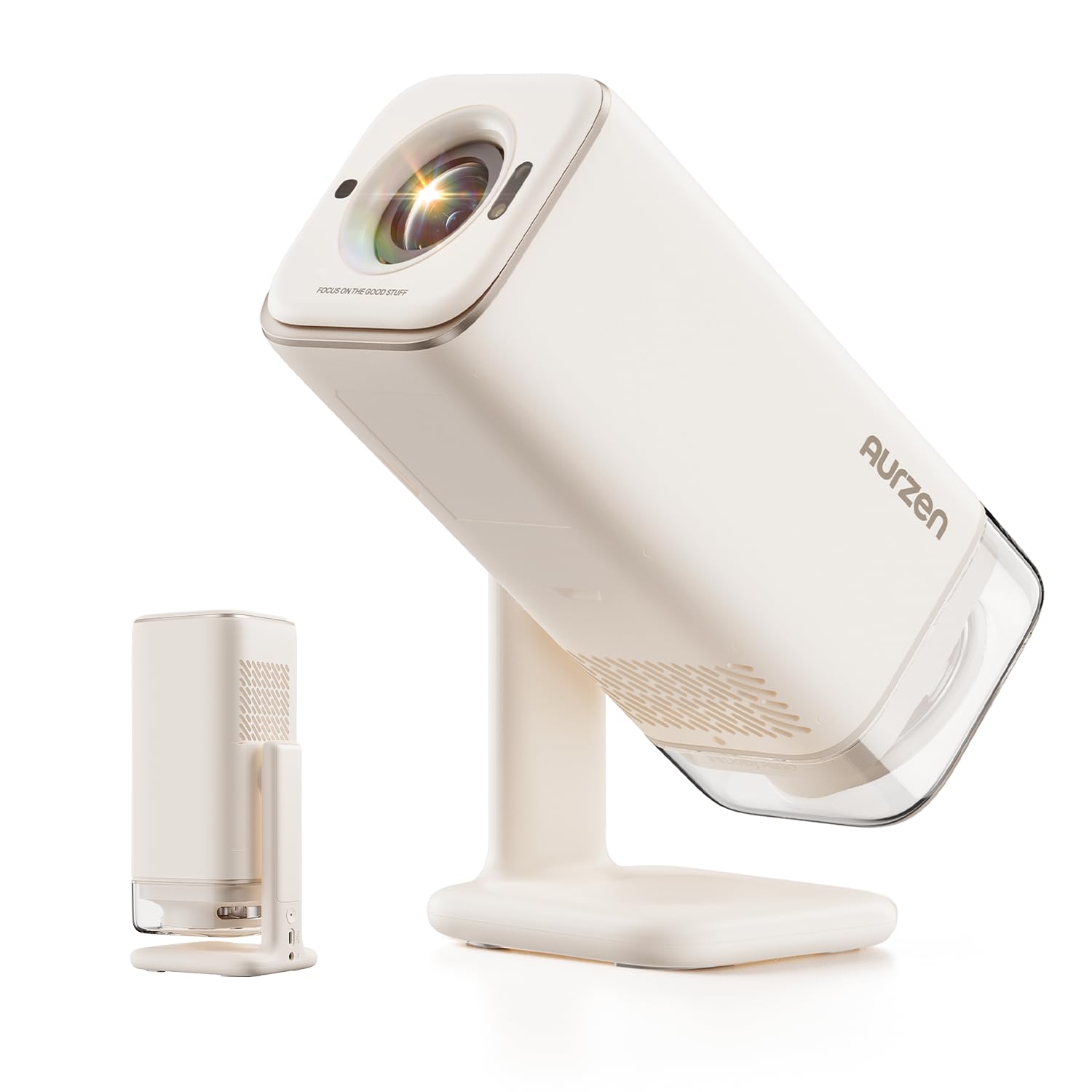
About the size of a water bottle, and it casts from an iPhone in a few taps.
This is the portable half of Aurzen’s lineup, and the sizing is the pitch: it is built to be as compact as an outdoor water bottle and runs on USB-C power with a 65W+ bank. Google TV is built in with 10,000+ apps including Netflix, YouTube, Prime Video, Hulu, HBO, Peacock, and essential+, so no dongle goes in your bag. For casting, it uses Google Cast to stream from Android, iOS, or a laptop — your iPhone mirrors through Google’s system rather than AirPlay.
The picture is native 1080P with HDR10 and 300 ANSI lumens, with a stated contrast of 500:1. It performs best in dim or moderately lit rooms, and 4K input needs an HDMI-connected device like a Fire TV Stick. Projection size runs 40 to 200 inches, and the maker recommends 5.58 ft for a 60-inch image. ToF real-time focus keeps the picture sharp as you move the unit, and the tilting gimbal stand aims it at a wall or ceiling.
Sound comes from visible 10W speakers with 360° Dolby Audio, which is a step up in cabinet volume from tiny built-ins. Google Voice control handles search and playback by voice, and a Kids Mode manages screen time with age-appropriate filters. What wins people over is the portability plus Google TV combination; the honest caveat is the 500:1 contrast, the lowest stated ratio on this list, so deep blacks are not its strength.
Carry-on friendly: bottle-sized body, USB-C power, and built-in Google TV mean one bag covers the whole setup.
Sound caveat: the 10W speakers are solid for a portable, but the contrast figure is modest, so dark scenes look flatter than on the WiMiUS or HAPPRUN units.
Reach for this if: you want Google TV and iPhone casting in a bag you can carry to a friend’s yard.
Leave it if: black-level depth is high on your list of priorities.
7. WiMiUS G1 Official Google TV Projector
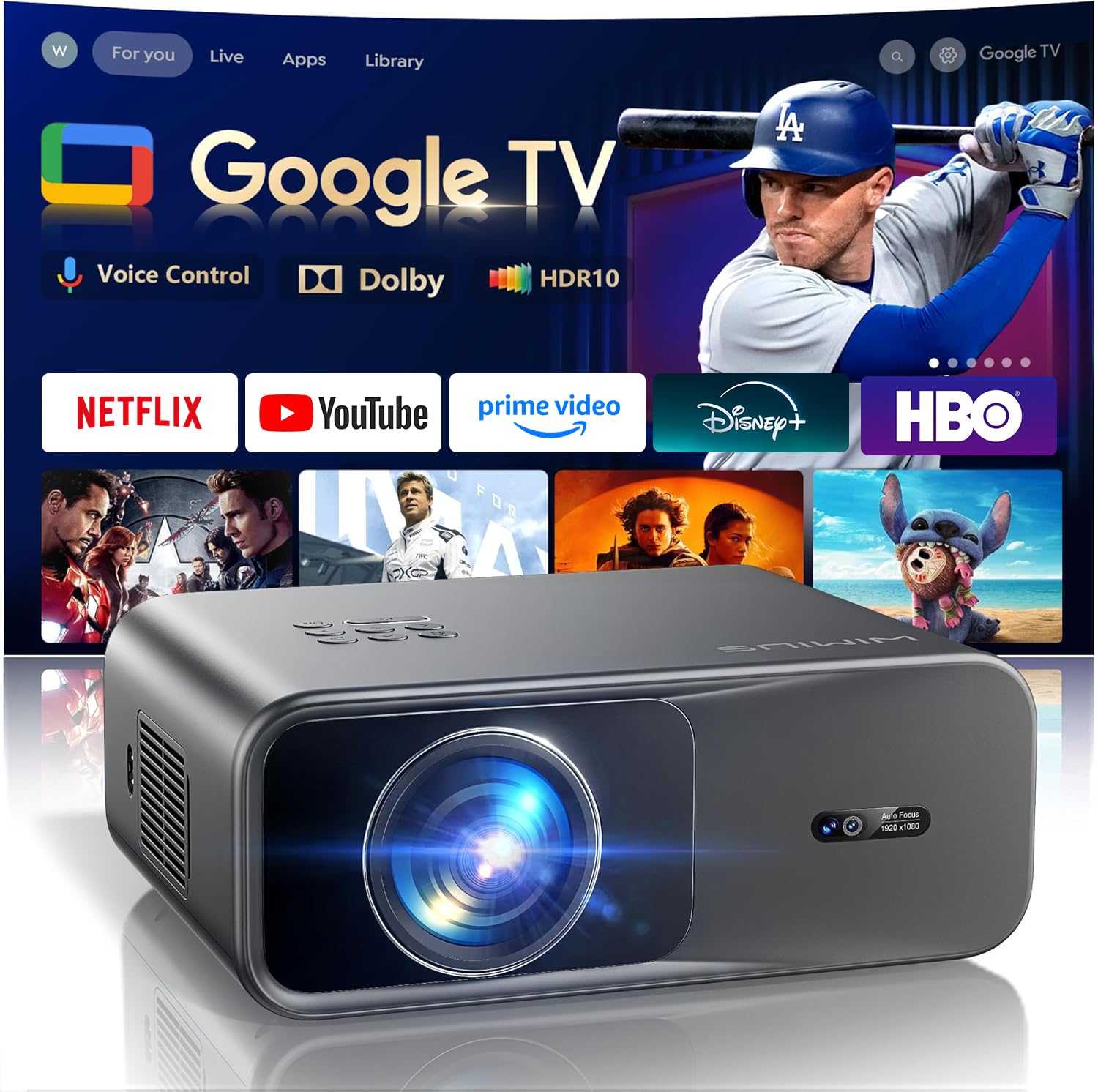
A 20,000:1 contrast ratio that keeps night scenes from washing out grey.
Contrast is the number that gives this projector its edge. It lists a 20000:1 ratio and 580 ANSI lumens, both well ahead of the 1000:1 units around it — higher contrast means deep blacks and brighter whites, so a dark movie scene keeps its detail instead of fading into grey. Native 1080P with 4K support and HDR10 round out the picture, with three brightness levels including a High Brightness mode and five picture presets. The maker is candid that it is best in dim or dark rooms and not built for daylight.
Google TV is fully integrated here — the licensed system, not a stripped version — pulling YouTube, Disney+, Prime Video, Plex, HBO Max, Peacock, Apple TV, and 800+ live channels onto one screen. Voice control handles search and volume, and the Google Home app lets you type with a phone keyboard. Casting from your iPhone works through the Google ecosystem, so mirroring and Google Photos both land on the wall.
Setup is the automatic kind: auto focus, auto keystone, obstacle avoidance, screen alignment, and 50%-100% zoom all run together. Dual 10W HiFi speakers with Dolby Audio total 20W, and two-way Bluetooth 5.2 lets the projector double as a speaker or pair with a soundbar over HDMI ARC/CEC. Multi-user profiles and a Kids Mode with screen-time limits suit a shared family unit. The one thing to plan for: the remote needs two AAA batteries, sold separately.
Strongest spec: 20000:1 contrast plus 580 ANSI lumens gives it the best-looking dark scenes of the Google TV picks.
Real-world note: dim-room only, and it is square and shelf-sized rather than pocket-portable.
The pick for: film fans who care about black levels and want Google TV without a dongle.
Not for: daylight viewing or anyone wanting to slip it into a jacket pocket.
8. HAPPRUN 2500 ANSI Google TV Outdoor Projector
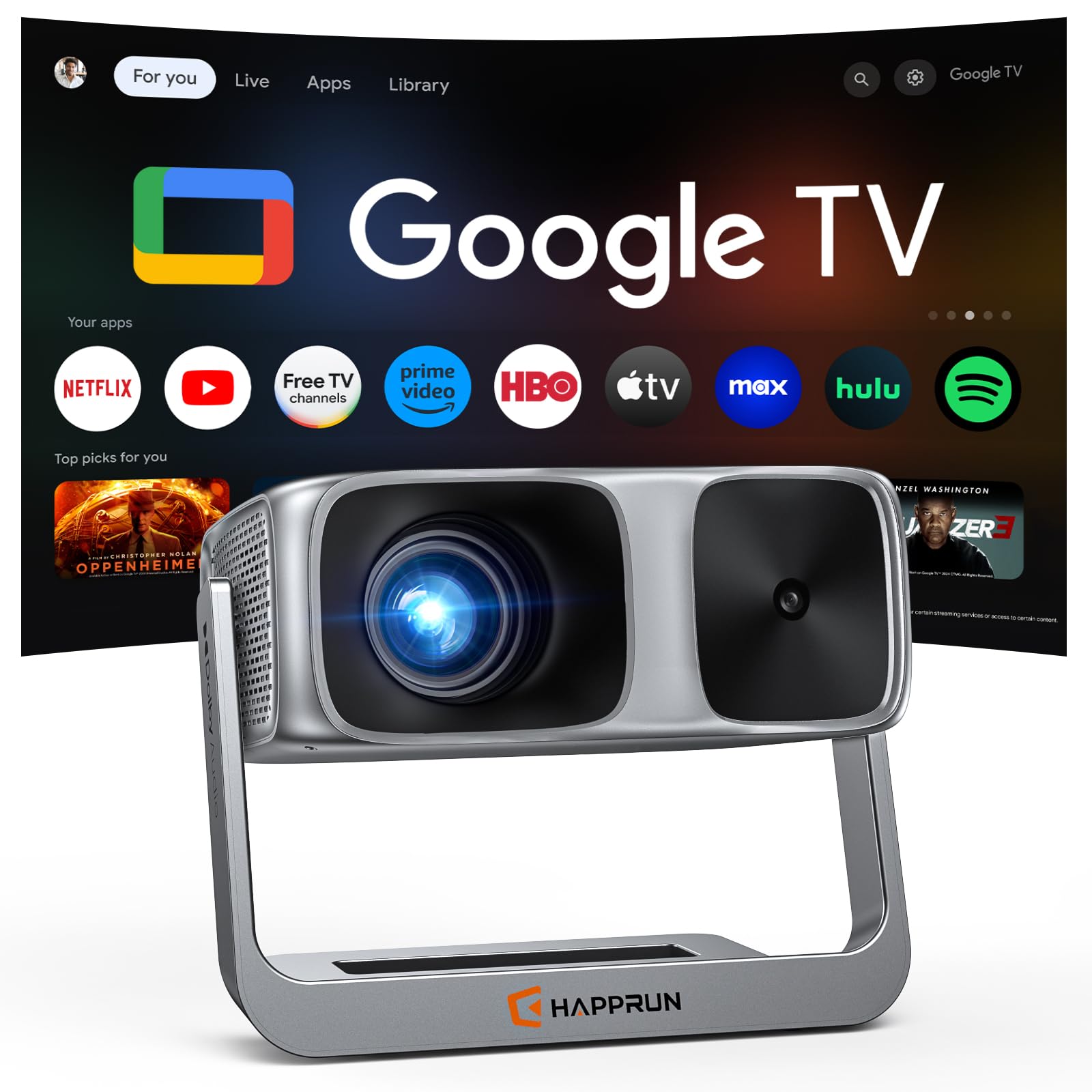
The only pick here that claims a picture with the lights on and in daylight.
Most projectors on this list ask you to lower the blinds. This one is rated 2500 ANSI lumens, the highest stated brightness in the group, and the maker positions it for images with the lights on or in daylight. Pair that with 4K decoding, a 20000:1 contrast ratio, a 95% color gamut, and HDR10+ support, and you get the sharpest, most colorful picture of the picks — the kind of brightness that holds up for an afternoon backyard party.
Google TV is built in with over 1,000 apps including Netflix, Prime Video, YouTube, and Hulu, so the streaming side is handled without a stick. Auto focus and 6D auto-keystone square a rectangular picture within 3S of startup, whether it sits on a table, a bedside stand, a wall mount, or a ceiling mount. One note from the maker: ceiling projection needs manual focus and keystone, so plan for a quick adjustment if you mount it overhead. Casting from your iPhone runs through the Google system.
An adjustable stand removes the need for a tripod, letting you aim at walls, ceilings, or a screen. The trade-off is weight and size — this is a desktop unit, not a pocket projector, so it earns its place on a shelf rather than in a backpack. For a family room or a backyard that needs real light output, though, it is the brightest answer here.
Why it stands out
- 2500 ANSI lumens is the top brightness figure on this list, aimed at daylight and lights-on viewing
- 4K decoding with a 20000:1 contrast ratio and 95% color gamut for rich color
- Auto focus and 6D keystone square the picture within 3S of startup
- Adjustable stand means no separate tripod to buy
What to plan around
- Desktop-sized, so it is not a carry-in-a-bag unit
- Ceiling projection needs manual focus and keystone
The right call for: a living room or backyard where the lights stay on and the picture must fight the glow.
Keep shopping if: you need something that travels in a backpack.
9. NEBULA Mars 3 Outdoor Portable Projector
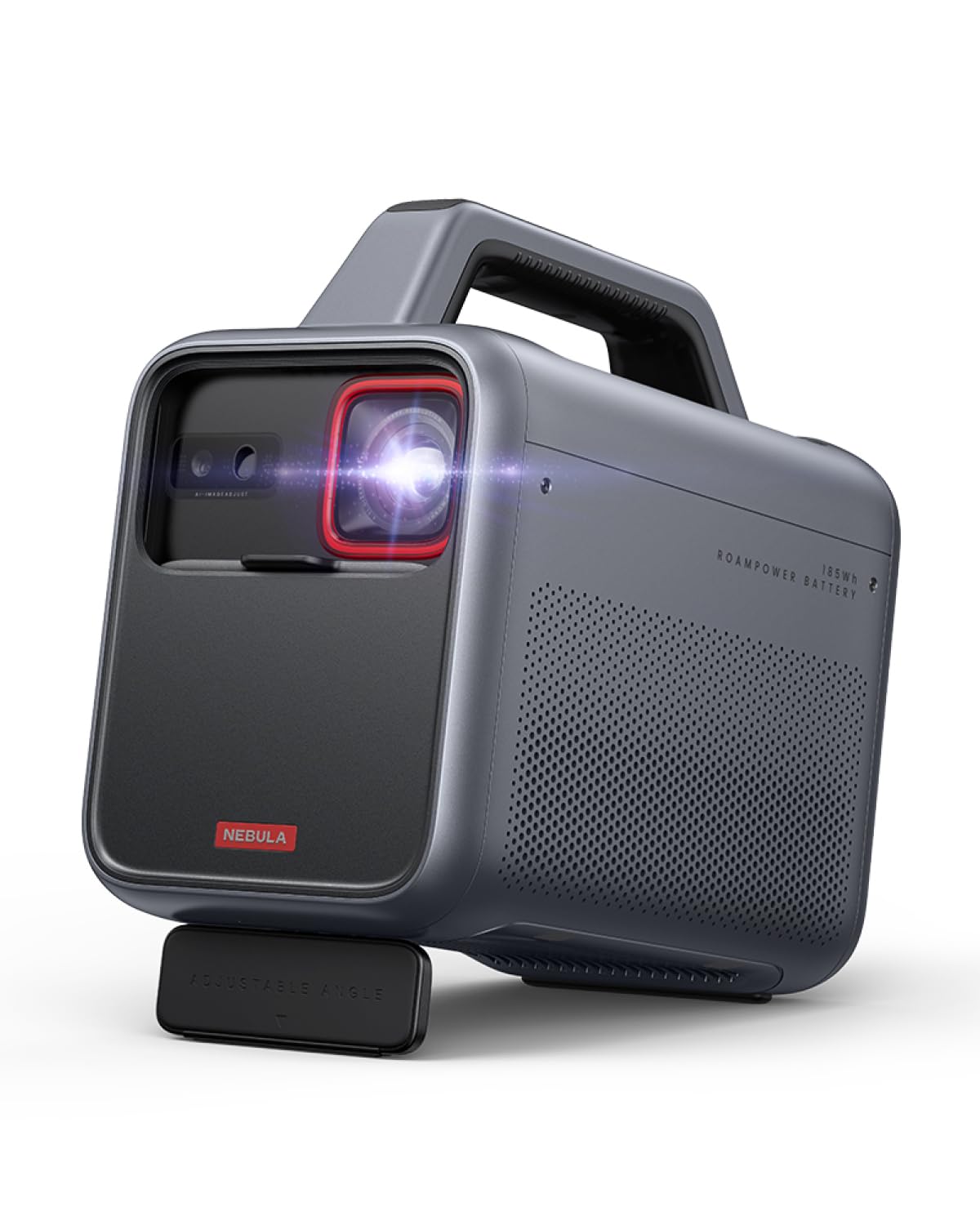
A projector with its own battery, built to survive a night in a field.
Every other pick here needs a wall outlet or a power bank. The Mars 3 carries its own 185Wh battery, which the maker rates for up to 5 hours of movies or 15 hours of music, and it doubles as a power bank for your phone. That is the difference between a camping trip with a movie and a camping trip without one, and it is the single spec that anchors this pick.
Outdoor survival is the second story: IPX3 water resistance (spray-resistant, not submersible), 0.5 m drop resistance, 0.7 mm dust resistance, a lens cover, a camping light, a carry handle, and a built-in stand. The picture is 1080p at 1000 ANSI lumens with a 200-inch maximum screen, and Android TV 11.0 brings 400,000+ movies and shows plus 7000+ apps, working with Chromecast and Google for casting from your iPhone. AI adjusts screen brightness automatically.
Audio comes from a built-in 40W speaker with Dolby Digital Plus. Setup uses Intelligent Environment Adaptation, where a sensor completes autofocus, keystone correction, and Screen Fit in about 3 seconds. The honest limit: the stated contrast is 400:1, the lowest ratio here, so dark scenes are its weak point, and it is a DLP unit (a chip-based display engine) that carries a premium-tier build. If portability and battery life lead your list, the trade-off is worth it.
Why it is the outdoor pick: the 185Wh battery, IPX3 rating, and drop resistance mean it works where there is no outlet and no shelter.
The honest trade-off: 400:1 contrast is the lowest on this list, so it favors bright outdoor scenes over moody dark ones.
Worth it for: campers and tailgaters who need the projector to power itself and survive the trip.
Overkill if: it lives on a shelf in a dark room — the WiMiUS G1 costs far less brightness-for-brightness on contrast.
10. HAPPRUN Roku TV Smart Mini Projector
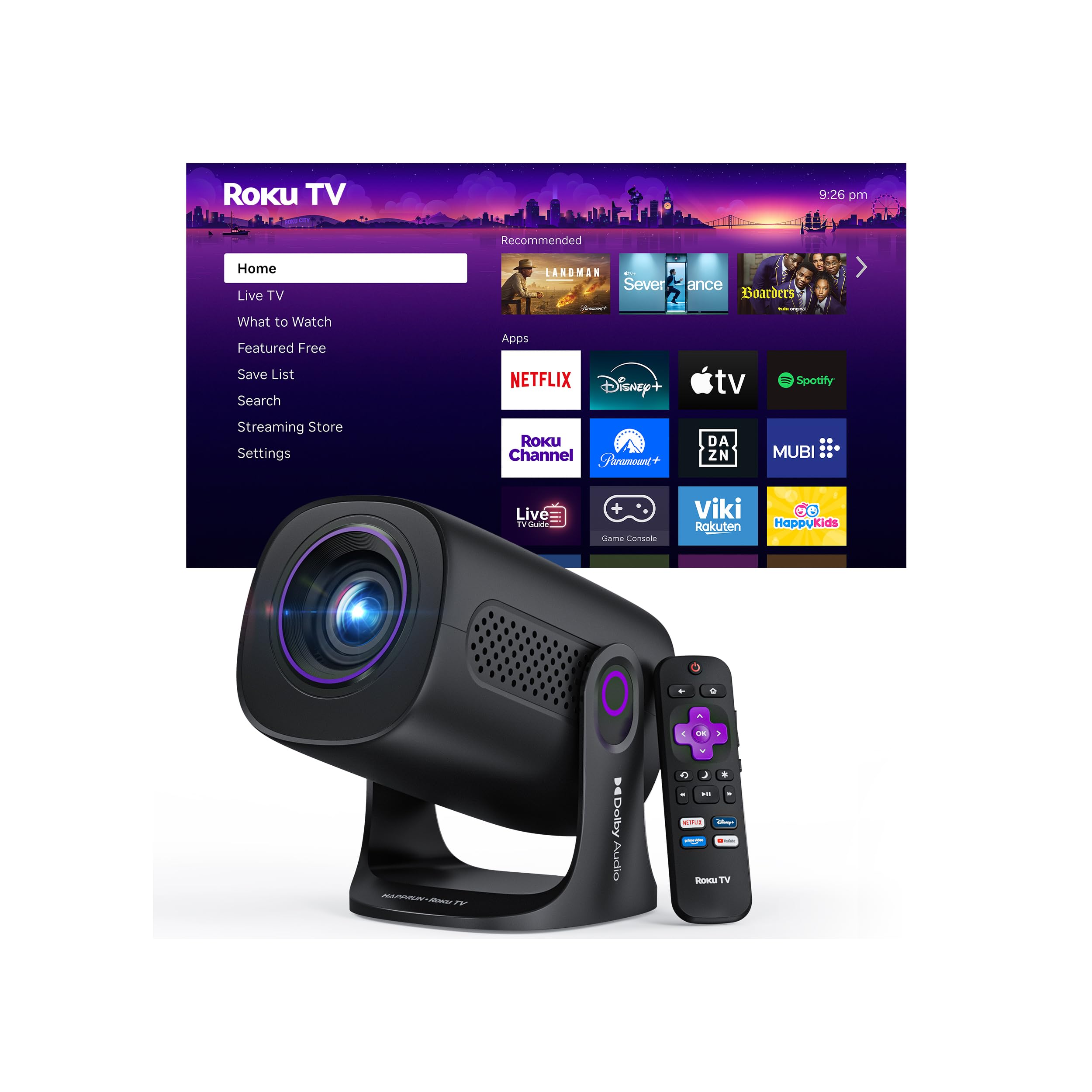
The entry point: Roku apps, a rotating stand, and a backpack-sized body.
For a first projector, the appeal is the price of entry plus the software. Roku Entertainment is built in with Netflix, Prime Video, Hulu, YouTube, the Roku Channel, and Apple TV already on the home screen, and Roku’s own channel carries 500+ free live channels. The maker also lists official Apple AirPlay and instant iOS casting, so your iPhone connects without an extra app. Roku smart features are supported in the U.S., Canada, and Mexico.
A built-in 270° rotatable stand lets you aim at a wall or a ceiling for bed viewing without a tripod, and the body is small enough for a backpack or suitcase — the spec sheet puts it at 5.94″L x 4.13″W x 5.2″H. Dual-band Wi-Fi on 2.4G and 5G keeps streaming steady, and two-way Bluetooth 5.2 pairs a speaker, soundbar, or headphones, or turns the projector into a music speaker. Dual stereo speakers with Dolby Audio cover the built-in sound.
The compromise is on the spec sheet: the display resolution maximum is listed as HD rather than 1080P, and the contrast ratio is 1800:1 — the lowest among the Roku picks, though above the Nebula. For a dark bedroom or a dorm room, that is a fair trade for the Roku app library and the tiny footprint.
Value read: Roku TV, AirPlay, and a 270° stand in a body you can pack — the essentials without the brightness or resolution of the premium picks.
Set expectations: HD display resolution and a 1800:1 contrast ratio mean it is a dim-room, casual-viewing unit.
Best for: a first projector, a dorm room, or a bedroom where Roku apps matter more than pixel count.
Step up if: you want native 1080P — the Boldever and Aurzen D1R cover that.
11. TMY 1080P Mini Projector with Netflix
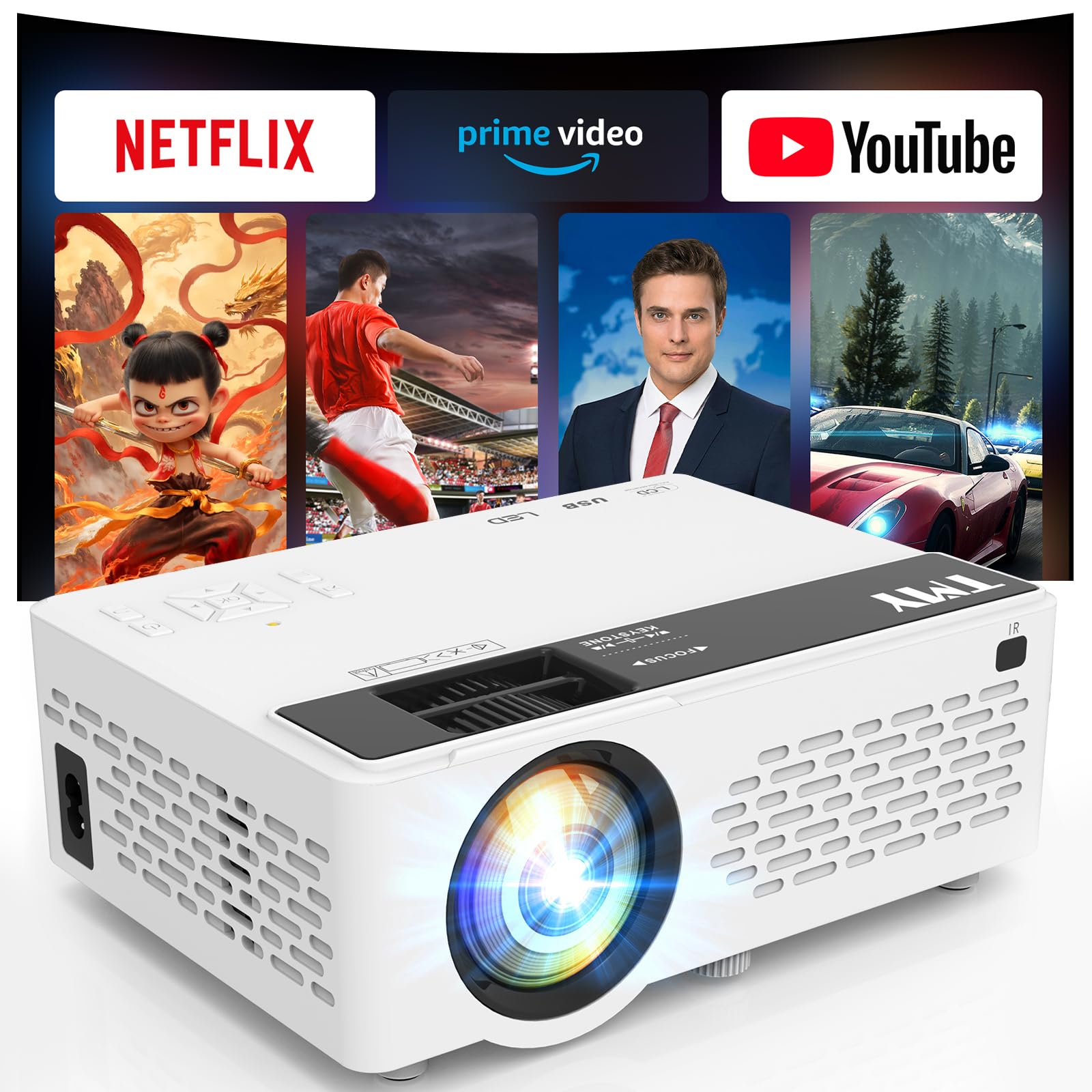
Apps already installed, mirroring in one tap, and a speaker to take to the yard.
The value case for the TMY is the app lineup sitting on the home screen. Netflix, Prime Video, and YouTube come pre-installed, so you connect to Wi-Fi and start watching without sideloading an APK or plugging in a streaming stick. Wi-Fi 6 handles the wireless side and the maker describes iOS and Android mirroring as a one-tap affair from your iPhone.
The image is native 1920 x 1080 across a 32-inch to 220-inch screen from 1.5-6m, with a 10000:1 contrast ratio and a lamp rated 10,000 hours. That contrast figure is well above the 1800:1 of the HAPPRUN Roku mini, so dark scenes hold more detail. Bluetooth 5.2 does double duty: pair a soundbar or headphones, or switch to Bluetooth Speaker Mode and use the projector as a standalone speaker for music and podcasts.
Physical ports — HDMI and USB — cover laptops, consoles, and USB drives without adapters. Honest sizing: brightness is 200 lm, so this is a dim-room viewer, and the maker notes no screen is included. Setup is basic and the app experience does not please every buyer, so treat it as a low-cost way to get apps and casting on a wall rather than a theater-grade picture.
Where it wins: a 10000:1 contrast ratio and pre-installed Netflix, Prime Video, and YouTube at the bottom of this list’s price tier.
Where it is thin: 200 lm brightness and a basic, no-frills setup mean low-light use only.
Good fit for: a first projector on a tight budget, or a second unit for a spare room.
Skip if: you need a bright picture or a polished app experience.
Know the Specs
ANSI Lumens and ISO Lumens
These are two ways of measuring how much light the projector actually throws, and a higher number means you can watch with more room light on. A unit around 200 to 300 lumens, like the Boldever or Aurzen D1R, is built for a dim or dark room. A 1200-lumen projector such as the LYNCAST handles some ambient light, and the 2500 ANSI lumen HAPPRUN is the pick for daylight. ISO lumens use a different measurement standard from ANSI, so do not read a 200 ISO lumen figure as directly equal to a 200 ANSI lumen figure.
AirPlay, Google Cast, and Built-In Smart TV
AirPlay is Apple’s own mirroring standard, and it works natively from an iPhone — the Boldever and Aurzen D1R both list official AirPlay support. Google Cast is Google’s equivalent, used by the Google TV picks like the BOOM Air, WiMiUS G1, and HAPPRUN 2500. Roku TV and Google TV systems also mean the projector streams on its own once set up, so your phone becomes optional. Check which casting method your pick supports before you buy, because an iPhone mirrors most cleanly through AirPlay.
Native 1080P Versus 4K Supported
Native 1080P means the projector’s panel really draws 1920 x 1080 pixels, which keeps text and menus sharp. A “4K supported” or “4K decoding” label means the projector accepts a higher-resolution signal and displays it at the panel’s own resolution. For iPhone mirroring, the native resolution is what you see, so a true 1080P panel such as the Boldever’s beats a “4K supported” claim with a lower native panel.
USB-C Power and Built-In Batteries
Some portables run off USB-C PD power from a bank or charger instead of a wall outlet. The HP MC425 and Aurzen projectors need a 65W-or-higher USB-C PD source to operate away from a socket. The NEBULA Mars 3 takes a different route with a built-in 185Wh batteryrated for up to 5 hours of movies. A built-in battery means no cord at all; USB-C power still needs the right brick and cable.
Common Questions
Will a wireless projector connect to my iPhone without a cable?
Do I need an Apple TV or a dongle to mirror from my iPhone?
How bright does a projector need to be to watch during the day?
What is the difference between native 1080P and 4K supported?
Can a portable projector run off a power bank?
How long does the lamp in these projectors last?
Is the WiMiUS G1 or the BOOM Air better for dark-room movies?
Do these projectors need a screen or can I use a blank wall?
Can I project onto the ceiling for bed viewing?
Will the built-in speakers be loud enough or do I need a soundbar?
The Bottom Line
For most people, the wireless projector for iphone that gets the balance right is the LYNCAST 1200 ANSI Google TV Projector, because it pairs the brightest picture in the mid-range with Wi-Fi 6 mirroring, licensed Google TV, and dual 36W Dolby speakers in one box. If Apple’s own mirroring is what you want, the Boldever Roku TV Mini builds official AirPlay in and focuses in under 2 seconds. And for a night with no outlet at all, the NEBULA Mars 3 carries its own 185Wh battery and shrugs off a little weather.
One nudge worth acting on: the LYNCAST holds the highest rating of any pick here at 4.5+ stars across 400+ owners, the strongest signal that its 1200 ANSI lumens holds up in real rooms rather than just on the spec sheet. Whichever you choose, match the ANSI lumens to your room first and the casting method to your iPhone second.
How we choose
We do not accept paid placement. Every pick is matched to a real buyer and a real use-case; we do not hands-on test units.
Sources
Specifications: manufacturer listings and product documentation. Review insights: verified customer reviews, as of November 2026. Pricing: not shown on this page (it changes often); check the current price via the retailer link.
As an Amazon Associate, Tactical Gear Guy earns from qualifying purchases. This does not affect which products we feature.