Specs are compiled from manufacturer listings and verified buyer reviews and can change over time — please confirm the key details on the product page before buying.
Wet gear ruins trips in a specific, annoying way: your spare clothes get damp through a bag that only claims to be waterproof, and everything smells like river by day two. The fix is simple — you want a bag with a genuine roll-top seal and thick coated fabric, not a zippered duffel with a rain cover. This guide ranks nine bags by how well they actually seal, how much they hold, and how they carry when full.
This guide is built by comparing the manufacturers’ published specifications and the patterns across verified customer reviews, so you get each pick’s real strengths and trade-offs instead of marketing spin.
Ilex sorted these by sealed closure type, fabric weight in denier, and real carry options, then matched each one to the trip it suits. Here is how each wet weather bag holds up once the rain starts and the deck is slick.
Top Picks


How To Choose The Best Wet Weather Bag
Most people buy a bag that looks waterproof and then find out on the water that it is only water-resistant. The difference costs you a phone or a dry sleeping bag. Focus on three things: how the top closes, what the fabric is, and how many liters you actually need.
The closure decides everything
A roll-top seal works by folding the fabric over itself several times and clipping it shut with a buckle. Each fold creates another barrier, so water has to travel a long way to get in. A zipper, even a coated one, gives water a straight path along the teeth. Bags that use a roll-top with side clips seal more reliably than zippered bags in heavy rain, and that is the single most important choice you will make. Roll the top at least three times before you buckle it.
Fabric weight and why denier matters
Denier is a measure of how thick and heavy the fabric threads are, so a higher number means a tougher, more puncture-resistant shell. 500D PVC (a tough vinyl-coated fabric) is the standard for bags that get dragged over rocks, laid on boat decks, and stuffed into truck beds. Thin nylon packs down smaller but gives up abrasion resistance — fine for a dayhike splash bag, less fine for a river trip with gear you care about. Look for welded seams over stitched seams, since stitching creates tiny needle holes in otherwise waterproof fabric.
Capacity, straps, and the carry question
Litres tell you roughly how much gear fits: think 5L to 20L for a phone, wallet, and a layer; 30L to 55L for a full day of clothes plus a towel; and 60L and up for multi-day or group gear. Beyond the number, look at how the bag carries. A shoulder strap works for a short walk to the launch. A padded backpack harness with a sternum strap makes a difference when you are carrying it a mile to camp with the bag fully loaded.
Side-by-Side Comparison
| Model | Best For | Capacity | Fabric | Weight | Amazon |
|---|---|---|---|---|---|
| Earth Pak Waterproof Dry Bag with Phone Case★ Best Overall | All-around kayak and beach days | 20 liters | 500D PVC | 1.1 pounds | Amazon |
| Osprey Ultralight Waterproof Dry SackFeatherweight Choice | Packing small dayhike essentials | 6 liters | Nylon | 1.12 ounces | Amazon |
| Pelican Exodry Waterproof Dry BagBest Visibility | Splash protection with reflective visibility | 10L / 20L / 30L | — | — | Amazon |
| MIER Roll Top Floating Dry Backpack | Commuting and wet-weather carry | 30 liters | TPU | 2 pounds | Amazon |
| LANEDO 80L Dry Duffel | Group gear and long expeditions | 80 liters | PVC | 1.71 kg | Amazon |
| OSAH DRYPAK Waterproof Backpack | Multi-day hikes with a full harness | 35L / 55L / 85L | 500D PVC | 1.54 kg | Amazon |
| Malo’o Waterproof Dry Duffel | Molle-ready marine duffel | 40 liters | 500D PVC | 2.4 pounds | Amazon |
| Haimont IPX7 Dry Duffel Backpack | Submersible-grade duffel packing | 60 liters | 500D Tarpaulin | 2.5 pounds | Amazon |
| Skog Å Kust Duffelsak | Heavy-duty gear hauling in any weather | 40 liters | 500D PVC | 2.1 pounds | Amazon |
Detailed Reviews
1. Earth Pak Waterproof Dry Bag with Phone Case
Our pick — 4.5+★ from 33,000+ verified ratings; the strongest balance of quality and price.
Thick 500D PVC, a roll-top buckle seal, and a waterproof phone case thrown in — the crowd favorite for good reason.
The bag that wins people over here is the shell itself: 500D PVC (a heavy coated fabric that shrugs off scrapes against rock and deck) wrapped around a roll-top closure you buckle down tight. Buyers report the 500D PVC shell shows no wear after a full paddling season, and gear stays dry even after a dunking at the put-in. At 1.1 pounds and 20 liters, it is the size that handles a change of clothes, a towel, and a lunch without becoming a burden to carry to the water.
What seals the deal for paddlers is the included IPX8 phone case — that rating means it is built to survive being submerged in water, and it fits phones up to 6.5 inches with dual clear windows so you can shoot photos from the kayak without pulling the phone out. Strap options scale by size too: the 10L and 20L add a 24 to 42 inch adjustable shoulder strap, while bigger versions step up to backpack-style straps with a sternum strap. For boats, beaches, and rafting, this 20L 500D PVC bag is the one owners rate highest.
The catch is the fabric’s thickness cuts both ways. The 500D PVC is what makes it tough, but it does not roll down as small as the thin nylon packs, so it takes up more room in a kayak hatch or a suitcase. And note the strap difference between sizes — if you want to carry a full load on your back, you need to be in the 30L or larger.
What earns its keep
- 500D PVC shell resists abrasion on rocks and decks
- IPX8 waterproof phone case fits phones up to 6.5 inches
- Sizes from 5L to 55L, with backpack straps on 30L and up
- 1.1 pounds — easy to stuff into a hatch or trunk
Where it asks for care
- Thicker PVC packs down larger than thin nylon sacks
- Shoulder-only strap on the 10L and 20L sizes
Grab this one if: you paddle, raft, or hit the beach and want one tough bag that keeps a phone dry and doubles as a day pack.
Size up if: you plan to carry it on your back — the backpack harness only kicks in at 30L and above.
2. Osprey Ultralight Waterproof Dry Sack
At 1.12 ounces and 6 liters, this one disappears into a daypack until the sky opens.
The spec that matters is the weight: 1.12 ounces, light enough that you forget it is in your pack until you need it. It is a 6 liter sack — the size for a fleece, a phone, and a set of keys on a dayhike, not for hauling camp gear. The rectangular shape packs more efficiently than a round sack does, so it slides into a pack without leaving dead space around it. Nylon construction with waterproof-coating on the fabric and seams, sealed by a roll-top closure.
Here is the honest comparison: that 6 liters puts it well behind the 80L duffel on our list for sheer capacity, and that is exactly the point. This is not a gear hauler — it is a dry layer of protection for the essentials you carry on foot. It is rated IPX5, which means it handles splashes and rain without letting water in but is not built to be submerged. The description is blunt about that: waterproof, non-submersible. For a dayhike or a quick dip where the bag tips into the shallows for a moment, that is fine. If you plan to swim with your pack or run a river where gear gets swamped, you want a higher-rated bag.
Owners like how versatile the 1.12-ounce nylon sack feels, with a D-ring for clipping or hanging to dry and a build that holds up to repeated packing. The consistent gripe is on the water-resistance end: it is a splash guard, not a submersible vault. Treat it as the essential-layer sack in your pack and it delivers every time.
Best for minimalists: hikers and day-trippers who want a nearly weightless safety net for phone, wallet, and a warm layer.
Know the limit: the IPX5 non-submersible rating means splashes and rain are fine, but a swamped canoe is asking too much.
Reach for it when: saving every ounce counts and you just need your essentials to survive rain and spray.
Look elsewhere if: your trips involve gear getting fully dunked or you need to pack a weekend’s worth of clothes.
3. Pelican Exodry Waterproof Dry Bag
A reflective dry bag with padded backpack straps — built for hands-free hauling and being seen after dark.
Pelican’s Exodry covers the water-sports bases in 10L, 20L, or 30L sizes, and the parts that matter for carrying are already on it: two padded backpack straps let you go hands-free over long distances, so you are not one-arming a wet bag up the beach. Integrated buckles and loops make it easy to clip the bag to a boat or a pack, and the reflective exterior is the detail that earns its spot here — it picks up light so you are easier to spot in low light or on the water after dark.
A water-resistant front pocket gives you quick access to small items, though it is not the place for anything that has to stay dry — the manufacturer points you to the main compartment for that. The 20L version carries dimensions of 9 inches by 9 inches by 24 inches and weighs 1.2 pounds per the maker’s comparison chart. Owners consistently confirm the roll-top seal keeps gear dry, with no water getting inside. For kayaking, fishing, and hiking, it fits a change of clothes, a towel, a phone, and a wallet without crowding.
The trade-off is organization rather than protection. The front pocket is splash-resistant at best, so you end up consolidating important items in the main roll-top compartment and digging around for them. If you like quick-access compartments for keys and snacks, this bag asks you to pack deliberately instead.
Worth picking for: kayakers and anglers who want to carry gear on their back and stay visible on evening paddles or near boat traffic.
Think twice if: you rely on exterior pockets for important items — the front pocket is water-resistant, not watertight.
4. MIER Roll Top Floating Dry Backpack
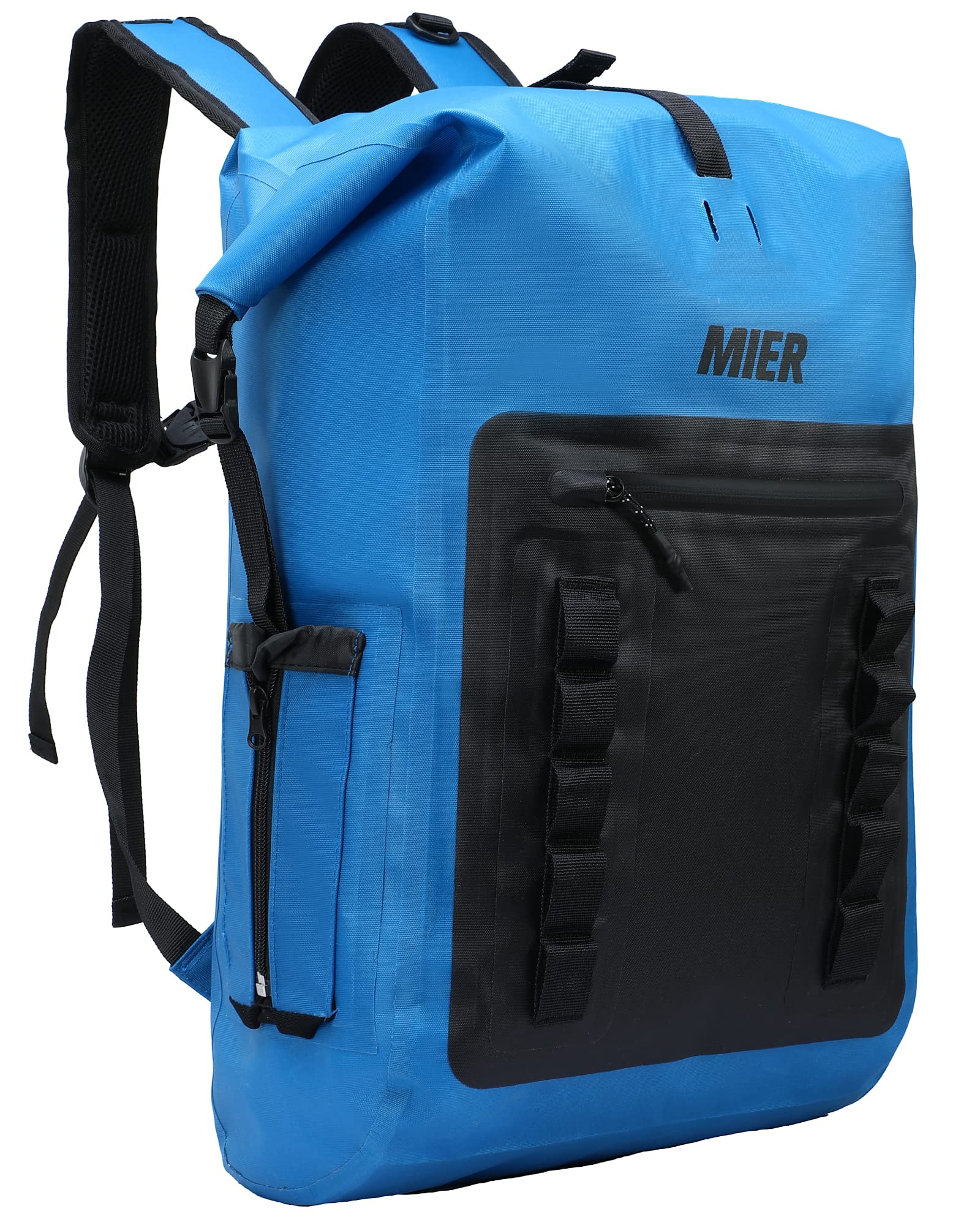
A 30L TPU dry pack that floats, carries a laptop, and looks enough like a normal daypack to wear off the water.
Most dry bags look like dry bags. This one is a dry backpack, and that is its entire appeal. It holds a laptop, iPad, lunch, mask, bike lock, and notebook, so you can commute, bike, or hike in the rain without switching bags at the trailhead. The 30L main compartment is 100 percent waterproof, sealed by the roll-top closure in TPU fabric (a flexible, fully weldable material that resists water). And it floats — if it goes overboard, it does not sink to the bottom.
Where owners give it marks off is durability and long-term water resistance, both of which land in mixed territory. That is a fair warning for a TPU pack: it is not the same heavy 500D PVC shell as the Earth Pak, so a hard scrape against a rock is where you want to baby it. It is also heavier than the ultralight sack at 2 pounds — the price of a full pack shape with straps and compartments. Neither of those is a dealbreaker for most people, but if you are hard on gear, the thicker-shell bags above take more abuse.
The straightforward note from the maker is the front pocket: it is only splash-proof, so keep valuables in the main compartment. Pack that way and the bag lives up to what people like about it — good looks, sensible size, and dry gear on a wet ride.
The reason to pick it: a real backpack silhouette with a fully waterproof 30L main compartment, so it works for a rainy commute as well as a paddle.
The one caveat: TPU is not as abrasion-tough as thick PVC, and the front pocket is splash-proof only.
This is your bag if: you bike or commute in wet weather and want one pack that keeps a laptop dry and floats if it drops.
Pass on it if: you drag gear over rocks — the TPU shell wants more care than a heavy PVC duffel.
5. LANEDO 80L Dry Duffel
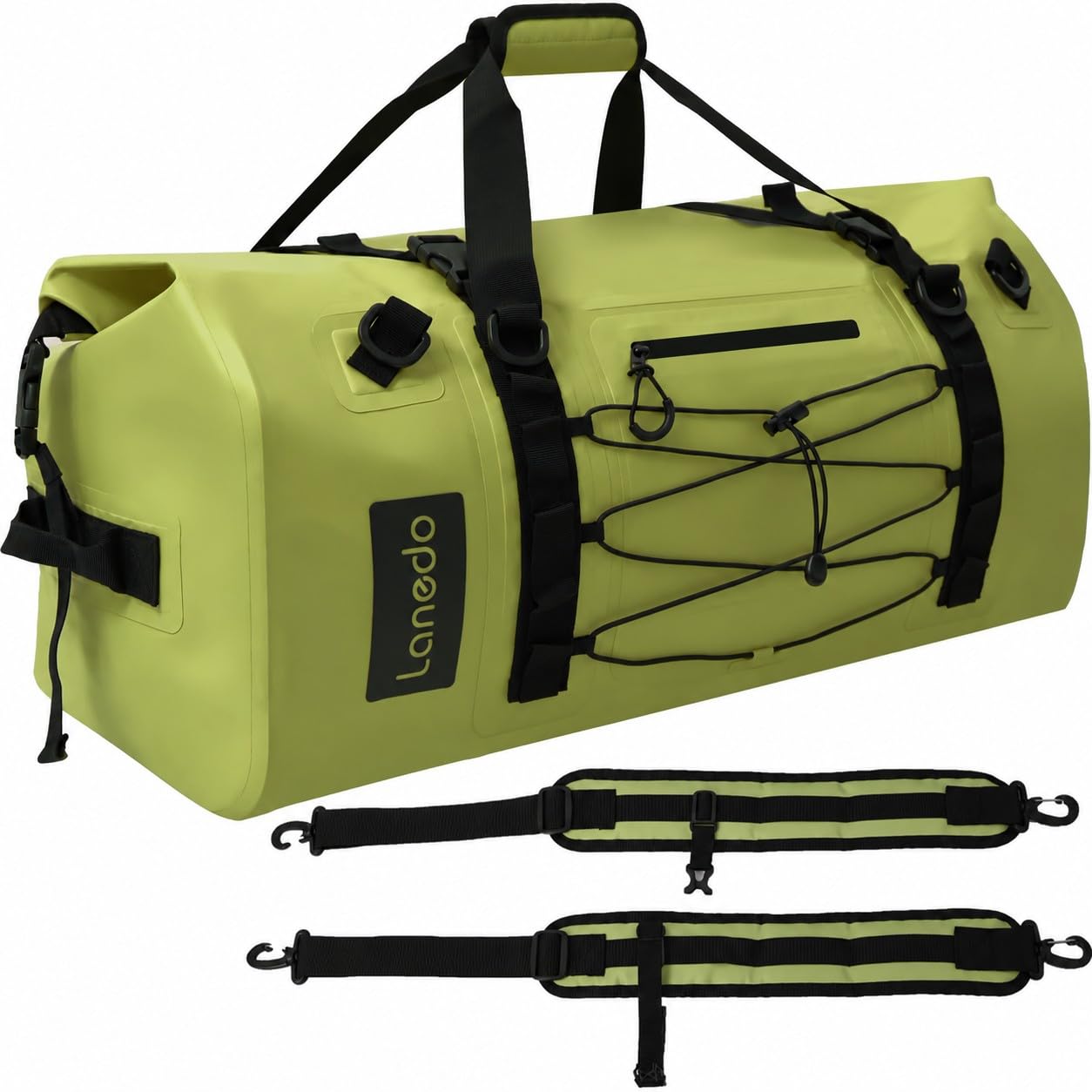
Eighty liters of PVC space — the bag that swallows a weekend’s worth of gear for the whole group.
Start with the number: 80 liters. That is the 80 liters against the 6 liter Osprey sack on this list, and it changes what the bag is for. This is not a personal dry bag; it is the hauler for a canoe camping trip, a Boy Scout weekend, or a family beach day. Three compartments — an external zipper pocket, a separate interior pocket, and the main compartment — let you separate wet towels from dry clothes instead of dumping everything in one pit. Built-in drainage outlets let water that gets in escape, and the Velcro-assisted roll-top with buckle straps seals quickly even when your hands are cold and wet.
Carrying options are what sell this one: side straps for two-handed lifting, a top handle for short carries, and adjustable straps for cross-body or shoulder wear. Owners praise the strong seams and strap attachment points, which keep the 80L PVC shell from splitting when you load it to the top. For kayak camping and group trips it earns its keep.
Here is what you give up: this bag has no backpack harness, so a long carry to camp means shouldering it or sharing the load. At 1.71 kg it is manageable, but you feel it when loaded with 80 liters of wet gear. And an 80L duffel takes up real space — this is the bag you leave at base camp, not the one you stuff in a daypack.
Wins on volume and build
- 80L of PVC space for group or multi-day gear
- Three compartments, including interior and exterior pockets
- Drainage outlets, side straps, top handle, and shoulder strap
- Strong seams and strap attachment points hold up under load
Where it stops short
- No backpack harness — long carries mean shouldering it
- Very large footprint once packed
Load it up if: you need to move a trip’s worth of gear for two or more people on a canoe, raft, or camp.
Leave it home if: you are carrying on your back for miles — there is no harness here.
6. OSAH DRYPAK Waterproof Backpack

The trail-ready waterproof pack: welded 500D PVC, a chest belt with a safety whistle, and space up to 85 liters.
Picture the mile between the landing and the campsite, with your dry bag full and the trail getting steep. That mile is where this pack earns its premium position. The 500D PVC shell is high-frequency welded at the seams, which means no stitching to leak, and the harness has ergonomic shoulder straps, breathable back padding, and a chest belt with a safety whistle for balanced weight distribution. It comes in 35L, 55L, or 85L, so you can pick your trip length and not overshoot.
The storage layout is more thought-out than most dry bags: inner zip pockets, side mesh bottle holders, a splash-proof front pocket, and elastic bungee cords for a jacket. A reflective strip adds visibility, and there are D-rings plus a carabiner hook for clipping gear. Owners find the welded 500D PVC pack roomy and tough, with two large pockets and enough space to pack a trip.
Two honest notes from the field. First, water resistance is mixed in reports — some find it excellent, while others say the top does not seal as tightly as they expect. That points at the closure rather than the fabric, so learn the roll-top properly and do not leave it half-sealed. Second, the front pocket is splash-proof only, so keep critical items in the main compartment.
Perfect match for: hikers and kayakers who carry their gear a real distance and want a proper harness with ventilation and a whistle.
Note first: the roll-top needs to be closed deliberately — reports on water resistance are split, so seal it fully every time.
7. Malo’o Waterproof Dry Duffel

IPX6 rated, welded at every seam, and ringed with Molle loops — a duffel built for gear-heavy boat and camp trips.
The number to note here is IPX6. That rating means the bag is built to handle powerful water jets — think spray off a boat bow or a heavy rain on a deck — which is a step above the splash protection of a basic sack. DryCore construction seals it: 500D PVC with high-frequency welded seams and a roll-top closure, sized at 40 liters for daily trips, with 60L for weekends and 100L for expeditions. Four compartments plus interior and exterior zip pockets keep your gear sorted, and dual handles with a padded shoulder strap make it carryable fully loaded.
The Molle loops (the horizontal webbing straps meant for attaching pouches) are the detail that stands out on a wet-weather bag — you can clip a small pouch or tool to the outside instead of digging through the main compartment. Six color options (black, gray, blue, orange, green, yellow) mean you can go high-visibility or blend in. It carries a two-year warranty from the maker.
Here is the trade-off, and it is worth knowing before you buy: water resistance is mixed in reports. Some owners say it keeps gear dry in rain, others say clothes got soaked. That inconsistency usually traces back to the roll-top closure not being rolled enough before clipping — close it properly and check the seal before you commit gear. The 2.4 pounds is also heavier than a simple sack, so this suits a duffel trip rather than ultralight travel.
The reason to pick it: IPX6 protection against spray and heavy rain, plus Molle loops and zip pockets for organized gear.
The honest trade-off: the roll-top seal does the heavy lifting — close it properly or you risk a wet load, which some owners have hit.
Choose this for: boat, camp, and beach trips where you want a duffel that handles spray and gives you attachment points.
Skip if you expect: durability with zero care — the roll-top needs a firm seal to deliver the IPX6 protection.
8. Haimont IPX7 Waterproof Roll-Top Dry Duffel Backpack

IPX7 means this duffel is rated to survive temporary immersion — the most water-protective pick on the list.
If your gear regularly ends up in the water rather than on it, the IPX7 rating is the reason to look here. IPX7 means the bag is rated to withstand being submerged in water for a specified time under defined conditions — well beyond the splash protection of the smaller sacks. It is built from 500D tarpaulin (a thick, tough waterproof sheet material) with high-frequency welded seams and reinforced stress points, so rafts, decks, and rocky banks are not a problem.
Storage comes in 60L and 90L with a large waterproof main compartment, interior mesh pockets, and quick-access front storage — the layout that suits multi-day trips where you need to find things without emptying the whole bag. The roll-top closure with compression straps seals it and stabilizes the load, while multiple haul handles and convertible adjustable backpack straps let you switch from hand-carry at the launch to on-back for the portage. For motorcycle camping and overnight paddle trips, it fits plenty — enough for two people to survive several days, as one owner put it.
What it costs you is weight and bulk. At 2.5 pounds, it is the heaviest pick on the list, which is what you trade for tarpaulin thickness. This is a duffel first and a backpack second — good straps, but a big bag to carry when full.
Why it leads on protection: IPX7 submersible rating with welded seams and reinforced stress points.
What you accept: heavier than other picks at 2.5 pounds, and best suited to trips where you are not hiking it far.
Go with this one if: your gear might take a swim and you want the highest water rating here with convertible backpack straps.
Consider the lighter pick if: you are carrying on long trails — at 2.5 pounds this is the heaviest of the nine.
9. Skog Å Kust Duffelsak

Puncture-resistant 500D PVC with a roll-down top — the bag that takes the hardest use here and still seals tight.
Puncture-resistant 500D PVC and welded seams are the two specs that matter on this duffel, and they explain why it lands at the premium end. Owners vouch for the welded 500D PVC construction, reporting no signs of wear after multiple trips. The watertight roll-down top, closed with side clips, seals out rain, snow, mud, and sand, and the maker points out that a roll-down seal is more effective than a zipper closure. One owner reports carrying it through heavy rain with everything inside staying dry.
Weighing 2.1 pounds and measuring 21 inches by 13.5 inches by 10 inches, it holds a surprising amount for a 40L bag: up to 4 adult life preservers fit inside, which tells you how much real gear volume you get. Padded, adjustable shoulder straps plus reinforced handles make a loaded carry comfortable, and the straps are removable when you want to shift between modes. It works as a gym bag, sports bag, or travel bag just as readily as a kayak duffel — a genuinely versatile piece.
Single main compartment too — if you want pocket organization, the Malo’o or Lanedo bags divide your gear more.
The case for the premium
- Puncture-resistant 500D PVC with welded seams
- Watertight roll-down top with side clips seals out rain, snow, mud, and sand
- Padded, adjustable, removable shoulder straps and reinforced handles
- 40L volume holds up to 4 adult life preservers
What you settle for
- 2.1 pounds and a bulkier packed footprint than ultralight sacks
- Single compartment — no zip pockets for sorting gear
Confident buy for: anyone who needs a duffel that takes hard use across boating, camping, and travel without giving up a proper seal.
One caution: the roll-down top needs solid rolling and clipping, and the single compartment means no quick-access pockets.
Know the Specs
What the Denier Number Tells You
Denier is a measure of fabric thread weight, so a higher number generally means a thicker, more abrasion-resistant shell. 500D PVC is the durable standard for bags that meet rocks and decks, while nylon sacks are lighter and pack smaller but want gentler handling. Match the fabric to your abuse level, not to a label.
IPX Ratings Explained
An IPX rating describes how much water a bag can resist. IPX5 handles low-pressure splashes and rain but is not built for submersion, IPX6 tolerates powerful jets and spray, and IPX7 means it is rated to survive temporary immersion. IPX8 is higher still and shows up on the sealed phone cases. Buy to the rating your trips actually demand.
Capacity by Trip Type
Litres are a rough guide to what fits. Think 5L to 20L for phone, keys, wallet, and a layer; 30L to 55L for a full day of clothes plus a towel and lunch; and 60L and up for multi-day trips or group gear. Do not buy for the biggest number — buy for the trip you take most often.
Seams and Carrying Options
Welded seams bond the fabric without stitching, leaving no needle holes for water to travel through. Stitched seams can be sealed, but welded is the more reliable choice on heavy PVC. Equally important is the carry system: a shoulder strap is fine for a short walk to the launch, but a backpack harness with a sternum strap matters when the bag is full and the trail is long.
Common Questions
Will a roll-top dry bag actually keep my phone dry if it tips into the water?
How many times should I roll the top before clipping it?
Is 500D PVC better than nylon for a wet weather bag?
What is the difference between a dry bag and a dry duffel?
Can I carry an 80L dry duffel on my back?
Will a dry bag float if it goes overboard?
How do I know what liter size I need?
Do welded seams really matter on a waterproof duffel?
Can I use a wet weather bag for air travel as checked luggage?
How should I store and dry the bag after a wet trip?
The Bottom Line
The crowd favorite in this lineup is the Earth Pak 20L Dry Bag, and it earns the spot: 500D PVC that stands up to a paddling season, a roll-top it seals tight, and an IPX8 phone case included so you can shoot photos on the water. If you want a waterproof pack you can carry on foot for miles, the OSAH DRYPAK and its welded 500D PVC harness are the better fit. And when the trip calls for group gear, the LANEDO 80L swallows the whole crew’s kit with room to spare. Pick the one that matches how you actually move water — then roll the top three times, clip it, and go.
How we choose
We do not accept paid placement. Every pick is matched to a real buyer and a real use-case; we do not hands-on test units.
Sources
Specifications: manufacturer listings and product documentation. Review insights: verified customer reviews, as of November 2026. Pricing: not shown on this page (it changes often); check the current price via the retailer link.
As an Amazon Associate, Tactical Gear Guy earns from qualifying purchases. This does not affect which products we feature.