Specs are compiled from manufacturer listings and verified buyer reviews and can change over time — please confirm the key details on the product page before buying.
If you are buying a wheelchair for yourself or someone you care for, the two things that matter most are how easy it is to get in and out of a car, and whether it holds up to daily use. Everything else — the seat trim, the color, the brand name — is secondary. This guide walks through ten real chairs sold on Amazon today, from a 13.5-pound featherweight to a heavy-duty recliner, and tells you in plain English which one fits your body, your car, and your daily routine.
This guide is built by comparing the manufacturers’ published specifications and the patterns across verified customer reviews, so you get each pick’s real strengths and trade-offs instead of marketing spin.
The single biggest mistake buyers make is ignoring seat width and chair weight until the box arrives. The right chair lifts into a sedan without a struggle, fits through your bathroom door, and puts the brakes where your hands naturally reach — and every wheelchair for handicapped pick below is ranked on those three tests.
Top Picks
How To Choose The Best Wheelchair for Handicapped
A wheelchair is not a one-size purchase. Get the width wrong and the chair rubs your hips. Get the weight wrong and every car trip becomes a wrestling match. Get the propulsion type wrong and the person using it cannot move independently. Start with these four decisions and the rest gets easy.
Start with seat width, not brand
The seat width is the number that decides whether a chair is comfortable or painful. Most adult chairs sit around 18 inches wide, and that is the common standard. A 16-inch seat suits a smaller frame, while a 20-inch seat gives a larger person room to sit without pressure on the hips. Measure across the widest part of the hips while seated, then add roughly an inch of clearance on each side. That number is your seat width target.
Chair weight decides who can actually lift it
If the chair lives in a car trunk, weight is the spec you will feel every single day. An ultra-light chair at 13.5 pounds lifts with one hand. A steel chair at 41.3 pounds needs a real effort and a strong back. Caregivers who load and unload a chair several times a day should look hard at the weight number before anything else. If the chair stays in one room, weight matters far less.
Self-propelled or caregiver-pushed
Self-propelled chairs have large rear wheels with hand rims, so the user pushes themselves. Transport chairs have smaller wheels and are pushed by a caregiver. If the person using the chair wants independence around the house or on short outdoor trips, choose self-propelled. If a caregiver does the pushing on hospital visits and shopping trips, a transport chair is lighter and easier to fold.
Check the weight capacity honestly
Every chair lists a maximum weight capacity, and you want headroom, not a number you exceed. Capacities in this group run from 220 lbs to 300 lbs. Choose a capacity well above the actual user weight so the frame and wheels are not stressed at their limit. A 300 lb-rated chair carrying 240 lbs will feel more stable and last longer than a 240 lb-rated chair pushed to its ceiling.
Footrests and armrests shape your transfers
Swing-away footrests move out of the way so you can step in and out safely. Flip-back or removable desk-length arms let you slide up to a table or transfer sideways onto a bed or car seat. If you get in and out of the chair many times a day, these two features matter more than any cosmetic detail. A chair with fixed arms and fixed footrests is harder to transfer into.
Side-by-Side Comparison
All three spec columns below use the same dimension in every row, so you can scan straight down and compare chairs on equal footing. If a value is not published for a chair, it shows a dash rather than a guess.
| Model | Best For | Chair Weight | Weight Capacity | Seat Width | Amazon |
|---|---|---|---|---|---|
| Drive Medical Blue Streak★ Best Overall | Everyday home and caregiver use | 41.3 lbs | — | 18″ | Amazon |
| EconoHome ExpeditionBest for Travel | Car travel and errands | 22 lbs | 300 lb | — | Amazon |
| Invacare Compact FoldingMost Compact | Tight storage and small trunks | 38 lbs | 300 lb | 16″, 18″, 20″ | Amazon |
| Drive Medical Cruiser III | Adjustable seating for long days | 35 lbs | 300 lb | 16″ | Amazon |
| VOCIC U31 | Comfort on uneven ground | 38.6 lbs | 300 lbs | — | Amazon |
| Vive Air Frame | Lightweight all-around use | 28 lbs | 240 lb | 18″ | Amazon |
| Vive Reclining | Pressure relief and rest | 60 lbs | 300 lbs | — | Amazon |
| ByteTecpeak 24 LBS | Budget travel and daily transport | 24.2 lbs | 220 lbs | — | Amazon |
| Karman S-115 | Ultra-light ergonomic seating | 25 lbs | — | 18″ | Amazon |
| FeatherMobility Feather | Absolute lightest to lift | 13.5 lbs without wheels | 300 lbs | 18″ | Amazon |
Detailed Reviews
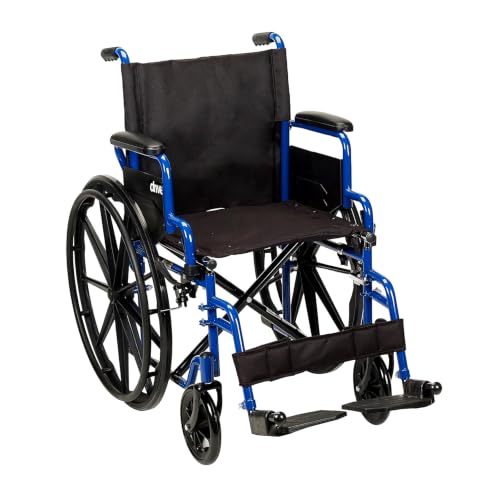
1. Drive Medical Blue Streak Wheelchair 18″
Our pick — 4.5+★ from 18,500+ verified ratings; the strongest balance of quality and price.
The 18-inch seat, flip-back arms and swing-away footrests make it the easy default for home caregivers.
Here is the chair that keeps showing up in living rooms and care homes across the country. It is a self-propelled steel wheelchair with a solid 18-inch seat, and it covers the basics most people actually need: flip-back desk-length arms that let you slide up to a table, swing-away footrests that clear the way for transfers, and push handles with ergonomic grips for a caregiver. The solid wheels and single-axle frame roll through tight hallways with control, and the push-to-lock brakes hold the chair still when you need it to stay put.
The comfort and ease-of-use story is where this chair earns its reputation. Owners describe it as comfortable for long stretches and simple to load and unload, and it works well for wheeling around the house. It is not the lightest chair here at 41.3 pounds, so loading it into a trunk takes real effort. Compare that to the FeatherMobility at 13.5 lbs without wheels and you see the trade-off clearly: this is a sturdy steel chair built for daily indoor use, not a featherweight you toss in the car one-handed.
The honest concern is durability on the front end. Some buyers report the front wheel breaking after about three days of use and footrests coming off, though that is not the norm across thousands of owners. Treat the front casters gently on rough pavement and this chair holds up well. At this price, with a steel frame most owners use for years, the value is tough to top.
What earns it the top spot
- 18″ seat and flip-back desk arms make transfers and table access easy — you slide up without standing first
- Swing-away footrests clear the path so you step in and out safely
- Sturdy steel frame with solid wheels holds up to regular indoor and outdoor use
- Push-to-lock brakes and ergonomic handles keep the chair controlled
The trade-offs to weigh
- 41.3 lbs is heavy — loading it into a trunk is a real lift
- A minority report front wheel and footrest durability problems
- Fixed steel frame means no fold-down backrest like the Invacare
Best matched to: someone who keeps the chair at home and uses it around the house or on short trips where a caregiver handles the loading.
Think twice if: you load a chair into a car by yourself several times a day — a lighter frame will save your back.
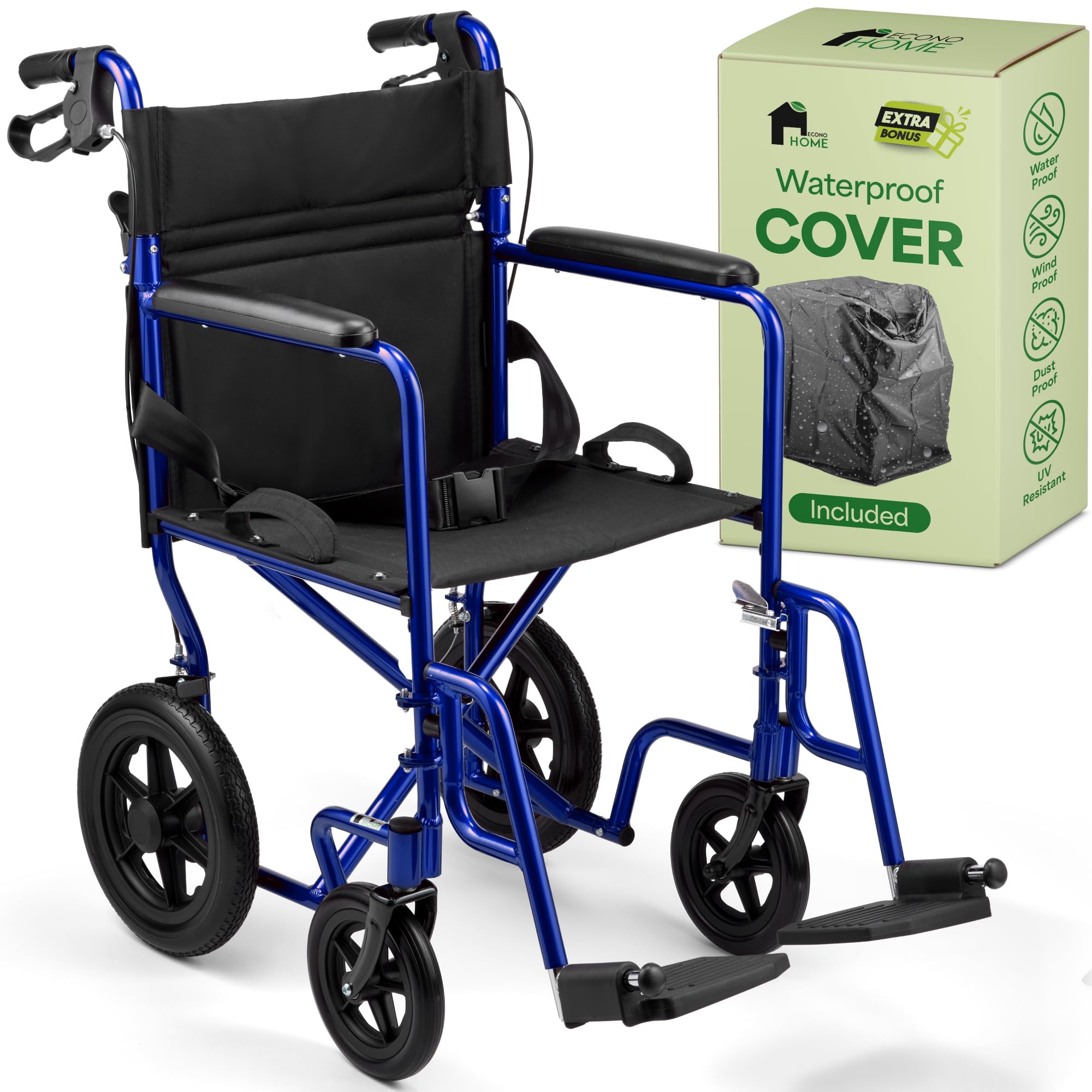
2. EconoHome Expedition Wheelchair
Twenty-two pounds of fold-flat aluminum that lifts into a trunk without a second thought.
If the chair’s main job is getting someone into a car and out again, weight is the spec that rules the day. The Expedition weighs 22 pounds, and that is roughly the difference between a chair you can lift with one hand and one you brace against your hip. It folds flat with an aluminum frame, so it slides into the trunk of a sedan or SUV and comes back out without a wrestling match. It also arrives fully assembled, so there is no tool-driven setup on day one.
Owners praise the build quality and the low weight most, and the sturdiness of the aluminum frame carries the same 300-pound capacity as chairs that weigh much more. The larger back wheels make it easier to push over thresholds and narrow hallways, and it comes with companion-activated hand brakes, a seat belt, padded armrests, and swing-away footrests. For shopping trips, doctor visits, and airport travel, it is a sensible tool that does not ask much of the person loading it.
One thing to note: this is a transport chair, meaning it is pushed by a caregiver rather than self-propelled by the user. If the person in the chair wants to push themselves, a self-propelled model like the Drive Blue Streak is the better fit. A waterproof cover is included, which is a small bonus for storing it outdoors or in a garage.
Where it shines: 22 lbs with a fold-flat aluminum frame and a 300 lb capacity — the balance for anyone who loads a chair into a car every day but still wants room to spare. Owners mention that the 22-pound frame makes lifting it in and out of vehicles easy, and the foldability is what they call out most.
The honest caveat: it is a caregiver-pushed transport chair, and the 25-pound package weight means it arrives ready to roll but a bit bulky on the pallet. If independence by self-pushing is the goal, this is not the chair for that job.
Reach for this one if: your priority is a lightweight chair that a caregiver can load into a trunk without strain, and you want the extra confidence of a 300 lb rating.
Look elsewhere if: the person using the chair needs to propel themselves — this one is pushed, not self-driven.
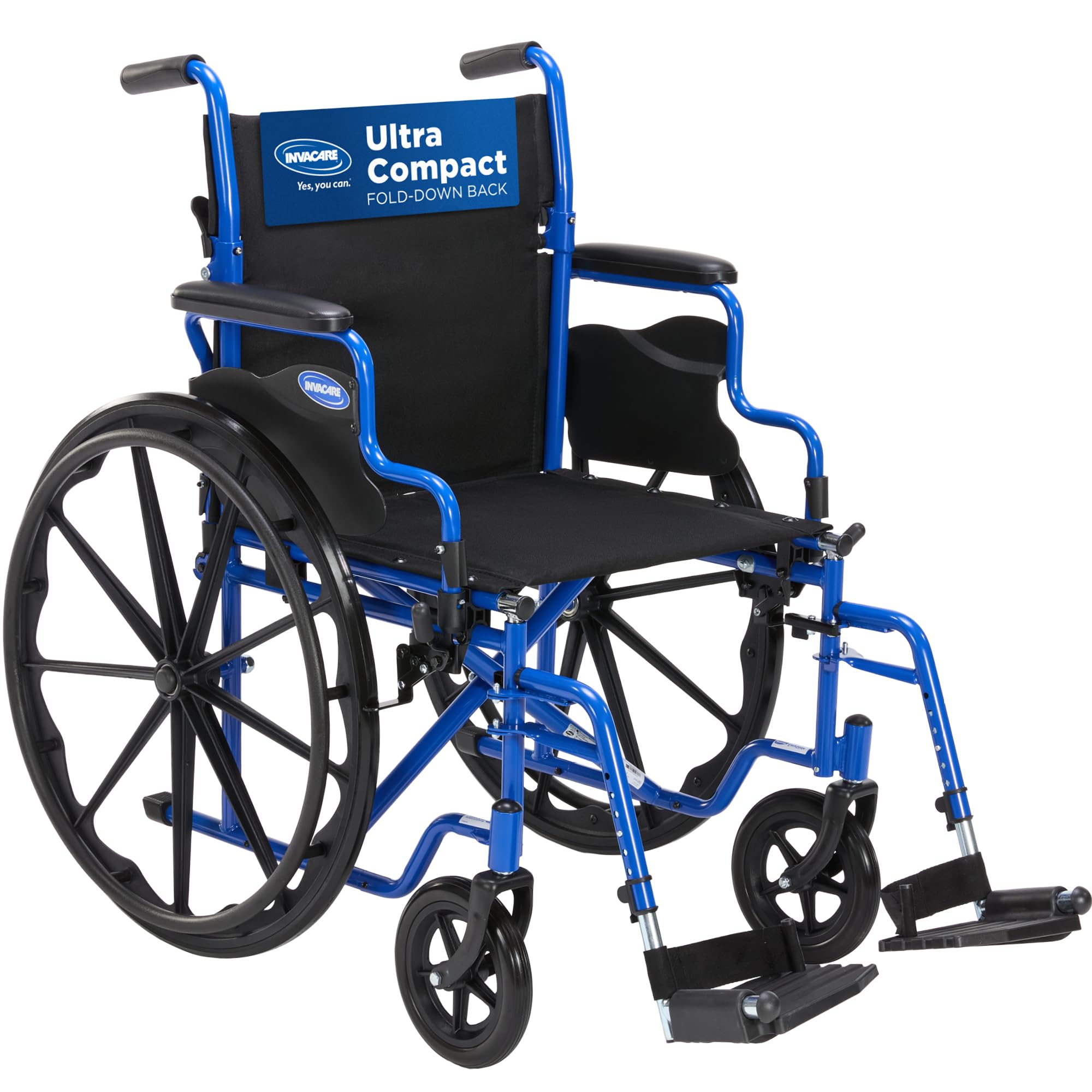
3. Invacare Compact Folding Wheelchair
The fold-down backrest drops the chair from 37.75 inches to 30.5 inches, so it hides in a closet.
Storage is the spec that gets overlooked until your hallway turns into an obstacle course. This Invacare answers it with a folding backrest that reduces the chair from 37.75 inches tall down to 30.5 inches. A one-hand folding frame narrows the width to just 12 inches, so it tucks into a small trunk or the corner of a closet without tools. At 38 pounds it is not the lightest chair here, but the compact folded footprint is the real advantage.
The armrests are the standout feature for daily transfers. They are padded, desk-length, and both flip back and remove, so you get the side access you need for a bed or car seat. The nylon upholstery breathes to keep the seat from getting stuffy, and the backrest has a full-size pocket with Velcro closure for personal items. Owners praise the sturdiness and build quality, and the reinforced steel single-axle frame carries a 300 lb capacity with a 5-year frame warranty.
On the road, 8-inch TPU front casters and 24-inch rear wheels with non-marking tires roll smoothly indoors and hold their line outdoors. There is a built-in curb assist lever to help a caregiver climb obstacles. The add-on seat widths run 16, 18, and 20 inches with a standard 16-inch seat depth, so you can size it to the body. The recurring note is weight — some find it lighter, others call it heavy, which is fair for a 38-pound reinforced steel frame.
The compact win: folding from 37.75” to 30.5” and narrowing to 12” wide is the difference between a chair that lives in a closet and one that takes over a room. Owners also single out the flip-back and removable arms as the thing that makes daily transfers easier.
What to expect: at 38 lbs this is not a chair you carry up stairs. The 300 lb frame and 5-year warranty are built for the long haul, but the weight is a fair trade for that sturdiness.
The right chair for: a small home or apartment where the chair must disappear into a closet between uses, and the user wants full armrest flexibility for transfers.
Not the pick if: you need to lift the chair in and out of a vehicle constantly, since 38 lbs adds up over a day.
4. Drive Medical Cruiser III Wheelchair 16″

Seat depth slides from 16 to 18 inches and the leg rests adjust without tools — fit, not guesswork.
Most chairs make you pick a seat and live with it. The Cruiser III bakes adjustability into the frame. Built-in seat rail extensions and extendable upholstery adjust the seat depth from 16 inches to 18 inches, and the tool-free front riggings let you set the footrests and leg rests where they actually suit the user.
The frame is carbon steel with a silver vein finish, and the nylon upholstery is durable and easy to clean. Composite Mag-style wheels are maintenance-free, and the 8-inch front casters adjust across three positions. Precision sealed wheel bearings keep the roll smooth, and push-to-lock wheel locks hold the chair in place. It weighs under 36 lbs excluding the front riggings, and though the capacity is 300 pounds, some owners note it works best for those under 200 lbs operating it themselves.
Compared to the Blue Streak’s 41.3 pounds, this chair at 35 pounds is the lighter sibling in the same family — about 6 pounds less to haul around, with more adjustment built in. Owners praise the maneuverability and the quick attach-and-detach leg rests, which make it easy to strip the chair down for transport. The one caveat is that the seat height sits at 16 inches and the adjustability is fixed at the frame, so measure before you buy if legroom is tight.
Why it holds up
- Seat depth adjustable from 16″ to 18″ — real fit where most chairs give you one size
- Tool-free footrest and leg rest adjustment, quick to attach and remove
- Maintenance-free Mag-style wheels with sealed bearings
- 35 lbs vs the Blue Streak’s 41.3 lbs — lighter, but just as sturdy at 300 lb
Where it gives
- Not a featherweight at 35 lbs
- Owners note best self-propelled performance for those under 200 lbs
- Adjustability is fixed at the frame — no fold-down backrest like the Invacare
Ideal for: a user whose seating needs may shift over time, or a caregiver who wants a chair that adapts to different people in the household.
Consider another model if: you need the absolute lightest lift or a chair that stores in a tight closet.
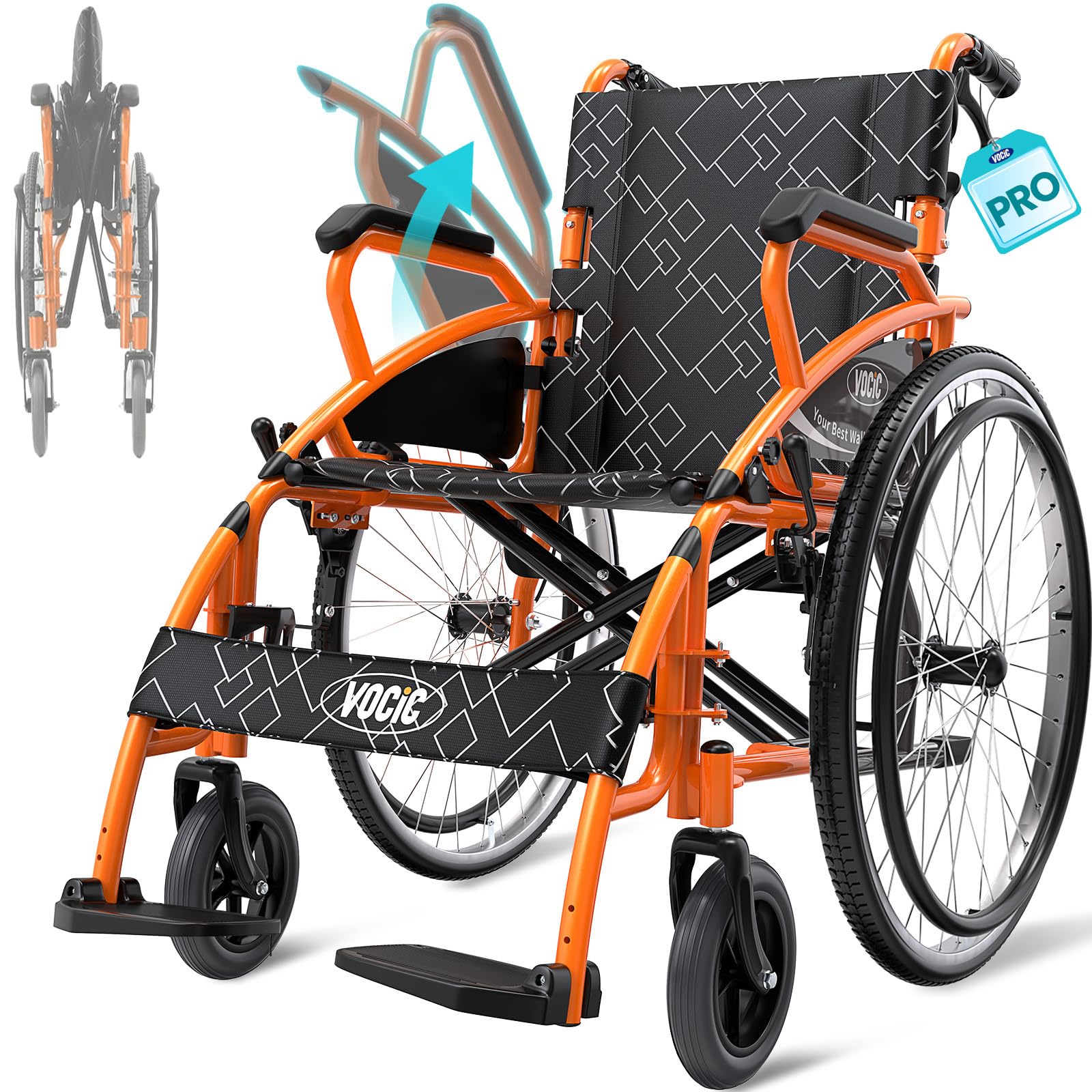
5. VOCIC U31 Wheelchair
A double-X carbon steel frame and dual brakes built for uneven pavement, not just the living room.
The VOCIC leads with its frame: a reinforced carbon steel double-X design that stays steady on rough or uneven ground. It weighs 38.6 lbs, folds in about three seconds, and packs down to 11.8 by 29.9 inches. The 23.6-inch rear wheels are wear-resistant with shock absorption and slip resistance, and the 360-degree swivel PU front wheels turn on a dime in tight rooms. For someone who wants to get outside on sidewalks and uneven paths, that frame strength is the point.
The safety package is unusually complete for this weight class. There is a double brake system with handle brakes and a handbrake, plus a seat belt and leg restraints that add safety during transport. The armrests have a protective plate that guards the arms from friction. Owners say the comfort is what wins them over, and the appearance gets compliments too — the side arms lift for an easy exit, which matters on the days you are tired.
One fair note: at 38.6 lbs this is not the chair you want to haul up stairs. The weight buys you that double-X stability, and the 300 lb capacity backs it up. The 3-second fold is helpful for storage but does not shrink it to Invacare-small. If your priority is a confident ride on imperfect ground, the trade-off is sensible.
Ride quality first: the double-X carbon steel frame and 23.6-inch shock-absorbing rear wheels are what keep this stable on rough surfaces, and comfort is the thing owners mention most.
What to know: 38.6 lbs is on the heavy side for a portable chair, and the folded size is larger than the most compact option here. That weight is the price of the extra frame stability.
Go with the VOCIC if: you plan to spend real time outdoors or on uneven surfaces and want a secure, steady ride with strong braking.
Pass if: the chair will be lifted into a car daily — the 38.6 lb frame makes that a chore.
6. Vive Mobility Ultra Lightweight Wheelchair
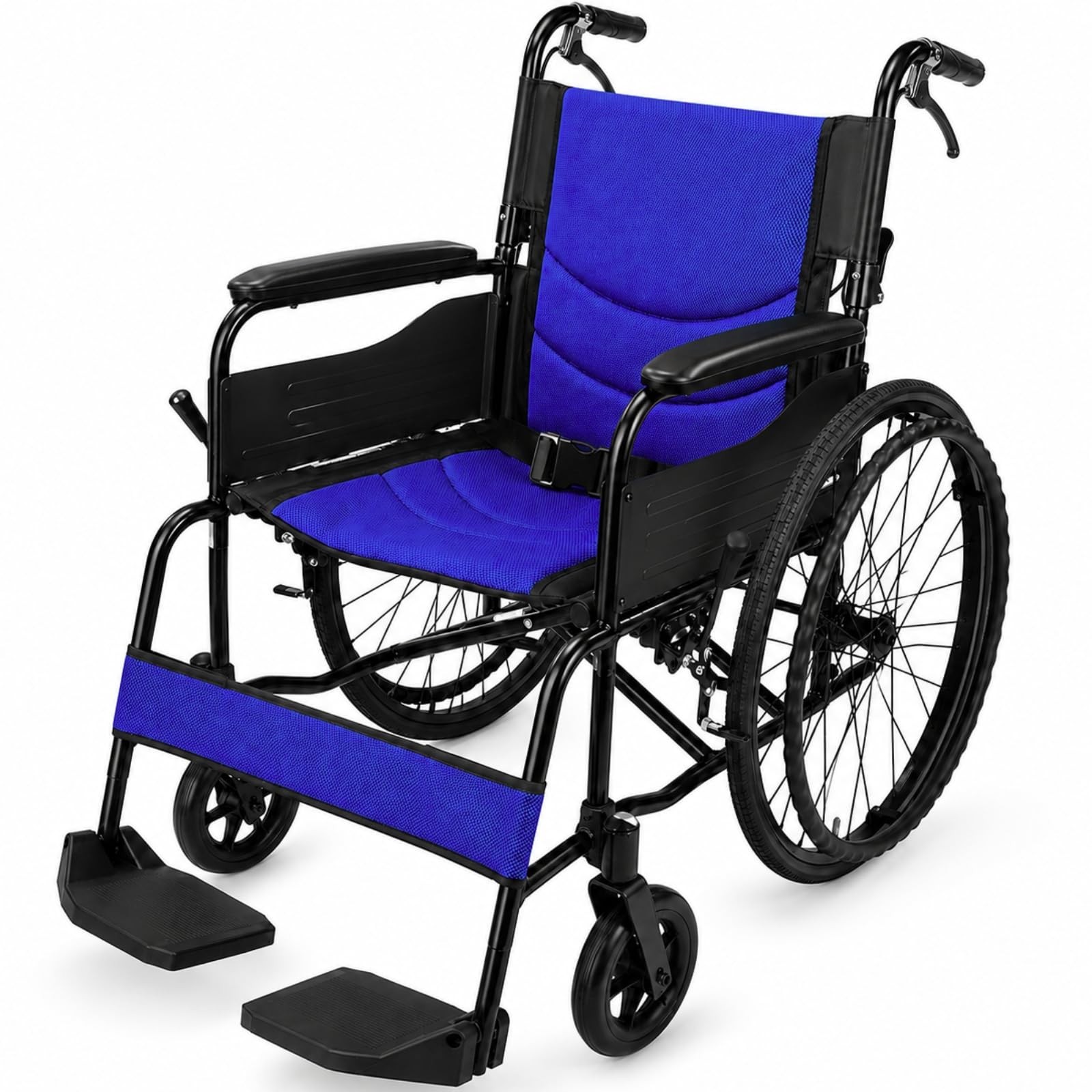
A 28-pound aluminum chair with an adjustable footrest and foldable handles that fit the car.
Twenty-eight pounds is the number that makes this Vive chair feel portable in practice. It is built from high-quality aluminum with 22-inch wheels and an 18-inch wide by 15.5-inch deep seat, so it rolls smoothly on varied ground while staying light enough to fold and lift. The adjustable footrest accommodates different heights, which helps when more than one person uses the chair.
Safety is where Vive loads it up. There is a foot-securing strap, a seat belt, hand brakes, and rear brakes, all designed for control during transfers and travel. The foldable handles make it easier to get the chair in and out of a car, and owners say it glides easily and is much easier to scoot around with feet than expected. The aluminum construction keeps it light without giving up a stable ride, and the chair folds for storage when not in use.
The capacity is 240 pounds, which is lower than several chairs here rated at 300. If the user is near that ceiling, choose a chair with more headroom. It is also HSA/FSA eligible and comes with a Vive 1-year guarantee. For a mid-weight aluminum chair at 28 pounds, the package is well-rounded — just measure the weight carefully against the 240 lb limit before buying.
The lightweight answer: at 28 lbs and 18 inches wide, it is the middle ground between a heavy steel chair and the premium featherweights. Owners praise the weight and build quality most, and the 22-inch wheels keep the roll smooth.
Watch the limit: 240 lbs is the lowest capacity among the aluminum picks, so anyone near that number should look at a 300 lb chair instead.
Worth picking if: you want a genuinely light aluminum chair under a common adult weight limit, with an adjustable footrest and a full safety set.
Not if: the user weighs close to 240 lbs — the 300 lb models give you safer headroom.
7. Vive Mobility Reclining Wheelchair with Elevating Leg Rests
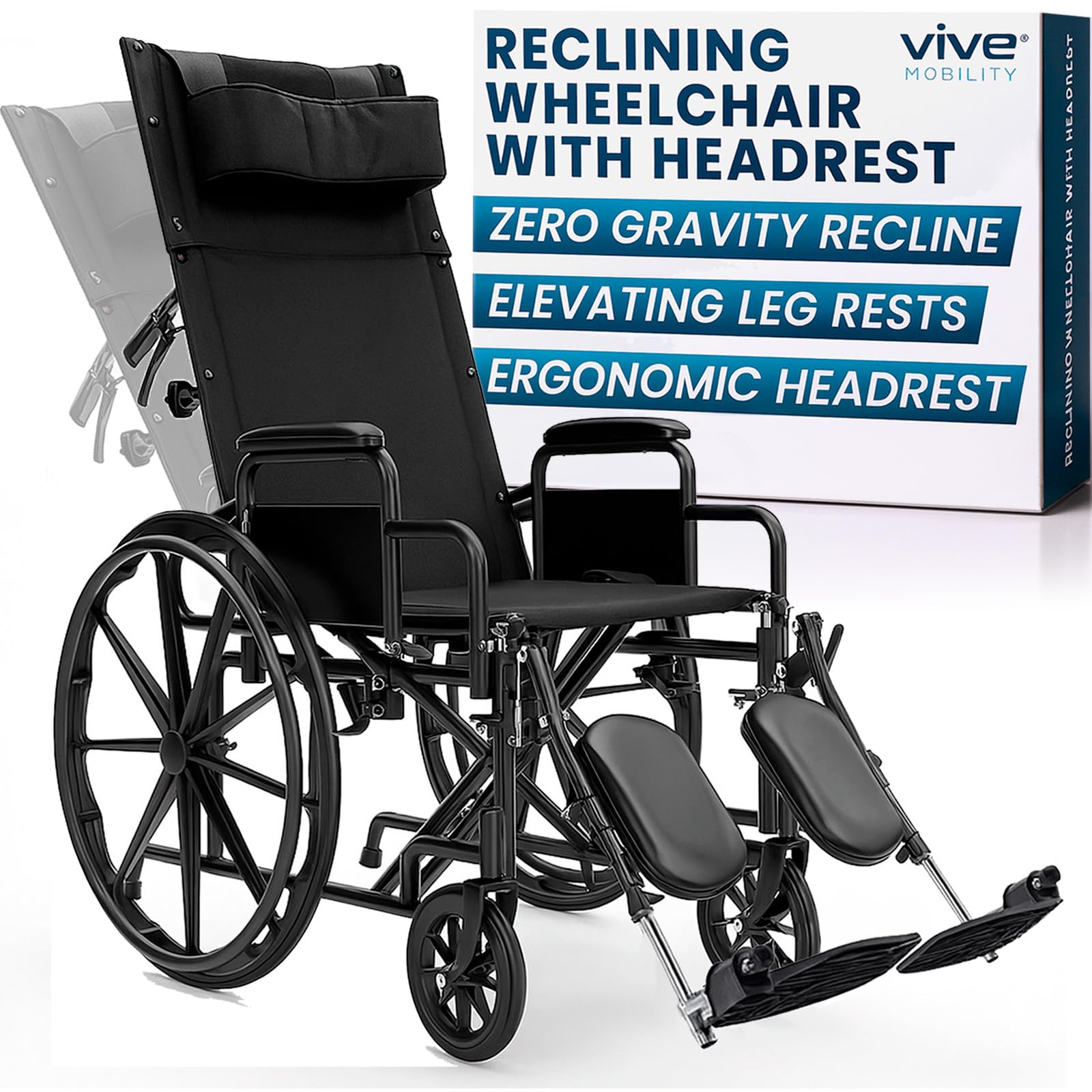
It reclines to a true 170 degrees, locks at multiple angles, and adds elevating leg rests — bed-like comfort on wheels.
This Vive recliner goes to a full 170 degrees and locks at multiple angles, which makes it useful for long seated stretches, transfers, or napping between activities. The elevating leg rests with dual calf pads swing away and adjust, and the headrest with a detachable cervical cushion supports the neck while reclined.
Owners describe the recline as feeling like a bed and call it the best chair they have used. The quality and comfort stand out most, alongside the sturdiness of the reinforced steel frame rated at 300 lbs. It assembles and open up easily, which helps when you are moving between home and clinical settings. The 24-inch rear wheels and 8-inch front casters roll over indoor flooring and outdoor paths, and secure locking rear brakes keep it still during transfers.
Here is the catch: at 60 pounds it is the heaviest chair in this group by a wide margin, and you will not be lifting it into a trunk. The recline and leg rests add the mass, and that is a fair trade if the chair stays in one place. If you need portability, this is not the pick — the weight alone rules it out for daily car travel.
What it does best
- Reclines to a full 170° and locks at multiple angles — real rest between activities
- Elevating leg rests with dual calf pads for comfort and circulation support
- Headrest and detachable cervical cushion keep the neck supported while reclined
- Reinforced steel frame handles 300 lbs with locking rear brakes
Where it costs you
- 60 lbs is the heaviest here — lifting it into a car is out of the question
- Big footprint means it needs real floor space
- Owners are split on weight, and the mass is the honest reason
Built for: someone who spends long hours seated and needs to recline and rest, with the chair staying in one home or care setting.
skip it if: the chair must travel in a car — the 60 lb frame and wide footprint fight against that.
8. ByteTecpeak 24 LBS Wheelchair
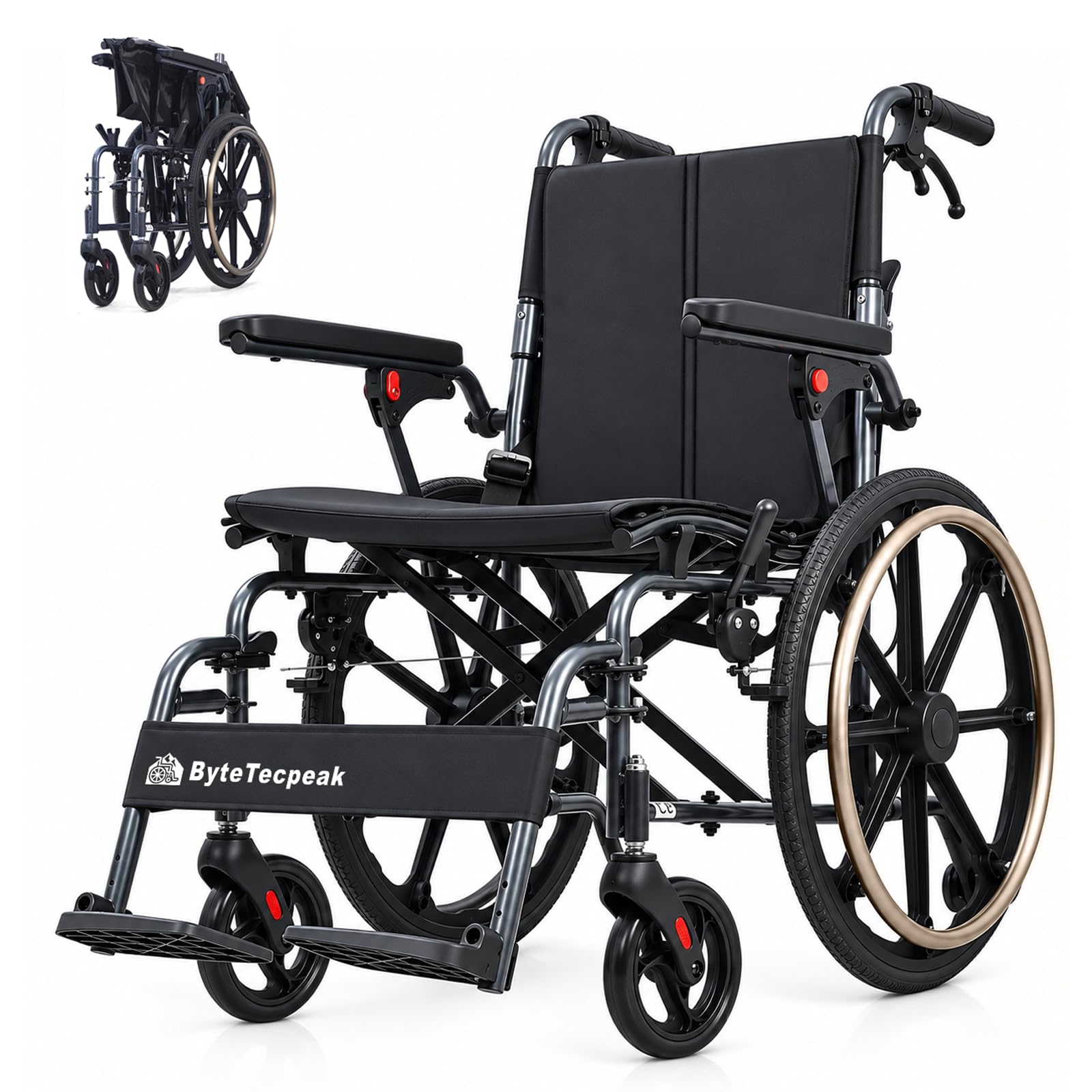
At 24.2 pounds it folds in about three seconds and rolls out of the trunk for doctor visits and shopping.
The number to start with here is 24.2 pounds. That is what premium aluminum alloy buys you — a chair light enough to move around all day, with a 3-second fold that fits into a car trunk, a closet, or a small living space. The large rear wheels allow self-propelled movement, and the ergonomic push handles let a caregiver take over when needed. It suits seniors, adults recovering from surgery, and anyone who needs daily mobility support.
Safety is covered with a dual braking system: hand brakes for caregivers and push-to-lock wheel brakes for the user. Anti-tip wheels, a safety belt, and a double cross-brace frame add confidence on varied surfaces. For comfort, there is a soft PU seat, an ergonomic backrest, a padded calf strap, flip-up armrests, swing-away footrests, and a rear storage pocket. That is a full feature set for a lightweight chair.
The weight capacity is 220 pounds, the lowest in this group, so treat it as a personal chair for a smaller user rather than a shared household one. The 24.2-pound weight is the trade-off you accept for the low capacity — this chair trades payload for portability. If you need a chair that can carry more, a 300 lb model is the safer choice.
Portability first: 24.2 lbs and a 3-second fold make this one of the easiest chairs here to live with on the go, and the flip-up arms and swing-away footrests help transfers.
The capacity caveat: 220 lbs is the lowest limit in the lineup, so it is a personal chair, not a shared one. Size it to the user honestly.
Choose this if: you want a light, fold-fast chair for one user within a 220 lb range, with transit and errands in mind.
Choose a 300 lb model instead if: the chair will be shared, or the primary user needs more weight headroom.
9. Karman S-115 25 lbs Ultra Light Ergonomic Wheelchair, Red

A patented S-shape seating frame with an 18-inch seat, at just 25 pounds — the ergonomic pick.
The Karman carries its weight at 25 pounds, but the story here is the seating geometry. It uses a patented S-shape seating frame with an 18-inch seat width and 17-inch seat depth, a design meant to shape the seat to the body rather than force the body to the seat. The red frame is a distinct look, and the removable footrest adjusts in height for a proper fit.
The 24-inch rear wheels and 7-inch front casters are flat-free, so you are not dealing with flats on the sidewalk or the hallway. Owners praise the quality most, along with the lightweight build, sturdiness, and mobility — one buyer notes rolling in it independently. The heavy-duty hardware earns mention for holding up, and a folded chair stands on its own when stored. For a lightweight ergonomic chair, the package is tight and well-finished.
Two things to weigh. The 18-inch seat depth is fixed, so a very tall user may want to check legroom before buying. And the color feedback is mixed — some buyers like the red, others are less keen, which is cosmetic and not a performance issue. If the S-shape seating suits your body, this chair rewards you with easy independent rolling and a small footprint.
The ergonomic edge: that patented S-shape frame with an 18-inch seat width and 17-inch depth is the differentiator, and the 25 lb weight keeps it manageable. Owners praise the quality and the lightweight build most.
The fit note: the seat depth is fixed at 17 inches, so check legroom if the user is tall. The red finish divides opinion, but that is purely cosmetic.
The chair for you if: you want an ergonomic seat shape and a genuinely light 25 lb chair that rolls independently on flat-free casters.
Look at another model if: you need adjustable seat depth or a different frame color — those are fixed here.
10. FeatherMobility Folding Wheelchair 13.5 lbs
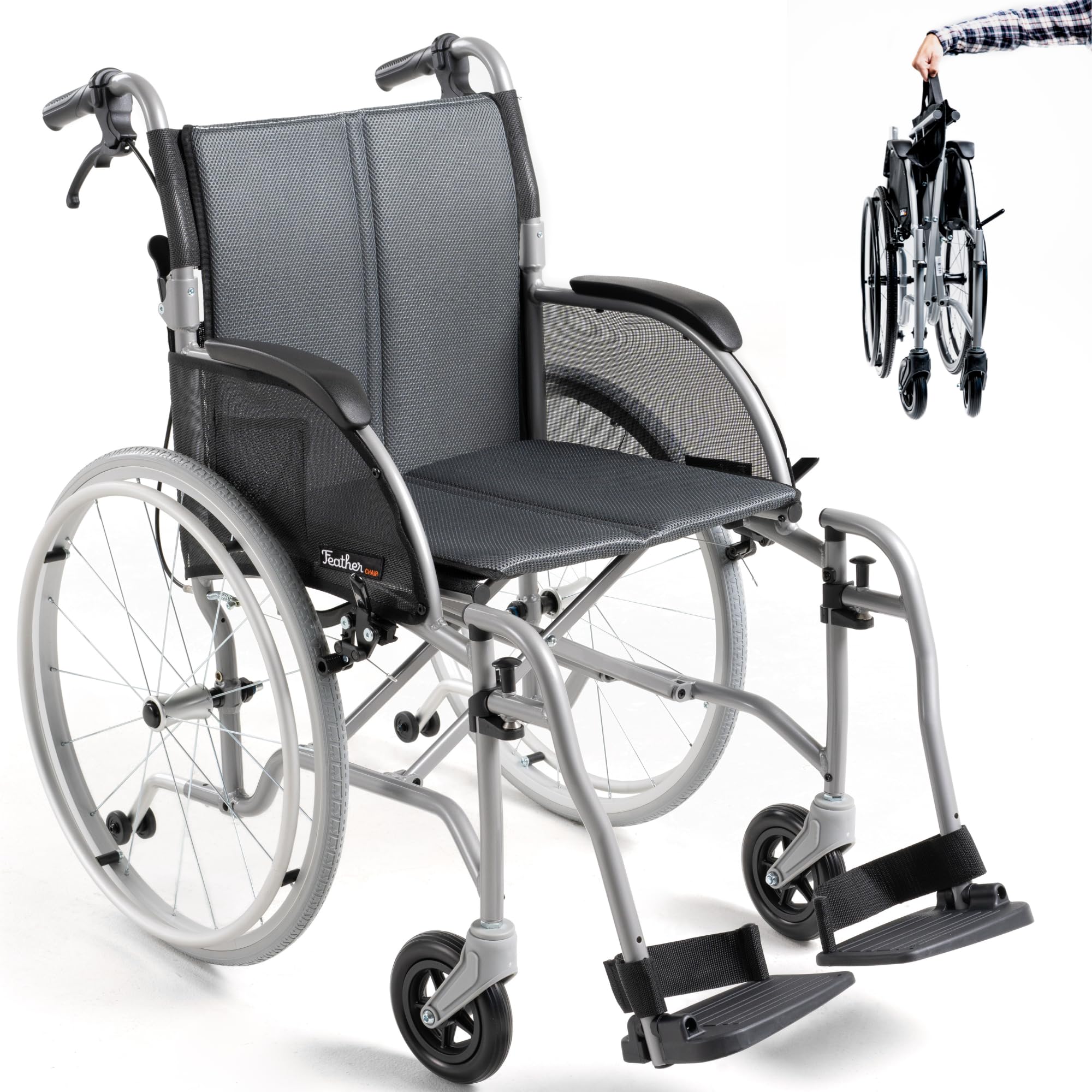
Thirteen and a half pounds without wheels — the lightest chair here, and it still carries 300 pounds.
Nothing else in this group comes close on bare weight. The Feather tips the scale at 13.5 pounds without the wheels and 19 pounds with the leg rests and wheels attached, yet the frame is rated for 300 pounds. Quick-release wheels and swing-away leg rests come off in under a minute, so you can break it into two light pieces instead of lifting one heavy chair. The folded footprint passes through narrow doorways at 26 inches wide, and it fits a car, SUV, or truck.
Owners praise the quality and the lightweight build most, and the maneuverability is a recurring positive. The bicycle-style locking brake levers sit on the push handles, and front wheel locks add user control. The 20-plus years behind the brand show in the finish and the folding mechanism. For frequent travelers or anyone with a bad back who loads the chair alone, 13.5 lbs is the difference between dreading the lift and not noticing it.
The honest trade: at this price and this weight, ease of use and durability draw more mixed feedback than heavier chairs. The push handle locking mechanism gets occasional complaints, and some buyers feel the premium is steep. This is a chair bought for its weight, not for heavy outdoor punishment. Keep the folding mechanism clean and it stays smooth through years of lifts.
What makes it unique
- 13.5 lbs without wheels — lightest here by a full 11.5 lbs vs the 25 lb Karman
- Quick-release wheels split it into two easy pieces in under a minute
- 300 lb capacity in a 13.5 lb frame is a rare combination
- Folds narrow enough to pass through doorways and fit most vehicles
Where it asks patience
- Push handle locking mechanism draws some complaints
- Durability feedback is mixed compared with heavier steel chairs
- Premium build carries a premium cost, which some buyers question
The best fit for: the solo loader, the frequent flier, or anyone whose back cannot take a 40-pound chair — 13.5 lbs and 300 lb capacity is a combination almost nothing else here offers.
Consider a sturdier frame if: the chair lives outdoors on rough pavement, where a heavier steel chair will take more punishment.
Know the Specs
Chair weight and why it rules your day
Chair weight is measured in pounds and it decides how easy the chair is to live with. A chair at 13.5 pounds lifts with one hand; a chair at 41.3 pounds takes a real effort and a strong back. If you load the chair into a car several times a day, weight is the first number to check. If it stays in one room, weight matters much less and you can favor sturdiness instead.
Weight capacity and headroom
Weight capacity is the maximum load the frame is rated to hold, and capacities here run from 220 lbs to 300 lbs. Buy with headroom — choose a rating comfortably above the user’s actual weight so the frame and wheels are not stressed to their limit.
Seat width and depth
Seat width is the distance across the seat, and most adult chairs sit around 18 inches. A 16-inch seat suits a smaller frame; a 20-inch seat gives a larger person room. Seat depth is the front-to-back measurement and affects leg support. Measuring the hips before buying is the single best way to avoid a chair that rubs or feels cramped.
Propulsion type: self-propelled vs transport
Self-propelled chairs have large rear wheels and hand rims so the user pushes themselves. Transport chairs have smaller wheels and are pushed by a caregiver. Choosing the wrong one is the most common regret — a self-propelled chair gives independence, while a transport chair is lighter and easier to fold for trips where a caregiver does the pushing.
Common Questions
How do I know what seat width wheelchair to buy?
Is a lighter wheelchair always better?
What is the difference between a self-propelled and a transport wheelchair?
Can a wheelchair fit through a standard doorway?
How much weight can a lightweight wheelchair hold?
Do wheelchair footrests come off for transfers?
What is the best wheelchair for a heavy adult?
Is a reclining wheelchair worth it?
How long does a manual wheelchair usually last?
Do I need a wheelchair with a seat belt?
The Bottom Line
For most people buying a wheelchair for handicapped use, the Drive Medical Blue Streak is the one to start with. It pairs an 18-inch seat with flip-back desk arms and swing-away footrests, so transfers and table access stay simple, and its steel frame is built for years of daily living-room use. If you load a chair into a car by yourself, switch to the EconoHome Expedition at 22 pounds with a fold-flat aluminum frame. And if lifting a chair at all is the problem, the FeatherMobility Feather at 13.5 pounds without wheels is the lightest answer here, still rated to 300 pounds.
Measure the hips before you click buy, confirm the chair’s assembled width against your doorway, and match the capacity to the user with real headroom. Do those three things and any chair on this list will fit the user and the routine. The Blue Streak carries the most ratings of the group, which makes it the safe default for most households.
How we choose
We do not accept paid placement. Every pick is matched to a real buyer and a real use-case; we do not hands-on test units.
Sources
Specifications: manufacturer listings and product documentation. Review insights: verified customer reviews, as of November 2026. Pricing: not shown on this page (it changes often); check the current price via the retailer link.
As an Amazon Associate, Tactical Gear Guy earns from qualifying purchases. This does not affect which products we feature.