Specs are compiled from manufacturer listings and verified buyer reviews and can change over time — please confirm the key details on the product page before buying.
Buying ice cleats is about one thing: staying upright on a surface you cannot see through. The right pair puts hard metal between your boot and the ice so each step bites instead of sliding. This guide covers nine real picks that do exactly that, sorted by what each one is genuinely best at — walking the dog, shoveling the drive, working all day outdoors, or stuffing in a bag for a hike.
This guide is built by comparing the manufacturers’ published specifications and the patterns across verified customer reviews, so you get each pick’s real strengths and trade-offs instead of marketing spin.
One quick note before you read: these picks use flexible, human-like matching for “designed for walking on ice and snow,” so not every model is the exact number you searched — the nearest same-type option serves the same purpose.
Top Picks


How to Choose Ice Cleats That Actually Stay On
Most people buy cleats expecting the spikes to be the hard part. In practice, the spikes work; the failure point is the fit. A cleat that shifts under your arch turns a confident step into a rolled ankle, so start with how it attaches before you count studs.
Spike count and spike material
More contact points spread your weight across the ice instead of concentrating it. A 19-spike pair puts metal nearly everywhere under your foot, which suits mixed terrain like packed snow, icy driveways, and mud. Tungsten carbide studs are a harder material used in a smaller number on work-focused cleats, usually seven or eleven per pad or pair, and they bite sharply into glass-hard ice. Stainless steel coils and chains flex with the sole and are gentler on indoor floors.
How the cleat holds your shoe
A full rubber sling grips the toe and heel of your boot, which is the most secure design for boots. A strap or elastic band pulls the cleat tight against the sole, and a toe strap keeps the front from sliding back. Mid-sole designs cover only the middle of the foot and rotate up when you do not need them — handy when you walk in and out of buildings all day.
Cold-weather flexibility
The rubber or thermoplastic elastomer body is what lets you stretch the cleat over a bulky boot. In sub-zero air that material wants to stiffen, so look for a stated cold rating.
Side-by-Side Comparison
| Model | Best For | Spike Type | Spike Count | Size / Weight | Amazon |
|---|---|---|---|---|---|
| Cimkiz Crampons Ice Cleats★ Best Overall | All-round winter walking | Stainless steel spikes | 19 per foot | Large / 9.44 oz | Amazon |
| ICETRAX Pro Tungsten GripTop Performer | Hard-packed ice and work days | Tungsten carbide studs | 11 | — | Amazon |
| Yaktrax Walk Traction CleatsBest for Town Walking | Everyday town walking | 1.2mm zinc-coated steel coils | Coil (not stud) | Medium | Amazon |
| Due North All Purpose Work Cleats | Industrial and job-site use | Military-grade tungsten carbide | 12 per pair | — | Amazon |
| Easy Spike Ice Cleat | Slip-on simplicity | Carbonized steel studs | — | S–XL / 14.72 oz | Amazon |
| Pecube Ice Cleats | Driveway and dog walks | Stainless steel chain | Chain (not stud) | X-Large / 0.32 kg | Amazon |
| Yaktrax Traction Chains | Prolonged walks, low bulk | Steel chain links | Chain (not stud) | S–XL / 8 oz | Amazon |
| Walk Traction Ice Snow Cleat | Budget all-rounder | Stainless steel spikes | 19 (12 forefoot, 7 heel) | Large / 390 g | Amazon |
| GGS Anti-Slip Ice Cleats | Indoor-to-outdoor transitions | Tungsten carbide studs | 7 per pad | One Size | Amazon |
Detailed Reviews
1. Cimkiz Crampons Ice Cleats Traction Snow Grips
Our pick — 4.5+★ from 13,000+ verified ratings; the strongest balance of quality and price.
Nineteen spikes per foot is a lot of bite, and it is why this pair leads the list.
If you want one pair to cover the whole winter — the icy sidewalk, the driveway, the trailhead, and the frozen lake — this is the one to grab. Each foot carries 19 stainless steel spikes locked into a firm chain system, which spreads your weight across many contact points rather than a few. That density is what keeps you steady when the ground goes from crunchy snow to polished ice without warning.
The stretch body is where the build separates itself. It is made from thermoplastic elastomer (a rubbery plastic that springs back into shape) at 5 mm thick, which the maker says is thicker than ordinary rubber, and it is rated to keep working down to -45°C. On your foot that means you can haul the sling over a chunky insulated boot in cold air without it fighting you.
What wins people over is the sheer grip; the traction and the spike quality are the two things the review pages keep returning to. Durability is the honest caveat. While plenty of owners say the chains hold up nicely through a season of daily use, a share report chains giving out after brief use. Treat this as a pair that rewards not stomping on bare pavement or rock, and it will serve you well. The crowd has spoken loudly here — 4.5+ stars across 13,000+ ratings. One note the listing itself flags: the “L” on the cleat means Large, not Left, and there is no left or right side.
Where it earns its keep
- 19 stainless steel spikes per foot give dense contact on mixed ice, snow, and mud
- 5 mm TPE body stays flexible down to -45°C so it stretches over thick boots in deep cold
- Adjustable strap plus chain system holds the fit secure on angled ground
- Packs into the included carry bag at 9.44 ounces
The honest trade-offs
- Chain breakage is the recurring gripe — keep them off bare pavement and rock
- Heavier than a coil-style cleat because of the spike count
- Sizing runs to a Large label that has nothing to do with left or right feet
Best for: anyone who wants one versatile pair for icy sidewalks, driveways, trail sections, and ice fishing.
Think twice if: you mostly walk on finished indoor flooring and want something that never needs to come off — a coil cleat is gentler.
2. ICETRAX Pro Tungsten Grip Winter Ice Cleats
Eleven tungsten carbide studs tuned for the kind of ice you can see your reflection in.
This is the pick for the person who walks the same frozen route every morning and knows exactly where it turns to glass. There are 11 tungsten carbide cleats (a stud made of an extremely hard metal compound) placed strategically under the foot. Fewer points than a 19-spike chain, but each one is sharp and built to pierce rather than scrape. On hard-packed snow and refrozen slush, that focus is what you feel underfoot.
The fit is where owners stay happy. The stretch rubber pulls over boots and stays put, a built-in heel puller and toe puller make them easy to haul on and off with gloves, and the heel is reflective so a car sees you in the dark. The size chart is accurate enough that buyers land on the right fit the first time, which is not something every cleat can claim. On the ice itself, the grip holds on surfaces where coil cleats can start to skate.
Where it falls short of the Cimkiz is raw coverage — 11 studs against 19 spikes per foot — so on loose, chunky snow you feel a little less float and a little more poke. For slick, hard ice, though, the ICETRAX is the sharper instrument. If your winter walking is town sidewalks, a steep driveway, and a dark walk to the car, this earns its place.
What stands out: tungsten carbide studs bite into glass-hard ice where steel can slide, and the reflective heel is a real safety detail for early-morning walks.
Where it gives ground: with 11 studs it favors hard ice over deep, loose snow, so a 19-spike pair suits mixed backcountry better.
Reach for this if: your route is hard-packed pavement ice and you want a cleat that goes on fast with gloves on.
Look elsewhere if: you need maximum flotation across soft snow or deep slush.
3. Yaktrax Walk Traction Cleats
Coil cleats instead of spikes, built for the walk to the bus stop rather than the mountain.
Not everyone wants metal studs underfoot for a trip to the shop. This Yaktrax uses a different approach: a ladder of 1.2mm zinc-coated steel coils wrapped around the sole. Instead of sharp points that bite, the coils flex and grip in every direction — forward, backward, and sideways — which is what the 360-degree claim means in practice. For slushy sidewalks and freezing rain, they grab without the jarring poke of a spike.
The sling is thermoplastic rubber (a flexible plastic-rubber blend) that the maker states will not degrade, crack, or fail in cold, and it is fully recyclable. A heel tab makes them easy to pull on and off over a range of shoe shapes. Because the coil has no sharp edges, you can walk into a store or across a tile floor without scratching it, and you are less likely to gouge your own footwear.
Durability is the one place to set expectations. A portion of owners find the coils wear through after a few weeks of hard use, so these suit the everyday pedestrian better than the daily industrial worker. The traction, on the other hand, is the thing praised most in the review pages — freezing rain and icy pavements are exactly where this design shines.
The coil advantage: 1.2mm zinc-coated steel coils grip in every direction and resist rust and abrasion, so you are not shuffling carefully on a slushy sidewalk.
The trade-off: coil wear is the honest weak spot for heavy daily use — lighter commuter walking suits them best.
Pick these for: town and suburban walking where you want grip without sharp points and need to step indoors freely.
Not the fit for: a job that keeps you on ice and gravel all day, every day.
4. Due North All Purpose Work Ice Cleats
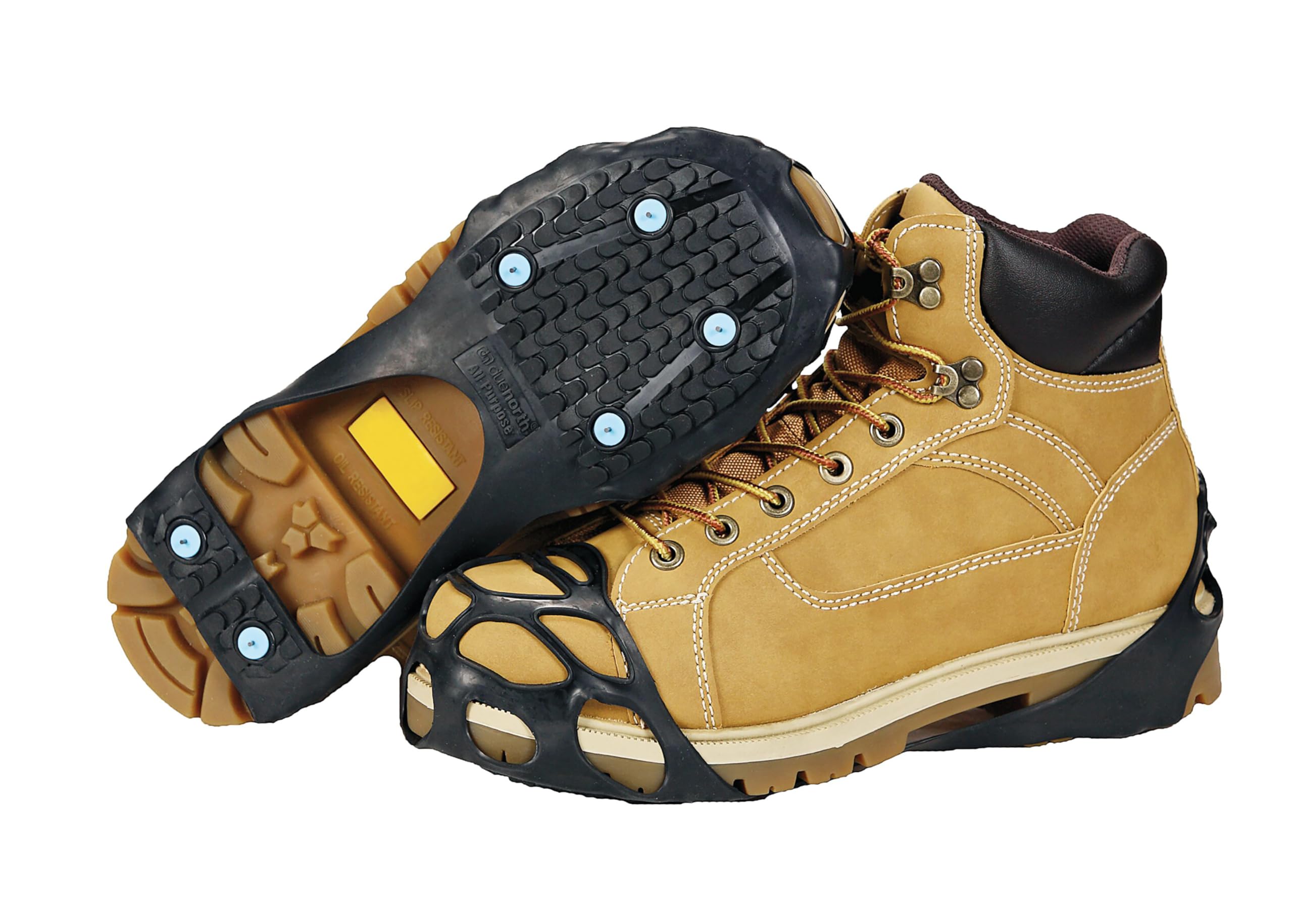
Built for the person who clocks eight hours on ice, not eight minutes.
Industrial settings are a different job entirely, and this pair is shaped around them. It carries 12 Ice Diamond spikes per pair made of military-grade tungsten carbide, arranged in a staggered pattern that grips icy pavement and packed snow alike. The tread underneath channels water away so slush does not build up and turn your sole into a ski.
What makes it work-ready is the coverage. The cleat wraps the full foot in 100% natural rubber that stays flexible in extreme cold, and it has an exposed heel and mid-sole so you can climb ladders and rungs without the cleat snagging or peeling off. A webbed toe-box is built to stretch over work boots and safety shoes, and a pull tab gets it on fast. When a spike finally wears down, you swap it out rather than replace the pair — 12 replaceable spikes per pair keeps the cleat in service.
Compare it to the ICETRAX, which is a walking cleat first: the Due North is engineered for ladders, rungs, and long shifts, which is why the build runs heavier and the rubber is thicker. If your driveway or dog walk is the job, a lighter cleat will feel less clunky. If you spend a full shift on ladders, rungs, and icy pavement, this is the one.
Made for a shift, not a stroll
- 12 military-grade tungsten carbide spikes per pair in a staggered pattern
- Full-foot 100% natural rubber stays flexible in extreme cold
- Exposed heel and mid-sole let you climb ladders and rungs securely
- Replaceable spikes keep it in service instead of replacing the whole cleat
What it asks in return
- Heavier build than a coil or small-stud walking cleat
- Overkill if your ice exposure is a short sidewalk walk
- Weathered industrial look rather than a sleek street design
Right call for: delivery drivers, railroad and municipal workers, and anyone on snowy ground all day.
Too much cleat if: you only need traction for a ten-minute walk to the car.
5. Easy Spike Ice Cleat by Winter Walking

Carbonized steel studs in an aggressive tread, sized S through XL for a no-fuss pull-on.
Some buyers just want a cleat that goes on and stays on, and this Winter Walking pair is designed around that. The studs are molded in carbonized steel, and the sole has an aggressive tread pattern that adds surface contact under the studs. Low-temperature elasticity keeps the body stretchy in the cold, so it still pulls over a boot when the air is brutally dry and freezing.
What makes it useful for insulated winter boots specifically is the sizing spread, S through XL, plus the stretch body that takes a bulky boot without a fight. Owners find them easy to slip on and off and report they stay put while walking, which is the exact problem a loose cleat causes. Weighing in at 14.72 ounces in the XL, it is on the heavier end, so it is a solid choice for a boot you lace up and wear all day rather than a spare you stuff in a coat pocket.
The honest note is weight. Against a 9.44-ounce Cimkiz or an 8-ounce Yaktrax chain, this XL build carries more on your foot. That weight buys you a chunkier tread and a fit that takes a heavy snow boot, so weigh whether you are walking ten minutes or the whole afternoon.
Why buyers keep it: the combination of aggressive tread and low-temp stretch means it grips a snow-covered walk and still goes on over a heavy boot.
The honest limit: at 14.72 ounces in XL, it is heavier than most walking cleats here.
Go with it if: you wear insulated snow boots and want a simple pull-on with a chunky tread.
skip it if: you want a cleat you can fold into a jacket pocket for occasional use.
6. Pecube Ice Cleats for Shoes and Boots

Shoveling, snow blowing, and dog walks — an X-Large chain cleat that stays flat underfoot.
This is a chain-style cleat for the everyday outdoor chores. Instead of studs, it lays stainless steel chain across the sole so there are multiple metal edges biting into the ice. The low-profile design keeps the chain close to the shoe, which is what makes it comfortable enough for a long driveway push rather than a quick dash to the mailbox.
The detail that separates it from a cheap chain is the connection. Each metal chain is linked to the rubber through metal grommets, so the chain does not simply tear out of the body under load. The stretch is strong enough to pull over a boot and holds its elasticity in low temperatures. An X-Large size and a small carry bag make it a straightforward pick for clearing the drive, walking the dog, or reaching the sidewalk in a storm.
Where it trails the leading picks is in long-term stamina. Rust is the recurring gripe on the chain over time, so dry them off after a wet slush day. Traction is the reason you buy it, and that is where it delivers — the grip on hard-packed snow is what the reviews keep coming back to, and the recommendation rate reflects it. For shoveling the driveway and walking the dog around the block, it grips well enough.
Great fit for: shoveling, snow blowing, and dog walks where you want a flat chain cleat you can pull on fast.
Worth knowing: the steel chain will show rust over time if you store it wet.
7. Yaktrax Traction Chains for Walking on Ice and Snow

Steel chain links in a low ladder pattern — grip you barely notice you are wearing.
For a walk that lasts through a whole icy season, low bulk matters as much as bite. This pair uses TIG-welded steel links (a welding method that fuses the joint so it does not pull apart easily) in a ladder pattern that runs heel to toe. The square links have 90-degree edges that dig into ice, so the grip comes from many small corners rather than sharp spikes.
At 8 ounces it is the lighter option next to the Cimkiz at 9.44 ounces, and you feel the difference on a longer walk. The natural rubber sling stays elastic and secure even in sub-zero temperatures, and it goes on and comes off without a wrestling match. Because the links are low profile, you barely feel them under the shoe, which makes them a natural for prolonged use on snowy commutes and country walks.
The one thing to get right is sizing. These come in S, M, L, and XL, and the maker’s advice is to add one shoe size for regular boots and two sizes for insulated boots. Owners who go up for a bulky insulated boot report a better result than those who order their shoe size. Durability is the fair caveat; a share of buyers see breakage after light use, so treat them as a walking cleat rather than a mountaineering crampon.
The draw: TIG-welded steel links with 90-degree edges bite on ice while the low-profile ladder pattern lets you walk normally.
Size it right: add one size for regular boots and two for insulated boots, or the fit will feel tight over a bulky toe box.
Choose this pair for: long winter walks where you want grip without noticing anything on your feet.
Pass if: you need a cleat that survives rough, rocky ground day after day.
8. Walk Traction Ice Snow Cleat Treads with 19 Spikes

Same 19-spike idea as the top pick, in a budget package with a 20-month guarantee.
If the Cimkiz feels like more than you need to spend, this is the value route to the same basic tool. It runs 19 stainless steel spikes, laid out as 12 at the forefoot and 7 at the heel, on reinforced 2.2mm stainless chain links. That front-to-back spread pushes grip into the ball of your foot where the weight lands when you push off an icy step.
The elastomer body is thicker than ordinary rubber and rated to hold up at -31℉, and the maker backs it with a 20-month seller guarantee, which is a long window for a cleat at this level. A reinforced strap secures the fit, and the whole thing packs into a handbag without hogging space. For trail running, hiking, climbing, or ice fishing, the coverage is broad.
Where it falls short of the Cimkiz is finish and consistency. A share of buyers report the chains unhooking or coming apart over time, and the fit gets a mixed reception, so sizing carefully matters. For the price, though, the 19-spike traction is real and the 20-month guarantee covers you. Just do not push these beyond walking and light trail use.
Right pick for: a budget buyer who wants the 19-spike layout and a long seller guarantee behind it.
Think twice if: you need rock-solid chain durability for daily hard use rather than occasional walks.
9. GGS Anti-Slip Ice Cleats with Adjustable Mid-Sole Traction

A mid-sole pad that flips up when you step inside, so you skip the remove-and-reattach routine.
If your day is a string of icy sidewalks and warm lobbies, this is the clever pick. The GGS is a mid-sole cleat: seven tungsten carbide studs on each pad bite into packed snow and ice, and a tread pattern adds extra grip on slippery ground. The difference is that the mid-sole rotates upward when you do not need it, so you can walk indoors, drive, or climb a ladder without taking the whole thing off.
An adjustable elastic strap fits it over a range of footwear in one size, and the flexible construction is built to stay functional in freezing temperatures. That makes it useful for snow removal, delivery routes, dog walks, and any job that keeps bouncing you between outdoor ice and indoor floors. It is the one here that treats the transition as the main problem to solve.
The honest caveat is hold. Some owners find the pads do not stay on the foot as firmly as a full-sling cleat and that the straps give out over time, which is the trade-off for the quick-flip design. Quality and ease of use are the two things the reviews back up most. It is a workday cleat that suits quick trips in and out of buildings better than a long backcountry walk.
The clever bit: rotating mid-sole pads mean seven tungsten carbide studs lift out of the way for indoor floors, tiles, and ladders — no removing them at the door.
The catch: the mid-sole design stays on with less grip than a full-sling cleat, so heavy snow and rough ice suit a different pick.
Best when: you move in and out of buildings all day and want traction that flips up on its own.
Different pick if: you want the most secure full-foot hold for rough terrain.
Know the Specs
Spikes, Studs, and Coils
Three designs do the same job differently. Spikes and studs are discrete points of hard metal that pierce the ice; a 19-spike pair spreads contact widely, while a smaller set of tungsten carbide studs concentrates force into fewer, sharper points for glass-hard ice. Coils and chains are continuous flexible links that grip in every direction and are gentler on indoor floors. There is no single winner — match the design to whether your ice is hard and polished or soft and chunky.
Cold Temperature Ratings
The rubber or thermoplastic elastomer body is what stretches over your boot. In freezing air that material can stiffen, so a stated cold rating tells you how far it keeps its give. One pick is rated to -45°C and another to -31℉. If you regularly walk in deep cold with insulated boots, hire a cleat that publishes a rating rather than guessing.
Fit and Sizing for Boots
A cleat sized for shoes will fight a bulky insulated boot. Several makers advise adding a shoe size for regular boots and two sizes for insulated ones. Straps and heel tabs help pull the sling tight, and a full-foot sling holds more securely than a mid-sole pad. Check how the cleat is secured before you trust it on a slope.
Weight and Carry
Weight matters once you are walking, not standing. An 8-ounce chain pair disappears underfoot, while a 14.72-ounce XL build is felt on a long walk but brings a chunkier tread. If you want to stash a cleat in a bag, look for a pair around 8 to 9.44 ounces with a carry bag included.
Common Questions
Do ice cleats damage indoor floors if I forget to take them off?
How do I size ice cleats over insulated winter boots?
Are tungsten carbide studs better than stainless steel spikes on ice?
Can I wear these cleats while driving and shoveling?
Will the rubber crack or stiffen in sub-zero cold?
How long should a pair of ice cleats last?
Do ice cleats work on packed snow or only on hard ice?
Can I wear ice cleats on a ladder or at a job site?
The Bottom Line
For most people, the walking cleats for ice winner is the Cimkiz Crampons Ice Cleats because 19 stainless spikes per foot cover mixed ice, snow, and trail in one pair, and the review base backs it up — 4.5+ stars across 13,000+ ratings. If your route is hard, glazed ice and you want sharper bite, grab the ICETRAX Pro Tungsten Grip. And for a job that keeps you on a ladder and ice all shift, the Due North All Purpose Work Ice Cleats is the one to reach for. Every pick here grips ice; choose by whether your winter is town sidewalks, a steep driveway, or a full work shift outdoors.
How we choose
We do not accept paid placement. Every pick is matched to a real buyer and a real use-case; we do not hands-on test units.
Sources
Specifications: manufacturer listings and product documentation. Review insights: verified customer reviews, as of November 2026. Pricing: not shown on this page (it changes often); check the current price via the retailer link.
As an Amazon Associate, Tactical Gear Guy earns from qualifying purchases. This does not affect which products we feature.