Specs are compiled from manufacturer listings and verified buyer reviews and can change over time — please confirm the key details on the product page before buying.
If your steering wheel sits a few degrees off straight while the truck tracks true, you do not need a full four-wheel alignment — you need a pair of toe plates and twenty minutes on a flat driveway. That is the whole promise of a home alignment kit. The tools below measure toe, and some also read camber, caster, and thrust angle, so you can reset the front end after a suspension swap or a tie-rod job without booking shop time. The hard part is picking the right kit for your hub size and your patience level, and that is exactly what this breakdown covers.
This guide is built by comparing the manufacturers’ published specifications and the patterns across verified customer reviews, so you get each pick’s real strengths and trade-offs instead of marketing spin.
A toe plate is only as good as the tape it holds and the hub it bolts to, so every pick here has a clear job. Read on for the wheel alignment kit that matches your garage, your vehicle, and how precise you actually need to be.
Top Picks

How To Choose The Best Wheel Alignment Kit
Every kit here does one thing: it lets you compare the distance between the front and rear of your wheels so you can correct toe. What separates them is how they attach, how fine the reading goes, and whether they add camber or caster on top. Get those three right and you will not fight the tool in your driveway.
Rim-mount vs sidewall-mount toe plates
Sidewall plates press against the outer tire at three contact points, so you keep the wheels on the ground. That is fast, but a bulging sidewall can skew the reading. Rim-referenced plates index off the wheel itself, which removes tire deformation from the equation at the cost of a little more setup care.
Reading accuracy: what 1/16 inch buys you
Toe is measured as a difference between two tape readings, then converted to degrees. Tapes marked in 1/16 in increments give you a coarser step than 1/32 in tapes, and that step is your real precision floor — not the plate. If you are chasing a factory spec of a few tenths of a degree, the finer tape matters more than the metal.
Do you need a digital angle finder?
A digital angle gauge magnetically mounts to the brake disc and reads camber directly, often to 0.2°. That beats squinting at a bubble level. If your job is toe-only, skip it; if you just replaced struts or control arms, camber almost certainly moved and the gauge earns its keep.
Hub and bolt fitment is the deal-breaker
Plates bolt over the wheel studs, so stud spacing and nut size decide whether a kit works on your vehicle at all. Check the stated hub range or nut size limit against your own car before you order. A perfect plate that will not seat on your hub is scrap metal in your garage.
Side-by-Side Comparison
| Model | Best For | Tool Type | Tape Accuracy | Stated Weight | Amazon |
|---|---|---|---|---|---|
| AutoSolo Turn Plates★ Best Overall | Full-garage toe sessions | Turn plates with brass dial | — | 30 lb | Amazon |
| VEVOR Stainless Toe PlatesBest Value | Tightest storage footprint | Stainless toe plates | 1/32 in | 7.28 lb | Amazon |
| PICURA Upgraded Toe PlatesNo Caliper Removal | No caliper removal | Iron toe plates, detachable | 1/32 in | 10.01 lb | Amazon |
| VEVOR Carbon Steel Toe & Camber | Toe plus camber in one kit | Toe plates with digital gauge | 1/16 in | 7.72 lb | Amazon |
| ORGANPRO Toe Kit | Rough adjustments after repairs | Toe plates with digital level | — | 7.9 lb | Amazon |
| PHATRIP Toe Plates | M14 bolt vehicles | Steel toe plates with gauge | — | 7.94 lb | Amazon |
| AutoSolo 3-in-1 Toe Plates | Toe, steer ahead, thrust angle | Stainless 3-in-1 plates | 1/16 in | 5 lb | Amazon |
| Tenhulzen Toe Plates | Rim-referenced accuracy | Rim-indexed toe plates | 1/32 in | — | Amazon |
| Tenhulzen 2-Wheel All-in-One | Camber, caster, and toe together | All-in-one wheel stand-off gauge | — | 5.88 lb | Amazon |
Detailed Reviews
1. AutoSolo Wheel Alignment Turn Plates
Our pick — 4.5+★ from 200+ verified ratings; the strongest balance of quality and price.
The pair that lets your front wheels pivot without friction while you read the angle.
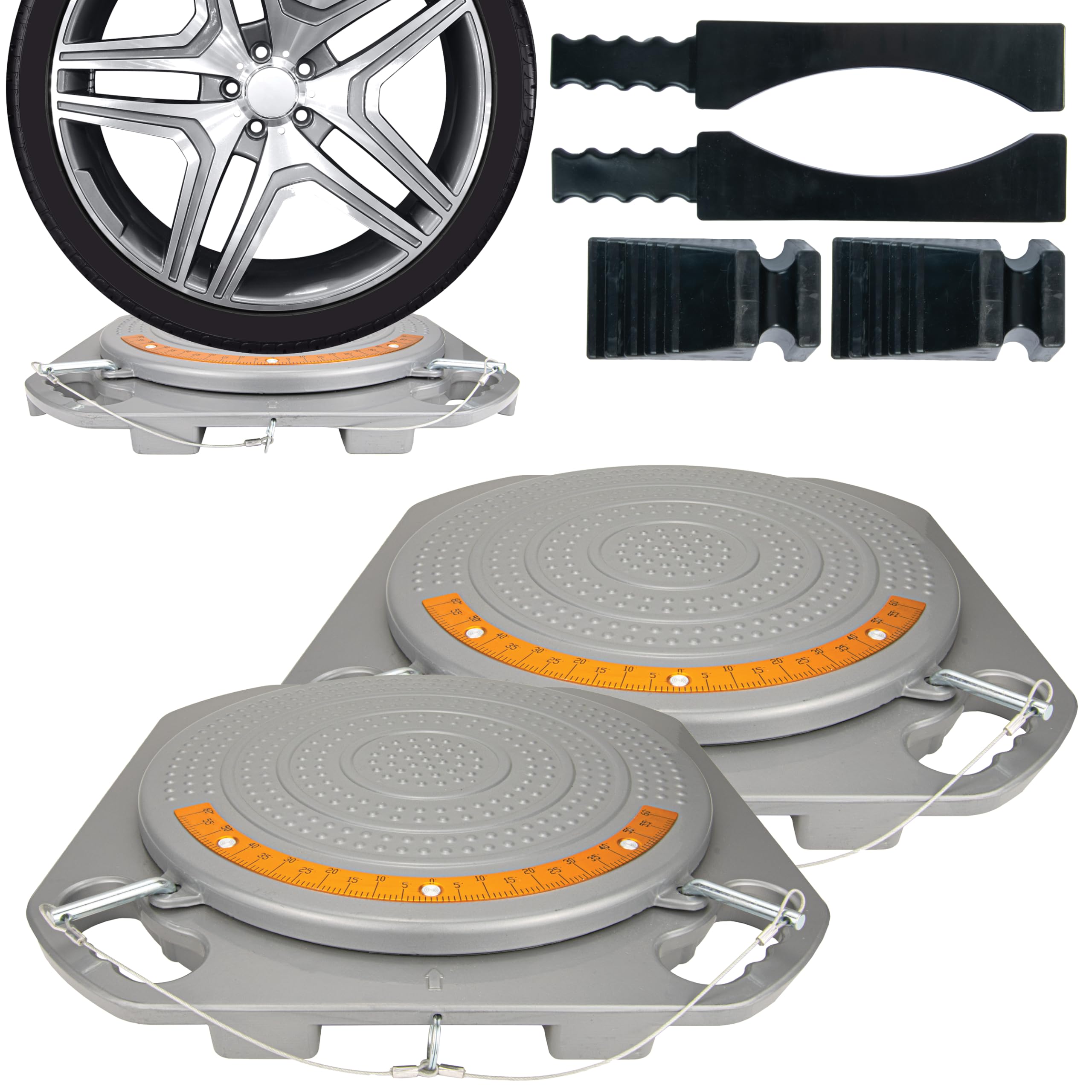
These are turn plates, not toe plates, and that difference is the whole reason they sit at the top. Each plate carries a 4-ton capacity per pair, so a passenger car or a full-size truck rolls onto them without you worrying about the plate taking a set. The brass dial reads in 1-degree increments and allows up to 60 degrees of rotation left and right — enough to sweep the wheels lock to lock and watch what the toe does as they turn.
Underneath, a 1-inch offset from the centerline leaves room for the wheel to travel as it steers. Heavy-duty locking pins hold each plate still while you work, which is what stops the plate from skating out from under the tire mid-measurement. Handle slots let you carry and position each plate without pinching your fingers, and the die-cast metal body with a powder-coated finish is built to shrug off garage abuse.
The set arrives with two wheel chocks and two transition bridges, so rolling a lowered or wide-track car onto the plates is less of a wrestling match. It weighs 30 pounds, which is heavier than a bare toe-plate set — that mass is why the plate stays put. The one thing to plan for is storage: at 15.75″ x 15.75″ x 2″ per plate, these want a shelf, not a toolbox drawer.
What wins people over
- Frictionless front-wheel rotation is the point of the tool, and it delivers — you can sweep the steering while the gauge stays readable.
- The built-in degree dial makes caster work straightforward instead of guesswork.
- Chocks and transition bridges are included, so no separate ramp purchase.
- 4-ton pair capacity covers passenger cars and trucks alike.
Where it asks something of you
- 30 pounds of metal means it lives on a shelf, not in a bag.
- It is one half of a system — you still need a toe plate set or a gauge to complete a full alignment.
- At 15.75″ square per plate, tight one-car garages will feel it.
Buy this if: you already run toe plates or a camber gauge and want the front wheels to move freely while you measure — this is the missing half of a real garage setup.
Pair it with: a stainless toe-plate kit; the 4-ton plates alone will not read toe for you.
2. VEVOR Wheel Alignment Tool 2-Pack Toe Plates
Seven pounds of stainless that folds flat and reads toe without pulling a wheel.
The headline number here is 7.28 pounds — the AutoSolo turn plates weigh 30, and that gap is the difference between a tool you store on a wall hook and a tool you leave on the floor. It also measures toe at the hub face with adjustable rods spanning 10.5″ to 21.2″, which skips the tire entirely so sidewall lettering and bulges cannot throw your reading off.
Two 5m tape measures come in the box with 1/32″ increments, plus a conversion chart so you can turn an inch difference into degrees. The magnetic slots grab the tape head and hold it there, which is the quiet feature that matters most when you are working alone and out of arms. The triangular base with non-slip rubber keeps the thing from shivering while you read.
The all-steel construction replaced aluminum, so the plates resist bending and rust better than the softer older design. It fits hubs from 15 in through 20 in by the stated wheel-diameter limits, and 21 in and 22 in hubs are listed as all applicable. Its 22.83 x 8.19 x 1.38 inch footprint is far longer than the 16.93 x 5.12 x 0.79 inch VEVOR carbon-steel kit below, so check your storage before you commit.
Where it lands: a single-person, no-wheel-removal toe kit at a genuinely low entry point, with the magnetic tape slots doing the work a second pair of hands normally would.
The honest caveat: it is toe only. If camber moved when you swapped suspension, you will want a digital angle gauge alongside it.
Reach for this if: you want accurate toe readings without jacking the car up or owning a second tool.
Look elsewhere if: your hubs fall outside the stated 15-22 in range or you need camber from the same kit.
3. Upgraded Wheel Alignment Tool 2 PCS
Extension pieces mean you clamp on and measure instead of pulling brake calipers first.
For anyone who dreads the caliper-removal step, this is the kit that quietly deletes it. The versatile extension pieces let you seat the plates and start measuring immediately, so the job stays a driveway task rather than a lift job. Two 16.4-foot imperial tapes come with 1/32 of an inch accuracy, and the tapes read the distance between coaxial wheels directly.
The reinforced core is the upgrade worth knowing about — thicker components carry the load better and hold shape through repeated sessions compared with the thinner original design. The plates break down to a compact 16-inch size and hang from an integrated hole, so a wall in the garage or the side of a toolbox is enough storage. Iron construction with a rust-resistant painted finish keeps it serviceable on a concrete floor.
Fitment is broad by design: Jeeps, sedans, trucks, SUVs, dirt bikes, and UTVs/ATVs, with the nut size listed at under 15mm. That last figure is the one to check against your own vehicle before ordering, because a nut over 15mm will not seat on these plates. Owners praise the build quality most and functionality close behind, describing a tool that behaves the same on the tenth job as the first.
Why it earns its spot
- No caliper removal — the biggest time sink in DIY toe work, gone.
- 1/32 in tapes give you a finer step than 1/16 in kits.
- Collapses to 16 in and hangs on a wall.
- Covers dirt bikes and UTVs as well as cars and trucks.
What to know before you buy
- Nut size limit of under 15mm rules out some heavier truck hardware.
- Assembly is part of the routine, and durability talk is split — some find it sturdy, others hit assembly friction.
- At 10.01 pounds it is the heaviest toe-plate set here, so it is not a pack-along tool.
Best fit for: the home wrencher who wants accurate toe without touching the brake calipers.
The trade-off: verify your lug nut size first — under 15mm or this plate will not seat.
4. VEVOR Wheel Alignment Tool Carbon Steel
Camber and toe from one carbon-steel set, with a magnetic gauge that sticks to the disc.
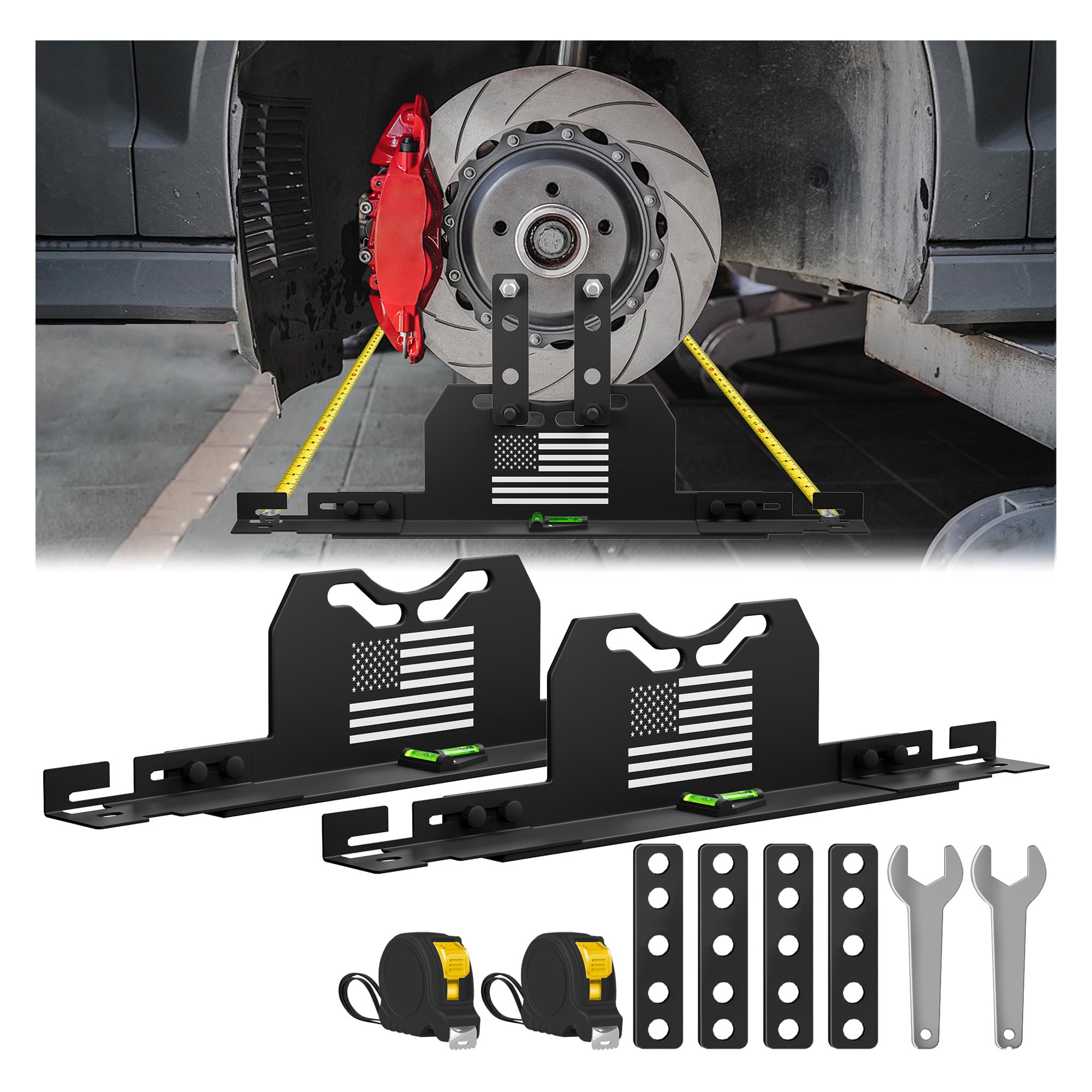
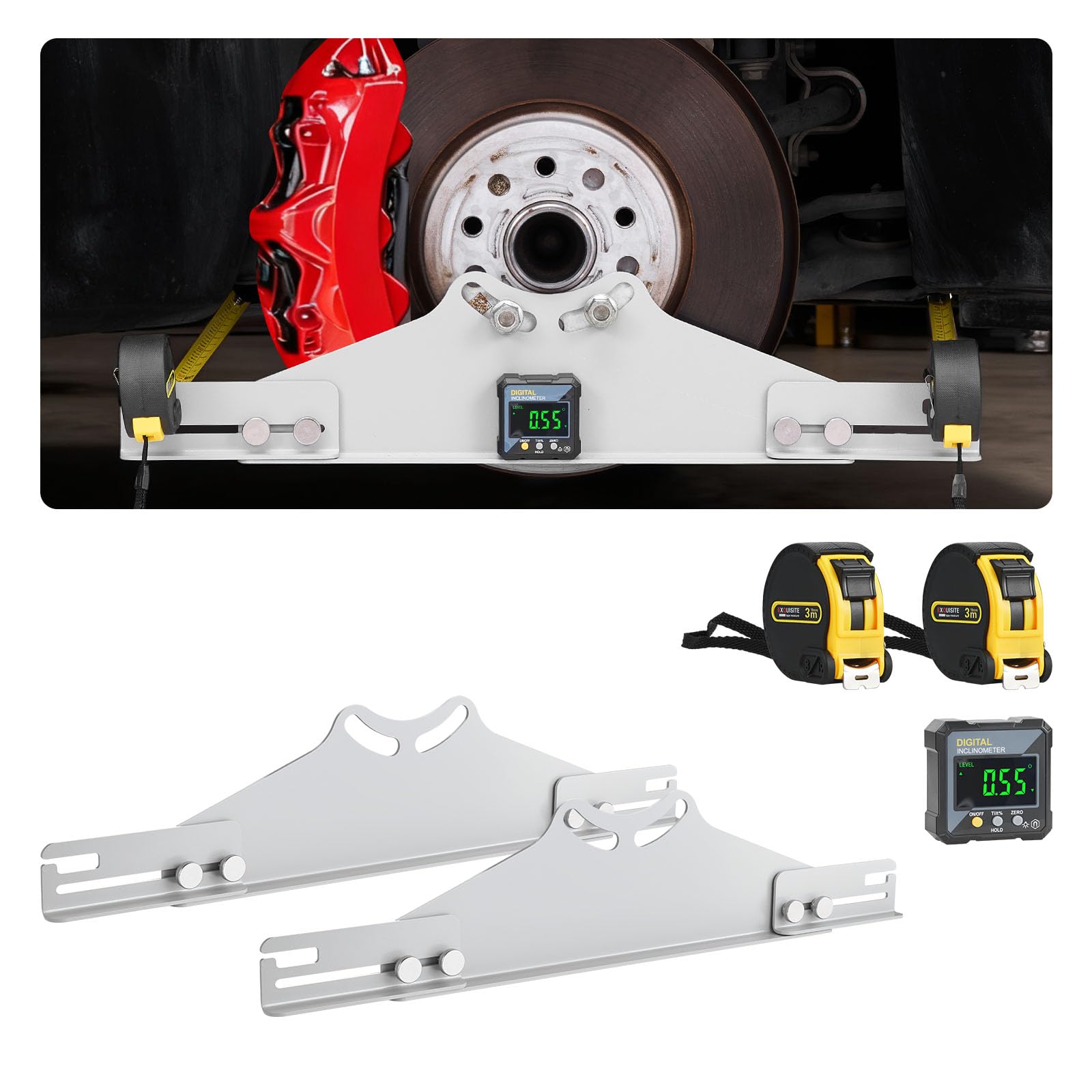
Here is the upgrade that changes what jobs you can finish: the kit includes a magnetic digital angle gauge accurate to 0.2°, and it clamps to the brake disc to read camber directly. That is far finer than eyeballing a bubble level, and it means a strut or control-arm job does not send you to a shop for the camber half. Two imperial tapes at 16.4 ft with 1/16 in accuracy handle the toe side.
The plates mount to the brake disc hub and are unaffected by tire bulges or sidewall markings, which is the same rim-referenced logic that makes a reading trustworthy. Raised panels give the tape extra clearance to run under the vehicle, and the adjustable length of 20.1-24.0 in (510-610 mm) with universal bolt holes covers most sedans, trucks, and SUVs. Carbon steel with a baked enamel finish resists deformation as well as water and oil.
Compare the storage numbers and this kit is the tidier one: it measures 16.93 x 5.12 x 0.79 inches against the 22.83 x 8.19 x 1.38 inches of the stainless VEVOR set above, so it tucks into a shorter slot on the shelf. At 7.72 pounds it is easy to carry out to the driveway. The gauge accuracy is what serious home mechanics chase first in this category, and 0.2° is the number that puts this above the toe-only kits.
The case for it: toe and camber in a single purchase, with the gauge doing the job a bubble level cannot — accurate to 0.2° rather than a glance-and-guess.
The catch: the tapes read to 1/16 in, a coarser step than the 1/32 in tapes on the PICURA and Tenhulzen kits, so ultra-fine toe trims take more care.
Worth it for: anyone who has just replaced suspension parts and needs camber as well as toe.
Think twice if: your only goal is toe and you would rather have the finer 1/32 in tapes.
5. Wheel Toe Alignment Tool Kit
A mechanical kit with a digital level and a bag, aimed at rough adjustments after a repair.
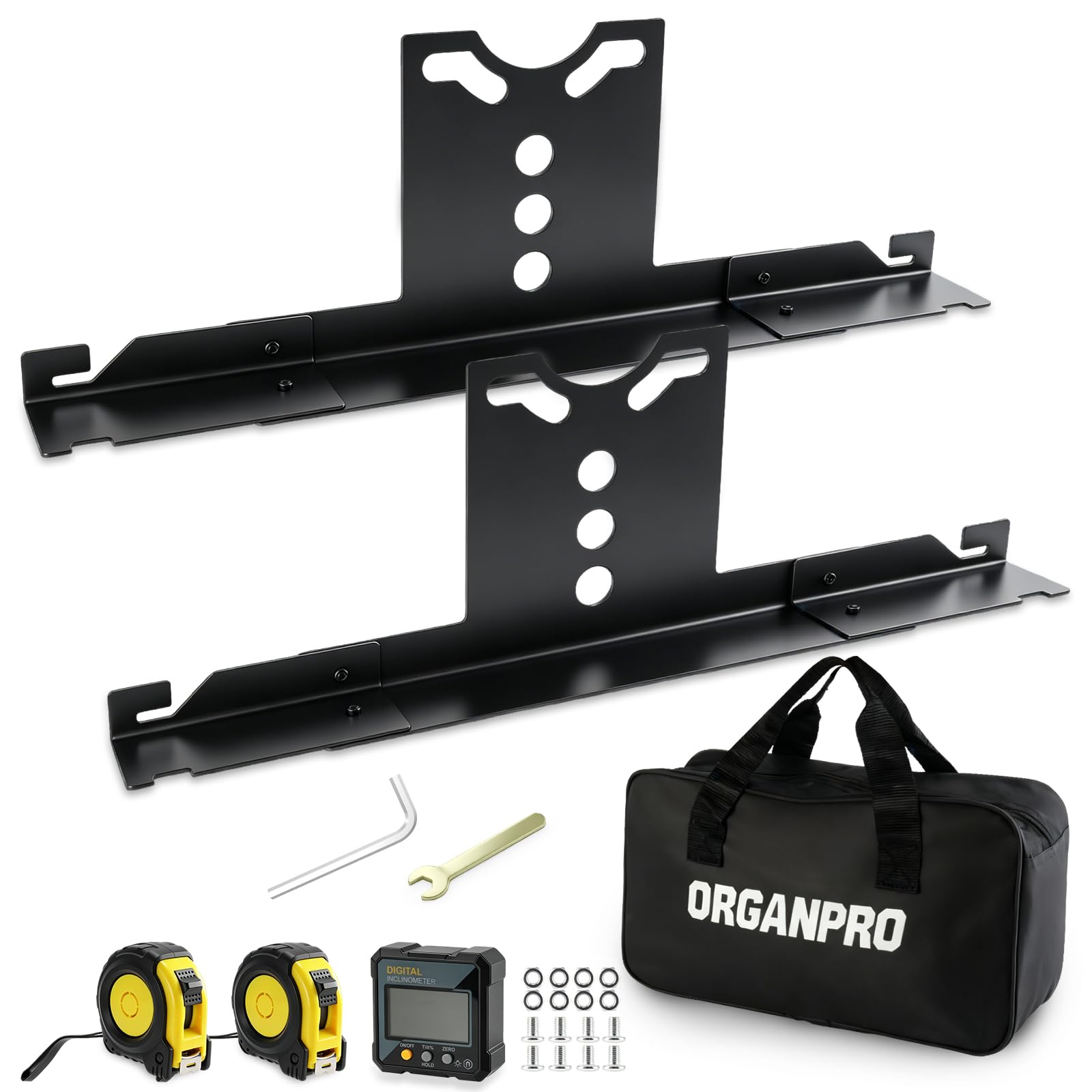
The manufacturer is refreshingly direct about what this is: a tool for restoring basic settings and making rough adjustments after you replace suspension components, steering links, tires, or shocks. It is not, by their own words, a replacement for a high-precision computer four-wheel alignment system, and it is not meant for fine-tuning complex multi-link suspensions. That honesty places it clearly: a driveway corrector for rough post-repair resets, not a shop alignment machine.
The build is 2mm-thick industrial-grade steel, engineered to resist deformation and corrosion, and the digital angle instrument gives clearer data than a traditional spirit level. Assembly tightens down in under a minute, and the included storage bag keeps the plates and tapes together. The idea is simple: attach plates to the brake rotor with the tire off, hook dual tapes to compare wheel distances, and adjust.
One number to take seriously before you buy: the maker notes the tape measure may carry a margin of error of 1 mm, and says plainly not to purchase if that is a concern. For a rough post-repair reset that tolerance is fine; for chasing a factory toe spec to a tenth of a degree it is not. Fitment covers most cars, SUVs, trucks, ATVs, SxS, and dirt bikes, with the nut size listed under 17mm.
Pick this up if: you want an inexpensive mechanical kit with a bag to reset settings after your own suspension work.
Pass on it if: you need repeatable precision — the stated 1mm tape tolerance puts a ceiling on how fine you can go.
6. Toe Alignment Tool Toe Plates
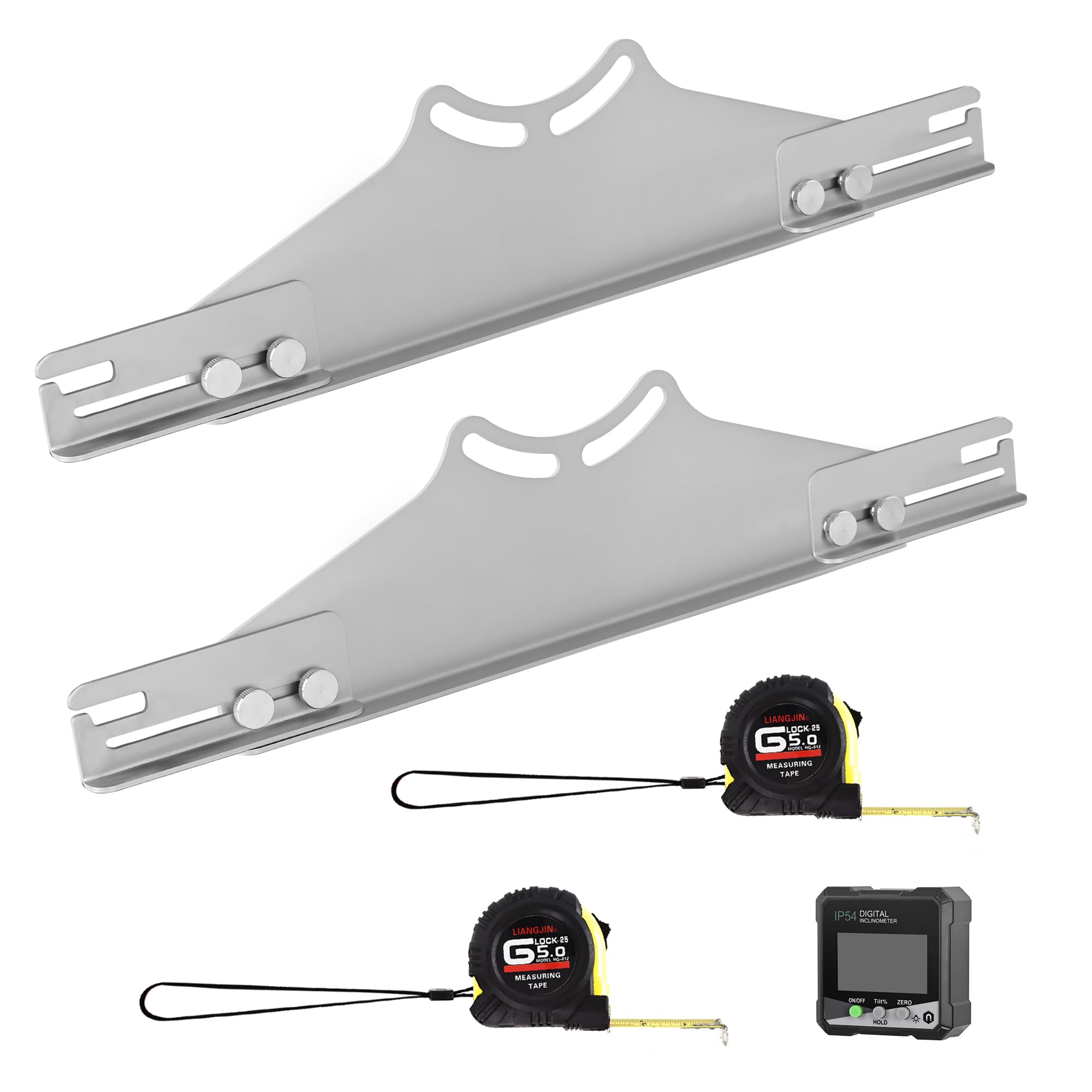
Raised plates let the tape run under the car, and the angle finder reads to 0.2°.
The heightening design is the practical detail most people miss on a spec sheet. Because the plates stand the tape off the ground, the measure stretches under the vehicle without snagging on the floor or the subframe. Two tapes and a digital angle finder with 0.2° accuracy come with it, so camber moves are measurable alongside toe.
Heavy-duty steel with a powder coating gives it strength and a rust-proof surface that holds up to a concrete driveway. The workflow is the standard one — remove the wheels, attach each plate to the hub, and use the tape and finder to set the alignment. What owners consistently praise is the build quality, with the tape measures drawing specific credit for their precision.
Fitment is the one thing to verify closely. The kit is built for vehicles using M14 wheel bolts, and it lists SUVs, Jeeps, ATVs, UTVs, and golf carts, but some buyers hit fitment snags, so match the M14 spec to your own hardware first. At 7.94 pounds it is light enough to carry out and hang up afterward. There is also a genuine diagnostic use here — the tool is reported to have helped track down a bent trailing stabilizer, which is the kind of thing a tape and two plates can expose.
Why owners keep it
- Raised plate design lets both tapes run under the car cleanly.
- 0.2° digital angle finder covers camber in the same session.
- Powder-coated steel holds up on a concrete floor.
- Light enough at 7.94 pounds to set up and stow alone.
Check before ordering
- M14 bolt fitment is the gate — it does not suit every vehicle.
- Fitment issues are the recurring note, so measure your hardware first.
Best suited to: M14-bolt cars and trucks where you want toe and a 0.2° camber read in one go.
Not the one for: vehicles outside the M14 spec — start with the PICURA kit instead.
7. 3-in-1 Toe Alignment Plates
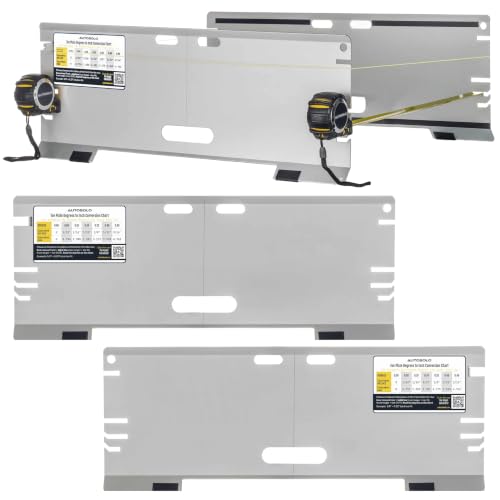
Toe, steer ahead, and thrust angle from one stainless set you can use with the wheels on.
Toe is half the story for a car that pulls or a wheel that sits off-center, and this kit measures the other half. Three readings come from one set: toe in or out, steer ahead (whether the steering wheel is centered relative to travel), and thrust angle (whether the rear axle is square to the centerline). A non-zero thrust angle means the rear is steering the car, and no basic toe-plate kit will show you that.
You get two ways to run it. The sidewall method keeps the vehicle on the ground with the wheel on — the kickout plate rests at three contact points on the outer sidewall, foam strips protect the rim, and spring tension holds both tapes so you read to 1/16″. The hub-mount method pulls the wheels and drops machined 0.57″ / 1.45 cm slots over the lower two wheel studs, seating flush against the hub and fastened finger-tight with the existing lug nuts.
A cut-out slot at the bottom of each plate clears the AutoSolo turn plates, so if you pair these with the 4-ton turn plates above, the plates sit flush while you steer the wheels and check steer ahead. The set includes two plates, two tapes, a string kit, and a manual, and at 5 pounds it is the lightest pick here. Owners talk about value most, then how the three readings hold up in a real session.
The argument for it: three measurements — toe, steer ahead, thrust angle — from one stainless kit, which no toe-only set here can claim.
The honest limit: it tops out at 1/16″ readings, so a few buyers find the durability conversation split; treat the tapes as the precision ceiling, not the plates.
Go with this if: your car pulls or tracks crooked and you want to find out whether it is toe or the rear axle.
Leave it if: you only ever touch front toe — a simpler plate set does that job for less.
8. Toe Plates Wheel Alignment Tool – – Made in USA

Measures off the wheel rim instead of the tire, so sidewall bulge cannot skew the read.
Most toe plates press against the tire, which means a bulging sidewall sits between you and a true number. This set reads from the wheel rim itself, so the tire is out of the equation. The package carries two high-resolution tapes with 1/32in increments, and a degree-to-inch conversion chart lets you turn your measurement into a spec number without doing the math yourself.
The details are where the design shows: specially cut slots stop the ends of the tapes from falling out mid-measurement, and everything snaps together for storage with no case needed. That matters if you are tight on shelf space and want the kit to live in a corner rather than a cabinet. Owners single out build quality first and functionality second, the pattern of a tool that holds up job after job.
What you should expect going in is the stability question. The plates are reported to wobble or fall over for some users, particularly during setup, so plan on a flat surface and a little care with positioning. Buyers report finishing an alignment in about 20 minutes and the plates paying for themselves across jobs.
What earns the extra money
- Rim-referenced measurement removes tire deformation from the reading.
- 1/32in tapes and a degree-to-inch chart take the arithmetic out of the job.
- Cut slots hold the tape ends — no fishing for the hook.
- Snaps together with no case required.
The honest trade-off
- Plates can wobble or tip during setup — work on level ground.
- Rim indexing takes a little more care to seat than a sidewall plate.
- Price sits well above the entry toe-plate kits.
Made for: the buyer who wants rim-accurate toe readings and does not mind spending a little time getting the plates seated.
The honest caveat: stability is the thing to manage — a level surface makes the difference.
9. 2-Wheel Alignment Tool

Camber, caster, and toe from one stand-off gauge — and no turn plates required.
The number that justifies this kit is the camber figure: accurate to within 0.1 degrees, which the maker points out beats a bubble gauge by a clear margin. It is the finest accuracy claim in this whole group — the 0.2° digital gauges on the VEVOR and PHATRIP kits are coarser — and for caster it manages without expensive turn plates at all, which saves you buying the AutoSolo pair as well.
Patent-pending wheel stand-offs are the mechanism that keeps the tool square to the wheel, and that is where the accuracy comes from. Detailed step-by-step video instructions walk you through the process, which is meaningful if you have never adjusted caster — it is the angle most home mechanics have no idea how to touch. It runs on one 9V battery, included.
At 5.88 pounds it is light enough to lift onto the wheel without help. The honesty landmine here is instructions: the online video is what makes it click, but the box is light on paper directions, and measurements are reported as not always repeatable for some users. Owners praise its function first and ease of use second, while opinions on value split. In short, expect to work carefully and lean on the video.
What sets the ceiling: 0.1° camber accuracy and caster without turn plates — the most complete angle coverage here from one tool.
Where it asks for attention: paper directions are thin, so the video is the instruction manual, and repeatability takes a steady hand.
For the serious home mechanic: you want camber, caster, and toe with the tightest stated accuracy and no turn plates to buy.
Not for the casual tuner: if you have never set caster and want printed steps in the box, start simpler.
Know the Specs
Toe and toe angle
Toe is the difference in distance between the front and rear edges of your paired wheels. Rear tape longer means the wheels point inward, which is toe in; front tape longer means toe out. You measure the difference, then convert it to degrees with the chart. Toe in or out is what scrubs tread and makes a car wander, so it is the setting a toe plate is built to catch.
Camber and caster
Camber is how far the top of the wheel tilts in or out of vertical, and it is read with a digital angle gauge stuck to the brake disc. Caster is the steering-axis tilt that affects how the wheel self-centers, and it normally needs turn plates unless the tool works around them. A kit that measures camber to 0.1° or 0.2° gives you a usable number instead of a rough guess.
Tape accuracy in inches
Your precision floor is the tape marking, not the plate. A 1/32 in increment gives you a finer step than 1/16 in, and since toe is a small difference between two big numbers, that step adds up. Fine increments help when you are dialing in a factory spec; coarser is fine for a rough reset after a repair.
Hub mount vs sidewall and rim reference
Hub-mount plates bolt over the wheel studs with the wheel off, which isolates toe from tire deformation and needs a jack. Sidewall plates press on the tire with the car on the ground, which is faster but reads through the tire. Rim-referenced plates split the difference by indexing off the wheel so bulge cannot skew the number.
Steer ahead and thrust angle
Steer ahead tells you whether the steering wheel is centered relative to the direction of travel — the classic off-center wheel. Thrust angle is the rear axle’s angle to the centerline, and a non-zero reading means the rear is steering the car, which you feel as a pull. Only a 3-in-1 style kit or a full system surfaces these.
Common Questions
Do I really need to remove the wheel to use a toe alignment kit?
What does 0.2 degrees of accuracy in a digital angle finder mean for me?
Will a toe plate set fit my lifted truck or a car with large wheels?
Can I do a full four-wheel alignment at home with one of these kits?
How accurate are the included tape measures?
What is the difference between toe plates and turn plates?
Do these kits include camber and caster or only toe?
What is thrust angle and why does it matter on a rear axle?
How do I convert an inch reading to a degree spec?
Are turn plates needed for caster?
The Bottom Line
For most home mechanics, the wheel alignment kit answer is the AutoSolo Turn Plates — 4-ton pair capacity, a 1-degree brass dial, a 1-inch centerline offset, and chocks and bridges in the box. It is the piece that lets the front wheels move freely so every other measurement is real. Pair it with the VEVOR stainless toe plates for a complete two-tool setup, or grab the VEVOR carbon-steel kit if you want camber from a 0.2° digital gauge in the same purchase. And if you need to know whether the rear axle is square, the AutoSolo 3-in-1 toe plates are the only set here that reads thrust angle.
If your goal is simply tocorrect an off-center wheel or a knackered toe setting, the PICURA Upgraded Toe Plates are the sensible buy — they delete the caliper-removal step entirely and read to 1/32 in. Verify your lug nuts sit under 15mm first, and check hub coverage on the VEVOR stainless set if you drive something large. For the tightest camber number in this group, the Tenhulzen 2-Wheel All-in-One quotes 0.1° accuracy and skips turn plates for caster. Whatever you choose, match the kit to your hub size and your tape-reading patience.
How we choose
We do not accept paid placement. Every pick is matched to a real buyer and a real use-case; we do not hands-on test units.
Sources
Specifications: manufacturer listings and product documentation. Review insights: verified customer reviews, as of November 2026. Pricing: not shown on this page (it changes often); check the current price via the retailer link.
As an Amazon Associate, Tactical Gear Guy earns from qualifying purchases. This does not affect which products we feature.