Specs are compiled from manufacturer listings and verified buyer reviews and can change over time — please confirm the key details on the product page before buying.
If your glasses leave red marks on your temples or slide forward every time you look down, you already know the real problem is frame width, not lens strength. A frame sized for a wide face spreads that pressure across the sides of your head instead of pinching it into two points. This shortlist covers four wide-fitting options that range from a headband-style reader that never gets lost to full-rim optical frames built around a 58 mm lens. Each one is here because its actual measurements suit a broader face, and each has a genuine trade-off worth knowing before you buy.
This guide is built by comparing the manufacturers’ published specifications and the patterns across verified customer reviews, so you get each pick’s real strengths and trade-offs instead of marketing spin.
Width is the number most buyers skip, and it is the one that decides whether a frame feels fine at the counter and painful by lunchtime. Here is what actually holds up on a wide head in wide glasses frames.
Top Picks
How To Choose The Best Wide Glasses Frames
Most people buy glasses by lens power and frame color, then wonder why the arms dig in after an hour. On a wide face, the fit comes from three measurements working together: the lens width, the bridge, and the arm length. Get those wrong and no amount of adjusting at the optician’s counter fixes it for long.
Read the numbers before the style
A frame is usually stamped with three figures, such as 58-16-145. The first is lens width in millimeters, the middle is the bridge that sits on your nose, and the last is the arm length reaching back to your ear. A larger lens width combined with a longer arm gives a wider overall frame. If you already own glasses that fit well, check those numbers first and stay close to them.
Adjustability beats a fixed size
Some frames let you change the fit rather than asking you to pick perfectly once. Telescoping temples pull out to add length, and a width dial at the back of the head can open or close the frame around a broader skull. That flexibility matters more than a single fixed measurement if your head sits between sizes or you share the glasses.
Decide if you need magnification or clear lenses
A reading frame comes with built-in magnification for close work, which suits books, labels, and screens held near. A clear optical frame is an empty shell that your optician fills with a prescription. Those are two different purchases, so know which one you are actually shopping for before you compare anything else.
Side-by-Side Comparison
| Model | Best For | Lens Width | Arm Length | Frame Type | Amazon |
|---|---|---|---|---|---|
| Clic Magnetic Reading Glasses Original Expandable (M-XL)★ Best Overall | Never losing your readers | — | Adjustable, plus 1/2″ extension | Rigid headband reader | Amazon |
| Optifine Oversized Blue Light Reader | Long desk sessions | — | — | Full-rim oversized reader | Amazon |
| Gucci GG0025O Optical Frame 002 Avana 56 mm | Style-first prescription build | 56 mm | — | Full-rim acetate optical | Amazon |
| Gucci GG 0424 O 005 Black | The widest spec of the group | 58 mm | 145 mm | Full-rim rectangular optical | Amazon |
Detailed Reviews
1. Clic Magnetic Reading Glasses M-XL
Our pick — 4.5+★ from 600+ verified ratings; the strongest balance of quality and price.
The reader that hangs around your neck instead of vanishing into a coat pocket.
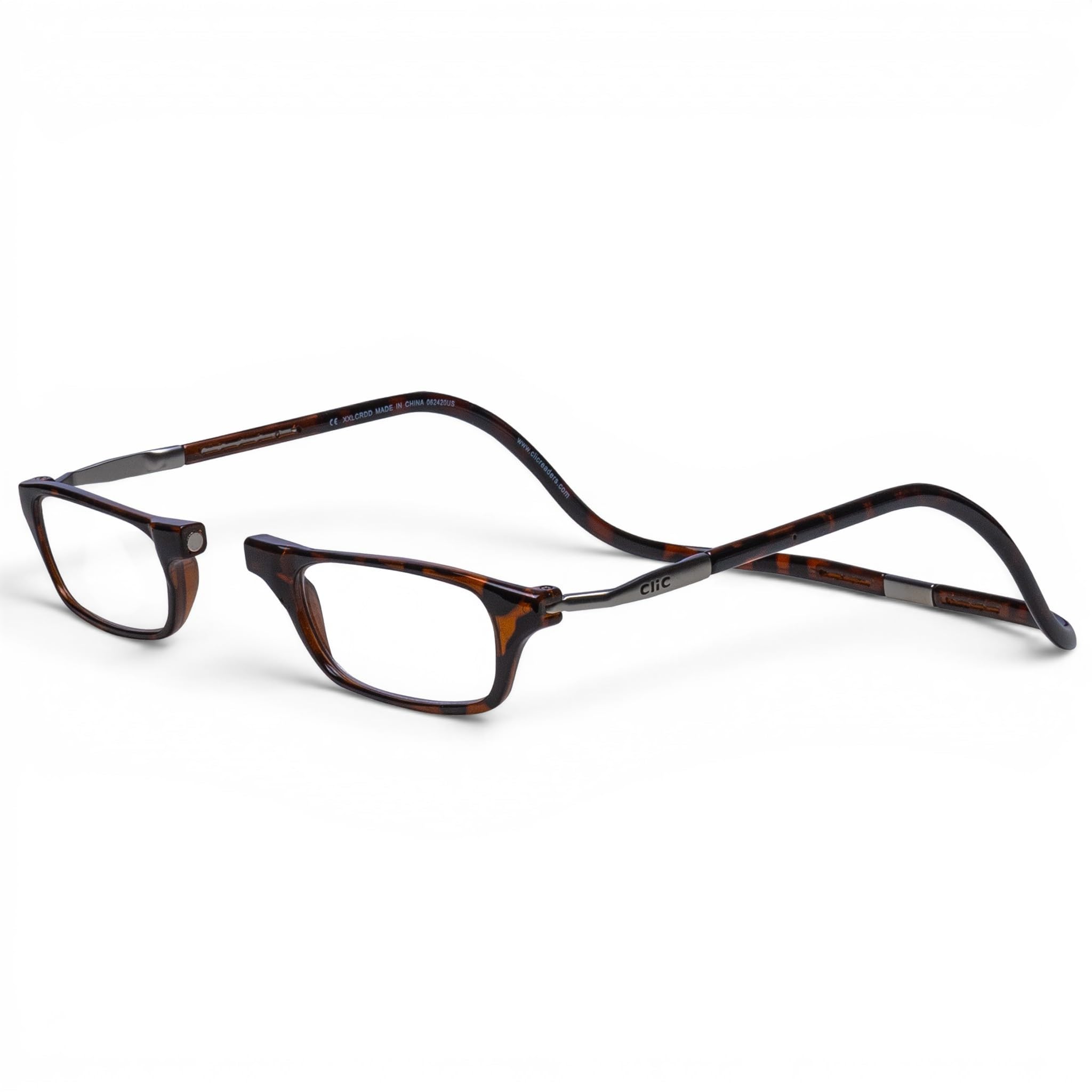
What makes this one worth owning on a wide head is the fit system, not the frame color. The Expandable version adds an extra 1/2″ of length and uses a 35° stem, which is an arm angle set to sit wider across your temples rather than clamp against them. Pull the temples to lengthen them, and turn the width dial at the back of the headband to open or close the frame around your skull. You are adjusting the frame to your head instead of hunting for the one size that happens to match.
The front of the frame splits away on neodymium magnets — strong small magnets that hold the two lens halves together — and the rigid TR90 headband keeps it draped around your neck when you take it off. That is the whole reason this pick leads: the glasses physically cannot get left on a counter. A 180-degree hinge lets each lens fold up and down, and the acrylic lenses are rated high-impact by the maker. This is a reading frame, so the magnification is built in and aimed at close work such as labels, phones, and books. It comes in M-XL here, with Regular (S-M) and Long (M-L) versions for smaller fits.
The honest catch is the shape itself. A rigid headband is not a folding pair you can slip into a shirt pocket, and the magnetic front means the two halves lift apart when you want them to. Buyers who want a conventional temple-over-the-ear frame should look elsewhere. What owners consistently value is the convenience — the frame is still around your neck at the next close-up task, standing or sitting. That is the trade: you gain a frame you cannot lose and give up a frame you can pocket.
Where the Clic earns its keep
- Magnetic front connection means the frame lives around your neck, not in a drawer.
- Adjustable temples plus a back-of-head width dial open the fit for a broader skull.
- The Expandable version adds an extra 1/2″ and a 35° stem for a wider feel.
- TR90 headband and a 180-degree hinge on each lens hold up to daily handling.
What you give up
- A rigid headband does not fold into a pocket the way standard temples do.
- Magnet halves separate on purpose, so it is not a frame you forget you are wearing.
- Reading magnification only — there is no clear-lens version here.
Reach for this if: you misplace readers constantly and want a wide, adjustable fit you can dial in around your own head.
Look past it if: you need a slim pair that folds flat into a case.
2. Anti Blue Light Blocking Reader Oversized Frame

An oversized reader built for long hours in front of a monitor, not just a paperback.
The lens does the work here. This is a blue light blocking reader — a filter built into the lens to cut down the blue part of screen light — so your eyes get some relief if you stare at a computer or phone most of the day. Optifine builds it as a full-rimmed frame in a clear tone, and the oversized shape is described as suited to a mid or big face. The bridge and temples are shaped to sit without pressing, and the full-rim frame is light enough to wear through a shift.
Where it beats the Clic above is straightforward: that pick is a rigid headband you wear around your neck, while this is an ordinary full-rim frame you can wear for hours at a desk. If you need magnification for reading, this covers that too, since it is a reading frame with blue-light filtering rather than a plain tinted lens. The honest limit is the lens opening, which runs narrower than the oversized label suggests. The oversized sizing works well for plenty of broader faces, but a few find the lens a bit narrower than they hoped, so it pays to check your own measurements against the frame before you commit.
Style is the quiet bonus: the clear-tone full-rim shape reads as modern specs, not a clinical accessory. The clear-tone full-rim shape reads as a modern pair of specs rather than a clinical accessory, which is why appearance sits right behind blue-light blocking as the thing buyers like most. Treat it as a light daily reader, not a rugged pair built to take knocks. Any eye-strain relief claims come from the maker, not from measurements taken here.
The desk-side logic: a lightweight oversized full-rim reader with blue-light filtering, priced as an everyday accessory, so you can leave a pair at the monitor and a pair in the bag.
Check your numbers first: the lens opening runs narrower than some wide-face buyers expect, so verify the frame dimensions against the pair you already know fits.
The fit call: buy it if late-night screen work and a mid-to-big face describe your day.
The one check: measure your current frame’s lens opening before you order, because the oversized label is not the same as a guaranteed wide fit.
3. Gucci GG0025O Optical Frame 002 Avana Avana 56 mm

A 56 mm avana frame that turns your prescription into a deliberate look.
Start with the number in the name: a 56 mm lens width gives this optical frame real presence across your face. It is a full-rim design in avana, the brand’s warm tortoise tone, and the maker lists premium cellulose acetate as the body material alongside titanium and stainless steel across the wider Gucci line. This is a clear optical frame, meaning the lenses are meant to be filled with your prescription rather than reading magnification baked in at the factory.
The pitch here is appearance first, which is what separates it from the two readers above. Buyers drawn to this frame tend to want a piece they keep and wear to the office, not a pair they leave by the monitor. The catch is that the fit gets mixed reactions — some find it exactly right on a broader face, while others run into sizing issues. With the lens at 56 mm it sits slightly narrower than the 58 mm Gucci below, so a very wide head should weigh that difference before choosing.
The frame arrives as the shell only. You still need to have lenses cut and set by your optician, which adds a step and a cost that reading frames do not carry. That is not a flaw in the frame; it is simply how an optical frame purchase works. If you want to walk out of a store already wearing your glasses, this is the wrong shelf for you.
Why pick it: a 56 mm full-rim acetate optical frame in avana for buyers who want the frame itself to carry the style, then have lenses built around it.
The fitting caution: fit reports split between perfect and simply wrong for a given head, so try to confirm the frame on your face before lens work begins.
Buy it when you want a designer clear frame and you are prepared to have prescription lenses fitted afterward.
Think twice if your head is on the widest end of the range, where the 58 mm frame below likely suits you better.
4. Gucci Eyeglasses GG 0424 O- 005 BLACK /, 58-16-145

The most generous measurements on this list, stamped right into the model name.
Those three figures tell the whole story: 58-16-145 means a 58 mm lens, a 16 mm bridge, and a 145 mm arm. Compared with the 56 mm frame above, this one gives you a wider lens across each eye and a longer arm reaching back to the ear — the geometry a broad head needs to avoid pressure points. It is a full-rim rectangular shape in black plastic with transparent lenses ready for a prescription, built for everyday office wear rather than a headband setup.
Black rectangular frames are the low-risk choice if you do not want to think about color matching every morning. The longer arm is the practical win — more length behind the hinge means the frame is less likely to press into the side of your head, the complaint that pushes most wide-face buyers into shopping in the first place. It is the same Gucci optical shelf as the 56 mm frame above, but the measurements here tilt more toward wearing comfort than pure style statement.
As with the previous frame, the catch is logistics: this is a frame only, and lenses come after a trip to your optician. There is also no run of user reports on this listing to lean on, so your confidence has to rest on the published 58-16-145 fit numbers rather than a crowd of owner impressions. If you are comfortable buying from the spec sheet, that is enough.
The measurement case: a 58 mm lens with a 145 mm arm — the longest and widest combination here — in a full-rim rectangular black frame built for office wear.
What to plan for: the frame ships empty, so budget a separate lens fitting before you can wear it.
Pick this one when the fit numbers matter most and you want the widest lens-and-arm combination on the list.
Choose the 56 mm frame instead if a softer avana finish appeals more than the black rectangle.
Know the Specs
Lens width, bridge, and arm length
These three figures, usually printed on the inside of a temple as something like 58-16-145, describe the frame in millimeters. Lens width is the opening across each eye, the bridge is the gap that rests on your nose, and arm length is the run back to your ear. Together they decide whether a frame spreads across a wide face or pinches it. A larger lens width and a longer arm give you more room to wear.
Adjustable temples and width dials
A fixed frame asks you to guess your size correctly once. An adjustable one lets you correct it. Telescoping temples pull out to add length, and a dial at the back of a headband opens or closes the whole frame. On a head that sits between standard sizes, this flexibility is what saves you from a frame that fits at the counter and hurts by afternoon. Look for a maker’s size chart to see how far the adjustment actually goes.
Common Questions
How do I know if a frame is wide enough for my face?
What does 58-16-145 actually mean on a glasses frame?
Can I wear a rigid headband reader like the Clic with a prescription?
Do blue light blocking readers actually reduce eye strain?
Will the Clic headband fit a very large head?
Is the 56 mm Gucci frame wider or narrower than the 58 mm one?
Do the Gucci optical frames come with lenses already in them?
Which of these wide frames is best for reading in bed or on the go?
How long do frames like these typically last?
The Bottom Line
For most people shopping for wide glasses frames, the winner is the Clic Magnetic Reading Glasses Original Expandable, because the adjustable temples and back-of-head width dial let you tune the fit to your own skull instead of hoping one size matches — and the magnetic front means the frame never gets left behind. If your wide face spends its days in front of a screen, the Optifine Oversized Blue Light Reader puts a blue-light filter in an oversized full-rim shape you can wear for a whole shift. And when you want a frame built around the widest measurements here for a prescription build, the Gucci GG 0424 O pairs a 58 mm lens with a 145 mm arm. Measure your current frame before you choose — width, not color, is what decides whether these actually feel right on your head.
How we choose
We do not accept paid placement. Every pick is matched to a real buyer and a real use-case; we do not hands-on test units.
Sources
Specifications: manufacturer listings and product documentation. Review insights: verified customer reviews, as of November 2026. Pricing: not shown on this page (it changes often); check the current price via the retailer link.
As an Amazon Associate, Tactical Gear Guy earns from qualifying purchases. This does not affect which products we feature.