Specs are compiled from manufacturer listings and verified buyer reviews and can change over time — please confirm the key details on the product page before buying.
If your old wired alarm is chirping at 3 a.m. or you are staring at a ceiling bracket you do not want to patch and repaint, the fix is simpler than you think. The right hardwired smoke detector slides onto existing wiring and keeps working on battery backup when the power drops. The picks below all run on 120-volt house current with a battery backup, and each one is matched to a specific kind of home and buyer.
This guide is built by comparing the manufacturers’ published specifications and the patterns across verified customer reviews, so you get each pick’s real strengths and trade-offs instead of marketing spin.
You will see which units slot into old Kidde or First Alert harnesses without a screwdriver fight, which ones interconnect across the whole house, and which trade a little convenience for rock-bottom fuss. Below is the clearest breakdown of best wire smoke detectors you will find for a straightforward replacement job.
Top Picks

How To Choose The Best Wire Smoke Detectors
A wired smoke detector only helps if it fits the hole and the wires already in your ceiling. Two things decide that before you ever think about brands: the voltage your house supplies, and the shape of the harness and mounting plate your old unit left behind. Match both and the swap is often a ten-minute job with a screwdriver and no drywall dust.
Match the harness before you match the brand
Most homes built for wired alarms run 120-volt AC current to a plug-in harness tucked behind the ceiling plate. Many replacement units ship with a harness that plugs straight into that same connector. If your old unit was a Kidde or First Alert, staying in that family is the safest bet for a plug-and-play fit. Check the model number stamped inside your old alarm lid before ordering — that one detail saves the most returns.
Ionization versus photoelectric sensing
An ionization sensor (a chamber that reacts to fast, flaming fires) is the classic hallway and bedroom choice. A photoelectric sensor (one that watches for smoke particles scattering a beam of light) tends to react faster to smoldering, smoky fires and is the better neighbor to a kitchen. Neither is “wrong” — many whole-home setups mix both across rooms.
Interconnection limits and battery backup
Interconnection means when one alarm sounds, the wired alarms on the same circuit sound too, so a fire in the basement wakes you upstairs. The catch is a hard cap. One pick here connects up to 24 devices with 18 of those able to be the initiating alarm; another caps the network at 12 alarms. Count your ceilings and plan the whole-house network before you buy, not after.
Battery backup keeps the alarm live when the mains power fails. A 9-volt backup is the common standard, and AA cells show up on a few models. Whichever you get, note the manufacture date stamped on the unit — most smoke alarms should be replaced around the ten-year mark from that date.
Side-by-Side Comparison
| Model | Best For | Sensor Type | Alarm Loudness | Unit Count | Amazon |
|---|---|---|---|---|---|
| First Alert 9120B 5-Pack★ Best Overall | Whole-home swap in one box | Ionization | 85dB | 5 Count | Amazon |
| Kidde SMACFEX I4618ACBest Single Replacement | Single-unit replacement | — | — | 1 Count | Amazon |
| First Alert SM6W01 3-PackBest Multi-Room Set | Landlord-friendly multi-room set | Ionization | Audible | 3 Count | Amazon |
| First Alert SA521CN-3ST | Wireless interconnect networks | Photoelectric | 85dB | 1 Count | Amazon |
| Kidde I12040 | Big interconnected systems | Ionization | Visual | 1 Count | Amazon |
| Siterlink GS562A 4-Pack | New-build whole-property sets | Photoelectric | Audible | 4 Count | Amazon |
| SITERWELL GS562A | Quiet-night do-not-disturb mode | Photoelectric | Audible (85dB+) | 1 Count | Amazon |
Detailed Reviews
1. First Alert 9120B Smoke Alarm 5 Pack
Our pick — 4.5+★ from 450+ verified ratings; the strongest balance of quality and price.
Five hardwired alarms in one box, so the whole upstairs gets replaced in a single afternoon.
The number that wins this pick is the 5 Count box. You get five complete 120-volt hardwired alarms with a 9-volt battery included in each one, and that alone makes it the sensible choice for a homeowner with more than one ceiling to handle. It is the crowd favorite here — 4.5+ stars across 400+ ratings — and what wins people over is straightforward construction quality, not a gimmick.
The alarm sounds at 85dB, loud enough to wake a heavy sleeper behind a closed bedroom door. Each unit runs on 120-volt AC power with a 9-volt battery backup (an internal cell that keeps it guarding the room during an outage). It uses an ionization sensor (a chamber tuned to fast, flaming fires), which is the classic choice for hallways and bedrooms.
What makes the replacement easy is the wiring. The unit connects to existing house wiring and drops into existing mounting brackets, so the ceiling plate you already have usually works. Buyers report it went in without drama and that the included batteries meant no extra trip to the store. Tamper-resistant locking pins and a single-button silence/test control round out the everyday handling.
Here is the honest catch. This is a five-pack, so if you only have one ceiling to fill, you are buying four spares. That is fine for a rental turnover, less so for a single-ceiling fix.
Where this five-pack earns its keep
- Five alarms in one box covers a whole upstairs or a rental turnover in one order
- 85dB alarm is loud enough to wake a heavy sleeper in an average bedroom
- 9-volt battery included in each unit, so no separate battery run
- Tamper-resistant locking pins help deter theft in shared or rental buildings
The practical head-scratchers
- Five units is more than a single-ceiling fix needs
- Ionization sensing is the hallway standard but not the kitchen-friendly pick
- Battery-only backup means the 9-volt cell still needs checking
Reach for this if: you have several ceilings to fill and want one consistent alarm across the house.
Look elsewhere if: you need exactly one alarm or a photoelectric sensor for a smoke-prone kitchen.
2. Kidde SMACFEX Smoke Alarm
One alarm, one model number, purpose-built to slot in where an old Kidde used to live.
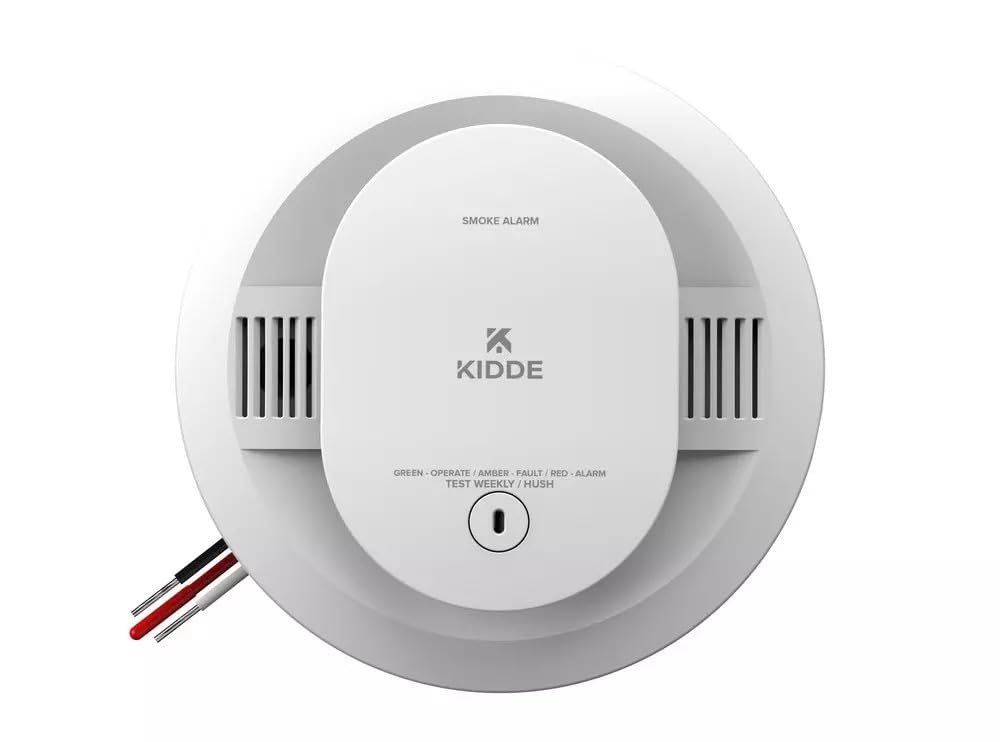
This is the pick for the homeowner with a single dead unit and a model number on the old lid. The SMACFEX is a 120-volt hardwired detector with battery backup, sold as one unit, and it is tuned to be a direct replacement rather than a redesign project. Buyer consensus lands on exactly that: it fits, it works, and the job is done.
The body is a white plastic enclosure at 2″D x 5″W x 5″H (depth, width and height), a footprint that matches the common ceiling cutout and makes the swap close to drop-in. At 12.32 ounces (a little over three-quarters of a pound) it is light enough to hold one-handed while you route the wires — handy on a step stool. It runs off corded electric power with a battery backup so it keeps working through an outage.
The one honest caution is compatibility. The replacement quality and reliability come through clearly in owner feedback, but the interchangeability and compatibility side is more mixed. Some older Kidde harnesses and brackets line up perfectly, and some do not. The model number on your old alarm is the deciding detail — check it against the I4618AC harness before you order.
My read on reliability: this is the classic “replace the dying one with the same thing” pick, and owner experience backs it — a straight, quiet swap when the model number matches.
The one detail to check: the harness plug on your old Kidde. If it matches the I4618AC, installation is a small job; if not, you will be the person doing the wire-nut dance.
Your call: buy this when you are replacing one aging Kidde and want the wiring to line up.
Hold off if: you are swapping a whole house or an unfamiliar brand — start by confirming the harness first.
3. Hardwire Smoke Alarm with Battery Backup SM6W01 (3-Pack)
Three alarms that drop straight onto the old wiring and stop the old model’s nuisance-chirp routine.
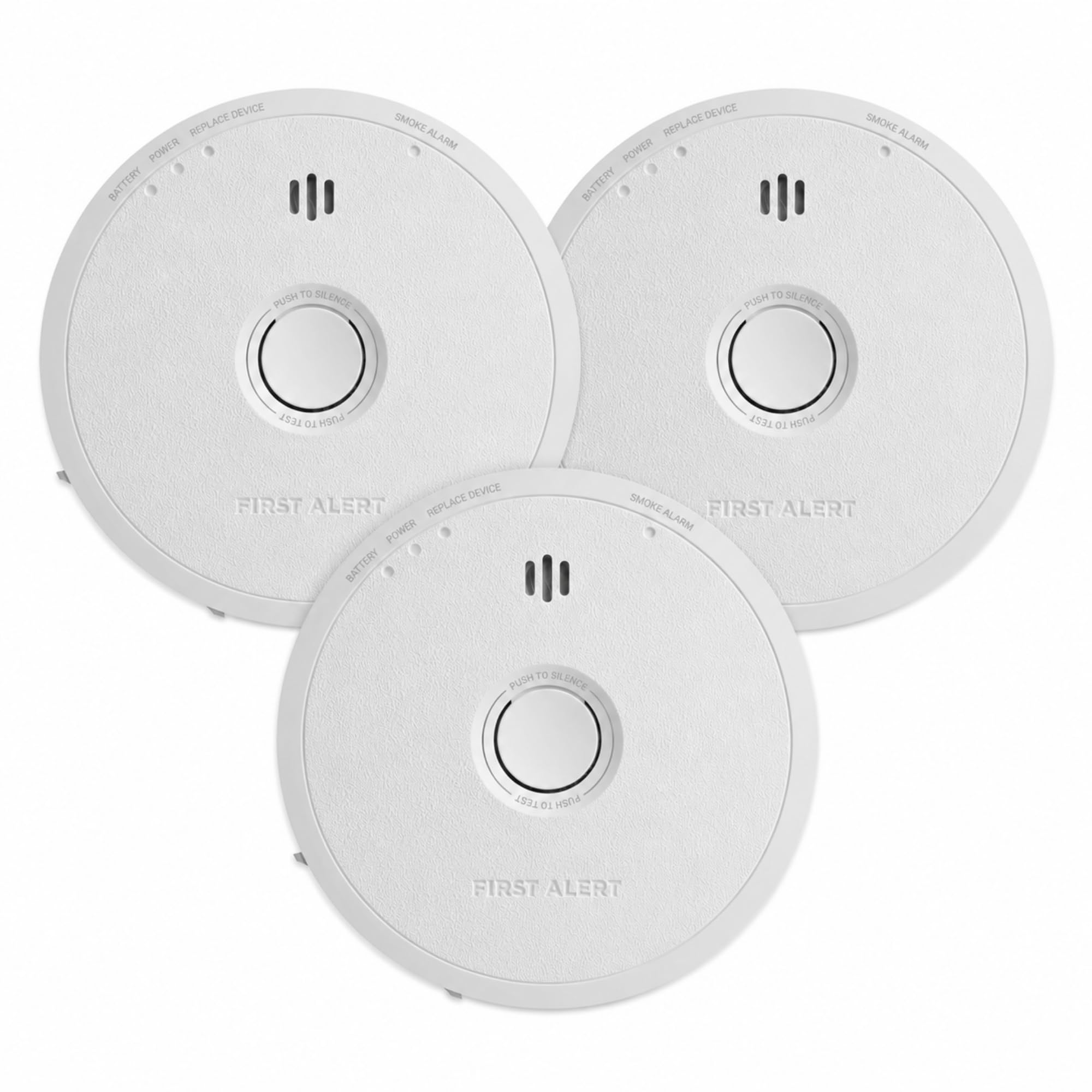
If your house is due for a full alarm refresh and you want the same model in every room, this 3-pack is a tidy middle ground. Owner feedback centers on it working as advertised and fitting old wiring accurately enough that the install is a straight swap. It is an ionization sensor alarm with 9-volt battery backup, sold as a 3 Count set.
The size is what surprises people first. This unit measures 6″D x 2″W x 6″H (depth, width and height), and at 16 ounces it is noticeably chunkier than the Kidde Hardwired Smoke Detector two picks down, which measures 1.88″D x 5″W x 5″H and weighs 12.8 ounces. That extra bulk is mostly housing, but it matters if your old ceiling plate has a tight trim ring.
The functional side is where buyers seem happiest — the units work as expected and the accurate wiring match means less fiddling on a ladder. The included 9-volt battery is a nice touch that saves a store run. Where owners do grumble is battery life; the 9-volt backup is not a forever cell, so plan to check it at daylight-saving time each year.
Why it makes the shortlist: one order, three matching alarms, and an accurate wiring match that keeps the job short.
The catch to size up: a 6-inch footprint and 16 ounces of housing is more than the compact Kidde models, so measure the trim ring before ordering.
Suits you if: you have three ceilings to fill and want every alarm to match.
Pass if: your old plate has a tight trim ring or you only need one alarm.
4. FIRST ALERT SA521CN-3ST Smoke Alarm

The hardwired alarm that talks to the rest of the house without a single extra wire run.
This is the one for a home that already has wired alarms but wants a linked network without pulling cable into the far bedrooms. It interconnects wirelessly with other First Alert–enabled alarms, and you can join up to 18 of them into one whole-home safety network. That is a genuinely different job than a plain wired unit, and it is why this pick sits above the basic replacements.
The sensor here is photoelectric, tuned to catch the larger smoke particles a smoldering fire throws off, which helps cut the number of false alarms from cooking. The alarm is rated at 85dB, and it runs on 120-volt AC with 2 AA backup batteries included for outages. It comes with a test/silence button, a low-battery warning, and an EZ access battery door so you are not fighting a bracket at 2 a.m.
The trade-off is real and worth saying plainly. Owner feedback on reliability splits — some report years of no issues, and some have random false alarms. It also weighs 10.4 ounces, so it is lighter than the First Alert SM6W01 3-Pack’s 16 ounces, which makes one-handed mounting easier. That lighter housing is welcome on a ladder, but the reliability split is the main thing to weigh.
What the network buys you
- Wireless interconnection links up to 18 First Alert–enabled alarms
- Photoelectric sensor is tuned for smoldering fires and fewer cooking false alarms
- Two AA backup batteries included for power outages
- EZ access battery door means no bracket removal at battery-change time
What to weigh
- Reliability feedback splits, with some units firing random false alarms
- Wireless linking only works with First Alert–enabled alarms
- Front cover design may vary between units
Pick this for: a home that wants linked alarms across rooms without new wiring.
Skip if: you are not already in the First Alert ecosystem or want a single standalone alarm.
5. Kidde I12040 Smoke Detector
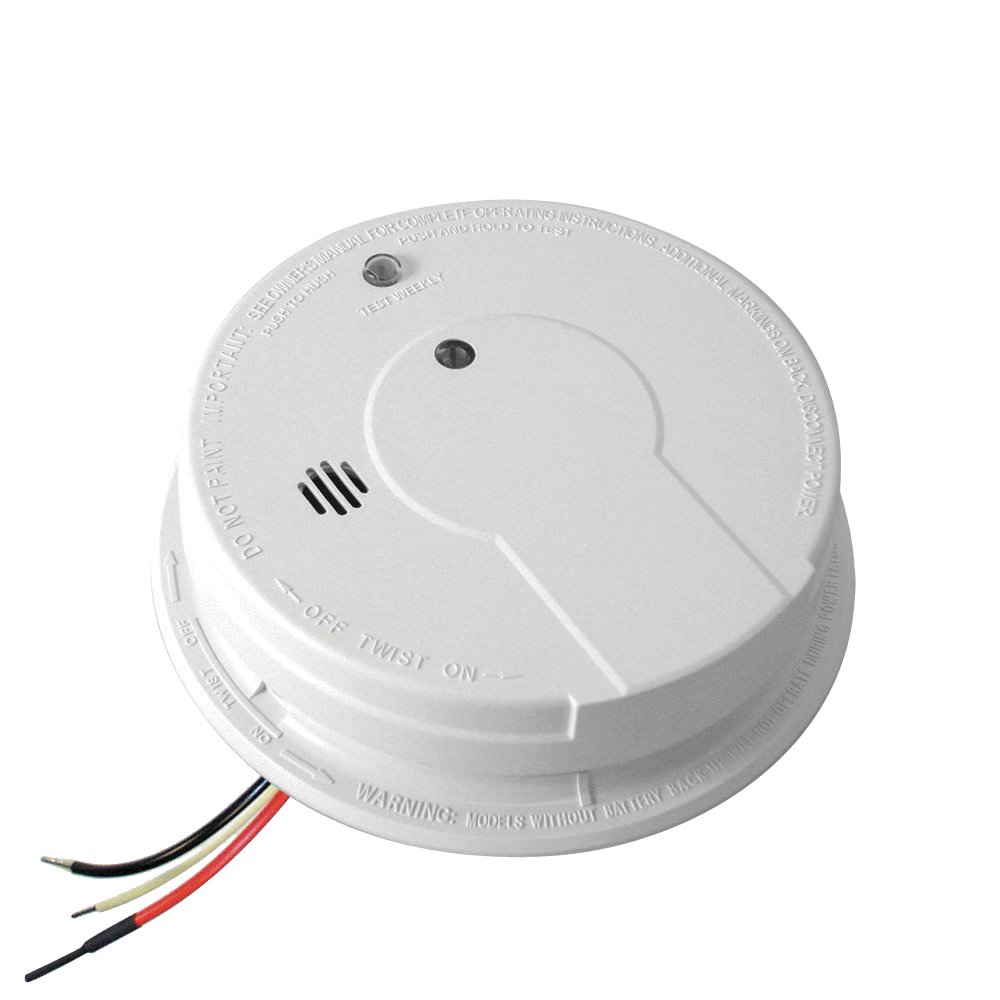
The connector’s alarm — one unit can tie into a 24-device network of smoke, CO and heat alarms.
Twenty-four is the number that defines this unit. It interconnects with up to 24 devices on the same circuit, of which 18 can be the initiating alarm, and that network can include smoke, CO and heat alarms together. In a larger home or a multi-level place, that headroom is exactly what you want when you are planning a full safety system rather than one ceiling.
Everyday handling is where this one shows its engineering. A front battery pull tab lets you activate the 9-volt battery without pulling the alarm off the bracket, and the pre-stripped wiring harness has an easy-off cap so you do not need a wire stripper. The tinned strands are meant to up conductivity and give the wire nut better grip, which is a small thing that matters at installation time.
There is also more here for quieter living. One button runs both Hush and the alarm test, the dust cover protects the sensor from construction debris, and battery run-down protection shuts off alarm memory when AC power drops to cut false low-battery chirps. At 13.6 ounces it is one-hand-mountable, and a visual alarm indicator rounds it out. The catch: 24-device networks need the right wiring and interconnection setup, so read the guide before you plan.
The installer’s detail: that pre-stripped harness with the easy-off cap is the feature that turns a two-hour job into a twenty-minute one.
Who this suits: a large home or a planned smoke, CO and heat network that needs real interconnection headroom.
Choose this when: you are building or expanding a big linked alarm system and want room to grow.
Pass when: one hallway alarm is all you need — this unit is built for the network, not a single ceiling.
6. Kidde Hardwired Smoke Detector 2 Pack
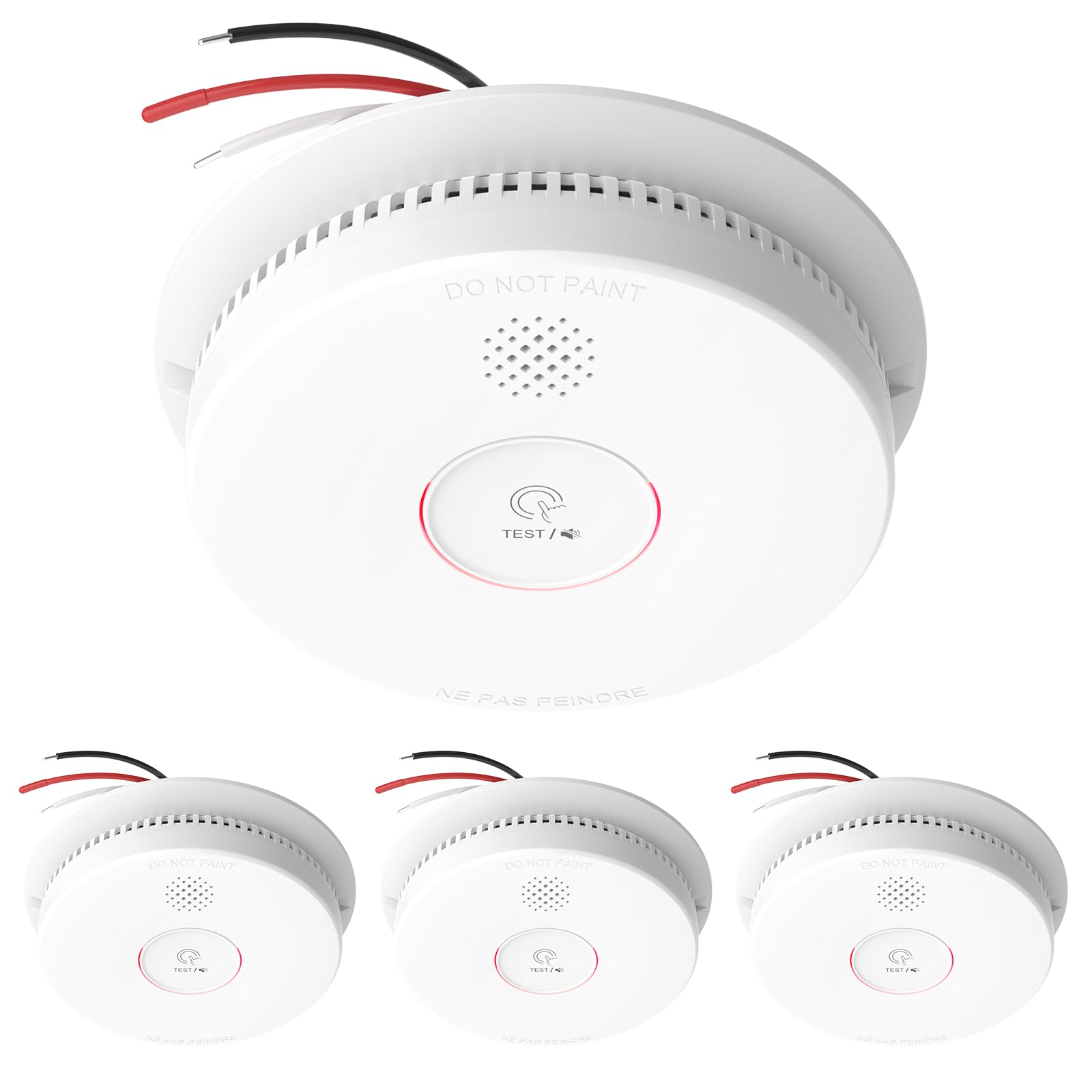
Four connected photoelectric alarms in one order — a starter network for a fresh install.
Four is the count that makes this a build starter. The GS562A is a 4 Count interconnected set, and the interconnection is the point: these are designed to talk to each other on a hardwired circuit, so a single alarm sounds the linked ones across the property. If you are wiring a new build or a large remodel, that is a natural starting package.
The sensor is photoelectric and tuned to reduce false alarms from cooking, which is the friendly choice near a kitchen. It uses an ABS plastic housing (a tough, common enclosure plastic) at 1.5″D x 5.67″W x 5.67″H, and the product is listed as a UL Listed smoke detector. Owner feedback praises the look of these units and their replacement fit, so they earn their place as a clean-install set.
The honest signal to weigh is reliability. Feedback on reliability and value is mixed, with reports of alarms going off with no obvious cause, and some buyers question the value. That is the most-discussed trait and it should shape your plan: buy this to install a connected set that looks the part, and test each unit thoroughly right after install and again a few weeks in.
What the 4-pack delivers
- Four interconnected photoelectric alarms in a single order
- Photoelectric sensing reduces cooking false alarms
- Slimmer 1.5-inch depth profile sits closer to the ceiling
- UL Listed, in an ABS housing
The reality check
- Reliability feedback is mixed, with some random alarms
- Value-for-money opinion splits
- Noise and battery feedback are mixed too, so test early
Right for: a new build or remodel that needs a connected photoelectric set up on day one.
Wrong for: a buyer who wants the most proven reliability record and minimal fuss.
7. SITERWELL Smoke Detector

A silent switch for the 3 a.m. chirp — the alarm that lets you sleep through a low-battery night.
The feature that justifies this pick is Do Not Disturb mode. If the hardwired interconnected detector senses low voltage or a fault, pressing the test button silences it for roughly ten hours so a chirp or flashing light does not wreck your sleep. If you have ever stood on a stool at 3 a.m. trying to find the offending ceiling, that single feature earns its keep.
The basics: it connects up to 12 alarms on a hardwired circuit, and when one detects smoke they all sound at more than 85 decibels. The brand states a ten-year product life, and the unit uses a 9-volt battery backup for outages. A green LED stays on for normal running and a red LED flashes every 40 seconds, so a glance tells you the status. At 8.48 ounces it is the lightest pick here, which makes one-handed mounting on a ladder easy.
The catch is reliability and noise consistency. The noise level earns mixed feedback — some find the alarm loud enough to wake them while others report constant chirping — and reliability feedback includes reports of units going off randomly. The Do Not Disturb mode helps with the low-voltage chirps, but you still want to test this unit thoroughly and replace the battery at the first low-battery signal.
Why the sleep feature is real: a ten-hour DND window on a fault is a small but genuinely useful thing in a bedroom alarm.
The noise caution: chirping and random triggering show up in feedback, so install carefully and test after a week or two.
Reach for it if: you hate night-time chirping and want a DND button plus a lightweight easy-mount alarm.
Look past it if: you want the most consistent noise and reliability record above all else.
Know the Specs
Ionization vs photoelectric sensing
An ionization sensor reacts to fast, flaming fires and is the standard hallway choice. A photoelectric sensor watches for smoke particles and tends to respond faster to smoldering fires, which makes it a friendlier kitchen neighbor. Many whole-home setups mix the two across rooms.
Interconnection limits
Interconnection links alarms on the same hardwired circuit so a single alarm sounds the rest. The cap varies by model — some link up to 12 alarms, others up to 18, and one here reaches 24 devices with 18 able to initiate. Plan the whole-house network before you buy.
Alarm loudness and battery backup
Loudness is measured in decibels (dB), and 85dB is the common standard that cuts through a closed bedroom door. Battery backup keeps the alarm live during a power cut — 9-volt is the usual choice, and AA cells appear on a few models. Check the cell yearly.
Mounting, tamper pins and ten-year life
Existing wires and mounting brackets are the deciding fit detail — staying in the same brand family is the safest route. Tamper-resistant locking pins deter theft in shared buildings. Most smoke alarms should be replaced around the ten-year mark from the manufacture date.
Common Questions
Do these wired smoke detectors work with my existing Kidde or First Alert wiring?
What does a 120-volt hardwired smoke detector need to run?
How many alarms can I interconnect on one circuit?
Will a photoelectric alarm reduce false alarms from cooking?
What is Do Not Disturb mode on a hardwired alarm?
How often should I replace a hardwired smoke detector?
Do I need a wire stripper to install these alarms?
What does 85dB actually sound like in a bedroom?
Should I interconnect smoke alarms across a whole house?
What is a tamper-resistant locking pin on a smoke detector?
The Bottom Line
For most homes, the winner is the First Alert 9120B 5-Pack — five 120-volt hardwired alarms with 9-volt backup and 85dB loudness, sold as a set so a whole upstairs gets one consistent model. If a single ceiling is all you need and you want the wiring to line up, the Kidde SMACFEX I4618AC is the targeted replacement. And for a larger plan that needs interconnection headroom up to 24 devices, the Kidde I12040 is the one to build around.
One last nudge: the 5-pack holds the higher score at 4.5+ stars with the highest count here — 400+ ratings — which is why it earns the top spot.
How we choose
We do not accept paid placement. Every pick is matched to a real buyer and a real use-case; we do not hands-on test units.
Sources
Specifications: manufacturer listings and product documentation. Review insights: verified customer reviews, as of November 2026. Pricing: not shown on this page (it changes often); check the current price via the retailer link.
As an Amazon Associate, Tactical Gear Guy earns from qualifying purchases. This does not affect which products we feature.