Specs are compiled from manufacturer listings and verified buyer reviews and can change over time — please confirm the key details on the product page before buying.
You want full bars in bed, not one flickering dot by the window. A Wi-Fi extender placed correctly for a single room fixes that. Two things decide whether it works: how much area it claims to cover and whether the brand’s app makes setup a five-minute job. Below are seven extenders that fit a bedroom job, ranked by what each one does best.
This guide is built by comparing the manufacturers’ published specifications and the patterns across verified customer reviews, so you get each pick’s real strengths and trade-offs instead of marketing spin.
Bedrooms are the hardest room to fix because the signal has to pass through walls and around corners, so placement matters as much as the hardware itself. Here is how to pick a Wi-Fi extender for bedroom use without buying a box that just copies a weak signal.
Top Picks

How To Choose The Best Wi-Fi Extender for Bedroom Use
A bedroom is a small, boxed-in room, which changes what matters. Raw megabit figures from the router mean less here than getting a clean, steady signal through one wall and keeping it steady while you stream in bed. Judge each candidate on three things: where you can plug it in, how many devices it will juggle, and whether it hands your phone off cleanly as you walk in from the hallway.
Coverage claims versus real bedroom walls
Every extender advertises a coverage figure in square feet, but a drywall bedroom and a brick bedroom behave entirely differently. A model claiming up to 1,500 sq. ft. is sized for a small-to-medium area, which is a sensible match for a single bedroom or a bedroom plus landing. Treat a huge number with suspicion unless the specs line up — an extender still needs to receive a usable signal from your router before it can repeat anything. Placing the extender halfway between the router and your bed solves most of this.
Bandwidth, bands and device limits
Bandwidth is the total data pipe the extender can pass through, measured in Mbps (megabits per second). A dual-band model splits that pipe across a 2.4 GHz band (slower but reaches further through walls) and a 5 GHz band (faster at short range). Check the device count too: an extender that handles 25 devices is fine for a bedroom, while one built for 64 devices leaves you room for phones, tablets, a TV and smart speakers without a queue forming.
Mesh compatibility and one network name
If your router supports EasyMesh, an EasyMesh-compatible extender can join it as one single network name, so your phone jumps to the strongest point automatically. Without that, the extender creates its own separate network name and you have to switch over by hand when you walk into the bedroom. If your router is a mesh system of its own brand, stay inside that brand’s ecosystem for the cleanest handoff.
Side-by-Side Comparison
| Model | Best For | Total Bandwidth | Coverage Claim | Wi-Fi Standard | Amazon |
|---|---|---|---|---|---|
| TP-Link RE315 (AC1200)★ Best Overall | Best Overall for most bedrooms | 1200 Mbps | Up to 1,500 sq. ft. | Wi-Fi 5 (AC1200) | Amazon |
| Tenda A23 (AX1500)Compact Pick | Smallest footprint, Wi-Fi 6 | 1500 Mbps | Up to 1,500 sq. ft. | Wi-Fi 6 (AX1500) | Amazon |
| NETGEAR EX5000 | Family households, 25 devices | 1200 Mbps | Up to 1,500 sq. ft. | Wi-Fi 5 (AC1200) | Amazon |
| TP-Link RE515X (AX1500) | Busy homes, many devices | 1500 Mbps | Up to 1,800 sq. ft. | Wi-Fi 6 (AX1500) | Amazon |
| Cyseed Long Range Booster | Widest claimed coverage | — | Up to 10,000 sq. ft. (maker claim) | 802.11a/b/g/n/ac (2.4 GHz) | Amazon |
| ASUS RP-BE58 | Early Wi-Fi 7 adopters | 2882 Mbps listed transfer rate | — | Wi-Fi 7 (802.11be) | Amazon |
| NETGEAR Nighthawk EXS27 | 4K streaming and gaming rooms | 5 Gbps (BE5000) | Up to 1,500 sq. ft. | Wi-Fi 7 (BE5000) | Amazon |
Detailed Reviews
1. TP-Link AC1200 WiFi Extender Dual Band 5GHz/2.4GHz (RE315)
Our pick — 4.0+★ from 45,500+ verified ratings; the strongest balance of quality and price.
The proven everyday fix: two adjustable antennas, 1,500 sq. ft. of coverage, and the least fussy setup in the group.
The RE315 gives you a total of 1200 Mbps split across the two bands — 867 Mbps on the faster 5 GHz band and 300 Mbps on the longer-reaching 2.4 GHz one. That is a step below the 1500 Mbps of the RE515X further down, but for a bedroom phone, laptop and TV it is plenty of throughput. Two adjustable external antennas do the dead-zone work, and you can angle them to push the signal toward your bed rather than the hallway wall.
What wins people over here is reliability of the basics: the signal carries into bedrooms the router gave up on, and the setup sequence is short enough that non-technical people finish it without help. The extender pairs with an EasyMesh router for one network name and swaps rooms automatically as you move. Against the RE515X below it covers 1500 sq. ft. versus that model’s 1800 sq. ft. — a smaller radius, so it suits one bedroom and a landing rather than a whole floor.
Plan around this catch: like every wireless extender on this list, it repeats your existing signal rather than improving it. TP-Link’s own note says actual speeds will be 50% or less of what your router serves. If the signal arriving at the bedroom wall is already weak, this cannot conjure more speed out of it. For a solid bedroom connection, plug it where the signal indicator shows a good pickup.
What earns it the top spot
- 1,500 sq. ft. of added coverage from a plug-in box — sized for a bedroom plus landing
- Compatible with almost all routers and Wi-Fi devices, so brand matching is not a worry
- Fast Ethernet port for a wired connection in the room
- EasyMesh support means one network name with a compatible router
- Two adjustable antennas you can aim where you need them
Where it asks a little of you
- Speeds land at 50% or less of your router’s — it extends range, not speed
- Creates a separate network name on a non-EasyMesh router
- Not compatible with TP-Link Deco mesh systems
Best for: the bedroom that just needs solid, steady coverage without any brand-matching headaches.
Worth knowing: if your whole upper floor is a dead zone, step up to the RE515X and its 1,800 sq. ft. claim.
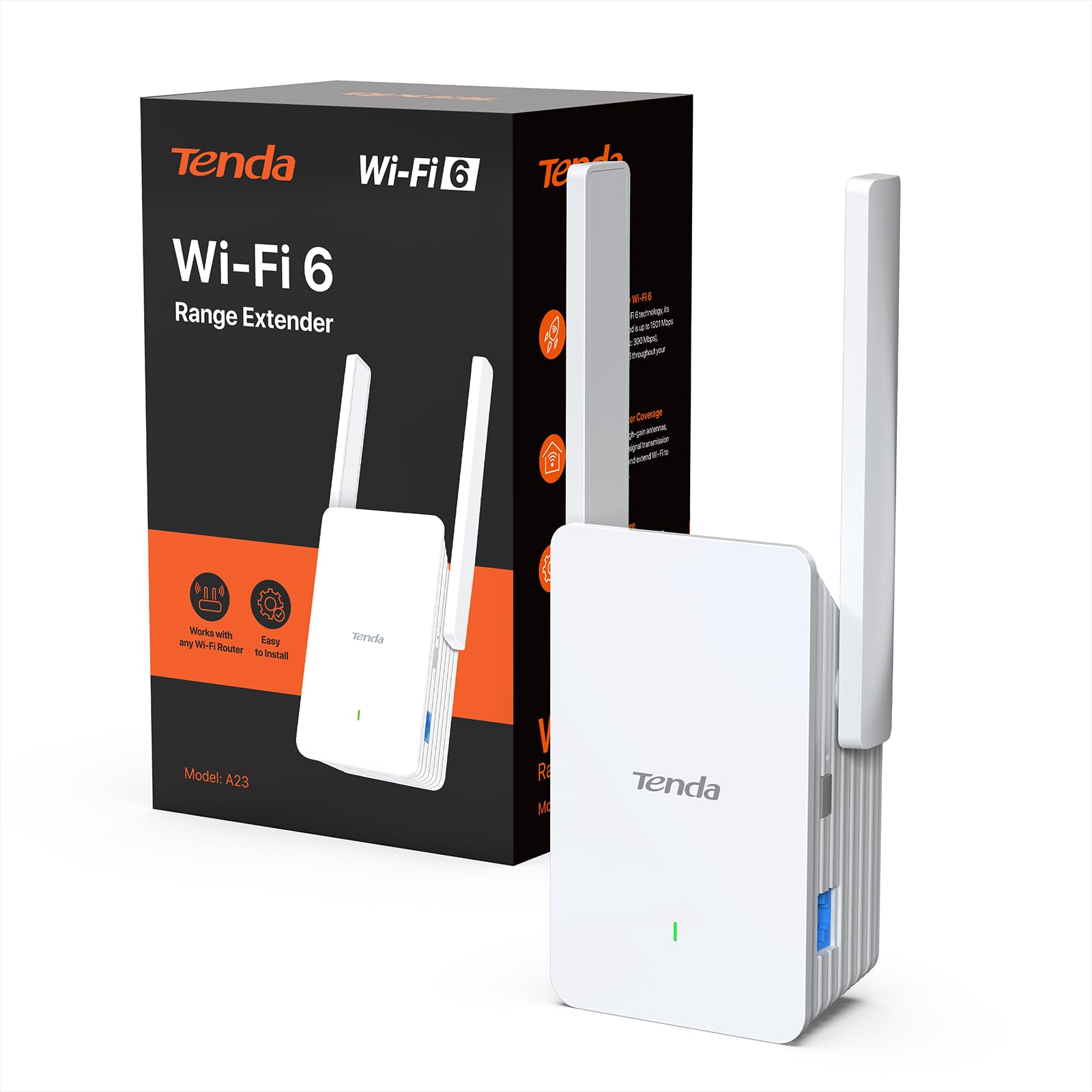
2. Tenda AX1500 WiFi 6 Range Extender (A23)
Newer Wi-Fi 6 tech in a body small enough to vanish against a bedroom wall socket.
Tenda builds the A23 to the AX1500 spec — 1500 Mbps total, split 300 Mbps on 2.4 GHz and 1201 Mbps on 5 GHz. That figure edges the RE315’s 1200 Mbps, and the newer Wi-Fi 6 standard handles a crowded bedroom network (phones, smart speaker, TV stick) more gracefully. Two 5 dBi high-gain antennas — 5 dBi being a gain rating that pushes signal outward — reach up to 1500 sq. ft. and 30+ devices in the maker’s claims.
Where this really shines is size. It measures 1.87″D x 2.83″W x 4.84″H and weighs 100 g, so on the dimension front it takes up about 87% less space than the TP-Link RE315’s 3.5″D x 1.4″W x 4.9″H. The built-in gigabit Ethernet port also means you can wire a smart TV or console straight into it for a locked-in connection. Buyers report the extender performs well within a 25–30ft radius, which is exactly the bedroom-plus-hallway zone you are targeting.
Honest caveat: this is a newer, less-reviewed model compared to household names, so you are trusting a smaller brand on long-term reliability, and there is no retail history to lean on. The signal-boost verdict is split — some buyers see a strong lift, others less. If you want a brand with a longer track record, the RE315 above is the safer bet; if compactness and Wi-Fi 6 appeal, the A23 fits the bill.
The size payoff: smaller than the competitors at 100 g and under 2 inches deep, so it slots behind furniture without a fight.
The trade-off: a short track record on a less-established brand, and mixed reports on how much of a boost each room sees.
Reach for this if: you want Wi-Fi 6 and a gigabit port in a body that disappears into a tight bedroom corner.
Look elsewhere if: you’d rather stick with a name that has years of reviews behind it.
3. NETGEAR WiFi Extender EX5000, up to 1,500 sq ft, 1.2 Gbps

Built for the household where phones, tablets and a bedroom TV all compete for the same signal.
The EX5000 spreads up to 1,500 sq. ft. of coverage across up to 25 devices, delivered as 1.2 Gbps (AC1200) on dual bands. For a bedroom-plus-landing setup that device ceiling is comfortable, and the promise of streaming HD without buffering lines up with what the room needs. Plugging into any standard wall outlet keeps the install clean — no cables draping across the floor.
What wins people over is the setup: NETGEAR’s Nighthawk app walks you through it step by step, or you can press WPS on the router and the extender and let them pair themselves. The WPA2 security blanket (an encryption standard that scrambles traffic) covers every device on the extended network, with automatic firmware updates to keep it current. It works with routers and gateways from the major internet providers, so you don’t need a matching-brand box.
The honest downside: compatibility here is about the router, and the device count is capped at 25 — lower than the 64-device capacity of the TP-Link RE515X below. A very busy bedroom packed with gadgets could hit that ceiling. If your room is just a couple of phones and a TV, you will never notice the limit. The trade is a well-supported brand for a lower device cap.
Good match for: a family bedroom with a dependable brand and app-guided setup you can hand to anyone.
Second thought: if a big gadget count fills that room, the RE515X takes far more devices.
4. TP-Link RE515X AX1500 WiFi 6 Range Extender w/Ethernet Port
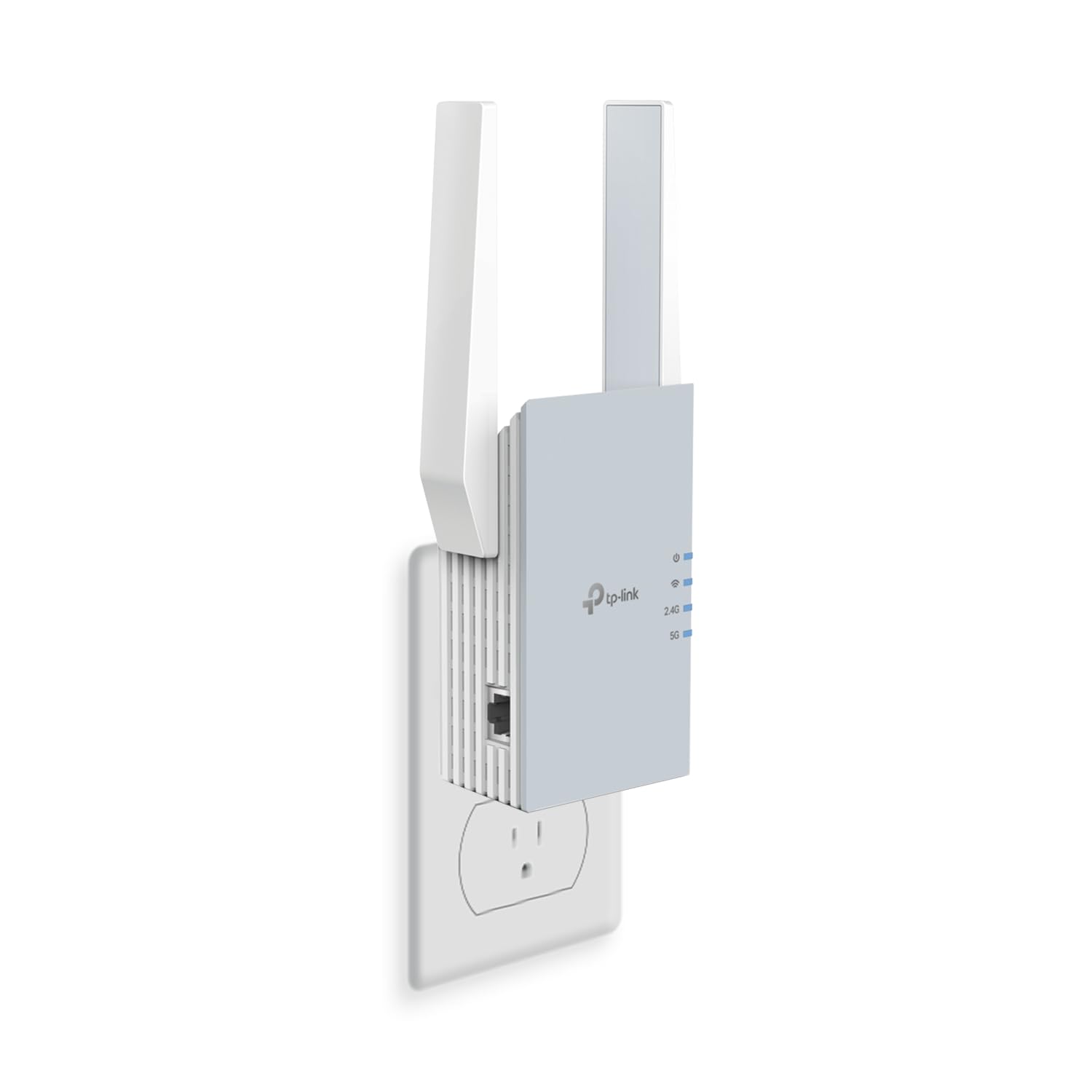
The biggest room-by-room reach and the highest device count of any extender here.
The RE515X carries 1500 Mbps total — 1201 Mbps on 5 GHz and 300 Mbps on 2.4 GHz — and reaches up to 1,800 sq. ft. with beamforming, a signal-shaping trick that aims the antenna at your devices. That coverage figure tops the RE315’s 1,500 sq. ft. by a clear margin, and the two high-gain directional antennas are the reason. Hand it up to 64 devices and it will keep them all fed, which covers every phone, tablet and smart plug in a bedroom and then some.
What earns it the busy-home badge: unlike the AC1200 models here, this is a Wi-Fi 6 extender, so it talks to newer AX phones and laptops more efficiently. There is a gigabit Ethernet port for wiring a smart TV or console, plus an Access Point mode that turns the port into a wired-to-wireless broadcast point. Against the NETGEAR EX5000’s 25 devices, the RE515X’s 64 is a much larger ceiling for a gadget-packed room.
The honest caveat is reliability, and you should hear it plainly. There are reports of units quitting and speeds slowing rather than improving, and it is not the most bulletproof box in this group for consistency. Setup and range are where it wins; long-run steadiness is where you should set expectations and keep the return window open if you adopt it.
Range and capacity win: 1,800 sq. ft. and 64 devices make this the one for a crowded bedroom or a room plus wire-hungry TV.
What to watch: consistency over the long haul is the weak spot, so position it well and don’t over-distance it from the router.
Pick this if: coverage breadth and device count matter more than any other spec for your room.
Think twice if: you want the steadiness of a long-established AC model like the RE315.
5. Cyseed WiFi Extender
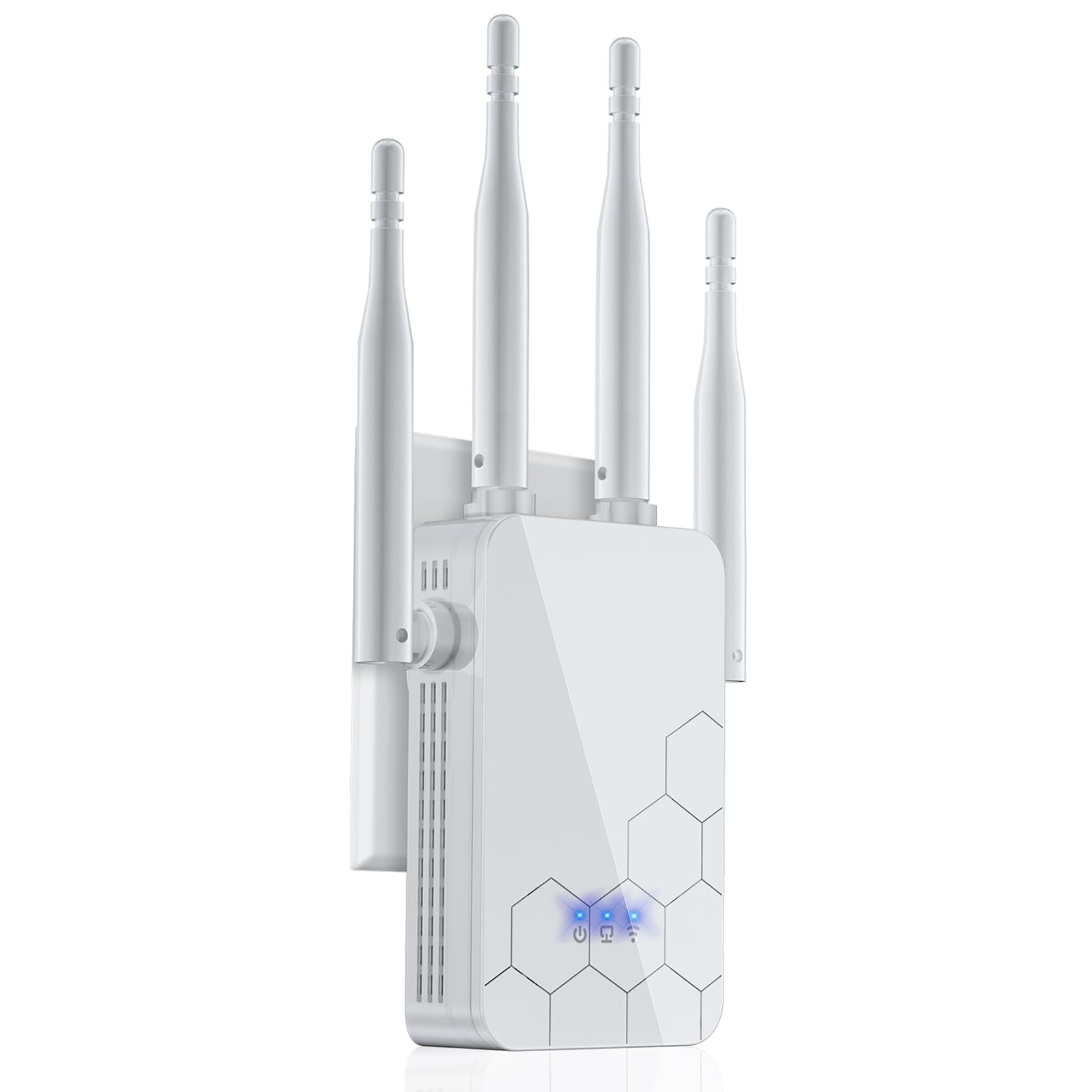
An entry-level extender that runs on the 2.4 GHz band alone and boasts the largest headline number here.
Cyseed advertises a 10,000 sq. ft. coverage claim, which is the biggest figure on this page by a wide margin. Before you take it at face value, know the mechanics: this is a 2.4 GHz-only extender on the 802.11a/b/g/n/ac standards, so it uses the slower, longer-reaching band rather than the faster 5 GHz one. That setup is genuinely good for pushing through bedroom walls, but it will not deliver the dual-band speeds the other picks here manage. The maker says the smart IC chip handles 65+ devices.
What makes this the easiest one to hand to a non-technical person: a 1-tap WPS setup that pairs with your router in seconds, no app or password dance required. Five modes cover your bases — Repeater, Client, AP, Bridge and Router — plus an Ethernet port for a wired connection. Security runs on WPA/WPA2 protocols, which is the baseline encryption you want on any network.
The caveat worth stating clearly: a 10,000 sq. ft. claim on a single-band extender should be read as a manufacturer’s marketing figure, not a measured bedroom result. Expect the real range to be much more modest inside a walled room. For a single bedroom it does the job — but if you want the speed of a dual-band Wi-Fi 6 extender, look at the AX1500 models above.
Why it earns a spot
- 2.4 GHz band pushes through walls well — good for a stubborn bedroom corner
- 1-tap WPS setup takes seconds
- Five modes and an Ethernet port add flexibility
- Handles 65+ devices per the maker
Where it falls short
- 2.4 GHz only — no faster 5 GHz band
- 10,000 sq. ft. is a headline claim, not a measured bedroom figure
- No dual-band speed for heavy streaming
Best suited to: a straightforward bedroom where easy setup and wall penetration beat raw speed.
Not for: the room running 4K streams or online games that need the faster band.
6. ASUS RP-BE58 BE3600 Dual Band WiFi 7 Range Extender

The future-proof pick that brings the newest Wi-Fi 7 standard into a single bedroom.
ASUS builds the RP-BE58 to the Wi-Fi 7 standard (802.11be), with the maker claiming speeds up to 3600 Mbps and 4096-QAM — a modulation scheme that ASUS says lifts a single band’s transmission speed by 1.2 times. Its listed data transfer rate of 2882 megabits per second tells you it is aimed at cutting-edge gear, not just current devices. On paper it outmuscles every AC1200 and AX1500 model on this page, which all top out at 1200 or 1500 Mbps total.
Multi-link Operation (a feature that links to multiple bands at the same time) gives you steadier data flow. If you own an ASUS AiMesh system, this joins it for one smooth network as you move room to room. Setup runs through the ASUS Router app or ASUS Extender app in a few taps, so the learning curve stays low.
Real talk on the catch: you only open up that Wi-Fi 7 speed if your router and your bedroom devices also support Wi-Fi 7, or the extra headroom mostly goes unused. And the reliability reports are mixed — some see a solid extension, others find connections flaky. If you already run an ASUS AiMesh home, the payoff is real; if not, the value is thinner.
The tech edge: a genuine Wi-Fi 7 extender with 3600 Mbps claimed speeds and 4096-QAM — headroom most homes cannot yet use.
The reality check: speed only materializes with Wi-Fi 7 gear at both ends, and connection steadiness is uneven.
For the early adopter: an all-ASUS or all-Wi-Fi-7 home that wants the newest standard in rooms still waiting.
Wait instead if: your router is still Wi-Fi 5 or Wi-Fi 6 — you won’t tap the upgrade.
7. NETGEAR Nighthawk EXS27
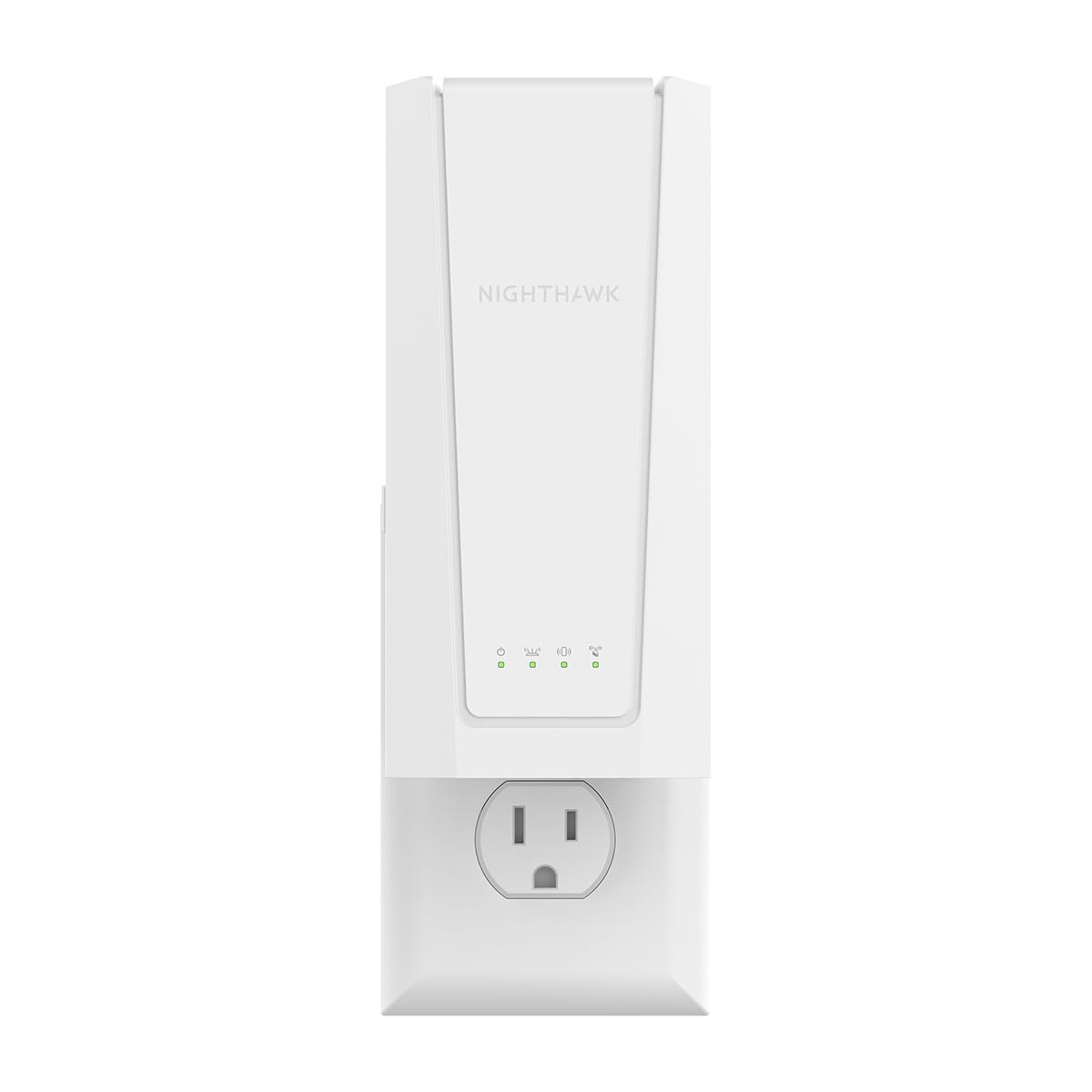
The heavyweight for a bedroom built around 4K streaming, gaming, and a wired console.
The EXS27 delivers up to 5 Gbps (BE5000) and is a full Wi-Fi 7 extender, covering up to 1,500 sq. ft. for up to 45 devices. NETGEAR says that is roughly 2.7x faster than previous Wi-Fi — a claim worth treating as the maker’s own. The 2.5 Gigabit Ethernet port (a wired connection faster than the standard gigabit port) lets you cable a smart TV, console or desktop straight to the extender. That locked-in link matters more than wireless speed when the room is your entertainment hub.
Two things make it painless in a bedroom. Smart Roaming keeps your existing network name and shifts each device to the strongest signal automatically, so calls and streams don’t drop as you walk from hallway to bed. Setup goes through the Nighthawk app or a WPS button press, just like the EX5000 above, and the wall-outlet form means no cable clutter.
Set expectations on the downside: consistency is the weak link, with reports of units failing well inside a year, and the Wi-Fi 7 speed again needs Wi-Fi 7 routers and devices to fully pay off. For a gaming or 4K bedroom it still earns its place — just buy it for the wired port and coverage, and keep an eye on it early on.
Worth it for: a bedroom treated as a media room, where the 2.5G port and Wi-Fi 7 speed earn their keep.
Skip if: you still run older devices that can’t use Wi-Fi 7 — the cheaper NETGEAR EX5000 does the same job for less.
Know the Specs
Mbps and total bandwidth
Mbps means megabits per second — the total data pipe the extender can pass through. A dual-band model splits that pipe between a 2.4 GHz band (slower but pushes further through walls) and a 5 GHz band (faster at short range). If a spec reads “1200 Mbps,” that is usually the two bands added together, not one band’s speed. For a bedroom, this figure tells you whether the box can keep up with streaming and calls at the same time.
Coverage in square feet
Coverage claims tell you the area the extender is built to reach — up to 1,500 or 1,800 sq. ft., for example. Treat them as a rough ceiling, not a guarantee. Walls, furniture and where you plug it in all cut into the real figure. The best placement is roughly halfway between your router and the room you’re trying to fill, so the extender receives a clean signal before it repeats it.
Wi-Fi standards: AC, AX and BE
Wi-Fi 5 is labeled AC, Wi-Fi 6 is labeled AX, and Wi-Fi 7 is labeled BE. Newer standards handle a crowded home more gracefully, but the speed benefit only appears when your router and your devices match that standard. An AX1500 extender feeding a Wi-Fi 5 laptop simply behaves like a Wi-Fi 5 link. Match the standard to your existing gear rather than chasing the highest number.
Mesh compatibility and network names
EasyMesh and AiMesh are agreement systems that let an extender join your router as one network name. Join one and your phone hops to the strongest point as you move room to room; skip it and the extender broadcasts its own separate name you switch to by hand. If your router is a same-brand mesh, stay inside that brand. Otherwise, check the extender lists EasyMesh support before you count on a single name.
Common Questions
Will a Wi-Fi extender actually increase my internet speed in the bedroom?
Where should I plug in an extender for a bedroom?
Do I need a dual-band extender for a single bedroom?
Will an extender give my bedroom one Wi-Fi name or a separate network?
Can I connect a smart TV or console to my extender with a cable?
How many devices can a bedroom extender handle at once?
Does an extender work with any router company?
Is a Wi-Fi 7 extender worth it for a bedroom?
Will the extender’s signal reach through a brick or concrete bedroom wall?
Why does my extender show a strong signal but slow speeds?
The Bottom Line
For most bedrooms, the extender to beat is the TP-Link RE315 — 1,500 sq. ft. of coverage, EasyMesh support and a simple setup that suits any router brand. If your room is packed with devices, the TP-Link RE515X stretches to 1,800 sq. ft. and 64 devices. And for a media-first bedroom with a console or 4K TV, the NETGEAR Nighthawk EXS27 and its 2.5 Gigabit port are the ones to reach for. The quiet winner is the RE315: it does the everyday bedroom job without asking you to match a brand.
How we choose
We do not accept paid placement. Every pick is matched to a real buyer and a real use-case; we do not hands-on test units.
Sources
Specifications: manufacturer listings and product documentation. Review insights: verified customer reviews, as of November 2026. Pricing: not shown on this page (it changes often); check the current price via the retailer link.
As an Amazon Associate, Tactical Gear Guy earns from qualifying purchases. This does not affect which products we feature.