Specs are compiled from manufacturer listings and verified buyer reviews and can change over time — please confirm the key details on the product page before buying.
If your phone clings to one bar the moment you step onto the patio, the fix is not a bigger indoor router — it is a box built to live outside. An outdoor WiFi repeater takes the signal from your house and pushes it across the yard, barn, or driveway, and the ones below are all sealed against rain and dust rather than sitting indoors pretending. The short answer: the TP-Link Deco 7 Outdoor BE5000 is the pick worth starting with, and the eero Outdoor 7 is the one to choose if you already run an eero network.
This guide is built by comparing the manufacturers’ published specifications and the patterns across verified customer reviews, so you get each pick’s real strengths and trade-offs instead of marketing spin.
You will see how IP ratings, PoE power, and antenna gain change what actually reaches your shed or gate. The right pick turns a dead zone into a usable signal at the gate, shed, or patio.
Top Picks

How To Choose The Best Outdoor WiFi Repeater
Start with where the box will physically sit, because that single decision rules out half the market. A unit mounted under an eave in a windy coastal yard faces different punishment than one strapped to a pole in a field. Get the housing rating and the power route right first, then worry about speed.
The IP rating is the first gate
IP stands for Ingress Protection — two digits that say how well the case keeps out solids and water. The first digit covers dust, the second covers water. An IP65 case is dust-tight and handles water jets; IP66 adds protection against powerful jets; IP67 survives brief immersion. Almost every unit here wants to be mounted vertically so water runs off rather than pooling in a connector.
How you will power it changes the install
Power over Ethernet (PoE) sends electricity and data down the same network cable, so the repeater needs no outlet where it hangs. Active PoE follows the 802.3af/at standard and negotiates power automatically; passive PoE pushes a fixed voltage like 24V or 54V from an included adapter. Check which one your unit wants, because plugging the wrong type in can damage it.
Speed, bands, and how many devices
Dual-band means the repeater runs both a 2.4 GHz band (slower, reaches farther, cuts through walls) and a 5 GHz band (faster, shorter reach). The headline Mbps figure is the combined total across both bands, not what a single phone will see. If you are feeding security cameras and a few phones, client capacity matters as much as raw speed.
Antennas, gain, and real range
Antenna gain is measured in dBi — a higher number focuses the signal into a flatter, longer throw. A 7dBi or 8dBi omni antenna sends coverage outward in a ring rather than a narrow beam. Range figures are quoted in open, line-of-sight conditions, so trees, siding, and metal roofs will cut whatever number the box promises.
Side-by-Side Comparison
| Model | Best For | Weather Rating | Top Speed | Power Method | Amazon |
|---|---|---|---|---|---|
| TP-Link Deco 7 Outdoor BE5000★ Best Overall | Whole-yard Wi-Fi 7 mesh | IP65 | 4,324 Mbps (5 GHz) | PoE+ or AC adapter | Amazon |
| Cudy AP1200 OutdoorBudget Champion | Budget point-to-point bridging | IP65 | 867 Mbps (5 GHz) | 24V passive PoE | Amazon |
| Cudy AP1300 OutdoorWired Speed Pick | Gigabit wired backbone outdoors | IP65 | 867 Mbps (5 GHz) | 802.3at/af or passive PoE | Amazon |
| JIFGAO AC1200 Outdoor Extender | Starlink setups and big antenna count | IP65 | 867 Mbps (5 GHz) | PoE (adapter included) | Amazon |
| WAVLINK AC1200 WING 12HP | Farm and acreage mesh builds | IP65 | 867 Mbps (5 GHz) | 54V active/passive PoE | Amazon |
| WAVLINK AX1800 Outdoor WiFi 6 | Long-line-of-sight countryside coverage | IP67 | 1800 Mbps combined | 802.3af/at or passive PoE | Amazon |
| WAVLINK AX3000 WiFi 6 Outdoor | Highest wireless speed here | IP67 | 2402 Mbps (5 GHz) | 802.3at active PoE | Amazon |
| eero Outdoor 7 PoE | Existing eero homes needing yard coverage | IP66 | 2.1 Gbps | PoE+ or AC (adapter not included) | Amazon |
Detailed Reviews
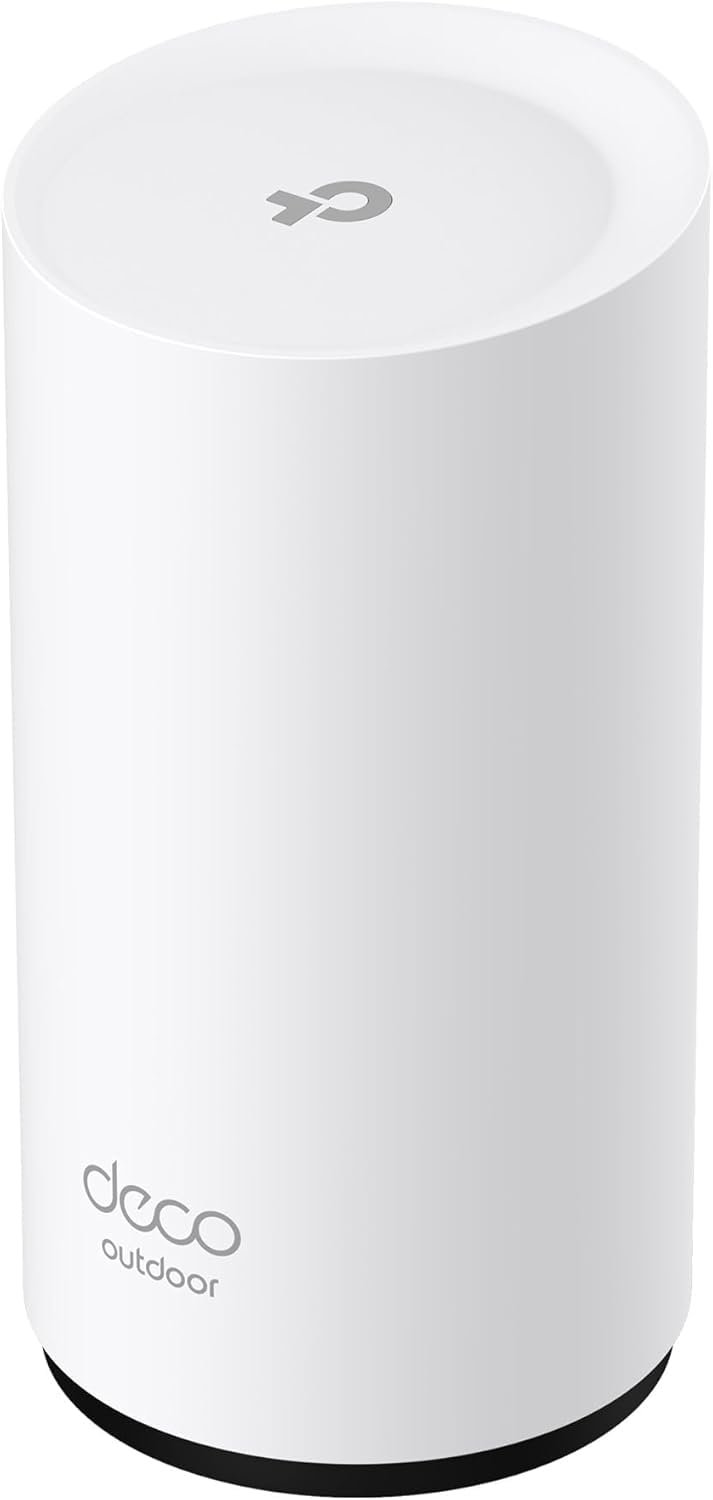
1. TP-Link Deco 7 Outdoor BE5000
Our pick — 4.5+★ from 350+ verified ratings; the strongest balance of quality and price.
This is the newest-generation pick that turns your whole backyard into one smooth network.
The number that earns it the top slot is 4,324 Mbps on the 5 GHz band — the fast lane of a two-lane road, with 688 Mbps on the 2.4 GHz band handling the slow-and-steady long-throw work. That is 4,324 Mbps on 5 GHz versus the Cudy AP1200’s 1200 Mbps total, and it is the kind of speed that keeps 4K cameras and a laptop on the patio happy at the same time. The Deco 7 uses Wi-Fi 7, the newest wireless standard, so it talks to older gear without complaint via backward compatibility.
Where it really changes an evening is coverage: TP-Link rates this add-on unit for up to 2,800 sq. ft. of extra area and up to 150 devices, all sharing one network name as you walk around. Setup runs through the Deco app, and you can feed it with either a wired or wireless backhaul — backhaul being whatever pipe carries traffic back to your main router. Two 2.5 Gbps PoE+ ports let one cable deliver both power and data from indoors, so there is no outlet needed at the mounting point. The included kit covers pole and wall mounting, so a fence post works.
Be aware this is an add-on, not a standalone router — it needs an existing Deco mesh to join. It also lacks the 6 GHz band, so it is not the last word in Wi-Fi 7 capability. Mounting height and line of sight still decide your real range, and dense trees will eat into the advertised 2,800 sq. ft. It holds a 4.5+ star score across 300+ owners.
What earns the crown
- 4,324 Mbps on 5 GHz — fast enough for outdoor 4K cameras and streaming at once.
- Two 2.5 Gbps PoE+ ports mean one cable for power and data, no outdoor outlet.
- Adds up to 2,800 sq. ft. and up to 150 devices to one Deco network.
- Pole and wall mounting hardware in the box, plus a tabletop option.
Where it holds back
- It is an add-on extender — it needs an existing Deco mesh to extend.
- No 6 GHz band support, so it is dual-band rather than fully tri-band Wi-Fi 7.
- Real coverage drops fast through heavy foliage or thick walls.
Reach for this if: you already run a Deco network and want fast, sealed Wi-Fi out to the patio, pool, or garden office.
Look elsewhere if: you have no Deco mesh and need a standalone outdoor access point on day one.
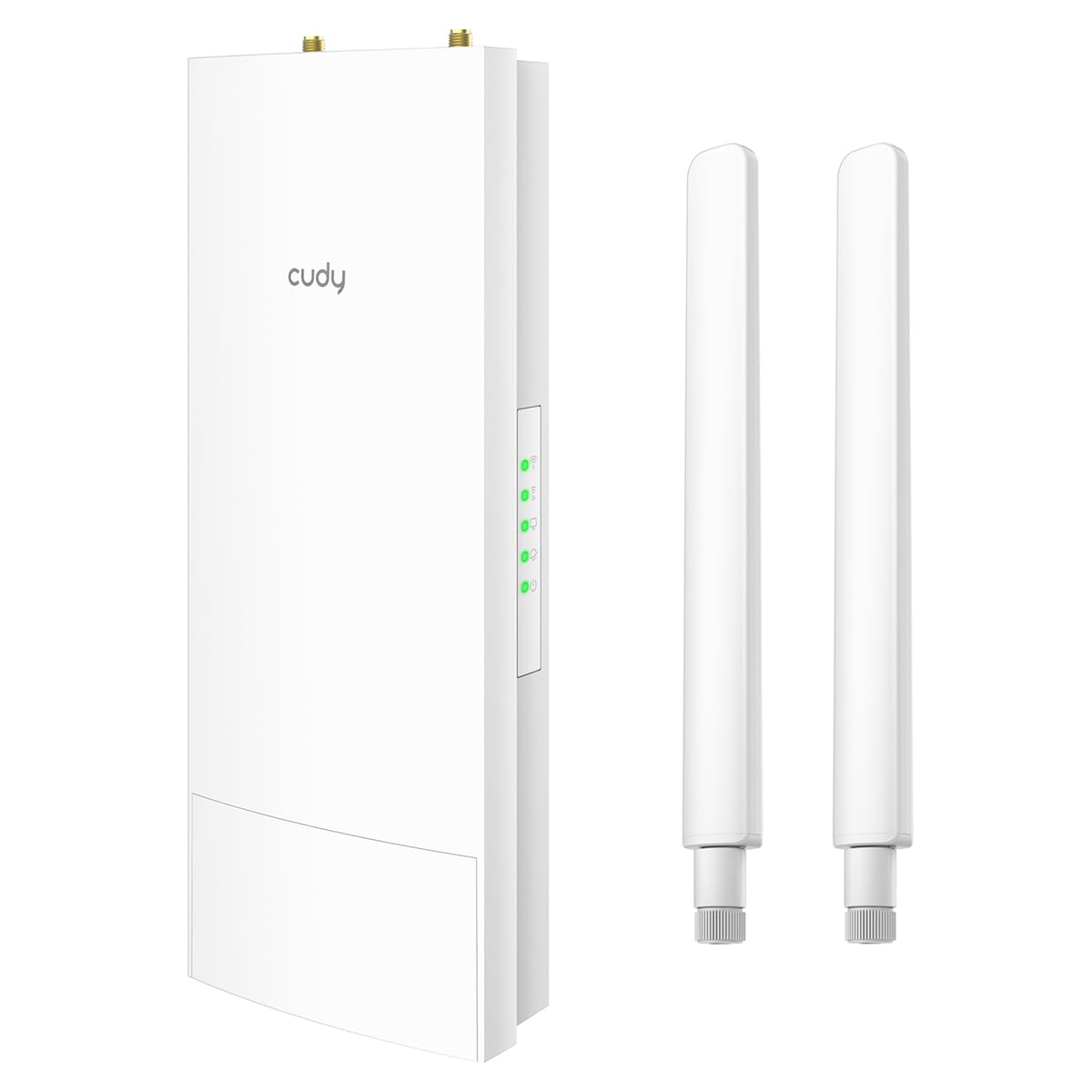
2. Cudy AP1200 Outdoor
The entry ticket to outdoor Wi-Fi that still hits 558 feet with two antennas.
Two external antennas push the AP1200’s reach to up to 170 m (558 ft) in open ground, so it is a smart starting point for a yard or a long driveway. It delivers up to 867 Mbps on the 5 GHz band and 300 Mbps on 2.4 GHz — versus the Deco 7’s 4,324 Mbps on 5 GHz — but four streams of Wi-Fi 5 are plenty for cameras and phones. Beamforming (which aims the signal at connected devices instead of spraying it evenly) tightens real coverage.
Power comes from one 24V passive PoE cable, and the adapter sits in the box — passive means the unit takes a fixed voltage, so do not substitute an active PoE switch without checking. Five modes (Router, Access Point, Range Extender, WISP, Client) let you share a wired feed, extend a signal, or bridge a shed. Capacity is listed at 30 recommended clients and 128 maximum, with WPA3 security and VPN client support.
One practical catch lives in the Ethernet port: it is a 10/100 Mbps fast Ethernet link rather than Gigabit, so your wired backhaul tops out below what the wireless radios can do. If you are running fiber into the house, the AP1300 above is the better match. For a camera out at the gate and a phone on the lawn, this covers the job for an entry-level spend.
Where the value lands: 558 ft of reach with two detachable antennas, five operating modes, and an included passive PoE adapter — you can get an outdoor signal running without buying anything else.
The trade-off worth knowing: the 10/100 Mbps Ethernet port caps wired speed, and passive 24V PoE means you match the included adapter rather than a standard active switch.
Best match for: a first outdoor build on a tight budget — a shed, a gate camera, or a workshop edge of the property.
Think twice if: you need Gigabit wired throughput or plan to power it from an existing 802.3af switch.
3. Cudy AP1300 Outdoor
Same 558-foot reach as its sibling, now with a shielded Gigabit port behind it.
If the AP1200 was the value entry, the AP1300 is the same platform with the bottleneck removed. One shielded Gigabit Ethernet port accepts 802.3at/af PoE or 24-57V passive PoE, so it will play nicely with a standard active switch and still take a passive injector. And unlike the AP1200, that means Gigabit data over the same run as its power — worth knowing when you are pulling cable once and want it future-proof.
Wireless performance matches its stablemate: up to 867 Mbps on 5 GHz and 300 Mbps on 2.4 GHz across four streams, with Beamforming and dual external antennas reaching up to 170 m (550 ft) in ideal conditions. The specification quotes a 1,600 square_feet coverage range, and it carries the same IP65 housing, -40 to 65°C rating, and 4kV surge protection. Client capacity is higher here — up to 128 clients with 100 recommended and 5 GHz MU-MIMO, which means multiple devices share the air more efficiently than a single-stream unit.
If you run more than one box, management is where this steps up: the Cudy AP Controller lets you manage several access points centrally, with a captive portal and WPA3 security, plus a hardware watchdog and scheduled reboot to keep uptime steady. WireGuard and OpenVPN support are there too. Buyers report the build quality is what people keep coming back to. There is no app-driven setup hand-holding — this is a browser-and-config box, so expect to read the manual once.
The upgrade that matters: a shielded Gigabit port that accepts standard 802.3at/af PoE, which the cheaper AP1200 cannot offer.
Plan for this: configuration is manual rather than app-guided, so budget a half hour with the guide before it is live.
Who it suits: anyone wiring a Gigabit backbone out to a barn, park, or parking area and wanting one controller for several units.
Who should look on: buyers who want a phone app to walk them through setup step by step.
4. AC1200 Outdoor WiFi Extender

Six 8dBi antennas and a Starlink-friendly setup for wide rural properties.
Antenna count is the headline here: six 8dBi external antennas plus dual signal amplifiers, which the maker pitches as the tool for pushing a signal across large properties, garages, and sheds. It runs dual-band with 5 GHz up to 867 Mbps and 2.4 GHz up to 300 Mbps, and it supports WPA3 encryption — the newer, tougher security standard for your network password. It is rated to work with over 99% of routers, Starlink included, so it slots into a rural internet setup without a rebuild.
Installing it is a one-cable affair thanks to included PoE, which sends power and data together so you do not need an outdoor outlet. The IP65 shell is built to shrug off rain, snow, dust, and temperature swings. Three modes — AP, Router, and Repeater — cover most jobs: extend an existing network, or create a fresh one where there was none. Owners mention the coverage punches through thick block walls and large trees, which is exactly the scenario a yard-camera owner cares about.
The fair warning is reliability — that is the one theme in the feedback that splits, with some units running as advertised and others acting up. Treat it as a box to test thoroughly during the return window, not one to install at the far fence and forget. It is the lowest-rated pick in this group, so go in with eyes open. That said, the antennas and the Starlink compatibility make it a legitimate option for a specific kind of buyer.
What makes it interesting: six 8dBi antennas, WPA3 security, and confirmed Starlink compatibility in a PoE-powered box.
The fair catch: reliability is the mixed note in the feedback, so test it hard while returns are easy.
Pick this when: you run Starlink on a big rural lot and want a cheap antenna-heavy shot at pushing the signal to outbuildings.
Pass if: you want a set-and-forget box you can mount at the property line and never think about again.
5. WAVLINK AC1200 Outdoor Mesh Extender

A farm-first box with dual Gigabit ports and a 300-meter reach spec.
The WING 12HP is built around a split-scenario idea: dedicate the 5 GHz band’s 867 Mbps to 4K surveillance feeds, and let the 2.4 GHz band’s 300 Mbps handle the slow chatter of smart sensors and POS systems. Four 7dBi antennas (two per band) and a high-power chip push the signal out to a listed 300 m per unit, with the understanding that real range shifts with the terrain. Dual 10/100/1000Mbps Gigabit ports give you an extra wired connection option at the box.
Power is flexible: 54V active or passive PoE lets you run current down an Ethernet cable from up to 100 m away, which handles the barn-and-pasture layout without dangerous outdoor wiring. The IP65 heat-resistant case runs -20°C to 50°C, with 15KV ESD and 4kV lightning protection for storm country. Fat AP mode drops it in as a plain access point; Fit AP mode hands control to a WAVLINK AC Controller (sold separately) for fleets of units. WPA2/WPA3-MIX and WPA/WPA2-Enterprise cover the security side for a business-running-a-homestead setup.
Two things to size up before you buy. Mesh only happens with other WAVLINK devices that support the same Everything Mesh technology, so this is not a universal mesh node. And the overall owner experience is genuinely divided — range is the part that draws the strongest praise, while functionality and value land all over the map. It earned 4.0+ out of 5 with the most ratings of any unit here, which tells you it is a mainstream choice with real fans and real critics.
Why farm owners look at it
- Listed 300 m reach per unit with four 7dBi antennas.
- Dual Gigabit Ethernet ports for a second wired connection.
- 54V active or passive PoE powered from up to 100 m away.
- 15KV ESD and 4kV lightning protection for exposed installs.
What to weigh carefully
- Mesh only works with compatible WAVLINK devices, not across brands.
- Owner sentiment is split — some love it, some hit trouble.
- Fit AP fleet control needs a separate controller you buy.
Go for it if: you are building out a homestead of barns and coops with WAVLINK gear and want wired and wireless reach in one box.
Hold off if: you expect it to mesh into an existing non-WAVLINK network.
6. WAVLINK AX1800 Outdoor WiFi 6 Extender

Wi-Fi 6 speed and a sealed IP67 shell for properties that stretch out of sight.
Wi-Fi 6 (the second-newest wireless generation) delivers up to 1800 Mbps combined here — 1201 Mbps on 5 GHz plus 574 Mbps on 2.4 GHz — which is the streaming workhorse for 4K cameras and gaming. Four high-gain 8dBi omni-directional fiberglass antennas push coverage to a listed 200-300 m radius in line of sight, and it is rated for up to 256 devices. That makes it the pick for a big yard, farm, estate, or RV pad where the house router simply cannot follow you.
The IP67 housing is the tougher of the two ratings you will see here — sealed against dust and able to survive brief water immersion, not just rain. It runs -20°C to 50°C and resists moisture, dust, lightning (6KV), and static shock (15KV). Power is flexible with both 802.3 AF/AT active PoE and passive PoE over a single cable, and the box includes a 54V/0.3A passive adapter. Starlink Gen 2/3 connection is possible through a Starlink Ethernet Adapter. Modes run Mesh, AP, Router, Repeater, and AP+Repeater, so it adapts to almost any outdoor layout.
Two things to plan for. There is no app — configuration is direct, so expect to spend a little time with the guide. And the included Ethernet cable is a one-meter run; if your mounting point is farther from power, you will buy a longer CAT5E or better cable under 100 m yourself. Range is the part owners rave about, with long-distance property coverage the reason it earns its place.
The standout spec: dual-band Wi-Fi 6 at 1800 Mbps combined plus IP67 sealing — the combination of speed and the tougher weather rating in one unit.
The catch to plan around: no app control, and the supplied Ethernet cable is only one meter, so most installs need a longer run.
Made for: long, open properties where line of sight stretches far and you want Wi-Fi 6 speed at the far end.
Not your pick if: you insist on a phone app walking you through every setting.
7. WAVLINK AX3000 WiFi6 Outdoor WiFi Extender
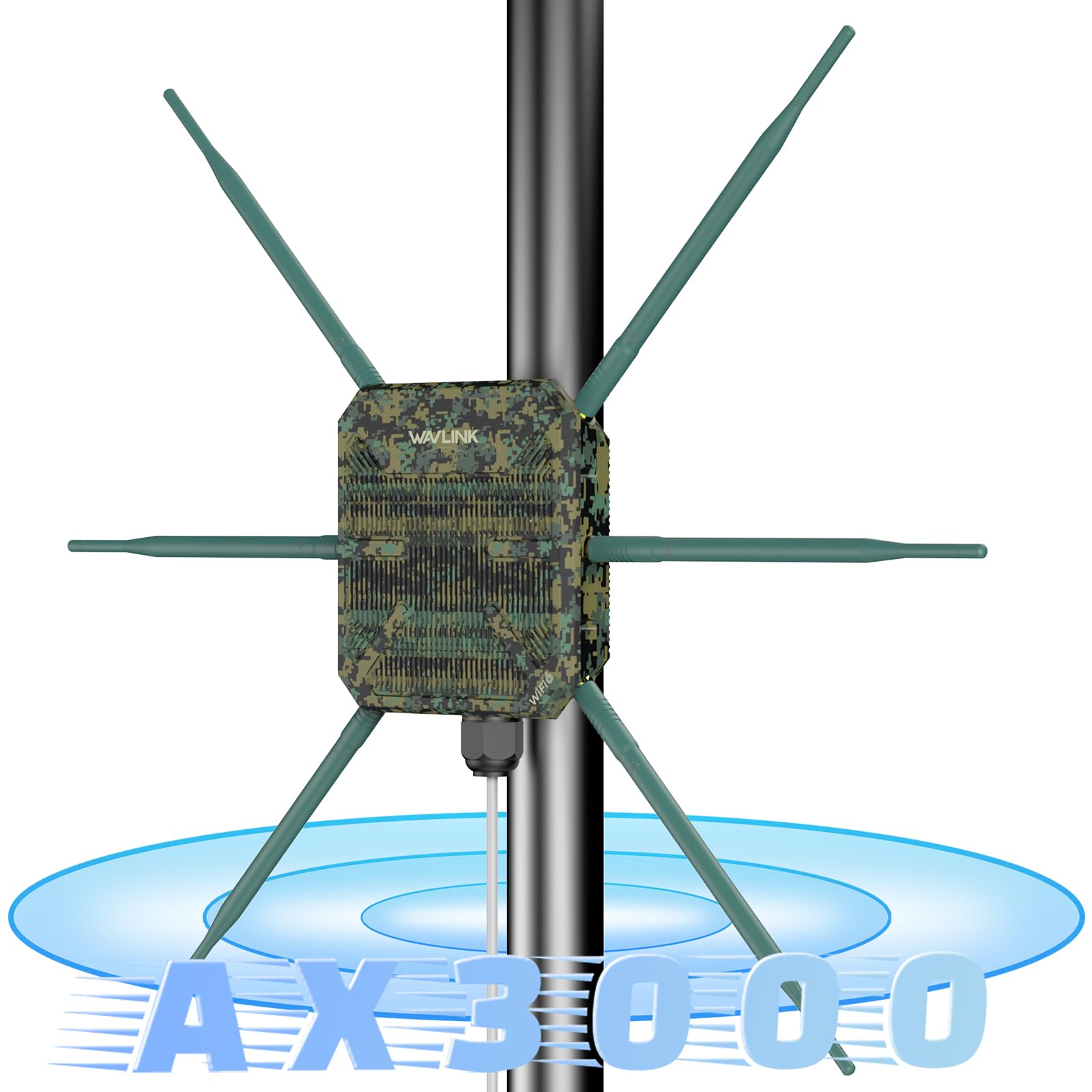
The fastest outdoor radio in this lineup, at 2402 Mbps on the 5 GHz band.
That 2402 Mbps figure on the 5 GHz band — paired with 573 Mbps on 2.4 GHz for a 3000 Mbps total — is the biggest wireless number any pick here posts, and it sits above the AX1800’s 1800 Mbps combined. Six 7dBi omni-directional antennas plus built-in high-power amplifiers (PA 800mW, an 800 milliwatt amplifier) and an enhanced receiver are pitched to push further and punch through more obstacles than a standard repeater. Channel-selection automatically dodges congested channels, which keeps an outdoor stream steady when the neighborhood is busy.
For weather, the IP67 enclosure and dedicated high-gain antennas are built for cold, heat, and continuous moisture, withstanding -30°C to 70°C (-22°F to 158°F). It carries 15KV ESD and 4KV lightning protection. Because the case is discreet, it can pass indoors too, so it is not confined to the yard. Mesh Extender, AP, Repeater, and Router modes, plus pole or wall mounting, let you cover a farm, RV, campsite, or just the back garden. Active 802.3at PoE keeps the install to a single cable.
Reliability is the honest asterisk — it is the mixed aspect in feedback, with some units running exactly as advertised and others seeing occasional disconnections. Coverage, by contrast, is its strongest suit. Weight is note for mounting: at 2255 g (about 5 lb), use proper anchors on a wall rather than a light hook. It holds 4.0+ out of 5, and for sheer speed it is the pick to beat.
Why speed chasers pick it
- 2402 Mbps on 5 GHz — the fastest radio in this group.
- Six 7dBi antennas with 800mW amplifiers for longer throw.
- IP67 casing rated from -30°C to 70°C.
- Four modes plus pole and wall mounting for flexible placement.
The honest watch-outs
- Connection stability is the mixed note — some units drop out occasionally.
- At 2255 g it needs solid mounting hardware.
- Active PoE only; you supply the PoE switch or injector to match.
Right for you if: raw wireless throughput at the far end of the property is what you are chasing.
Better to choose another if: a rock-steady link matters more than headline speed and you cannot tolerate the odd reconnect.
8. Amazon eero Outdoor 7 PoE
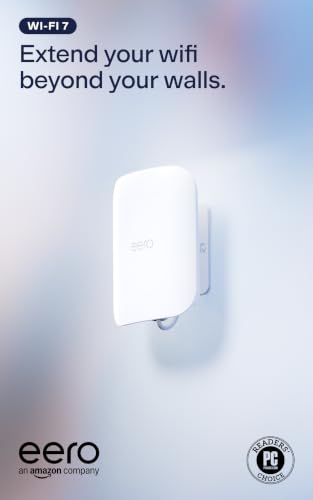
A yard-sized blanket of coverage for anyone already living inside the eero app.
The reach claim is the biggest of the group: up to 15,000 sq. ft. of outdoor mesh coverage, connecting 100+ devices, which can cover a full lot including a treehouse. Wi-Fi 7 delivers wireless speeds up to 2.1 Gbps for streaming outside. It carries an IP66 rating for protection from dust, rain, and snow, tested to run between -40°F and 131°F, so it can stay outdoors year-round without being brought in.
what separates it is the point-to-point bridge — two eero Outdoor 7 units spaced up to 1,000 feet apart with clear line of sight wirelessly extend an eero network across a large property. Power comes via AC or PoE+ (Power over Ethernet), though the AC adapter is not included, so plan the power source before you mount it. Setup runs through the eero app, which also handles automatic updates and remote management. It is backward compatible with all previous eero generations and works with eero Built-in on selected Amazon Echo devices.
The gating fact is that this is an eero-only expansion — it brings eero’s TrueMesh, TrueRoam, and TrueChannel software into the yard, and none of that helps if your network is not eero. Some advanced security features, like the optional eero Plus tier, require a subscription. For existing eero homes, the 15,000 sq. ft. coverage claim and the step-by-step in-app setup are the draw.
What it does best: up to 15,000 sq. ft. of IP66 outdoor coverage and a 1,000-foot point-to-point bridge between two units.
The gate to clear: it is eero-only, and the AC adapter does not come in the box.
Choose it when: you already run eero indoors and want the same app managing your yard, pool area, or gate.
Look past it if: your network is not eero — this will not join a mixed-brand setup.
Know the Specs
The IP rating explained
Two digits tell the weather story: the first means dust protection, the second means water protection. IP65 survives water jets, IP66 survives powerful jets, and IP67 survives brief immersion — which is why a unit headed for an exposed fence post wants IP66 or IP67. Almost every outdoor repeater here asks to be mounted vertically so rain drains off. Remember the PoE adapter is often not waterproof and belongs indoors, even when the unit itself is sealed.
PoE — active vs passive
PoE sends power and data down one network cable so your repeater needs no outdoor outlet. Active PoE follows 802.3af or 802.3at and negotiates the power draw automatically; passive PoE pushes a fixed voltage (24V or 54V) from an included adapter and expects the unit to sip exactly that. Match the type to your equipment — a passive-only device on an active switch may not power up, and a passive adapter on the wrong device can do damage. The Gigabit, AF/AT, and PoE+ labels tell you which side of that line a unit sits on.
Common Questions
How far can an outdoor WiFi repeater realistically reach?
What does IP65 mean and do I need IP67 instead?
Do these work with Starlink?
Will an outdoor repeater power up without a nearby outlet?
Can I mesh a repeater with a router from a different brand?
What is the difference between Access Point mode and Repeater mode?
How many devices can one outdoor repeater handle?
Should I buy Wi-Fi 6 or Wi-Fi 7 for outdoor coverage?
Can I run several outdoor units together on one network?
Does the repeater need to be mounted high on a pole?
The Bottom Line
For most people, the TP-Link Deco 7 Outdoor BE5000 wins because it pairs the newest wireless generation with 2,800 sq. ft. of add-on coverage and two 2.5 Gbps PoE+ ports on a single run of cable. It also holds 4.5+ stars across 300+ owners, and if you already run a Deco mesh, this is the add-on that extends that network to the patio. If you are feeding a large outbuilding on a budget, the Cudy AP1300 gives you a Gigabit port and 802.3at/af PoE for an entry-level spend. And if your network already lives inside the eero app, the eero Outdoor 7 covers up to 15,000 sq. ft. without a second app to learn.
How we choose
We do not accept paid placement. Every pick is matched to a real buyer and a real use-case; we do not hands-on test units.
Sources
Specifications: manufacturer listings and product documentation. Review insights: verified customer reviews, as of November 2026. Pricing: not shown on this page (it changes often); check the current price via the retailer link.
As an Amazon Associate, Tactical Gear Guy earns from qualifying purchases. This does not affect which products we feature.