Specs are compiled from manufacturer listings and verified buyer reviews and can change over time — please confirm the key details on the product page before buying.
If food settles in a still corner and algae creeps in, you need a wave maker with enough flow to push water the full length of the glass. The hygger 18W Cross Flow is the pick most reef keepers land on, with its 1850 GPH (gallons per hour) flow spread across five wave modes. Below, you’ll see which pump suits your tank size, which ones stay quiet at night, and which are built for a nano reef versus a big cichlid setup.
This guide is built by comparing the manufacturers’ published specifications and the patterns across verified customer reviews, so you get each pick’s real strengths and trade-offs instead of marketing spin.
You’ll see flow rates in GPH (gallons per hour) and liters per hour, tank-size ranges, and the mounting type for each pump. By the end, you’ll know which of these eight belongs on your glass. The right wave maker for fish tank depends on matching its flow rate to your gallon count and its mount to your glass thickness.
Top Picks


How To Choose The Best Wave Maker for Fish Tank
A wave maker is a submersible pump that pushes water across your tank to break up dead spots and stir the surface. The mistake most first-time buyers make is grabbing the strongest pump they can find. Too much flow blasts soft corals and stresses fish that prefer calm water. Too little and you are back to algae blooms in the corner.
Start with your gallon count. Every pump here lists a tank range, and that range is the single fastest filter. Then check what it mounts with — a magnetic base that holds through thicker glass gives you far more placement freedom than a suction cup that lets go after a few months.
Match flow rate to tank size first
Flow rate is measured in gallons per hour, written GPH. It tells you how much water the pump moves in an hour. A pump rated for tanks up to 25 gallons and one rated for 135 gallons are built for completely different jobs. Read the tank range in the listing, not just the headline GPH number.
Decide if you want a controller
A controller lets you switch between wave patterns — a gentle pulse, a steady constant flow, a random surge. Some pumps also add a feeding mode that pauses the pump so food stays in the tank instead of swirling down the overflow. If you keep corals, a controller’s pulse and random modes matter more than raw GPH.
Weigh noise honestly
Noise is the most divisive spec in this category. Pumps with sine wave motor control tend to run quieter because the motor drive smooths out vibration. A pump sitting against glass can also hum if the magnet is loose. Where you place it and how firmly it mounts affect what you hear as much as the motor does.
Side-by-Side Comparison
| Model | Best For | Flow Rate | Wattage | Tank Range | Amazon |
|---|---|---|---|---|---|
| hygger 18W Cross Flow★ Best Overall | Large tanks up to 135 gal | 1850 GPH / 7000 L/H | 18W | Up to 135 gal | Amazon |
| hygger 2100GPH Double HeadBest Value | Mid-size tanks on a budget | 2100 GPH | 5W | 40–110 gal | Amazon |
| Fluval Sea CP2Compact Pick | Compact nano setups | 1600 L/H | — | Up to 25 gal | Amazon |
| SICCE Voyager Nano 1000 | Nano reefs needing a slim pump | 270 GPH / 4.5 gpm | 2.8W | 5–30 gal | Amazon |
| Hydor Koralia Evolution 850 | 50–100 gal freshwater and marine | 850 GPH / 3217 L/H | 5W | 50–100 gal | Amazon |
| Uniclife 2100 GPH | Big tanks that need raw power | 2100 GPH | 25W | 60–120 gal | Amazon |
| Jebao SOW-8 | Reef tanks wanting quiet variable flow | 2245 GPH / 8500 L/H | 23W | 20–60+ gal | Amazon |
| Jebao SCP-90 Cross Flow | Broad gyre-style current in larger tanks | 55 gpm | 25W | — | Amazon |
Detailed Reviews
1. hygger Aquarium Wave Maker, 18W Adjustable Cross Flow Pump
Our pick — 4.5+★ from 400+ verified ratings; the strongest balance of quality and price.
A cross flow head that spreads soft waves across the whole tank instead of firing one narrow jet.
If you keep a big tank, this is the one that moves the most water here at 1850 GPH — or 7000 liters per hour — spread over a 360-degree pattern. Compare that to the Fluval Sea CP2’s 1600 liters per hour and you get roughly four times the flow from a single pump. It suits freshwater and marine setups up to 135 gallons, which is the widest tank range on this list.
The controller is where this pump earns its keep. You get five wave modes — pulse, sine, constant, random and cross flow — plus adjustable flow and frequency levels, a feeding mode and a night mode. The magnetic base holds through glass up to 1/2″ thick, so you can park it high, mid-tank or near the bottom. Mount it low and it sweeps debris off the sand; mount it high and you see the surface waves form. What wins people over is the flow itself: it pushes water through the entire tank rather than leaving a dead corner.
The catch is noise, and it is the most divided point in the feedback. Some owners run it in near silence, while others pick up a high-pitched hum that would bother a light sleeper in the same room. Set it up outside your bedroom and it is a non-issue. At 18W it also draws more power than the 5W pumps lower down this list, which matters if you are running several devices on one outlet.
Where it pulls ahead
- 1850 GPH covers tanks up to 135 gallons
- Five wave modes plus feed and night settings on one controller
- Magnet holds firm through 1/2″ glass
- Rotatable head points waves in multiple directions
What to plan around
- Noise splits opinion — some units hum at a higher pitch
- 18W draw is heavier than the small pumps on this list
The right tank: Anything from a mid-size freshwater setup up to a 135-gallon reef that needs real, adjustable current.
The trade-off to accept: If your tank sits in a quiet room where you need near-total silence, audition the noise level before you commit.
2. hygger 2100GPH Double Head Aquarium Wave Maker
Two heads doing the work of one big pump, on a 5W motor that barely sips power.
The headline number here is 2100 GPH of total flow — 2 times 1050 GPH from the twin horizontal heads — while the motor pulls just 5W. Compare that to the hygger 18W above and this one moves more water on a fraction of the power, at 5 watts versus 18 watts. That wide-angle twin face spreads the current across a broader band of the tank instead of a single tight stream, which suits 40 to 110 gallon setups.
The mounting is built to stay put. It uses a suction cup base to dampen vibration and a thickened magnet base to hold firm on glass under 0.47 inches thick. A 360-degree rotating base means you can aim both heads without moving the whole unit. The front cover has an anti-pinch outer shell that keeps fish from getting pulled into the intake. Quality is the thing owners praise most, and the quiet operation backs it up.
Reliability is the honest question mark. There is a mixed thread in the feedback — most units run for years, but a minority stop working, and the value debate reflects that. The adjustability is also limited on the head itself; the heads do not rotate independently, so the dual angle is set by the base rotation. For a mid-size tank where you want maximum water movement on a small power draw, it is a strong balance.
The bottom line: A dual-head design that spreads 2100 GPH on 5W is hard to argue with for 40 to 110 gallon tanks. Just keep the magnet base clear of thick glass above 0.47 inches.
Reach for this if: You want broad, powerful current in a mid-size tank without paying for a controller you will not use.
Look elsewhere if: You need the heads to aim independently — the base rotates as one unit, not each head.
3. Fluval Sea CP2 Wave Maker Circulation Pump
A small-footprint pump built for nano tanks where every inch of glass counts.
Nano tank owners know the struggle: a pump that looks like a brick sitting in the corner. The CP2 keeps a low profile and still delivers 1600 liters per hour for aquariums up to 25 gallons. The 270-degree adjustable output nozzle points the flow wherever you need it, which is the whole game in a small tank — you are trying to reach the far wall without blasting the near one.
Installation is a suction cup mount, so it goes on in seconds and repositions just as fast. That is convenient, but suction cups are the weak point over time and do not hold through thick glass the way the magnet mounts on the hygger and Jebao pumps do. The CP2 is also European-engineered and rated for both freshwater and saltwater. Owners find it works well and stays quiet while it runs.
The honest friction is flow consistency. The feedback splits — a good share of owners get solid movement across the tank, while others find it barely stirs the water. In a 25-gallon tank with a light bioload that is usually fine. In a taller or heavily stocked nano, the 1600 L/H can feel thin, and that is when people start looking for more. The pump itself is well made; the question is whether your tank needs more push.
What it nails
- Compact body fits tight nano corners
- 270° nozzle lets you aim flow precisely
- Quick suction cup install and repositioning
- Rated for freshwater and saltwater alike
Where it comes up short
- Flow feedback is split — some find it barely moves water
- Suction cup mount is less secure than a magnet base
Fits best: Nano and small tanks up to 25 gallons where a low-profile body matters more than raw flow.
Think twice if: Your tank runs tall or heavily stocked — the 1600 L/H may not reach the far end.
4. SICCE Voyager Nano 1000 Wave Maker Flow Pump

Slim, magnetic and built to disappear against the glass of a nano reef.
The number that jumps out is 2.8 watts. This pump sips power — the hygger 18W above draws 18 watts, roughly six times the draw — so it barely dents your electricity use while delivering 270 GPH, or 4.5 gallons per minute. That flow suits tanks from 5 to 30 gallons, which is nano reef territory. Owners call it the best pump they have run, and quality is the trait that gets praised most.
The magnet is the star of the mounting system. It holds onto glass up to three-quarters of an inch thick, so you can slide it anywhere on the wall and it stays. The 360-degree movable rotor and a manual flow adjuster let you dial in direction and strength without tools. Inside, a self-cleaning impeller and stainless steel shaft keep it running longer between cleanings. Sicce has supplied the aquarium market for over 40 years, and this pump carries that design language.
Noise is the split point again. Most owners find it very quiet; some units randomly start buzzing loudly. That is worth knowing if the tank lives near a couch or bed. The flow adjuster is also manual, so you set it by hand and leave it — there is no controller and no wave pattern switching. For a nano reef that wants calm, steady, low-power circulation, that simplicity is a feature, not a gap.
Why nano owners like it: A 2.8W motor and a magnet that grips ¾” glass make it easy to place and cheap to run all day.
Best served: Nano and small reef tanks from 5 to 30 gallons where you want discreet, constant, low-power flow.
Not the one for: Anyone who wants programmable wave modes or a controller — the flow adjuster is manual only.
5. Hydor Koralia Evolution Circulation & Wave Pump, 750-850 GPH

A shaft-less impeller that pushes 850 GPH from a body made to survive urchins and puffers.
The flow lands at 850 GPH, or 3217 liters per hour, and the motor that drives it draws 5 watts. Hydor says that is 50% less power consumption and up to 20% more water flow than its previous Koralia models — a maker claim worth knowing but not measuring against a different pump. The 850 GPH suits tanks from 50 to 100 gallons in fresh or marine water, which covers a wide middle band of setups.
what separates it mechanically is the shaft-less impeller (a spinning part with no metal rod for grit to grind against). The pump ships with a cable protector so urchins, puffers, parrot fish and triggers cannot chew through the cord. The vibration-absorbing magnet mounts solidly on glass or acrylic up to 1/2″ thick. A sphere joint lets you aim the output. Owners describe dead-quiet operation and plenty of water movement, and the 850 GPH output is the trait they single out for larger tanks.
Two things to weigh. It is the only pump on this list made in the USA, which matters if you want domestic manufacturing behind the warranty — a 2 year manufacturer warranty backs it. The other is that the design is larger than newer, slimmer powerheads, so it takes up more visual space in the tank. The 850 GPH is strong but not programmable; there is no controller, no wave modes, no feeding pause. It moves water steadily and quietly, and that is its whole job.
Strengths worth noting
- 850 GPH suits 50 to 100 gallon tanks
- Shaft-less impeller survives messy, toothy fish
- 5W draw keeps running costs low
- 2 year manufacturer warranty and US-made
Points to weigh
- No controller, wave modes, or feeding pause
- Body is bulkier than newer slim powerheads
For the fish-first tank: Freshwater or marine setups from 50 to 100 gallons that want steady, quiet flow and a cord that survives nippers.
Skip the appeal if: You want to program wave patterns — there is no controller here.
6. Uniclife 2100 GPH Aquarium Wave Maker

Raw power for big tanks, with a controller and a feeding pause at a working price.
This pump is built for tanks that need volume, not finesse. The max flow is 2100 GPH on a 25W motor pulling DC 24V, and it is rated for 60 to 120 gallon aquariums. That is a narrow window on purpose — Uniclife says it is not fit for tanks under 60 gallons, so if you are running a 40-gallon breeder, this is not your pump. The rotatable head and strong magnetic base let you aim the waves from more than one direction.
The controller gives you four wave modes, labeled M1 through M4, and a feeding feature. Hold the speed/feed button about 3 seconds and the pump stops for 10 minutes so food stays put instead of flying into the filter. Power is the quality buyers single out most, and it is not subtle — this pump moves the entire tank with ease. It also pulls sediment off the substrate as it churns.
Two honest notes. First, it makes noise like a quiet ringing while running, so it is not the whisper-quiet pump for a bedroom tank. Second, durability is the one recurring concern in the feedback, and there is a mixed read on controls and the size of the unit. For a big, high-flow freshwater or marine tank where you want maximum push and a feeding pause without paying premium money, it delivers a lot of movement for the spend.
The read: 2100 GPH and four wave modes on a controller is serious output for the price, and the 10-minute feed pause is genuinely useful on a big tank. Just plan for some motor ringing and keep it away from sleeping quarters.
Made for: 60 to 120 gallon tanks that want maximum flow and a feed pause at a working price.
Steer clear if: Your tank is under 60 gallons — this pump is explicitly not sized for it.
7. Jebao SOW-8 Wave Maker Flow Pump with Controller

Sine wave motor control and 2245 GPH of variable flow, tuned to run quiet in a reef.
The flow ceiling is 2245 GPH, or 8500 liters per hour, on a 23W motor running 24V DC. Compare that to the hygger 18W above at 7000 liters per hour and this pump pushes more volume while staying in the same power class. It suits 20 to 60+ gallon tanks, so it bridges the gap between nano and mid-size reef setups. And the upgraded sine wave motor drive is designed to dampen vibration and electrical noise for quieter running.
The digital drive controller is the flexible part. You get Classic Pulse (W1), Sine Wave Surge (W2), Reef Gyre Random, Constant Flow, a night sensor mode and a one-touch feed mode. Owners describe it as quiet, powerful and well made, and the ability to alternate between strong and gentle current runs continuously. There is also 2.4G wireless communication that lets multiple SOW pumps sync in master-slave pairs for alternating tidal currents — useful if you run two on opposite walls of a large reef.
The mounting uses a heavy-duty external magnet bracket with a 360-degree ball joint, so it clings to thick glass and points where you want. The honest limit is the warranty: 180 days is shorter than the 2 year cover on the Hydor above. For a reef keeper who wants programmable, synchronized, quiet flow in a mid-size tank, that trade is worth weighing against the flow range.
Brings to the tank
- 2245 GPH on 23W of 24V DC power
- Six wave patterns plus night and feed modes
- 2.4G wireless master-slave sync for twin pumps
- Sine wave drive cuts motor noise
Keep in mind
- Warranty is 180 days, shorter than others here
- Controller adds a setup step compared to a plain powerhead
Worth it for: Reef keepers from 20 to 60+ gallons who want programmable, synchronized, quiet variable flow.
Consider the trade: The 180-day warranty is the shortest of this group — factor that against its flow range.
8. Jebao SCP-90 Cross Flow Aquarium Wave Maker Pump
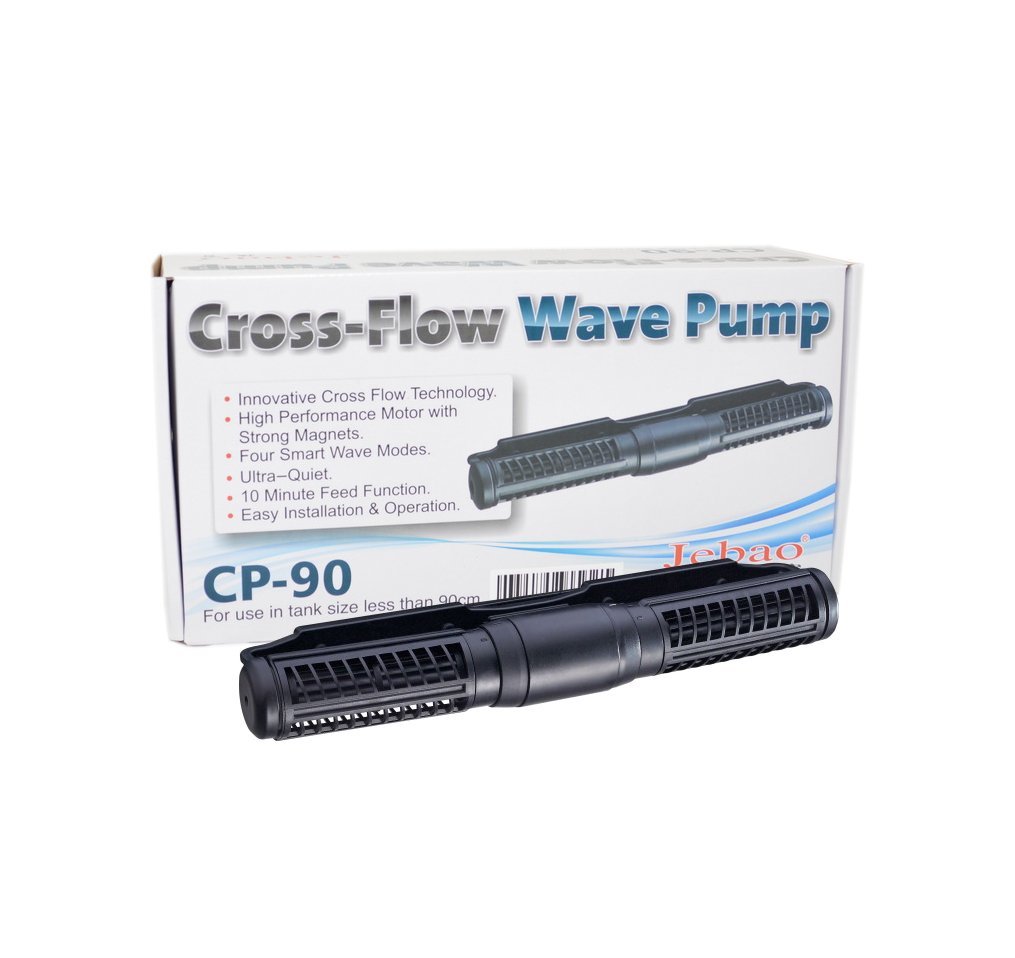
A broad gyre-style cross flow pump built to blanket a whole tank in moving water.
This is the top-tier option, and it shows in the numbers. The flow rate is 55 gallons per minute, powered by a 25W motor rated for 100-240V and 50/60Hz. The cross flow design throws a wide sheet of current rather than a single jet, which is exactly what you want to complement your filtration and keep a big display tank turning over. The pump body is roughly 10.5 by 2.5 by 1.75 inches, so check your available glass space before you mount it.
The controller adds normal flow, pulse wave and reef modes, with a 10-minute feed mode that pauses circulation while you feed. Build quality is what buyers praise most, and the cross flow layout draws comparisons to pricier gyre pumps — you are getting a similar broad-current effect for less. It comes with the pump, the controller and an AC adapter, and plugs into a standard 3-prong US outlet.
Reliability is the point to watch. There is a mixed thread in the feedback — some units run better than expected, and some run into trouble with the controller not working properly. Noise also splits, with some calling it extremely quiet and others finding it noisy. Durability is the other soft spot. So it is the pump for a large tank where broad cross flow matters and you can tolerate a small amount of controller and noise variance.
For the big display tank: A 25W cross flow pump with three wave modes and a 10-minute feed pause gives a wide, gyre-style current across a large tank.
Pick it for: A large tank where a broad, gyre-style cross flow current does the work and you want premium flow control.
Go another route if: You want the longest warranty — controller reliability is the mixed thread here, so buy with support in mind.
Know the Specs
Flow rate: GPH and liters per hour
Flow rate is the volume of water a pump moves in a given time, written in gallons per hour (GPH) or liters per hour (L/H). It is the number that decides whether the far corner of your glass gets flow or collects detritus. A pump rated for tanks up to 25 gallons is built for a small setup; one rated for 135 gallons moves far more water. Always match the tank range in the listing to your actual gallon count rather than chasing the biggest GPH figure.
Wattage and what it means at the wall
Wattage is how much power the pump draws while running. A 2.8W pump barely registers on your bill; an 18W or 25W pump draws several times more. That matters when you run two pumps plus a return and skimmer on one circuit. Low wattage does not automatically mean weak flow — the 5W hygger double head pushes 2100 GPH while sipping power. Compare GPH per watt, not wattage alone.
Magnetic mount versus suction cup
The mounting type decides how freely you can place the pump and how long it stays there. A magnet pair holds the pump on the outside and inside of the glass at once, and it works through thicker glass — up to ¾” on the Sicce Voyager Nano. A suction cup mount installs faster but can lose grip over time and does not hold through thick glass. For a tank with thick walls, a magnet base is the practical choice.
Wave modes and controllers
A controller lets you change how the pump pushes water — a steady constant flow, a pulsing surge, a random reef pattern, or a gentle night setting. A feeding mode pauses the pump so food stays in the tank instead of getting swept into the filter. For coral and reef tanks, alternating surge and calm periods is what keeps polyps fed and detritus suspended. For a simple freshwater setup, a single-speed pump with no controller covers the job.
Common Questions
How do I know what GPH my tank needs?
Will a wave maker work on thick aquarium glass?
Is a wave maker the same as a filter?
Can I use a wave maker in a freshwater tank or only saltwater?
Why do some wave makers hum and others run silent?
What does a feeding mode do on a wave maker?
How many wave makers do I need for a large tank?
Are wave maker pumps safe around small fish and inverts?
What is the difference between a cross flow pump and a standard powerhead?
How much power do these pumps draw and does it cost much to run?
The Bottom Line
For most tanks, the wave maker for fish tank winner is the hygger 18W Cross Flow because its 1850 GPH and five wave modes cover everything from a mid-size freshwater setup up to a 135-gallon reef. If you want the most flow per watt without a controller, grab the hygger 2100GPH Double Head — 2100 GPH on just 5W. And for a nano reef where a slim, low-power pump disappears against the glass, the SICCE Voyager Nano 1000 is the one to reach for. Match the pump’s published tank range to your gallon count first, then compare mounts and controllers.
How we choose
We do not accept paid placement. Every pick is matched to a real buyer and a real use-case; we do not hands-on test units.
Sources
Specifications: manufacturer listings and product documentation. Review insights: verified customer reviews, as of November 2026. Pricing: not shown on this page (it changes often); check the current price via the retailer link.
As an Amazon Associate, Tactical Gear Guy earns from qualifying purchases. This does not affect which products we feature.