Specs are compiled from manufacturer listings and verified buyer reviews and can change over time — please confirm the key details on the product page before buying.
A home weather display usually gets ignored within a month. The forecast is rarely the problem. The screen is often unreadable from across the kitchen, or the outdoor sensor batteries died. You fix that by picking a console you can read at a glance and a sensor that keeps talking to it through winter. The nine displays below do exactly that, sorted by what each one is genuinely good at.
This guide is built by comparing the manufacturers’ published specifications and the patterns across verified customer reviews, so you get each pick’s real strengths and trade-offs instead of marketing spin.
You’ll see which screens hold up in a dim hallway, which sensors reach the far fence, and which models track rain and wind rather than just temperature. Here is the honest breakdown of the best weather display for home use.
Top Picks

How To Choose The Best Weather Display for Home
A weather display is really two purchases in one box: the console that sits on your shelf, and the outdoor sensor that feeds it. Get the console wrong and you squint at it forever. Get the sensor wrong and the numbers drift or stop arriving entirely.
Screen size and how far you stand from it
A large color screen earns its place when you read it from the couch, not from six inches away. The 7.5-inch panels here show temperature and humidity in big digits, which matters if anyone in the house wears glasses. Smaller consoles like the La Crosse 308-1417BL still read well from across a room thanks to large digits and a built-in sensor.
What the outdoor sensor actually measures
A basic sensor gives you temperature and humidity only. A 7-in-1 array adds wind speed, wind direction, rainfall, UV, and light intensity, so you get a real picture of your yard. If you garden or keep animals outside, the rain and wind numbers are the ones you’ll check every morning.
Power, backlight, and battery backup
Most consoles run on a 5V adapter and take AA batteries as backup so your settings survive a power cut. Note that on several models the backlight only stays on when the adapter is plugged in; on battery power the screen dims or shuts off to save juice. If a permanently lit display matters to you, confirm the adapter is included.
Side-by-Side Comparison
| Model | Best For | Display | Outdoor Sensor | Power | Amazon |
|---|---|---|---|---|---|
| AcuRite Notos (01604A2)★ Best Overall | Everyday backyard tracking | Illuminated color LCD | 3-in-1 temp, humidity, wind | Electric with battery backup | Amazon |
| Raddy UV7Top Performer | Sun and garden monitoring | 5.12″ VA, 4 brightness levels | 7-in-1 with UV and light | USB-C with AAA backup | Amazon |
| Sainlogic WiFi StationData Keeper | App tracking and data export | 8.5″ LCD wide-angle | Swiss-chip, ±0.2°C accuracy | Adapter with 3 AA backup | Amazon |
| Ambient Weather WS-2902 | Smart-home integration | LCD color console | Osprey array, 7 metrics | AC adapter | Amazon |
| Govanli WS-SA8 | Rain planning and gardens | 7.5″ LCD, 3-level backlight | Wireless with rain gauge | Power adapter | Amazon |
| ECOWITT Wittboy Pro HP2564 | Sensor expansion and servers | 7″ TFT console | WS90 7-in-1 haptic rain | USB power cord | Amazon |
| La Crosse S77925-INT | Color forecast at a glance | Color LCD, constant backlight | Wireless temp and humidity | 5V power cord with AA backup | Amazon |
| LFF 3-Sensor Station | Monitoring multiple rooms | 7.5″ color touch screen | 3 wireless sensors | AC adapter or AAA battery | Amazon |
| La Crosse 308-1417BL | Budget barometric tracking | Constant backlight LCD | Wireless temp and humidity | 5V adapter with AA backup | Amazon |
Detailed Reviews
1. AcuRite Notos (01604A2) Pro Weather Station
Our pick — 4.5+★ from 550+ verified ratings; the strongest balance of quality and price.
The set-and-leave pick: wind readings refresh every 18 seconds and the sensor battery is rated for 2 years.
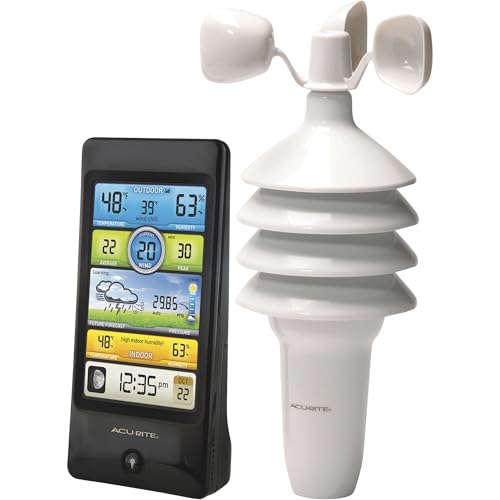
The AcuRite Notos earns the top spot because it does the daily job without drama: a 3-in-1 sensor reads temperature, humidity, and wind speed, and the color console shows all three on one lit screen. It has the most ratings in this lineup and the highest score among the mid-range group at 4.5+ stars across 500+ owners, which is exactly what a set-and-leave weather display should look like.
What wins people over is build quality. Owners consistently describe it as a station they set up once and trust season after season, and the sensor updates wind readings every 18 seconds so the gust you just saw on the porch shows up almost immediately. The daily and all-time high and low records give you a simple history without needing an app, and the adjustable dimmer means the lit display won’t glare through your kitchen at night. Battery life is rated for 2 years on the sensor, which keeps maintenance down to a rare refill.
The honest catch: the customer consensus on accuracy is divided. Temperature can run a degree or two off, and wind speed is the reading buyers question most often. The display visibility also splits — clear to most, harder to read for others. Neither is a defect so much as a reason this is a backyard reference station rather than a scientific instrument. If you need calibrated wind data for a weather service, look further up the list.
Why it takes the crown
- 3-in-1 sensor covers temperature, humidity, and wind speed in one mount.
- Wind readings refresh every 18 seconds, so current, average, and peak speed stay current.
- Daily and all-time high/low records build a running history on the console itself.
- Rated 2-year sensor battery life keeps trips to the yard rare.
Where it asks patience
- Temperature and wind accuracy are the two most debated points among owners.
- Some find the color display easy to read, others don’t.
Made for: anyone who wants a lit color console, wind readings, and a sensor they don’t have to babysit.
Look elsewhere if: you need lab-grade wind accuracy for reporting to a weather network.
2. Raddy UV7 Professional 12-in-1 Weather Station
The gardener’s console: UV index up to 15 with a 5-level exposure indicator and an auto night mode.
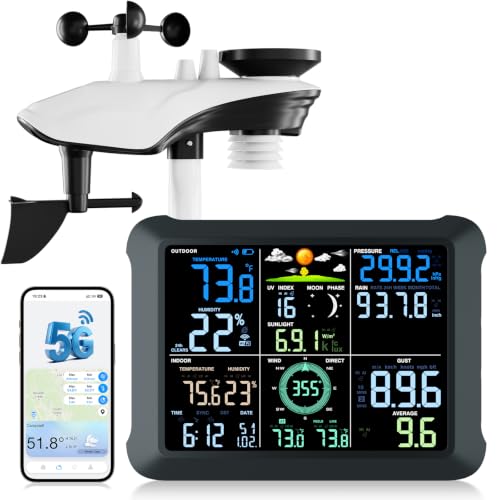
If your yard work depends on the sun rather than the temperature, the Raddy UV7 is the pick. A single integrated outdoor sensor measures temperature, humidity, wind speed, wind direction, rainfall, UV, and light intensity, then sends it up to 300 ft to the indoor console. That’s a full picture of your plot from one mount on a fence post.
The 5.12-inch VA screen (a panel type built for wider viewing angles) displays all of it with 4 brightness levels and an automatic night mode, so it dims itself when the room goes dark. The UV sensing goes up to an index of 15 with a 5-level exposure indicator, and light intensity reads up to 128 klux — useful if you’re protecting seedlings or just deciding whether to move the shade cloth. Atomic time syncs itself and handles daylight saving, and two alarms with a 5-to-60 minute snooze make it a bedside clock as well as a weather console.
The trade-off is signals. This is a young product with a small review base, and its Power Source listing points to battery power even though the listing also mentions USB-C — so confirm how you’ll keep the console live before committing. The 5-second channel cycling across up to 5 locations also moves quickly; if you’re watching several zones, you’ll want the optional remote sensors so the cycle has something to show.
Best for sun-sensitive yards: a UV index up to 15 plus a 5-level exposure indicator is genuinely rare in a home display, and the auto night mode makes it livable in a dark room.
The realistic limit: solar, rain, and wind sensors all live in one outdoor unit, so a single placement has to serve every reading — pick your mount spot with that in mind.
Worth it for: gardeners, greenhouse owners, and rooftops that want UV and light data alongside the usual temperature readout.
Not the one if: you want a long track record of owner feedback to lean on.
3. Sainlogic 5GHz/2.4GHz WiFi Weather Station
An 8.5-inch console that also keeps two years of charts on your phone.
Sainlogic’s WiFi station earns its spot on range: its sensor array transmits up to 135m / 443ft, the longest in this guide. That reach suits a big property or a farm with outbuildings. The 8.5-inch LCD (a standard liquid-crystal screen) supports wide-angle viewing, so you read temperature, humidity, rainfall, wind, pressure, and moon phase from across the room without walking up to it. Buyers report the wide viewing angle holds up from the side, not just head-on.
Under the hood sits an imported Swiss chip with accuracy rated at ±0.2°C for temperature and ±1.8% RH (relative humidity). Rain accuracy is ±1 mm under 15 mm and ±7% above that, and a built-in bubble level helps you mount the gauge flat so that accuracy isn’t wasted. From there, the inercom app refreshes every 5 minutes, stores up to 2 years of history, and exports to Excel up to 30 days at a time. Dual-band 5GHz/2.4GHz WiFi and Weather Underground connectivity round it out for anyone who wants their readings on a public map.
Setup and the manual are where this one asks for patience — connectivity is the most debated point, and the printed instructions are the weakest link. Get past the first configuration and the day-to-day running is largely automatic. For the money it’s a lot of display and a lot of history, provided you’re comfortable in an app settings screen.
What the spec sheet promises: an 8.5-inch wide-angle LCD, a ±0.2°C Swiss-chip sensor, and a 443ft transmission range — the longest reach here.
The honest friction: the WiFi pairing step and the paper manual trip people up, so budget a calm half hour for first setup.
Pick this if: you want charts and exports, not just a live number on a wall.
Think twice if: you want a display you can unbox and never touch a phone app for.
4. Ambient Weather WS-2902 Wi-Fi Smart Weather Station

The only station here that turns your readings into Alexa, Google Home, and IFTT automations.
Ambient Weather’s WS-2902 is the only station here that turns weather into an automation trigger rather than just a readout. The Osprey sensor array measures wind speed and direction, temperature, humidity, rainfall, UV intensity (how strong the sun’s ultraviolet rays are), and solar radiation. The console pushes that data over WiFi, so you can set alerts and program other devices through IFTT, Google Home, and Alexa. If you want your lights or sprinklers to react to rain, this is the pick.
The owner consensus is overwhelmingly positive on the fundamentals — build quality and setup are the two things buyers talk about most, and both come out strongly. Accuracy and value show up as positives too, which is why this has the largest review base in the lineup by a wide margin. The console itself is a colorful LCD, and the array can be tied into the Ambient Weather Network to share hyperlocal conditions from your own yard.
Two things to size up before buying. Connectivity is the most divided topic — some run it for years without a hiccup, while others see drops — and the color console splits opinion on readability at an angle. Ambient lists a lower temperature rating of 14 °F, so in a hard-freeze climate check that against your winters. The 2.4 GHz WiFi band is what it connects on, so keep it on that network rather than a 5GHz-only setup.
Strengths worth paying for
- Works with IFTT, Google Home, and Alexa for weather-triggered automations.
- Osprey array covers wind, rain, UV, solar radiation, temperature, and humidity.
- The biggest owner base here, with quality and setup praised most.
Points to weigh
- WiFi drops are the recurring complaint; the 2.4 GHz band is required.
- Console readability at an angle divides owners.
- Lower temperature rating of 14 °F limits extreme-cold use.
Fits your shelf if: you already run a smart home and want the forecast to trigger it.
Pass if: your winters drop well below 14 °F and you need the array to keep reporting.
5. Govanli WS-SA8 Weather Station with Rain Gauge
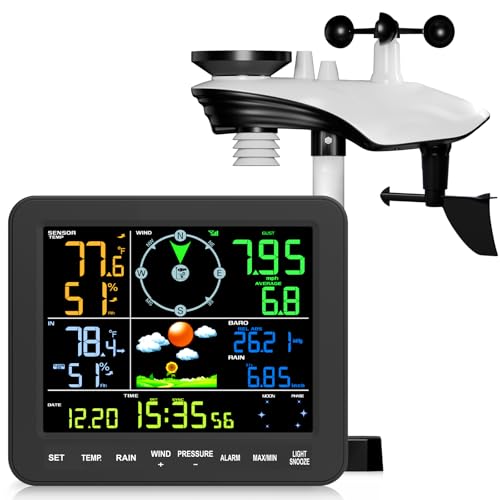
A 7.5-inch high-contrast screen with a rain gauge and no app to check.
Govanli aims this console squarely at gardeners and anyone keeping animals. The 7.5-inch high-definition display uses large digits, clear icons, and high contrast, with a 3-level backlight for both a bright kitchen and a dim hallway. It measures indoor and outdoor conditions and adds a rain gauge on the outdoor sensor, so your watering decisions come from your own yard rather than the regional forecast.
Rain accuracy is where this station is unusually specific. It’s rated within ±1 mm for light rain up to 15 mm and ±7% for heavy rain between 15 and 9999 mm, with a manual calibration function so you can tune it to your local conditions. The sensor mounts on fences, poles, rooftops, gardens, farms, or orchards and sends data indoors without wiring; the listed wireless range tops out around 328 feet. It’s also simply easy to start — the components arrive pre-assembled and the controls are intuitive enough for a first-timer.
The honest limit is range. At roughly 328 feet it has the shortest transmitter distance in this guide, so a long property may find the far fence out of reach. There’s no WiFi or app here either, which is a deliberate choice: it’s a display you walk past, not a dashboard you check from work. skip it if you want phone alerts from the far end of a large yard.
Where it shines: a big, high-contrast 7.5-inch screen plus specific rain tolerances of ±1 mm and ±7% make it a genuine garden tool.
What you give up: no WiFi and a shorter wireless span, so it’s strictly a one-property, in-the-room station.
Right for: gardeners, small farmers, and anyone who wants a rain total big enough to read with reading glasses on.
Wrong for: big acreage or anyone who wants the data on a phone.
6. ECOWITT Wittboy Pro HP2564 Weather Station
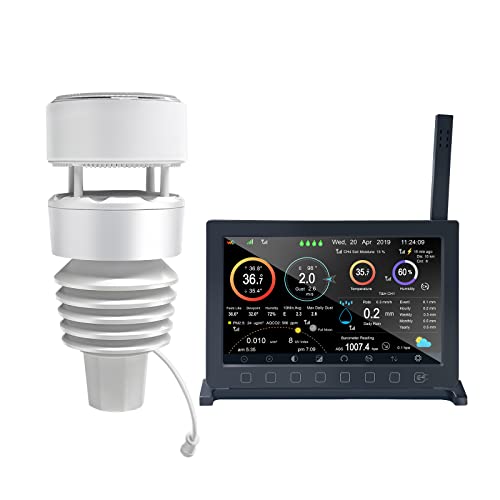
The expandable one: a haptic rain sensor on the WS90 array and support for up to 8 soil moisture probes.
The Wittboy Pro is the most configurable display here, and that’s why it beats a simpler console. The WS90 outdoor sensor is a 7-in-1 unit with a haptic rain sensor at the top (a motion-based sensor that measures rainfall volume without a tipping bucket). It’s rated IPX5 (a water-jet resistance rating), so it shrugs off heavy spray, and it runs on a built-in solar panel with backup batteries. Transmission reaches up to 150m / 500ft with obstacles in the way and up to 300m / 1,000ft in open space.
It supports up to 8 WH51 soil moisture sensors, air quality sensors, a pool thermometer, a water leak detector, and a dedicated WH40 rain gauge. It uploads your readings to Ecowitt Weather, Weather Underground, Weather Cloud, or WOW. The 7-inch TFT screen (a brighter, more vivid panel type than a plain LCD) shows it all, and the free Ecowitt server stores your graphs and can email you alerts. Owners mention the email alerts are handy for catching a leak before it spreads.
The one thing to know before you buy: Ecowitt says itself that the haptic rain sensor can drift under certain conditions, because raindrop size and wind speed affect its output. If precise per-storm rainfall matters, the brand recommends pairing a WH40 gauge with the WS90. Treat that as a known quirk, not a hidden flaw. Setup is regarded as straightforward and the data availability is a highlight for enthusiasts.
Why enthusiasts pick it: support for up to 8 soil moisture sensors plus air quality, leak, and pool add-ons turns one console into a whole-property dashboard.
The trade-off worth knowing: the haptic rain sensor is convenient rather than exact, so pair the WH40 gauge if accurate rainfall totals matter to you.
Choose it if: you want one console feeding several sensors and uploading to public weather networks.
Choose something simpler if: you only need temperature and don’t plan to add sensors.
7. La Crosse Technology S77925-INT Weather Station

An 8.98-inch color console built around dynamic forecast icons and a 24-hour pressure graph.
La Crosse’s S77925-INT is built around the thing most people actually look at: the forecast. Dynamic color icons with trend arrows show which way the weather is heading, and a 24-hour barometric pressure graph gives you the context behind it. It reads indoor and outdoor temperature and humidity, adds dew point and heat index views, and lets you set custom high and low alerts for both temperature and humidity.
At 8.98 inches wide the console is generous, and the constant backlight (powered by the included 5V cord, with 3 AA backups for outages) keeps it glowing. Atomic time self-sets in 12 or 24-hour mode and handles daylight saving automatically, with 7 time zone choices and a crescendo alarm with a 10-minute snooze. Note that the outdoor sensor’s batteries are not included, so add two AA before first setup. Give the barometric reading 7–10 days to settle and calibrate before you judge the forecast icons.
Readability is the honest divide here — owners love the wood-grain look and find it clear from across the room, but a few find the screen tough at a steep angle. Functionality also splits, with older outdoor sensors sometimes being the weak point. Keep the console at a natural viewing height and this is a friendly, informative centerpiece.
What makes it pleasant to live with: dynamic color forecast icons, a 24-hour pressure graph, and a constant backlight make it readable without hunting for a button.
What to watch: it needs 7–10 days for barometric calibration, and the display is easiest to read straight-on.
Good match for: a kitchen counter where you glance at the forecast rather than scrutinize it.
Not the pick if: you need wind or rain data, which this station doesn’t measure.
8. LFF Weather Station with 3 Wireless Sensors

Three wireless sensors in the box cover three rooms on channels 1, 2, and 3.
The LFF station stands out for a practical reason: you get 3 wireless outdoor sensors, so you can watch temperature and humidity in three different places. That’s a real advantage over single-sensor stations if you want to compare the greenhouse to the porch. The sensors reach 330 ft / 100m in open air, but set them to channel 1, 2, and 3 before you mount them or the station won’t see all three.
The 7.5-inch color screen hosts 12 functions in one place: self-calibrating atomic time across 7 time zones, two alarms with snooze, temp and humidity, a comfort level icon, barometric pressure, and max/min records. Seven touch buttons handle the settings, and the 3-level backlight adjusts for day and night. On the adapter the screen stays on; on battery power it shuts off after about 10 seconds to save juice. At 7.48 inches deep, 0.59 inches wide, and 5.12 inches tall, it’s a slim panel that fits a narrow shelf.
Setup and accuracy are the two areas that split opinion most — some buyers find pairing simple and readings spot-on, while others hit snags. Weather prediction here is a 6-to-12-hour look ahead based on sensor readings and pressure shifts, not a live reading, so expect a forecast, not a fact.
The practical win: three sensors let you spot-check several spots, and 12 built-in functions cover time, alarms, pressure, and records in one unit.
The fair warning: channel setup is fussy and accuracy is mixed, so read the sensor-pairing steps carefully before mounting.
Best for: anyone with a greenhouse, garage, or basement they want to monitor alongside the house.
Skip if: one reliable sensor is all you need and you’d rather not juggle three channels.
9. La Crosse 308-1417BL Wireless Backlight Forecast Station
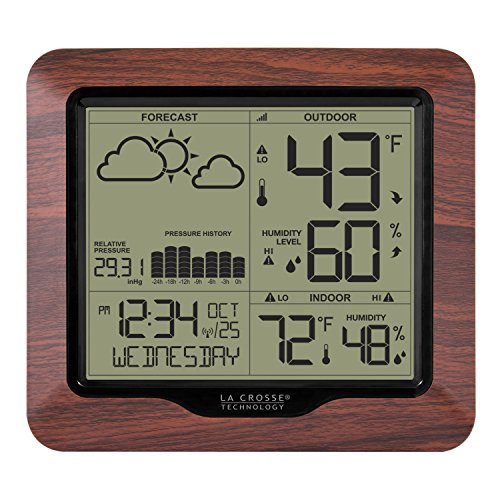
A compact console with a 24-hour pressure graph and no wind or rain sensor to mount.
La Crosse’s 308-1417BL keeps it simple: changing forecast icons with tendency arrows, IN/OUT temperature in °F or °C, and humidity in %RH, plus a barometric pressure graph that shows the past 24 hours. If you like to see pressure falling before a storm rolls in, this covers it without wind or rain sensors to set up.
The backlight runs constantly when the included 5V adapter is plugged in, with adjustable settings; on battery power it gives temporary illumination only, so plan to keep it wired. Atomic time self-sets with automatic daylight saving and selectable US time zones, and it records MIN/MAX values with temperature alerts. At 12.8 ounces and built from plastic with a wood-grain-look brown finish, it’s a straightforward console for a desk or shelf. Add three AA batteries for backup and two AA for the sensor, since neither is included.
The mixed signals here are accuracy and battery life, plus a backlight a few find too bright at night. Owners like the appearance and find the display easy to read from across a room. Keep it wired in a spot where the glow won’t bother you and it’s a solid pressure-focused station.
What it does best: a 24-hour pressure graph and forecast tendency arrows give you weather context in a compact footprint.
The catch to plan around: the constant backlight needs the adapter, and the brightness is best kept away from the bedroom.
Pick it for: a desk or kitchen counter where pressure trends matter more than wind and rain.
Leave it if: you want a permanently lit screen on batteries only.
Know the Specs
Display Type: LCD vs TFT vs VA
LCD panels are the standard here. TFT (like the Ecowitt’s 7-inch screen) is a brighter, more colorful panel that shows more detail, while VA (the Raddy’s 5.12-inch display) is chosen for wide viewing angles. Larger screens with big digits let you read temperature from across a room; smaller consoles like the La Crosse 308-1417BL still work well thanks to large digits. Look for adjustable backlight levels so the screen suits both a bright kitchen and a dim hallway at night.
Transmission Range and Sensor Type
A wireless sensor sends data to the console, and range decides how far you can mount it. In this lineup, the Sainlogic reaches 443ft, the Ecowitt up to 500ft with obstacles and 1,000ft in open space, the Raddy up to 300ft, the LFF 330ft, and the Govanli around 328ft. A basic sensor reads temperature and humidity; a 7-in-1 array adds wind, rain, UV, and light. Match the sensor to what you actually want to track.
Atomic Time and Barometric Pressure
An atomic clock self-sets by radio signal and handles daylight saving automatically, so you skip resetting twice a year. A barometric pressure graph shows the past 24 hours, which helps you spot a falling trend ahead of a storm. Give a new station up to 7–10 days for its pressure reading to calibrate before trusting the forecast icons.
Power Adapter and Battery Backup
Constant backlights usually require the power adapter; on batteries alone, most consoles dim or shut off to save power. A station with AA backup batteries keeps its settings and clock through a power cut, then picks up where it left off. Confirm whether the sensor batteries are included — on several models here they aren’t.
Common Questions
How far can the outdoor sensor be from the display?
Will a weather display work with Alexa or Google Home?
Do these stations show wind and rain or just temperature?
Why does my backlight turn off on battery power?
How long does the outdoor sensor battery last?
Is the atomic clock worth having on a weather display?
Why does my new station’s forecast seem wrong at first?
Can I add more sensors to these stations later?
What does IPX5 mean on an outdoor weather sensor?
Do I need WiFi for a home weather display?
The Bottom Line
For most homes, the weather display for home winner is the AcuRite Notos. Its lit color display, 3-in-1 sensor, and 18-second wind refresh cover the daily basics without an app, and it’s the most trusted pick here by owner count. If UV and light data matter for your garden, reach for the Raddy UV7. And if you want pressure graphs and history on your phone, the Sainlogic WiFi station is the one to order. Whichever you pick, check the sensor range against your property and confirm whether backups are included before you mount anything.
How we choose
We do not accept paid placement. Every pick is matched to a real buyer and a real use-case; we do not hands-on test units.
Sources
Specifications: manufacturer listings and product documentation. Review insights: verified customer reviews, as of November 2026. Pricing: not shown on this page (it changes often); check the current price via the retailer link.
As an Amazon Associate, Tactical Gear Guy earns from qualifying purchases. This does not affect which products we feature.