Specs are compiled from manufacturer listings and verified buyer reviews and can change over time — please confirm the key details on the product page before buying.
You are about to put a screw through drywall, and somewhere behind that paint is a live electrical cable. That is the whole job in one sentence. A wire detector in wall mode reads the electromagnetic field a live, unshielded AC cable gives off, and it warns you before the drill bit arrives. Below are nine units that do this, ranked so the one you should actually buy sits at the top. The winner is the Zircon StudSensor A100 — a simple, honest tool that alerts you to live wiring up to 2 in. deep while it hunts for stud edges.
This guide is built by comparing the manufacturers’ published specifications and the patterns across verified customer reviews, so you get each pick’s real strengths and trade-offs instead of marketing spin.
Every unit here was checked for one thing: whether it actually flags live AC wiring behind drywall, plaster, or tile. Knowing which mode to trust, and how deep each scanner reads, is what separates a confidence-inspiring tool from a beeping box. Here is the honest rundown of the wire detector in wall market, ranked by real-world usefulness.
Top Picks

How To Choose The Best Wire Detector in Wall
The single most expensive mistake in home renovation is drilling into a live cable. Wire-detection mode senses the field of a live AC cable, while stud mode reads density — two different sensors that often share one housing. Know which mode reads cable and which reads studs before you drill.
Wire depth versus stud depth
AC wire detection reaches a different depth than stud detection, and the two numbers are quoted separately. The Zircon A100 sees live unshielded AC wiring up to 2 in. deep, but its standard stud scan reaches only 3/4 in. That gap matters: cables run through the cavity behind the drywall, often further back than the stud face you are trying to find. Match the quoted AC wire depth to your wall build-up — 2 in. covers most drywall, but thick plaster eats into that reach.
Why calibration is the whole ballgame
Every scanner here calibrates itself against the wall surface before it scans. Press that button while the tool is hovering over a cable or a stud, and the tool treats that reading as the baseline — so it reports a false all-clear. The fix is simple: hold the unit flat against a clean patch of wall, press until you hear the confirmation beep, and do not move it during calibration. Calibrating over a cable or stud is the most common cause of false all-clear readings on every unit here.
Wall type changes everything
Drywall, plaster over lath, tile, and acoustic ceiling panels all behave differently under a scanner. Lath and plaster can scatter the signal, while tile adhesive can mimic a dense object. Check that the spec sheet names your wall type, then confirm any reading with a second pass.
Rechargeable or disposable batteries
Most units run on a 9V alkaline or a pair of AA cells. A few use an internal lithium-ion pack and charge over USB. A rechargeable pack saves buying cells, but the scanner sits dead on the charger mid-job. AA or 9V cells let you swap and keep scanning, which suits a tool that lives in a job bag.
Side-by-Side Comparison
| Model | Best For | AC Wire Depth | Display | Power | Amazon |
|---|---|---|---|---|---|
| Zircon StudSensor A100★ Best Overall | Simple, reliable live-wire alerts | Up to 2 in. | LCD | 1 x 9V (not included) | Amazon |
| HANMATEK SF1Most Capable Scanner | Deep multi-material scanning | 2 in. (50 mm) | HD LCD | Battery powered | Amazon |
| NOTANY RE-9Best Extras | Laser and level extras | 1.97 in. | 2-inch backlit LCD | Battery powered | Amazon |
| FNIRSI WD-01 | Rechargeable 6-in-1 scanning | 2 in. | LCD | Lithium-ion (rechargeable) | Amazon |
| Premium Wall Scanner WD-02 | Adjustable sensitivity levels | Live AC wires | TFT LCD | Polymer (rechargeable) | Amazon |
| POROMETISTO DSF06 | Moisture plus wire detection | 1.97 in. | 3-colour indicator | 1 x 9V (included) | Amazon |
| Zircon MultiScanner A200 | Metal scan on top of wire alerts | WireWarning detection | Digital LCD | 1 x 9V (not included) | Amazon |
| BOSCH GMS120-27 | Jobsite-grade body | Live AC detection | Graphical display | 2 x AA or Bosch 3.7V | Amazon |
| Bosch Professional GMS 120-27 | Long-range material ID | 50 mm | Tri-colour LED ring | 2 x AA (included) | Amazon |
Detailed Reviews
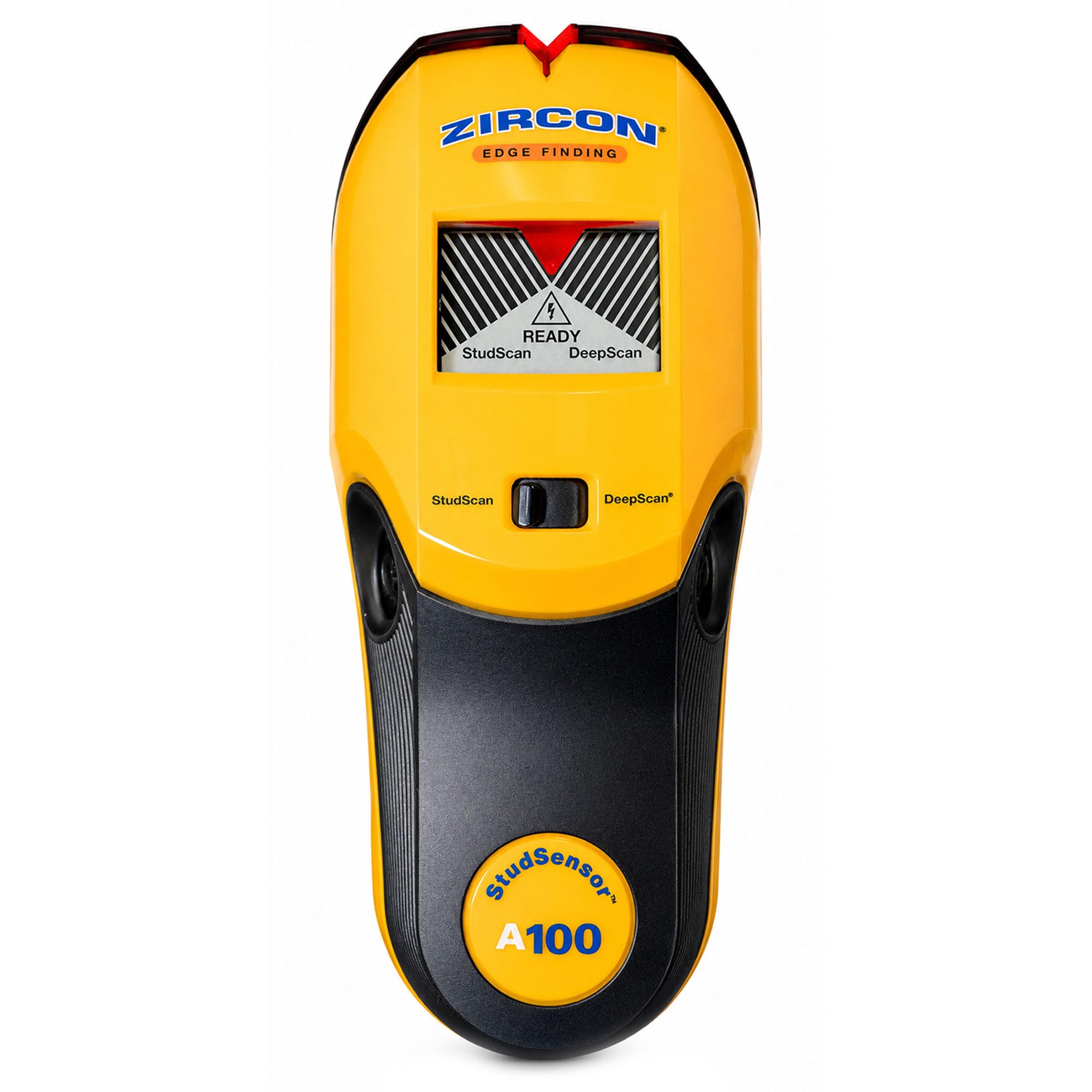
1. Zircon StudSensor A100 Stud Finder w/ Live Wire Detection
Our pick — 4.0+★ from 900+ verified ratings; the strongest balance of quality and price.
Simple, honest wiring alerts from a tool that does exactly one job well.
If your goal is to avoid a drill bit meeting a live cable, the A100 delivers the most direct answer of the group. It flags live, unshielded AC wiring up to 2 in. deep while you scan in either mode, so the warning fires even during a routine stud pass. That 2 in. AC depth is the spec to watch — most interior cable runs sit shallow enough for it to catch.
The scanning itself is split into two depths. StudScan finds wood and metal stud edges up to 3/4 in. deep, which covers standard drywall. DeepScan reaches 1 1/2 in. for thicker surfaces. The LCD screen, audio tone, and SpotLite pointer combine to mark both edges of a stud before you mount a TV or hang a cabinet, and the ergonomic grip keeps the body flat against the wall.
Here is the honest trade-off. The A100 is a stud-first tool with wire alerts built in, and it is not a metal detector or pipe finder. If you need to trace copper pipes or rebar, this is not the unit. It also runs on one 9V alkaline battery that is not included, so budget a trip to the drawer before first use. For the buyer who wants a dependable pre-drill check on drywall, the balance is right.
What earns its place
- Flags live AC wiring up to 2 in. deep in both scan modes
- Two depth modes: 3/4 in. standard, 1 1/2 in. deep
- SpotLite pointer plus audio tone for edge marking
- Low-battery indicator warns before readings go bad
Before you commit
- 1 x 9V battery is not included
- No dedicated metal or pipe scan mode
- Calibration must be done on a clean patch, not over a cable
Best for: drywall mounting jobs where the main risk is a live cable behind the screw.
Think twice if: you also need to trace copper pipe or metal framing — that calls for a multi-material scanner.
2. HANMATEK Stud Finder Wall Scanner
Five scanning functions and an IP66 body — a lot of tool for the money.
Where the Zircon A100 keeps things narrow, the HANMATEK spreads out. It carries five scanning functions: stud exact mode at 0.8 in. (20 mm), stud deep mode at 1.5 in. (38 mm), AC wire scan at 2 in. (50 mm), ferrous metal to 4.7 in. (12 cm), and non-ferrous metal to 4 in. (10 cm). That last pair is uncommon at this level — it means you can hunt rebar or copper pipe, not just a wooden stud.
The screen does the explaining, showing signal strength, scan mode, detection depth, and battery status all at once. A three-colour light system tells you green for nothing detected, orange at the edge of a target, and red backlight when you have hit the stud centre. The audible alarm can be switched off, which matters in a quiet house at night. An IP66 rating — dust-tight and protected against powerful water jets — plus a rubber back that guards the wall surface make this a genuinely job-site-friendly build.
The catch: auto-calibration has to happen over a clear patch with no nails, AC wires, or metal beneath the sensor. Calibrate over a cable and the machine writes that reading as its zero point, and you get a false all-clear. The accuracy and reliability results across owners split both ways for that reason. Treat calibration as a ritual, not a formality, and it rewards you.
Where it pulls ahead: no other pick in this group lists both ferrous and non-ferrous metal scanning at those depths, so it doubles as a pipe and rebar finder.
Fit note: buyers report accuracy and reliability as mixed — the ceiling for this unit depends heavily on how carefully you calibrate it before each scan.
Reach for this if: you want one tool to find wires, pipes, rebar, and studs across a whole renovation.
Look elsewhere if: you want a single-button tool with nothing to configure.
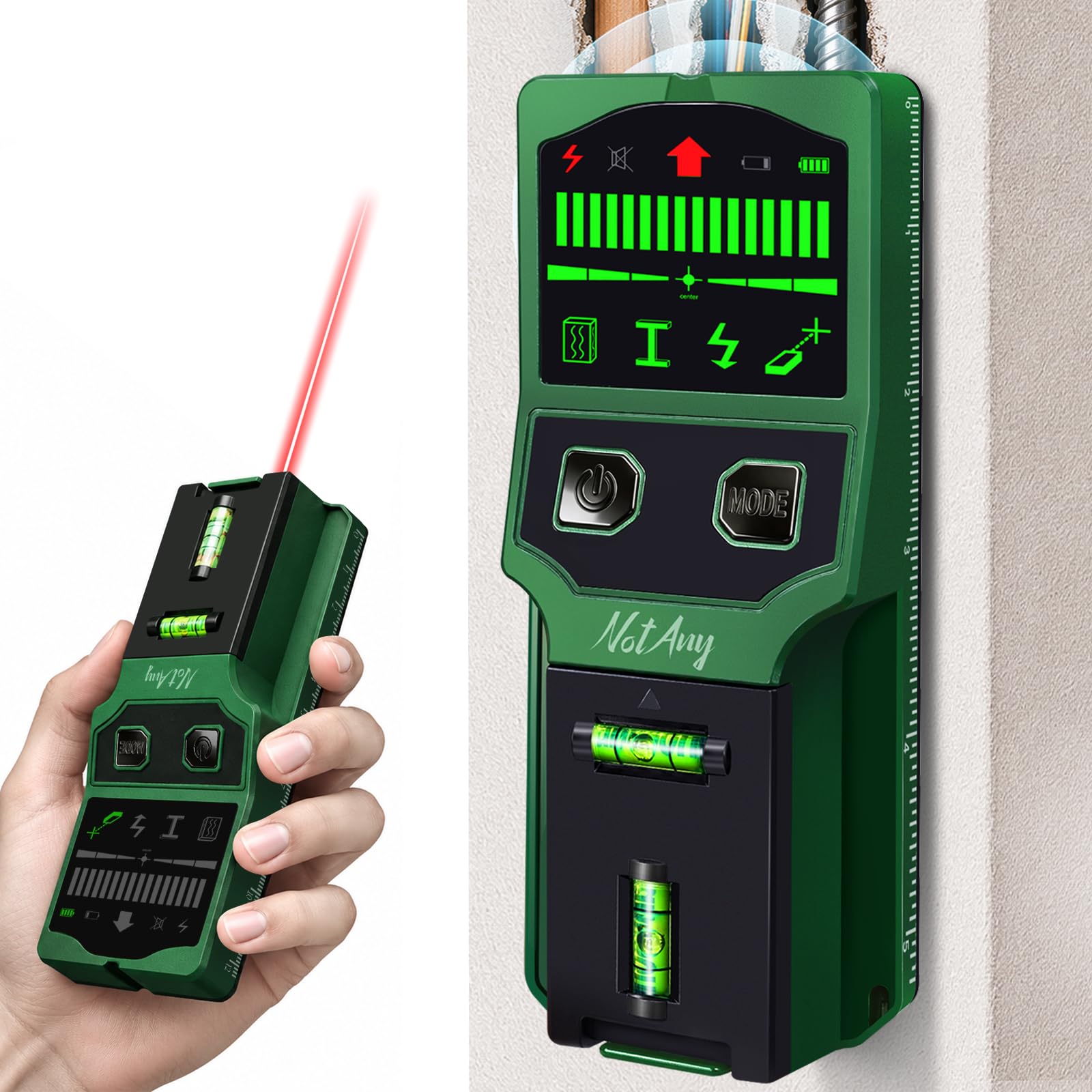
3. NOTANY Stud Finder Wall Scanner 7-in-1 with Laser Level
Four sensors under the hood and a laser to keep your shelf line straight.
At 6.56 ounces, the NOTANY is the lightest scanner on this list — the FNIRSI WD-01 tips the scale at 9.3 ounces, so there is a real heft difference in the hand. That matters when you are holding the unit flat against a wall overhead for several minutes.
Its three modes run to 1.5 in. for foreign objects, 4.72 in. for metal, and 1.97 in. for AC power. The headline here is the built-in laser positioning and bubble level — you can set a straight line for a shelf or TV mount at the same time you are confirming what is behind the plaster. The 2-inch backlit LCD shows the rivet centre, signal grid position, and battery status, and it stays readable in dim light.
What wins people over is the accuracy, followed by overall build quality and then the laser features — that trio is what owners talk about. Reliability is the one area where opinions split; it is a sub- tool after all, and it rewards patient, slow scanning over a rushed pass. Buttons on the quieter side of the market and a 1-year warranty round it out.
Go for it when: you plan to hang shelves or a TV and want a level and wire warning from one compact unit.
Keep looking if: you need a tool that stands up to daily professional use — reliability here is best treated as a careful-use friend.
4. FNIRSI WD-01 6 in 1 Rechargeable Stud Finder Wall Scanner

No battery drawer dives — this scanner charges and scans wire at 2 in. deep.
The FNIRSI brings a feature nobody else in the first half of this list has: a rechargeable lithium-ion pack. No trips for 9V cells, no dead-tool crises on a Sunday afternoon. It also packs six detection modes — exact scan to 0.75 in. for wood and metal stud edges, depth scan to 1.5 in., non-ferrous metal to 3.9 in., ferrous metal to 4.7 in., live unshielded AC wires to 2 in., and copper wire to 1.6 in. That copper-wire mode is unusual, and it gives you a fighting chance when the cable is small-gauge.
Its positioning hole is the standout physical feature — it lets you mark the edge or centre of a target directly rather than eyeballing a pencil line off the side. An LCD screen and audio alarm give you both visual and audible confirmation, and the tool auto-calibrates against the wall. The body is 9.3 ounces, which is heavier than the NOTANY above, but that extra weight buys the lithium pack and the six modes.
Owners describe it as useful for renovation and installation work, with the functionality winning praise. The honest caveat is accuracy: opinions on detection are split, and some units will not lock onto every material. It is a scanner that rewards you for scanning slowly and confirming a spot from two angles before you drill.
The practical edge: a rechargeable pack plus a dedicated copper-wire mode puts this a notch above the plain 9V units for finishing a job without a break.
The trade-off to know: at 9.3 ounces it is the heaviest pick here, and detection accuracy divides owners — plan on a confirmation pass.
Choose it if: you hate buying batteries and want a tool that covers wood, metal, live AC, and copper wire.
Pass if: you want the group’s lightest scanner.
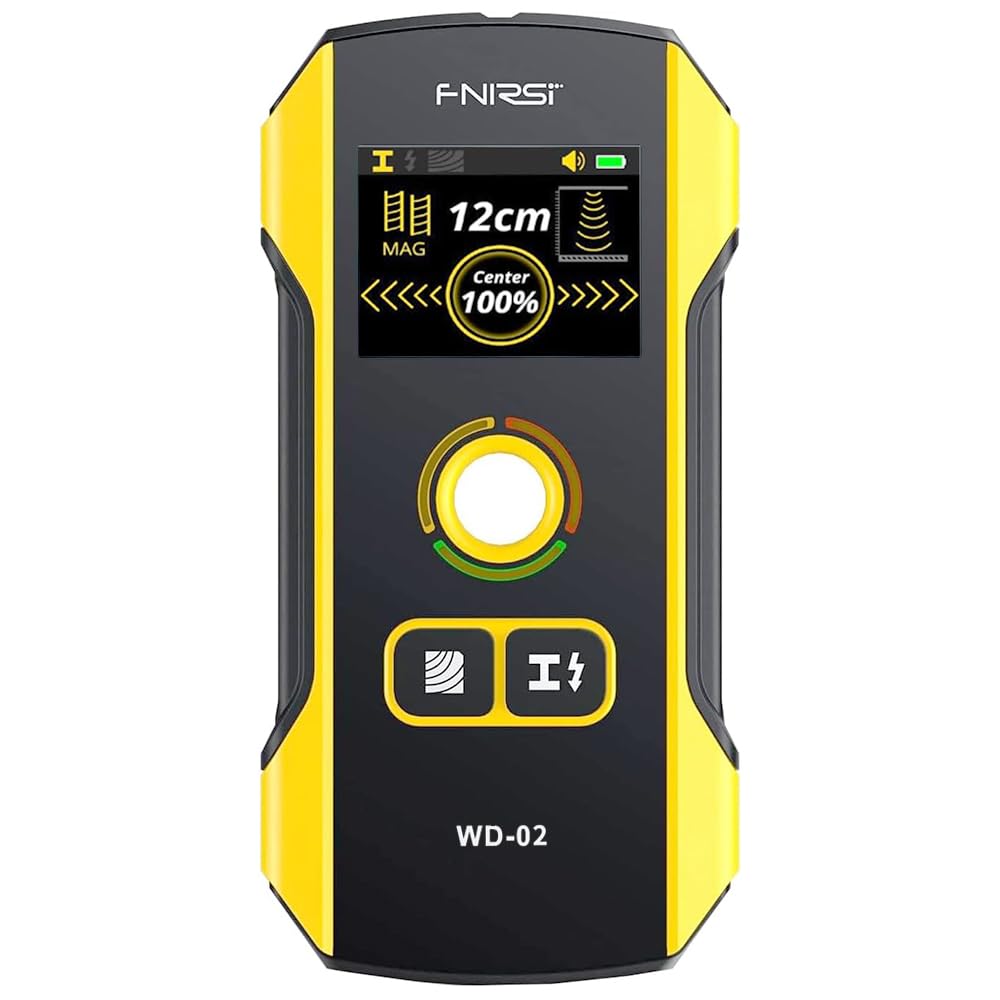
5. Premium Wall Scanner Stud Finder
Three modes, three sensitivity levels each — fine control when a wall fights back.
This is the pick for the wall that refuses to cooperate. Instead of one fixed sensitivity, the scanner offers three dedicated modes — studs, metals, and live wires — and within each mode you can dial three sensitivity levels. That lets you step down when plaster scatters the signal, or step up when a cable sits further back than the standard reading. Very few tools at this level give you that much manual control.
The physical side is equally deliberate. A visible positioning hole lets you mark centre and edge directly, saving the offset guesswork. A bright TFT LCD — a type of screen that stays readable from an angle — shows real-time feedback, and an audible alarm backs it up. It auto-calibrates on drywall, plaster, wood, and painted walls, and the rechargeable polymer battery means no disposable cells. At 8.1 ounces it sits mid-pack on weight.
The honest framing here is that functionality and quality divide owners. Some find it outstanding; others find it not fully effective on their wall build-up. That split is typical for a tool with this many settings — it is only as good as the mode and sensitivity you pick for the surface in front of you. Read the manual page on sensitivity once and the experience improves sharply.
Suits you if: you work across mixed wall types and want to tune sensitivity by hand.
Skip the complexity if: you would rather the tool make the mode decision for you.
6. POROMETISTO 2-in-1 Stud Finder
A wire scanner and a damp tester sharing one body — useful for leak hunts.
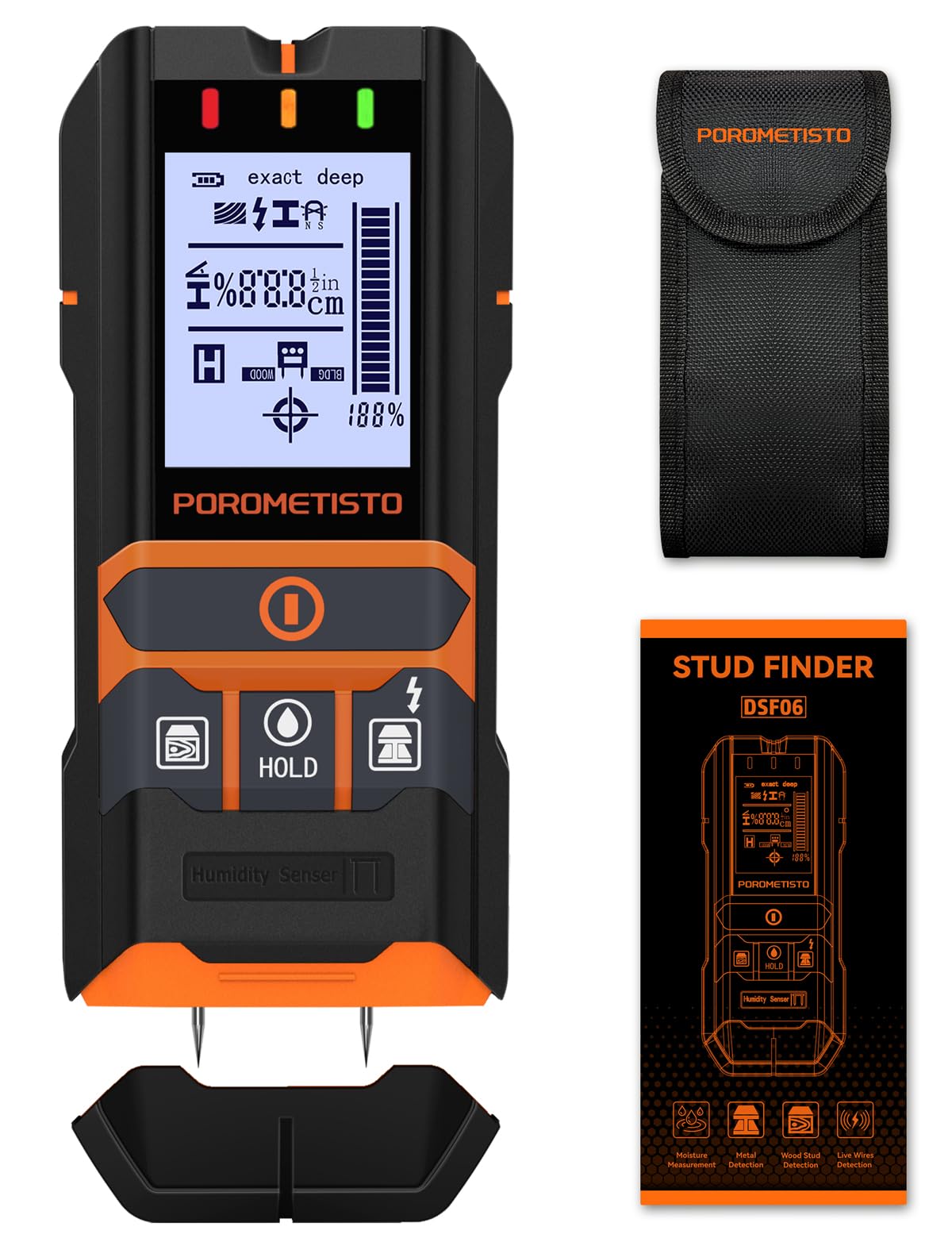
This is the odd one out, and that is exactly its appeal. The DSF06 scans walls like the rest — live AC wires at 1.97 in., wood studs at 0.79 in. exact or 1.50 in. deep, ferrous metal at 4.72 in., and non-ferrous metal at 3.15 in. — and then it also reads moisture across a 1.5%–50% range with ±2% accuracy. For anyone chasing a hidden leak or checking a damp patch of drywall before mounting something heavy, those two jobs belong on the same trip.
Operation is one-touch. The device powers on in metal mode; press the [MOISTURE] button to test damp, press [STUD] to return to wall scanning and hold it until the green light finishes auto-calibration. A three-colour indicator gives you a clear read — green for ready, yellow for close, red with a beep for target found — and a centre hole mark on the screen pinpoints the spot for drilling. A 9V battery, carry pouch, and manual are all in the box.
The caveat is that the moisture function demands some discipline. Always pull the black protective cap off the bottom pins before testing and refit it afterwards. Gently touch the pins to the surface rather than stabbing them in. And if the tool has been in a hot truck or a freezing garage, let it settle for 30 minutes before you trust a reading.
Why it earns a slot
- Combines live AC wire scanning with a 1.5%–50% moisture meter
- Three-colour light plus centre-mark for accurate drilling
- 9V battery, pouch, and manual included in the kit
- Backed by a 2-year free replacement service
Worth weighing first
- Moisture pins need careful handling and the cap must come off
- Fewer owner reports than the Zircon and HANMATEK picks
- Requires a 30-minute settle time after extreme temperatures
A good match for: homeowners chasing a leak who also need wire and stud detection on the same wall.
Less ideal if: you only ever need wire alerts — a simpler scanner does that job with less to learn.
7. Zircon MultiScanner A200 Stud Finder
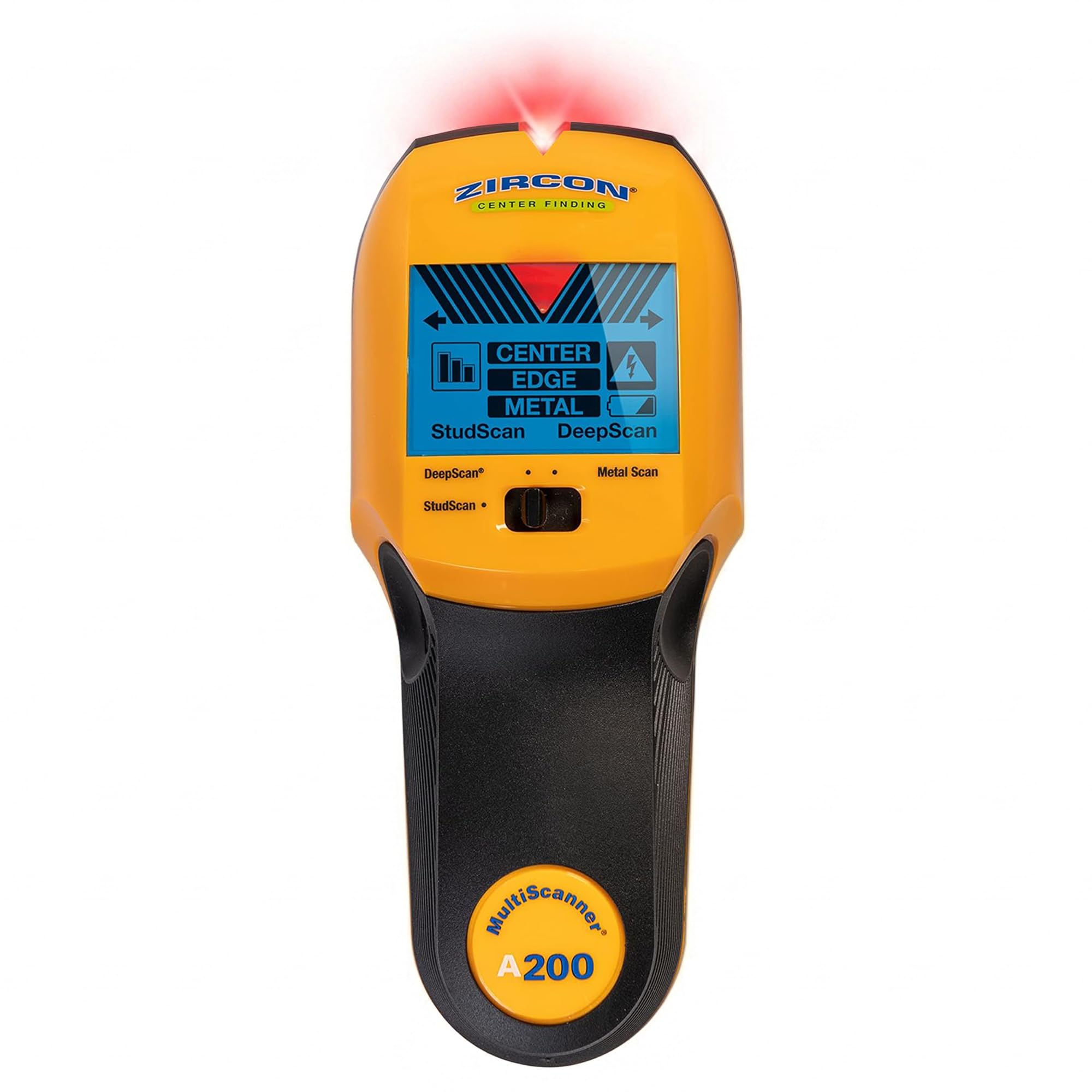
The step up from Zircon’s A100 adds a metal mode and a tougher body.
If the A100 is the entry point, the MultiScanner A200 is the same logic with more room to work. StudScan finds wood or metal stud edges and centres up to 3/4 in. deep, DeepScan goes to 1 1/2 in., and Metal Scan locates metal behind the wall before you drill. WireWarning detection still fires on hot electrical wires during a scan, and the SpotLite pointer plus audio tone mark the edge and centre for you.
Compared with the A100, the A200 adds the metal scan mode and an IP54 rating — protected against dust and splashing water — along with a limited lifetime warranty. The orange body and digital display stay readable in dim work areas, which owners call out as a real plus when you are scanning a closet or a garage corner lit by one bulb. Easy operation is the aspect the tool wins on most, followed by build quality.
The trade-off is accuracy, which owners describe as mixed. Some find it mostly accurate; others report false readings and trouble with copper pipes. Calibration is again the lever: place the unit flat, hold the power button, wait 1–2 seconds for the short beep, and do not move until it finishes. Get that right and this is a dependable pre-drill companion at 0.37 kg.
Step-up value: the metal mode and IP54 shell make this a better fit for mixed jobs than the A100, without the price jump into pro territory.
Honest read: accuracy splits owner opinion, and copper pipes are the known weak spot — confirm with a second pass.
Best used by: DIYers mounting heavy things who want metal detection on top of live-wire warning.
Better to look on if: copper pipe detection is your main job.
8. BOSCH GMS120-27 Wall Scanner

A rubber-armoured chassis and a colour ring that goes red when a cable is live.
The GMS120-27 is built for the van, not the drawer. A shock-absorbing rubber casing and an IP54-rated body — dust-protected and splash-resistant — are designed to take daily abuse on a construction site. The centre-finding feature helps you hit the middle of a stud, and the colour-coded marking ring changes to green for safe and red for live wire detected. That single visual cue is the clearest wiring read of any tool on this list at a glance.
Power is a genuine advantage. It ships with two AA batteries for use straight from the start, and it also accepts a Bosch 3.7V lithium-ion battery sold separately for rechargeable running. For a pro who already carries Bosch batteries, that removes the mid-job battery run. At 13.76 ounces it is the heaviest unit here, which is the cost of that armoured build.
The caution is real, and it needs saying plainly. Owner reliability reports on this model are not glowing — inconsistency in detection comes up repeatedly, and the indicator lights can illuminate without giving useful information. If you buy it, budget time to learn its quirks on scrap drywall before you trust it on a live wall, and always treat a red ring as a hard stop.
Worth choosing if: you want a pro-grade body and the clearest live-wire warning light in the group.
Consider carefully if: you expect point-and-go accuracy — this one needs a learning curve and confirmation scans.
9. Bosch Professional GMS 120-27 Detector with Protective Bag
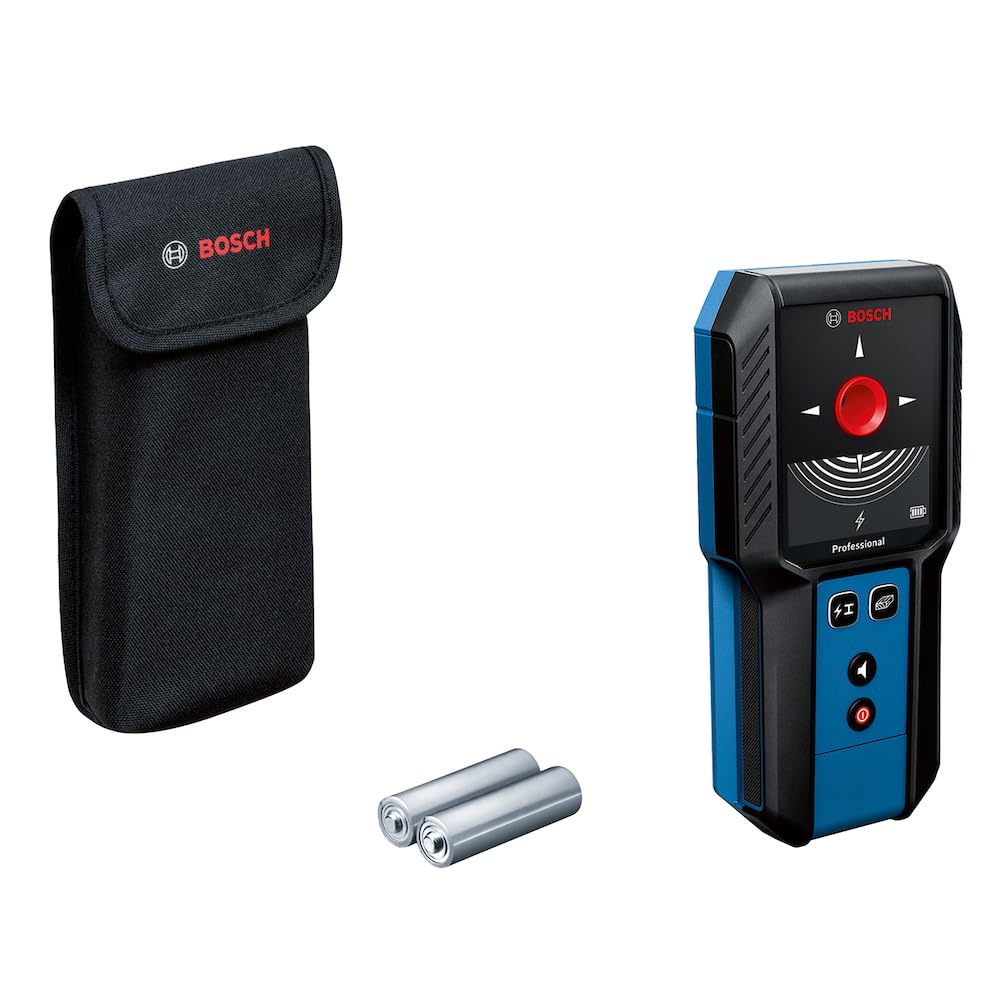
Publishes its detection depths in writing — the tool for buyers who want numbers.
Most scanners keep their depth figures vague. Bosch prints them on this one: maximum detection depth of 120 mm for non-magnetic metal, 100 mm for magnetic metal, 50 mm for voltage-conducting cable, and 30 mm for wood. Those are real, checkable numbers, and the 50 mm cable figure is the one that matters for wire detection — enough for a cable set back in a service cavity. Someone mounting a bracket in a wall with thick plaster will get more out of that reach than a shallow-reading unit allows.
Its real skill is telling you what you just found. The detector reports whether the object is magnetic metal, non-magnetic metal, a live line, or a non-metallic material — so a reading is not just a beep but a label. A tri-colour LED ring around the marking opening glows red when an object is detected, yellow when approaching, and green when nothing is there. The rubber housing and IP54 rating carry the same job-site durability as the GMS120-27, and the box includes a protective case and two AA batteries.
At 0.24 kg it is lighter than its GMS120-27 sibling, and the simpler mode selection is a plus rather than a compromise. The trade-off is that it sits in the premium tier and asks you to learn the material-ID language before you can lean on it — but once you do, the tri-colour ring and depth figures make it the most informative read in the group.
What it does better than most: it names what the sensor found — magnetic metal, non-magnetic metal, live cable, or wood — instead of just beeping.
The cost of entry: it is the deepest-reaching and most informative pick here, and priced accordingly, with a learning period before the material labels become second nature.
Made for: the buyer who wants published depth figures and a tool that names the material behind the wall.
Not the first pick if: you want the cheapest path to a wire alert on plain drywall.
Know the Specs
AC wire depth (mm and inches)
This is how far into the wall the scanner can sense the electromagnetic field of a live, unshielded AC cable. The Bosch GMS 120-27 lists 50 mm for voltage-conducting cable; the Zircon A100 lists up to 2 in.; the FNIRSI WD-01 lists 2 in. for live AC and 1.6 in. for copper wire. Deeper reach means cables set further back in a service cavity are still caught. Shallow reach means you may pass over a live run and get silence.
Stud exact versus deep mode
Exact mode finds the edge and centre of a stud close to the surface — typically around 0.75–0.8 in. Deep mode reaches further, often 1.5 in., to cope with thicker drywall or plaster build-up. The number quoted is the maximum depth the sensor is rated for, not a guarantee for every wall. Use exact mode on standard drywall and switch to deep mode when the first pass finds nothing.
Auto-calibration
Before scanning, the unit sets a baseline by reading the wall directly in front of it. Press the button flat against a clean patch, wait for the confirmation beep, and keep still. If you calibrate over a cable or a stud, the tool treats that object as empty wall and reports a false all-clear. Every unit in this list uses this system, and every one of them can be fooled by a careless calibration.
Indicator systems
Most scanners use a traffic-light scheme: green for nothing detected, yellow or orange at the edge of a target, red at the centre or at a live wire. Bosch takes it further with a tri-colour LED ring around the marking opening. The Zircon A100 and A200 add an audio tone and a SpotLite pointer to mark the edge with light. The richer the indicator, the fewer confirmation passes you need.
Common Questions
How deep into a wall can a wire detector sense a live cable?
Will a wire detector find a cable that is switched off?
Why does my scanner beep randomly on a plain wall?
Can a stud finder also find metal pipes behind drywall?
Do I need the deep scan mode for standard drywall?
Is a rechargeable scanner better than one that takes batteries?
What does the IP rating on these scanners mean for a job site?
Can these scanners see through tile or plaster?
How do I know the tool is calibrated correctly before I drill?
Does a moisture reading help when I am hunting for a hidden wire?
The Bottom Line
For most buyers, the wire detector in wall answer is the Zircon StudSensor A100 — it flags live AC wiring up to 2 in. deep in both scan modes and keeps the whole job to one button and two depths. If you want metal and pipe detection on top, the HANMATEK SF1 adds ferrous and non-ferrous scanning to 4.7 in. and 4 in. And for the buyer who wants published depth figures with a tool that names the material, the Bosch Professional GMS 120-27 is worth the step up. Whichever you pick, calibrate on a clean patch and scan slowly — the tool is only as good as its baseline.
How we choose
We do not accept paid placement. Every pick is matched to a real buyer and a real use-case; we do not hands-on test units.
Sources
Specifications: manufacturer listings and product documentation. Review insights: verified customer reviews, as of November 2026. Pricing: not shown on this page (it changes often); check the current price via the retailer link.
As an Amazon Associate, Tactical Gear Guy earns from qualifying purchases. This does not affect which products we feature.