Specs are compiled from manufacturer listings and verified buyer reviews and can change over time — please confirm the key details on the product page before buying.
If you want the short answer: buy the HM Digital COM-80. It is the pick that reads both conductivity (EC) and dissolved solids (TDS) with four scales, and it does it without asking you to babysit a calibration routine every single morning. The cheaper pen-style meters flooding the listings look identical in a photo — same white body, same LCD window, same promise. What separates them is what happens after the first few weeks, when the electrode either holds its reading or starts drifting toward whatever number you were secretly hoping for.
This guide is built by comparing the manufacturers’ published specifications and the patterns across verified customer reviews, so you get each pick’s real strengths and trade-offs instead of marketing spin.
A water conductivity meter works by passing a current between two electrodes and reporting how easily that current travels — more dissolved salts, easier travel, higher number on the screen. That number is only useful if the probe is clean, the temperature is corrected, and the calibration actually stuck. Below you’ll find the seven picks worth your attention, ranked by genuine strengths, so you can scan the water conductivity meter options and stop guessing.
Top Picks


How To Choose The Best Water Conductivity Meter
The thing that ruins most people’s meter is not the electronics — it’s the routine. A conductivity pen lives in a drawer, gets dunked in reservoir water, comes out wet, and sits there until tomorrow. Whatever the box promised, the probe is what decides whether the number on screen is real. So before you compare screens and scales, decide how much maintenance you are honestly going to do.
Start with the probe, not the screen
Two meters can carry the same accuracy claim and behave nothing alike. A platinum-black sensor (a dark-coated electrode that resists the mineral film that builds up in hard water) tends to hold its reading longer between cleanings than a plain metal pin. That coating is the difference between a meter that still agrees with your calibration solution in week six and one that has quietly wandered off by a couple of points. If you are testing hydroponic nutrient solution every day, the probe material matters more than any feature on the display.
Decide your units before you buy
EC (electrical conductivity) is the raw physical measurement. TDS (total dissolved solids) is that same reading converted into a parts-per-million estimate using an assumption about what the dissolved stuff is. Nutrient feed charts usually quote EC in µS/cm or mS/cm, so a meter that only speaks ppm forces you to convert constantly. A meter that switches between EC in µS and mS, plus TDS in ppm and ppt, keeps you out of that arithmetic.
Check whether the calibration solution ships in the box
A kit with a bottle of 1413 µS/cm buffer solution saves you a separate shopping trip and, more importantly, gives you a known reference to check against. Without a reference you cannot tell whether the meter is drifting. Hydroponic kits that include pH calibration solution and EC buffer solution are ready on day one; bare pens usually are not.
Match the range to your actual water
Tap water and base reservoir water sit low on the scale. Full-strength nutrient solution sits higher. Saltwater pools and seawater sit higher still. Know roughly where your water lives before you buy, because a meter that tops out below your working range is useless no matter how accurate it claims to be.
Side-by-Side Comparison
| Model | Best For | EC Range | Scales / Modes | Temp. Compensation | Amazon |
|---|---|---|---|---|---|
| HM Digital COM-80★ Best Overall | All-rounder for nutrient testing | 0–5000 ppm TDS | EC µS, mS; TDS ppm, ppt | ATC | Amazon |
| YINMIK 4-in-1 Hydroponics MeterReservoir Monitor | Continuous reservoir monitoring | — | pH, EC, TDS, Temp (4-in-1) | ATC | Amazon |
| EZTOCH Hydroponic pH EC Meter | Beginners reading three values at once | 0.00–19.99 mS/cm | pH, EC, TDS ppm + Temp, with lock | — | Amazon |
| Rowyet 5-in-1 Water Tester | Salt pools, spas and wine testing | — | Salinity, TDS, EC, pH, Temp (5-in-1) | ATC (0–60 °C) | Amazon |
| HM Digital COM-100 | Outdoor and wet-handed work | 0–9.99 mS; 0–8560 ppm | µS, mS, ppm, ppt | Built-in temp reading | Amazon |
| Apera EC20 Pocket Tester Kit | Calibration discipline, long field days | 0–20 mS/cm | EC/ppt dual display + Temp | ATC (0–50.0 °C) | Amazon |
| Apera EC60 Premium Kit | Switching EC/TDS/salinity on the fly | ±1% F.S over range | EC, TDS, Salinity (switchable) | ATC (0–50.0 °C) | Amazon |
Detailed Reviews
1. HM Digital COM-80 Hydro Tester
Our pick — 4.5+★ from 800+ verified ratings; the strongest balance of quality and price.
Four scales in one pen, and the accuracy that keeps you off the conversion chart.
The COM-80 solves the problem that annoys most reservoir keepers first: it reports EC in both µS and mS, and TDS in both ppm and ppt, from a single dip. That matters because nutrient feed charts and water reports rarely agree on units — you get the same reading in whichever language the bottle in front of you speaks. Readings span 0–5000 ppm on the TDS side at 1 ppm resolution, with a claimed ±2% readout accuracy, so a small shift in your mix actually shows up instead of hiding inside a rounded number.
What wins people over here is accuracy — the meter reads within 1% margin of error in one owner’s testing, which is the kind of consistency that lets you trust a small adjustment to your nutrient strength. Ease of use gets named 15 times against 31 for accuracy, and that tracks with the design: automatic temperature compensation corrects the reading to a standard temperature, so cold top-off water does not drag the number down and send you chasing a phantom problem. The 2.08-ounce body (about 59 grams) rides in a shirt pocket, and it is water resistant rather than fully sealed, which suits bench and reservoir work but not a dunking.
The honest catch is calibration, and it is a mixed bag for buyers here. Some find the routine quick and repeatable; others find the value equation weaker once they price in the calibration solution they had to buy separately. Neither is a defect — it is a maintenance reality. Automatic shutoff, a data-hold function and a low-battery indicator round out the practical side, and the 15.5 cm immersion depth (roughly six inches) gets you deep enough into a reservoir or pool without submerging the screen. The label reads Best Overall for a reason: this is the one that does the broadest job without demanding you learn a whole protocol first.
Where the COM-80 earns its spot
- Four scales — EC in µS and mS, TDS in ppm and ppt — kill the unit-conversion arithmetic
- 1 ppm resolution and ±2% readout accuracy surface small shifts in your mix
- Automatic temperature compensation keeps cold water from skewing the number
- 2.08 oz and 15.5 cm immersion depth: pocketable, deep enough for a reservoir
What you should know going in
- Water resistant, not waterproof — do not leave it sitting in the bucket
- You will want a separate calibration solution to verify it stays honest
Reach for this one: nutrient mixers and pool owners who want EC and TDS from one dip without learning four different menus.
Heads up: it weighs 2.08 oz versus 120 g on the COM-100, and the plastic/rubber body is built for the bench rather than the boat deck.
2. YINMIK pH Meter
The one you can leave sitting in the nutrient tube instead of fishing it out every time.
Most pens want to be pulled out, rinsed and dried after each dip. The YINMIK 4-in-1 is built the other way — the company says it can be immersed long-term, so you can drop it straight into your hydroponic equipment or tube and simply switch it on when you want a fresh reading. That single design choice removes the fiddliest step in daily reservoir checking, and it is why this one suits growers running a live system rather than someone doing a weekly spot check.
It shows temperature and pH on screen continuously, with one-click access to the pH EC value of your nutrient solution. The pH ppm mode is aimed at base reservoir water; the pH EC mode is aimed at mixed nutrient solution. The extended stainless steel electrode responds quickly, and automatic temperature compensation keeps the EC figure honest when the reservoir warms up or cools down. Package dimensions of 10.04 x 5.71 x 2.24 inches describe a boxed kit rather than a bare pen — part of that is the calibration liquid.
That kit is the practical selling point: the box arrives with 4.00–7.00 pH calibration solution and 1413 µS/cm EC buffer solution, so there is no mixing powders before your first reading. TDS and EC are calibrated at the factory, so it works straight out of the packaging. It handles planting water, pool water, drinking water, tap and well water, plus fermented wort and aquarium water. The catch is weight and bulk — 1.06 pounds in the box, so this is a desk or grow-tent tool, not something you clip to a shirt.
Best fit: soil-less growers who want a permanent probe in the loop and refuse to calibrate with powder scoops.
Trade-off: the kit is heavier and bigger than a pocket pen, and long-term immersion means you still owe the electrode a clean now and then.
Go here if: you run DWC or a continuous reservoir and want pH, EC, TDS and temperature from one device that stays put.
Think twice if: you need something that lives in a jacket pocket — this one belongs next to the tank.
3. EZTOCH Hydroponic pH EC Meter, Water pH TDS PPM Meter
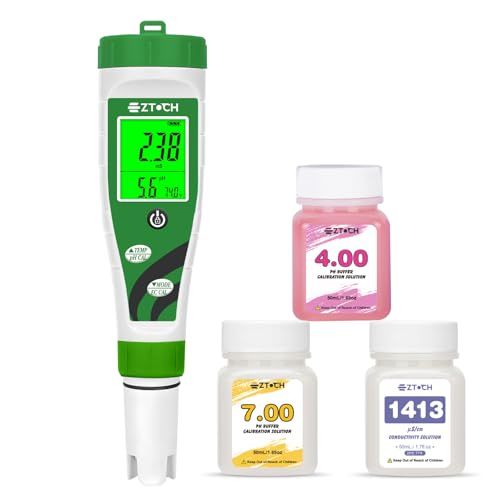
Three readings on one screen, and a lock button so you can actually write them down.
Here is a spec that does real work: conductivity is measured across 0.00–19.99 mS/cm in 0.01 mS/cm steps. That fine a step size means a small drift in your nutrient concentration shows up rather than disappearing into a rounded figure, and 19.99 mS/cm covers full-strength feed without maxing out. The unit also carries a PPM 500 hydroponic scale alongside it, so you can read the same solution the way your feed chart writes it.
The screen shows pH, EC and temperature together, and a MODE press swaps to pH, PPM and temperature together — three parameters visible at once. The lock function is the detail beginners underrate: you take the reading, press lock, pull the pen out and read it comfortably instead of squinting into a reservoir. The manufacturer quotes a target of around 7.0 pH neutral and within 70 ppm for base water, which is the number to aim for before you ever add nutrients.
What buyers praise most is overall quality, with value for money the next most-cited strength. Quality is the thing that stands out, alongside a price that undercuts the Apera kits significantly. Calibration divides opinion — some find it quick, others hit pH calibration errors — and a handful report units that failed after a few uses. Treat that honestly: it is a minority experience, not a pattern, but it is the reason a cheap insurance policy (a bottle of fresh buffer solution) is worth keeping on the shelf. Factory calibration means it is usable on arrival, and the included 4.00 and 7.00 pH solutions plus 1413 µS/cm EC solution let you verify at any time.
Wow factor: 0.01 mS/cm resolution at an entry-level tier — that is precision normally reserved for pricier benches.
Reality check: the package is 10.08 x 5.79 x 2.13 inches, a boxed kit — slightly deeper footprint than the YINMIK’s 10.04 x 5.71 x 2.24 inch carton, so shelf space is a wash.
Ideal for: first-time hydroponic growers on a DWC, Kratky or tower setup who want pH, EC, TDS and temperature without a premium outlay.
Also consider: keep a calibration solution on hand and check it monthly; that habit is what separates a good unit from a frustrating one.
4. Rowyet PH Meter

Five functions crammed into a backlit pen, with salinity read three different ways.
If you keep a saltwater pool, a hot tub or a reef tank, salinity is the number that matters — and this meter reports it in ppm, ppt and percent simultaneously. The ranges are specific: 0–9999 ppm for pool salt testing, 10–200 ppt for seawater, and 0.01–25% for food testing. When the ppm figure climbs past 9999 the meter flips to ppt on its own, so you are not doing long division in your head while standing barefoot on wet concrete.
The full feature list runs salinity, TDS, EC, pH and temperature in one body, which is the widest net in this group. The pH side uses a sensitive glass probe across a 0–14 pH range with 0.01 pH resolution, and a HOLD key locks the value so you can step away from the sample and read it comfortably. Automatic temperature compensation works across 0 °C–60 °C (32 °F–140 °F), which covers a cold tap fill and a hot tub on the same afternoon. For fermentation and homebrew wort checks, that range is genuinely useful.
Quality is the aspect buyers praise most, and ease of use sits close behind. The drawbacks are real and worth knowing before you commit: calibration is the sore spot, with reports of the calibration mode misbehaving, and the printed instructions are hard to follow. Weigh that fairly — plenty of owners get accurate readings and consider it a sound buy, but this is a meter you should expect to learn rather than unwrap and forget. At 5.6 ounces it is the heaviest pen in this lineup, which is the cost of five functions in one shell.
Why it suits pool and spa duty
- Salinity in ppm, ppt and % — no manual unit conversion
- 0–14 pH, 0.01 pH resolution, with HOLD to lock a reading
- ATC across 0 °C–60 °C covers cold tap water through hot tubs
- 5 functions in one pen is the broadest spread here
The parts that test your patience
- Calibration mode has a reputation for misbehaving
- Instructions are thin and take some figuring out
Pick it for: saltwater pools, hot tubs, spas and homebrew — anywhere salinity or pH is the headline number.
skip it if: you want a plug-and-play pen with no learning curve; the calibration menu will cost you an evening.
5. HM Digital HMDCOM100 Combo Meter

The meter you can drop in the bucket, fish out, and keep working.
IP67 is the spec to lead with. That rating means the housing is sealed against dust and survives being submerged in shallow water, so a slip off the edge of the pool deck is an inconvenience rather than a replacement. It measures EC, TDS and temperature across four scales — µS, mS, ppm and ppt — with mS and ppt both new on this model. The ranges are listed as 0–9990 µS, 0–8560 ppm, 0–9.99 mS and 0–8.56 ppt.
The standout engineering detail is the conversion. Three nonlinear EC-to-TDS factors — KCl, 442 and NaCl — let you match the meter’s math to the standard your reference chart uses. Nutrient charts, water reports and pool guidance do not all assume the same dissolved material, so a single fixed conversion quietly builds error into every TDS number. Picking the right factor removes that error at the source. A large LCD shows temperature alongside the main reading, and there is a factory calibration from a 1413 µS solution plus push-button digital recalibration — no screwdriver required, which is the difference between calibrating in ten seconds and hunting through a toolbox.
Accuracy is what buyers single out most, and the +/- 2% precision figure comes up against industry standards. Quality ranks right behind it. The trade-off is weight and format: 120 g and 8.9 inches of length make this a full-size instrument rather than a shirt-pocket pen — 120 g versus the 2.08-ounce COM-80 above, though the extra body buys that IP67 shell and 100 hours of battery life. A 1 metre immersion depth means you can reach into a deep tank without dunking your hand past the wrist.
Built for the wet side: IP67 plus 1 metre immersion depth is a genuinely different class of durability from a water-resistant pen.
The cost of that shell: 120 g and 8.9 inches long — this is a toolbag item, not an EDC one.
Worth it for: outdoor testing, poolside work, and anyone who has already lost a meter to a splash.
Not the one for: minimalists who want a pen that vanishes into a pocket — the 8.9-inch body will not.
6. Apera Instruments EC20 Tester Kit

An electrode that resists the film, and a calibration routine you can actually trust.
The EC20’s headline is the probe itself. Apera calls it BPB — Brush-resistant Platinum Black — meaning the electrode is coated in a platinum-black layer that resists the mineral film and light brushing that slowly degrades a bare sensor. That is the single biggest reason a meter drifts, and treating it physically rather than with software is the right fix. Accuracy is quoted at ±1% F.S across 0 to 20 mS/cm, with auto calibration and auto buffer recognition so the meter recognizes the solution it is sitting in.
Calibration is what buyers rate most highly here, and reliability follows closely behind. That pairing is not an accident — auto buffer recognition plus a known calibration solution means the whole verification takes seconds rather than a procedure. Automatic temperature compensation across 0–50.0 °C keeps readings consistent when the sample is not at room temperature. The large LCD dual-displays temperature with the reading and flags completed calibrations and stable readings, so you know when to write the number down.
The kit is complete: calibration solutions, batteries and a lanyard, all in a portable case. Battery life runs 1000 hours of continuous operation on AAA cells, and the unit is waterproof. The weak spot is readability, which splits opinion — some find the display clear, others less so. Weigh that against everything else and it is a minor gripe; the calibration and reliability strengths carry the product. It also accepts rechargeable AAA cells, which owners have used without issue, so the running cost stays low.
What sets the EC20 apart
- BPB platinum-black probe resists the mineral film that causes drift
- ±1% F.S accuracy across 0–20 mS/cm
- Auto calibration with auto buffer recognition
- 1000 hours on AAA batteries, waterproof, full kit in a case
One thing to accept
- Display readability divides opinion — fine for some, tight for others
Buy it when: you test daily, want the calibration to be the easy part, and need a meter that keeps its reading for months.
Consider elsewhere if: a large backlit screen is a must — the EC60’s 3-color LCD does that job better.
7. Apera Instruments EC60 Tester Kit

One tap from conductivity to salinity, and a probe you replace instead of a meter you replace.
Let’s be direct about the two things that justify the EC60 over the EC20 below it in price terms. First, the probe is replaceable. When a conductivity sensor finally gives up, the alternative is usually a new meter — here the platinum-black sensor comes off. Second, the display changes colour by mode, so you can see at a glance whether you are reading EC, TDS or salinity from across the bench without reading the digits.
One-tap switching moves you between conductivity, TDS and salinity, with a customizable TDS factor from 0.40 to 1.00. That range matters if your reference chart assumes a conversion factor other than the common ones — you set the meter to match the document instead of converting the document to match the meter. Auto calibration with auto buffer recognition and ATC across 0–50.0 °C keep it honest, and the large LCD dual-displays temperature with the reading while flagging completed calibrations and stable readings.
Reliability is the trait owners cite most, and value for money comes next — significant for a kit at this tier. The case arrives with ready-to-use calibration solutions, calibration bottles, AAA batteries and a lanyard. Durability is the divided subject: some report it stands up to hard use, others report a short life. Instructions also get flagged as thin. Size up the body at 4.7 ounces and 17.8 cm and it is still pocket-class, though the 4.7 ounces versus the EC20’s 3.9 ounces comes from that colour display and replaceable probe assembly.
The upgrade logic: a replaceable sensor turns a dead meter into a small parts order — that alone can pay back over years of use.
The honest caveat: durability feedback is genuinely mixed, so treat the case and lanyard as functional, not decorative, and the instruction gap as a reason to watch a calibration walkthrough first.
Choose it for: testing that spans EC, TDS and salinity in one session, especially where a custom TDS factor matters.
Second thoughts if: you want the simplest possible tool — three modes and a colour display add steps you may not need.
Know the Specs
EC vs TDS — Two Names, One Measurement
EC (electrical conductivity) measures how readily current passes through your water. TDS (total dissolved solids) is that same raw reading run through a conversion assumption to estimate parts per million of dissolved material. Two meters reading the same sample can show different ppm figures purely because they assume different dissolved material — which is why the three factors on the HM Digital COM-100 matter. If your nutrient chart quotes EC, work in EC and stop converting.
Automatic Temperature Compensation (ATC)
Conductivity changes as water warms — the same solution reads higher when warm and lower when cold. ATC corrects the displayed value to a standard reference temperature, so a reading taken from a cold top-off and one taken an hour later agree. Without it you end up chasing a nutrient problem that is really just a temperature difference.
Why the Probe Material Decides Longevity
A plain metal pin accumulates mineral film and gradually loses sensitivity. Platinum-black coatings — Apera’s BPB and the sensors on the Apera EC60 and HM Digital units — resist that buildup and tolerate careful cleaning. This is the spec that separates a meter still matching its calibration solution in month six from one that has drifted into flattery.
Reading the Units on the Screen
µS (microsiemens) and mS (millisiemens) are EC units, with mS being the larger. ppm and ppt are TDS units, where ppt is the larger. Saltwater ranges get reported in ppt because ppm numbers run into the thousands. When a meter flips from ppm to ppt automatically, that is a convenience feature, not an error.
Common Questions
Can a conductivity meter test salt level in a swimming pool?
Do I really need to calibrate before every use?
What is the difference between EC and TDS readings on the same meter?
Will a conductivity meter work for hydroponic nutrients?
How long does the battery last on these meters?
Can I leave the probe sitting in the reservoir permanently?
Is a waterproof meter worth the extra over a water-resistant one?
What does the calibration solution in the kit actually do?
Why does my reading jump around when I first dip the probe?
Can these meters test drinking water or aquarium water safely?
The Bottom Line
For most people shopping for the water conductivity meter, the HM Digital COM-80 is the one to buy — four scales in a single dip, automatic temperature compensation, and 1 ppm resolution that surfaces small changes before they become problems. It is the crowd favourite at 4.5+ stars across 800+ ratings, and the only pen here that reads EC and TDS on four scales from one dip. If you want a probe that can simply live in your reservoir, take the YINMIK 4-in-1. And for saltwater pools, spas or homebrew salinity checks, the Rowyet 5-in-1 is the one to reach for. Whichever you choose, buy a bottle of fresh buffer solution along with it — a meter is only as good as the last time you checked it against a known reference.
How we choose
We do not accept paid placement. Every pick is matched to a real buyer and a real use-case; we do not hands-on test units.
Sources
Specifications: manufacturer listings and product documentation. Review insights: verified customer reviews, as of November 2026. Pricing: not shown on this page (it changes often); check the current price via the retailer link.
As an Amazon Associate, Tactical Gear Guy earns from qualifying purchases. This does not affect which products we feature.