Specs are compiled from manufacturer listings and verified buyer reviews and can change over time — please confirm the key details on the product page before buying.
Here is the uncomfortable truth about shopping in this budget: most headsets you see are just plastic shells that hold your phone. They are not real VR. A genuine VR headset has its own screen, its own processor and its own tracking, so you are not sliding a phone in and out for every session. The picks below split cleanly into those two camps, and the right choice depends entirely on which camp you actually want.
This guide is built by comparing the manufacturers’ published specifications and the patterns across verified customer reviews, so you get each pick’s real strengths and trade-offs instead of marketing spin.
You will see phone-dock goggles that turn a handset into a private cinema, and one proper standalone headset with its own screen and processor. Weigh what you actually want from a session before you commit to either. The strongest value in any vr headset under $200 usually comes from knowing which camp you fall into.
Top Picks


How To Choose The Best VR Headset Under $200
Start by answering one question honestly: do you want a headset that runs on its own, or one that borrows your phone’s screen? That single answer decides whether you shop phone docks or standalone headsets. A standalone headset carries its own LCD display and processor, so nothing needs to be tethered. A phone-dock headset uses the display you already own, which is why the price stays friendly.
Check your phone’s size against the fit list first
Phone-dock goggles list a supported screen range, usually somewhere between 4.7 and 7.0 inches. Get a ruler out before you order. A phone that sits outside the listed range will either rattle in the cradle or refuse to seat at all. Several listings also name specific models that do not fit even when the size looks right, so read the exclusion list closely.
Field of view tells you how wide the world looks
Field of view, written in degrees, is the width of the scene your eyes take in. A wider number means more of the virtual world fills your vision and less of the room bleeds in at the edges. In this bracket you will see listings running from 100 degrees up to 120 degrees. That 20-degree spread is the widest gap between picks in this bracket.
Refresh rate affects comfort, not just smoothness
Refresh rate is measured in hertz, which counts how many times the display redraws per second. A 60 Hz panel redraws 60 times a second, while a 120 Hz panel doubles that. Higher numbers tend to make head movement feel less sticky, which matters if you plan to play for more than a few minutes at a stretch.
Decide whether built-in headphones matter
Several phone-dock headsets in this range ship with foldable Bluetooth headphones built into the frame. That saves you threading a cable under the headset every time. If you already own a favourite pair of wireless headphones, skip the built-in set and save the bulk.
Side-by-Side Comparison
| Model | Best For | Field of View | Refresh Rate | Display Resolution | Amazon |
|---|---|---|---|---|---|
| TiCCoonuts Phone VR with Bluetooth Headphones★ Best Overall | Phone owners who want big-screen 3D on a budget | 120 degrees | 60 Hz | 1920 x 1080 | Amazon |
| ZYbesthao Wireless 3D VR GlassesBest for Travel | Wide phone compatibility and travel | 110 degrees | 60 Hz | 3840×1080 | Amazon |
| TiCCoonuts 3D VR Headset (Black) | Smoother motion for gaming sessions | 120 degrees | 90 Hz | 1920 x 1080 | Amazon |
| PlayStation VR (Renewed) | PS4 owners who want a real VR library | 100 degrees | 120 Hz | 1920×1080 | Amazon |
| Meta Quest 2 128GB Headset Only (Renewed) | Standalone VR with no phone or console needed | 110 degrees | 120 Hz | 1832×1920 | Amazon |
Detailed Reviews
1. Virtual Reality VR Headset
The widest window into a virtual world you will find in this bracket, with the sound built in.
This is the pick for anyone whose phone is already their entertainment centre and who wants the biggest possible picture without spending standalone money. The scene fills 120 degrees of your vision — the widest field of view here, versus the PlayStation VR’s 100 degrees. In practice that means less of your living room creeping into the corners while a film plays.
The audio is the part that keeps it simple. Foldable Bluetooth headphones are built into the frame, so there is no cable to thread under the strap and no separate pair to remember. Adjustable focal settings let you tune sharpness for your own eyes rather than accepting whatever the factory set. The frame folds flat for storage between sessions.
The honest limit is your phone. It officially takes handsets from 4.5 to 6.2 inches, with a stated full-screen ceiling of 6.5 inches — versus the 7.0-inch support the ZYbesthao offers. A big modern handset may simply not seat. An adjustable headband and padded face contact make longer sessions tolerable, and the age guidance starts at 7 years, so it can be shared with kids.
Where the money goes
- 120-degree field of view — the widest of the phone-dock headsets here
- Bluetooth headphones built in, so audio needs no extra cable
- Adjustable focal settings let you dial in sharpness for your eyes
- Folds flat for storage between sessions
The fine print worth reading
- Supports 4.5-6.2 inch phones, with a stated 6.5-inch full-screen ceiling
- The 60 Hz refresh rate is the lowest tier shown in this article
- It holds a phone, so it cannot match a headset with its own screen
Reach for this if: your phone sits in the 4.5-6.2 inch band and you want the widest view plus built-in sound in one box.
Look elsewhere if: you carry a 7-inch handset or want a headset that runs without a phone at all.
2. Wireless 3D VR Glasses
At 0.8 lbs and folding to 6.3 x 4.7 inches, this one lives in a backpack, not a drawer.
This is the pick that leaves the house with you. The frame weighs 0.8 lbs and folds down to 6.3 x 4.7 inches, which is the sort of footprint that slides into a bag alongside a laptop. A breathable facial cover and leather fabric face contact keep things from getting swampy, and a low power consumption board is listed as part of the build. Anti-blue-light treatment is a stated feature if you plan to watch late.
Compatibilty is the strength. It accepts 4.7-7.0 inch phones, which covers more handset sizes than the TiCCoonuts picks above. The 55mm lenses are paired with a 50mm large diaphragm headphone unit for audio, and the scene stretches to 110 degrees. That compares with 120 degrees on the TiCCoonuts headsets and 100 degrees on the PlayStation VR.
The catch is the exclusion list, and it is a long one. The maker states plainly that it does not fit the iPhone 16 Plus, 16 Pro Max or 15 Pro Max, nor the Samsung Galaxy S24 Ultra, S23 Ultra, S22 Ultra or S20 Ultra. It also will not work with a Nintendo Switch, PS4, PC or TV. Check your exact model against that list before you order, because the physical size alone will not tell you.
The travel verdict: Light, foldable and built to leave the house — a strong second pick if portability outweighs a few degrees of view width.
Read before buying: Several popular large-screen phones are explicitly excluded, including the Ultra models and the Pro Max iPhones.
Suits: buyers who want VR in a carry bag and whose phone appears on the supported list.
Not for: anyone holding an explicitly excluded Ultra or Pro Max handset.
3. 3D Virtual Reality Headset for Adults and Kids, Black
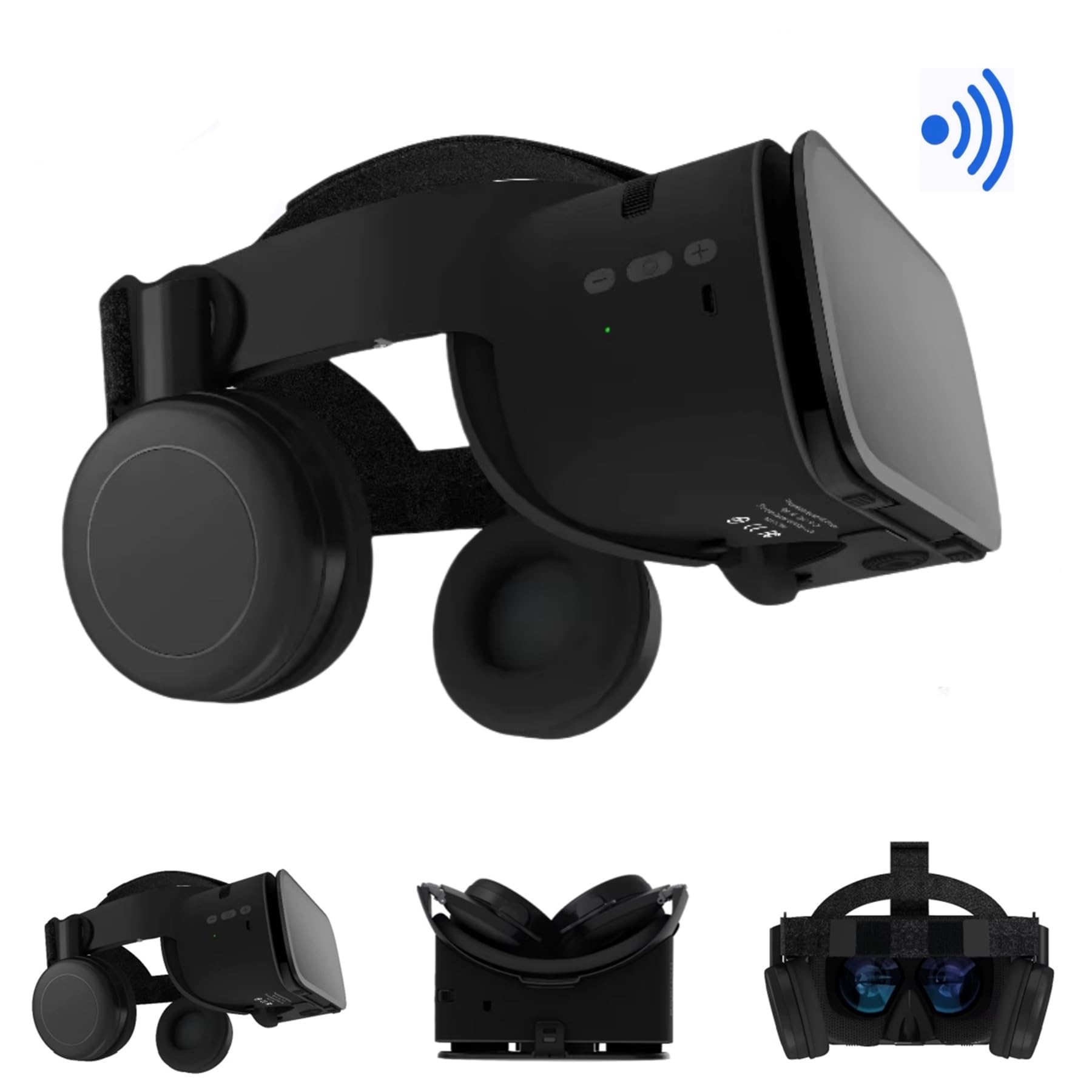
Ninety refreshes a second in a phone dock — the middle ground between budget and console VR.
Head turns are where refresh rate shows up as comfort or queasiness. This headset redraws its display 90 times per second, so motion lands between the 60 Hz phone docks and the 120 Hz PlayStation VR. You keep the wide 120-degree field of view that makes the scene feel big, and you gain a little smoothness over the two 60 Hz headsets above.
Built-in foldable Bluetooth headphones handle audio, same idea as the Best Overall pick, and adjustable focal settings let you correct sharpness for your own eyes. Adjustable straps are designed to hold the frame steady across a longer sitting. The maker positions it as a gift for both adults and kids, and the age guidance reads adults and kids.
Phone fit is the constraint worth weighing. It supports 4.7-6.5 inch smartphones, versus the ZYbesthao’s 7.0 inches. The listed compatible models run from iPhone 17 down through the 8 and 7 series, and from Samsung Galaxy S25 down through the A-series. If your phone sits near that 6.5-inch line, measure it first.
What the numbers buy: A 90 Hz panel plus a 120-degree view is a sensible pairing for gaming rather than passive movie watching.
The trade-off: Still a phone dock at heart, and its 6.5-inch phone ceiling rules out the largest handsets.
Pick this when: games matter more than films and your phone measures under the 6.5-inch limit.
Think twice if: you want the maximum phone-size tolerance in this bracket.
4. PlayStation VR (Renewed)
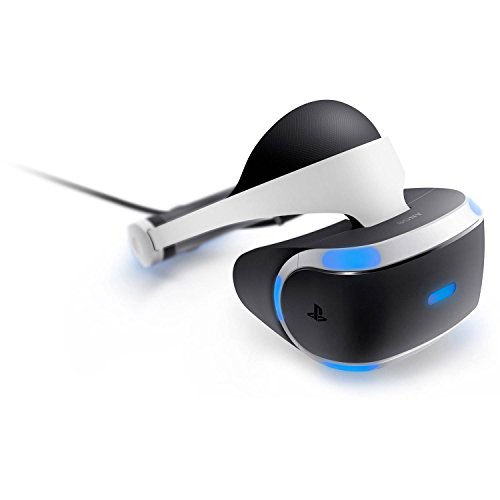
A 5.7-inch OLED panel and 120 frames per second, if you already own a PS4.
This is the only headset here that belongs to a console ecosystem rather than a phone. The display is a 5.7-inch OLED running 1920×1080 and refreshing at up to 120 frames per second, versus 60 Hz on the two phone docks at the top of this list. OLED panels light individual pixels on their own, so dark scenes hold their depth instead of washing out to grey.
The view spans 100 degrees, the narrowest in this article, versus 120 degrees on the TiCCoonuts headsets. In exchange you get 3D audio that lets you judge where a sound sits above, below or behind you. The balanced, adjustable headset design is built to sit steady while you move your head. Setup runs through the PlayStation Camera, which is sold separately.
Two things shape the buying decision. First, it ships as a certified refurbished unit — tested and cleaned, with a minimum 90-day warranty, and it may arrive in a generic box. Second, you need a PlayStation 4 to use it at all. Reviewers split on the refurbished condition itself: the appearance reads as new, but reports on whether a given unit powers up and works cleanly run both ways.
Reasons it holds its ground
- OLED panel at 1920×1080 with refresh up to 120 frames per second
- 3D audio helps you place sounds above, below and behind you
- Ships with processor unit, cables, stereo headphones, adaptor and demo disc
What you are signing up for
- Needs a PlayStation 4 and a PlayStation Camera, both sold separately
- Narrowest field of view here at 100 degrees
- Refurbished stock can arrive in a generic box, and reliability reports vary
The right home: a PS4 already sits under your television and you want a proven VR game library.
Wrong fit: no PlayStation 4, or you want the widest possible view.
5. Meta Quest 2 128GB

The only headset here with its own screen, processor and storage — no phone required.
Everything else on this list asks your phone or your PlayStation to do the work. This one does not. It runs on Oculus Quest 2 software with 128GB of storage built in, so games and video live on the headset itself. That onboard screen and processor are what separate it from every phone dock here.
The display is an LCD running 1832×1920, refreshing at 120 Hz — the same refresh figure as the PlayStation VR, versus 60 Hz on the two phone docks at the top. It also carries gaze tracking and gesture tracking, which let the headset follow where you look and what your hands do. The view spans 110 degrees, matching the ZYbesthao and sitting above the PlayStation VR’s 100 degrees.
Read the listing twice: this is the headset only, with no controllers in the box. That is a genuinely different package from a full retail unit. It arrives as a renewed product, and it holds the lowest rating in this article at 3.5+ out of 5. If you want hand-tracked games right away, budget for controllers separately or lean on the gesture tracking.
Why it still earns a slot: True standalone VR — its own LCD at 1832×1920, 120 Hz, 128GB of storage — is a different class of product from a phone holder.
The asterisk: No controllers included, and it is a renewed unit, so treat it as a headset to build on rather than a complete kit.
Ideal for: buyers who want VR without a phone or console and can add controllers later.
Skip if: you expect a sealed retail box with controllers ready to play.
Know the Specs
Field of View in Degrees
This is how wide the virtual scene stretches across your vision. A 100-degree headset like the PlayStation VR frames the picture more tightly, while a 120-degree headset like the TiCCoonuts models opens it up. A wider view tends to make you feel more inside the scene and less aware of the room around you. Narrower views are not bad — they simply frame a smaller window.
Refresh Rate in Hertz
Hertz counts how many times per second the screen redraws. A 60 Hz phone dock redraws 60 times a second, a 90 Hz headset 90 times, and a 120 Hz headset 120 times. Higher figures usually make head turns feel less sticky, which matters during games more than during films. All three figures appear in this article, so you can compare directly.
Display Resolution and Panel Type
Resolution is the pixel count the screen produces. Phone docks list figures like 1920 x 1080 or 3840×1080, while the Meta Quest 2 lists 1832×1920 and the PlayStation VR runs 1920×1080. Panel type matters too: OLED pixels light themselves individually, while LCD panels use a backlight. That changes how deep the blacks look in a dark scene.
Phone Compatibility Ranges
Phone-dock headsets publish a supported screen size, usually stated in inches measured diagonally. The range tells you which handsets physically seat in the cradle. Some listings also name specific models that will not fit despite the size, so the exclusion list is as important as the range itself.
Common Questions
Will a phone-dock VR headset work with my iPhone 16 Pro Max?
Do I need a phone or console to use the Meta Quest 2 headset?
Does the PlayStation VR work with a PlayStation 5?
How much difference does 60 Hz versus 120 Hz really make?
What does a 120-degree field of view actually change?
Can kids use these headsets?
Do the phone headsets come with headphones built in?
What is the difference between a renewed headset and a new one?
Will these headsets work with a Nintendo Switch or a PC?
The Bottom Line
You get the widest scene and built-in sound for the money with the TiCCoonuts Phone VR with Bluetooth Headphones — 120 degrees of view (a wide field of vision, so the scene fills more of your sight), foldable headphones and adjustable focus in one box, as long as your phone stays within its stated range. The ZYbesthao Wireless 3D VR Glasses folds into a bag and accepts a 7.0-inch handset, so it suits travel — check your model is not on its exclusion list first. Want to skip the phone entirely? The Meta Quest 2 headset has its own screen and 128GB of storage, so it runs standalone — just plan for controllers separately.
How we choose
We do not accept paid placement. Every pick is matched to a real buyer and a real use-case; we do not hands-on test units.
Sources
Specifications: manufacturer listings and product documentation. Review insights: verified customer reviews, as of November 2026. Pricing: not shown on this page (it changes often); check the current price via the retailer link.
As an Amazon Associate, Tactical Gear Guy earns from qualifying purchases. This does not affect which products we feature.