Specs are compiled from manufacturer listings and verified buyer reviews and can change over time — please confirm the key details on the product page before buying.
You want dry socks at the end of a wet day, and that is the whole job. Everything else — the height of the shaft, the tread pattern, whether the boot slips off at the heel — is detail compared to feet that stay dry on a muddy walk or a rainy commute. The nine boots below all use genuine rubber or PVC shells rather than water-resistant fabric, because water-resistant fabric eventually soaks through. What separates them is height, weight, insulation, and how easy they are to get on when your hands are full.
This guide is built by comparing the manufacturers’ published specifications and the patterns across verified customer reviews, so you get each pick’s real strengths and trade-offs instead of marketing spin.
The boots here split into two jobs: tall insulated pairs for cold mud, and ankle-high pairs light enough to forget you have them on. Each pick below spells out its shaft height, weight, and insulation in plain numbers, so you can match a pair to your own puddles at a glance. The rundown of waterproof rain boot options starts with the tall rubber pair that owners keep coming back to.
Top Picks


How To Choose The Best Waterproof Rain Boot
A rain boot fails in one of two ways: water gets in through a seam, or your foot gets so uncomfortable you stop wearing it. Both are avoidable if you know what the shell is made of and how tall the shaft runs. Start there, then work down to the sole and the lining.
Check the shell material before anything else
Natural rubber flexes with your foot and grips wet ground well, which is why the tall Hunter pair is built from it. PVC is firmer and cheaper, and it shows up on several short boots here. Both are genuinely waterproof when the shell is continuous — the question is whether the material stays supple through a long walk or stiffens up in the cold.
Match shaft height to your deepest puddle
An ankle boot handles a rainy sidewalk and a wet lawn without trouble. A mid-calf boot gets you through garden mud and shallow standing water. A tall boot is what you want for deep puddles, heavy snow, and farm work where the mud comes up past your ankle. Choose the height for the worst conditions you actually walk in, not the average day.
Decide if you want insulation
Neoprene lining traps warmth and adds flex, and the work-boot picks here use it in 5mm and 6mm thicknesses. That is welcome in cold mud and wet mornings. It is less welcome in summer, when a rubber shell with a breathable lining keeps your feet cooler. If you wear the boots year-round, a removable insole helps you manage the fit as your socks change.
Side-by-Side Comparison
| Model | Best For | Shell Material | Stated Weight | Shaft / Style | Amazon |
|---|---|---|---|---|---|
| Hunter Women’s Play Tall Rain Boot★ Best Overall | Tall coverage and all-day comfort | Natural rubber | 3.22 lb | Mid-calf, pull tab | Amazon |
| Women’s Short Chelsea Rain BootsBest Value | Everyday rainy-season wear | PVC | — | Short, elastic band | Amazon |
| Women’s Mid Calf Rubber Garden ShoesBest for Gardening | Garden and yard work | PVC | 1.5 lb | Mid-calf, removable insole | Amazon |
| Western Chief Pull-On Chelsea | Prints and personality | Rubber | — | Chelsea, back pulls | Amazon |
| HISEA Women’s Deck Rain Boots | Fishing, sailing, and boat decks | Rubber with neoprene | 1 lb | Ankle, reflective pull straps | Amazon |
| Trudave Rubber Boots with Steel Shank | All-season mud and farm work | Rubber with 6mm neoprene | — | Mid-calf, steel shank | Amazon |
| HISEA Women’s Tall Neoprene Rain Boots | Cold, deep mud | Rubber with 5mm neoprene | — | Tall, adjustable calf | Amazon |
| BASSDASH Explorer-DG Deck Boots | Deck work and dog walking | Rubber | — | Ankle, 4.5-inch shaft | Amazon |
Detailed Reviews
1. Hunter Women’s Play Tall Rain Boot
Our pick — 4.5+★ from 500+ verified ratings; the strongest balance of quality and price.
The tall rubber boot that made a hundred imitators and still outsells them.
Natural rubber is the reason this boot feels different from a stiff PVC shell. It flexes at the ankle instead of fighting you, and the 100% waterproof build means the whole boot is the barrier — no seams to leak, no coating to wear through. The flatter platform sole and pull tab at the back make it a simple boot to live with, which is why it sits at the top of this list.
It is also the heaviest pick here at 3.22 pounds, and that number is honest about what a full rubber tall boot weighs. The HISEA deck boots come in at 1 pound — a real gap if you are carrying a pair in a bag or walking a long way. What you trade that weight for is legitimate coverage up the calf and a shell that shrugs off a deep puddle rather than just a wet lawn.
What wins people over is the build quality, with the look of the boot a close second. The recurring fit note worth knowing: the ankle runs generous, so if your calves are slim you may want the fit snugged with a thicker sock. That is a sizing-fit issue rather than a defect, and it is the only real caveat on an otherwise very well-liked boot.
Where it earns its keep
- 100% waterproof natural rubber shell with no seams to leak
- Pull tab and flat platform sole make entry quick
- Recycled polyester lining inside the boot
- Tall coverage handles deep puddles and yard work
What to weigh before you buy
- 3.22 pounds is the heaviest boot on this list
- Ankle fit runs generous — slim calves may need a thicker sock
- Tall shaft is more boot than a city commute needs
Go for this if: you want one tall rubber boot for deep puddles, garden work, and everything wet in between.
Look elsewhere if: you want something light to toss in a bag — the HISEA deck boot weighs a fraction as much.
2. Women’s Short Rain Boots
A short PVC boot with an elastic band that pulls on in seconds.
If you want a rainy-day shoe rather than a work boot, this short Chelsea style gets you out the door faster than anything else here. The elastic band at the ankle is the reason — you step in and go, no wrestling, no hands needed. The PVC shell is genuinely waterproof, so a wet commute or a soggy walk to the shop never reaches your socks.
The look is what draws people in, and the fit holds up to it: this one runs true to size for most buyers. There is a concave-and-convex texture on the sole to add grip, plus a steady heel so you are not wobbling on wet pavement. It is a short PVC boot for wet sidewalks and errands, and it handles both without fuss.
The obvious limit is height. A short boot does not go through a deep puddle or hold up in serious mud, so it is a rainy-season shoe for sidewalks and errands, not a farm boot. For that use it is one of the easiest pairs here to recommend.
Plain value read: a waterproof short boot that slips on with an elastic band, runs true to size, and handles rainy-day wear with no fuss.
Made for: the commuter or shopper who wants a light, easy short boot for wet days.
Not the one for: deep puddles or real mud — this short shaft is a sidewalk boot.
3. Women’s Rain Boots Mid Calf
A mid-calf PVC garden boot that keeps the mud off your jeans.
For pulling weeds, moving soil, and walking the wet edge of a lawn, the mid-calf height is the useful part. It reaches up past the splashes a short boot misses, and the 100% waterproof PVC shell means the wet ground never gets a vote. A removable insole lets you swap in your own support or pull it out to dry.
The build quality is what this boot gets credit for most, and it earns that on garden duty. Two honest notes for buyers: the boot can be difficult to get on at first, and some find the calf opening not wide enough. The odor some buyers notice is a real PVC trait — airing the boots out before the first long wear helps.
It is the lightest mid-calf option on the list at 1.5 pounds, so a long afternoon of bending and squatting does not drag your feet down. Reach for it when the job is soil, not a mile of hiking.
Garden-duty verdict: mid-calf height, a waterproof PVC shell, and a removable insole make this a purpose-built yard boot.
The honest caveat: PVC can carry a smell when new and the calf opening runs narrow for some — check the sizing before you commit.
Best for: gardeners who want mud protection up the calf without a heavy tall boot.
Think twice if: you have wider calves or want a boot that slides on with zero effort.
4. Western Chief Pull-On Chelsea Rain Boot
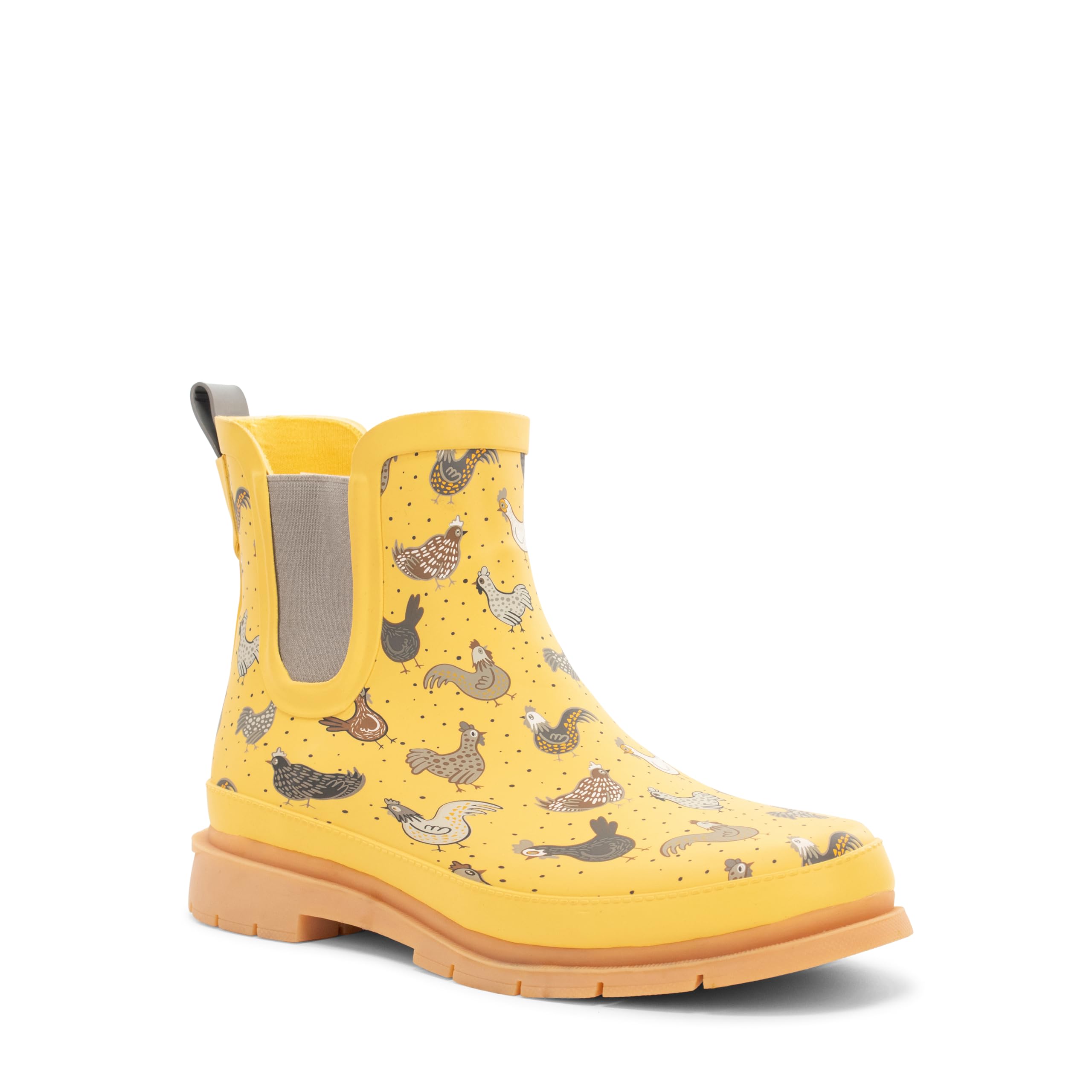
The print boot for people who refuse to look soggy on a wet day.
Most rain boots are grey and joyless. This one leans the other way — fun, whimsical prints with a side buckle and back pulls, so a rainy school run or a wet walk still looks like a choice rather than a compromise. The rubber shell and treaded sole hold up as well as the print suggests, and the treaded sole gives you stabilizing grip on slick pavement.
The water resistance holds up in showers and yard work, and the boot is genuinely made to keep the wearer dry in unpredictable weather. The fit is where opinions split: some find it true to size, others say it runs small. If your feet run wide or long, size up rather than hope.
Getting the boot on and off divides people too — the back pulls help, but a stiff new Chelsea can take a few wears to loosen. Wear them around the house first, and the entry eases up.
Style-first read: a pull-on Chelsea with prints, a side buckle, and a treaded sole — the rare rain boot you want to be seen in.
The fit caveat: sizing runs small for some and the entry is stubborn when new, so try them on with the socks you will actually wear.
Reach for this if: you want a print rain boot that makes wet days feel less grey.
Size up if: your feet run wide, and give them a few wears to loosen at the ankle.
5. HISEA Women’s Deck Rain Boots

An ankle deck boot at one pound, built for wet boats and muddy paths.
One pound. That is the number that defines this boot, and it is why it handles fishing, sailing, camping, and quick hikes without dragging. A reinforced rubber shell blocks water while the neoprene lining and moisture-wicking mesh keep the inside from turning into a swamp. Reflective pull straps mean you can find them and get them on in the dark.
Compare it to the Hunter at 3.22 pounds and the gap is plain: this is the boot for a wet boat deck or a fast trip out the door, not the deep-puddle boot. Arch support comes from a molded, curved outsole with a memory foam insole, so standing on a hard deck does not punish you.
Owners rate its build quality highest, with the look a close second. The fit runs large for some feet, so consider sizing down if you are between. And while the water resistance is solid, the durability story is more mixed — this is a lighter, comfort-first boot rather than a heavy-duty work shell.
The one-pound argument: light enough to forget, waterproof enough for the deck, warm enough for a wet morning.
Buyer be-aware: it runs large for some and the long-term durability is less certain than a heavier rubber boot.
Fits the bill when: you are on a boat deck, at a campsite, or walking the dog in the rain and want light feet.
Not built for: deep mud or heavy farm work — that is a taller, heavier boot’s job.
6. Trudave 6mm Neoprene Mid Calf Rain Boots
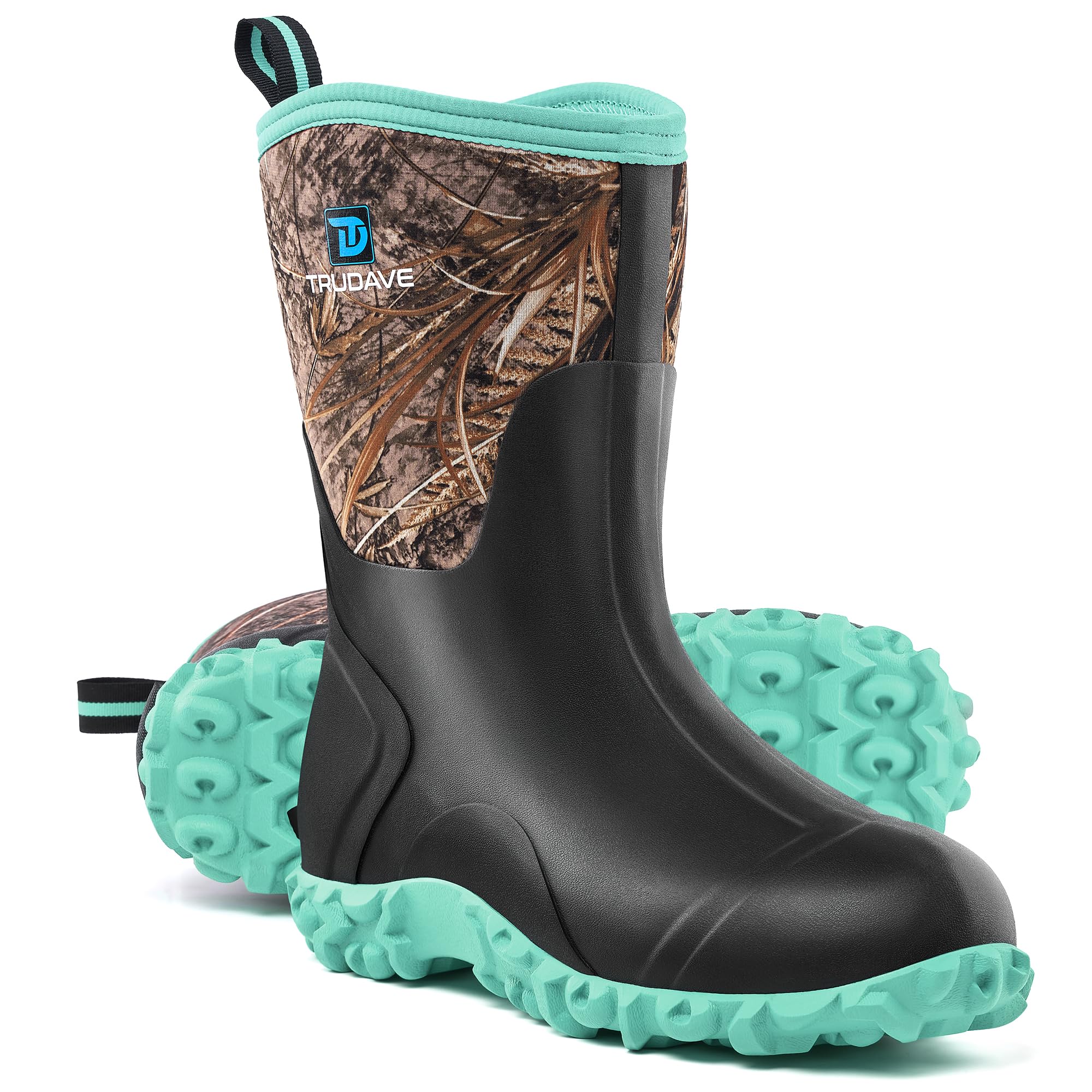
The work boot with a steel shank underfoot and 6mm neoprene wrapped around your calf.
Two specs make this a genuine work boot rather than a fashion one: 6mm neoprene and a built-in steel shank. The neoprene (a rubber-foam lining that stays soft and traps warmth) means the boot flexes with your leg and keeps feet warm in cold mud. The steel shank is a rigid strip inside the sole that stops soft ground from bending the arch of your foot — the difference between a long shift on a muddy path and a sore one.
Traction holds on snow and ice, and the reinforced protective toe adds another layer for kicking through brush and rocky ground. Fit is the standout strength: it accommodates both thin and thick socks, which solves the common rain-boot problem of a boot that only fits one sock weight. Users consistently describe it as outlasting cheaper store brands.
The trade-off is weight and bulk. Six millimeters of neoprene is warm in winter and less welcome in a hot summer, and the boot is built sturdy rather than light. If your work is genuinely cold and muddy, that is a fair trade. If it is a summer shower on a sidewalk, it is more boot than you need.
The work-boot case
- Steel shank stops soft ground from bending your arch
- 6mm neoprene flexes and traps warmth in cold mud
- Fits thin or thick socks without changing size
- Reinforced protective toe and deep-tread anti-slip sole
What it costs you in return
- 6mm neoprene runs warm in hot weather
- Built sturdy rather than light
- More boot than an everyday sidewalk needs
Worth it if: your week involves cold mud, farm work, and long shifts on soft ground.
Overkill if: you only need a boot for a wet walk to the car.
7. HISEA Women’s Tall Neoprene Rain Boots

Tall coverage with a calf you can cinch, so it fits without gaping.
Calf fit is where tall boots usually lose people — a boot that swims around a slim calf, or pinches a wider one. This pair solves that with side gussets and cinch buckles, so you dial the fit to your own leg. The 5mm neoprene (the same flex-and-warmth lining the work boots use, a touch thinner here) adds shock absorption and keeps the cold out.
The rubber outsole is built for traction in mud, and the boot is fully waterproof with heat retention, so wet ground and cold mornings both get handled. Build quality and value are what buyers come back to, and the pink sole and trim is a genuine favorite detail.
The honest notes: it runs big for some feet, so sizing down may be right. And durability is where opinions split — a few pairs start separating around 15 months of hard use. Treat it as a garden-and-mud boot that gives good years of service, not a forever boot.
Tall-boot answer: cinch the calf, warm the foot, and walk into the mud without a leak.
Set expectations: it can run big, and long-term durability is less certain than the Trudave.
Go here for: tall coverage when your calf shape has made other tall boots a poor fit.
Look elsewhere if: you need a boot that will take years of daily heavy work.
8. BASSDASH Explorer-DG 4.5” Deck Boots

A 4.5-inch ankle boot that leaves room for thick socks.
The 4.5-inch shaft is the spec to picture: it clears the ankle but stops well below the calf, which makes it the easiest boot here to pull on and kick off. It is 100% waterproof and built for deck work, gardening, dog walking, and country walking — a light all-rounder rather than a specialty boot.
Comfort is the part that lands hardest: the boot has enough room inside that even thick socks do not make it feel tight, and it does not wear on the foot over a long walk. That combination of roomy comfort and easy entry makes it a natural choice if you hate stiff, fussy boots.
Sizing is the one thing to plan around. Some find it true to size, but the boot does not come in half sizes, which leaves you picking between the nearest whole sizes. Durability is also a shorter story than the heavy rubber work boots — treat it as a light everyday deck boot rather than something to hand down.
Where it shines: roomy, comfortable, ankle-high, and easy to slip on — the easiest boot on this list to live with daily.
The one snag: no half sizes, so between-size feet have to choose a whole size up or down.
Best fit for: dog walkers and deck workers who want comfort and quick on-off above all else.
Consider the Trudave instead if: durability through years of work matters more than light comfort.
Know the Specs
Waterproof vs Water-Resistant
A waterproof boot uses a continuous rubber or PVC shell — the material itself is the barrier, so water has no seam to get through. Water-resistant means the fabric repels some water but will eventually soak through under sustained rain or standing water. Every boot here is a waterproof rubber or PVC build, which is why they are on this list rather than a water-resistant fashion boot.
Shaft Height
Shaft height is how far up your leg the boot reaches, measured from the arch of the foot. Ankle boots like the BASSDASH 4.5-inch cover a wet sidewalk and a dew-covered lawn. Mid-calf boots like the Trudave reach into garden mud and shallow puddles. Tall boots handle deep puddles and heavy snow. Pick for the worst condition you actually walk in.
Neoprene Thickness
Neoprene is a stretchy rubber-foam lining measured in millimeters. The thicker it is, the warmer it keeps your feet and the more cushioning it adds — but the warmer it runs on a hot day. The Trudave uses 6mm neoprene, a work-boot thickness for cold mud. The HISEA tall boot uses 5mm for warmth with a bit more flex.
Steel Shank and Sole
A steel shank is a rigid strip built into the sole that keeps soft ground from bending the arch of your foot. On a muddy path, that is what saves your feet over a long day. A removable insole lets you swap in your own support or pull it out to dry, and a deep tread pattern adds grip on wet pavement and slick mud.
Common Questions
Is a rubber rain boot actually better than a PVC one?
How do I choose between an ankle, mid-calf, and tall rain boot?
Do rain boots run true to size or should I size up?
Will neoprene lined boots be too warm in summer?
What does a steel shank actually do in a rain boot?
How do I stop a new PVC rain boot from smelling?
Can I wear rain boots for hiking on muddy trails?
How should I dry a wet rain boot so it lasts?
Are tall rain boots harder to walk in than ankle ones?
What is the difference between a garden boot and a deck boot?
The Bottom Line
The waterproof rain boot that does the most for the most people is the Hunter Women’s Play Tall Rain Boot. A natural rubber shell with no seams to leak, tall coverage for deep puddles, and a comfort level owners keep coming back to — it is the tall rubber boot you stop thinking about once it is on. If your work is cold mud and long shifts, the Trudave with its steel shank and 6mm neoprene is the tougher tool. And if you want dry feet without extra weight on a rainy commute or a boat deck, the one-pound HISEA Deck Rain Boot is the ankle boot light enough to forget you are wearing it.
How we choose
We do not accept paid placement. Every pick is matched to a real buyer and a real use-case; we do not hands-on test units.
Sources
Specifications: manufacturer listings and product documentation. Review insights: verified customer reviews, as of November 2026. Pricing: not shown on this page (it changes often); check the current price via the retailer link.
As an Amazon Associate, Tactical Gear Guy earns from qualifying purchases. This does not affect which products we feature.