Specs are compiled from manufacturer listings and verified buyer reviews and can change over time — please confirm the key details on the product page before buying.
You want to hear footsteps behind a wall before the other player hears you, and you want the cable gone. Most wireless over-ear gaming headphones get the sound roughly right, then fail on the two things that actually ruin a session: a battery that dies mid-match and a wireless link that drifts out of sync with your screen. This guide sorts nine real headsets by how long they run, how low their latency (the delay between the game picture and the sound you hear) actually goes, and whether the microphone makes your callouts sound like you or like a walkie-talkie in a windstorm.
This guide is built by comparing the manufacturers’ published specifications and the patterns across verified customer reviews, so you get each pick’s real strengths and trade-offs instead of marketing spin.
Below you will find the battery claims, the driver sizes, and the connectivity modes laid out side by side, so you can pick the one headset that matches how you actually play. Every option here is a genuine wireless over-ear gaming headphone, which means each one earns its place on real specs rather than a spec sheet promise worth ignoring.
Top Picks


How To Choose The Best Wireless Over-Ear Gaming Headphones
The one question that separates a headset you keep from one you resell is this: does it connect the way your console or PC needs it to? A 2.4GHz dongle (a small USB stick that carries the audio signal with very little delay) is the mode you want for competitive play. Bluetooth is the mode you want for a phone call or music between rounds.
Read the battery number in the right mode
Battery claims are almost always quoted with the lights off and in one specific mode. The HyperX Cloud Flight 2 is the clear example: it lists up to 100 hours on 2.4GHz or 150 hours over Bluetooth, but only up to 23 hours with the RGB lighting running at full glow. That is the same headset telling you three very different numbers, so match the figure to how you will actually use it.
Match the wireless mode to your console
Not every dongle talks to every machine. Some headsets run Bluetooth on PC and mobile but need the 2.4GHz stick for PlayStation. A few lean on Bluetooth only for certain consoles. Check the compatible-device list on the exact model you are buying, because a headset that pairs fine with your laptop can still sit silent on your console.
Judge the microphone by how you sound to your squad
A boom mic that flips up to mute is a small thing that saves you from broadcasting a sneeze to your team. Detachable mics let you leave the boom at home when you are using the headset for music. Noise-cancelling mic tech on a gaming headset targets your voice; it is a different job from noise cancellation in the earcups, which most of these simply do not claim.
Weigh comfort in grams, not adjectives
You will feel the difference between a 210 g headset and one over 300 g after hour three. The lightest picks here cluster around 210 g to 270 g, and the heavier ones climb toward 309 g. If you wear glasses or play marathon sessions, that gap matters more than any equalizer preset.
Side-by-Side Comparison
| Model | Best For | Battery Life | Wireless Modes | Weight | Amazon |
|---|---|---|---|---|---|
| SteelSeries Arctis Nova 5P★ Best Overall | All-round pick for console and PC | 60 hours | 2.4GHz + Bluetooth 5.3 | — | Amazon |
| Razer BlackShark V3 X HyperSpeedTop Performer | Competitive FPS positional audio | 70 hours | 2.4GHz + Bluetooth 5.3 + USB | 270 g | Amazon |
| ASUS ROG PeltaBest Audio | Sound quality across PC and console | 70 hours (2.4GHz, RGB off) | 2.4GHz + Bluetooth 5 + USB-C wired | 309 g | Amazon |
| Corsair Void v2 | Spatial audio on PS5 and PC | 70 hours | 2.4GHz + Bluetooth 5.3 | — | Amazon |
| HyperX Cloud Flight 2 | Long battery and swappable looks | 100 hours (2.4GHz) / 150 hours (Bluetooth) | 2.4GHz + Bluetooth | — | Amazon |
| Logitech G325 LIGHTSPEED | Comfort for long sessions | 24+ hours | LIGHTSPEED wireless | 212 g | Amazon |
| SteelSeries Arctis Nova 3P | Fast charging and lightweight fit | 40 hours | USB-C dongle | 260 g | Amazon |
| Logitech G321 LIGHTSPEED | Lightest grab-and-go option | 20+ hours | LIGHTSPEED + Bluetooth 5.2 | 210 g | Amazon |
| BINNUNE Wireless Gaming Headset | Endurance battery on a value budget | 120 hours | 2.4GHz + Bluetooth 5.3 | — | Amazon |
Detailed Reviews
1. SteelSeries Arctis Nova 5P Wireless
Our pick — 4.0+★ from 700+ verified ratings; the strongest balance of quality and price.
A headset that swaps from game audio to your phone call with one button press.
The feature that carries this SteelSeries is the quick-switch button: it toggles between the 2.4GHz gaming link and Bluetooth 5.3 with a single tap, so a call does not force you to tear the headset off mid-match. Notification beeps still tell you a call is coming while you play. That is the practical version of dual connectivity, and it is why this one takes the top spot.
You get 60 hours of battery, which SteelSeries frames as eight hours a day for a full week. Run it dry and USB-C Fast Charge gives you six hours of use from a 15-minute top-up, so a quick plug-in between matches keeps you playing. Compare that with the BINNUNE below, which lists 120 hours against this 60. The SteelSeries answers back with 100+ game presets through its Companion App for titles like GTA V, FIFA and Call of Duty, and the BINNUNE does not offer app tuning at all.
The audio hardware is a set of custom Neodymium Magnetic Drivers, and the mic is a fully retractable ClearCast 2.X with a high-bandwidth chipset running 32KHz/16Bit audio. Retracting the boom into the earcup means you can wear these in public without looking like you are mid-raid. Reviewers praise the sound and battery life, but console pairing is the recurring complaint — several buyers struggled to get it to connect to a PS5. Check your platform’s pairing path before you commit.
Where it earns the top slot
- One-tap switch between 2.4GHz gaming and Bluetooth 5.3 calls
- 60-hour battery with six hours back from a 15-minute charge
- 100+ game audio presets tuned per title in the Companion App
- Fully retractable ClearCast 2.X mic at 32KHz/16Bit
What to know before you buy
- Console pairing is the recurring frustration for some owners
- 60 hours of battery versus 120 hours on the value BINNUNE pick
Worth it if: you bounce between console gaming and phone calls all evening and want one headset to do both without unplugging anything.
Think twice if: you need the longest possible gap between charges — the cheaper BINNUNE lists 120 hours against this 60.
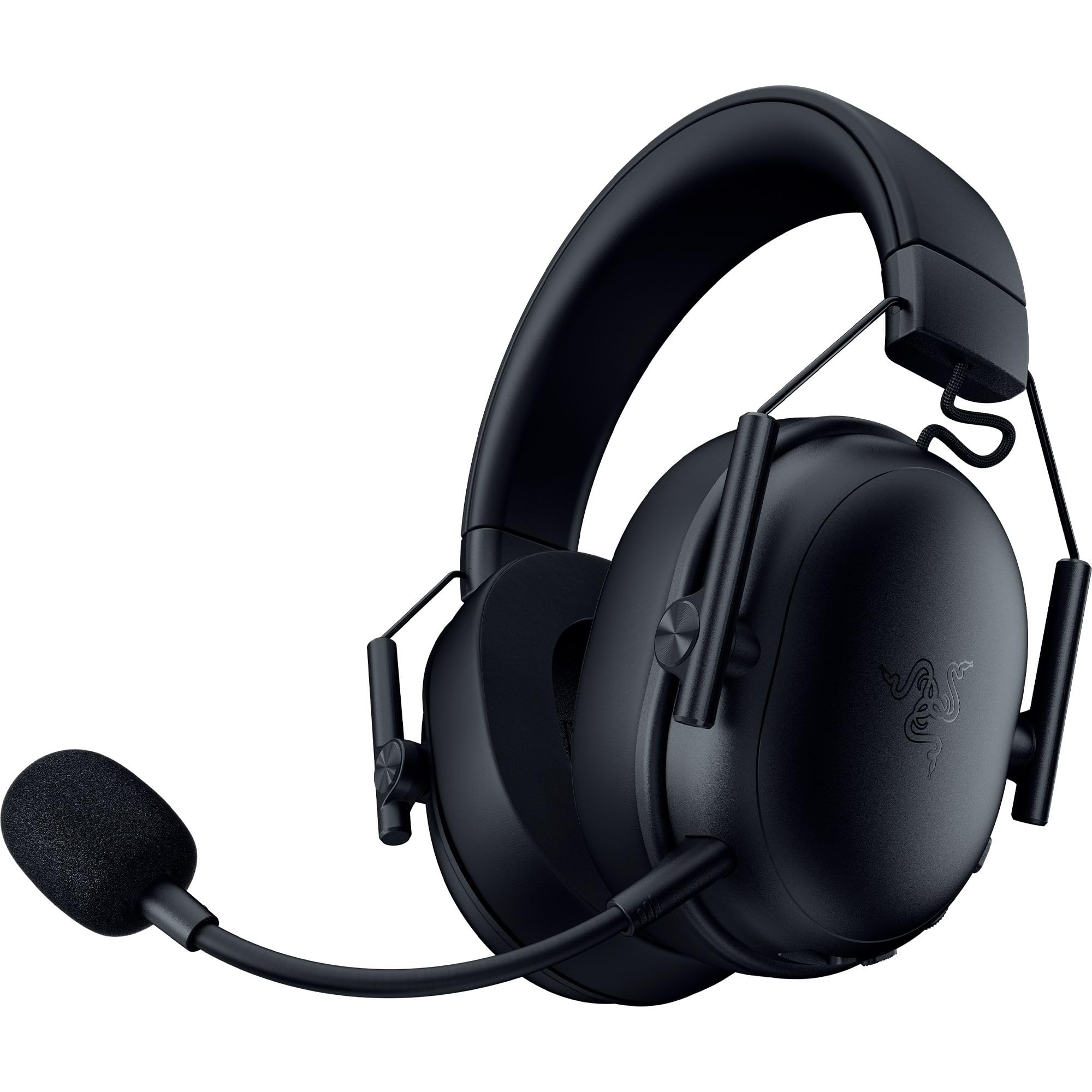
2. Razer BlackShark V3 X HyperSpeed
The positional-audio specialist that puts enemy reloads exactly where they happened.
Razer’s TriForce 50 mm Drivers Gen-2 are tuned for positional accuracy, which is the difference between hearing a reload somewhere to your left and knowing it came from the doorway behind the left pillar. Activate 7.1 Surround Sound on Windows and the directional cues sharpen further. If your game is ranked FPS or battle royale, this is the pick that treats audio as information rather than atmosphere.
It also runs 70 hours on a charge, and it weighs 270 g versus 309 g for the ASUS ROG Pelta below. On Bluetooth it carries version 5.3 to the Logitech G321’s 5.2, so it sits at the newer end of the wireless standard. The detachable HyperClear Cardioid 9.9 mm mic prioritizes your voice and cuts background noise, which keeps your callouts clean when the room around you is not.
Comfort is where you should temper expectations. The hybrid fabric and leatherette memory foam cushions are plush on contact, but the cushioning earns mixed feelings overall and neck strain does come up. It is not a defective headset — it is one that fits some head shapes better than others, so give yourself a return window. Owners are broadly satisfied, and sound quality is the second most-praised trait after build quality.
The competitive case: 50 mm positional drivers, 7.1 surround on Windows, and a detachable 9.9 mm cardioid mic add up to a headset built for callouts and cues rather than cinematic bass.
The honest rub: 270 g is comfortable by gaming standards but the cushioning is a mixed experience, and long sessions can leave your neck asking for a break.
Reach for this if: you play ranked shooters and want directional detail plus 70 hours between charges.
Look elsewhere if: you have had neck issues with heavier headsets — the 270 g shell will not solve that for you.
3. ASUS ROG Pelta Wireless
Three ways to connect, plus titanium-coated drivers that carry the sound-quality conversation.
People talk about the ROG Pelta for its sound. Its 50mm titanium-plated diaphragm drivers (the speaker cones, coated in titanium) cover a wide 20 Hz–20 kHz frequency response (the range of low to high pitches it can play). In plain terms, you get the low rumble of an explosion and the thin high tick of a distant shell casing from the same pair of cups. If you split your time between games and music, this is the one that does not feel like a compromise on either.
Connectivity is the other headline: Bluetooth, 2.4GHz through ROG SpeedNova wireless, and USB-C wired — three routes, so you can run it on a PC, a PlayStation, a Switch, or a phone without hunting for an adapter. Battery reaches up to 70 hours in 2.4GHz mode with RGB off, and a 15-minute charge returns 3 hours of play. That quick-charge figure is the one to note if you are the type who forgets to plug in until the low-battery chime.
Here is the catch worth weighing: reliability gets mixed feedback, with owners split between those who never have an issue and those who cannot get it working consistently. At 309 g it is also the heaviest headset on this list, though the three-level adjustable elastic headband distributes that weight and the fit is adjustable in ways the lighter fixed-band designs are not. Buy it for the sound and the tri-mode flexibility, and keep your receipt handy.
Pick this one if: you want one headset that sounds good in games and in music and can plug into almost anything you own.
Second-guess it if: you want a set-and-forget connection — reliability is the split opinion here, and 309 g is the heaviest shell in this group.
4. Corsair Void v2 Wireless

Cushiony cups, Dolby Atmos positioning, and a 15-minute charge that buys you six more hours.
Dolby Atmos Spatial Audio is the centerpiece on the Void v2. It places sound directionally so a footstep off to your right reads as coming from your right, and that is the whole reason to buy a spatial-audio headset for a PS5 or PC setup. The 50 mm dynamic drivers back it with the low end you expect from a gaming can, and the dual wireless switch flips between 2.4GHz and Bluetooth with one button.
You get 70 hours of battery, matching the Razer and the ASUS picks in this guide. What separates the Corsair is the top-up speed: 15 minutes on the charger returns up to 6 hours, the longest quick-charge payoff of the three 70-hour headsets here, so a short break refills most of a play session. A full charge from empty takes about 1.5 hours per the spec sheet. Owners consistently call the ear cushions plush and non-clamping rather than tight.
The microphone is omni-directional and pairs with NVIDIA Broadcast technology, which requires a compatible NVIDIA GeForce RTX graphics card to work — so if your PC runs different silicon, treat that as a bonus you will not get. Bluetooth 5.3 keeps the wireless standard current, and the headband design keeps the pressure modest. For a console-first player who also takes calls, this is the balanced answer.
Why it lands here: Dolby Atmos spatial audio, 70 hours of battery, and a 15-minute charge that hands back up to 6 hours make it a strong console companion that also handles Bluetooth.
Before you count on the mic tech: the NVIDIA Broadcast noise handling needs a compatible GeForce RTX card, so it is a feature some buyers simply will not access.
Made for you if: your main screen is a PS5 and you want directional audio plus one of the faster quick-charges in this lineup.
Not for you if: you are on AMD graphics and counting on that NVIDIA mic processing — it will not be available.
5. HyperX Cloud Flight 2
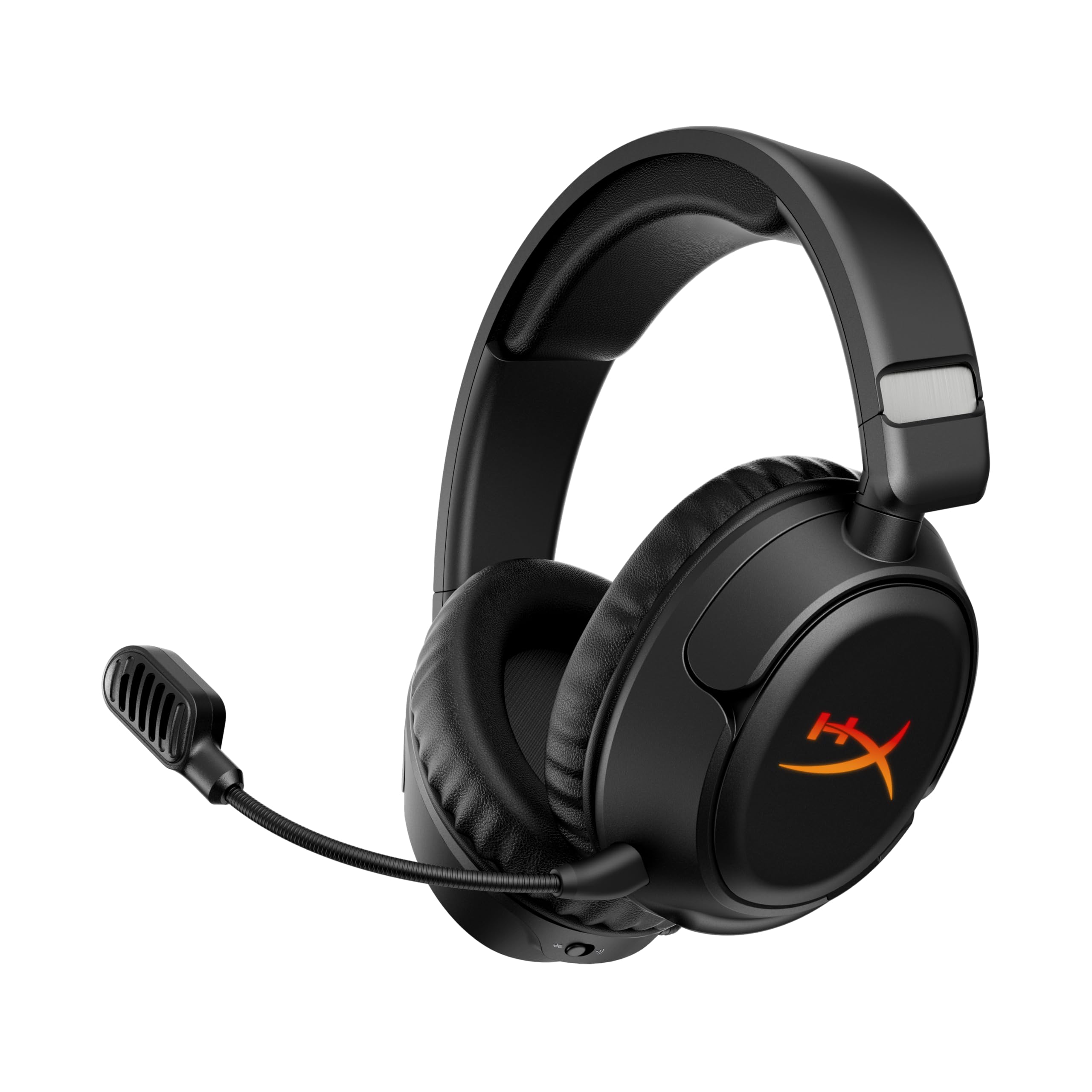
The endurance king that turns itself into a different headset with a pop of the earcup plates.
Read the HyperX battery claim carefully, because it is really three numbers. You get up to 100 hours on 2.4GHz or 150 hours over Bluetooth with lighting off, but only up to 23 hours at full RGB glow. SteelSeries frames its 60 hours as eight hours a day for a week; HyperX frames its 100 as four hours a day for 25 days. Same idea, more headroom.
Then there is the customizing. Removable magnetic earcup plates with full-panel RGB pop off and swap without tools, and you can save one lighting profile onboard through HyperX NGENUITY software. Removable earcup plates, ear pads, headband pad and mic all come off, so you can refresh the look instead of replacing the whole headset. A detachable 10mm boom mic handles comms, with an internal mic as the boomless backup and an LED that shows mute status.
Build quality draws the most praise, followed by sound clarity, and the 90° rotating earcups with steel sliders are why it holds up. Two honest notes: connectivity is a mixed bag, and Xbox is specifically not supported, so verify your platform first. The other split is value — some buyers feel it earns its place, others do not. Set against the 60-hour SteelSeries at the top of this list, the HyperX gives you 100 hours of 2.4GHz play and a shape you can restyle.
The endurance argument
- Up to 100 hours on 2.4GHz or 150 hours over Bluetooth with lighting off
- Magnetic earcup plates swap without tools, one lighting profile saved onboard
- Detachable 10mm boom mic plus a built-in internal mic
- 90° rotating earcups and steel sliders for durability
Where it asks for patience
- Xbox is not supported, so check your console before buying
- RGB at full glow cuts runtime to 23 hours
Strongest match: marathon players on PS5, PC or Switch who want to charge once and forget it for days.
Wrong turn if: you are an Xbox player — this one does not connect there.
6. Logitech G325 LIGHTSPEED Wireless Gaming Headset – Black
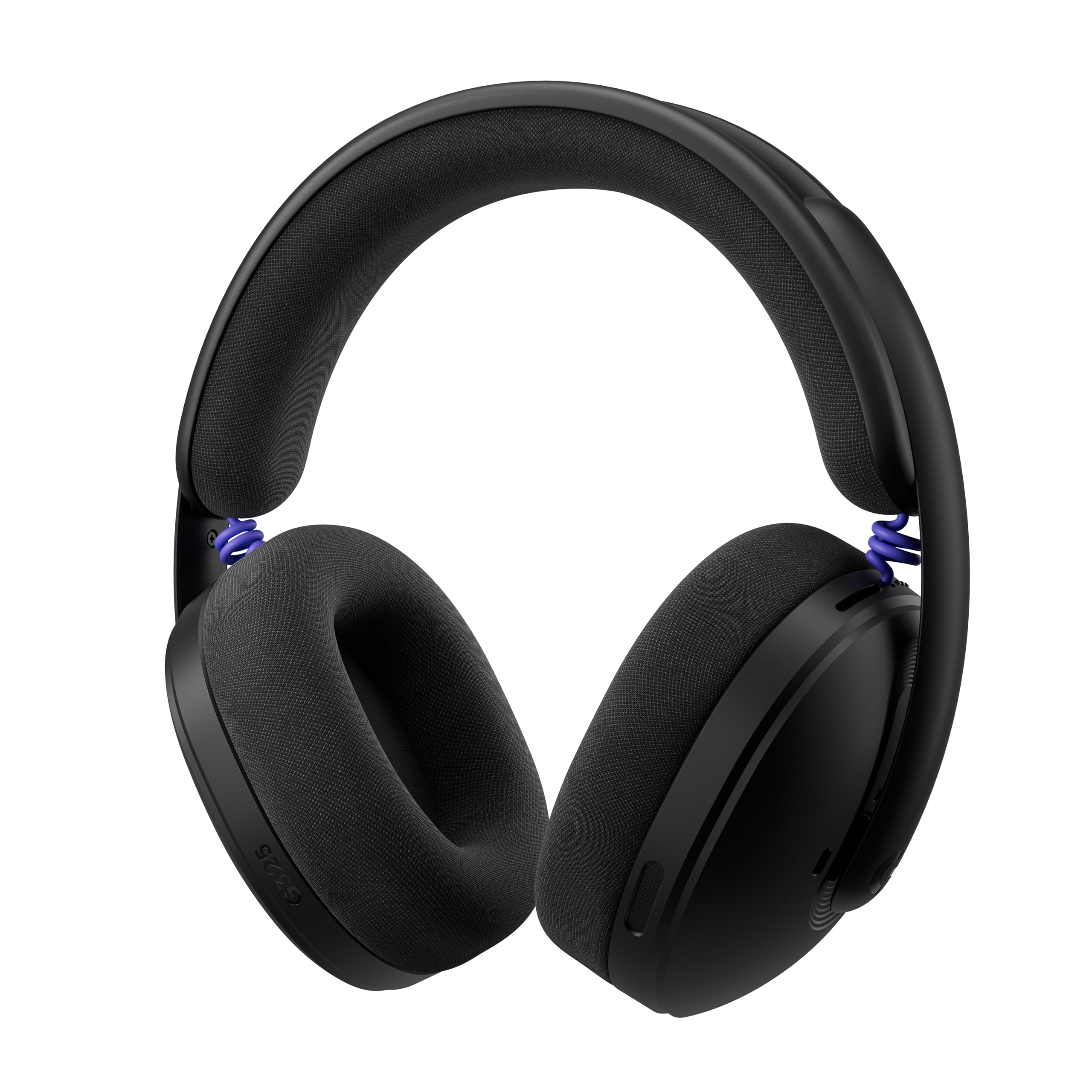
At 212 g with dual-layer memory foam, this is the headset you forget you are wearing.
Comfort is the entire pitch on the G325, and the spec backs it: 212 g of shell, dual-layer memory foam ear cups, and a soft knit headband. Buyers report wearing it for hours without discomfort and getting up to a week from a single charge. That matches the 24+ hour battery claim — an entire day of play from one charge.
The mic is built in rather than a boom, using AI-powered noise reduction to pull keyboard clicks and fan hum out of your voice. It is a different approach from the detachable boom on the Razer above, and it means there is nothing to flip up or lose. Audio is 24-bit with enhanced bass, and the frequency response runs to 20,000 hertz so the high end stays present.
What you give up is the 2.4GHz-versus-Bluetooth switch some rivals offer — connectivity here is LIGHTSPEED wireless, Logitech’s low-latency link, without a second wireless mode on the spec sheet. It is also listed at 24+ hours against the 100 hours of the HyperX, so if battery is your deciding factor this is not the one. For pure long-session comfort, though, the 212 g shell is among the lightest in this group alongside its G321 sibling.
The comfort read: 212 g with dual-layer memory foam and a knit headband is among the lightest over-ear shells here, and it is what the praise centers on.
The trade-off: no Bluetooth mode and a 24+ hour battery mean this is a one-link, one-charge-a-day headset rather than an endurance machine.
Choose this when: comfort is your first filter and your games all live on one PC or console.
Keep shopping if: you need dual wireless or multi-day battery between charges.
7. SteelSeries Arctis Nova 3P Wireless
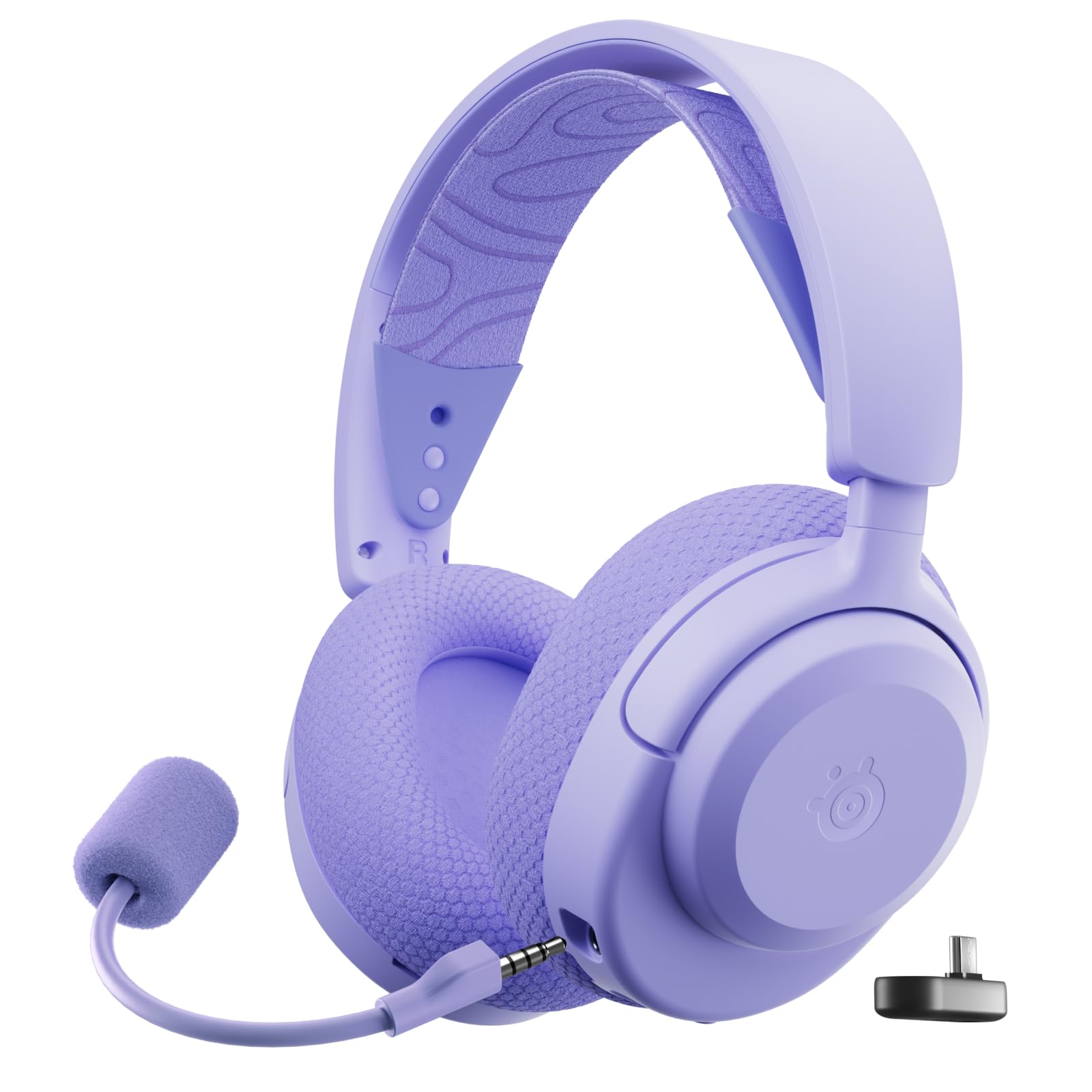
Fifteen minutes on the charger and you are back in for nine hours.
Fast charge is the standout spec here: 15 minutes returns up to 9 hours of playback, and a full charge runs up to 40 hours. Set that against the Arctis Nova 5P up top, where 15 minutes gets you six hours — the 3P gives you a longer stretch from the same short break. If you game in bursts and never plan ahead, that is the number that keeps you playing.
Comfort is the other strong suit, and it is deliberate: 260 g with a stretchy headband and multiple adjustment points, plus a dual-hinge design for durability. The mobile app open up 200+ game presets in the Arctis Companion, so you can nudge the mix toward footsteps in shooters and then leave it. A USB-C dongle moves between PC, PlayStation, Switch, handhelds, phones and tablets without drama.
The honest caveat: sound quality and reliability both draw split opinions, with some players reporting distortion after extended play and odd noises during matches. That is not the experience everyone has, but it is common enough to mention. The 260 g shell and the long fast-charge window are the reasons to pick it; the sound is the reason to buy from somewhere you can return to.
The right call for: short-session players who value a 15-minute charge that returns up to 9 hours.
Look past it if: you have run into distorted audio on past headsets — this is where opinions split.
8. Logitech G321 LIGHTSPEED Wireless Gaming Headset – White

The grab-and-go pair that weighs next to nothing and pairs to your phone between rounds.
At 210 g, the G321 is the lightest headset in this whole lineup, and the thick headband, high-elasticity knit fabric and memory foam ear cups are built around that number. Comfort and weight are the two things buyers mention most, which suggests Logitech hit its design target. For a player who notices a heavy headset by hour two, the difference is immediate.
Wireless is LIGHTSPEED, Logitech’s low-latency PC link, with 20+ hours of battery. Flip the switch and Bluetooth 5.2 pairs for Discord, mobile games or music — a versatile little flip rather than a full dual-mode system. The 16 kHz microphone is a flip-to-mute boom, so silencing yourself is a single motion. Audio drivers handle footsteps, explosions and in-game cues without any tuning required.
Where it runs into trouble is the audio and connection experience. Sound quality and connectivity both draw mixed feedback on this one, with some players happy and others reporting thin audio or dropped links. It is the lightest and most portable of the group, and the 210 g weight is not shared with the 270 g Razer. Buy it for the weight and the Bluetooth convenience; expect to lean on the return policy if the audio does not suit your ears.
The weight-first read: 210 g with a knit headband and memory foam is the lightest build here, and it is the reason to consider it over the heftier picks.
The caveat to own: audio quality and wireless stability are the split opinions on this model, so try it somewhere you can send it back.
Fits you best: laptop and mobile players who want the lightest possible can and a Bluetooth hop to Discord.
Better to pass if: audio quality is your first priority — this is the model where that opinion splits.
9. BINNUNE Wireless Gaming Headset
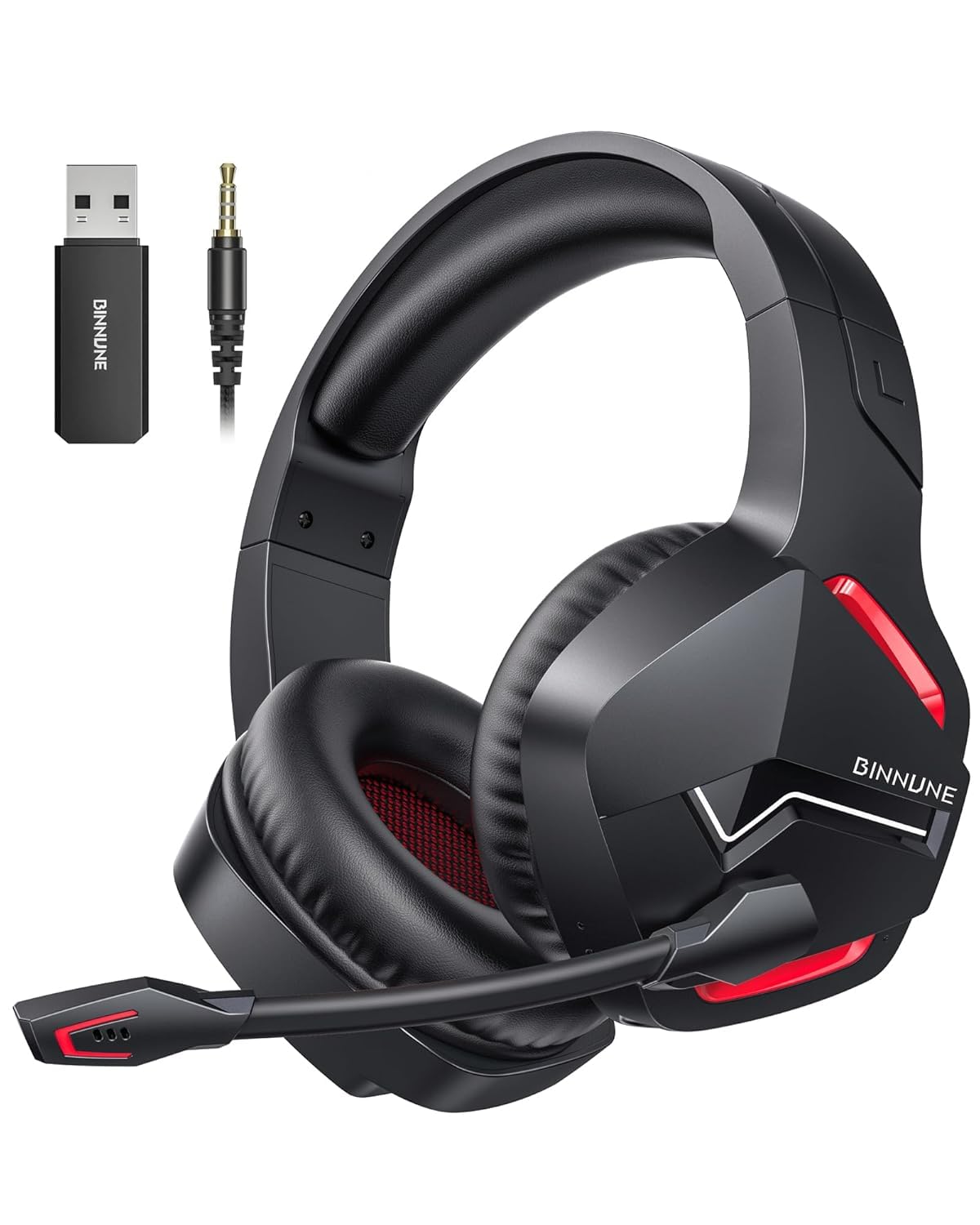
120 hours of battery versus the top pick’s 60, on the smallest budget in the group.
The BINNUNE lists 120 hours of battery, and the SteelSeries Arctis Nova 5P at the top lists 60. Buyers cite battery life as the reason they reach for it, with endurance holding up over long sessions and a 2.5-hour charge returning it to full. For a marathon player who resents charging, that number alone justifies a look.
The rest of the package is aimed at the same buyer. The 2.4GHz link runs as low as ~15 ms of latency, which is a delay short enough to keep sound locked to the action in a fast shooter. Then there is Bluetooth 5.3 alongside it, and a double-click of the power button switches between the modes so you do not miss a call mid-match. Bluetooth will not connect to PS5 or Xbox, so the 2.4GHz dongle is the gaming path on those consoles.
The 50 mm dynamic drivers carry deep bass and crisp highs, and the flip-to-mute noise-cancelling mic keeps comms simple. Build quality draws the most praise, with value a close second. Where it gets honest: sound quality and connectivity are both mixed, with some buyers finding the volume low. For a value headset that is the usual give-and-take, and the 120-hour battery is still the loudest argument in the room.
Worth your attention if: battery endurance matters more than tuning and you want the cheapest way into 2.4GHz plus Bluetooth.
Spend up instead if: you need consistent volume and a rock-solid link — those are the split points here.
Know the Specs
2.4GHz vs Bluetooth
A 2.4GHz dongle is a small USB stick that carries audio on a dedicated channel, which keeps the delay between your screen and your ears very short. That low latency matters in shooters, where sound positioning is a cue you react to. Bluetooth is the flexible mode — it pairs to phones and laptops without a stick, but it is not the latency path you want for competitive play. Headsets here run one or the other, or both with a switch between them. The BINNUNE pairs 2.4GHz with Bluetooth 5.3 and switches with a double-click; the SteelSeries Arctis Nova 5P toggles with a single tap.
Battery Life and Fast Charge
Battery numbers in this category range from 20+ hours on the Logitech G321 to 120 hours on the BINNUNE, with 60, 70, 100 and 150-hour figures in between depending on mode and lighting. Treat the lighting toggle as a real lever: the HyperX Cloud Flight 2 runs up to 100 hours on 2.4GHz or 150 over Bluetooth with lighting off, but only up to 23 hours with full RGB glow. Fast-charge specs tell you how much play a short break returns — 15 minutes gives the Arctis Nova 5P six hours, the Arctis Nova 3P nine hours, and the Corsair Void v2 six hours.
Common Questions
Will a wireless over-ear gaming headset work on both PS5 and PC?
Is 2.4GHz better than Bluetooth for gaming?
How long does the battery actually last on these headsets?
Do these headsets work with Xbox?
Does a bigger driver mean better sound?
Can I use these headsets for calls and music as well as gaming?
Is noise cancellation on these headsets for the mic or the earcups?
How much does headset weight matter during a long session?
Can I swap the microphone for a cleaner look?
How fast can I get back to gaming after the battery dies?
The Bottom Line
For most players, the wireless over-ear gaming headphones winner is the SteelSeries Arctis Nova 5P. Its one-tap switch between 2.4GHz gaming and Bluetooth 5.3 calls (the short-range wireless standard phones use) ends the daily tug-of-war between your game and your phone, and 60 hours means you rarely think about charging. If endurance is what you are chasing, the HyperX Cloud Flight 2 runs up to 100 hours on 2.4GHz and lets you restyle the shell with magnetic earcup plates. And for a PS5-first setup with a quick top-up, the Corsair Void v2 pairs Dolby Atmos spatial audio (surround sound that places effects around you) with a 15-minute charge that returns up to 6 hours.
One last nudge: if you want the cheapest route into 2.4GHz plus Bluetooth 5.3, the BINNUNE delivers 120 hours of battery for first-time wireless buyers. The SteelSeries Arctis Nova 5P remains the crowd favorite at 4.0+ stars across 700+ ratings, which tells you a lot of people found the balance they wanted.
How we choose
We do not accept paid placement. Every pick is matched to a real buyer and a real use-case; we do not hands-on test units.
Sources
Specifications: manufacturer listings and product documentation. Review insights: verified customer reviews, as of November 2026. Pricing: not shown on this page (it changes often); check the current price via the retailer link.
As an Amazon Associate, Tactical Gear Guy earns from qualifying purchases. This does not affect which products we feature.