Specs are compiled from manufacturer listings and verified buyer reviews and can change over time — please confirm the key details on the product page before buying.
If you want better sound at home without running speaker cable through walls, the answer is simpler than the listings make it look: buy a wireless system built around one job. A bar-and-sub combo for movie nights, a single smart speaker for music, or a room-by-room setup for whole-home listening. Pick the system built for your main job — movie nights, music, or whole-home listening — and any pick below will beat your TV speakers.
This guide is built by comparing the manufacturers’ published specifications and the patterns across verified customer reviews, so you get each pick’s real strengths and trade-offs instead of marketing spin.
Below you’ll find the details that actually change how a system sounds in a livable room, plus the honest limits nobody puts in the bullet points. The real trick to vetting wireless home audio is checking channel count, subwoofer size and wireless protocol against your room.
Top Picks

How To Choose The Best Wireless Home Audio
Wireless home audio covers two different kinds of product, and mixing them up is the most common buying mistake. One is the TV soundbar system with a subwoofer and sometimes rear speakers. The other is the standalone smart speaker you place around the house for music and voice control. Pick your primary job — TV sound or room-filling music — before comparing specs.
Decide between a TV system and a room speaker
A soundbar system is the pick when your main complaint is thin TV dialogue and weak movie bass. It processes the surround formats on your discs and streams, and it usually includes a boxy subwoofer that sits on the floor. A standalone speaker is for music, podcasts and multi-room listening — one speaker per room, grouped through an app. Count which one you’d actually switch on most weeknights before you spend.
Read channel count before wattage
Channel count is the number of separate speaker feeds in the system. A 5.1 count means five main channels plus one subwoofer channel; a 7.1.4 count adds two more surround channels and four height channels that fire upward for overhead effects. Wattage numbers are peak figures that tell you little about clarity. Channel count tells you how many distinct speaker positions the system fills, from a front-only bar to overhead height drivers.
Check the wireless protocol on the rears
Wireless rear speakers still need power at the wall, but they receive their signal without a receiver box or speaker cable across the floor. The better systems transmit on dedicated wireless bands rather than fighting your home Wi-Fi. A listing that specifies dual-band or 5GHz transmission is a good sign for pairing stability in a crowded house.
Match streaming standards to your phone
AirPlay is Apple’s wireless streaming standard, Google Cast is Google’s equivalent, and Spotify Connect streams straight from the Spotify app. Check that at least one of those standards matches the phone in your pocket. For TV use, HDMI eARC is the modern single-cable connection that carries high-resolution surround audio — worth having if your TV supports it.
Side-by-Side Comparison
| Model | Best For | Channels | Subwoofer Driver | Wireless Connectivity | Amazon |
|---|---|---|---|---|---|
| ULTIMEA Skywave X70★ Best Overall | Full home theater immersion | 7.1.4 | 10 inches | Dual 5GHz wireless | Amazon |
| Sonos Era 100 SLCompact Pick | Compact music speaker | Stereo | — | Wi-Fi, Bluetooth | Amazon |
| LG S40TRBest Value | Budget surround for any room | 4.1 | — | Bluetooth, Wireless | Amazon |
| WiiM Sound Lite | Hi-Res streaming and multi-room | Stereo | — | Wi-Fi 6E, Bluetooth 5.3 | Amazon |
| TCL S65K | Atmos movies on a budget | 5.1 | 6.5 inches | Bluetooth, Wi-Fi, Wireless | Amazon |
| Bose Lifestyle Ultra | Versatile single-room speaker | Surround | — | AirPlay, Bluetooth, Google Cast, Wi-Fi | Amazon |
| Google Nest Audio (3-Pack) | Whole-home voice control | Stereo | — | Bluetooth, Wi-Fi | Amazon |
| ULTIMEA Skywave X50 | Gaming and movie surround | 5.1.4 | 8 inches | Dual 5GHz wireless | Amazon |
| LG S90TR | LG OLED owners | 7.1.3 | — | Bluetooth, Wi-Fi, Wireless Dolby Atmos | Amazon |
| JBL Bar 700MK2 | Detachable rear surround | 7.1 | 10 inches | Bluetooth, Wi-Fi | Amazon |
| Polk MagniFi Max AX SR | Dialogue clarity in big rooms | 7.1.2 | 10 inches | Bluetooth, Wi-Fi, AirPlay 2, Chromecast | Amazon |
Detailed Reviews
1. ULTIMEA Skywave X70
Our pick — 4.5+★ from 200+ verified ratings; the strongest balance of quality and price.
The one that puts sound above your head, not just beside it.
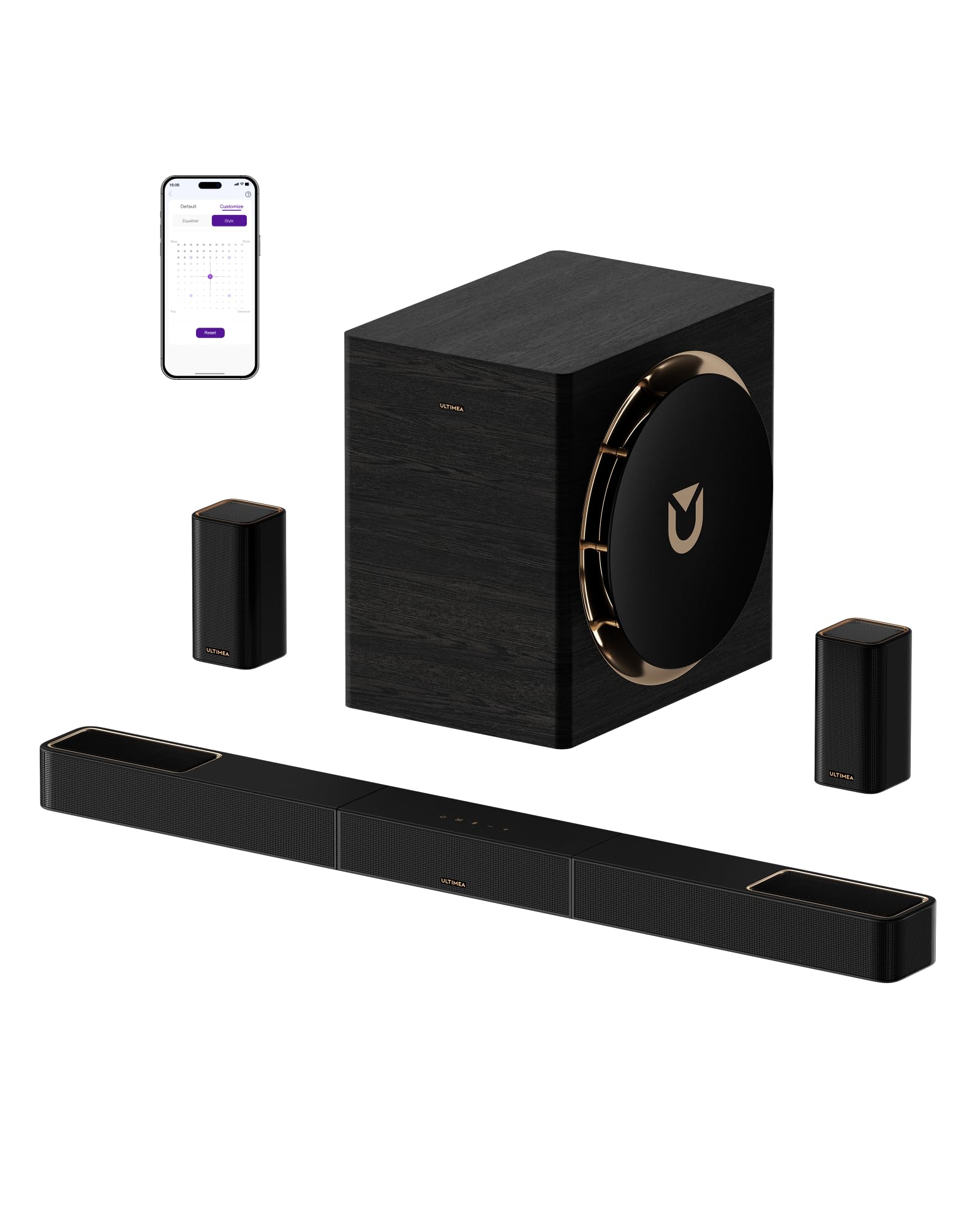
The headline is the channel count: 7.1.4 means seven surround channels plus a subwoofer channel plus four height channels that fire upward. That is how you get rain overhead and helicopters crossing the ceiling of your living room instead of just a louder version of your TV speakers. For a full movie-night setup, that spread is the whole point of buying a surround system at all.
The bass hardware is equally serious. A 10-inch wireless subwoofer reaches down to 20Hz with 980W peak output, which is the kind of low end you feel through the couch rather than just hear. A GaN amplifier (a power stage built from gallium nitride instead of silicon) runs it with low heat and low distortion, so peaks in an action scene stay clean instead of turning muddy. The NEURACORE processing engine handles 24-bit/192kHz audio with under 0.5% distortion, according to the maker, and supports up to 17 channels of imaging.
Setup is genuinely the strong suit here — the dual 5GHz wireless transmission keeps the rear speakers and sub talking to the bar without dropouts, and the picture-based instructions get you connected fast. The app adds a 10-band EQ and 121 sound presets, which is more tweaking than most people will ever use. Honest catch: with a bar assembled in three parts, a subwoofer and two surrounds, you need furniture room and a few wall outlets before this system earns its keep. It suits a dedicated movie room, not a studio apartment.
Where it earns its keep
- 7.1.4 channels with four height drivers for overhead effects
- 10-inch wireless sub reaching 20Hz with 980W peak output
- HDMI eARC, Optical, Bluetooth and USB all on board
- 4K HDR pass-through keeps your picture untouched
- 10-band EQ and 121 presets for tuning to taste
What to know before ordering
- Rear speakers and sub each need a power outlet
- Bluetooth remote needs a battery you supply
- Sound settings get mixed reviews — expect to tune by ear
Worth it for: anyone building a real home theater where overhead effects and deep bass matter as much as volume.
Hold off if: your room has no floor space for a sub and no free outlets behind the couch.
2. Sonos Era 100 SL Compact, Microphone-Free Speaker – White
A bookshelf speaker that fills the room without eating the shelf.
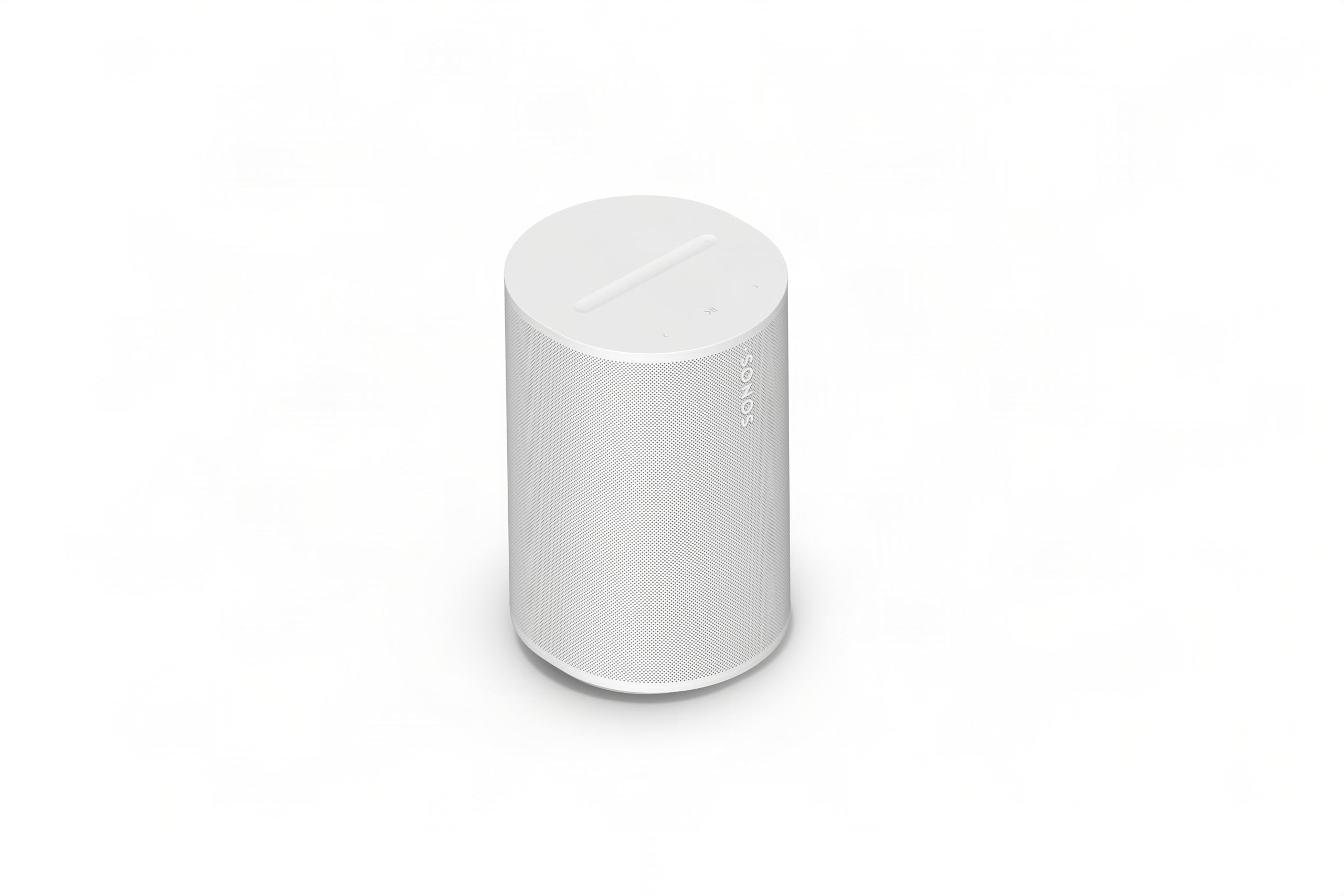
Two angled tweeters and a midwoofer do the work here, and the effect is stereo sound that spreads wide for a speaker this small. Sound quality is what wins people over — the room-filling, balanced output from a box that hardly takes up space is the recurring theme in owner feedback. Trueplay then listens to your room’s acoustics and fine-tunes the output to suit it, which is why the same speaker can sound right on a bookshelf or a kitchen counter.
What makes this the SL version is worth spelling out: no microphone. It cannot hear you, so there is no always-listening voice assistant inside. For anyone who has worried about a smart speaker sitting in a bedroom, that is a real selling point, not a footnote. You stream over Wi-Fi, pair by Bluetooth, or run a turntable and other gear through line in — three ways in, and a quick plug-in setup through the Sonos app.
The catch is the app. It handles the setup and room tuning, but owner feedback splits on it: helpful for some, intrusive for others, and a few find the speaker loses connection and needs coaxing back. That said, with 4.0+ stars across 450+ ratings, the sound is clearly doing the convincing. Buy this as a music speaker first, and treat voice control as something you were never promised.
Room tuning that works: Trueplay adapts the sound to your actual room, so placement matters less than it does on a fixed-tuning speaker.
The honest trade: no microphone at all, so if you wanted hands-free voice commands, this is the wrong variant of the Era 100.
Reach for this if: you want rich stereo music from a small footprint and privacy matters more than a built-in assistant.
Look elsewhere if: you expect to bark commands at your speaker or you need it to survive a bathroom’s humidity.
3. LG S40TR Soundbar
Surround speakers in the box without the receiver box you’d expect.
This is the budget route into real surround, and it gets there by including wireless rear speakers and a wireless subwoofer in the bundle. Four channels plus that sub deliver the wrap-around effect without a separate AV receiver taking up a shelf. Dolby Digital and DTS Digital compatibility keep your shows, movies and music sounding enhanced rather than flat.
Dialogue is the hidden strength. Clear Voice Plus analyzes the audio output and lifts voice clarity through the center speakers, which is exactly the fix for mumbled TV dialogue during loud action. If you own an LG TV, WOW Orchestra plays both the TV speakers and the soundbar together while WOW Interface lets one remote run both. The Smart Up-Mixer converts plain 2-channel audio into a wider multi-channel soundstage, and the LG Soundbar App gives you a 3-band equalizer for bass, treble and mid-range.
Now the honest part. Setup and sound draw praise, but connectivity and functionality split opinion — some units pair flawlessly and others drop the Bluetooth link. Wiring also comes up as a sore point, since the rear speakers still need a cable to power. With 4.0+ stars across 700+ ratings, most owners are happy; just budget a little patience for the pairing step and a plan for hiding the rear speaker cable.
What buyers keep praising: the whole package lands as strong value — a real surround effect for a fraction of flagship bar money.
Plan for this: rear speakers are wireless for signal but still need wall power, so pick your placement with an outlet in mind.
Best fit: a first surround system for a normal living room where space and budget both have limits.
Think twice if: you need rock-solid Bluetooth reconnection every single time or you have an LG OLED that deserves the higher-tier match.
4. WiiM Sound Lite
Hi-Res streaming with the widest support list in this lineup.
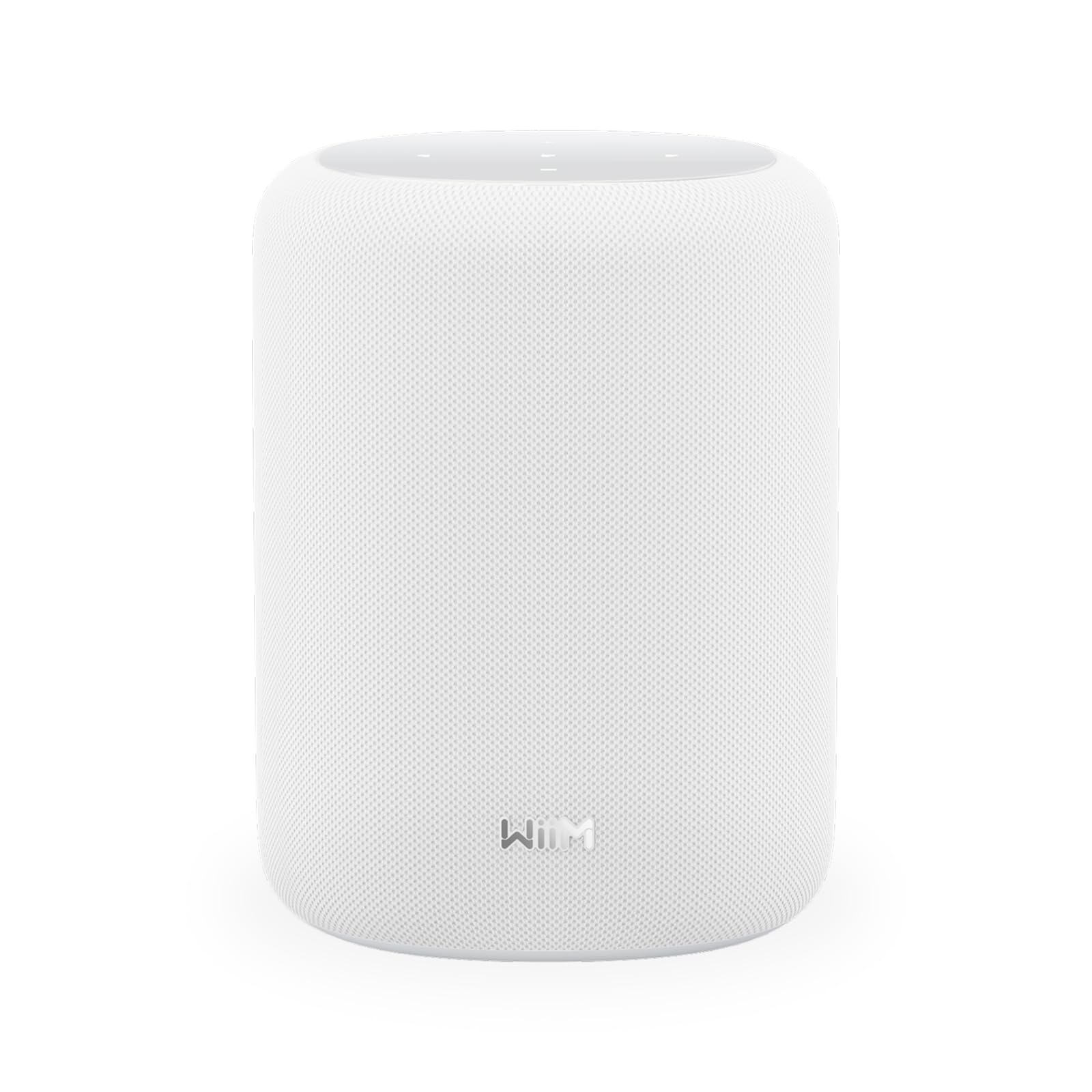
Streaming format support is where this speaker separates itself. It handles up to 24-bit/192kHz Hi-Res audio, which is the high-resolution tier above CD quality, and it opens the door to Google Cast, Spotify Connect, TIDAL Connect, Qobuz Connect, Alexa Cast, DLNA and Roon or LMS. That last set matters: a lot of speakers lock you into one app, and this one lets you cast from whichever service you already pay for.
The hardware backs it up with a 100W peak amplifier, a 4-inch paper-cone woofer and dual 1-inch silk-dome tweeters. AI RoomFit adjusts the sound to your room and where you place the speaker, so vocals stay clean and bass stays balanced even against a wall. When you want more, pair two for true left/right stereo, add a WiiM Sub Pro for deeper bass, or slot it into a WiiM home theater as a center or surround channel.
Wireless is future-proofed with Wi-Fi 6E — the newer Wi-Fi band built for less congestion — plus Bluetooth 5.3 and Ethernet if you prefer a cable. Audio latency sits at 50 milliseconds, which is tight enough that lip-sync in video stays believable. The trade-off is that this is a single speaker, so you’ll need a second one for stereo, and the plain-button, no-remote control scheme asks you to lean on the app. Sound quality and mid-to-treble clarity are what earn it its 4.5+ star standing.
Why it moves up the list
- 24-bit/192kHz Hi-Res with a 100W peak amplifier
- Dual 1-inch silk-dome tweeters and a 4-inch paper-cone woofer
- Wi-Fi 6E and Bluetooth 5.3 for crowded networks
- Google Cast, AirPlay-free casting, TIDAL and Qobuz Connect built in
- Stereo pairing and surround duty for a WiiM theater
The fine print
- One speaker means mono until you buy a second
- No screen or remote — setup leans on the app
- Deeper bass requires the optional sub
Pick this if: your library lives in TIDAL, Qobuz or Roon and you want a speaker that speaks every one of those languages.
skip it if: you want one box to fill a big room with bass without adding a subwoofer later.
5. TCL S65K S Series Soundbar
Overhead movie sound drawn from a single HDMI cable.
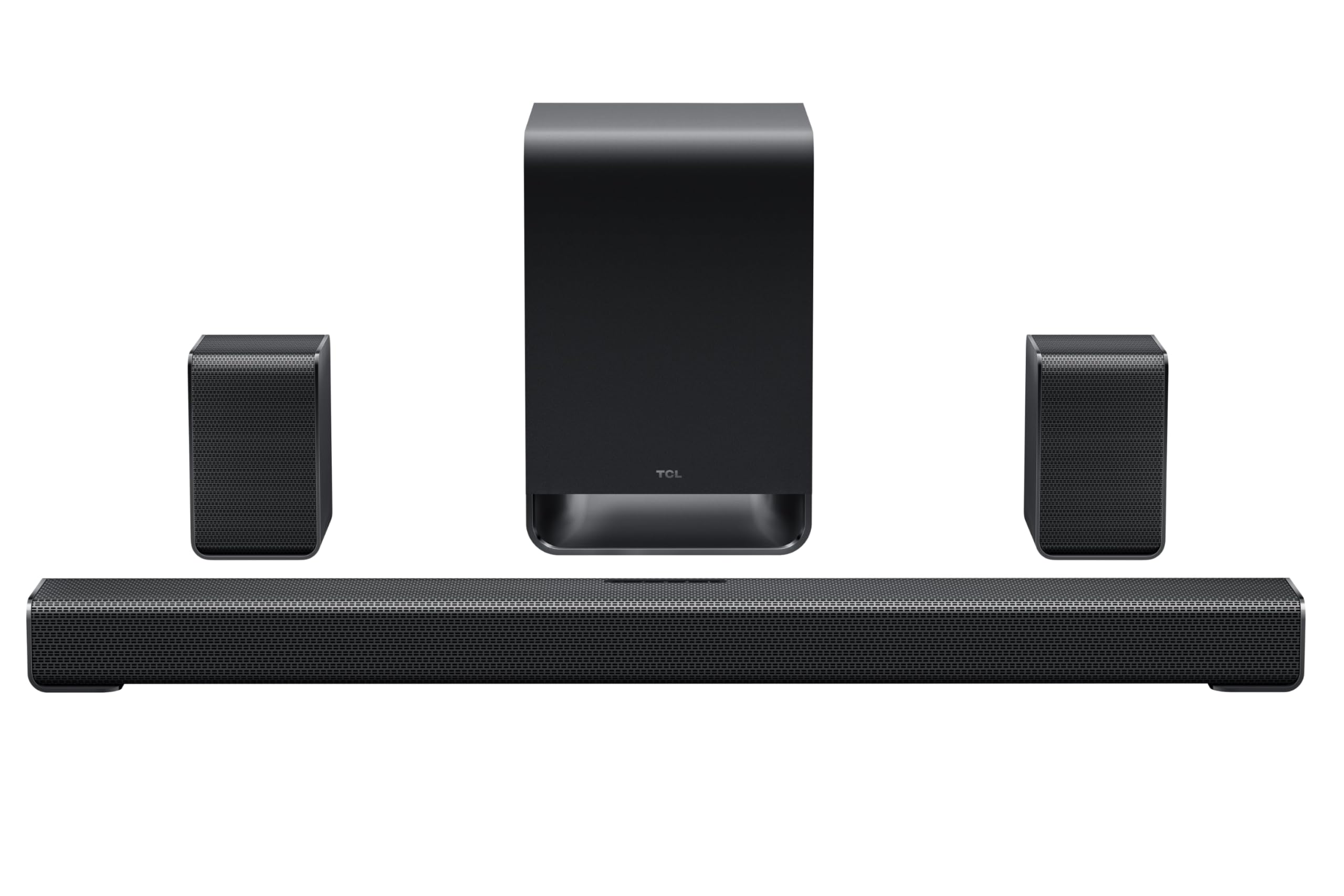
Five channels, two surround formats and a wireless subwoofer all arrive in one box. Dolby Atmos and DTS:X handle spatial sound from above and behind, so a movie’s rain and flyovers move around the room rather than firing straight at you. Ray Danz technology widens the soundstage further, and a built-in center channel plus a center tweeter keep dialogue crisp even during loud action.
You get everyday bass without a big box in the corner: the wireless subwoofer uses a 6.5-inch driver (the round speaker cone that makes the low notes) with Bass Boost. That driver is smaller than the 10-inch subs on the ULTIMEA and JBL systems above, so you feel less gut-punch rumble, but music and movies still sound full. Setup takes one HDMI cable (the single cable that carries picture and sound from your TV). ChoruSound then pairs the bar with your TV’s own speakers for a wider stage. AI Sonic auto room calibration (the bar listens to your room and tunes itself) adjusts the sound to your space without you touching a menu.
Owners describe punchy bass, easy TV connection and satellites that pair to the bar automatically — the sort of setup that works on the first try. The recurring gripe is sheer size: this soundbar measures 33.46 inches wide and shows 27 pounds, so measure your TV stand before it arrives. It’s the easy route to Atmos on a modest budget, provided your console is wide and sturdy.
The Atmos entry point: Dolby Atmos and DTS:X with wireless rears and a sub, in a package tuned for small rooms.
Measure first: at 33.46 inches wide and 27 pounds, this bar wants a real TV console, not a narrow shelf.
Made for: a bedroom or small living room where Atmos effects sound notable and a compact sub is welcome.
Not for: anyone chasing the deepest bass or needing a slim bar that slips under a wall-mounted TV.
6. Bose Lifestyle Ultra Speaker
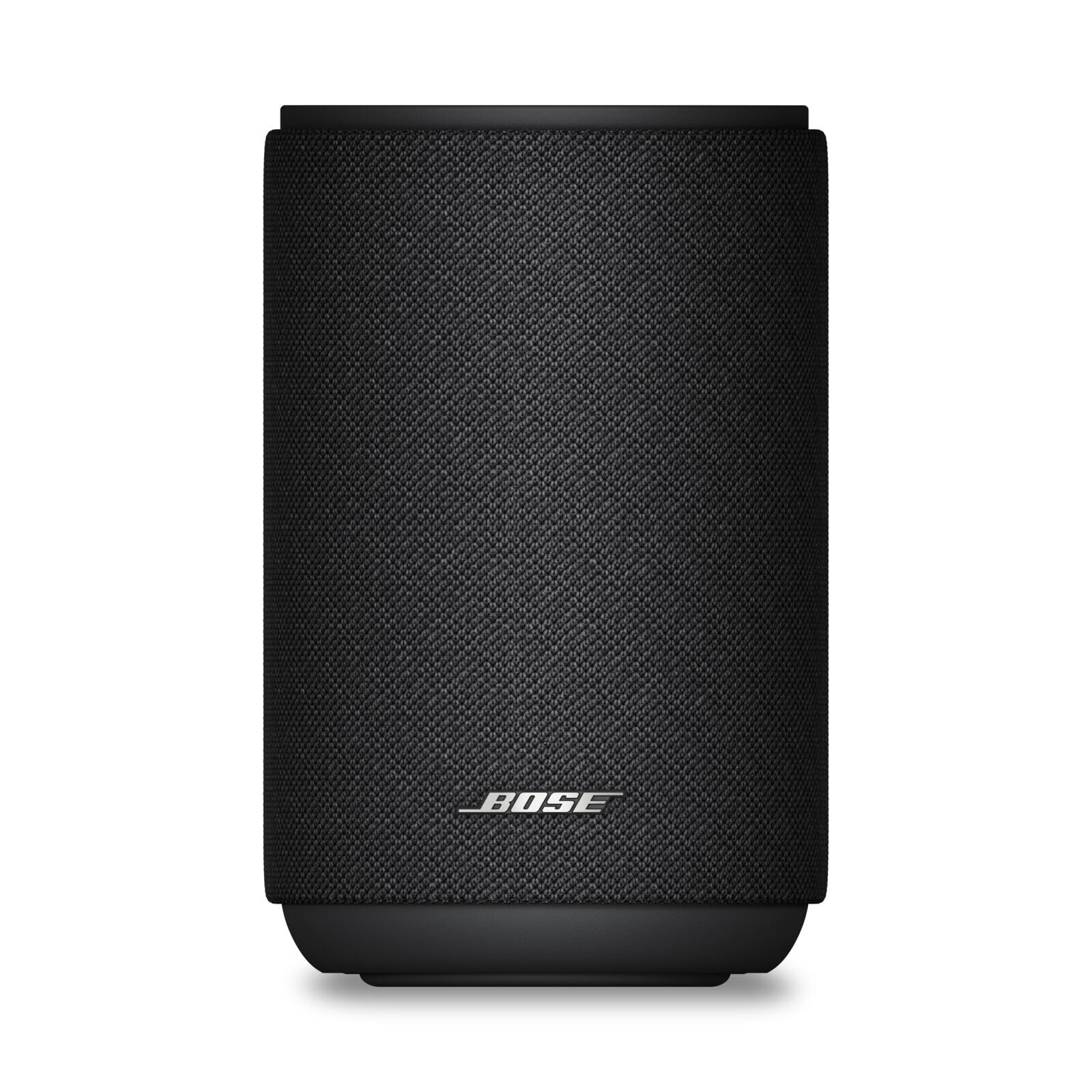
One box that serves as a kitchen radio, a bedroom speaker or a stereo pair half.
Flexibility is the pitch. Use one in a compact spot for room-filling sound, pair two for stereo, or link multiple speakers across the house for multi-room listening. TrueSpatial Audio handling and CleanBass tuning carry the low end, and Adjustable EQ lets you dial from crisp highs and clear vocals to fuller bass — either in the Bose app or by voice. Owner feedback centers on exactly that: excellent sound for the speaker’s size.
Connections are unusually broad for a single speaker: Wi-Fi, Bluetooth, AirPlay, Spotify and Google Cast all work, so an iPhone, an Android phone and a streaming app can all feed it. Voice control runs through the all-new Alexa+ if you want it, and touch controls cover quick play and pause. If you later add the Bose subwoofer or soundbar, the speaker folds into that system rather than being replaced.
The split in the feedback lands on connection reliability, particularly staying linked to Amazon Music over Wi-Fi. Some owners sail through setup, others need a few attempts. At 4.0+ stars across 350+ ratings, most people are clearly hearing what they paid for. The 30-foot Bluetooth range is honest indoor reach, and there is no water resistance rated for splashy rooms.
Its real edge: AirPlay and Google Cast in the same speaker means everyone’s phone can cast to it, no adapter required.
Fair warning: it is not rated waterproof, so keep it away from the tub and the kitchen sink sprayer.
The one for: a mixed-device household that wants one good speaker adaptable to music, podcasts and a later surround setup.
Maybe not if: your main listening is Amazon Music over Wi-Fi and you want a set-and-forget link.
7. Google Nest Audio (3-Pack)

Three rooms of sound, grouped or split, all answering to your voice.
The concept is whole-home audio in one purchase. You get three speakers to place in a kitchen, a living room and a bedroom, or you can group all three for multi-room playback of the same song. Pair two together and they form a true stereo set. Stream over Wi-Fi from Spotify or YouTube Music, or hop on Bluetooth from a phone, and it all works with Android and iOS.
Google Assistant is the second half of the deal. Ask for a song, set a timer, check the weather or tell it to dim the lights — the speaker integrates with thousands of compatible smart home devices. Each speaker houses a 7.5cm driver, and owners describe the sound as room-friendly and easy to fit into any size room. Setup through the Google Home app is quick, which is why it rates as good value.
Reliability is the honest watch point. Stories of a unit going silent are out there, so a speaker that depends on an active Wi-Fi link and a cloud service should be treated as a connected device, not a passive box. Most owners are plenty happy at 4.0+ stars across 200+ ratings, and this bundle spreads that sound across your whole home rather than one corner of it.
Why the bundle makes sense
- Three speakers for three rooms, or grouped into one system
- Stereo pairing on two, with the third free for another room
- Voice control for music, timers and smart home gear
- Wi-Fi and Bluetooth streaming, Android and iOS both supported
Weigh this honestly
- Each speaker needs a power outlet in its room
- Wi-Fi and cloud dependency means occasional troubleshooting
- Voice control is the point — avoid it if you dislike always-listening devices
Go for it when: you want music following you from room to room and voice commands doing the switching.
Pass when: you mainly watch movies and want the deep bass a TV system provides.
8. ULTIMEA Skywave X50
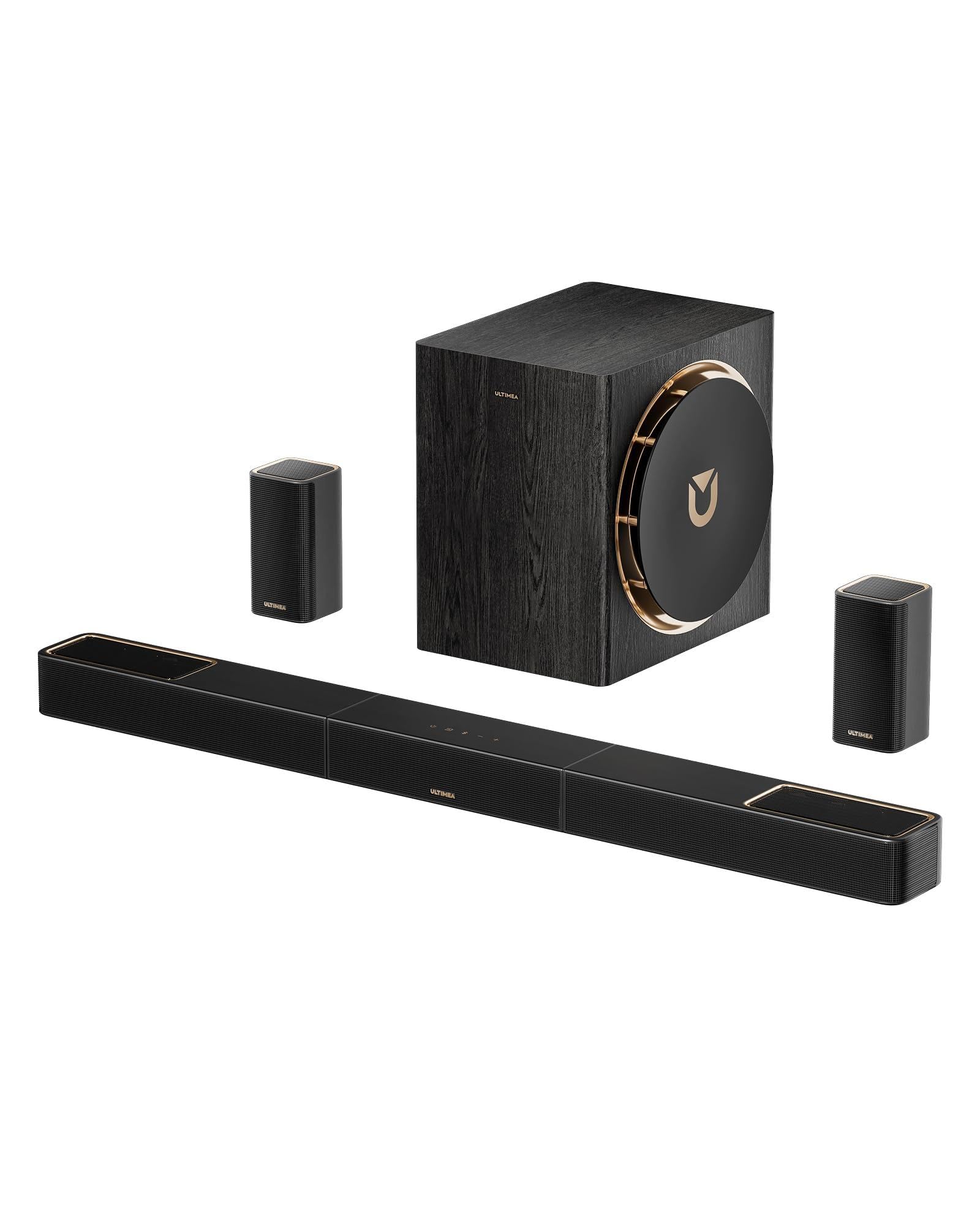
The gaming sound system that shakes the room without a wire in sight.
Five main channels plus four height channels plus a sub — that’s the configuration here, and the 760W peak power figure gives you a sense of the headroom behind it. Dual 5GHz wireless transmission keeps the rear speakers and sub locked to the bar, which is the part that matters most for gaming: a dropped rear channel is an instant immersion killer. 4K HDR pass-through keeps your console’s picture quality intact on the way to the TV.
Bass comes from an 8-inch subwoofer reaching down to 28Hz via Gravus Ultra-Linear Bass, so it’s a step below the X70’s 10-inch driver but still deep. The same GaN amplifier and NEURACORE engine appear here, handling 24-bit/192kHz audio below 0.5% distortion and up to 17 channels of processing. If your main use is a PS5 and a movie library, the 5.1.4 layout is exactly what those formats expect.
Where owners land is the theater feel — it’s the kind of system people describe as shaking the house. Setup is straightforward, EQ settings are adjustable, and the value holds up well against flagships that charge more for similar channel counts. The one thing to plan around: rear speakers and sub still need power, so keep outlets behind your seating area in mind before wall-mounting anything.
Built for gamers: 5.1.4 channels and 4K HDR pass-through suit a PS5 or console setup without a wire run.
Tuning note: the 8-inch sub reaches 28Hz, so expect deep bass, though the X70 one step above goes lower.
Strongest choice for: a living room that doubles as a game room, where the surround needs to stay locked in through long sessions.
Consider the step up if: you want the deepest bass the line offers or a room large enough to need it.
9. LG S90TR 7.1.3 ch OLED evo TV Matching Home Theater Soundbar

Sharper than the S40TR — seven channels and three height drivers versus four flat channels.
Both this and the S40TR carry the LG name, but the channel math separates them fast. This one runs 7.1.3 with three dedicated height channels for overhead effects and an up-firing center speaker that focuses on dialogue clarity. That’s a wider, richer soundstage than the S40TR’s 4.1 layout, and the wireless rear speakers deliver surround with no receiver required.
WOWCAST wireless Dolby Atmos is the standout. It carries Atmos and DTS:X without a cable between soundbar and TV, so the wire clutter disappears when paired with a compatible LG set. WOW Orchestra syncs audio from the TV and the bar speakers into one performance, and the built-in microphone measures your room and auto-calibrates the settings. Gaming gets VRR and ALLM passthrough up to a 120Hz refresh rate, keeping the picture and the sound in step.
Your TV brand decides how well this bar works. Buyers report the sound quality is excellent, and the live-event realism stands out. But connectivity splits: owners pairing it with LG TVs are happy, while others hit issues. WOWCAST (LG’s wireless link that cuts the cable to the TV) and WOW Orchestra (which runs the bar and your TV speakers together) lose much of their appeal if your TV isn’t LG. Set against the S40TR, expect more precise surround and calmer power draw. Check that ecosystem match before you buy.
Worth the room: wireless Atmos, room calibration and 120Hz gaming passthrough all sit in one bar.
Match the TV first: the best features lean on an LG TV, so a different brand cuts the value substantially.
Best matched with: an LG OLED evo set, where wireless Atmos and one-remote control actually work as designed.
Not the answer if: you own a different brand TV and want those sync features to pay off.
10. JBL Bar 700MK2 Soundbar with Subwoofer, Dolby Atmos Surround

Rear speakers that click off the bar and sit behind you in seconds.
The clever part is the surround solution. Lift the speakers off each end of the bar and place them behind your seat — that’s true 7.1-channel wireless surround in seconds, no separate stands or speaker cables. It’s a genuinely different approach to the rear-channel problem that the LG and ULTIMEA systems solve with permanently placed surrounds.
You get 780W max of power (watts measure how loud the system can go), so action scenes hit hard. A 10-inch wireless subwoofer (the box that handles deep bass) provides thundering low end — the same driver size as the Skywave X70’s sub. Dolby Atmos and DTS Virtual:X (two surround formats that place sound in 3D) move audio around you, so a helicopter sounds like it flies overhead. MultiBeam 3.0 projects a wide soundstage, so you’re in the balance wherever you sit. PureVoice 2.0 tackles dialogue automatically, adjusting clarity by scene and volume so quiet lines stay clear.
Owners note the theater-like sound and quick setup, with HDMI e-ARC handled cleanly. Where it asks something back: those detachable speakers are battery-powered, so battery life lands as a mixed point — recharge them after long movie marathons. If one rear goes flat mid-film, that’s the trade for the instant surround setup. Weigh that against the convenience and it’s still a strong call for a mixed-use living room.
The JBL advantage
- Detachable wireless surrounds for true 7.1 in seconds
- 780W max power with a 10-inch wireless subwoofer
- Dolby Atmos and DTS Virtual:X for 3D sound
- MultiBeam 3.0 widens the balance across the room
- PureVoice 2.0 lifts dialogue automatically
Where it asks more
- Detachable rears run on battery and need recharging
- Reliability feedback is mixed across the listings
- No Wi-Fi streaming protocols beyond Bluetooth for music
Ideal for: a living room where the layout changes — detach the rears for movie night, dock them for everyday TV.
Less ideal for: anyone who wants to stream music over Wi-Fi from their phone rather than Bluetooth.
11. Polk Audio MagniFi Max AX SR
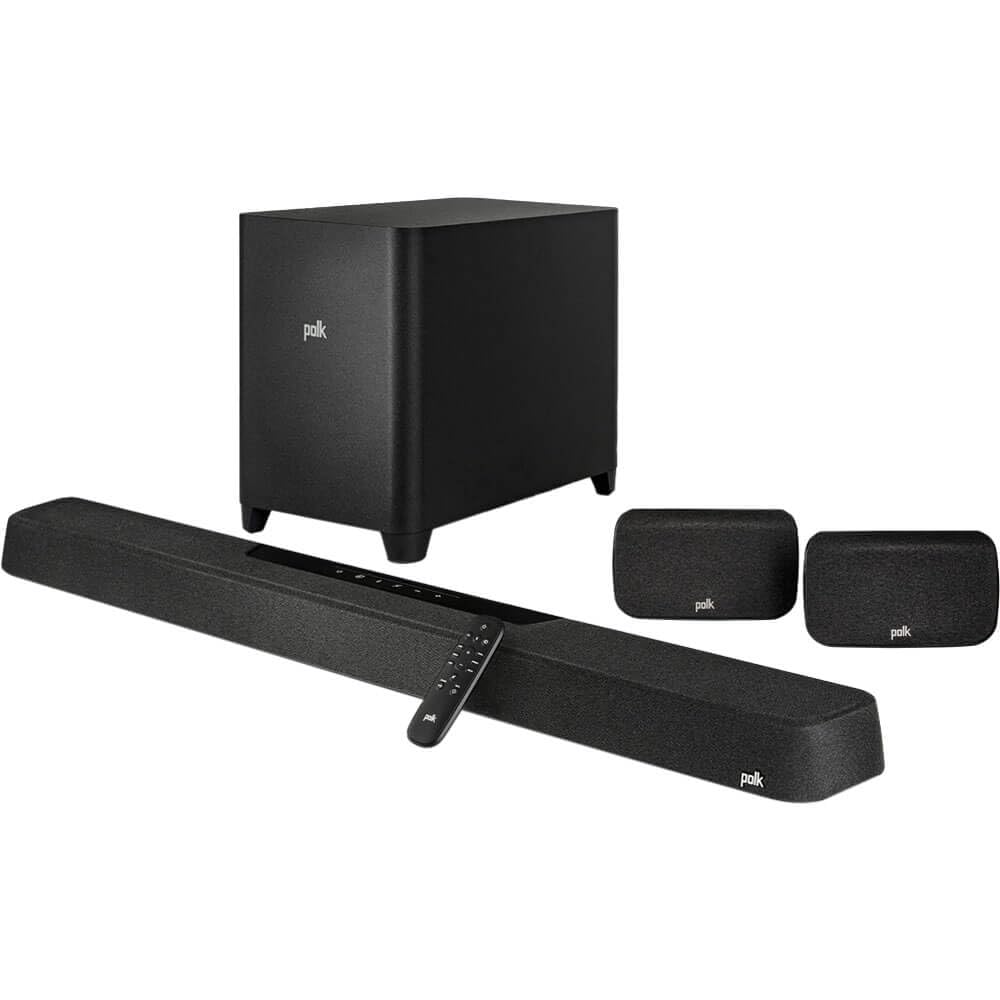
Built to stop you rewinding the same mumbled line twice.
VoiceAdjust is the feature that earns this system its place. Polk’s patented technology works with the built-in center channel to boost vocal levels without dragging the rest of the soundtrack up with them. If your nightly problem is missing whispered dialogue under a swelling score, that targeted fix is worth more than another hundred watts of power.
Around that sits a full 7.1.2 system: the flagship MagniFi Max AX bar, a 10-inch wireless subwoofer, and SR2 surround speakers in the bundle. SDA 3D technology and two up-firing speakers produce certified Dolby Atmos and DTS:X, so overhead effects come through, and the sub connects the moment you power it on. For music, the bar streams over Wi-Fi, Bluetooth, AirPlay 2, Chromecast, Spotify Connect and Alexa multi-room.
The input panel is the most complete in this lineup: HDMI eARC, optical in, USB-A for firmware and three 4K HDMI inputs. Most soundbars give you one or two HDMI ports — this one lets you plug a console and a streamer straight in. Owners describe impressive surround and height channels, with setup taking minutes. The fair note is price-tier: this sits at the premium end, so it’s the pick when dialogue and inputs matter more than shaving the budget.
Dialogue, solved: VoiceAdjust lifts vocals through the center channel without ruining the rest of the mix.
Input flexibility: three 4K HDMI inputs mean you can route devices through the bar instead of buying a switcher.
Choose this when: your household fights over volume during quiet movie dialogue and you want it fixed at the source.
Look at the alternatives if: you don’t need three HDMI inputs and would rather spend less on a smaller system.
Know the Specs
Channel Count (5.1, 7.1.3, 7.1.4)
The first number is your surround channels, the middle one is the subwoofer, and the final number is height channels that fire upward. A 5.1 system wraps sound around you; a 7.1.4 adds two extra surround channels and four height drivers for overhead effects. More channels usually means more speakers in the box — and more outlets to plan for behind your seat.
Wireless Protocol and Band
Wireless rear speakers still need wall power, but the signal travels over the air. Systems that transmit on 5GHz use a band less crowded than standard 2.4GHz Wi-Fi, which reduces interference and dropouts. Cloud-based systems lean on your home Wi-Fi, so network quality matters more there.
Subwoofer Driver Size
This is the diameter of the subwoofer cone, and it drives how much low end you feel. A 10-inch driver pushes more air than a 6.5-inch one, so it delivers deeper, heavier bass. In a small room a smaller sub is often enough; in a larger space the bigger driver keeps its composure at volume.
Streaming Standards: AirPlay, Google Cast, Spotify Connect
These are the apps that send audio from your phone to the speaker over Wi-Fi. AirPlay is Apple’s, Google Cast is the Android equivalent, and Spotify Connect streams straight from Spotify. A speaker that supports more of these standards works with more phones without adapters.
Common Questions
Do wireless surround speakers still need a power outlet?
Is a 7.1.4 channel system worth it over a 5.1?
Will a soundbar work with a non-LG or non-JBL TV?
What is HDMI eARC and do I need it?
Can I group different speakers around my home?
Do I need a subwoofer with a soundbar system?
Is a Wi-Fi speaker better than a Bluetooth one for music?
How do I set up a soundbar with rear speakers without running cable across the floor?
Which is better for movies, a soundbar system or a pair of smart speakers?
Can I add a second speaker later for stereo sound?
The Bottom Line
If you’re building a wireless home audio system around your TV, the ULTIMEA Skywave X70 is the one to buy. Its 7.1.4 channels (seven speakers around you, one bass channel, four height channels) with a 10-inch sub reaching 20Hz (hertz measures how low the bass goes) deliver overhead effects and deep bass, so a movie feels like a real theater. If your room is smaller or your budget tighter, grab the TCL S65K for Dolby Atmos with wireless rears. And for music-first listening, reach for the WiiM Sound Lite, with 24-bit/192kHz streaming (high-resolution audio) across TIDAL, Qobuz and Roon.
One nudge worth making: the top picks here sit in the higher-score range with review counts in the hundreds, which tells you the sound has held up over real use, not just at unboxing. Buy for your room’s size and the formats your TV and phone actually output, and the system should last well past the first year.
How we choose
We do not accept paid placement. Every pick is matched to a real buyer and a real use-case; we do not hands-on test units.
Sources
Specifications: manufacturer listings and product documentation. Review insights: verified customer reviews, as of November 2026. Pricing: not shown on this page (it changes often); check the current price via the retailer link.
As an Amazon Associate, Tactical Gear Guy earns from qualifying purchases. This does not affect which products we feature.