Specs are compiled from manufacturer listings and verified buyer reviews and can change over time — please confirm the key details on the product page before buying.
You hung the TV, and now the back of your living room looks like a dropped plate of spaghetti. The fix is not complicated: a channel that sticks or screws to the wall, swallows your HDMI and power cords, and disappears against the paint. What matters is how many cords it swallows, how wide the channel is, and whether the adhesive will take your paint with it when it comes off. This guide covers those three things for every pick below.
This guide is built by comparing the manufacturers’ published specifications and the patterns across verified customer reviews, so you get each pick’s real strengths and trade-offs instead of marketing spin.
Some kits cut a hole in the drywall and run the cables through the cavity. Others are surface channels that peel and stick. Which one you need depends on three things: whether you rent, whether you can cut the drywall, and how many cords you’re hiding. Here is how to sort the best wire hiders for TV without guessing.
Top Picks
How To Choose The Best Wire Hiders for TV
Start with the count. Lay every cord you need to hide on the floor and count them — HDMI, the TV power lead, an Ethernet run, a soundbar cable. Surface raceways are typically rated to hold 2-5 cords, and a wall-mounted TV with a console underneath often needs more than a basic strip can take. Measure before you buy, because a channel that is too narrow means a second trip to the store and a second strip on the wall.
Measure the channel, not just the strip
The outside width of a raceway tells you how much wall it covers. The inside width tells you how many cables fit. A 1.18-inch-wide cover with 0.52 inches of internal space holds a different load than a 1.6-inch-wide cover rated for 4 HDMI cables or 5 Cat 6 Ethernet runs. Check the internal figures and compare them to the thickness of your thickest cord.
Decide whether you can cut the wall
An in-wall kit gives the cleanest result because the cables vanish entirely behind the drywall. It also means cutting a hole between two studs. Kits of that kind include a saw and a template, and they typically require a cavity depth of around two and a half inches, which standard walls usually have. If the wall is a rental, or you are not comfortable with a drywall saw, stay with the adhesive route.
Think about the paint before you peel
Self-adhesive strips hold well, but paint is the fragile layer. A strip that grips hard can lift paint when it comes off. Warm the adhesive slightly before sticking if the maker suggests it, plan the full route before peeling anything, and avoid re-positioning the strip. If you paint the cover afterward, key the surface lightly and build up coats so it blends with the wall.
Side-by-Side Comparison
| Model | Best For | Install Type | Total Length | Cords Held | Amazon |
|---|---|---|---|---|---|
| Mount-It! In-Wall Cable Concealer Kit★ Best Overall | Hiding everything behind the drywall | In-Wall | 9 ft extension cord | Multiple HDMI, Ethernet and A/V | Amazon |
| Yecaye TV Cord Hider 42inBest Value | Tool-free peel and stick on a rental wall | Self-Adhesive | 42 in | 3-4 wires | Amazon |
| Large Cord Hider 47in | Fat bundles of HDMI and Ethernet | Self-Adhesive | 47 in | Up to 4 HDMI or 5 Cat 6 | Amazon |
| D-Line TV Wall Mount Cord Hider | A low profile finish on a modern wall | Self-Adhesive | 31.4 in | — | Amazon |
| Delamu Cord Hider 157in | Long runs across a whole wall | Self-Adhesive or Screw-In | 157 in | 2-4 wires | Amazon |
| ECHOGEAR TV Cord Hider 48″ | Adding or swapping cords later | Screw-In | 48 in | 6+ cables | Amazon |
Detailed Reviews
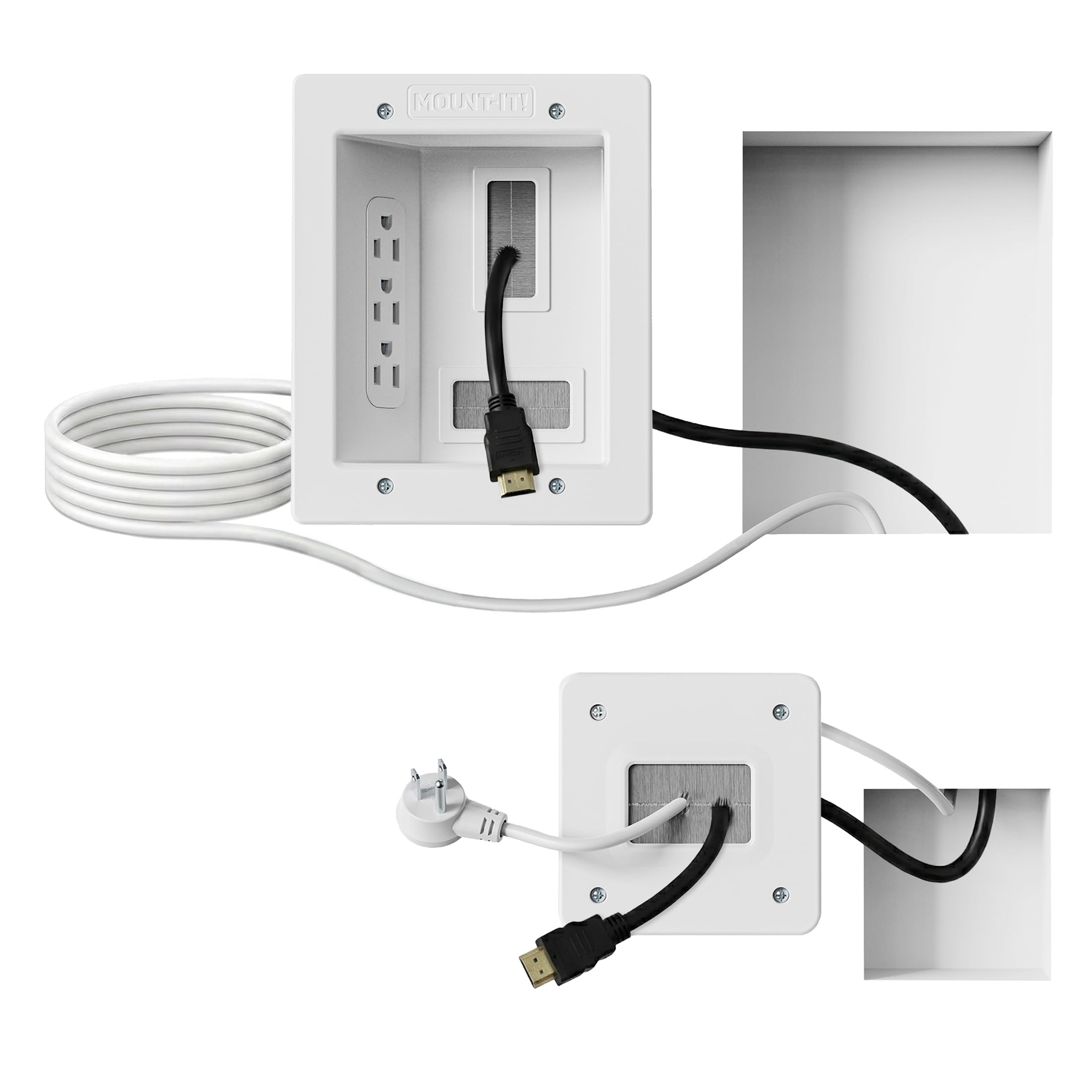
1. Mount-It! in-Wall TV Cable Concealer Kit with Recessed Power
Our pick — 4.5+★ from 650+ verified ratings; the strongest balance of quality and price.
The one that makes the cables disappear behind the drywall entirely, not just cover them.
If you own the wall and you want a result that looks like an electrician did it, this is the kit to buy. You cut two openings between the studs, drop the low-voltage cables through the cavity, and the power runs off a 9 ft extension cord that plugs into the outlet you already have. No new circuit, no electrician, no visible channel on the paint. The triple outlet gives you a place to plug the TV and two more devices right at the plate.
The install is genuinely a weekend-morning job rather than a project. The box includes a drywall saw, a cutting template, and step-by-step instructions, and the maker puts the job at under 30 minutes. The large plate measures 6.3″ x 7.9″ and the small plate is 4.5″, both with pre-installed screws. Buyers consistently rate installation as the standout strength, with build quality close behind. A tidy cavity and a sharp blade do most of the work.
The catch is that it is a cutting job. The large plate needs a cutout between studs and a minimum cavity depth of 2.4 inches, and that check has to happen before the saw comes out. Measure the space first — standard walls usually clear it, but a shallow or furred-out wall will not. It is also ETL In-Wall Certified (a safety listing for cables run inside a wall cavity), which is the thing to look for if you are hiding power-carrying cords rather than just HDMI. Weight lands at 2.5 pounds for the whole box. For anyone unwilling to cut drywall, none of this matters — go with a stick-on channel instead.
Why this one earns the top slot
- Cables run inside the wall cavity, so nothing shows on the paint at all
- Includes the drywall saw, template and instructions — no separate tool run
- ETL In-Wall Certified for hiding power and low-voltage cables safely
- Plug-in design means no electrician and no new circuit
What it asks of you
- Requires a drywall cutout with 2.4 inches of cavity depth behind the plate
- Not an option for renters or anyone avoiding wall cuts
Reach for this if: you own the wall, want a truly invisible run, and can handle a drywall saw for one morning.
Look elsewhere if: the wall is a rental or the cavity behind it is shallower than 2.4 inches.
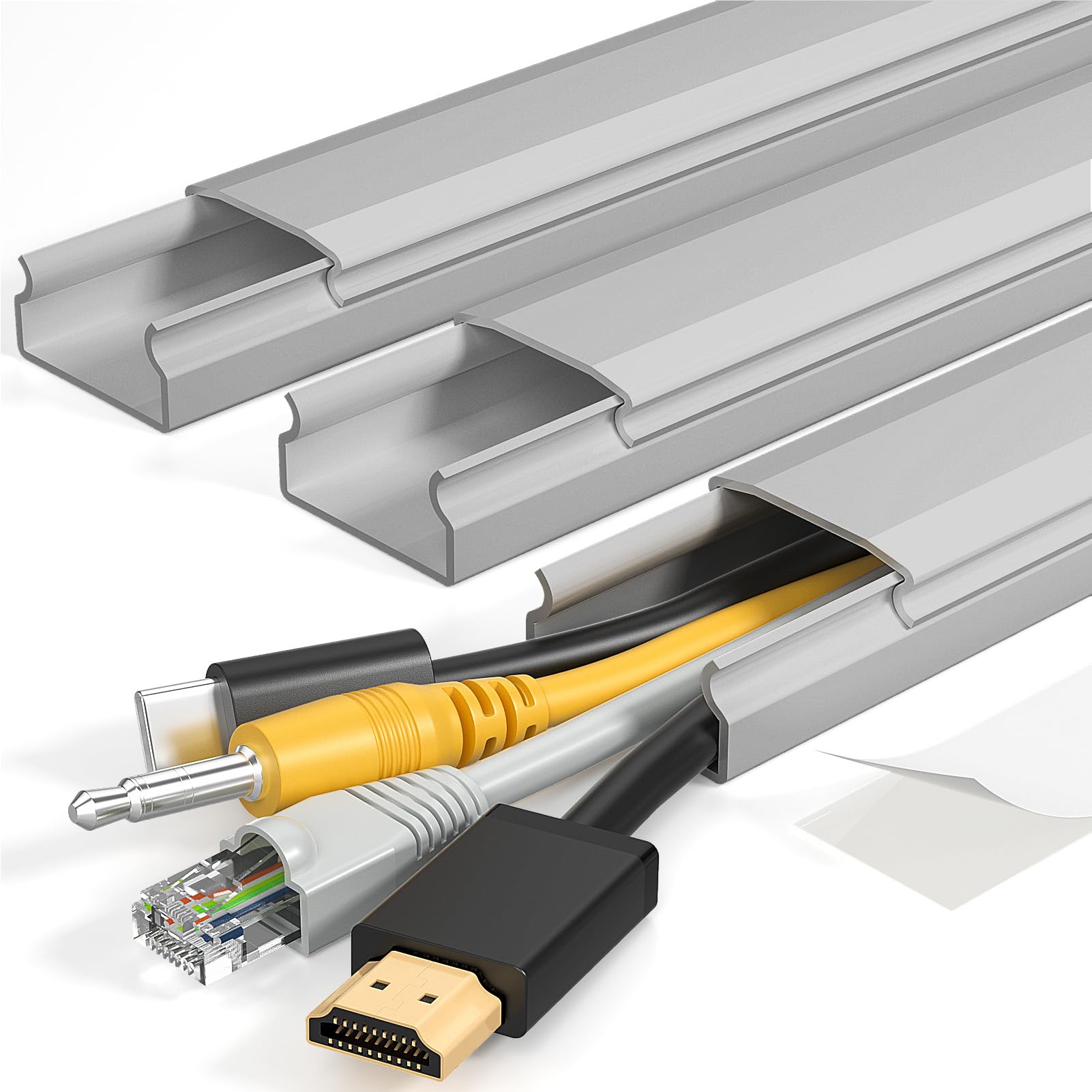
2. Yecaye TV Cord Hider, 42in Cord Cover Wall Mounted, Grey
Three grey raceways that click together for a full 42 inches of covered wall.
Three sections, 42 inches total, spliced into one continuous run or spaced out under the set. The grey finish is the point here — it is the one color in this lineup that reads as a deliberate trim line rather than a white strip hoping nobody notices it. Each cover runs 1.18 inches wide and 0.6 inches high, and the internal space is 1.1 inches long by 0.52 inches wide. That is real room for 3-4 cords of typical TV-wire thickness.
Setup is the part buyers rave about most — appearance draws the heaviest praise by a wide margin, with ease of installation right behind it. The pre-applied tape means one peel and you are done, and the snap-on lid lets you get back inside for a cable swap without pulling the whole strip off the wall. In tight spaces under a low-hung TV you can slide the cover on rather than fight it into place.
Here is your honest warning: the tape is the weak link, and the adhesive feedback splits both ways. Done right — clean wall, one confident placement, no re-pressing — it holds. Peel it and reset it and you can lift paint with it. Plan the entire route before you touch the backing, and treat the first placement as final. Width is also the narrowest in this round, at 1.18 inches against 1.6 inches on the Large Cord Hider, so a fat bundle of thick HDMI leads is not its job.
The trim-line trick: grey is doing quiet work here — on a painted wall it looks like a fitted detail, and it takes paint if you want it gone completely.
The tape reality: place it once, correctly, or budget for a paint touch-up.
Suits: renters and anyone hiding three or four cords under a wall-mounted set without touching a saw.
Not for: thick multi-HDMI bundles, which want the wider 1.6-inch channel.
3. Large Cord Hider 47in

The fat channel for people who counted their cables and found too many.
Width is the whole story with this one. At 1.6 inches wide by 0.8 inches high, it swallows up to 4 HDMI cables or 5 Cat 6 Ethernet cables in a single run — a meaningful step up from the 1.18-inch Yecaye, where the internal space sits at 0.52 inches. If your wall has a streaming box, a console, and a soundbar all feeding one TV, this is the channel that does not need a second strip beside it.
Three 15.7-inch sections give you 47 inches total, spliced to whatever route your wall demands. The PVC is paintable, so a coat or two makes it vanish against the wall color rather than sitting there as a white line. The tape is pre-applied and rated to carry the weight of a 3-5 cord bundle without shifting. It also puts a physical barrier over the cords, which matters if small hands or a cat are curious about the dangling end.
Two things to know. First, the tape has a temperament — repositioning it weakens the grip, so the maker suggests planning the route beforehand and warming the adhesive slightly at low temperature before you press it down. Second, the physics of a wider channel: because it stands 0.8 inches off the wall versus 0.59 inches on the D-Line, it sits a little prouder on the paint. That extra depth is the trade for holding more cables, and on most walls you will not notice it.
Best argument for it: the widest surface channel in this round — 1.6 inches wide, 0.8 inches high, and rated for up to 5 Cat 6 runs.
One thing to prep: warm the tape and commit to the route the first time; re-pressing is the enemy.
Choose it when: your bundle runs four or five cords and you want one paintable channel instead of two strips.
Think twice if: you want the flattest possible line against the wall — the D-Line sits closer.
4. D-Line TV Wall Mount Cord Hider

A hinged lid that clicks shut, so the cover looks fitted rather than stuck on.
Two 15.7-inch lengths, 31.4 inches in total, each 2.36 inches wide and just 0.59 inches high. That width is the widest plate in this round — the Yecaye runs 1.18 inches — and the height is the lowest, which is why it sits flatter against the paint than the 0.8-inch Large Cord Hider. If you care about how the wall looks from the sofa, this is the one that reads as architecture rather than accessory.
The mechanism is the differentiator. A hidden flexible hinge lets you open the lid, lay the cables in, and snap it shut on a click-lock — no sliding, no fighting a cover back into a track. Peel-and-stick backing handles the mounting, and the surface takes paint if you want it matched exactly: key it with fine sandpaper and apply two coats. Fit and quality are the things buyers praise most here, and the low profile delivers on the promise of an installation you stop seeing.
Length is where it asks you to think. At 31.4 inches total, it covers less distance than the 47-inch Large Cord Hider — the 47-inch runs roughly 50% longer, and it stands 36% taller at 0.8 inches versus 0.59 inches. So if your cable drop from TV to console is a long one, you will be splicing or buying a second pack. And the adhesive is the consistent gripe: it holds, but it lifts paint on removal. Two lengths per pack gives you one splice point without extra parts.
Where it shines: the click-lock hinge — open, load, snap, done, and you can get back inside later without peeling anything.
The honest limit: 31.4 inches total is a short run for a tall wall, and the tape takes paint with it if you pull it.
Fits best: a short, tidy drop from a wall-mounted TV where a flat, near-invisible line matters most.
Go longer instead if: your run is more than about two and a half feet — you will want the 47-inch channel.
5. Delamu Cord Hider, 157in Wire Covers for Cords on Wall

Thirteen feet of channel — enough to route a cord across a room, not just down a wall.
Nothing else in this lineup comes close on distance. At 157 inches total, this kit handles the corner run from a wall-mounted TV across to an outlet on a different wall, or the whole perimeter of a home office. The channel is 0.95 inches wide with 0.55 inches of height, sized for 2-4 wires. Pre-sectioned pieces with matching connectors mean you splice your own route instead of fighting one fixed length.
The build is where the money went. The plastic carries a UL94 V-0 flammability rating (a standard where burning stops within 10 seconds on a vertical piece), which is a meaningful detail if you are routing power cords and want the cover itself to resist flame. The Attach & Snap design lets you open and close the channel with a click rather than prying a lid off. It is cuttable to any length and paintable to match your wall. Quality and ease of use are what people praise most, and the finish reads as a professional job rather than a stick-on afterthought.
Two things to weigh. The tape is the recurring complaint: it grips well but lifts paint on removal, so plan the route before peeling and don’t reposition. And the width, at 0.95 inches, is the narrowest here; the Yecaye runs 1.18 inches and the Large Cord Hider runs 1.6 inches. That is fine for 2-4 cords, but a fat bundle needs a wider channel. You can also screw it in rather than stick it if the wall is difficult.
The distance argument: 157 inches is roughly five times the 31.4-inch D-Line pack — this is the only pick here built for a cross-room run.
The width caution: 0.95 inches is the narrowest channel in this round, so count your cords before committing.
Right for: long routes, corner turns, and anyone who would rather cut one kit than buy three short ones.
Wrong for: a heavy multi-cable bundle that needs the wider 1.6-inch channel.
6. ECHOGEAR TV Cord Hider 48″

Snap-off covers and a 48-inch run built for anyone who changes their setup often.
Six cables or more, in one 48-inch kit split into three 16-inch pieces. The pitch here is flexibility: trim each piece to your route, use the offcuts for the desk or the soundbar, and treat the cover as a system rather than one fixed strip. Add or remove cords whenever you want without tools — the covers snap on and off, which is the feature that separates it from every stick-and-leave channel in this round.
Install needs a screwdriver rather than a clean thumbnail. That is a real difference from the peel-and-stick options: the covers are screwed in, so they hold firm without relying on tape against your paint, and there is no adhesive to lift a layer when you move them. The maker puts the job at about 20 minutes and backs it with a 5-year warranty. It is made in the USA from durable plastic, and the surface takes paint to blend with the wall.
The trade is that screw holes are permanent. If you rent, or you are the type who rearranges the living room twice a year, a screw-in kit leaves marks the tape-only route does not. It is also a 48-inch run — shorter than the 157-inch Delamu — so a long cross-room route still needs the bigger kit. The reward is a cover that stays put and lets you get back inside for a cable swap without taking anything off the wall.
The rewire advantage: three snap-on 16-inch pieces, 48 inches total, holding 6+ cables with no tools needed after install.
The permanence trade: a screwdriver install holds firm, but the holes stay if you move the TV.
Pick it if: your setup changes and you want a cover you can open, add to, and close again.
Pass if: you need a tape-only solution or a run longer than four feet.
Know the Specs
Internal Channel Width
The number that decides whether your cables fit. A cover’s outside width is what you see on the wall; the internal width is what holds the cords. A 0.95-inch channel handles 2-4 wires, a 1.18-inch channel handles 3-4, and a 1.6-inch channel is rated for up to 4 HDMI cables or 5 Cat 6 Ethernet runs. Measure the thickness of your thickest cord before you buy, because a flex-resistant HDMI lead is chunkier than a plain one.
In-Wall vs Surface Mount
Surface channels stick or screw to the paint and cover the cables. In-wall kits cut the drywall and route the cables through the cavity, so nothing shows at all. In-wall is cleaner but permanent and needs a cutout — the Mount-It! kit asks for 2.4 inches of cavity depth. If you rent, stay on the surface; if you own the wall and want an invisible run, the in-wall route is the better result.
Adhesive and Paint
Peel-and-stick tape grips well but is the most common complaint category. It can lift paint when removed. Plan the route before peeling, press once and leave it, and warm the tape slightly first if the maker suggests it. A screw-in kit avoids the issue entirely, at the cost of holes.
Common Questions
How many cords can a wire hider for TV actually hold?
Do I need to cut the wall to hide my TV cables?
Will the adhesive tape damage my paint?
Can I paint the cord cover to match my wall?
Is an in-wall kit better than a surface channel?
How long should the cord hider run be for a wall-mounted TV?
Can I run a power cord through a cord hider?
Do cord hiders stay on textured or painted walls?
Can I cut the channel to a shorter length?
What happens if I move the TV to a different wall?
The Bottom Line
The best wire hiders for TV split on one question: are you willing to cut the drywall? If yes, the Mount-It! In-Wall Kit gives the cleanest result in this lineup, with a triple outlet and an ETL In-Wall rating. If no, the Yecaye 42in is the value play — peel, stick, done. For a long cross-room run, the Delamu 157in kit covers more wall than anything else here. Count your cords, measure the channel, and commit to the route before you peel the tape.
How we choose
We do not accept paid placement. Every pick is matched to a real buyer and a real use-case; we do not hands-on test units.
Sources
Specifications: manufacturer listings and product documentation. Review insights: verified customer reviews, as of November 2026. Pricing: not shown on this page (it changes often); check the current price via the retailer link.
As an Amazon Associate, Tactical Gear Guy earns from qualifying purchases. This does not affect which products we feature.