Specs are compiled from manufacturer listings and verified buyer reviews and can change over time — please confirm the key details on the product page before buying.
A unit in this class is not a plug-and-play appliance. Every pick here runs on a 230/208V circuit, so the real question is not which one looks best on a spec sheet but which one your wiring can actually feed and which one keeps a large room genuinely cold. Below you get three window units that clear the high-capacity bar, sorted by what each does best and who it fits.
This guide is built by comparing the manufacturers’ published specifications and the patterns across verified customer reviews, so you get each pick’s real strengths and trade-offs instead of marketing spin.
You are buying cooling capacity measured in BTU (British thermal units — the standard heat-removal figure), plus the drainage, noise, and control details that decide whether a big room actually feels cool. The three units below cover the serious side of a 24000 btu window unit air conditioner shortlist without wasting your afternoon.
Top Picks
How To Choose The Best 24000 BTU Window Unit Air Conditioner
Start with the circuit, not the cooling number. A unit in this size class pulls serious current, and the listings here specify 230/208V — meaning you need a dedicated high-voltage outlet, typically the kind a large appliance uses, not a standard bedroom receptacle. Confirm what your wall offers before you fall in love with a model.
Match the BTU figure to the room you actually have
Cooling power is quoted in BTU (British thermal units — how much heat the unit can pull out of a room). Bigger numbers serve bigger spaces: the listings here range from a stated 1,000 square feet up to 1,560 square feet of coverage. Overshooting your room size wastes energy and can leave a small room feeling clammy rather than crisp, because the compressor short-cycles.
Decide how much noise you can live with
Window units put the compressor in the same frame as your window, so sound matters. The quietest figure in this group is 43 dB (decibels — a measure of loudness, where a quiet library sits far below normal speech) in mute mode, and the loudest listed low setting is 50 dB. If the unit goes in a bedroom, weigh that gap carefully.
Check drainage and dehumidification
Humidity control is quoted in pints per hour — how much moisture the unit wrings out of the air. The listings here range from 1.8 to 2.6 pints per hour. In a damp climate, 2.6 pints per hour keeps a large room from feeling sticky even when the thermostat reads cool.
Side-by-Side Comparison
| Model | Best For | Cooling Power | Room Coverage | Dehumidification | Amazon |
|---|---|---|---|---|---|
| LG 24,500 BTU Smart Window Air Conditioner★ Best Overall | Large rooms and app control | 24,500 BTU | 1,560 sq. ft. | 1.8 pints/hr | Amazon |
| Whirlpool 18,000 BTU Window Mounted Inverter Air Conditioner | Quiet operation in a mid-size room | 18,000 BTU | 1,000 sq. ft. | 2.6 pints/hr | Amazon |
| LG 23,000 BTU Window Air Conditioner with Supplemental Heat | Year-round cooling and heating | 23,000 BTU | 1,440 sq. ft. | 6.5 pints | Amazon |
Detailed Reviews
1. LG 24,500 BTU Smart Window Air Conditioner, 230/208V
The biggest cooling number here, and the only one you can start from the parking lot.
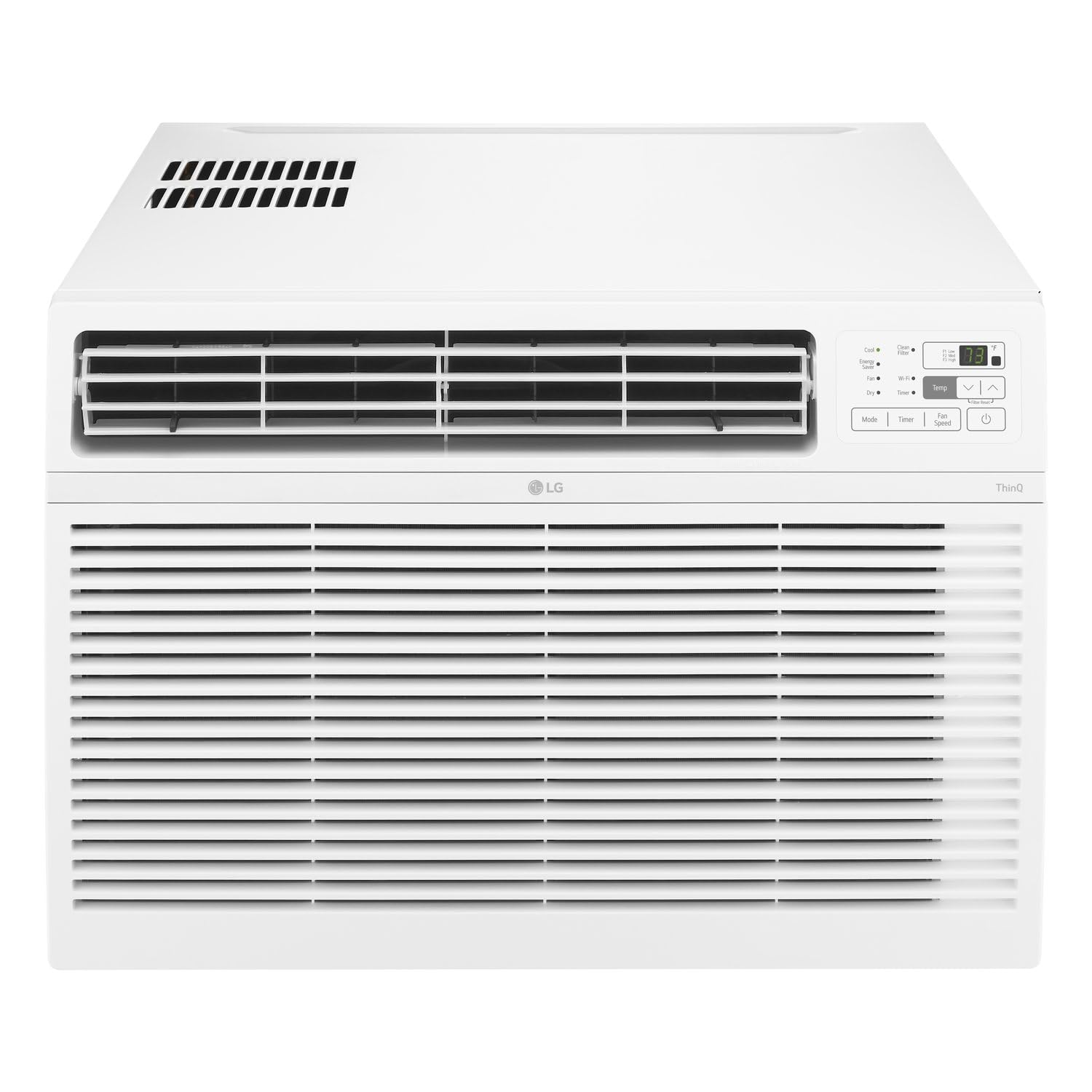
Start with the raw output: 24,500 BTU, the top figure in this group and stated to cool up to 1,560 square feet — a room around 39 by 40 feet. That is the number that separates it from the Whirlpool below, which lists 18,000 BTU and 1,000 square feet. If you are trying to knock down an open living area or several small rooms on one floor, this is the unit built for that job.
The convenience layer is where it pulls ahead for anyone who hates fiddling with buttons. LG ThinQ (the brand’s app) lets you start or stop cooling, switch modes, and set temperature from your phone, and it answers to Amazon Alexa and Hey Google (voice assistants that respond to spoken commands). A 24-hour on/off timer and a filter-check reminder light mean you can run it on a schedule and get a nudge when the mesh needs a rinse.
What wins people over is the smart control and the low-speed quiet — the unit is rated to run as low as 50 dB in low mode. The honest caveat is that cooling performance is the most-discussed topic in the feedback and it splits both ways: plenty of buyers find it cools well, while others say it does not get cold enough. Reliability feedback is similarly mixed, so treat this as a machine to buy for its capacity and app control, not as a guaranteed trouble-free decade. It does dehumidify up to 1.8 pints per hour, the lowest figure in this trio.
Where it earns its keep
- 24,500 BTU with 1,560 sq. ft. of stated coverage — the largest in the group
- Phone, Alexa, and Google control plus a 24-hour timer
- Runs as low as 50 dB in low mode for overnight use
- Power failure auto restart brings it back after an outage
The trade-offs to weigh
- Needs a 230/208V outlet, not a standard wall plug
- Cooling and reliability feedback both split; some run into noise or early failures
- Dehumidifies only up to 1.8 pints per hour
- Bigger cabinet than the Whirlpool, so measure your window opening
Go this way: you have a genuinely large room and a 230/208V outlet, and you want to set the temperature without leaving the couch.
Pause first: your window opening is tight or your wiring is standard 115V — this unit will not run on it.
2. Whirlpool 18,000 BTU Window Mounted Inverter Air Conditioner
Built for the room where noise is the dealbreaker — a bedroom, a nursery, a home office.
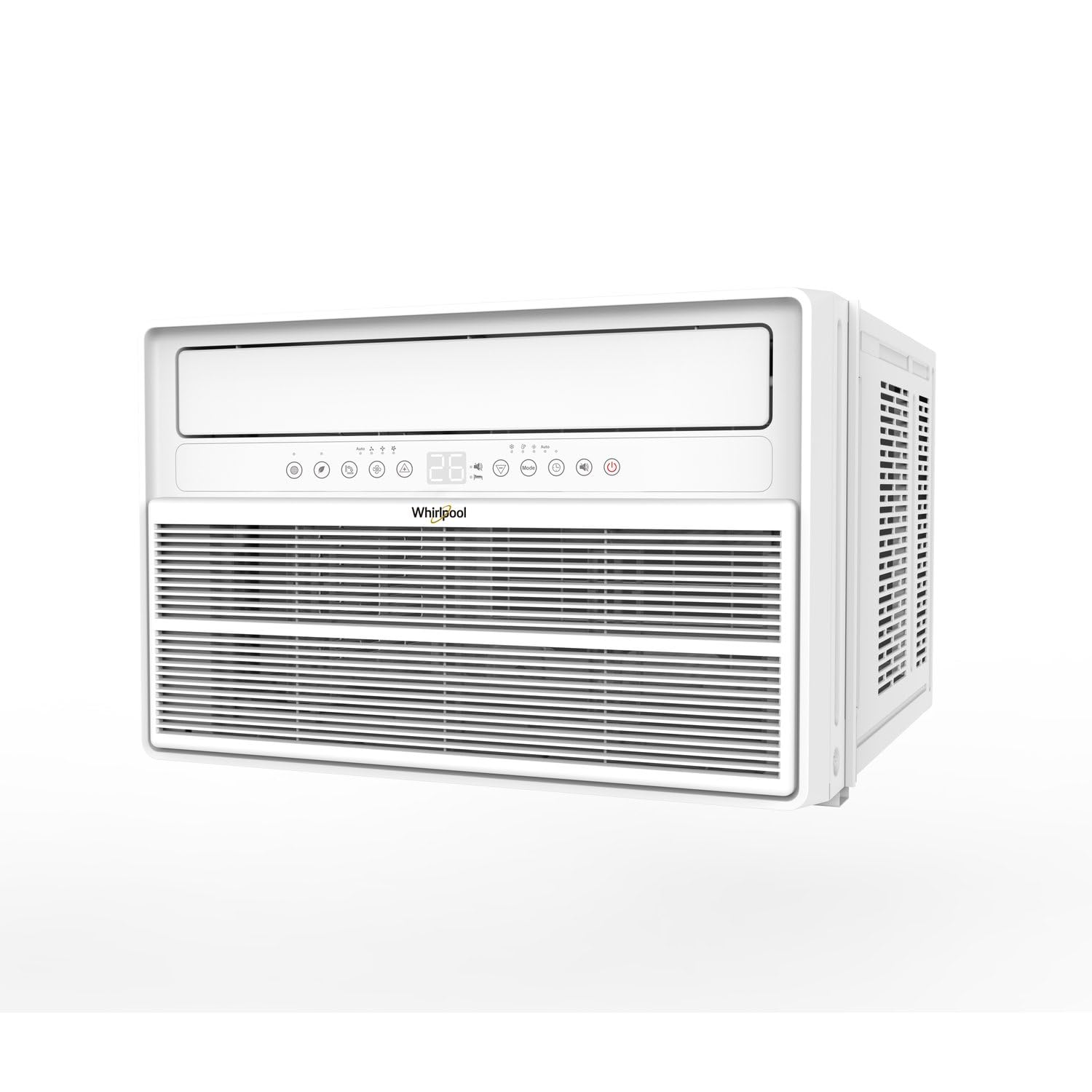
The headline spec is 43 dB in mute mode, the lowest loudness figure in this comparison and a full 7 dB below the LG at the top. Mute mode works by dropping the fan speed along with the sound, so you can nap or watch television without the compressor drowning out dialogue. An inverter compressor (a motor that varies its speed instead of switching fully on and off) is what makes that steadier, less clattery running possible — it dials the motor to exactly the power needed to hold your set temperature.
Where this one falls short of the LG is sheer size. It lists 18,000 BTU and 1,000 square feet of coverage, so it suits a mid-size room rather than an open-plan floor. What it gives back is moisture control: it dehumidifies up to 2.6 pints per hour, the highest per-hour figure here, which is what you want in a muggy climate where cool air alone still feels sticky.
The spec sheet also lists 3 fan speeds, Eco and sleep modes, a 24-hour programmable timer, and a washable filter with a clean-filter alert. Note the electrical requirement stated in the listing: a 230V/15A outlet. If quiet is the dealbreaker and your room tops out near 1,000 square feet, this is the one — just do not expect it to chill a whole open floor the way the 24,500 BTU LG can.
Real-world read: the low 43 dB mute setting and the 2.6-pint-per-hour dehumidification are a genuine pairing for a bedroom or a damp-weather climate, where quiet and dryness matter more than raw coverage.
The honest limit: 18,000 BTU and 1,000 square feet means this is a mid-size-room machine. In a large open space it will run harder and longer to hold temperature.
Reach for this if: quiet is non-negotiable and your room is closer to a thousand square feet than fifteen hundred.
Look elsewhere if: you need maximum cooling muscle for a big space — the LG above carries 6,500 more BTU.
3. LG 23,000 BTU Window Air Conditioner with Supplemental Heat

One unit that handles both seasons — cool in July, warm on a chilly October night.
The reason to pay more for this one is right in the name: supplemental heat. On cooler days it switches from cooling to warming your space, so a single window installation covers you year-round instead of getting pulled out and stored every autumn. The listing pairs that with 2 fan speeds across cooling, heating, and fan-only modes, electronic controls, and a remote.
Cooling muscle sits just under the top pick: 23,000 BTU across a stated 1,440 square feet, a room around 36 by 40 feet. Compared with the LG 24,500 BTU above, it gives up 1,500 BTU and about 120 square feet of coverage, and its listed efficiency reads 9.8 against 10.3. Its stated moisture removal is 6.5 pints. Those 1,500 BTU and 120-square-foot gaps only matter if you are right at the edge of a very large room.
The slide in-out chassis is the detail installers appreciate — the unit slides out of its outer frame so you can service or clean it without wrestling the whole cabinet out of the window again. Auto restart brings it back on after a power failure. Be clear-eyed about the feedback: quality and reliability are both heavily discussed and they split both ways, with some calling the unit excellent and others far less impressed. Temperature control gets mixed notes too. Buy this for the supplemental heat and slide in-out chassis, not for a spotless reliability record.
Why it earns a premium slot: supplemental heat plus 23,000 BTU of cooling in one window frame is a rare combination, and the slide in-out chassis makes maintenance a one-person job.
What you accept: quality and reliability opinions diverge sharply, so factor in the possibility of a warranty conversation down the road.
The fit: a home office, converted garage, or room you use in every season and want one machine to cover.
Not the fit: a buyer who wants pure cooling and nothing else — you are paying for the heat function whether or not you use it.
Know the Specs
BTU and Square Footage
BTU (British thermal units) is the cooling figure the whole category is built around, and it pairs with a stated room size. The units here range from 18,000 BTU for 1,000 square feet up to 24,500 BTU for 1,560 square feet. Buy for the room you actually have — an oversized unit short-cycles its compressor, wasting energy and leaving a small room clammy.
Voltage: The 230/208V Question
Every unit in this group runs on 230/208V, which means a dedicated high-voltage outlet rather than a standard wall receptacle. The Whirlpool listing spells out a 230V/15A requirement. Confirm your circuit and breaker before ordering — this is the single most common reason a high-capacity window unit gets returned.
Inverter Vs Standard Compressor
An inverter compressor varies motor speed to hold a set temperature, which tends to mean steadier cooling and less on-off clatter. That is what earns the Whirlpool its 43 dB mute-mode figure. Standard rotary and scroll compressors, like the ones listed on the two LG units here, run in fixed cycles and are typically louder at the low end.
Decibels and Dehumidification
Decibels measure loudness — the lower the number, the quieter the room. Here the range runs from 43 dB to 50 dB on their lowest settings. Pints per hour measure moisture removal, spanning 1.8 to 2.6 pints per hour on two of the listings. In humid climates, a higher pints-per-hour figure often decides comfort more than the thermostat setting does.
Common Questions
Can I plug a 24000 BTU window unit into a normal wall outlet?
How many square feet will a 24000 BTU window air conditioner cool?
Is an inverter window air conditioner quieter than a standard one?
What does dehumidification in pints per hour actually mean?
Do these window units need a special window or bracket?
Can a window air conditioner with supplemental heat replace a space heater?
How often should I clean the filter on a high-capacity window unit?
Will a 24000 BTU unit cool more than one room?
What happens to these units during a power outage?
The Bottom Line
If your priority is raw capacity for a genuinely large room, the LG 24,500 BTU Smart Window Air Conditioner is the pick — 1,560 square feet of stated coverage plus phone and voice control. When quiet matters more than coverage, the Whirlpool inverter unit earns its place with a 43 dB mute mode and the highest per-hour dehumidification here. And for a room you use in every season, the LG with supplemental heat covers cooling and warmth from one window frame. Confirm your 230/208V circuit first — none of these three will run on a standard 115V outlet.
How we choose
We do not accept paid placement. Every pick is matched to a real buyer and a real use-case; we do not hands-on test units.
Sources
Specifications: manufacturer listings and product documentation. Review insights: verified customer reviews, as of November 2026. Pricing: not shown on this page (it changes often); check the current price via the retailer link.
As an Amazon Associate, Tactical Gear Guy earns from qualifying purchases. This does not affect which products we feature.