Specs are compiled from manufacturer listings and verified buyer reviews and can change over time — please confirm the key details on the product page before buying.
If your welding happens where the nearest outlet is a quarter mile away, you need a machine that makes its own electricity and its own arc. That is exactly what a welder generator does: a gas engine spins a generator for your tools and pushes welding current through a stinger at the same time. This guide covers the three combination units worth your attention, what their real amperage and duty cycles mean for a gate repair or a trailer build, and which one fits your workload.
This guide is built by comparing the manufacturers’ published specifications and the patterns across verified customer reviews, so you get each pick’s real strengths and trade-offs instead of marketing spin.
You will see how amp ratings, duty cycle, engine size, and weight trade off, so you can match a machine to your actual jobs.
Top Picks

How To Choose The Best Welder Generator
Buying one of these is really two purchases in one box: a stick welder and a portable power plant. Get the amperage wrong and the arc stutters on thicker steel. Get the weight wrong and the machine never leaves the garage. Start with the metal you actually weld most often, then work backward to the engine and the frame.
Match amperage to the steel you weld
The amp rating is how much welding current the machine can push through the electrode. A 120-amp unit handles lighter repair work and thinner stock, while a 210-amp machine gives you headroom on heavier plate. If most of your jobs are fence posts, gates, and trailer frames, a mid-amperage machine covers them comfortably.
Read the duty cycle before you plan a long job
Duty cycle is the percentage of a ten-minute window a machine can weld before it needs to cool down. A 60% duty cycle means six minutes of welding, then four minutes of rest at the rated amperage. Plan your bead runs around that rhythm and you will never trip a thermal cutout mid-pass.
Decide if you need simultaneous power
Some units let you run a grinder or a work light while the welder is live. That saves a second generator on the truck and lets you dress a weld without walking to a separate power source. If your workflow is weld, grind, weld, simultaneous power saves you a second generator on the truck.
Weigh the frame against how you move it
A lighter frame rolls into a pickup bed single-handed. A heavy unit with a bigger engine usually needs a ramp, a second person, or a dedicated trailer spot. Be honest about how you load and unload before you pick a machine.
Side-by-Side Comparison
| Model | Best For | Welding Current | Engine Power | Weight | Amazon |
|---|---|---|---|---|---|
| Portable 2000 Watt Engine Driven Welder 130 Amp Stick Welder★ Best Overall | One-person jobsite and farm repair | 130 A | — | 74.8 lb | Amazon |
| TOMAHAWK Welder Generator Stick Welder Engine Driven 120 Amp 7 HP Gasoline Portable 2,200 Watt | Quiet inverter power plus welding | 120 A | 7 hp | 99 lb | Amazon |
| TOMAHAWK 15 HP Engine Driven Portable 2,000 Watt Generator with 210 Amp Stick and TIG Welder | Heavy plate and high-amperage work | 210 A | 15 hp | 202 lb | Amazon |
Detailed Reviews
1. Portable 2000 Watt Engine Driven Welder 130 Amp Stick Welder
Our pick — 4.5+★ from 40+ verified ratings; the strongest balance of quality and price.
The one you can actually load alone: 74.8 pounds, 130 amps, and no cord to hunt for.
This is the pick for the single operator who works fences, gates, and trailer frames in places the power company never reached. At 74.8 pounds it stays a one-person lift into the truck bed, and the 130-amp stick welder covers carbon steel and medium carbon steel — the everyday metals of farm and construction repair. The DC output runs 2,000 watts, so the same engine that strikes your arc can also feed a tool.
What wins people over is that it simply does the job without fuss. Buyers report it driving a 7-inch grinder, the test of whether a combo unit is a real generator or just a welder with a bonus outlet. The 6-hour outdoor working window covers a full day of repair work with cool-downs built in, and the one-touch switch keeps setup simple in the dirt.
The comparison that matters most here is weight. This machine checks in at 74.8 pounds, while the TOMAHAWK 15 HP at the other end of this list is 202 pounds — the same job class, a wildly different loading experience. The trade-off is amperage headroom: 130 amps against the TOMAHAWK’s 210 amps. If you mostly weld up to a quarter inch and want a machine you can handle solo, this is the sensible buy. Think twice if you regularly burn into 3/8-inch plate.
What earns its place
- 74.8 lb frame you can lift into a pickup alone
- 130-amp stick welder built for carbon and medium carbon steel
- 2,000 watts of DC output for running tools off the same engine
- Up to 6 hours of outdoor welding before you need to stop
- One-touch switch keeps setup and maintenance simple
Where it asks you to compromise
- 130 amps limits you on thick plate compared with a 210-amp machine
- No duty-cycle figure published, so pace longer beads conservatively
- Engine horsepower and displacement are not listed, so judge it by the arc in person
Reach for this if: you work alone, load your own truck, and weld light-to-medium steel on farms, sites, or DIY projects.
Look elsewhere if: your bread and butter is 3/8-inch plate and you want the extra amperage a bigger engine buys.
2. TOMAHAWK 120 Amp Gasoline Welder Generator

Inverter power that keeps the arc smooth and the neighbors off your back.
The headline number here is a 60% duty cycle at 120 amps. In plain terms, you get six minutes of welding in every ten-minute stretch before the machine wants a breather — enough to lay a solid run, reposition, and go again without losing your rhythm. A 7 hp four-stroke engine with 208 cubic centimeters of displacement turns the generator, and the permanent magnet generator (a design that holds voltage steady under load) is what keeps the arc from wandering.
You get smoother starts and fewer stumbles mid-bead thanks to the inverter design (a circuit that converts power for a steadier arc). The 2,200-watt output lets you run a tool while the welder is live, so you can grind a joint without shutting the machine down. The never-flat wheels and lightweight frame make it a roll-across-the-yard machine rather than a two-person lift. And a two-year warranty backed by a U.S.-based support team with a nationwide service network of certified technicians is real confidence for a gas-powered tool.
Compare it to the 210-amp TOMAHAWK below and the picture sharpens: this one welds at 120 amps versus 210 amps, but comes in at 99 pounds against 202 pounds, and it carries 7 hp against 15 hp. It also carries 208 cubic centimeters of engine displacement against 420. If quiet, stable inverter power and a 99-pound frame matter more than maximum amperage, this is your machine. Know that 120 amps is the ceiling — heavy structural steel will want the bigger unit.
What the spec sheet reveals: a 60% duty cycle paired with a 2,200-watt inverter generator means you can weld and run a tool in the same session, which is the workflow most repair jobs actually follow.
Plan around this: at 120 amps you are working comfortably on lighter stock, so budget your heavy-plate jobs for a higher-amperage machine or a second pass strategy.
The verdict: a smart balance of smooth inverter arc, steady tool power, and a frame you can roll solo.
Know before you buy: the 120-amp ceiling is the real limit, not the duty cycle.
3. TOMAHAWK 15 HP 210 Amp Welder Generator
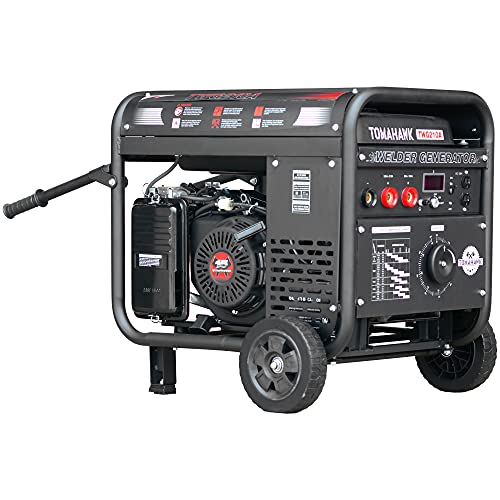
Two hundred and ten amps of stick and TIG, on a frame that wants a ramp.
When the job is thick plate and structural work, this is the machine that does not flinch. It welds up to 1/3, 1/4, and 3/8 inch, and the 210-amp output with a 60% duty cycle gives you real headroom on heavier stock. Stick and TIG both live in this box, so you can run a root pass and a cleaner finish pass without hauling a second welder to the site.
The engine is the story underneath the amperage. A 15 hp four-stroke with 420 cubic centimeters of displacement drives an inverter generator with a stable sine wave (a smooth, evenly shaped electrical output), which is what produces the steadiest arc in this group. An electronic reader and knob let you dial amperage precisely instead of guessing from a dial’s position, and the machine can weld and run electric tools at the same time. Owners call it a solid stick and TIG welder, and the value holds up for a machine that does both processes.
Here is the honest trade: 202 pounds is a two-person lift or a ramp job, and it is noticeably heavier than the 74.8-pound pick at the top of this list. That weight buys you 210 amps against 130, 15 hp against a machine that does not publish its engine rating, and 420 cubic centimeters against the mid-pick’s 208. If your work is heavy fabrication and you have a trailer or a fixed site for the machine, that trade is worth it. If you load alone every morning, it is not.
The case for the premium pick: 210 amps with a 60% duty cycle, TIG capability, and a 420-cubic-centimeter engine — this is the unit that handles 3/8-inch plate without complaint.
The honest caveat: at 202 pounds it is not a solo daily load, and the amperage dial precision matters most on thin stock where a heavy hand burns through.
Who it beats everything for: fabricators welding heavier steel who can park it where the work is.
Know before you buy: 202 pounds means a ramp, a helper, or a permanent spot on the trailer.
Know the Specs
Welding Amperage
Amperage is the amount of current the welder pushes through the electrode, and it sets how much heat lands in the metal. Higher amperage lets you penetrate thicker steel in a single pass. A 120-amp machine suits light repair, a 130-amp unit covers most farm and site work, and a 210-amp machine handles plate up to 3/8 inch. Match the number to your thickest regular job, not your thinnest.
Duty Cycle
Duty cycle is the share of a ten-minute window a machine can weld before it needs to cool. A 60% duty cycle means six minutes welding and four minutes resting at the rated amperage. Push past it and a thermal cutout stops the arc mid-job. Plan bead runs and grinding breaks around that rhythm and the machine stays cool and productive.
Engine Power and Displacement
Horsepower and displacement describe the gas engine that spins the generator. A larger engine holds voltage steadier under load, which translates to a smoother arc and less stutter when you strike up. A 7 hp engine with 208 cubic centimeters is enough for a 120-amp welder, while a 15 hp engine with 420 cubic centimeters feeds a 210-amp machine. Bigger engines also add weight.
Inverter and Sine Wave Output
An inverter generator shapes the electrical output into a stable sine wave, a smooth, evenly formed power curve. That steadiness is what produces a consistent arc and lets sensitive tools run without complaint. It also lets the machine run tools while the welder is live, so a grinder and a stinger can share one engine instead of two machines on the truck.
Common Questions
Can a welder generator power tools while I am welding?
How thick a piece of steel can a 130-amp welder handle?
What does a 60% duty cycle actually mean in practice?
Do I need a power outlet to run an engine-driven welder?
Is stick or TIG better for outdoor repair work?
How heavy is a welder generator and can one person move it?
Will a 7 hp engine weld as well as a 15 hp engine?
Does a welder generator need special maintenance?
Can I run a grinder off a welder generator between passes?
The Bottom Line
For most people chasing the welder generator, the winner is the Portable 2000 Watt Engine Driven Welder 130 Amp Stick Welder, because it balances 130 amps of stick welding with a 74.8-pound frame one person can load and 2,000 watts of DC output for tools. If quiet inverter power and easier transport matter more than maximum amperage, the TOMAHAWK 120 Amp 7 HP is the one to reach for. And for heavy plate and TIG work where 210 amps and a 15 hp engine earn their keep, the TOMAHAWK 210 Amp Stick and TIG is the machine that will not hold you back — just plan for its 202-pound frame.
How we choose
We do not accept paid placement. Every pick is matched to a real buyer and a real use-case; we do not hands-on test units.
Sources
Specifications: manufacturer listings and product documentation. Review insights: verified customer reviews, as of November 2026. Pricing: not shown on this page (it changes often); check the current price via the retailer link.
As an Amazon Associate, Tactical Gear Guy earns from qualifying purchases. This does not affect which products we feature.