Specs are compiled from manufacturer listings and verified buyer reviews and can change over time — please confirm the key details on the product page before buying.
You hook a meter to the spigot, fill the RV tank, and still have no idea whether you poured in 30 gallons or 50. That guesswork is exactly what a water flow counter fixes. It screws in between your faucet and hose, then shows the gallons (or liters) ticking past in real time, so you fill to a number instead of a feeling. Below are eight that do that job well — from a brass-threaded workhorse you can leave out all season to a heavy inline unit built for home plumbing.
This guide is built by comparing the manufacturers’ published specifications and the patterns across verified customer reviews, so you get each pick’s real strengths and trade-offs instead of marketing spin.
You need a meter that actually counts the water you use, not just shows a needle moving. Every pick below was checked for that first. The rest depends on thread material, accuracy tolerance, and how easy the screen is to read while water is running. Here is the honest breakdown of the best water flow counter for your setup.
Top Picks


How To Choose The Best Water Flow Counter
Before you compare screens and buttons, decide where the meter will live. A counter bolted between a hose and a spigot gets banged around and rained on; one spliced into an indoor supply line stays put for years. Those two jobs pull you toward different meters, and picking the wrong style is the most common way buyers end up frustrated.
Match the connector to your pipe, not your plan
A hose meter uses a garden-hose thread — the Restmo and Rainpoint picks here use a standard 3/4″ NH metal connector, and that fits most outdoor spigots and hoses. An inline meter for home plumbing instead uses NPT pipe threads, like the 3/4″ NPT couplings on the Watflow DN20. Neither one will swap onto the other’s pipe, so measure your connection before you buy.
Read the accuracy tolerance like a budget
Accuracy is stated as a percentage of error allowed. A ±1.5% tolerance (seen on the DAE and Watflow inline units) means less drift on a big fill than the ±4% tolerance on the Restmo dual-zone meter, or the less-than-5% tolerance on the Restmo 360° and the 2-pack. For watering a lawn it hardly matters; for splitting a water bill across tenants, tighter is better.
Decide if you need a running total
A single-session meter tells you how much went out in one watering. A totalizer keeps a cumulative number you can reset, which is what you want for tracking a season, a month, or a tank’s worth of fills. Several picks here carry two separate total modes — the Rainpoint splits it into TOTAL 1 and TOTAL 2 so you can track today and this month at once.
Side-by-Side Comparison
| Model | Best For | Connections | Accuracy | Mode Count | Amazon |
|---|---|---|---|---|---|
| RAINPOINT Water Flow Meter★ Best Overall | All-season hose meter | Brass inlet & outlet, 3/4″ | — | 4 settings | Amazon |
| RESTMO Dual Zone DisplayBest Value | Comparing day vs total use | 3/4″ NH metal inlet | ±4% | 4 (SINGLE, DAY, TOTAL, FLOW) | Amazon |
| RESTMO 360° RotatableBest for Awkward Angles | Awkward faucet angles | Solid brass inlet & outlet | Under 5% | 4 (FLOW, CONSUMPTION, AVERAGE, TOTAL) | Amazon |
| Save a Drop P3 | Campers and RV filling | Brass hose swivel | To 1/10 gallon | 1 setting | Amazon |
| DAE AS130U-50 | Inline home water lines | 1/2″ inline, horizontal | ±1.5% | Dial register | Amazon |
| RESTMO 2 Pack | RV and garden, two setups | Brass inlet, metal thread | Less than 5% | 4 (FLOW, LAST, DAILY AVG, TOTAL) | Amazon |
| Watflow DN20 3/4″ NPT | Apartment and home supply lines | 3/4″ NPT couplings | ±1.5% normal, ±3% low flow | Dial register | Amazon |
| Walston Industrial GH3100 | Heavy inline metering | 3/4″ female NPT | Factory calibrated | 4 units | Amazon |
Detailed Reviews
1. RAINPOINT Water Flow Meter with Brass Inlet & Outlet
Our pick — 4.5+★ from 850+ verified ratings; the strongest balance of quality and price.
The brass-threaded all-rounder that stays out in the weather and keeps counting.
Pure brass inlet and outlet with metal threads are the reason this one earns the top spot. Brass does not rust or wear out the way plastic threads do, so you can screw it on and unscrew it off season after season without stripping the connection. For a meter that lives outside between a spigot and a hose, that single choice matters more than any screen feature.
The screen flips a full 180 degrees with one button press. That matters when your spigot sits low or faces a wall — the flip turns the numbers toward you instead of leaving you crouched sideways. It pairs with a standard quick connector that matches garden hoses, faucets, and sprinklers. And you get four settings, the FLOW RATE and LAST modes plus two separate totalizers. The two totals (TOTAL 1 and TOTAL 2) let you track one period against another — today versus the month, for example — without resetting anything.
Waterproofing is handled by rubber rings around both the screen and the battery cover, and the one-touch flip replaces a rotating screen so water has fewer ways in. The catch worth knowing: the meter has a marked A-to-B flow direction, and it only measures accurately when the water runs the same way the arrow points. Install it backward and your numbers drift. It is the crowd favorite for RV filling and garden watering — 4.5+ stars across 800+ owners — and the safest first buy for most people.
What earns it first place
- Solid brass inlet and outlet with metal threads resist rust and wear
- 180° flip screen turns the readout toward you from any angle
- Two separate total modes for tracking different periods
- Double leak-proof seals on screen and battery cover
The one thing to watch
- Only reads correctly when installed in the marked A-to-B flow direction
- No stated accuracy tolerance in the listed specs
Go for it when: you want one durable hose meter for RV fills, sprinklers, and garden duty.
Look elsewhere if: you need a stated high-precision tolerance for billing or tenant splits.
2. RESTMO Water Flow Meter with Dual Zone Display Screen
Two numbers on one screen, so you never toggle to check your total.
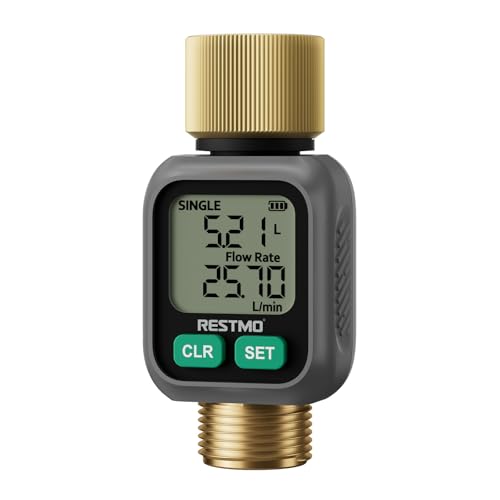
You can see your live flow and your running total at the same time, without pressing a button to switch views. This meter shows two zones at once, so real-time flow and accumulated usage sit side by side. It runs four display modes: SINGLE for the session you are in right now, DAY for your average over the last 7 days, TOTAL for everything since your last reset, and FLOW RATE for the live speed of water moving through.
You get a tighter stated accuracy than the Restmo 360° below: a ±4% tolerance, built around a Hall-effect sensor (a magnetic sensor that counts water movement) paired with a dedicated IC chipset. That makes this the more precise of the two hose-style Restmo units for measuring against your household meter. The body is ABS plastic with an anti-clog metal filter at the inlet and an IPX5 waterproof rating (protected against water jets). It works across a 0 to 116 PSI pressure range — low enough pressure to keep reading on a weak spigot.
Setup is a two-button affair: short press the SET button to cycle modes, long press to switch between gallons and liters, and one tap on CLR wipes your records. The 3/4″ NH metal inlet screws straight onto most standard garden hoses with no extra fittings. What buyers mention most often is simply that it works — the functionality and build both draw steady praise — and the ±4% accuracy gives confident readings rather than wild swings. A fair caveat: at 3.5″D x 1.9″W x 1.9″H it is the bulkier hose mount of the two Restmo options, so it juts out a little more from the faucet.
If your priority is watching a number tick up while you fill, the side-by-side screen is the reason to pick this over a single-view meter.
Reach for this if: you want a stated ±4% tolerance and two readings visible at once.
Think twice if: space at the spigot is tight — it is the longer-bodied hose meter here.
3. RESTMO 360° Rotatable Water Flow Meter
The one that twists the whole display around to face you, wherever the faucet points.
When your spigot sits low or faces a wall, the display panel is the whole battle. This meter’s display swivels a full 360 degrees, so you rotate the readout toward you instead of crouching and twisting to see it. It handles four modes — FLOW, CONSUMPTION, AVERAGE, and TOTAL — with one button: short press to change mode, long press to switch units or reset. The screen sleeps on its own to stretch battery life between changes.
You can leave it connected outdoors through the season: it carries an IPX6 waterproof rating (protected against strong water jets) and a rugged ABS build that the maker says stands up to UV and heavy rain. The inlet and outlet are solid brass, meant to survive repeated install and removal without stripping, and the threads create a tight seal against a standard hose or faucet. Readings come from a Hall-effect sensor and IC chip with a stated error under 5%.
Being honest about the follow-up question: under 5% is a looser stated tolerance than the ±4% on the dual-zone model above, so if you are measuring precisely against a utility meter, that unit is the sharper choice. Buyers here are mainly after ease of use, and the swivel panel is what earns the praise — particularly for RV owners who connect and disconnect at different campsite hookups. One real note from the instructions: keep your hands dry when you open the battery tray, insert the battery the correct way, and lock the compartment afterward.
Who it is built for: anyone who has ever bent sideways to read a hose meter. The 360-degree panel removes that annoyance entirely.
The trade-off: you give up a bit of stated precision (under 5% versus ±4%) in exchange for the swivel.
Pick this one if: your faucet angle makes a fixed screen hard to read.
Pass if: you want the tightest tolerance and never fight the viewing angle.
4. Save a Drop P3 Water Flow Meter with Heavy Duty Brass Swivel

The camping-and-lawn meter that reads down to a tenth of a gallon.
One number defines this pick: it measures accurate to 1/10 of a gallon. That fine-grained read is what campers and greenhouse gardeners want, because it turns “roughly a few gallons” into an actual figure. The brass hose swivel screws directly between the faucet and hose, so there are no extra fittings to buy.
It calculates both single-use volume and cumulative total, so one fill and a whole season’s watering each get their own number. The LCD is easy to read, and the whole point is taking the guesstimates out of watering your lawn. For RV users watching what goes into a holding tank, that per-session versus total split is the feature that carries the most weight.
Now the honest part. Durability draws mixed feedback — a share of buyers report the unit breaking within a couple of months — which is why some reviewers waffle on value. It is a small, single-setting unit: simple enough for campers who want one number, limiting for anyone who wants a flow-rate readout. Treat it gently and it is a dependable camping companion; expect it to survive years of drops and knocks and you may be disappointed.
Where it shines
- Measures accurate to 1/10 of a gallon
- Brass hose swivel attaches directly between faucet and hose
- Tracks single-use and total volume separately
What to weigh up
- Durability reviews are mixed — handle it with care
- One setting only, with no flow-rate readout
Best for: campers and gardeners who want a tenth-gallon reading and total tracking.
Not for: anyone who expects a meter to survive years of drops and knocks.
5. DAE AS130U-50 1/2″ Water Meter

A proper inline utility meter that reads to ±1.5% and mounts right into your pipe.
This is a different animal from the hose meters above — it is a horizontal inline meter that installs into a 1/2″ line with the dial facing upward, not one that screws onto a spigot. The accuracy spec is the reason it sits this high: ±1.5% within normal flow, conforming to both AWWA C700 and ISO 4064 Class C, and it ships with couplings. That tolerance is the tightest stated figure in this whole lineup.
The flow range is specified clean: a maximum of 15 GPM, a normal rate of 7.5 GPM, and a minimum of 1/4 GPM. So it keeps registering even at a trickle, which matters if you are tracking slow leaks or a dripping line. It is for clean city water only, and the horizontal mount is deliberate — install it vertically and you would need a different model in DAE’s line.
Accuracy is what owners lean on, and it is the thing that makes this unit feel like real plumbing equipment rather than a gadget: readings hold steady and the compact body fits into a tight pipe run. One caution to plan for: leaks are a mixed report — some setups seal fine, others see a drip at the connection, so use proper sealing and check it after install. It is not rated for outdoor pits; for exposed outdoor use the maker points to IP68-rated models instead.
The number that matters: ±1.5% accuracy to AWWA standard, plus a 1/4 GPM minimum flow so nothing slips by. The DAE reads tighter than the sub-5% hose meters here.
Know before you buy: horizontal mount, clean water only, and check your seals — connections can weep if not seated well.
The right meter for: hard-wiring accurate metering into a residential pipe line.
skip it if: you need an outdoor spigot meter or a vertical install — a different DAE model covers those.
6. RESTMO Heavy Duty Water Flow Meter (2 Pack)

Two meters, one for the RV fill and one for the garden spigot — no swapping.
You stop unscrewing your only meter and moving it from the RV hookup to the garden every time. This pair uses heavy-duty brass inlet threads and a metal thread for durability, and each unit runs 4 measure modes — real-time FLOW RATE in GPM or LPM, LAST-TIME consumption, a DAILY AVERAGE over a week, and a TOTAL. Gallons and liters are switchable with a long press in flow mode.
The stated tolerance is less than 5%, and the working range runs 0.3 to 12 GPM (1 to 45.5 LPM). Push beyond 12 GPM and the display throws an “HHH” error code — the fix is simply to dial the faucet back from full blast so the meter can catch the flow. Each unit runs on an included CR-2032 battery.
What owners value most is the build and the accuracy: it takes the guessing out of how many gallons go into an RV fresh-water tank, which is the daily job for a lot of these. The trade-off is real and worth stating plainly — durability is the weak spot, with a chunk of feedback about units giving out after around a month and a half, and some notes about leakage. Treat these as convenient metering tools rather than indestructible hardware — and the two-pack wins on value because the second unit is your spare.
Why the pair makes sense
- Two meters cover RV fill and garden duty at once
- 4 modes including a daily weekly average and a running total
- Brass inlet and metal thread for durability at the connection
- Battery included, gallons and liters switchable
The honest catch
- Durability feedback is genuinely mixed — a spare comes in handy
- Throws an HHH error above 12 GPM, so avoid full-blast flow
Worth it for: RV owners and gardeners who want a meter on each line and a backup on hand.
Weigh carefully if: you expect one unit to last many seasons at full faucet pressure.
7. Watflow DN20 3/4″ NPT Water Meter

A drinking-water-rated inline meter for apartments, homes, and shared supplies.
Where the DAE is a 1/2″ line meter, this Watflow steps up to a 3/4″ NPT connection with couplings included, so it fits the more common garden-and-home supply size. It measures in gallons and is built for US applications, with an eco-brass alloy main case and a top-loaded dry-type register. It meets the AWWA C708 standard, and the maker states it is fully suitable for drinking water, with a casing meeting WRAS certification.
Accuracy is specified precisely: ±1.5% in the normal flow range and ±3% at low flow. The flow rates give you a maximum of 20 GPM, a minimum of 0.25 GPM, and a continuous normal flow of 10 GPM — a higher ceiling than the DAE’s 15 GPM max. There is a premium filter at the inlet that lets you clean it without breaking the metrological seal, plus an optional non-return valve to stop backflow.
This is an indoor plumbing meter, not a hose gadget — it mounts horizontally, and the maker notes it is not suitable for industrial liquid measurement. The upside for a landlord or homeowner is that tighter tolerance and drinking-water rating; the follow-up question is simply installation: budget for a proper inline fit rather than a screw-on connection. Owners who have used it report it works well and gives a clean reading, and the build quality draws a solid reception for a smaller-sample unit.
Where it leads: a 20 GPM maximum flow and a ±1.5% normal-flow tolerance in a 3/4″ NPT package rated for drinking water.
The realistic limit: horizontal indoor install only, and not built for industrial liquids — this is a residential supply-line meter.
Choose it if: you are metering a home or apartment supply line and want an AWWA-certified inline unit.
Not for you if: you want a screw-on hose meter or need a vertical installation.
8. Walston Industrial GH3100 3/4″ Digital Water Meter
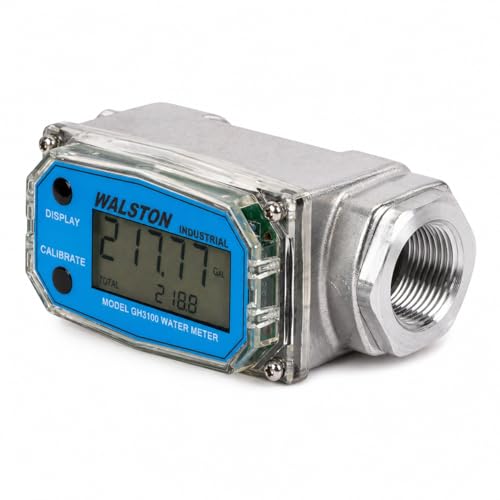
A genuine industrial inline meter with an aluminum body and four measurement units.
Most meters in this roundup are hose gadgets; this one is built for hard duty. The Walston GH3100 uses a rugged aluminum body made to hold up under extreme industrial use, and it installs inline through female NPT threads at both ends. If your metering job involves a permanent pipe run rather than a garden spigot, this is the build to look at.
It measures in four units — gallon, quart, liter, and pint — with a one-touch reset to whichever unit you prefer, so if your records are kept in pints rather than gallons this saves you the mental math. It comes factory calibrated for water and can be easily recalibrated for maximum accuracy. It runs on 2 AAA batteries, included.
The trade-off is fit, not quality: this is a heavier inline unit specified for permanent plumbing, and it is not the screw-on-hose style you would carry camping. For a portable spigot meter, the brass-inlet hose meters above are the right tool. But for a fixed water-usage count in a workshop or industrial line, the aluminum body and four-unit readout do exactly the job you would pick it for.
The defining spec: a rugged aluminum body rated for extreme-duty industrial applications, with four units of measure — gallon, quart, liter, and pint.
Who it does not fit: anyone wanting a hose-thread meter they can carry and move — this is a permanent inline unit.
Pick it for: permanent inline metering where the aluminum body and four-unit display earn their keep.
Look past it if: you want a lightweight hose meter for RV or garden use.
Know the Specs
Accuracy tolerance
Accuracy is stated as an allowed percentage of error, so a ±1.5% tolerance means readings stay within 1.5% of the true volume. Tighter tolerances like ±1.5% suit billing and tenant splits; looser ones like ±4% or under 5% are fine for watering and filling. Do not compare a tolerance against a count figure — they measure different things.
Flow rate and range
Flow rate is how fast water passes through right now, usually in gallons per minute (GPM) or liters per minute (LPM). The working range tells you where a meter still reads accurately — a 0.3 to 12 GPM range, for example, means a trickle below the low end may not register and a full-blast flow above the top end can throw an error code.
Thread type and size
Hose meters use a 3/4″ NH (garden-hose) thread; inline plumbing meters use NPT pipe thread, often in 1/2″ or 3/4″. NH and NPT are different thread standards, so a hose-thread meter will not seat on an NPT pipe and the reverse is also true. Match the connector to your connection, not to the meter’s looks.
IP rating
An IP rating like IPX5 or IPX6 tells you how well the body resists water — IPX5 handles water jets, IPX6 handles stronger jets and heavier rain. That matters a lot for a meter left outdoors on a spigot, and less for a protected indoor inline unit.
Common Questions
Will a 3/4″ NH hose meter fit my garden spigot?
What does ±4% accuracy actually mean at the spigot?
What is the difference between FLOW RATE and a TOTAL mode?
Can I leave a water flow counter connected outdoors in the rain?
Why does my meter show an HHH error?
Do inline pipe meters measure in gallons or liters?
What size inline meter do I need for a home supply line?
Can a hose water flow counter be installed in a permanent line?
Does the meter need batteries and how long do they last?
The Bottom Line
For most setups, the water flow counter winner is the RAINPOINT because its brass inlet and outlet withstand season-after-season outdoor use and its two total modes track different periods at once. If you want a stated tolerance and two readings visible side by side, grab the RESTMO dual-zone. And for a permanent home-supply line with a tight ±1.5% tolerance, the DAE AS130U-50 is the one to reach for. Start with the Rainpoint if you are unsure — it is the most forgiving first buy, and the brass threads are the part that outlasts everything else.
How we choose
We do not accept paid placement. Every pick is matched to a real buyer and a real use-case; we do not hands-on test units.
Sources
Specifications: manufacturer listings and product documentation. Review insights: verified customer reviews, as of November 2026. Pricing: not shown on this page (it changes often); check the current price via the retailer link.
As an Amazon Associate, Tactical Gear Guy earns from qualifying purchases. This does not affect which products we feature.