Specs are compiled from manufacturer listings and verified buyer reviews and can change over time — please confirm the key details on the product page before buying.
Buying a transformer is mostly a matching job, not a shopping spree. You need the output voltage your device expects, a volt-ampere (VA) rating that comfortably covers the load, and a mounting style that fits where the thing has to live. Get those three right and the unit runs quiet for years. Get one wrong and you are troubleshooting a dead doorbell or a sprinkler controller that never powers up. This guide sorts nine real transformers by the job they actually do, from doorbell power supplies to landscape lighting hubs and bench-style variable units.
This guide is built by comparing the manufacturers’ published specifications and the patterns across verified customer reviews, so you get each pick’s real strengths and trade-offs instead of marketing spin.
Below you will find the practical differences that matter when the box arrives: input taps, output taps, current limits, and install hardware. Each entry is matched to a real use case so you can skip the guesswork and buy the right volt ampere transformer on the first try.
Top Picks


How To Choose The Best Volt Ampere Transformer
Start with the device, not the transformer. Read the label on whatever needs power and write down its input voltage, its frequency in hertz (Hz, the number of AC cycles per second), and its wattage or VA draw. Everything else follows from those three numbers. A transformer that matches on voltage but falls short on VA will sag under load, run hot, and eventually trip its protection.
Match the VA rating with headroom
VA (volt-amperes) is the apparent power the transformer can pass through continuously. It is not the same number as watts once motors or heating elements enter the picture, because those draw a surge at startup. Mild-mannered electronics like doorbell cameras and laptop chargers track their label closely. Pumps, compressors, and anything with a motor can pull well above the steady-state figure for a second or two. Sizing slightly above the label figure is the safe habit, and one of the picks here recommends a quarter more capacity than the total device power as a rule of thumb.
Understand the input and output taps
A tap is a wire or terminal you connect to, and the tap you pick sets the voltage. Multi-tap primaries accept more than one supply voltage — one of these units takes 120, 208, or 240V in and puts out 24V, so the same part works across several panels. Center-tapped secondaries split the output into two halves around a neutral, which is common on irrigation controllers. Read the wiring diagram, connect only the tap you need, and insulate every unused lead before you energize the circuit.
Mounting and location decide more than you think
Transformers get mounted in a knockout on an electrical box, on a wall, on feet inside a cabinet, or on the base of the unit itself. Check the footprint against the space you actually have. A 2.7 × 2.2 × 2-inch metal frame slips inside a furnace cabinet, while a landscape lighting transformer with a remote photocell needs a spot out of standing water. If the unit goes outdoors, weatherproofing and corrosion resistance are part of the spec sheet, not a bonus.
Side-by-Side Comparison
| Model | Best For | Power Rating | Output Voltage | Mounting | Amazon |
|---|---|---|---|---|---|
| 2PC Doorbell Transformer 16V 30VA★ Best Overall | Smart doorbell power | 30 VA (1.5 A) | 16V AC | Wall Mount | Amazon |
| UPMMUD 24V 30W Center TapCompact Pick | Sprinkler controllers | 30 W (1 A) | 24V AC (12-0-12) | Base brackets | Amazon |
| Sevenjungle 24V 40VA Multi-Tap 2-PackTop Performer | HVAC control boards | 40 VA (1.66 A) | 24V AC | Foot Mount | Amazon |
| Edwards Signaling 598 | Multi-voltage signaling | 30 W | 8V / 16V / 24V AC | Surface / knockout | Amazon |
| Jlouneo 500VA Converter | Imported electronics | 500 VA | 110V/120V or 220V/240V | Freestanding | Amazon |
| VEVOR 2000VA Variable Transformer | Bench voltage control | 2000 VA (15.3 A) | 0-130V AC | Benchtop | Amazon |
| Yinleader 5000 Step Up/Down | Large appliances abroad | 28 A max draw | 110-120V or 220-240V | Freestanding | Amazon |
| SUNVIE 300W Landscape Transformer | Two-zone yard lighting | 300 W | 12V / 14V AC | Wall Mount | Amazon |
| DEWENWILS 300W Wi-Fi Transformer | Smart yard lighting | 300 W (25 A) | 12V / 14V AC | Wall Mount | Amazon |
Detailed Reviews
1. 2PC Doorbell Transformer 16V 30VA
Our pick — 4.5+★ from 8,500+ verified ratings; the strongest balance of quality and price.
Two transformers in the box, so a dead doorbell is a ten-minute fix, not a second order.
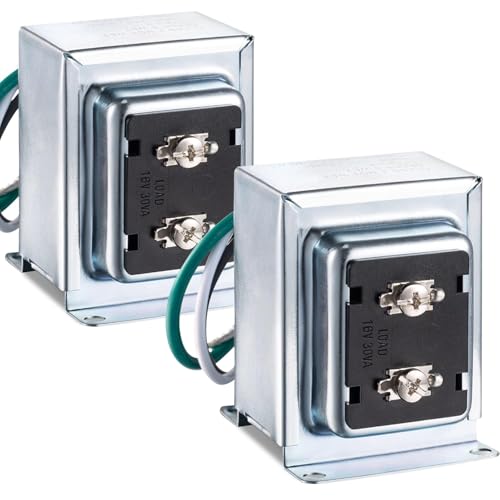
Here is the number that decides the whole purchase: 16V at 30 VA output, fed from a standard 120V, 60 Hz household line. That is the pairing most wired video doorbells want, and it is why this two-pack sits at the top. You get a spare unit for a second chime or a future swap, and the load tolerance is written right on the label — 16V ±5% under load, 19V ±5% with nothing connected. A 4.5+ star average across thousands of doorbell owners confirms the 16V/30VA pairing fits most wired video doorbells.
Installation is the part buyers worry about and the part this unit handles well. It screws, threads, or clamps to the electrical box, and a clear wiring diagram ships in the box so you are not guessing which lead goes where. The UL listing — the safety certification that means the unit passed standardized testing — is the reassurance you want behind a wall where you cannot see it. Slight operational hum is normal on this type of transformer and is not a fault sign.
Now the honest part. At 3.4 pounds and roughly 6.1 by 4.33 by 3.86 inches, it is a chunky block, and it wants wall-mount space with a little breathing room. If your existing transformer is wedged into a tight chime enclosure, measure before you order. Also check your doorbell’s required voltage: a model that calls for 24V will not be happy on 16V, no matter how clean the install is.
What earns the top spot: Two UL-listed 16V 30VA units, a real wiring diagram, and three mounting methods in one box. For a wired doorbell upgrade this removes the most common failure point — an undersized supply.
Measure first: The 6.1-inch depth is the one spec that can send you back to the drawing board if the mounting location is cramped.
Reach for this if: you are powering a Ring, Nest, Ecobee, Sensi, or Honeywell wired device and want a spare on the shelf.
Look elsewhere if: your device needs 24V AC — this one tops out at 16V.
2. 24V Power Transformers 30W
A sprinkler-controller replacement that disappears into the cabinet instead of hogging shelf space.
This is the smallest unit on the list, and that is its whole argument. It measures 2.47 by 2 by 1.6 inches and weighs 12.64 ounces — against the 6.1-inch-deep doorbell two-pack above, it is roughly a third the footprint. Inside an irrigation cabinet where the controller, valve wiring, and a season’s worth of dust all compete for room, that matters more than any spec on the box.
The electrical story is a 120V AC input feeding a 24V AC output rated at 30 watts and 1 amp, with a center tap that splits the secondary into 12V-0V-12V. That center-tap arrangement is what many lawn sprinkler and irrigation controllers expect, and it is also why you cannot simply swap this for a plain two-wire 24V unit and assume it will behave. Match the tap to your controller’s diagram before you connect anything.
One thing to keep in perspective: this model carries a 4.5+ star rating, but on a modest review base, so there is less owner history to lean on than the bigger sellers here have. The 30W ceiling also rules out anything with a serious motor load. For a standard controller swap in a small enclosure, though, the base-mounted brackets and the tiny frame make it an easy fit.
The trade-off in one line: the compact 2.47-inch frame and center-tap output are genuinely useful for irrigation panels, but verify your controller’s wiring diagram first — a center-tapped secondary is not a universal drop-in.
Best fit: a sprinkler or irrigation controller cabinet that is short on space and calls for a center-tapped 24V supply.
Think twice if: your load edges past 30 watts or your controller wants a straight two-wire output.
3. 24V Transformer 40VA 2 Pack
One part number that covers 120, 208, and 240V panels — the service-call transformer.
For anyone who works on HVAC control circuits, the flexible input is the selling point. This unit accepts 120, 208, or 240V AC on the primary — you simply connect the correct lead — and delivers 24V AC at 40VA, or 1.66 amps. That current figure beats the 1 amp on the compact pick above, and the extra headroom is what lets it run furnace control boards, contactors, gas valves, and thermostats without strain. Buyers put it to work in real HVAC panels: one report has it running clean in a Taco 6-zone valve controller, and reviews consistently report it functions and holds up.
The install details are unusually well documented for this price bracket. Color-coded leads are labeled WHT-BLK-RED-ORG on the primary and RED-GRN on the secondary, and a printed wiring diagram comes in the box. The metal frame is 2.7 by 2.2 by 2 inches with a slotted foot mount, so it drops into furnaces, air handlers, and control cabinets. Two units per pack means a spare for the truck or a second system serviced in the same trip.
The catch is a serious one if you skim the listing: this is a 24VAC transformer, not a 24VDC power supply. A no-load multimeter reading in the range of roughly 26.6 to 27.5VAC can be perfectly normal and will shift with input voltage and load. Do not read that as a defect. And as with any multi-tap primary, disconnect power and insulate the unused leads before energizing.
Where it earns its place
- Three primary taps, 120/208/240V, so one part serves mixed panels
- 40VA at 1.66A for furnace boards, relays, and gas valves
- Color-coded leads plus a wiring diagram cut install guesswork
- Two per pack — a spare for the service bag
Where to slow down
- AC output only; it will not substitute for a 24VDC supply
- No-load readings near 27VAC are normal, not a fault
- Confirm mounting pattern and wiring before ordering a replacement
The verdict: the most useful HVAC-side transformer here, because the multi-tap primary saves a second part number on the shelf.
Not for: anyone chasing DC output or a direct swap without checking the wiring configuration.
4. Edwards Signaling 598 120V 8/16/24V 30W Transformer
Three output voltages on one secondary — pick 8, 16, or 24V without buying a different part.
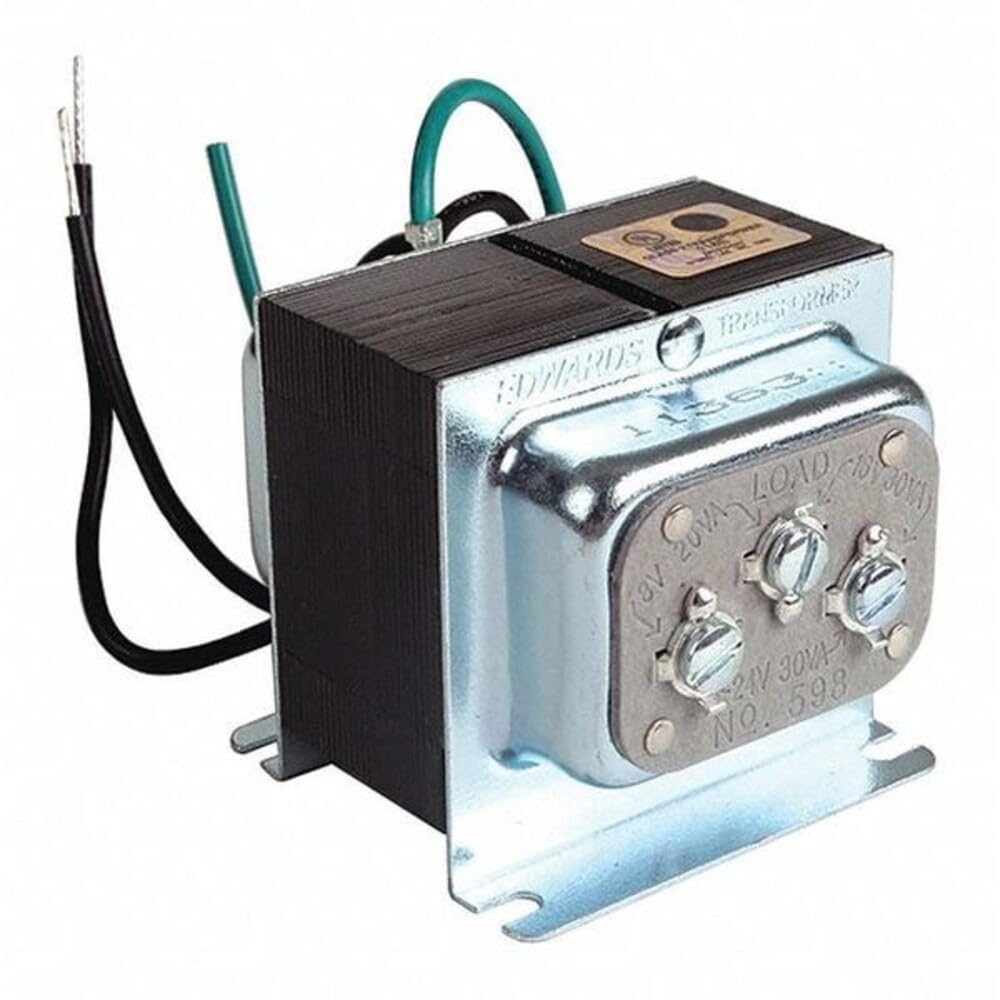
Most transformers give you one output. This one gives you a menu. From a 120V AC primary it offers 8V AC at 20VA, 16V AC at 30VA, and 24V AC at 30VA, all from the same compact body. That spread covers doorbells, security alarm contacts, HVAC signaling, and lighting loads with the same box, which is exactly why it earns a spot for anyone who works across more than one system type. The 4.5+ star standing is built on a few hundred owners, and the installers among them point to the same thing: it powers a Ring Pro or a Nest Hello with plenty of headroom and without a hum you can hear from the next room.
The physical package is built for retrofit work. It mounts in a 1/2-inch knockout or on a surface with optional feet, and it fits both plastic and metal back boxes. A grounding wire is included, and screw terminals on the secondary keep low-voltage connections tight. Non-regenerative thermal overload protection is built in — if the unit gets pushed, it protects itself rather than cooking. This is a UL Class 2 signaling transformer, the classification used for low-voltage control and signaling circuits.
The practical limitation is capacity, not flexibility. At 30W on the 16V and 24V taps, this is not the unit for a big multi-chime load unless you confirm the draw first. One buyer does report running two chimes, or two Eufy Smart Doorbells, off it — a useful data point, but size your own load rather than assuming it. It is also a single unit, so no spare in the box.
Why it stands out: three secondary voltages plus knockout or surface mounting means one part covers doorbell, alarm, and HVAC jobs.
Watch the load: 30W is generous for one device and tight for a crowd of them.
Pick it when: you want one transformer that can serve 8V, 16V, or 24V signaling work across a building.
skip it if: you are running several high-draw devices on a single output and need more than 30W.
5. 500VA Voltage Converter Transformer
Step up or step down with one box — and a 500VA rating that dwarfs the tiny control transformers above.
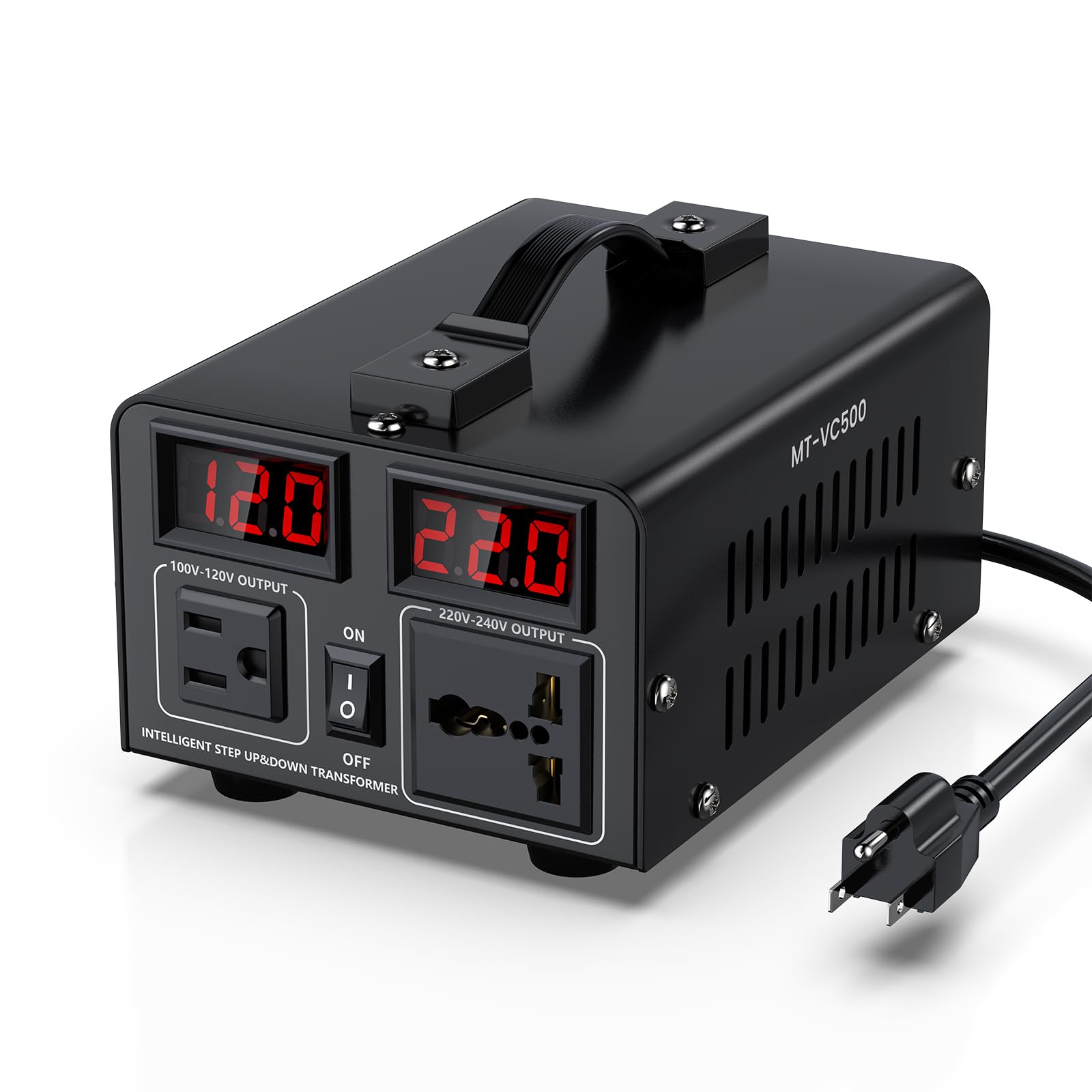
The capacity gap here is hard to overstate. This unit passes 500 VA, while the doorbell two-pack at the top of this list is rated 30 VA — a comparison that tells you these two solve completely different problems. The Jlouneo works in both directions: 110/120V up to 220/240V, or 220/240V down to 110/120V, set by an input selector you must match to your local supply before you plug anything in. Two AC outlets come built in — one US-style for 110V/120V gear and one universal-style for 220V/240V gear. Owners use it for exactly this: imported signs and European electronics running in a US home. Owners of imported signs and European electronics report it steps voltage correctly and runs quietly.
The breaker is worth knowing about. A resettable circuit breaker guards against overcurrent, and if it trips you disconnect the load, find and fix the cause, let the unit cool, then press the rear fuse reset button. Do not keep resetting it while the fault remains — that is how you turn a breaker trip into a dead transformer. The LCD screen shows what is happening, and the whole box weighs 2.4 kg with a US power cord attached.
The limit you need to hear clearly: this is a voltage converter, not a frequency converter. It does not change 50Hz to 60Hz, and motor-driven appliances designed for one frequency may run badly on the other. It is also explicitly not for high-wattage heating appliances like hair dryers, coffee makers, rice cookers, microwaves, air conditioners, or curling irons — those draw far more than 500 VA, especially on startup. And the universal outlet does not accept plug types J, K, M, or N.
Made for: students, expats, and travelers running small imported electronics — chargers, audio gear, TVs, consoles.
The catch: frequency stays whatever goes in, and heating appliances are off the table entirely.
6. VEVOR Auto Variable Voltage Transformer 2000VA

A dial instead of a fixed tap — set the output anywhere from 0 to 130V.
This is the unit for bench testing, voltage-sensitive equipment, and anyone who needs to nudge the supply rather than accept whatever the wall gives. It takes a 110V, 60Hz input and outputs anywhere from 0 to 130V, with a 2000VA rating and a 15.3 amp maximum output current. That current figure is where it separates from the fixed-output converters above: at 15.3A it can feed power tools and equipment that would trip a small converter instantly. Owners run power tools and bench equipment on it, and capacity for the money is the theme that keeps repeating.
Protection is layered. Fuses guard the circuit, a thermal control switch watches temperature, and a resettable overload protector backs both up. Four extra fuses ship in the box, which tells you the maker expects you to burn through one eventually. The LCD display reads out the setting, and the 6.7 by 8.7 by 7.7-inch body weighs 15 pounds, so plan a benchtop spot with room around it. It carries ETL certification.
Two honest caveats come with this design. The first is accuracy: the digital meter reads the setting, but it is not a precision instrument, and readings that drift from the true output are a known trade-off of this class of variable transformer — verify with a separate meter when precision matters. The second is that the maker recommends sizing the unit at least a quarter above your devices’ total power, so a 2000VA ceiling is not a 2000VA promise. Build quality draws mixed notes too, with soldering quality coming up as the recurring complaint.
Arguments for the bench
- 0-130V variable output at 15.3A handles heavy loads
- Fuses, thermal switch, and resettable overload together
- Four spare fuses included
- ETL certified with a readable LCD
Arguments for caution
- Meter accuracy is not lab-grade — verify the output separately
- Soldering quality draws mixed feedback
- 15 pounds needs a stable bench spot
Chosen by: tinkerers and technicians who need to dial a test voltage and push real current through it.
Not ideal for: anyone who needs a calibrated, certified-precision meter readout.
7. 5000 Step Up/Down Transformer Converter

Six sockets and a toroidal core for appliances that would laugh at a 500VA converter.
If you are moving a household appliance between voltage systems, this is the class of unit you want. It has 3 US standard sockets for 110-120V devices and 3 universal sockets for 220-240V devices, with the universal set accepting everything except the big South African plug. It handles appliances up to a Maximum Power Consumption of 3000 watts — rice cookers, hot water pots, blenders, food mixers. The current rating is 28 amps and it carries UL certification with a one-year warranty. The toroidal core design (a ring-shaped winding) is what lets it run 7x24hrs continuously with stable output and low consumption, which is the difference between a converter that survives one appliance and one that lives in a kitchen permanently.
Owners describe the build as well-built and powerful, and one report has it running 2600 continuous watts at 120V for an hour without trouble. For a unit in this class that is a serious real-world load. Value is the second theme, with the 3000W capacity-to-cost ratio coming up as a strong point. Owners also note the weight, and at 13.6 pounds with a 10.2 by 7.5 by 5.9-inch body, it is a fixed installation rather than something you move around.
Two things to get right before you buy. First, this converts voltage only — not frequency — so a 50Hz-only motor may still behave oddly on a 60Hz supply. Second, it is explicitly not for EV charging: do not use it on a 220-240V charge station. The unit also has a US power cord, so running it in a 220-240V country requires a plug adapter. Set the input voltage selector correctly before use; getting it wrong can stop the unit or damage what is plugged into it. The maker recommends sizing the unit at least 50% above your appliance’s max watts.
The real-world read: a 28-amp, six-socket step up/down unit with UL certification and continuous-run toroidal construction, sized for major appliances rather than desk gadgets.
Where it stops: EV charge stations are out of scope, and frequency stays untouched.
Built for: relocating households running rice cookers, blenders, and hot pots from another country’s voltage.
Wrong pick for: EV charging duty or any appliance that needs its frequency converted too.
8. SUNVIE 300W Low Voltage Landscape Transformer

Two zones, five modes, and a remote photocell you can mount where the sun actually reaches.
The remotable sensor is the clever bit here. A 6.8ft UL-listed sensor cord lets you put the photocell — the light sensor that triggers dusk-to-dawn operation — wherever it actually sees daylight, while the transformer itself sits indoors or tucked under an eave. It converts 120V household AC down to 12V or 14V AC for LED and halogen landscape systems, rated at 300 watts. Owners praise the housing quality and the five-mode control most, with installation and ease of use close behind. Set one up and the programming turns out to be straightforward rather than fiddly.
The two zones are individually switched, so you can run the front walkway on dusk-to-dawn and the back patio on a countdown. The five modes cover manual on/off, auto on at dusk and off at dawn, countdown off after 4, 6, or 8 hours, a timer you set, and a photocell-on/timer-off combination. The unit has a memory function, so it returns to your last setting after a power interruption. Built-in circuit protection cuts the output when the circuit looks abnormal. Capacity note from the maker: keep the total of zone 1 and zone 2 under 80% of the rated power.
The trade-off to weigh is reliability over the long haul. It comes up as the recurring concern in owner experience, so treat a remote photocell and a clean, dry mounting spot as insurance rather than extras. The housing is built to resist rain, snow, dust, and corrosion indoors or out. At 400+ ratings with a high average, most owners are clearly satisfied — the reliability note is a maintenance caution, not a reason to dismiss the unit.
What it solves: two independently controlled 12V/14V zones, five scheduling modes, and a photocell you can relocate on a 6.8ft cord — real flexibility for a yard with mixed lighting.
Good match for: a yard with two lighting runs that need different schedules, especially where the transformer has to sit out of the weather.
Plan for: a proper dry mounting spot and a little patience — long-term reliability is the soft spot.
9. DEWENWILS 300W Wi-Fi Low Voltage Landscape Transformer
Three zones you can split from your phone — no hub, no wall switch, no walk outside.
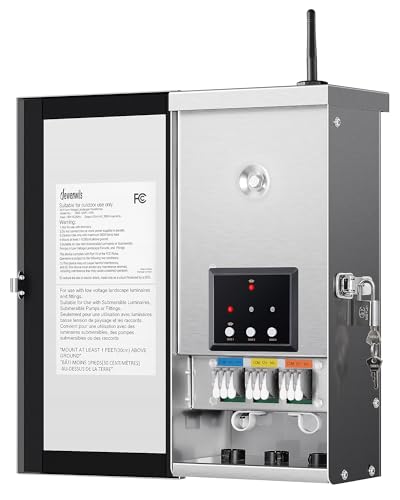
This transformer does the same 120V to 12V/14V conversion as the SUNVIE above, but it adds a control layer the other one cannot match. Three zones each get independent output, and you set them from the DEWENWILS app or by voice through Alexa and Google Assistant — no separate hub needed. Five modes cover Schedule, Circulate, Random, Countdown, and Astronomical. Pairing is a single button press on the “+” key. It is rated 300 watts with a 25 amp current figure, and it includes overcurrent and overload protection that shuts the output down if current thresholds are exceeded.
The hardware is built for permanent outdoor duty. Stainless steel housing resists rain, snow, dust, and corrosion, and the clamp-connect terminals — upgraded over a basic screw terminal — make the wiring side easier. Three zones give you more granular control than a two-zone unit: porch lights on astronomical timing, path lights on a countdown, and accent lighting on random for a lived-in look while you are away.
Two limits to plan around. The Wi-Fi radio is 2.4GHz only, so it will not join a 5GHz-only network — a common network setting that trips people up on first setup. And the physical size is worth measuring: it stands 13.7 inches tall and weighs 14.1 pounds, making it the biggest wall-mount transformer in this group. At 4.0+ stars on a few hundred ratings, owners cite reliable service and good build, with the three controllable zones as the standout.
Worth it for: anyone who wants three independently scheduled lighting zones and phone or voice control without extra hardware.
Check first: your router’s 2.4GHz band must be available, and the 13.7-inch housing needs real wall space.
Know the Specs
VA Rating and Why It Is Not Watts
VA (volt-amperes) measures the total power a transformer can carry, while watts measure the power your device actually uses. For simple electronics the two track closely. For anything with a motor or a heating element, the startup draw can spike well above the running figure, so the transformer needs headroom. The two conventions you see in this category: size at least a quarter above the total device power, or at least half again above your appliance’s max watts. Follow whichever rule the listing states and you avoid sagging output and nuisance trips.
Fixed Taps versus Variable Output
A fixed-tap transformer delivers one set output — 16V, 24V, 12V — chosen by which lead you connect. A variable transformer like the 2000VA unit lets you dial the output across a range, 0-130V in that case, so it can feed equipment that needs an exact figure. Variable units need more bench space and their meters are indicative rather than precision instruments. Fixed units are simpler to install and, for a specific appliance, the safer choice. Match the type to the job, not to the bigger number on the box.
Common Questions
What does 30VA on a doorbell transformer actually mean?
Can I use a 24V transformer on a 16V doorbell?
Will a voltage converter fix my appliance’s 50Hz versus 60Hz mismatch?
Can I run a coffee maker or hair dryer off a 500VA converter?
What is a center-tapped 24V transformer used for?
Why does my 24V transformer read close to 27V with nothing connected?
Which landscape transformer should I pick for two lighting zones versus three?
Does a 24VAC transformer work as a 24VDC power supply?
Can I use a step up/down transformer to charge an electric vehicle?
What should I do with unused primary leads on a multi-tap transformer?
The Bottom Line
For most people shopping this category, the volt ampere transformer that earns the nod is the 2PC Doorbell Transformer 16V 30VA, because it nails the most common job — a wired video doorbell — with UL-listed safety, a real wiring diagram, and a spare unit in the box. It is also the pick with the deepest owner history, and that confidence is worth something. If your work is HVAC control, the Sevenjungle 24V 40VA Multi-Tap 2-Pack is the smarter tool, since the 120/208/240V primary covers mixed panels and moves 1.66 amps through furnace boards and gas valves. And for a yard with more than one lighting run, the SUNVIE 300W Landscape Transformer gives you two independently scheduled zones and a photocell you can put where the sun actually hits.
One closing thought worth holding onto: match the output voltage first, size the VA with headroom second, and confirm the mounting footprint before you order. Do that and the best volt ampere transformer for your job is already sitting in the list above.
How we choose
We do not accept paid placement. Every pick is matched to a real buyer and a real use-case; we do not hands-on test units.
Sources
Specifications: manufacturer listings and product documentation. Review insights: verified customer reviews, as of November 2026. Pricing: not shown on this page (it changes often); check the current price via the retailer link.
As an Amazon Associate, Tactical Gear Guy earns from qualifying purchases. This does not affect which products we feature.