Specs are compiled from manufacturer listings and verified buyer reviews and can change over time — please confirm the key details on the product page before buying.
Do you want to aim the shot, or capture everything and pick your angle later? That choice decides which 360 camera for VR you buy. Every camera here records a full sphere with two lenses, so you can reframe any angle after the fact. The real differences sit in resolution, stabilization, low-light performance, and how painful the editing gets afterward.
This guide is built by comparing the manufacturers’ published specifications and the patterns across verified customer reviews, so you get each pick’s real strengths and trade-offs instead of marketing spin.
We break down which spherical shooters deliver clean footage, easy reframing, and honest battery numbers for your next adventure. Read on for the best VR video camera.
Top Picks


How To Choose The Best VR Video Camera
The wrong assumption most first-time buyers carry is that more megapixels automatically means better 360 video. In a 360 camera, the numbers on the box mix two different things: still-photo resolution and video resolution. A camera can shoot 120MP stills and still top out at 8K video. Know which number you are actually buying for.
Video resolution versus still resolution
Video resolution is what fills your VR headset or your flat reframed clips. 5.7K, 8K, and 8K50fps are video figures. Still resolution, measured in megapixels (MP), is for photos only. If you mainly shoot video for playback, weight the video spec far heavier than the megapixel count.
Sensor size and low-light performance
Two small sensors crammed into a tiny body struggle when the sun drops. A larger sensor gathers more light, which is why cameras listing 1-inch or 1/1.1-inch sensors tend to hold color and detail in dim conditions. If you shoot evening city walks or indoor scenes, this matters more than a bigger video number.
Stabilization and horizon lock
Stabilization smooths out bumps and shakes so handheld and action footage stays watchable. Horizon lock keeps the image level even when you spin or flip the camera. Both are software-driven on these cameras, so check that your chosen model lists them.
Side-by-Side Comparison
| Model | Best For | Video Resolution | Still Resolution | Battery Life | Amazon |
|---|---|---|---|---|---|
| Insta360 X5★ Best Overall | All-around 360 shooting | 8K30fps | 72 mp | 208 minutes | Amazon |
| AKASO 360Budget Champion | Entry-level 360 on a budget | 5.7K | 48 mp | 2 hours | Amazon |
| GoPro MAXDual-Mode Classic | Traditional plus spherical hybrid | 5.6K30 | 16.6 mp | 2 hours | Amazon |
| GoPro MAX2 | Replaceable-lens 8K | 8K | 29 mp | — | Amazon |
| Xtra 360 | Built-in storage, no SD card | 8K | 120 mp | 1.5 hours | Amazon |
| DJI Osmo 360 | 1-inch sensor low light | 8K/30fps | 120 mp | 100 minutes | Amazon |
| Insta360 X4 Air | Ultralight 165g travel | 8K30fps | 29 mp | — | Amazon |
| Ricoh Theta X | High-res stills + GPS | 5.7K (5760×2880) | 60 mp / 11K | — | Amazon |
| Ricoh Theta Z1 | Dual 1-inch still quality | 4K (3840×1920) 30fps | 23 mp | 60 minutes | Amazon |
Detailed Reviews
1. Insta360 X5
Our pick — 4.5+★ from 4,000+ verified ratings; the strongest balance of quality and price.
The dual-sensor workhorse that shoots the whole sphere in 8K and still has juice left.
If you want one camera that does the whole job, the X5 is the pick that keeps coming up. It packs two 1/1.28″ sensors (a large image sensor that gathers more light) shooting up to 8K30fps 360° video. For you, that means footage you can reframe into a flat clip or feed straight into a VR headset without it falling apart on detail. Its stills run up to 72 mp, and that is where it laps the GoPro MAX — 72 mp versus 16.6 mp for the older shooter, a 4.3x gap in still resolution.
Night footage stays usable thanks to the triple AI chip design (three processing chips working together to clean up noise) — you can shoot a dim street or a campsite after dark and still get recognizable faces and signs. Your vlog narration survives a breezy ridge because a 4-mic array with a dedicated wind guard hones in on voices. Battery lands at 208 minutes, the longest runtime in this lineup and enough for a full day of clips.
What wins people over is the sheer image quality — it is the most-praised trait by a wide margin. Footage stays level thanks to FlowState Stabilization and full 360° Horizon Lock, and the lenses are now replaceable in seconds if you scratch one. The honest catch is durability chatter: the body feels rugged, but the exposed lenses still ask for a lens cap and some care on rock gardens.
Why It Earns The Top Slot
- Two 1/1.28″ sensors at 8K30fps keep detail crisp in 360°
- 208-minute battery, the longest runtime on this list
- Triple AI chip cuts noise in low light
- Replaceable lenses swap in seconds after a scratch
What To Keep In Mind
- Battery life draws mixed notes at full 8K
- Lenses are tough but still need protecting on rough terrain
Go for it if: you want one camera that covers action, vlogging, and VR playback without juggling gear.
Think twice if: you plan marathon 8K sessions and cannot carry a spare battery.
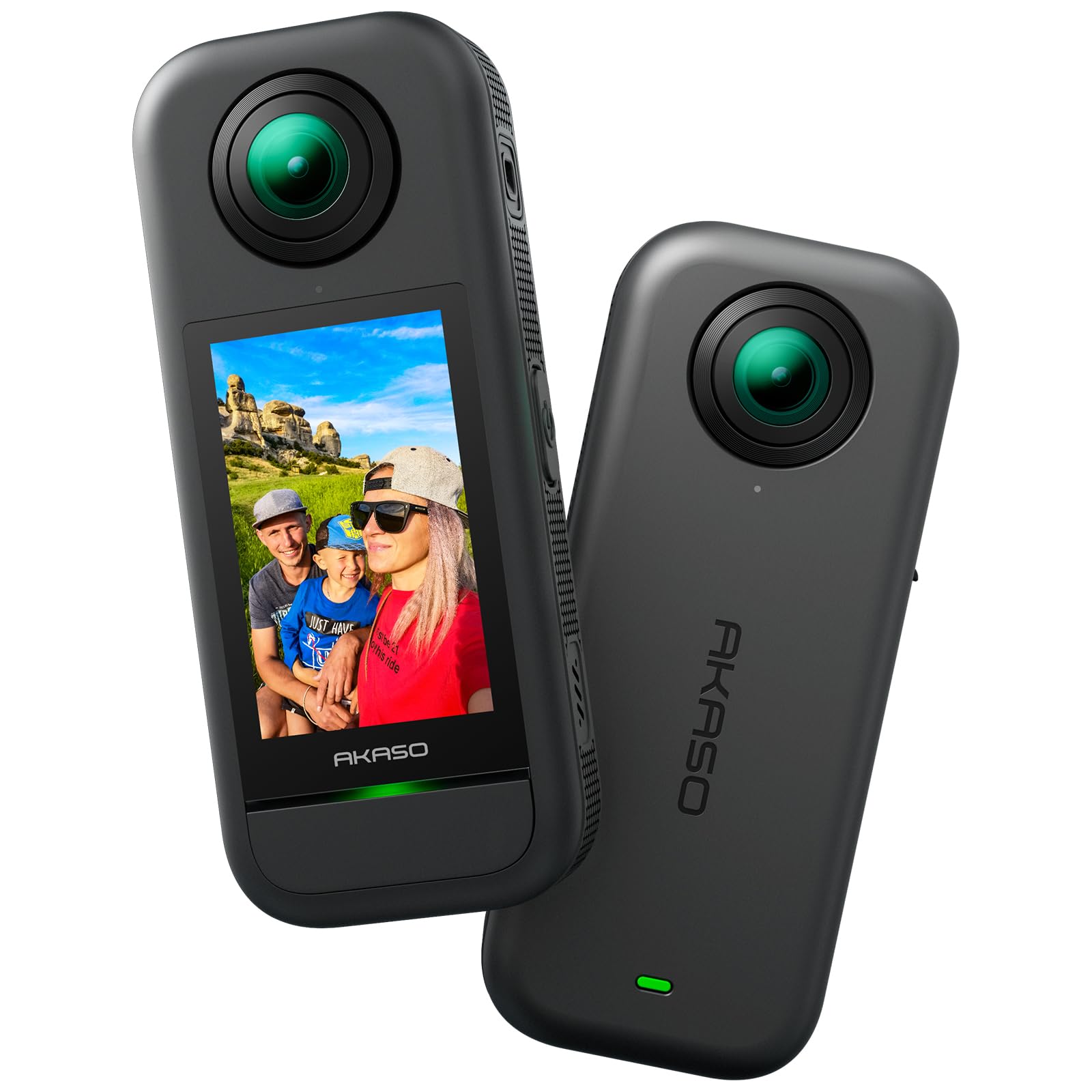
2. AKASO 360 Action Camera Standard Combo
The entry ticket to spherical shooting that does not punish your wallet.
If you are testing whether 360 video is for you, the AKASO is the sane place to start. It records fully rich 360° footage at 5.7K, and two 1/2″ 48MP sensors pull more pixels per frame than you would expect at this tier. It also shoots 72MP 360° photos. The catch is straight from the spec sheet: no HDR support, and the maker itself flags that quality drops in low light.
What makes it fun is the invisible selfie stick effect — mount it on a pole and the stick disappears from the footage, giving you that floating third-person shot without a cameraman. Note that the stick is not included. The app’s stabilization smooths shakes, and 360° Horizon Lock keeps the frame level when you flip or spin. AI subject tracking keeps a runner, rider, or pet centered while you shoot first and pick angles later.
The verdict from owners lands where you would expect: video quality is the thing buyers praise most, followed closely by how easy it is to pick up and use. Battery life, app connectivity, and weather resistance draw mixed notes — plan to carry a spare and to shoot in decent light. For a first 360 camera, that trade-off is fair.
The honest read: great value and a gentle learning curve make this a strong starter; low-light limits and a mixed app experience are the price of entry.
Reach for this if: you want to try spherical video for travel, bikes, or vlogs without committing to premium gear.
Look elsewhere if: most of your shooting happens after sunset.
3. GoPro MAX
Two cameras in one body — full sphere when you want it, standard action cam when you don’t.
The MAX is the dual-purpose pick. It shoots 5.6K30 spherical video so you can capture everything and reframe in the GoPro Quik app, then flip into Single Lens (HERO) mode for standard 1080p or 1440p footage like a classic GoPro. That flexibility is the whole reason to choose it over a pure 360-only body.
The invisible-pole trick works via the 1/4-20 mounting threads on the bottom — the pole stitches out of your videos automatically. Object tracking in Quik locks onto a subject and follows it as it moves through the sphere, which saves a ton of manual keyframing. You also get 3K60 for slow-mo, and stills land at 16.6 mp.
Owners split on video quality, reliability, and value — some find it well worth it, others less so. The upside is that build quality is the thing that earns the most praise, and a 2-hour battery keeps a session going. Treat the mixed reports as a sign to keep your expectations calibrated rather than a reason to walk away.
Best trick it has: the 1/4-20 mount lets any standard pole vanish from the shot.
For you if: you want one body that toggles between spherical and ordinary action footage.
Not for you if: you need top-end low-light detail — the MAX2 up the page is the newer answer.
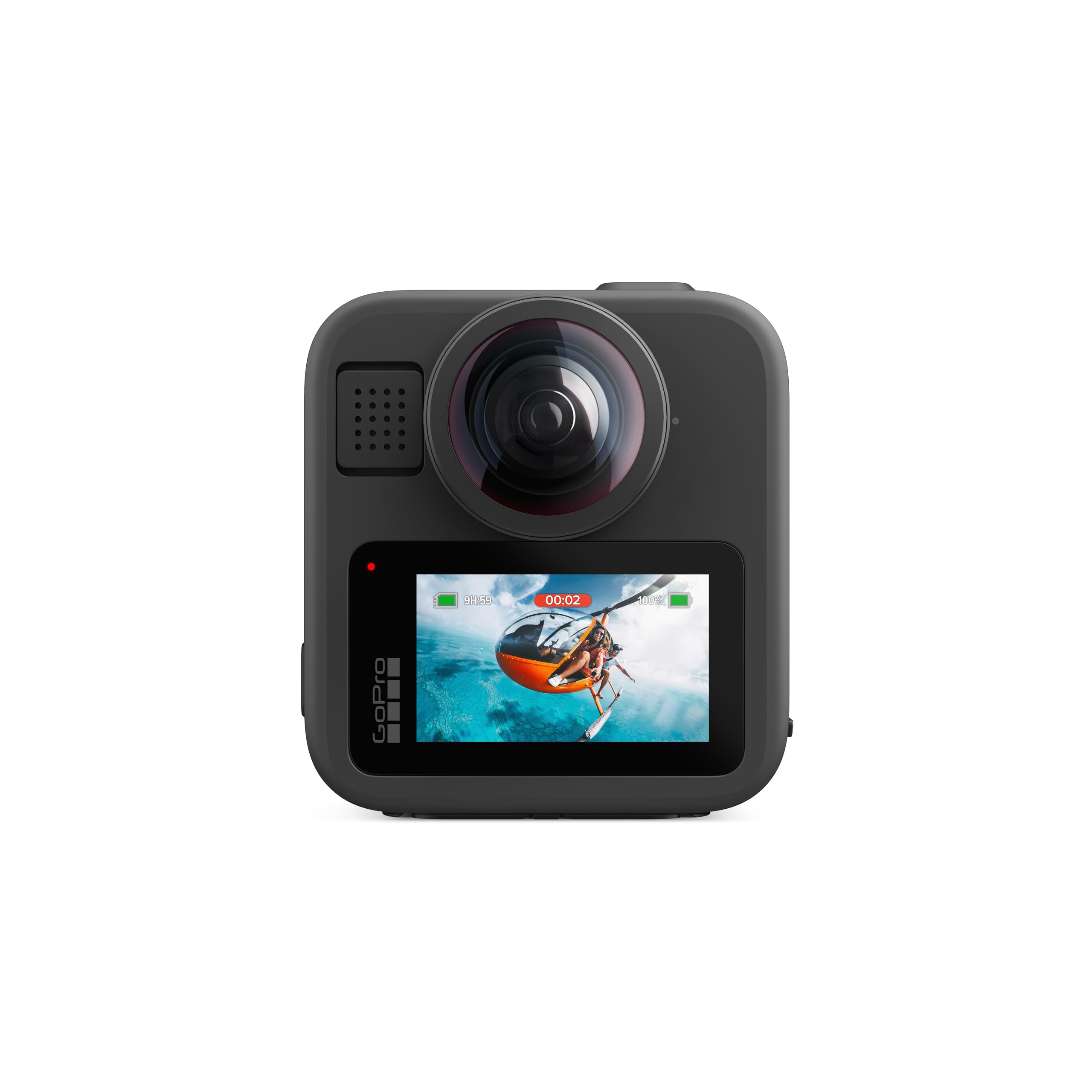
4. GoPro MAX2
The rugged lens-swapper for pilots and action junkies who break things.
The MAX2 steps the MAX line up to True 8K 360 video, and plain stills to 29 mp. Recording in 8K means when you reframe into a flat 4K clip, you keep more of the fine detail instead of watching it soften. The GoPro Quik app turns that sphere into standard 4K with a few taps, and you can adjust stabilization and Horizon Lock after the fact — so a bumpy run can still come out level.
The real reason it stands out is replaceable glass lenses. They are water-repelling and made from optical glass, and if one gets scratched you swap it instead of torching the whole camera. That is a meaningful durability move for anyone shooting in sand, salt, or rock. You also get an invisible-mount trick via the 1/4-20 threads, and the included 1960mAh Enduro Battery keeps it running.
Owners love the quality and find it easy to use for sports, and it is especially popular with drone pilots. The mixed note is video quality — the 8K wow-factor does not rescue every lighting situation. Compared with the older MAX’s 16.6 mp stills, the MAX2’s 29 mp is the bigger number you are paying for.
what separates it: when the lens takes a hit, a swap saves the camera — not a full-package replacement.
Pick this if: you shoot in punishing conditions and want the option to fix the lens, not the whole body.
Hold off if: you want the simplest low-light performer — a bigger sensor elsewhere wins that fight.
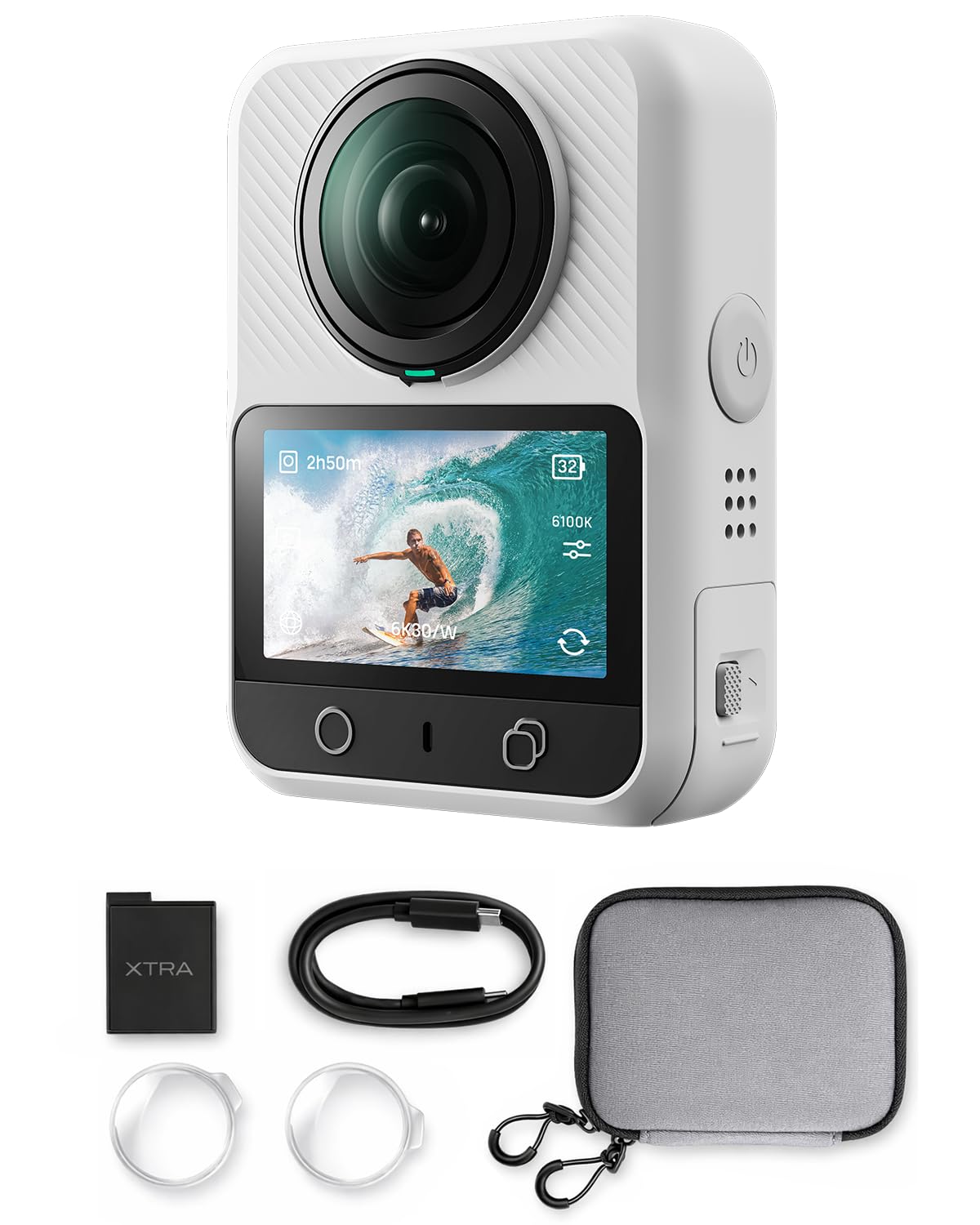
5. Insta360 X4 Standard Bundle (Renewed)
Skips the memory card entirely and fills a 105GB pocket of storage on its own.
Running out of card space mid-shoot is the small disaster this camera is built to solve. It carries 105GB of high-speed built-in storage, so there is no SD card to forget, lose, or fill. It shoots 8K 360° video and 100-megapixel panoramas — the megapixel spec on stills reads 120 mp in the technical data, so weigh that photo figure before you buy for photos.
A 1-inch sensor equivalent gathers more light than a small-sensor action cam, which helps color and depth in dim conditions. A magnetic quick-release mount lets you swap angles fast, and it plays nicely with common action camera mounts and selfie sticks. The battery is a 1900 cold-resistant cell rated at about 1.5 hours.
Buyers call it one of the sharper options on the market, with image quality and value both landing strongly. The honest note is battery and app-related feedback — some find the battery great and the app intuitive, others hit rough patches. Plan to test the app workflow on day one so you are not troubleshooting in the field.
Storage, solved: no card means 8K clips go straight to internal memory with zero setup hassle.
For you if: carrying a pile of SD cards is the part of 360 shooting you hate.
Look on if: 1.5 hours of battery will not cover your shoot and spares are not on hand.
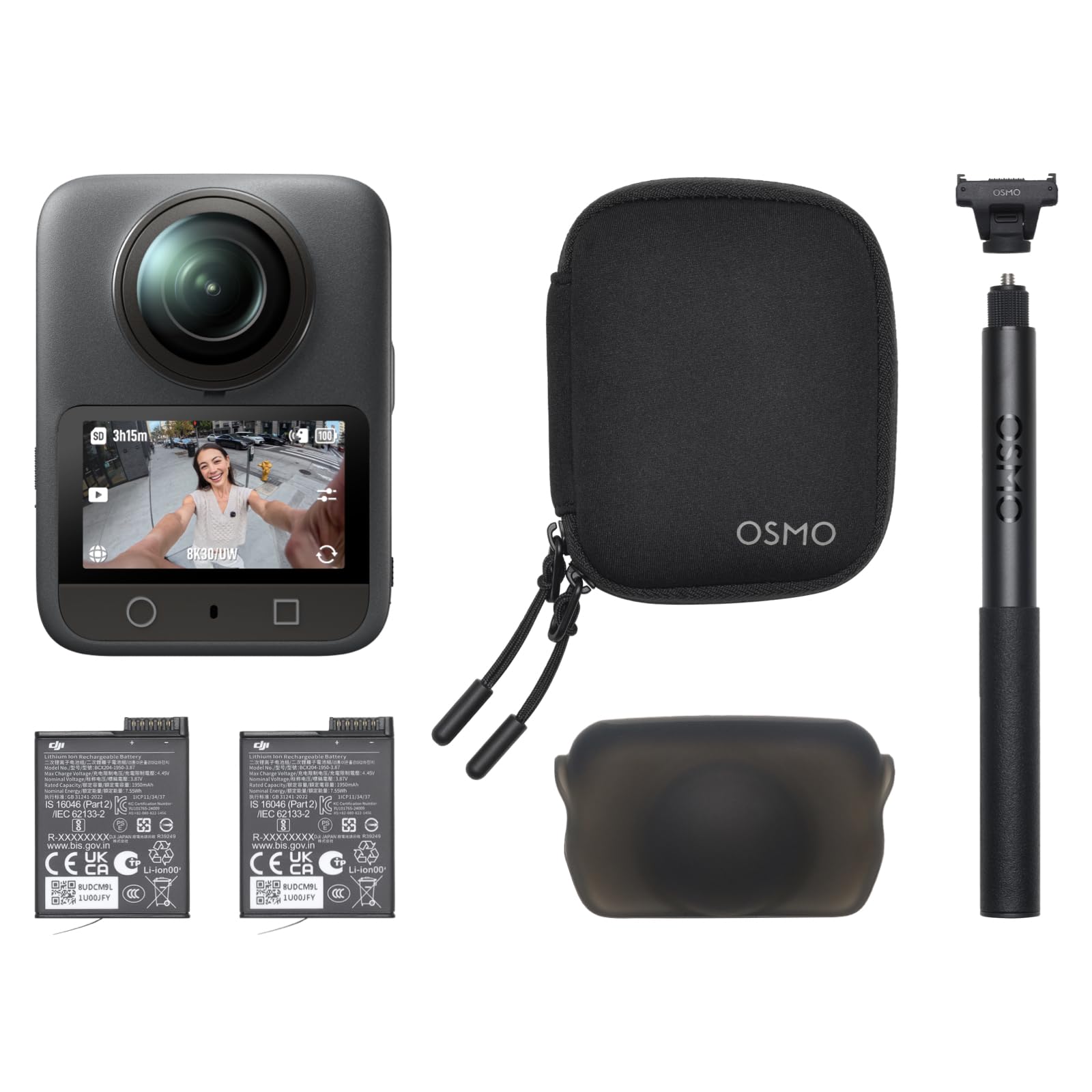
6. DJI Osmo 360 Essential Combo
A 1-inch 360 sensor that keeps color alive long after the sun clocks out.
The Osmo 360 is the night-shooter in this group. It uses a 1-inch 360° imaging system that soaks up light, plus 8K/30fps 360° video, so city nights and sunrise runs stay crisp and vivid. It also captures 120MP 360° photos in a tap, and the smooth 4K/120fps mode handles fast action without a hitch.
The bundle includes a 1.2m Invisible Selfie Stick that turns the camera into a self-following cameraman — carve a ski run and the pole simply is not in the shot. A magnetic quick-release flips you from 360° selfies to single-lens vlogging in seconds, and the 1/4″ thread fits standard gear. Four microphones capture audio from all directions, and it connects directly to up to two DJI microphone transmitters via OsmoAudio, no receiver needed.
What owners praise most is the video quality, with crisp pictures and clean detail. The mixed signals come from reliability — a few report it locking up at random — and from battery life, where some note charge retention issues. The 105GB built-in storage plus up to 190 minutes of recording means you can leave the card at home, though the rated average battery life of 100 minutes tells you to plan ahead.
What you get: a truly large sensor for the money, plus the stick and spare battery already in the box.
Your pick if: most of your shooting happens after dark or indoors.
Second-guess it if: you prefer a camera body known for zero lock-ups.
7. Insta360 X4 Air Starter Bundle
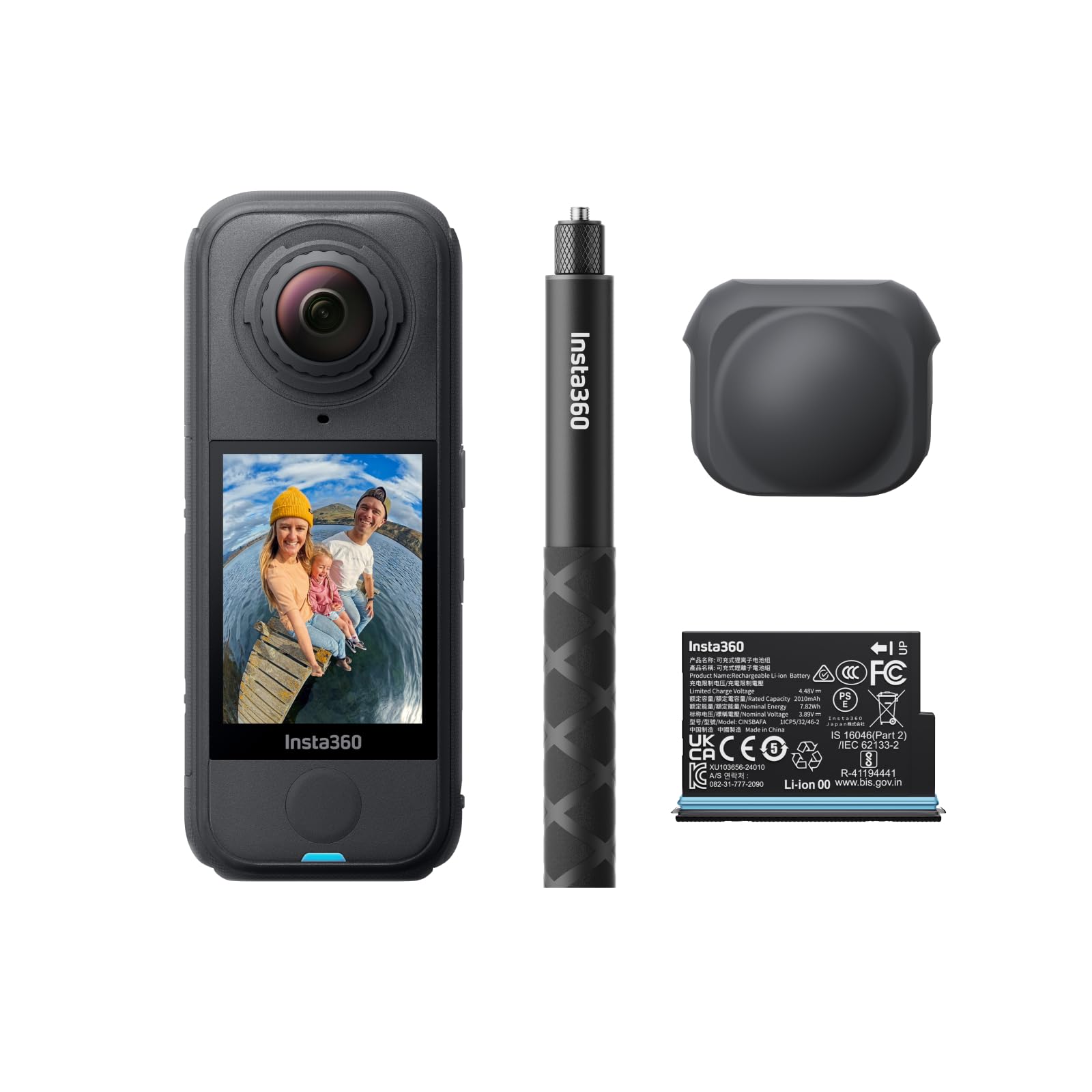
A 165g featherweight that disappears in your pack but shoots full 8K.
For hikers and travelers, weight is a real decision — and the X4 Air weighs 165g. The maker notes actual weight may vary with configuration, but the point stands: it is light enough to forget it is on the tripod. Dual lenses still capture every angle in 8K30fps, so nobody in your group is stuck behind the camera missing the moment.
Active HDR (a mode that balances bright and dark areas in the frame) lifts color in highlights and shadows for stabilized daytime shots — bright skies and shaded faces both survive. FlowState Stabilization and 360° Horizon Lock keep footage steady and level through full rotations, and replaceable lenses mean a scratch does not end the camera’s life.
The bundle includes an extra battery, a 114cm invisible selfie stick, and a lens cap, plus the Insta360+ cloud service with up to 2TB of storage. Buyers report excellent video quality — one notes incredible ski footage — and it is considered worth the money. Editing is the mixed bag: simple to use, but processing can feel slow while the app chews through 8K files.
Light on the pack: 165g with 8K and cloud backup makes this a travel-first 360 camera.
Best for: travelers and hikers who count every gram.
Not ideal for: anyone who wants instant edits without waiting on an app.
8. Ricoh Theta X

Built for gigantic stills and GPS-tagged tours rather than action footage.
The Theta X is a different animal: a photo-first 360 camera. It captures 11K high-resolution stills up to 60 megapixels, plus 360° video at 5.7K (5760 × 2880 pixels at 30 fps). If you are building room tours or street-level VR maps, the still resolution here is what you are after. It shoots HDR-DNG in 16-bit, so you can push tones in editing like you would a DSLR file.
Built-in GPS with QZSS and A-GPS compatibility embeds precise location into your 360 photos, which is exactly what you need to build Google Blue Line tours. A large color touchscreen lets you preview scenes, adjust settings, and review shots without a phone. The battery and memory card are both swappable, which means long shooting days are possible as long as you bring spares.
The frustrating part is quality feedback: the camera’s build is generally praised, but some buyers find the image output less consistent than expected. That makes it a specialist tool — great when your priority is high-res stills and location tagging, less so when you want modern 8K action footage.
The point of it: 11K stills plus GPS tagging is a niche no standard action 360 here fills.
Reach for this if: you build 360 photo tours and need GPS coordinates baked in.
Leave it if: you mainly want 8K video — a lens-shaped action cam is the better route.
9. Ricoh Theta Z1

Two 1-inch sensors for stills that look like they came from a serious camera.
The Theta Z1 is aimed at photo quality first and video second. It uses two 1.0-inch back-illuminated CMOS sensors — among the largest in consumer 360 — capturing 23MP-equivalent stills with ISO sensitivity up to 6400 for night and dim indoor shots. That makes it a strong fit for architecture, real estate, and low-light 360 photography where detail matters.
For video, it records 4K-size 3840 × 1920 at 30fps with 3-axis rotational stabilization to keep shots smooth. You get full manual control — aperture priority, shutter priority, ISO priority, and manual — plus RAW (Adobe DNG) support alongside JPEG. Ricoh’s free stitchery plug-in for Adobe Photoshop Lightroom Classic lets you generate spherical images with invisible seams.
Owners describe the still output as excellent and find it among the better 360 cameras for photos. The honest limitation is battery: the 60-minute rating is the shortest here, and some owners mention poorer than expected endurance. The software also draws mixed notes, with some describing it as janky. Bring spare batteries and patience with the app.
The visual payoff: big sensors and RAW editing are what put this camera’s photos ahead for stills shooters.
For you if: high-res 360 stills and RAW flexibility matter more than long runtime.
Not for you if: you shoot hours of 4K video and cannot carry spare batteries.
Know the Specs
Video Resolution (5.7K vs 8K vs 8K50fps)
Video resolution is how many pixels make up every frame of your 360 sphere. Higher numbers like 8K or 8K50fps keep more detail when you reframe into a flat clip or play back in a VR headset. The “fps” figure is frames per second — higher rates like 50fps capture smoother motion during fast action, while 30fps is fine for slower scenes.
Still Resolution and Sensor Size
Still resolution, measured in megapixels (MP), is for photos only — a 120MP camera can still shoot 8K video. Sensor size is the other half: a 1-inch or 1/1.1-inch sensor gathers more light for clearer night shots. Weigh both numbers together instead of assuming a bigger still count means better video.
Stabilization and Horizon Lock
Stabilization smooths shaky footage so it looks steady, and horizon lock keeps the horizon level even when you flip or spin the camera. Both are software-driven on these cameras, so check which model lists them before you buy.
Invisible Selfie Stick and Mounts
The invisible selfie stick effect uses software to erase a mounting pole from your footage, giving you a floating third-person view. You need a pole with a matching mount — often 1/4-20 threads or a magnetic quick-release — and note that some bundles include the stick while others do not.
Common Questions
What makes a camera a true VR video camera instead of a regular action cam?
Is 8K video really better than 5.7K for 360 footage?
Do I need a separate selfie stick for the invisible stick effect?
Can these 360 cameras handle shooting underwater?
Which camera works best for night or low-light 360 video?
Do I need a memory card, or can these cameras store footage internally?
How long does the battery last on a 360 action camera?
What is horizon lock and do I actually need it?
Can I use these cameras for standard flatscreen videos too?
Are replaceable lenses worth choosing a camera for?
The Bottom Line
For most shooters, the vr video camera winner is the Insta360 X5 because it balances 8K30fps dual-sensor video, 208 minutes of battery, and replaceable lenses in one rugged body. If night footage is your priority, the DJI Osmo 360 leads on its 1-inch imaging system. And for slow-motion 8K action, the Insta360 X6 is the frame-rate leader. Whatever you pick, match the sensor size and video spec to the light and motion you actually shoot in.
How we choose
We do not accept paid placement. Every pick is matched to a real buyer and a real use-case; we do not hands-on test units.
Sources
Specifications: manufacturer listings and product documentation. Review insights: verified customer reviews, as of November 2026. Pricing: not shown on this page (it changes often); check the current price via the retailer link.
As an Amazon Associate, Tactical Gear Guy earns from qualifying purchases. This does not affect which products we feature.