Specs are compiled from manufacturer listings and verified buyer reviews and can change over time — please confirm the key details on the product page before buying.
Buy the magnetic bank that actually sticks to your phone and refills it at a usable speed, not the one with the biggest number printed on the box. The spec that decides whether a wireless charging power bank is worth carrying is its certified wireless output — 7.5W, 15W or 25W (watts, the rate power crosses the air to your phone) — because that number, not the mAh figure, sets how long your phone sits glued to the back of it. Everything else on this page is about matching that number to your phone and your pocket.
This guide is built by comparing the manufacturers’ published specifications and the patterns across verified customer reviews, so you get each pick’s real strengths and trade-offs instead of marketing spin.
Below you get a plain-English breakdown of wireless wattage, magnet hold, capacity and heat, plus nine ready-to-buy magnetic packs. Here is the honest rundown of every wireless charging power bank worth a spot on your shortlist today.
Top Picks


How To Choose The Best Wireless Charging Power Bank
A magnetic power bank is a battery you stick to the back of your phone, and it either makes your day easier or becomes a brick in your bag. The mismatch that catches most buyers is buying a 25W wireless pack for an iPhone that only accepts 15W wirelessly — you pay for speed your phone cannot use. Match the pack to your phone first, then to your bag.
The wireless wattage your phone can actually accept
Wireless charging wattage is the speed of power travelling through the air between the pack’s coil and your phone’s coil, written in watts (W). An iPhone 12 through 15 tops out around 15W over MagSafe-style charging, while iPhone 16 and newer models can pull the higher Qi2.2 25W rate when the pack supports it. A pack advertising 25W will still work on an older iPhone, it just drops to the lower rate, so you never get the full benefit you paid for.
Magnet hold and whether it survives a walk
The magnets are what keep the pack from sliding off mid-text, and a weak array means the pack shifts, the coils misalign, and charging slows or stops. A pack with strong alignment snaps on in one motion and stays fixed while you scroll one-handed. This is also why a thick case can undo a good magnet — the gap between the two coils widens and efficiency falls.
Wired output as your fallback speed
Every pack here also charges by cable through USB-C, and that wired output is often several times the wireless rate. If you need a fast top-up in ten minutes at an airport gate, the cable is the tool that does it — wireless is for the slow, hands-free top-up while the phone rides in your pocket. Look at both numbers, because a pack that is quick on cable and slow on the coil is still useful.
Capacity, heat and what fits in a pocket
Capacity is stored energy, measured in milliamp-hours (mAh) — 10,000mAh is the everyday balance that refills a modern iPhone roughly once and a bit more, so it covers a normal day out. 20,000mAh packs are larger travel batteries that buy you multiple days but sit heavier in the hand. Heat is the quiet factor: wireless charging wastes energy as warmth, so a pack with real temperature control keeps both devices cooler and safer.
Side-by-Side Comparison
| Model | Best For | Wireless Output | Capacity | Wired Output | Amazon |
|---|---|---|---|---|---|
| Anker Zolo Magnetic Power Bank★ Best Overall | Everyday carry and travel | 7.5W | 10,000mAh | 30W | Amazon |
| Gatatol Magnetic Power BankBuilt-In Cables | Built-in cable convenience | 15W | 10,000mAh | 22.5W | Amazon |
| Baseus MagSafe Portable Charger (E00285)Pocket Qi2 | Pocketable Qi2 charging | 15W (Qi2) | 10,000mAh | 22.5W | Amazon |
| VONUV Magnetic Power Bank | Slim, thin profile | 15W | 10,000mAh | 22.5W | Amazon |
| INIU Magnetic Slimmest Power Bank | Thin Qi2 25W travel pack | Qi2 25W | 10,000mAh | 45W | Amazon |
| UGREEN 20,000mAh Qi2 Power Bank | Multi-day trips | Qi2 15W | 20,000mAh | 30W | Amazon |
| Baseus Picogo AM52 | Fastest wireless top-ups | Qi2.2 25W | 10,000mAh | 45W | Amazon |
| i.VALUX Qi2.2 25W Power Bank | Hands-free viewing | Qi2.2 25W | 10,000mAh | 45W | Amazon |
| UGREEN Qi2 25W 20,000mAh | Big-battery multi-device days | Qi2 25W | 20,000mAh | — | Amazon |
Detailed Reviews
1. Anker Zolo Magnetic Power Bank, 10,000mAh
Our pick — 4.5+★ from 5,000+ verified ratings; the strongest balance of quality and price.
A 10,000mAh magnetic pack that holds under 38°C on the coil and jumps to 30W over USB-C.
The Anker Zolo earns its spot on a 4.5+ star rating across thousands of owners, and performance is what wins them over above all. It runs a soft silicone magnetic surface against your phone — a skin-friendly, scratch-preventing panel — and holds a 10,000mAh cell, enough for roughly two full charges of an iPhone 15 or 1.5 charges of an iPhone 15 Pro Max. That makes it the pick most buyers should start with, and the crowd favorite on this list.
Where the Zolo earns its place is the combination of wireless and wired. Wireless tops out at 7.5W, which is a slow trickle but hands-free; the cable jumps to a 30W wired connection, so a fast top-up at a gate takes minutes rather than hours. Set that against the Gatatol below, which manages 22.5W wired, and the Zolo leads on wired output even though its coil is slower than the Qi2-certified packs further down the page.
The engineering detail buyers feel most is heat. Advanced temperature control keeps the pack below 38°C during wireless delivery, so it does not turn into a hand-warmer mid-top-up. Charging speed splits opinion — some find it fast, others wait longer to fill — and the pack carries real heft at 223.1 g, which is the insurance of a bigger cell. A 30cm USB-C to USB-C cable and 18-month warranty come in the box.
What earns it the badge
- 30W wired output for fast top-ups when you are in a hurry.
- Keeps itself under 38°C during wireless charging, so it stays comfortable in hand.
- Silicone magnetic surface protects the phone’s back from scratches.
- Compact and travel-friendly — slides into a carry-on pocket.
Where it gives ground
- 7.5W wireless is slower than the Qi2 and Qi2.2 packs on this list.
- At 223.1 g it carries noticeable weight for a 10,000mAh pack.
Reach for this if: you want one reliable magnetic pack for daily carry and air travel, with a fast cable when the coil is too slow.
Look elsewhere if: your iPhone 16 or newer deserves the higher 25W wireless speed — that lives further down this list.
2. Gatatol Magnetic Power Bank, 10,000mAh
Built-in USB-C and Lightning leads that charge up to four devices at once.
This Gatatol answers the most annoying question about magnetic banks: what happens when the coil is too slow and you cannot find a cable. Both a USB-C and a Lightning lead are built into the body, and you can charge up to four devices at once between them and the wireless pad.
The pack weighs 120 g, which is markedly lighter in the hand than heavier 10,000mAh packs on this list, and its built-in cables carry a 20W recharge rate back into the bank itself. Its marketing claims real efficiency gains — up to 10% greater power transfer and temperatures up to 5°C lower than typical — which is the maker’s figure, not a lab result you should treat as gospel. Real owners find it quick to charge, convenient for flights, and reliable with Samsung phones over the cable.
Where it asks something of you: the coil is rated for MagSafe-compatible iPhones, and Android phones only get the wired path. A full recharge of the bank takes 3.4 hours, so plan an overnight stop rather than a quick plug-in.
The honest read: strong on convenience and light on the wrist, with a wireless coil that beats the Zolo but a cable that loses to it. If your bag is already full of tangled cords, this one removes them.
Best fit for: mixed households running both Lightning and USB-C phones, or anyone who fatigues of packing cables.
Know before you buy: Android owners get wired charging only — no magnetic snap or 15W coil for them.
3. Baseus for MagSafe Portable Charger, Qi2 15W
Official Qi2 certification at 15W, shaped small enough to forget in a pocket.
Qi2 certification (an industry stamp that the pack’s magnet ring and wireless power delivery meet a defined standard) means a Qi2 pack and a Qi2 phone align and charge predictably rather than by luck. This Baseus carries that certification and delivers 15W over the coil plus 22.5W through USB-C, so your phone refills steadily without a cable and faster with one. It snaps onto an iPhone 17/16/15/14/13/12 with or without a magnetic case.
At 2.7 inches wide it is narrower than an iPhone 16, and 125 g in the hand makes it one of the genuinely pocketable options here. Pass-through charging means you can refill the bank and the phone together from one wall socket. It even auto-starts charging without a button press. The 22.5W cable can lift an iPhone 16 Pro Max to 37% in half an hour, per the maker.
The trade-off is speed consistency. Wireless performance divides owners — some see fast iPhone charging, and a smaller share find it slows after months of use. Set against the thinner VONUV below, the Baseus is 0.7 inches thick versus 0.39 — noticeably chunky in a front pocket, though the Qi2 stamp is worth the extra millimetre to many buyers.
The Qi2 case: certified alignment, real 15W, and automatic snap-to-charge are the three things you feel every single day. The bigger rival in the lineup is the Picogo further down, which takes certified speed to 25W.
Suits you when: you want certified Qi2 without paying flagship money, and the phone is usually a recent iPhone.
Second thought if: a truly flat profile in a slim front pocket is your priority — that is the VONUV two entries down.
4. VONUV Magnetic Power Bank 10,000mAh, 15W

A 0.39-inch magnetic slab with a 10,000mAh cell and a built-in USB-C cable.
This VONUV measures 0.39 inches thick — dramatically slimmer than the 0.7-inch Baseus above — so it barely bulges when snapped on and is far likelier to leave the house with you. Thickness is the number that decides whether a magnetic bank rides proudly or gets left at home. It still holds a 10,000mAh cell, enough for about two full iPhone 16 refills over the days’ use.
The magnetic attachment is the trait buyers talk about most here — phones stay put without slipping mid-scroll — and portability and compact size follow close behind. What owners single out as the strength is raw power delivery, keeping pace on wired top-ups and staying straightforward to use, including with Pixel 10 phones. Charging speed is the divided point: it is the highest-count topic on the listing, but buyers split between finding it quick on cable and slower over the coil, so treat the 15W wireless as the everyday figure.
Wired charging runs 22.5W with a built-in cable, and the marketing claims a 30-minute lift to 60% on an iPhone 16 — a maker figure, not a measured result. A nine-layer protection chipset covers over-voltage, over-current, temperature and short-circuit, which is the sort of spec you never notice until a hot phone makes you glad it is there.
Why the flat profile sells
- 0.39 inches thin — slim enough that a pocket stays a pocket.
- Strong magnet hold with 199 g of pack weight behind it.
- Built-in USB-C cable means no extra cord for wired top-ups.
- Nine-layer protection chipset covering the common electrical faults.
The thinness tax
- 15W wireless is a step below the Qi2 25W packs elsewhere here.
- Wireless speed divides owners — some find it slower than expected.
Grab it for: daily slip-in-pocket carry where the phone still has plenty of charge and you just need a shallow top-up.
Pass if: you expect certified 25W wireless speed — this one stops at 15W.
5. INIU Magnetic Slimmest Power Bank, Qi2.2 10,000mAh
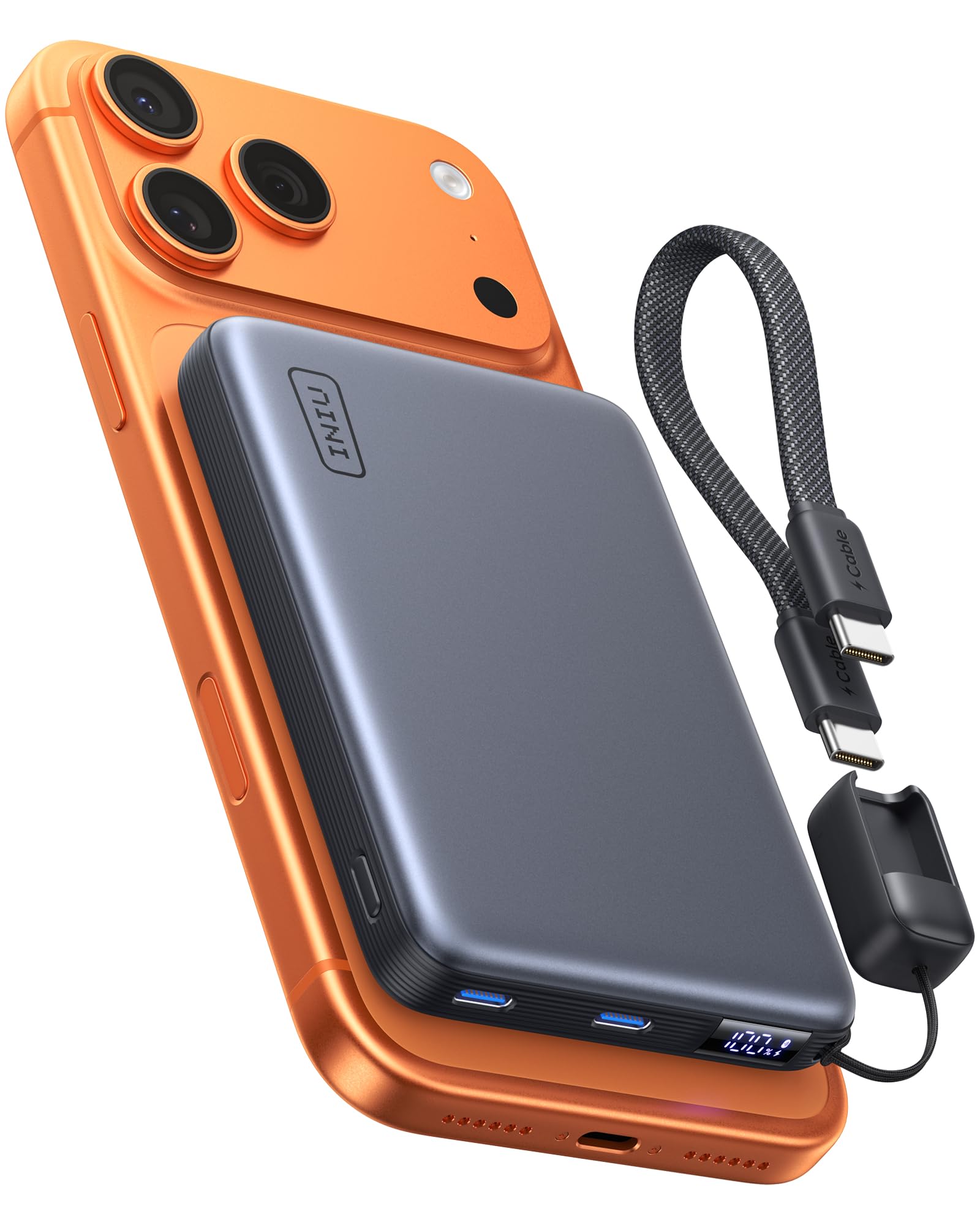
Qi2 25W wireless in a 0.5-inch body, with 45W over its detachable USB-C GoCord.
INIU puts Qi2 25W — the highest wireless rate most modern iPhones can draw over a magnet — into a pack just 0.5 inches thin, thinner than the Anker Zolo’s 0.59 inches and a hair under the VONUV’s flat slab. It packs 10,000mAh and a digital display that shows exact battery level and charging status, so you are never guessing whether it is nearly empty.
Its wireless wattage steps well past both Budgetus-style Qi2 15W packs and the original Zolo — 25W versus 7.5W on the Zolo is a notable gap in real use. The maker claims an iPhone 17 Pro goes 0-50% in 33 minutes, about 30 minutes faster than regular 7.5W packs. Important fine print: Qi2 25W only lands on iPhone 16 Plus/Pro Max and 17 series — older iPhones cap at the lower rate. Over cable it can hit 45W from its detachable USB-C GoCord.
Owners rate the build quality and the speed as the two things they like most — the pack recharges phones from mid-30% to full in under an hour. Weight and heat each get a mixed reception: some find it heavier than they expected, others note warmth during fast wireless, so a case and a little ventilation help. The 10,000mAh capacity is TSA-compliant for carry-on.
The speed-plus-thinness pairing: this is the pack to buy if your phone supports 25W Qi2 and you want it flat against your back. The 45W wired output is the real bonus — it undercuts both the Anker Zolo’s 30W and the Gatatol’s 22.5W at the wall end.
Made for: iPhone 16 Plus/Pro Max and 17-series owners chasing certified 25W wireless in a pocket-friendly frame.
Think twice if: you own an iPhone 15 or older — the pack works, but the fastest wireless tier will not apply to your phone.
6. UGREEN 20,000mAh Qi2 15W Power Bank

20,000mAh that refills a phone about 3.7 times, with a 30W USB-C lanyard cable.
UGREEN doubles the cell count of every 10,000mAh pack on this list, landing 20,000mAh of stored charge — enough to refill a phone roughly 3.7 times per charge, per the maker. That covers a road trip, camping weekend, or a messy airport layover, so if your worry is a flattened phone three days from a socket, this is the answer on capacity.
Wireless is where this pack asks restraint. It is rated Qi2 15W, well below the 25W certified packs further down, so while the coil works every time, the top-up is slow. Wired charging is 30W through an integrated USB-C cable that doubles as a lanyard, and the maker says that cable can give an iPhone 17 Pro Max 70% in 30 minutes. The battery management system monitors temperature and cycle counts in real time to cut off overheating and short circuits.
The honest catch is the bulge. It is the largest pack here — 20000mAh capacity, 360 g and shaped to sit in a bag rather than a pocket. If you want portability with big capacity, this is the trade because you get the extra days but you also feel the extra weight in hand. Pass-through charging means phone and pack top up together overnight at a hotel.
What it solves: days away from any outlet, with wireless as the slow-but-hands-free option and a 30W cable for the fast top-up. Weigh that against the Qi2 25W-compatible smaller packs: those are quicker but hold a fraction of the days this one carries.
Right for: campers, road trippers, and frequent flyers who need days of backup rather than one evening.
Not for: anyone who wants the pack in a jeans pocket — 360 g and the wider body belong in a bag.
7. Baseus Picogo AM52 MagSafe Power Bank, Qi2.2 25W
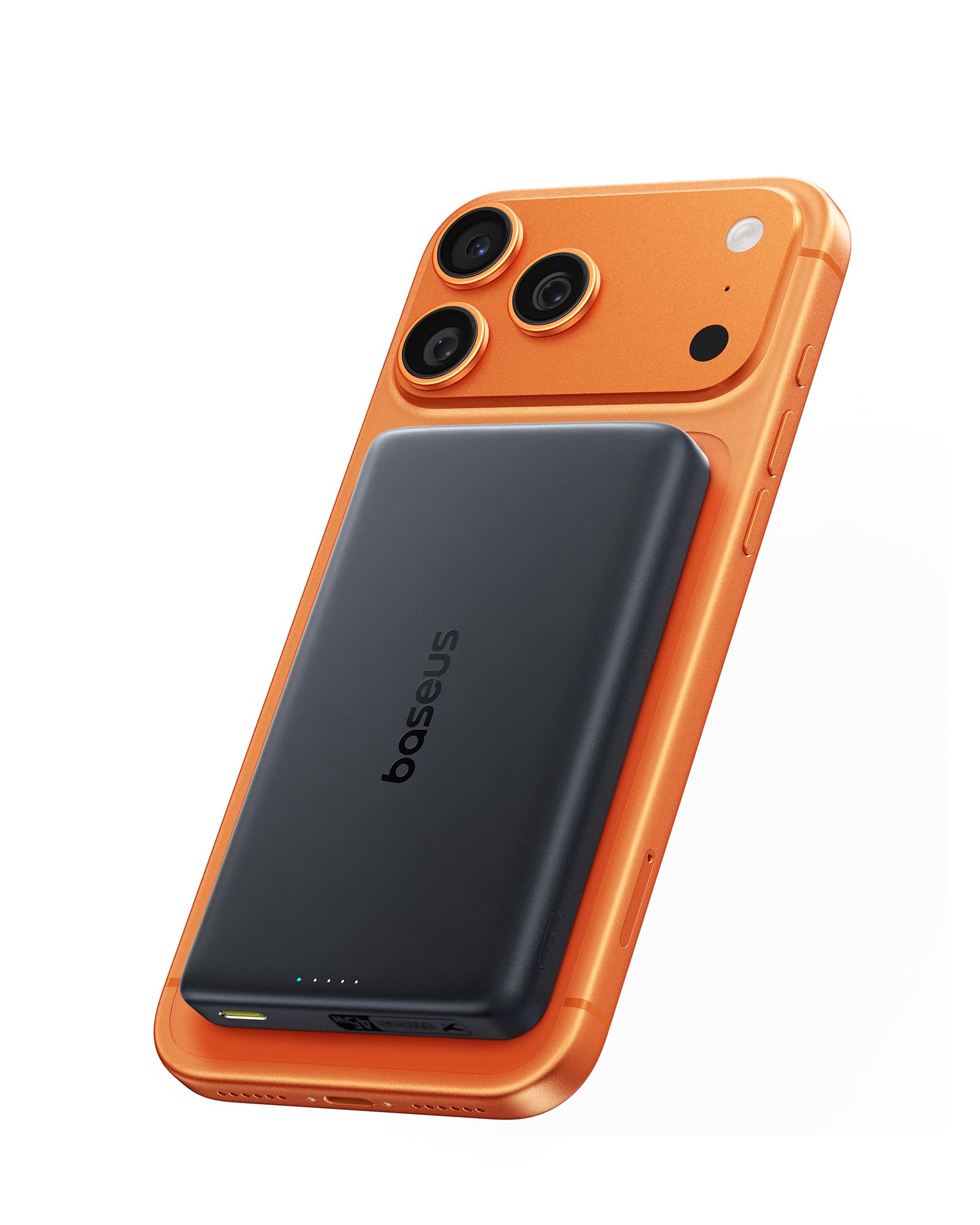
Qi2.2 25W wireless that holds under 97°F/36.2°C, plus 45W over USB-C.
The Picogo AM52 is what you buy when you have a recent iPhone and want the fastest wireless tier with the certification to prove it. Qi2.2 certification and 25W wireless charging let it lift an iPhone 17 Pro to 50% in about 34 minutes, so the top-up you grab at your desk is meaningful by the time you head out. The USB-C port climbs to 45W, pushing an iPhone 17 Pro Max from 0-65% in 30 minutes.
Heat is where Baseus has done the real work. An NTC temperature chip, a graphene inner layer and an aluminum alloy shell keep the surface below 97°F (36.2°C) — measurably cooler than the 104°F (40.3°C) of mainstream packs and the 118.4°F (48°C) industry standard, per the maker. That is the difference between a warm phone and a phone you can comfortably keep against your hand during a call. Its 30W input also refills the pack itself in 1.5 hours.
Charging speed is the trait buyers praise most, and reliability follows close behind. Understand the limit: iPhone 12-15 series top out at 15W, and Android phones get wired only — no magnetic snap or 25W wireless. The maker also warns against gaming while charging, and the silicone panel demands a MagSafe-compatible case.
What wins the speed crown
- Certified Qi2.2 25W wireless — the fastest tier on this list.
- 45W USB-C wired output for laptop and tablet top-ups too.
- Keeps to under 97°F/36.2°C, cooler than mainstream 104°F packs.
- 30W input refills the bank in 1.5 hours.
Know its boundaries
- iPhone 12-15 series cap at 15W; Android gets wired only.
- Non-MagSafe cases can cause overheating, per the maker.
Your pick if: you want certified 25W wireless and genuinely cool running during long top-ups, and your phone is an iPhone 16 or newer.
Skip if: your daily is an iPhone 15 or an Android — you would be paying for wireless speed your phone cannot draw.
8. i.VALUX Qi2.2 25W Wireless Power Bank, 10,000mAh
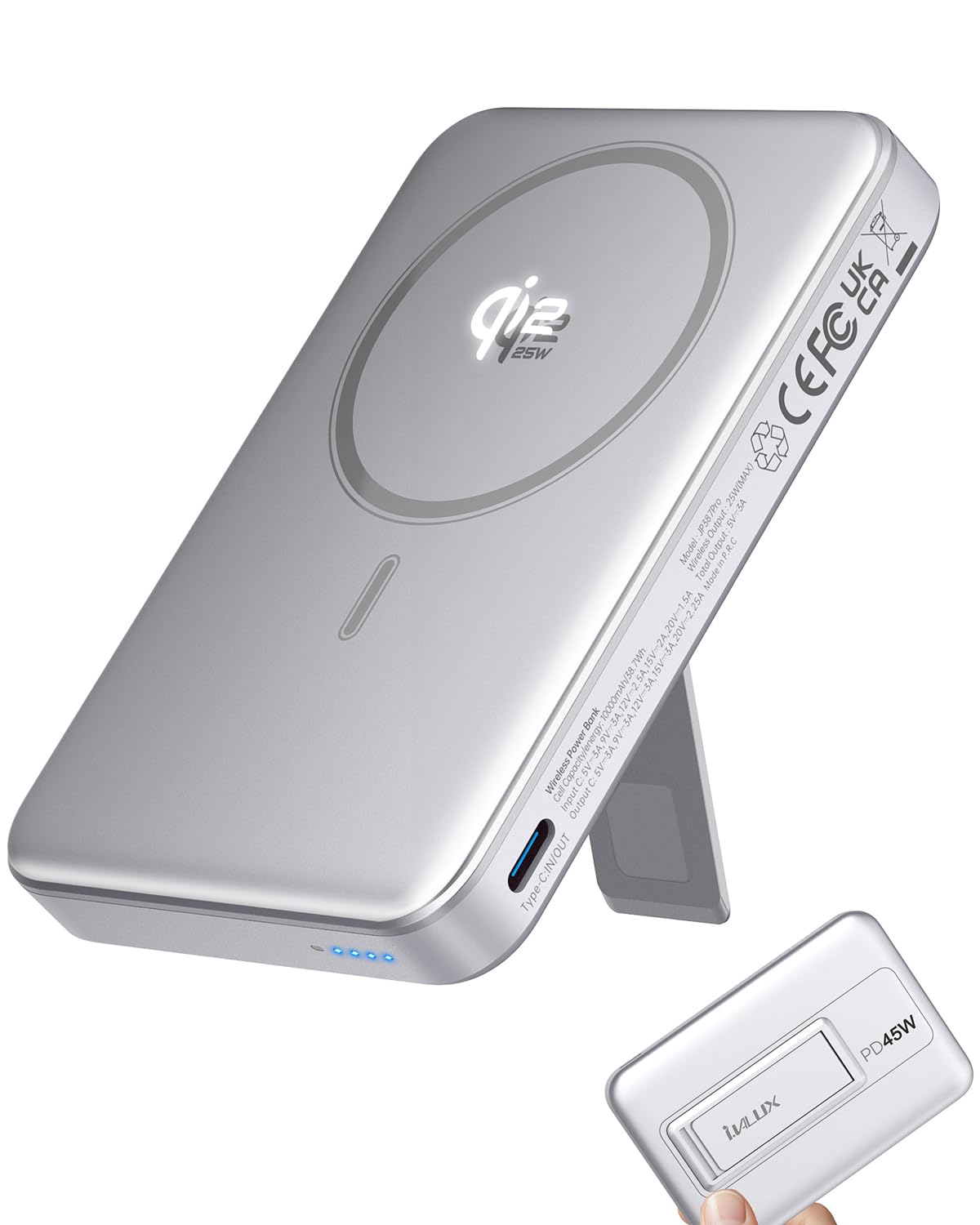
A Qi2.2 25W magnetic bank with a foldable kickstand for portrait or landscape viewing.
Most magnetic banks do one job: they hold a charge against your phone. This i.VALUX adds a foldable kickstand, so the phone stands portrait or landscape while it charges — the thing you actually want on a flight, at a desk, or while following navigation. The 25W Qi2.2 coil (certified) can pull an iPhone 17 Pro Max from 0-50% in 31 minutes under lab conditions, while the 45W USB-C port hits 50% in as little as 28 minutes wired.
It runs two 5,000mAh cells for balanced delivery, and the aluminum alloy housing handles heat instead of trapping it. An NTC temperature chip regulates warmth in real time, holding the bank within its certified safety limit and below 118.4°F (48°C). Owners see it lift a phone from about 12% to 56% in half an hour, and the magnet snaps on firmly with a secure hold.
Because this listing is young, the pool of owners is small compared with the heavier favourites. That is not a knock — the early signal is positive on speed, hold and portability — it simply means fewer long-term accounts of durability. Weigh it as a newer option, priced near the top of the premium tier, and note that it tops out at 1.8 charges for an iPhone 17.
The stand is the point: if you watch, navigate or take calls while charging, the kickstand turns a magnet back into a hands-free desk stand. The Qi2.2 25W coil gives you the same premium speed as the Picogo, backed by the all-metal shell.
Take it if: you want 25W certified speed plus a stand so your phone faces you during the charge.
Leave it if: you want a long track record — this one is newer and has fewer owners to consult.
9. UGREEN Qi2 25W Wireless Power Bank, 20,000mAh

20,000mAh and Qi2 25W wireless in a 236 g pack built for a bag, not a pocket.
This UGREEN is the largest and heaviest pack on the shortlist, and it is built for people whose priority is not running out rather than travelling light. It carries 20,000mAh at 236 g of internal cell weight and a Qi2 25W wireless output, so it combines the multi-day capacity of the smaller UGREEN above with the faster certified wireless tier of the Picogo.
Where owners feel it most is the size. It is a big, heavy brick — big enough that some find it blocks the camera when snapped on, and heavy enough that it belongs in a bag or on a desk rather than riding in a pocket on a walk. What it delivers is performance and fast charging that owners rate as its strengths, lasting most of a day on a charge and topping up quickly when it is running low.
That is the bargain: give up pocket fit and light weight, and you get days of power plus 25W wireless on a compatible iPhone 16 or newer. Wear it against a flat surface or prop it up while charging. The 20,000mAh figure also clears typical carry-on battery limits for most flights.
What you give up: pocket comfort and a light hand for the capacity of a power station and certified 25W wireless. If you need both maximum capacity and the top wireless tier, this is the only pack here that brings them together.
Built for: multi-device travellers and heavy users who need 20,000mAh plus 25W wireless, and who have a bag to put it in.
Not built for: pocket carry or anyone camera-sensitive about a pack sitting against the back of the phone.
Know the Specs
Wireless wattage and Qi2 certification
Wireless wattage is the power that crosses the air between the pack’s coil and your phone’s coil, measured in watts (W). It sets how fast the phone refills without a cable — 7.5W is a slow trickle, 15W is a steady everyday pace, and Qi2.2 25W is the faster tier on iPhone 16 and newer models. Qi2 and Qi2.2 are certification stamps that guarantee the pack’s magnets and wireless standard meet a defined bar, so the phone and pack align and charge predictably. Match the wattage to what your phone can actually accept, or you pay for speed your phone cannot draw.
Capacity (mAh) and what it really refills
Capacity is stored energy written in milliamp-hours (mAh). A 10,000mAh pack is the everyday carry size that refills a modern iPhone around once plus a partial second charge. A 20,000mAh pack doubles that and is for multi-day trips, at the cost of bulk and weight. Wireless charging wastes some of that energy as heat, so the usable refills are always a little less than the figure implies — plan for a top-up rather than a guaranteed full battery from a single charge.
Magnet hold and case compatibility
The magnet array is what keeps the pack and phone’s coils aligned while the phone moves. A strong hold snaps the pack on and keeps it there through scrolling and walking; a weak one lets the coils drift, and charging speed drops the moment alignment slips. Any case between the two magnets widens the gap, so a thick or non-MagSafe case can weaken the connection and, in the worst cases, cause overheating. A MagSafe-compatible case preserves the alignment the pack was designed for.
Heat, safety and wired fallback
Wireless charging turns wasted energy into warmth, and a pack pressed against your phone’s back needs to manage that heat. Packs with temperature control, NTC chips or aluminum heat-dissipating shells keep both devices cooler during fast charging. Every pack here also charges by USB-C at a far higher wattage than the coil — often 22.5W, 30W or 45W — which is your fast top-up when the coil’s rate is too slow for the moment. Treat the cable as the speed option and the coil as the hands-free convenience.
Common Questions
Will a magnetic power bank work with my iPhone case on?
Why does my phone charge slowly on a wireless power bank?
Is a 10,000mAh magnetic power bank enough for a full day out?
Can I charge my phone and the power bank at the same time?
Will a magnetic power bank charge an Android phone wirelessly?
How warm should a wireless charging power bank get?
Can I take a wireless power bank on a plane?
Does a thicker power bank charge faster than a slim one?
How long does it take to recharge the power bank itself?
Do I need a cable if the pack has a built-in one?
The Bottom Line
For most people, the wireless charging power bank winner is the Anker Zolo Magnetic Power Bank because it balances a 10,000mAh cell, cool sub-38°C running and a 30W cable into one dependable daily pack that performs well for thousands of owners. If certified speed is what you are after, the Baseus Picogo AM52 brings Qi2.2 25W wireless and a 45W cable. And for days away from any outlet, the UGREEN Qi2 25W 20,000mAh pairs multi-day capacity with the faster wireless tier. Whichever you pick, choose the pack that matches what your phone can actually accept over the coil, because that number decides how much of your day it really rescues.
How we choose
We do not accept paid placement. Every pick is matched to a real buyer and a real use-case; we do not hands-on test units.
Sources
Specifications: manufacturer listings and product documentation. Review insights: verified customer reviews, as of November 2026. Pricing: not shown on this page (it changes often); check the current price via the retailer link.
As an Amazon Associate, Tactical Gear Guy earns from qualifying purchases. This does not affect which products we feature.