Specs are compiled from manufacturer listings and verified buyer reviews and can change over time — please confirm the key details on the product page before buying.
Most wire staple guns fail for one plain reason: the staple lands too hard and bites into the cable jacket, and suddenly your Cat6 run is a dead run. The fix is a dedicated wire tacker with a grooved guide that rides the cable and sets an insulated staple over the jacket instead of through it. Below are the nine models worth your money, sorted by what they actually do well — some for structured wiring installs, some for low-voltage cable, and one pneumatic option for upholstery shops.
This guide is built by comparing the manufacturers’ published specifications and the patterns across verified customer reviews, so you get each pick’s real strengths and trade-offs instead of marketing spin.
You will see which guns load from the rear and which from the bottom, which run on a plain squeeze and which need a compressor, and where each one genuinely stops being the right tool. Every pick below earned its place by handling a real cable job, not by looking good in a photo — the honest way to shop a wire staple gun.
Top Picks


How To Choose The Best Wire Staple Gun
A wire staple gun is not a furniture stapler with a different label. It is a tool built to pin cable down without cutting the conductors inside. Pick the wrong one and you will spend an afternoon chasing dead Cat6 runs instead of finishing the pull.
Match the tool to the cable you actually run
Start with cable diameter, because that number sets everything else. The Arrow T59 handles wire up to 5/16-inch in diameter, which covers Cat5, Cat6, RG6, RG9, coax, and phone cable. The nVent GARDNER BENDER MSG-301 is built for low-voltage wire up to 1/4 inch. If your runs are thicker than the tool’s stated limit, the guide will not seat and the staple will crush the jacket.
Insulated staples versus plain staples
Most cable tackers fire an insulated staple — a staple with a plastic saddle across the crown that spreads pressure over the jacket instead of pinching it. That plastic saddle is what keeps the staple off the conductors. A plain flat-crown staple driven hard into a Cat6 cable will nick the conductors.
Rear-load versus bottom-load magazines
Rear-load magazines slide open at the back and take a full strip of staples. Bottom-load magazines drop the strip in from underneath. Neither is faster in every case, but rear-load tends to be easier to top up when you are working overhead or in a tight ceiling void.
Manual, corded, or pneumatic
Manual tackers run on hand squeeze alone — no hose, no cord, nothing to trip over. Corded electric models fire without hand pressure but need an outlet. Pneumatic staplers run off an air compressor and are built for high-volume shops. Buy the one that matches how often you actually tack cable: manual for a few drops, corded for speed, pneumatic for shop volume.
Side-by-Side Comparison
| Model | Best For | Staple / Fastener Type | Cable Size Handled | Load Style | Amazon |
|---|---|---|---|---|---|
| Arrow T59★ Best Overall | Structured wiring runs | Arrow T59 insulated, 3 sizes | Up to 5/16″ diameter | Rear-load | Amazon |
| Surebonder 5659Best Trigger Control | Tight-space cable work | Surebonder #19 or Arrow T59 | Coax RG6/RG59, Cat-5 | Not listed | Amazon |
| Acme 25ASmoothest Feeding | Jam-free cable work | 9/32″, 3/8″, 7/16″, 9/16″ | Up to 1/4″, 8 & 10 awg | Bottom-load | Amazon |
| Arrow T72 | Heavy jobsite cable | Arrow T72 insulated | Dual RG-6, non-metallic sheathed | Rear-load | Amazon |
| Acme 25AC | Cat 5e / Cat 6 and RG6 runs | Leg lengths up to 19/32″ | Up to 1/4″, Cat5/5E/6 | Bottom-load | Amazon |
| SENCO SFW-09 | High-volume upholstery | 22-gauge 3/8″ crown, 3/16″–5/8″ | Upholstery / fabric / trim | Not listed | Amazon |
Detailed Reviews
1. Arrow T59 Heavy Duty Staple Gun with Rear-Load Magazine
Our pick — 4.5+★ from 2,000+ verified ratings; the strongest balance of quality and price.
The default choice for anyone pinning Cat6, coax, or phone cable along a joist.
The spec that earns this gun its spot is the grooved wire guide — a channel cut into the nose that rides the cable as you press down. That guide keeps the staple centred and stops the tool from wandering, so the insulated staple lands over the jacket instead of into it. It handles wire up to 5/16-inch in diameter, which covers the Cat5, Cat6, RG6, RG9, coax, and phone runs most people actually install.
At 7.2 inches long and 1 inch wide, the body is narrow enough to slip between studs and under a desk without fouling on anything. Compare that to the Arrow T2025, which runs 9.5 inches wide across the body — the T59 is far easier to work one-handed in a tight ceiling void. It weighs 2 pounds, so it settles in the hand and stays balanced through a long pull of cable.
What wins people over is how quickly it makes wire management go. The rear-load magazine slides open and takes a full strip of insulated staples in three sizes: 1/4-inch by 1/4-inch, 1/4-inch by 5/16-inch, and 5/16-inch by 5/16-inch. Cross-compatibility with Cat5, Cat6, and AV cable means it handles just about every wiring situation on one job. The catch is the staple supply: this gun runs on genuine Arrow T59 staples only, so figure that into your buying plan rather than assuming any strip will feed.
What the T59 gets right
- Grooved wire guide tracks the cable and prevents jacket damage
- Handles wire up to 5/16-inch diameter in one tool
- Chromed steel housing with hardened steel working parts, made in the USA
- Rubberized grip on the short-span handle cuts hand strain
Where it asks something of you
- Locked to genuine Arrow T59 insulated staples only
- The 2-pound body is heftier than a light low-voltage tacker
Go with this one if: you run structured cable — Cat5, Cat6, RG6, or phone — and want the staple to seat clean over the jacket every time.
Look elsewhere if: your cable is thicker than 5/16-inch, because the guide and staple won’t clear it.
2. Arrow T2025 2-In-1 Staple Gun and Wire Tacker
Storage Handle
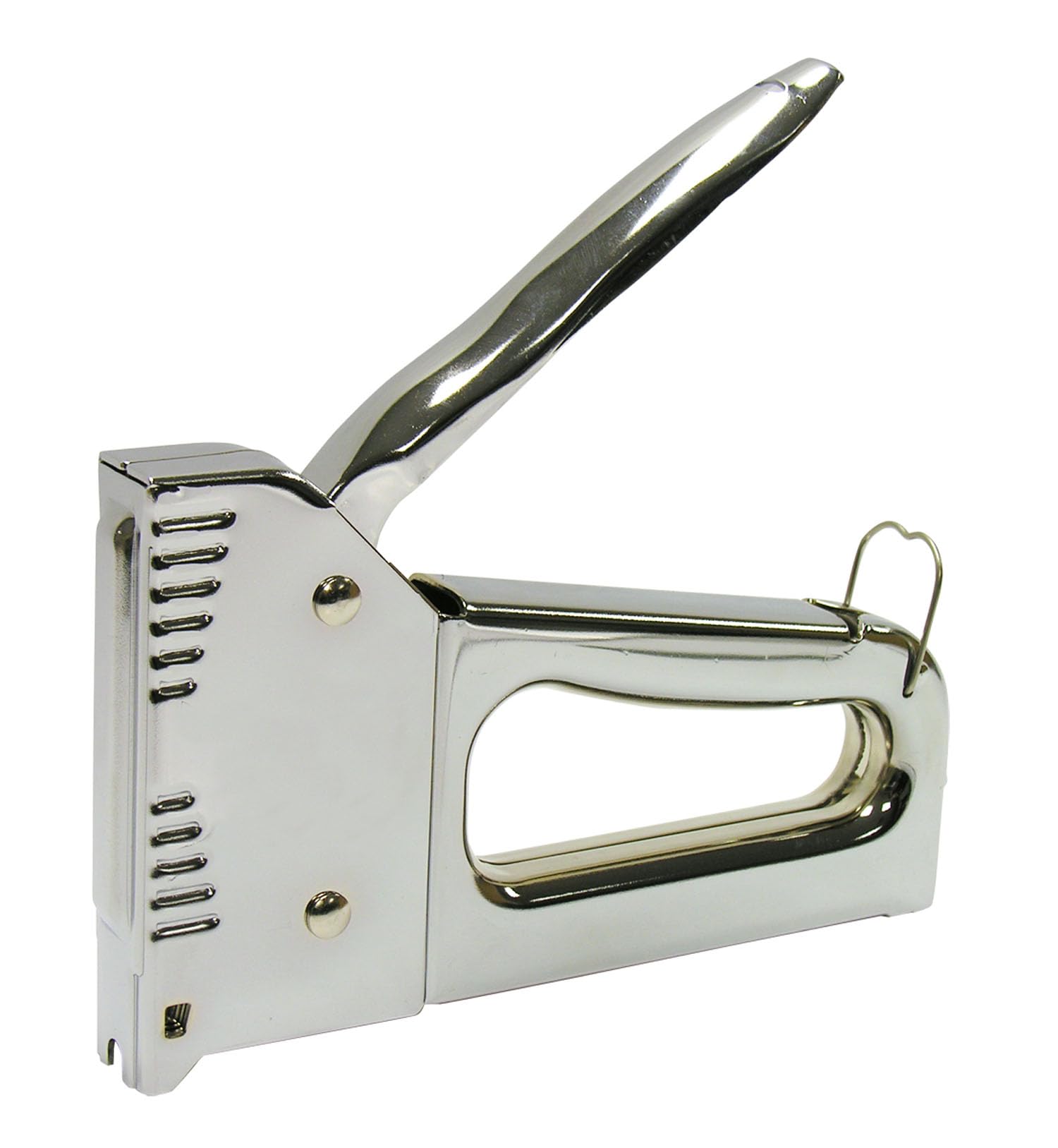
Feather-light stainless tacker built to leave Ethernet and coax jackets intact.
Start with the number that changes how this tool feels in your hand: 6.4 ounces. That is lighter than the Arrow T2025 at 11.36 ounces, so a long pull of cable along a baseboard does not wear your wrist out the way a heavier gun will. The stainless steel body shrugs off damp basements and garage air, and a safety handle locks the tool down to a compact shape for storage.
It is built for low-voltage wire up to 1/4 inch in diameter and runs on MMS-3101 or MMS-3102 staples. The reason installers reach for it is the wire protection — the staple sets around the cable rather than through it, and it is notably less prone to crushing an Ethernet run. It also works across Coax and other light cable, and it shines on exposed runs along trim and telephone poles where you need a tidy, low-profile tack.
Functionality is what the tool is known for — this is a plain, reliable low-voltage tacker that does its one job. What’s worth knowing before you buy: the squeeze grip draws mixed feelings, so if you have large hands or do hundreds of tacks at a stretch, try the T59’s rubberized handle feel first. For everyday low-voltage runs, though, the stainless body and near-weightless frame make it a quiet favourite.
Weight that disappears: 6.4 ounces of stainless steel means you can tack a whole run without the gun dragging your forearm down.
Sized for light cable: it tops out at 1/4-inch diameter, so thick dual RG-6 goes to a heavier tool instead.
Best fit for: anyone pinning Ethernet, coax, or phone wire in a damp or exposed spot who wants a light gun with real wire protection.
Wrong tool for: cable thicker than 1/4 inch or a hand that wants a big rubberized grip.
3. Surebonder TRIGGERFIRE Cable Tacker Staple Gun (5659)
Two firing modes let you pre-set the staple, then trigger it where your hand cannot reach.
The defining feature here is the mode switch. In Trigger mode you squeeze the handle to pre-set the staple, place the gun on the surface, then squeeze the trigger to fire. That lets you plant the tool in a cramped corner and set the staple without needing full handle travel. Flip to Normal mode and it behaves like a traditional stapler — place, squeeze, done.
Dual front and back staple guides keep the fastener square to the cable, and the tool covers the low-voltage staples most jobs need: Coax RG6, Coax RG59, Ethernet Cat-5, telephone wire, speaker wire, and thermostat wire. It takes Surebonder #19 staples or Arrow T59 staples, which gives you two supply routes if one is out of stock. Quality is what the tool is known for, and the trigger action is the second thing people notice.
There is a real caveat around the trigger mode — it does not always engage cleanly, so treat it as a convenience rather than the only reason to buy. Value also divides opinion, which is fair given it sits close to the T59 in the market. What tips it for tight-space work is that pre-set trigger; few manual tackers let you set a staple in a spot where the handle cannot swing through its full stroke.
Why cable installers like it
- Trigger mode pre-sets the staple for tight spots
- Runs on Surebonder #19 or Arrow T59 staples
- Covers Coax RG6, RG59, Cat-5, phone, speaker, and thermostat wire
- Dual front and back guides keep each staple square
What to weigh first
- Trigger mode can fail to engage, so normal squeeze stays the fallback
- Value is a matter of debate relative to simpler tackers
Pick this when: your cable runs duck into corners and ceiling voids where a full handle squeeze is impossible.
Skip the mode if: your work is open, flat, and straight — a plain tacker does the same job for less.
4. Acme 25A Cable Stapler, Bottom-Load
Bottom-load design and a jam-less feed for installers who hate stopping mid-run.
You get fewer stops mid-run, because Acme’s loading system and jam-less design are built to keep feeding through a long cable pull. The maker claims that design keeps the tool running, and clogged staples stay visible and easy to pull, so you are back on the job in seconds. The magazine (the channel that holds the staple strip) is bottom-load, so the strip drops in from underneath and you can watch the feed track as it moves.
On cable, it handles electrical wire up to 1/4 inch, including 8 and 10 awg stranded wire, plus bell wire, CAT 3, fire alarm cable, security system cable, telephone station, and thermostat wire. Staple leg lengths run up to 9/16-inch, which gives you room to set depth across different jacket thicknesses. The bottom-load system also interchanges with Arrow model T-25, so staple supply is not a locked-in problem.
The metal body with a yellow grip handle is built for a full install day, and a limited lifetime warranty backs the build. Given how well it feeds, that is a fair judgement call rather than a fault. If you have fought a jamming tacker through a ceiling full of Cat6, the jam-less feed is the upgrade that pays you back in saved time.
Your tool if: jam-free feeding on fire alarm, security, and Cat3 cable is worth more to you than a bargain price.
Not your tool if: you only tack a handful of staples a year and want the cheapest manual tacker that works.
5. Arrow T72 Heavy Duty Wire and Cable Staple Gun

Built for dual RG-6 and sheathed cable when a 1/4-inch tacker runs out of room.
This is the step up when your cable is thicker than a light low-voltage tacker can hold. The T72 takes dual RG-6 and non-metallic sheathed cable without crimping, and a grooved wire guide tracks along the jacket to keep the staple square. It fires 13/64-inch by 31/64-inch insulated staples from a rear-load magazine, so it keeps its place for serious jobsite cable runs.
The build is chromed steel housing with hardened steel working parts, made in the USA, and the handle has a rubberized grip on a short span for repeat compression. At 10 inches long and 1.5 inches wide, and 1.1 pounds, it sits on the heavier end of the manual tackers here. That weight and length are there for leverage on dense sheathed cable, not for light Ethernet work. The rear-load magazine loads a full strip at a time, which matters when you are working a long wall.
The trade-off is honest and worth saying plainly: this is not a set-and-forget tool. Feed can stop short once only a few staples remain in the strip, and the squeeze effort climbs when you are punching through tough material. Reliability and quality both read as mixed across buyers — some swear by the T72 on hard cable, and others find it fails sooner than they hoped. Buy it for the thick-cable job it is built for, not as an all-rounder.
Where it earns its place: dual RG-6 and sheathed cable are exactly what a 1/4-inch low-voltage tacker cannot hold, and that is the job this gun is for.
The honest limit: multi-hour runs get tiring, and a strip running low can stop feeding until you top it up.
Right call for: an installer running dual RG-6 or non-metallic sheathed cable who needs the staple to clear the jacket without pinching.
Overkill for: a homeowner tacking one Cat6 drop — the T59 is lighter and easier on the hand.
6. 25AC Stapler with Bottom-Load Magazine
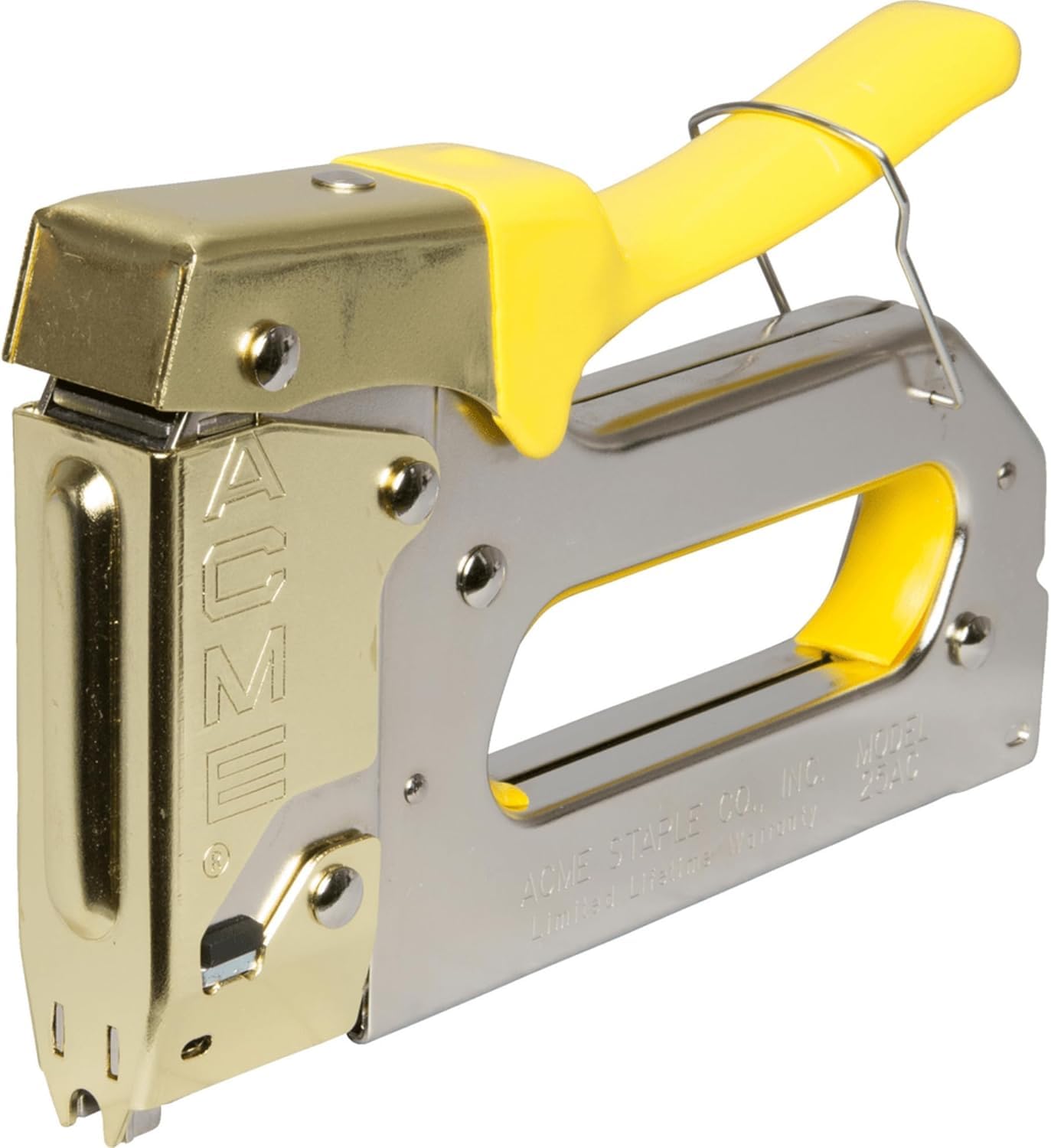
A niche tacker that names Cat 5e and Cat 6 in its own spec sheet.
Most tackers promise “low voltage” and leave you to guess. This one states its cable list outright: Bell Wire 18/3 AWG, CAT 5, 5E, and 6, and small diameter RG6 coax. If your job is a modern structured wiring install, that is the exact fit you want to see on the box. It handles electrical wire up to 1/4 inch and takes staple leg lengths up to 19/32-inch.
The bottom-load magazine drops the strip in from underneath, and the metal body with a yellow grip handle is built for a working install. At 2.3 pounds it carries more heft than a light low-voltage tacker, which gives it a steadier feel on a ladder. Acme’s loading design is aimed at fewer jams, and the tool is meant to clear them by itself when one does occur.
This is a specialist pick, and the practical caution is supply. It has a small base of buyers compared to the big-name guns, so fewer voices to lean on and a narrower track record. If you want the tool that directly names Cat 6 and RG6 and you are happy with a bottom-load magazine, it does the job it advertises. If you want the most proven track record in the category, the T59 above has far more history behind it.
Why it suits structured wiring: Cat 5e and Cat 6 are named in the spec, so you are not guessing whether a 1/4-inch limit will clear your run.
The follow-up question: it is a niche name with a thin review base, so leaning on a widely used tacker is a safer bet if you want proven history.
Fits you if: your install list reads Cat 5e, Cat 6, and small RG6, and you want a tool that names them outright.
Second-guess it if: you would rather have the most-reviewed track record in this list behind your purchase.
7. SENCO SFW-09 Pneumatic Fine Wire Stapler
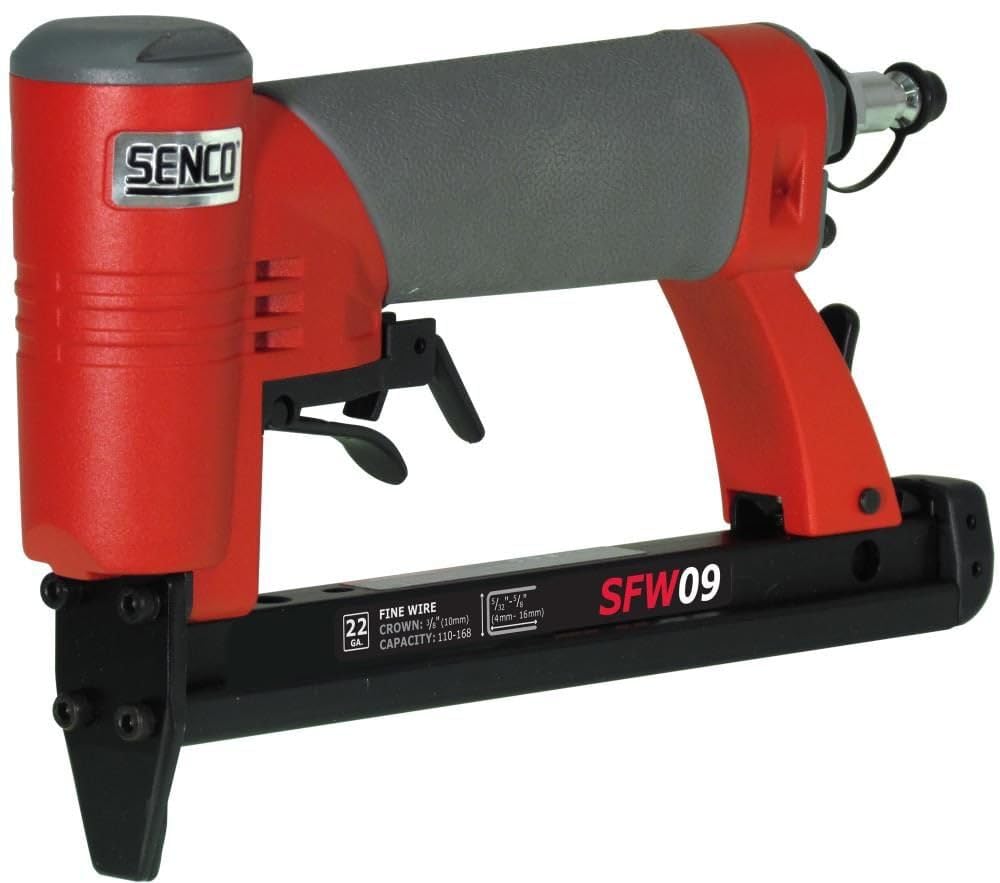
An air-powered shop tool for upholstery, not a cable run.
This one belongs in a different lane, and that honesty matters. The SFW-09 is a pneumatic fine wire stapler that runs off an air compressor and drives 22-gauge 3/8-inch crown fine wire staples from 3/16-inch to 5/8-inch long. It is built for upholstery, fabric, furniture, and light trim work — the kind of shop job where you fire hundreds of staples into padding and wood.
Two details make it pleasant for that work. The long 1-inch lip fits into tight spots where a chunkier stapler cannot reach, and a rounded steel cap will not snag fabric as you move across a piece. The rear exhaust keeps oil off the material, which is exactly what you want when the material is a customer’s upholstery. It is ultra-lightweight too, so your arm does not tire as you work across a sofa back.
The practical caution: it needs a compressor and an air line, so it is a shop tool, not a homeowner’s first staple gun. The trigger also draws mixed feelings — several find the safety trigger finicky to actuate. And it is not a cable tacker: it drives fine wire staples into soft material, not insulated staples over a Cat6 jacket. Buy it if you do upholstery volume. If your job is cabling, stay with the manual wire tackers above.
Where it shines: a 1-inch lip and a rounded non-snagging cap make it easy to reach inside furniture frames without tearing fabric.
Know before buying: it needs a compressor and air line, and the safety trigger is finicky — it is a shop tool, not a first gun.
Made for: an upholstery shop that wants a light pneumatic gun reaching tight spots with rear exhaust that keeps oil off fabric.
Not the pick for: anyone tacking cable or working without a compressor.
Know the Specs
Staple Crown and Leg Length
The crown is the flat bar of the staple that sits across the top; the legs go down into the surface. On a cable tacker you want a round crown with an insulated saddle so the crown spreads pressure over the jacket. Leg length sets how deep the staple drives — longer legs for thicker material, shorter for delicate cable. Wrong crown shape on the wrong cable is the fastest way to crush a jacket.
Staple Compatibility and Load Style
Check the staple type before you buy, because some tackers only take one brand of staple — the Arrow T59 and the Acme 25A’s Arrow T-25 interchange are two examples. Loading works two ways: a rear-load magazine opens at the back, while a bottom-load magazine drops the strip in from underneath. Both hold a full strip, so pick the one that is easier for how you work — overhead, in a corner, or across a long flat run.
Cable Diameter Rating
This is the number you check before you buy. A tool rated to 1/4 inch handles thin low-voltage wire and smaller coax. A tool rated to 5/16 inch opens up Cat5, Cat6, RG6, and RG9. If your cable sits above the tool’s rating, the guide will not seat and the staple will bite the conductor.
Manual, Corded, and Pneumatic Power
Manual tackers run on hand squeeze and need no power source. A corded electric model like the Arrow ET501F fires with a motor, so it needs an outlet and fires up to 60 shots a minute. Pneumatic models like the SENCO SFW-09 run on an air compressor and are built for high-volume shops. Match the power source to the work: hand squeeze for ladder work, an outlet for speed, a compressor for shop volume.
Common Questions
Will a wire staple gun work on Cat 6 cable without damaging it?
What is the difference between a wire staple gun and a regular staple gun?
Can I use a wire staple gun on cable thicker than the stated rating?
Do all wire staple guns use the same staples?
Is a manual or electric wire staple gun better for long cable runs?
Can I staple coax cable with these tools?
What does insulated staple mean and why does it matter?
Do I need an air compressor for a wire staple gun?
What is a grooved wire guide for on a cable tacker?
Will a wire staple gun clear its own jams?
The Bottom Line
One tool covers four cable types and wire up to 5/16-inch: the Arrow T59 names Cat5, Cat6, RG6, and RG9, so you can run network and coax jobs without swapping tackers. It also has the longest track record in this list, which matters when a crushed jacket costs you a whole run. Want a smoother feed that also handles fire alarm and security cable? The Acme 25A is built for that. And if you do upholstery volume rather than cabling, the SENCO SFW-09 is the shop tool built for that job.
How we choose
We do not accept paid placement. Every pick is matched to a real buyer and a real use-case; we do not hands-on test units.
Sources
Specifications: manufacturer listings and product documentation. Review insights: verified customer reviews, as of November 2026. Pricing: not shown on this page (it changes often); check the current price via the retailer link.
As an Amazon Associate, Tactical Gear Guy earns from qualifying purchases. This does not affect which products we feature.