Specs are compiled from manufacturer listings and verified buyer reviews and can change over time — please confirm the key details on the product page before buying.
You do not need to start a siphon with your mouth, and you do not need a power outlet either. A hand-operated water siphon pump uses a piston or squeeze bulb to pull liquid up and over an edge, then gravity does the rest. The payoff: a 55-gallon drum, a flooded kayak, or a rain barrel drains without lifting a heavy can or mouth-starting a hose. This guide sorts nine pumps by what they actually move best — drinking water, gasoline, aquarium gravel, or bilge water — so you grab the one that fits your job.
This guide is built by comparing the manufacturers’ published specifications and the patterns across verified customer reviews, so you get each pick’s real strengths and trade-offs instead of marketing spin.
Some pumps here move 5.5 gallons a minute and some handle a 33.4-inch suction tube, so the difference between a smooth job and a mess is usually the tube length and the seal. Below, each pick gets a plain-English read on the flow rate, the liquid it tolerates, and the trade-off to expect, which is exactly what you need before choosing the best water siphon pump for your tank, boat, or barrel.
Top Picks

How To Choose The Best Water Siphon Pump
The first question is not “which pump is strongest” — it is “what am I moving, and how far down does the tube need to reach?” A pump that empties a boat bilge is useless in a 55-gallon drum, and a drum pump with a 33.4-inch tube will not fit in a betta tank. Match the pump to the container first, then look at speed.
Start with the liquid, not the pump
Drinking water, gasoline, and antifreeze each need a different level of material safety. A food-grade or BPA-free body means the pump is built for water you or your pets may drink, while a general-purpose fuel pump is fine for gasoline and kerosene but should never touch your drinking supply. Check the compatibility list on each pump before you buy — several here name exactly which liquids they handle and which to avoid.
Flow rate tells you how long the job takes
Flow rate (measured in gallons per minute, or gpm — how much liquid the pump pushes each minute) is the number that predicts your afternoon. A drum pump rated 5.5 gpm can empty a barrel in one sitting, while a small aquarium siphon moves water slowly on purpose so you do not drain the tank too fast. Match the flow to your container size: fast for drums and bilges, gentle for fish tanks.
Tube length and reach decide whether it fits
A pump only works if its suction tube reaches the bottom of your container. Drum barrels need a long tube (some reach over 33 inches), while kayaks and small tanks need a shorter, more maneuverable one. Measure your container’s depth before ordering — a tube that is too short leaves liquid stranded at the bottom.
Side-by-Side Comparison
| Model | Best For | Flow Rate | Tube / Hose Length | Liquid Compatibility | Amazon |
|---|---|---|---|---|---|
| TERA PUMP Drum Barrel Pump★ Best Overall | 55-gallon drums and drinking water | 5.5 gpm | 33.4″ suction / 47.2″ discharge | Water (incl. drinking), gasoline, oils, mild corrosives | Amazon |
| TERA PUMP Heavy Duty Emergency SiphonBest for Emergencies | Small jobs and emergencies | 6.8 L/min | — | Gasoline, diesel, kerosene, light oils, non-potable water | Amazon |
| AREPK Compact Aquarium Siphon KitBest for Fish Tanks | Small fish tanks up to 10 gallons | — | — | Aquarium water, gravel and sand cleaning | Amazon |
| SMART JERRY Manual Fuel Transfer Pump | Transmission fluid and vehicle fluids | 2.5–3 gpm | 52″ hoses / 48″ extension | Gasoline, motor oil, transmission fluid, water, coolant | Amazon |
| Vila Multi-use Manual Transfer Pump Kit | Rain barrels and garage tasks | — | 15″ suction / 39″ discharge | Water, gasoline, diesel, detergents, kerosene | Amazon |
| MADHOLLY Antifreeze Hand Pump Kit | RV winterizing | — | 2 × 51.5″ PVC hoses | Antifreeze, gasoline, diesel, engine oil, water | Amazon |
| LINGVUM Manual Bilge Pump | Kayak and boat dewatering | — | 23.2″ hose | Bilge water | Amazon |
| Underhill Big Gulp Pro | Dirty water and field crews | 8.22 gpm | 36″ suction / 72″ outlet | Water, sediment-laden water | Amazon |
Detailed Reviews
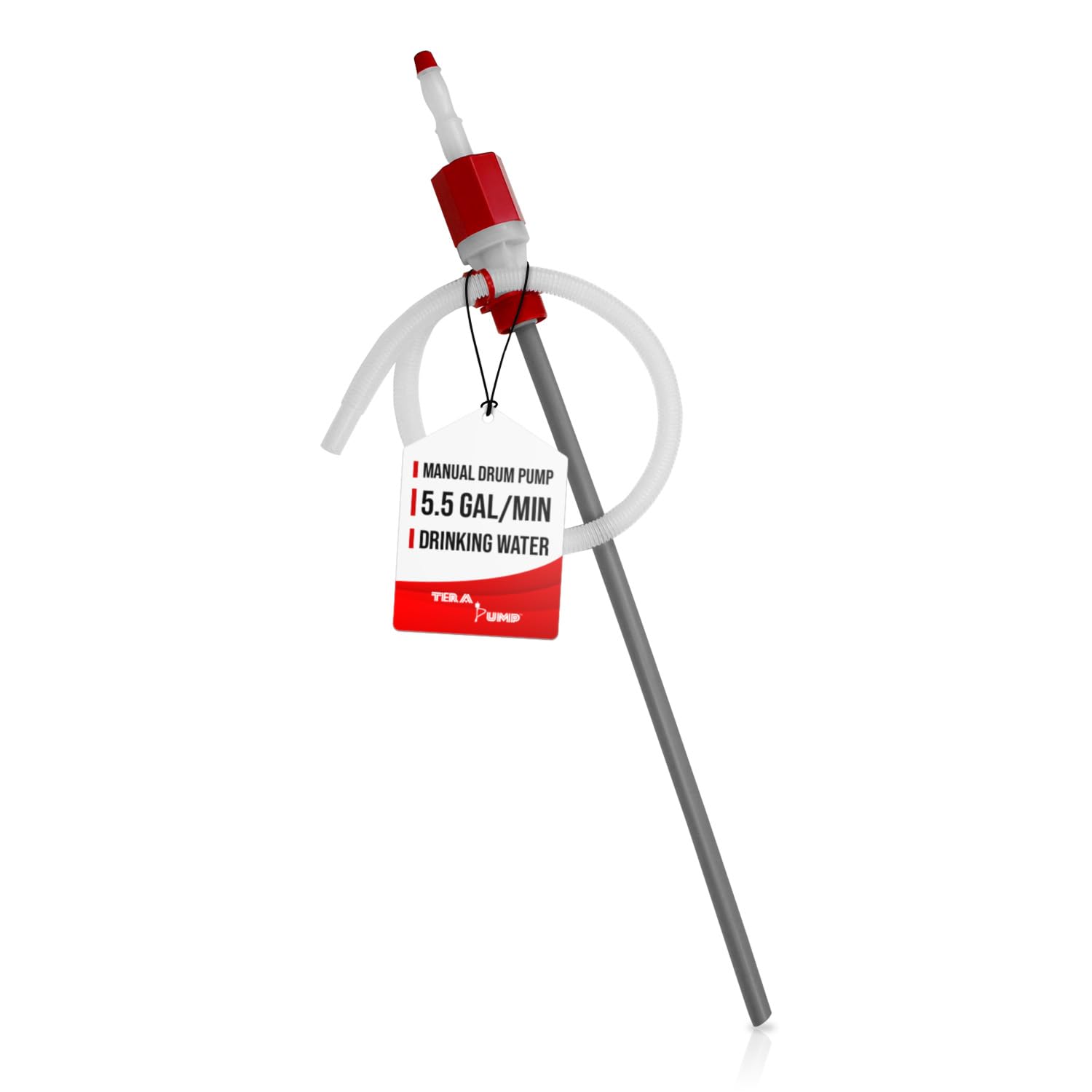
1. TERA PUMP Drum Barrel Pump for 55 Gallon and Drinking Water
Our pick — 4.5+★ from 800+ verified ratings; the strongest balance of quality and price.
A piston-action drum pump that moves 5.5 gallons a minute with no electricity at all.
If your job is a 55-gallon barrel, this is the pump the crowd favorite status belongs to — 4.5+ stars across 800+ owners, and the quality of the build is what wins people over first. It pushes 5.5 gallons per minute (about 21 liters), which means a full drum drains in one continuous session rather than a stop-start chore. The suction tube runs 33.4 inches, so it reaches the bottom of a standard drum, and the 1-inch diameter keeps the pull strong. The discharge hose stretches 47.2 inches, giving you room to aim the outflow into a bucket or second container.
The BPA-free polyethylene and polypropylene body is what makes this pump unusual: it is rated for drinking water as well as gasoline, kerosene, and mild corrosives. So the same tool that empties a fuel drum can fill your emergency water supply.
The catch worth knowing: the durability feedback is mixed, with a few owners noting wear over heavy use. Given the piston mechanism and the plastic build, treat it as a dependable tool for regular jobs rather than an indestructible industrial unit. It is also a dedicated drum pump — the 33.4-inch tube will not suit small tanks or tight boat compartments.
What earns its place
- 5.5 gpm flow empties large drums fast — about 21 liters per minute.
- BPA-free body handles drinking water and fuel in one tool.
- 33.4-inch suction tube reaches the bottom of a 55-gallon barrel.
- Air-vent cap lets you slow or stop the flow on command.
Where it asks for care
- Durability feedback is mixed under heavy, repeated use.
- Long tube is built for drums, not small tanks or kayaks.
Go for it if: you deal with 55-gallon drums and want one pump that handles both fuel and drinking water.
Think twice if: your container is small or your priority is a pump light enough to toss in a kayak.
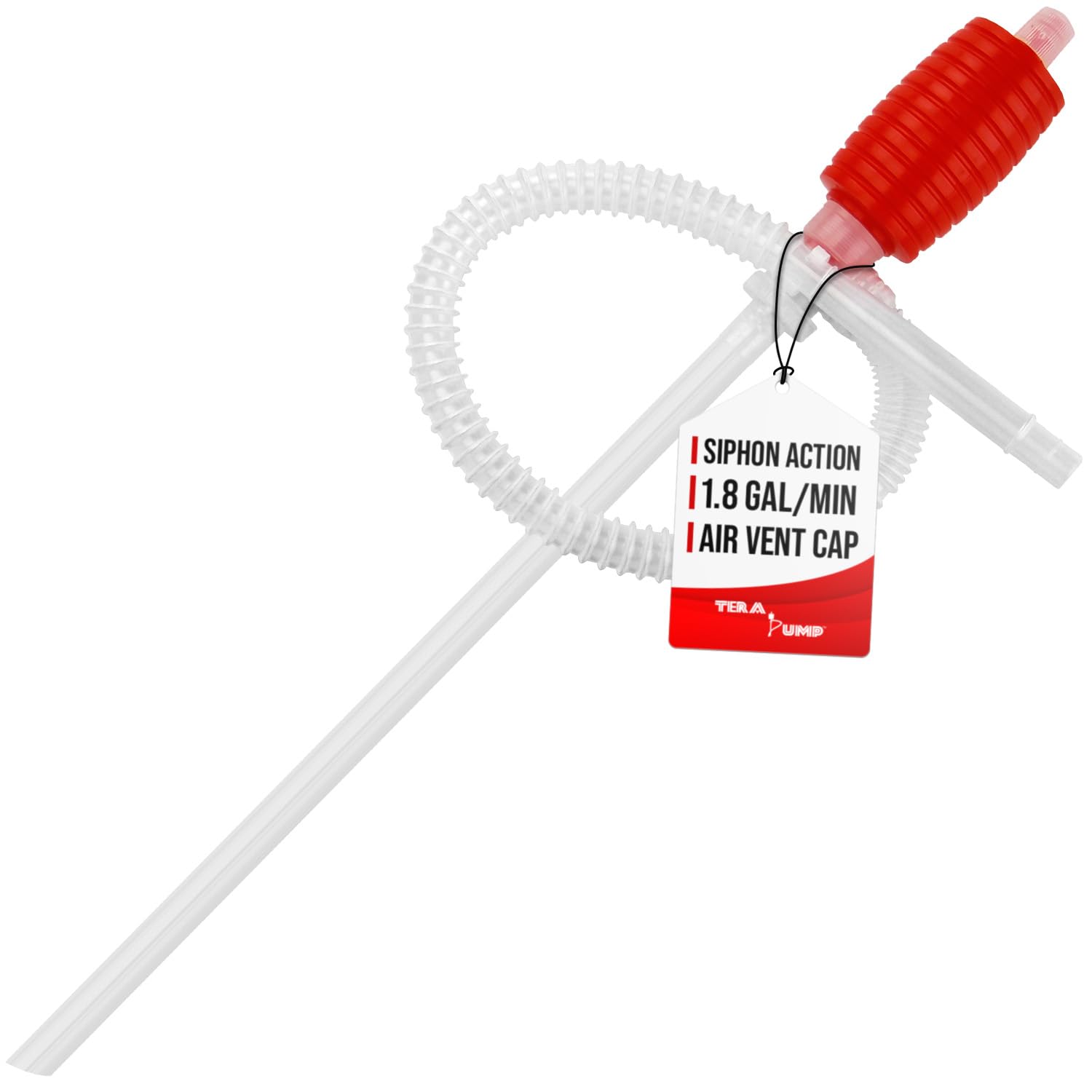
2. TERA PUMP Heavy Duty Siphon Pump
The pump that weighs next to nothing and lives in your emergency kit until the power dies.
At 1.6 ounces, this is the featherweight of the group — and that gap is real: the drum pump above weighs 16 ounces, so this one is a full order of magnitude lighter and disappears into a glovebox or toolkit. It moves 6.8 liters per minute through a manually handled mechanism, no batteries or cord required. The sturdy PE plastic body stands up to gasoline, diesel, kerosene, light oils, and light solvents, along with non-potable water — so it is a versatile backup for the small jobs that pop up around a garage or farm.
The value is what carries it. It is a budget-friendly entry point into siphon pumping, and the quality is the thing owners praise most in review after review. Its chemical-resistant materials are built to shrug off toluene and chemical insecticides. There is also a 1-year warranty on manufacturer defects, which for a manual tool at this tier is a fair safety net.
The honest trade-off: durability is mixed, with some expecting it to last many years and others finding it wears sooner than hoped, and a few note it is not perfectly leak-proof. It is also explicitly not for drinking water — this is a fuel and non-potable water pump. Keep that line clear and it does exactly what you need.
Build for the price: Durable PE plastic with chemical-resistant materials — a solid little tool for fuel, solvents, and garage liquids. The 6.8-liter-per-minute flow is enough for small transfers without feeling sluggish.
The honest limit: Mixed durability feedback and a “non-potable” rating mean you should keep this away from your drinking water supply and treat it as a light-duty helper.
Reach for this if: you want a tiny, budget-friendly pump for fueling equipment or moving non-potable water in a pinch.
Look elsewhere if: drinking water or long, heavy jobs are on the agenda.
3. AREPK Compact Aquarium Siphon Vacuum and Water Changer Kit
A tank-cleaning siphon built for betta and nano tanks under 10 gallons, gravel included.
Fish tanks need a gentler touch than drums, and this kit is tuned for that. It comes with three independent cleaning heads — a thinner straw for tight spots between rocks and plants, a brush head for scrubbing decorations, and a sponge for wiping tank walls, with two sets of replaceable sponges. Because it uses the siphon principle, it changes water and vacuums gravel in the same pass. The transparent tube is made of fish-friendly, odorless material, and a pipe fixing clamp holds the tube in place so the outflow does not slip and spill.
Owners recommend it heavily — that is the note that dominates the review feedback, and assembly and disassembly are described as genuinely easy, which matters when you are elbow-deep in a tank. It works for meticulous cleaning in larger aquariums above 10 gallons, and it is at its best on tanks under 10 gallons, mini and nano setups, and turtle tanks, where its compact size avoids wasting too much water in one pull.
Two things to plan around: size and clogging get mixed feedback, so very narrow gravel or heavy debris can slow it, and the pump head is detachable at both ends — that is your unclog and rinse access. For a small tank, the trade-off is worth it; the flow stays slow enough that you are not draining the whole tank before you notice.
Where it shines: A complete cleaning kit for nano and small tanks — three heads, replaceable sponges, and a clamp that keeps the tube put while you work. Easy assembly and tear-down make routine water changes far less of a hassle.
The honest limit: Mixed feedback on clogging and size means it is a small-tank tool; heavier gravel or debris may need the detachable head cleaned out mid-job.
Best for the fishkeeper with a small tank: betta, nano, and turtle setups up to 10 gallons get a full gravel-and-water-change kit in one box.
Not the pick for: large tanks or heavy gravel loads that need a stronger pull.
4. SMART JERRY Manual Fuel Transfer Pump

A leak-sealed fluid pump that assembles in 30 seconds and reaches deep into big tanks.
Where the drum pump zips along at 5.5 gpm, this one runs a steadier 2.5–3 gallons per minute — a slower pace but still enough to cut fluid extraction time on a lawn mower, car, or ATV. The two 52-inch flexible tubes plus a 48-inch extension hose are the real story: that reach gets you into deep tanks and large barrels without tipping anything. The PP pump cylinder and wear-resistant PVC hoses are built for long service with simple maintenance, and reinforced sealing keeps water, fuel, coolant, oil, and transmission fluid from leaking at the joints.
Functionality is what people rave about — it works well for transmission fluid changes especially, and the versatility of handling so many fluids is a big part of its appeal. Tool-free assembly is a genuine convenience: no screwdrivers, no clamps, done in about 30 seconds. There is even a dual function — switch from liquid suction to air inflation for sports balls and balloons with the dedicated adapter.
The caveat is quality and value, which split feedback — some find it fine for the light loads, others say you get what you pay for. Durability gets some negative notes, so this is a maintenance-friendly tool you keep clean between jobs rather than a shop-grade workhorse.
Why owners keep it handy
- 52-inch hoses plus a 48-inch extension reach deep into tanks.
- Reinforced sealing designed to stop leaks at the joints.
- Tool-free assembly in about 30 seconds, no clamps needed.
- Handles gasoline, oil, transmission fluid, coolant, and water.
What to keep in mind
- 2.5–3 gpm is slower than the bigger drum pump.
- Quality and durability feedback is mixed at this price tier.
Pick it for: transmission fluid changes and everyday vehicle fluid swaps where long hoses and quick setup matter.
Pass if: you need serious flow speed or a pump built to shrug off constant heavy use.
5. Vila Multi-use Manual Fuel Transfer Pump Kit

A 24-inch pump-and-tube kit for moving rain barrel water to the garden without lifting a can.
This seven-piece kit connects a 9-inch hand pump to a 15-inch suction tube for a 24-inch total reach, with a 39-inch discharge tube and a secure cap that rotates for on or off. It is a household garden helper as much as an automotive one — ideal for draining a rain barrel to water plants, or transferring detergents, soaps, thinner, and kerosene alongside water and petrol products. The strong PVC plastic body and tubes rinse clean with soap and water, and the lightweight build makes it easy to stow in a trunk for emergencies.
What works is the function — it drains fountains and moves transmission fluid with equal ease, and setup is straightforward. It is deliberately not for thick liquids or highly caustic ones like nitric, hydrochloric, or sulfuric acid, so keep those off the list.
Now the caution, and it is one to take seriously: durability feedback is poor, and more than one buyer reports it breaking after a couple of uses — so this is a light-duty transfer tool, not a long-term workhorse. The hose is also reported as rigid, which can make tight container angles awkward. If you need occasional simple transfers, it does the job; if you need something that lasts seasons, look at the drum or bilge picks above.
Where it earns its keep: A complete all-in-one kit with a rotating cap to control flow, a 24-inch reach, and an easy-to-rinse PVC body. Perfect for garden and household transfers that do not need heavy flow.
The real caution: Durability is the weak point, with reports of breakage after a few uses and a rigid hose that resists tight bends.
Worth it for: light, occasional rain-barrel or garage transfers where a full kit in one box is convenient.
Choose another pick if: you need the pump to survive repeated or heavy use over time.
6. MADHOLLY Antifreeze Hand Pump Kit for RV Accessories
An RV winterizing kit that pushes antifreeze into the black tank line before the first freeze.
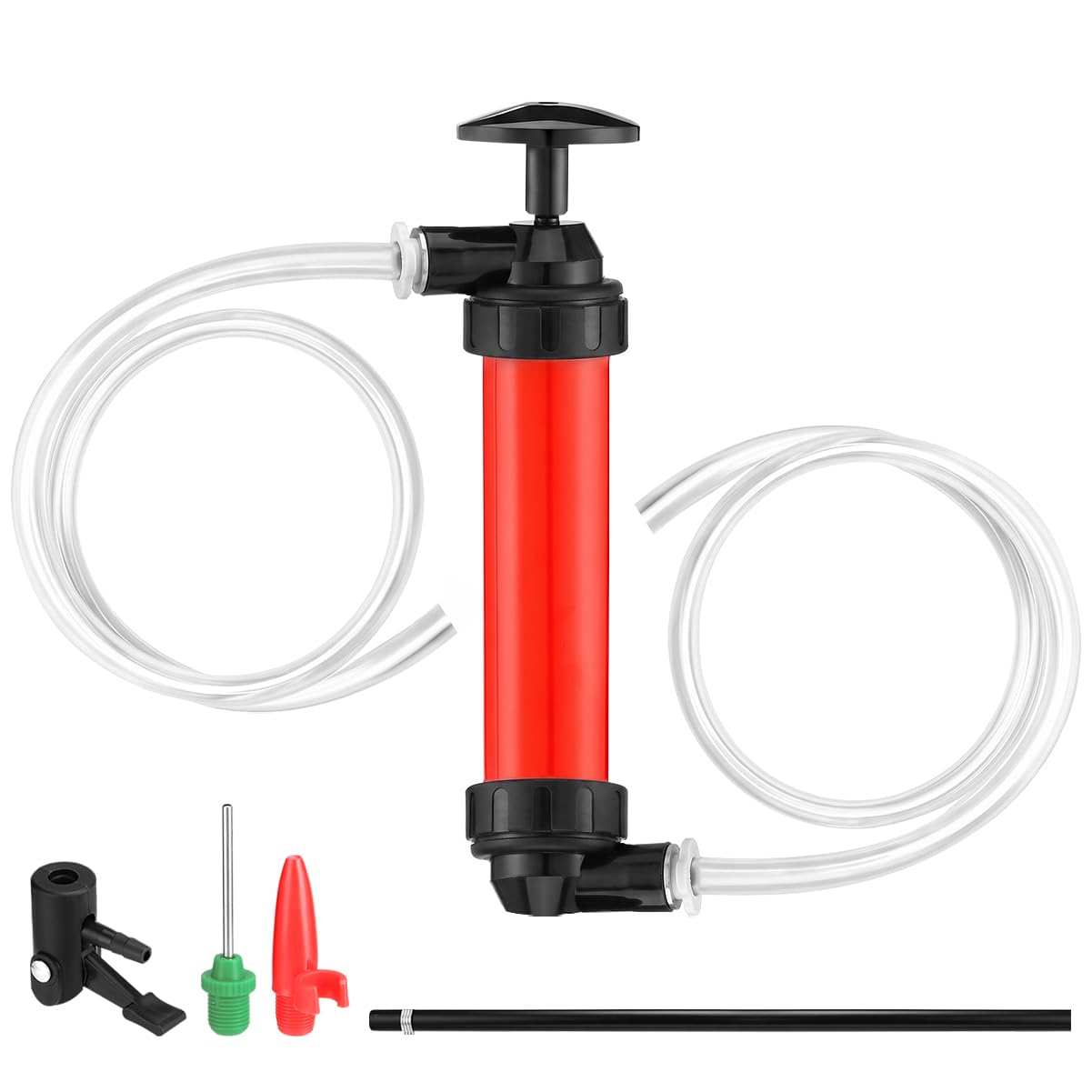
Cold weather is where this kit justifies itself. It quickly injects antifreeze into the black tank flush line, which is what protects your pipes from freezing or bursting when the temperatures drop. The set includes a red hand pump with two adjustable ports, two transparent PVC hoses at 51.5 inches each, a 16-inch black hose, and an inflation nozzle pack — a ball needle, lock-on air connector, and tapered nozzle for inflatables. The quick-connect fittings hold the soft PVC hoses directly at both ports without extra metal clips or brass adapters, which cuts down on loose connections and leakage when properly installed.
Winterizing an RV is what owners say it does well, and setup takes just a few seconds — a relief when you are prepping a camper in the cold. Past that, it is a multi-scenario siphon too: gasoline, diesel, engine oil, transmission fluid, and water, feeding lawn mowers, generators, boats, and fish tanks without lifting heavy cans. The corrosion-resistant plastic and soft, pressure-resistant PVC hose are built not to crack or age easily.
Quality and value feedback is mixed — some call it a great value, others question the cost. It also needs proper fitting to avoid leaks, so take a minute to seat the quick-connects fully. For the specific winterizing job, it is a fit.
The winterizing case: A purpose-built kit for pushing antifreeze into RV flush lines, with two 51.5-inch hoses, an inflation pack, and quick-connect ports that avoid extra clips. Fast to set up when the cold is closing in.
The honest note: Mixed quality-and-value feedback, and the quick-connects need to be fully seated to stay dry.
The one for camper owners: if your priority is winterizing an RV before a freeze, this kit is built for exactly that line.
Look further if: you want premium build and are not winterizing anything.
7. LINGVUM Manual Bilge Pump

A 16.5-inch bilge pump that stows on a kayak and clears water with a 23.2-inch hose.
This is the emergency dewatering tool for kayaks, canoes, and dinghies, and its numbers suit the job. The pump runs 16.5 inches and unfolds to 25.5 inches, with a 23.2-inch hose that attaches to either of two water inlets so you can aim the outflow where you need it. Each stroke displaces up to 0.4 liters, and the premium rubber seal is built to hold a watertight fit so the suction does not bleed away. At 0.78 pounds, it stows out of the way until you need it.
What owners like is that it simply works — it is well-built and easy to keep on a kayak, and the non-slip foam-padded handgrip doubles as buoyancy if it goes overboard. No power source required, so it is ready when the electronics are not.
Where it falls short is the hose, which several describe as too short for reaching the last of the water, and ease of use is mixed — some find it becomes difficult to operate when the going gets heavy. Value splits too, between those who see it as a bargain and those who find it overpriced for what it is. For calm-water kayakers clearing a splash, it is a solid fit.
Why kayakers keep one aboard
- 0.4 liters displaced per stroke with a sealed rubber fit.
- Two water inlets and a reversible 23.2-inch hose.
- 0.78-pound body with a buoyant foam grip.
- No power source needed in an emergency.
Where it asks patience
- Hose length draws the most complaints — too short for deep water.
- Operating effort is mixed when pumping heavily.
Made for: kayak and canoe paddlers who want a light, no-power bailer stowed on deck.
Not ideal for: deep compartments where a longer hose matters more than weight.
8. Underhill Big Gulp Pro Siphon Suction Water Pump

A polycarbonate field pump with a patented mudguard that moves 8.22 gallons a minute.
This premium pick is aimed at grounds crews, landscapers, and plumbers working in genuinely messy conditions. At 8.22 gallons per minute it is the fastest pump in this group, and the 36-inch suction length reaches down into a bilge or pit while the 72-inch high-grade outlet hose throws the water clear. Each stroke carries 37 ounces, and the polycarbonate body is built to resist crushing and cracking in the field. The patented MudGuard system keeps sediment and debris out of the working parts, which is what keeps output steady in dirty water.
Performance is what owners praise most, and the water capacity is close behind — it empties a bucket quickly and clears a bilge without drama. Fully removable parts make rinsing fast, and replacement parts are available, so the pump can be serviced rather than replaced. A padded handle keeps your grip comfortable through sustained work.
The honest caveat: durability is a concern, with reports of the pump breaking down within a short time, and some leakage feedback exists. It is also a water-focused tool — the sediment handling is its strength, so do not expect it to siphon fuel. Backed by a 2-year warranty, it is a professional-grade pick for dirty-water jobs with the understanding that it may need servicing.
The professional case: 8.22 gpm, a 36-inch reach, 37 ounces per stroke, and a MudGuard system that shrugs off sediment — the clear leader for dirty water in a field setting.
The trade-off: Durability draws concern in reviews and some units leak, so plan on servicing it and treating it as a water-only tool.
Built for: crews and homeowners pumping silty, debris-heavy water who want maximum flow and a mud guard.
Not the one if: you need to move fuel, or you want a pump that needs zero maintenance.
Know the Specs
Flow Rate (gpm)
Flow rate is how many gallons the pump moves each minute — the number that predicts how long a drum or bilge takes to empty. Higher is faster, but the right figure depends on your container: a drum or bilge wants a high flow, while an aquarium siphon wants a slow, controlled flow so you do not drain the tank before you notice. Gallons per minute is the apples-to-apples figure to compare across pumps.
Suction Tube and Hose Length
Tube length decides whether the pump reaches the bottom of your container. A 33.4-inch suction tube suits a 55-gallon drum, while a 16-to-24-inch setup fits a kayak or a small aquarium. Check your container’s depth and the distance to your receiving vessel before you buy; a hose that is too short strands water at the bottom, and a rigid hose resists tight bends.
Common Questions
How does a manual water siphon pump start without me sucking on the hose?
Can I use a fuel siphon pump for drinking water?
What flow rate do I need to empty a 55-gallon drum?
Will a bilge pump work as an aquarium water changer?
How long does a manual siphon pump usually last?
Can I siphon antifreeze into my RV with a hand pump?
Which liquids should I avoid in a general water siphon pump?
Do these pumps need electricity or batteries?
How do I stop the siphon flow mid-transfer?
Is a 20 gpm bilge pump faster than a drum pump for boats?
The Bottom Line
For most people emptying drums and handling drinking water, the water siphon pump winner is the TERA PUMP Drum Barrel Pump — 5.5 gallons a minute, a BPA-free body rated for drinking water and fuel, and an air-vent cap that keeps the flow under control. If your priority is a tiny emergency backup, the TERA PUMP Heavy Duty Emergency Siphon does it at 1.6 ounces. And for bailing out a kayak, the HIKULA Manual Bilge Pump is the one to reach for at 20 gallons per minute. Whichever you pick, match the suction tube to your container’s depth and the gpm to the liquid — that pairing is what prevents a spill.
How we choose
We do not accept paid placement. Every pick is matched to a real buyer and a real use-case; we do not hands-on test units.
Sources
Specifications: manufacturer listings and product documentation. Review insights: verified customer reviews, as of November 2026. Pricing: not shown on this page (it changes often); check the current price via the retailer link.
As an Amazon Associate, Tactical Gear Guy earns from qualifying purchases. This does not affect which products we feature.