Specs are compiled from manufacturer listings and verified buyer reviews and can change over time — please confirm the key details on the product page before buying.
You want a white headset that works on your Xbox without a dongle fight, and you do not want the white parts to yellow or the headband to pinch after ninety minutes. That narrows things fast. A white headset for Xbox has to clear three real hurdles at once: it must be genuinely white (many “white” listings ship a black model), it must talk to an Xbox One or Series X|S, and it must not be a PlayStation-only design with an adapter duct-taped on. Below you get the picks that clear all three.
This guide is built by comparing the manufacturers’ published specifications and the patterns across verified customer reviews, so you get each pick’s real strengths and trade-offs instead of marketing spin.
Wired or wireless, the choice mostly depends on how much latency (audio delay) and battery babysitting you tolerate — and this breakdown hands you the best white headset for Xbox without the guesswork.
Top Picks


How To Choose The Best White Headset for Xbox
Start with the connection question, because it decides everything else. A wired headset plugs into your controller’s 3.5 mm jack and simply works — no charging, no pairing, no dropout. A wireless headset needs either a USB adapter (a small dongle that broadcasts a low-latency signal) or Bluetooth, and on Xbox the dongle is usually the only path that gives you game audio plus chat reliably.
Connection: wired, dongle, or Bluetooth
Wired is the zero-drama option. A wired headset draws nothing from a battery, so it never dies mid-match, and a 3.5 mm jack (the standard round headphone plug) is on every Xbox controller. The trade-off is the cable itself — it snags, it tangles, and it limits how far you sit from the screen. Wireless with a USB adapter cuts the cable but introduces charging, and Bluetooth is generally the weakest link for Xbox game audio because it adds delay you feel during fast shooters.
Drivers, surround sound, and what you will actually hear
Driver size is the diameter of the speaker disc in each ear cup, measured in millimeters. Bigger drivers usually move more air and can push deeper bass, while tuned drivers of any size can sharpen the mid-range where footsteps and reloads live. Surround sound (a processing trick that places sound around you) matters more than raw size for competitive games, because it is what tells you an enemy is behind your left shoulder.
White that stays white
A white headset lives on your head, in your hands, and on a shelf — three places where skin oils, hair product, and dust collect. Look at what the ear cups are covered in. Leatherette wipes clean easily but traps heat; fabric breathes better but holds grime. Either way, white plastic shows scuffs faster than black, so a headset you plan to travel with benefits from a sturdy frame.
Comfort math: weight, clamp, and cushion
Weight is the spec that decides whether hour four is comfortable or a chore. A headset in the low 200-gram range barely registers; one past 300 grams starts to press on the crown of your head. Clamp force (how hard the band squeezes) matters just as much, and a stretchy or multi-adjustment headband spreads that pressure instead of concentrating it. Glasses wearers should specifically look for padding described as glasses-friendly, because arms under a tight cup create a hot spot.
Side-by-Side Comparison
| Model | Best For | Connection | Driver Size | Battery / Weight | Amazon |
|---|---|---|---|---|---|
| Turtle Beach Recon 70★ Best Overall | Cheapest reliable Xbox starter | Wired 3.5 mm | 40 mm | — / lightweight | Amazon |
| Razer Kraken Kitty V3 XMost Stylish | Streamers who want personality | Wired 3.5 mm | 40 mm | — / 270 g | Amazon |
| Corsair HS55 StereoBig Drivers | Big drivers on a wired budget | Wired 3.5 mm | 50 mm | — / lightweight | Amazon |
| LucidSound LS500X | Marathon wireless sessions | Wireless dongle + Bluetooth 5.3 | 50 mm | 50 hrs wireless / — | Amazon |
| Logitech G325 LIGHTSPEED | Featherweight wireless comfort | Wireless LIGHTSPEED | — | 24 hrs / 212 g | Amazon |
| SteelSeries Arctis Nova 3X | Fast-charge quick sessions | Wireless USB-C dongle | Neodymium magnetic | 40 hrs / 260 g | Amazon |
| Razer BlackShark V3 | Competitive Xbox play | 2.4 GHz + Bluetooth + USB | 50 mm | — / — | Amazon |
| Astro A20 X | Two-console households | Wireless PLAYSYNC | — | — / under 300 g | Amazon |
| SteelSeries Arctis Nova Pro Omni | Multi-device desk setups | 2.4 GHz + Bluetooth 5.3 | 40 mm | Swappable batteries / — | Amazon |
Detailed Reviews
1. Turtle Beach Recon 70 Wired Multiplatform Gaming Headset
Our pick — 4.0+★ from 69,000+ verified ratings; the strongest balance of quality and price.
The white headset that just plugs in and works — no battery, no pairing, no drama.
The Recon 70 is the sensible first white headset for most Xbox owners. It runs off a wired 3.5 mm connection, which means you plug it straight into your controller and the audio is live with zero pairing steps. Nothing to charge before a session, nothing to re-sync when you switch rooms. Because it draws power from the controller jack, it cannot die ten minutes into a ranked match.
Inside each ear cup sits a 40 mm speaker (the round disc that makes the sound), and Turtle Beach tunes it for clarity rather than earthquake bass. Owners consistently describe the sound as very clear, which is exactly what you want for hearing footsteps and reload tells. The flip-to-mute mic (you swing the boom up and the mic goes silent) makes muting a physical gesture instead of a button hunt, and there is a volume dial on the ear cup itself, so you never take your eyes off the screen.
The honest catch is longevity. This is a budget-tier headset, and the broader owner body is split on long-term build — plenty find it fantastic for the money, some find the plastic and cable don’t hold up to hard daily handling. Treat it as a great headset for a season or two of regular play rather than a decade purchase.
What earns it the top slot
- Wired 3.5 mm means it works on Xbox One and Series X|S with no dongle, no charge, no pairing
- 40 mm drivers deliver clear, position-friendly audio for the money
- Flip-to-mute boom plus an on-ear volume dial — both hands stay near the controller
- Noise-isolating ear cushions keep the room out during late sessions
Where it asks you to accept less
- Build quality draws divided opinions over the long haul — this is budget-tier plastic
- Retractable cable adds bulk when coiled up for travel
- No surround processing of its own; you lean on the console’s spatial audio
Buy this if: you want a white headset on Xbox today with zero setup friction — plug in, turn the dial, play.
Think twice if: you log years of hard daily use and want a frame that shrugs off abuse; step up to a wireless model instead.
2. Razer Kraken Kitty V3 X Wired Gaming Headset
Kitty ears on a white frame — a headset that shows up on camera as much as it does on your ears.
If you stream or record, the Kraken Kitty V3 X solves a problem spec sheets ignore: it looks like something on a webcam thumbnail. The white Mercury finish and the signature ears give your face a visual hook, and the 3.5 mm jack means it plugs into your Xbox controller and just works. Cross-platform plug-and-play is the whole pitch here — no transmitter, no battery gauge.
The audio hardware is more serious than the styling suggests. Patented 40 mm TriForce drivers split the speaker into three tuned zones so highs, mids, and low bass each get dedicated handling, and 7.1 surround sound processing widens the field for locating enemies. The HyperClear cardioid mic (a pickup pattern that favors your voice and rejects noise from behind it) keeps chatter clear on team comms.
Here is the honest split: the design and the build quality are what owners rave about, while comfort and fit land mixed. The hybrid fabric-and-leatherette cushions isolate noise well, but some wearers report tightness and neck pressure during long sessions. At 270 g it is not the lightest headset here — the Logitech G325 sits at 212 g, making the Kitty noticeably heavier on your head over an evening.
The camera-ready angle: Razer’s iconic ears and the white finish are the reason people pick this one. Nothing else in this lineup looks like it, and the build quality backs up the look.
What to weigh first: comfort is the mixed signal — the cushions isolate well, but a snug clamp plus 270 g can press on a bigger head or a glasses wearer after a few hours.
Reach for this if: you want a white Xbox headset with 7.1 surround that doubles as a visual on your stream.
Look elsewhere if: comfort is your number-one metric — the fit runs snug and the weight sits heavier than the lightest picks here.
3. Corsair HS55 Stereo Gaming Headset
Fifty-millimeter drivers on a wired white frame — the largest speaker disc in the wired tier.
The HS55’s calling card is speaker size. Its 50 mm neodymium drivers (neodymium is a magnet material that lets a driver hit harder for its size) are the same diameter as the far pricier BlackShark V3 and the wireless LucidSound LS500X. Bigger discs usually mean more low-end weight, and this one is tuned to fill out battlefields rather than thump. You get a 3.5 mm connection plus an included Y-cable adapter for PCs, so the same headset moves between your Xbox and your desk.
Comfort is the win here. The leatherette memory foam pads mold to your ears, and owner feedback consistently centers on how it feels on the head. The omni-directional mic (it picks up sound from all directions) flips up to mute and carries Discord certification, so party chat is audible without fiddling.
The oversized caveat is durability, and it is the biggest single risk in this whole list. The most-discussed topic in owner feedback is the frame breaking after a few months of use, and mic reliability draws split reports too. Corsair built a comfortable, good-sounding headset that wants gentle handling — no yanking the cable, no tossing it loose into a backpack.
Where the money went: 50 mm drivers and memory foam pads — real audio hardware and real padding at an entry-level position.
The risk you accept: the plastic frame is the weak point, so buy this as a desk headset you treat carefully, not a toss-in-the-bag travel pair.
Best matched to: a stationary Xbox setup where the headset lives on a stand and never leaves the room.
Wrong pick if: you need something that survives being shoved into a bag weekly — the frame is the known soft spot.
4. LucidSound LS500X Wireless Gaming Headset

Fifty hours of wireless play per charge — the battery math that makes every other cordless pick look needy.
Battery is the headline, so start there. The LS500X runs up to 50 hours in wireless mode through its USB adapter, and up to 70 hours over Bluetooth. The Logitech G325 is rated 24 hours per charge by comparison — a gap that decides whether you charge weekly or daily. It is also officially licensed for Xbox Series X|S and Xbox One, which means no compatibility gamble.
Under the hood the internals are properly specced. Custom-tuned 50 mm drivers (the speaker discs inside each ear cup) match the Corsair HS55’s diameter, and there are three EQ modes — Signature Sound, Bass Boost, and FPS — so you can shift the tuning toward footstep detail for shooters and back to fuller sound for single-player. Bluetooth 5.3 (the newest short-range wireless version in this lineup) is one step past the Logitech’s 5.2. A toggle on the included USB adapter switches between Xbox and PC, and a single button jumps you into Bluetooth for your phone.
What owners would tell you: the comfort spec is thoughtful. The frame is described as ultra-lightweight with moisture-wicking, breathable ear cups and a glasses-friendly fit — a specific point for anyone who wears specs and knows the hot-spot pain of arms crushed under a tight cup. The flip-to-mute boom mic adds noise reduction, and voice prompts call out battery level and mode so you never guess. The trade-off is the 3-hour charge time — plan a charging window rather than expecting a quick top-up.
Made for: the player who games nightly and wants to plug in a wireless headset and forget the charger exists for weeks.
Not ideal if: you need to grab-and-go — the 3-hour full charge means you top it up deliberately.
5. Logitech G325 LIGHTSPEED Wireless Gaming Headset

At 212 grams, this is the headset you forget is on — the lightest wireless pick in the lineup.
Weight is the spec that makes or breaks a long session, and the G325 wins that race outright. At 212 g it sits below the Razer Kraken Kitty’s 270 g, and it pairs that with dual-layer memory foam ear cups and a soft knit headband. Dual-layer memory foam cups and a soft knit headband spread that 212 g so the headset stops registering after a few minutes.
Logitech’s LIGHTSPEED wireless link is built for speed, cutting the lag that makes wireless feel off, and the spec sheet claims 24+ hours per charge. That is 24 hours against the LucidSound’s 50 hours, so if you refuse to charge often, the LS500X is the better fit. Otherwise 24 hours covers a week of moderate play. Audio runs 24-bit with enhanced bass, and a built-in beamforming mic (it aims its pickup at your mouth) uses AI-powered noise reduction to filter out keyboard clatter and fan hum.
Owners are vocal about the sound and the fit — the sense that you can pick out individual footsteps and gunshots, and that the headset simply does not hurt after hours. Bluetooth here is 5.2, which is one version behind the LucidSound and SteelSeries picks, so if you pair with a phone or tablet the older standard is worth noting.
What makes it stick
- 212 g is the lightest wireless build here, verified lighter than the 270 g Kraken Kitty
- Dual-layer memory foam plus a knit headband for pressure distribution
- Beamforming mic with AI noise reduction quiets room chatter
- LIGHTSPEED link targets low-latency console and PC play
The trade you sign up for
- 24 hours of battery versus the LucidSound LS500X’s 50 hours
- Bluetooth 5.2 sits behind the newer 5.3 on rival picks
- Plastic enclosure feels built-for-weight, not built-for-battle
Top of the list for: long sessions where head weight is what makes you quit early.
Pass it over if: you want a weekly-charge headset with no battery memory at all — the 50-hour LucidSound outlasts it.
6. SteelSeries Arctis Nova 3X Wireless Gaming Headset
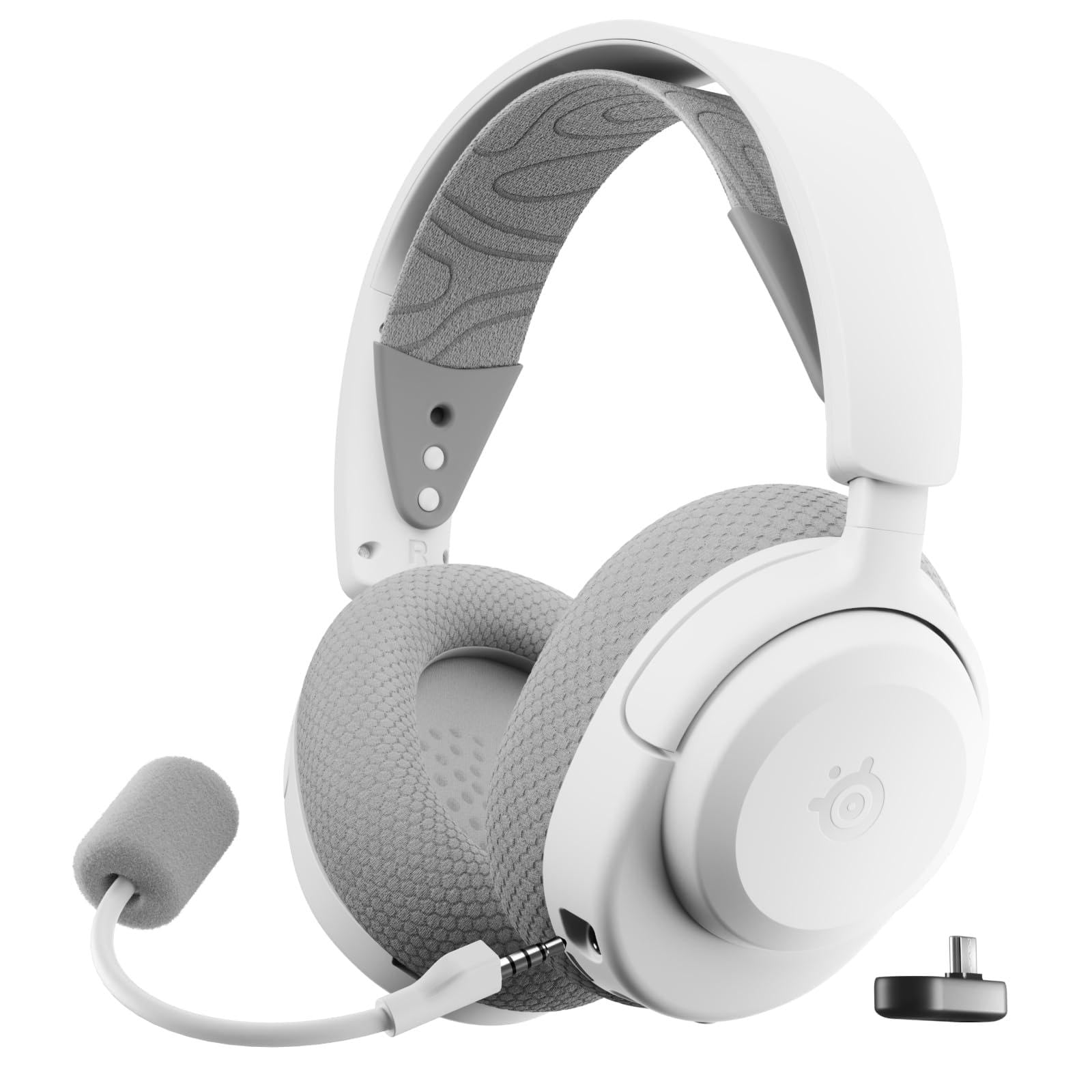
Fifteen minutes on the cable buys nine hours of play — the charge-time answer for disorganized gamers.
Most wireless headsets make you plan around the charger. This one mostly solves that. A 15-minute top-up returns up to 9 hours of playback, and a full charge runs up to 40 hours. The Logitech G325 is rated 24 hours and the Nova 3X up to 40 hours per fill — with the added luxury that a forgotten charge costs you a coffee break, not an evening.
The build is aimed at comfort through lightness. At 260 g it is heavier than the 212 g G325 but lighter than the 270 g Kraken Kitty, and the stretchy headband plus multiple adjustment points spreads pressure so it stays put without pinching. A dual-hinge design (two flex points on the frame) adds durability where headsets usually crack.
Sound comes from custom neodymium magnetic drivers tuned for clear highs and pinpoint mids — the exact range where enemy audio cues sit. The mobile app adds 200+ game presets, including profiles for shooters like CoD and Fortnite, so you can bias the tuning toward footstep clarity in one tap. A USB-C dongle (a small plug that carries the wireless signal) lets you swap between Xbox, PC, PlayStation, Switch, and handhelds without re-pairing.
What to know before you commit: mic quality and connectivity are the mixed notes in owner feedback. Some find the mic clear, others not; some report connection quirks with the dongle. Near the wired picks on price but not on reliability, the Nova 3X wins on charge speed and loses a little on consistency.
The feature that sells it: 15 minutes for 9 hours is a genuinely different relationship with a battery — you stop treating charging as a chore.
Fair warning: connectivity and mic reports are split, so if your setup has USB interference, this one is less forgiving than a plain wired headset.
Pick it for: a busy schedule where you squeeze in matches and cannot plan charging an evening ahead.
Steer clear if: crisp mic performance is non-negotiable for ranked team play.
7. Razer BlackShark V3 Wireless Xbox Gaming Headset

Ten-millisecond latency and Gen-2 titanium drivers — built for players who treat footsteps as intelligence.
This is the most competitive-focused white Xbox headset in the group. Razer’s HyperSpeed Wireless Gen-2 pushes latency as low as 10 ms, which is the delay between the game and your ears — low enough that the audio tracks the action instead of trailing it. Combine that with next-gen surround sound tuned for Xbox Series X|S and Xbox One, and you get positional cues sharp enough for split-second reactions.
The drivers are the standout hardware. Gen-2 TriForce Titanium 50 mm units use a titanium-coated diaphragm (a stiff, light cone that responds fast) to reproduce footsteps and audio cues with detail rather than mud. That 50 mm diameter matches the LucidSound LS500X and the Corsair HS55 — the largest here. The mic is a detachable HyperClear Super Wideband 9.9 mm unit covering a wider frequency range, so your callouts carry more voice detail than a narrowband boom.
What buyers consistently highlight: quality, sound, and wireless connectivity. The three-mode setup is unusual — you can run 2.4 GHz plus Bluetooth simultaneously to mix game and phone audio, or plug in USB-A for nonstop play without a battery worry. Pro-tuned FPS profiles are stored on the headset, so your custom EQ travels with it. The mixed note is mic quality and general functionality — some find the detachable mic fiddly, and the feature set has more moving parts than a wired headset.
Built for: ranked shooter players on Xbox who want the lowest latency and the most detailed positional audio in this lineup.
Not for you if: you want a one-button headset — three connection modes and detachable mic mean more setup choices.
8. Logitech G Astro A20 X Wireless Gaming Headset
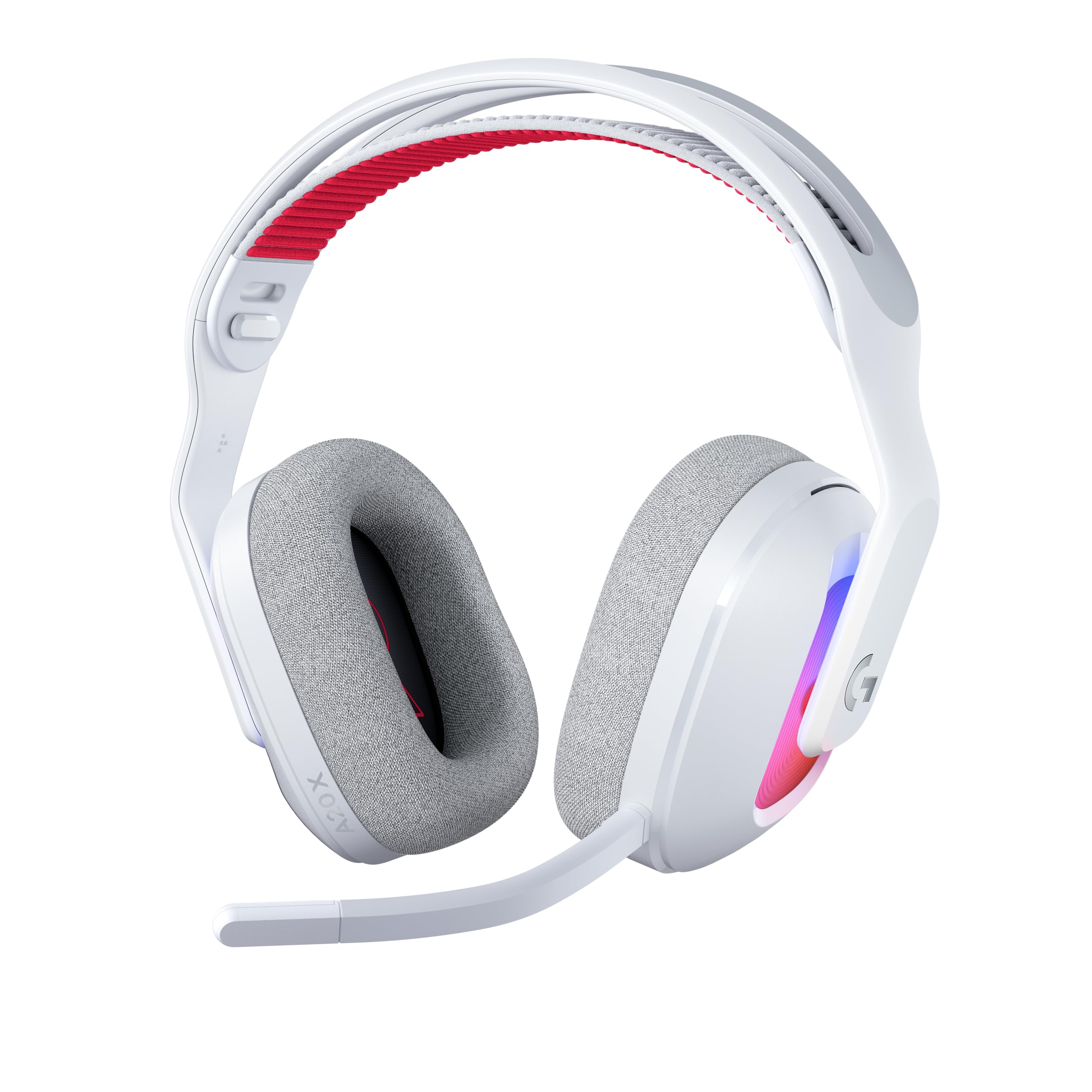
One headset that hops between your Xbox and your other console without unplugging anything.
Households with more than one console feel a specific pain: every headset is married to one box. The A20 X attacks that with PLAYSYNC AUDIO, which lets you switch audio between Xbox, Switch, Switch 2, PS5, and PC without reconnecting. It is the only headset in this list built explicitly for that two-console reality.
The comfort spec is a deliberately light one. Logitech describes the build as under 300 g with an ultra-light frame, so it sits in the same rough territory as the 270 g Kraken Kitty rather than the 212 g G325. A 48 kHz high-resolution microphone with Blue VO!CE customization (software tweaks that shape tone and add filtering) handles the chat side, and built-in MixAmp technology gives you game/chat balance right on the headset for PC and Xbox.
Owner feedback centers on two things: how good the sound is — the sense that teammates hear you perfectly — and how long it stays comfortable through a long session. The spread here is thinner on data than the older, more-reviewed picks, so treat it as the specialists’ choice for multi-console setups rather than the crowd favorite.
The unique move: PLAYSYNC means your Xbox and your other console share one headset, no swaps, no lost dongles.
Worth knowing: on-ear shape and feature density make it a fit gamble for larger heads — lean on the under-300 g build, not the ear-cup style, as the comfort story.
Choose it when: your entertainment center hosts an Xbox plus another console and you refuse to own two headsets.
Skip it when: you only game on Xbox — you pay for switching you will never use.
9. SteelSeries Arctis Nova Pro Omni Wireless Gaming Headset

A certified Hi-Res audio headset that swaps batteries instead of making you wait for a charge.
This is the top of the mountain, and the spec sheet explains why. The Arctis Nova Pro Omni carries Hi-Res Wireless Certification at 96 kHz/24-bit (a high-resolution audio label that samples sound fast enough to keep more detail than a standard Bluetooth stream) — the highest wireless audio standard here. It is also built as a switching hub: connect up to five devices, mix up to four audio sources at once with 3x USB, line-in, and Bluetooth, and move between PC, PlayStation, Xbox, Switch, and mobile without crawling behind your desk.
The battery design is the feature people talk about most. Instead of one sealed battery, SteelSeries includes two rechargeable batteries and lets you swap them so you never sit tethered. A 15-minute charge is a documented spec here, and the swap approach means playtime almost never ends for a charge. Connectivity is Bluetooth 5.3 with a 10-meter range, the same version as the LucidSound and SteelSeries Nova 3X picks.
What the review pages keep returning to: sound quality, battery life, and how easily it connects across devices. Noise cancellation and adjustability get a positive read too, and the built-in EQ presets are called out by people who want tailored sound without a PC. The mixed note is value for money and cross-platform compatibility — a premium headset that carries a premium footprint on your setup.
The top-tier argument: Hi-Res 96 kHz/24-bit certification and a two-battery swap system put this a class above every other wireless pick here.
The honest cost: compatibility reports are mixed and it demands a bigger footprint, so it rewards a dedicated desk build more than a single-console living room.
Worth it for: a multi-device player who wants a headset hub with Hi-Res audio and endless playtime via battery swaps.
Not worth it for: a simple Xbox-only setup — this headset is priced and specced for far more than one console.
Know the Specs
Connection Type (Wired vs Wireless vs Bluetooth)
Wired means a 3.5 mm plug into your Xbox controller — zero latency, zero charging, but a cable to manage. Wireless with a USB adapter uses a dedicated dongle for a low-latency signal, which is the standard path for Xbox game audio without a cord. Bluetooth is the easiest but adds delay, so it suits music and voice chat more than fast shooters. The LucidSound LS500X, Razer BlackShark V3, and Astro A20 X give you more than one mode, and each mode has its own strength.
Battery Hours vs Charge Time
Battery hours only mean something alongside charge time. A 50-hour headset with a 3-hour top-up is a weekly ritual; a 40-hour headset with a 15-minute fast charge is a quick snack. The LucidSound LS500X leads on runtime, the SteelSeries Arctis Nova 3X wins on how fast you recover, and the Arctis Nova Pro Omni sidesteps the question entirely by letting you swap a fresh battery in.
Driver Size and Surround Sound
Driver size is the diameter of each speaker disc. The 50 mm units on the Corsair HS55, LucidSound LS500X, and Razer BlackShark V3 are the largest here, while the 40 mm drivers on the Turtle Beach Recon 70, Kraken Kitty, and Arctis Nova Pro Omni are tuned smaller. Surround sound is the processing layer that turns stereo into a positional field (so you can tell which side a sound comes from), and for Xbox shooters that processing often matters more than raw driver millimeters.
Mic Type: Cardioid, Omni, and Detachable
A mic’s pickup pattern decides what it hears. Cardioid (the Kraken Kitty’s HyperClear) favors your voice and rejects sound behind it; omni-directional (the Corsair HS55) captures from all sides. A detachable mic, like the BlackShark V3’s HyperClear, lets you remove it for music listening. Flip-to-mute booms on the Turtle Beach Recon 70 and LucidSound LS500X make muting one motion.
Weight and Clamp Pressure
Weight decides whether hour four is comfortable or a chore. The Logitech G325 sits at 212 g, the SteelSeries Nova 3X at 260 g, and the Razer Kraken Kitty at 270 g — three noticeably different loads on your crown. Clamp force spreads that weight: a stretchy headband (Nova 3X) or a glasses-friendly cushion (LS500X) distributes pressure instead of concentrating it, which matters if you wear specs.
Xbox Compatibility Labels
An “officially licensed for Xbox” label means the maker paid for certification and testing against Xbox hardware. The LucidSound LS500X carries it for Xbox Series X|S and Xbox One. Plenty of other headsets work fine on Xbox without that label because they use a standard 3.5 mm jack or a USB dongle — the label is a stronger promise, not a strict requirement. Check that your intended headset actually lists Xbox among its compatible devices.
Common Questions
Will any wired headset with a 3.5 mm jack work on my Xbox controller?
Why do “white” headset listings sometimes ship a black one?
Do wireless Xbox headsets need a dongle, or can I use Bluetooth?
Does a 50 mm driver always sound better than a 40 mm one?
How long does a wireless gaming headset battery really last?
Is a detachable mic better than a flip-to-mute boom?
Can I use a white headset on both Xbox and PC without buying two?
Why does my headset mic sound muffled to teammates?
How much does headset weight actually matter for long sessions?
Is the SteelSeries Arctis Nova Pro Omni worth it for a single Xbox?
The Bottom Line
For most Xbox players, the white headset that wins is the Turtle Beach Recon 70 — a wired 40 mm design that plugs into your controller and works, with no battery to charge and a flip-to-mute mic that keeps team chat one motion away. Its 4.0+ rating across tens of thousands of owners is the highest score and largest owner base in this lineup, which is why a budget wired pick takes the top slot.
If you want to cut the cable and never think about charging, reach for the LucidSound LS500X, whose 50-hour wireless runtime and glasses-friendly frame make long sessions easy. And if Hi-Res audio and endless battery swaps matter more than simplicity, the SteelSeries Arctis Nova Pro Omni is the one to reach for.
The Recon 70 earns its first-place spot on volume of evidence: a 4.0+ across tens of thousands of owner ratings, the highest score and largest owner base of any pick here, at a price under a single evening out. If your priority is simply a white headset on Xbox that works today, that consensus is worth trusting.
How we choose
We do not accept paid placement. Every pick is matched to a real buyer and a real use-case; we do not hands-on test units.
Sources
Specifications: manufacturer listings and product documentation. Review insights: verified customer reviews, as of November 2026. Pricing: not shown on this page (it changes often); check the current price via the retailer link.
As an Amazon Associate, Tactical Gear Guy earns from qualifying purchases. This does not affect which products we feature.