Specs are compiled from manufacturer listings and verified buyer reviews and can change over time — please confirm the key details on the product page before buying.
If you are tired of cranking the volume just to understand what anyone on screen is saying, the fix is not a louder TV — it is a system with a dedicated center channel and a real subwoofer. That is the short answer to picking the best wireless audio system for a living room. A proper setup separates voices from explosions, sends sound behind and above you, and cuts the cable clutter down to a couple of power plugs. This guide covers eleven real systems, from bookshelf speakers that double as a turntable rig to full surround packages with wireless rear speakers.
This guide is built by comparing the manufacturers’ published specifications and the patterns across verified customer reviews, so you get each pick’s real strengths and trade-offs instead of marketing spin.
Your room size and how you watch decide which system fits. Below are plain-English breakdowns of channel counts (how many speakers carry sound), subwoofer sizes, connection types, and the quirks owners actually live with. That way you size the channel count and sub to your room instead of guessing.
Top Picks


How To Choose The Best Wireless Audio Systems
The biggest mistake people make is shopping by wattage alone. A soundbar that lists a big peak-power number can still mumble dialogue if it lacks a center channel. Start with the shape of your room and how you watch, then work backward to the specs.
Count the channels before anything else
A 5.1 system means five speakers plus one subwoofer, which gives you a left, right, center, and two surrounds. That center channel is what pins dialogue to the screen so voices do not wash into the music. A 7.1.4 number adds two more surround channels and four height channels, and those height channels are what make rain or a helicopter feel like it is overhead.
Decide if you want wireless rears or a wired sub
Wireless rear speakers save you from running cable across the floor behind the couch, which matters in a rental or a room with hard flooring. But wireless rarely means fully cordless — each rear speaker still needs a power outlet nearby. Check where your outlets sit before you commit to a layout.
Match the subwoofer to your space
A larger driver in inches generally moves more air, so it can dig deeper into low bass. A 10-inch sub in a small apartment can overpower a room, while a 6.5-inch sub may leave an open-plan living room feeling thin. Match the sub’s driver size to your room’s volume, not to the biggest number on the box.
Check the input you will actually use
HDMI eARC is the cleanest way to carry Dolby Atmos and DTS:X in one cable, and it lets your TV remote control the volume. Optical is reliable but older and cannot carry those height effects. If you own a game console and a streaming box, look for a system with pass-through HDMI inputs so you are not swapping cables.
Side-by-Side Comparison
| Model | Best For | Channels | Subwoofer Driver | Key Connectivity | Amazon |
|---|---|---|---|---|---|
| Edifier R1280DBs★ Best Overall | Music and TV in a small room | 2.0 stereo | 4-inch woofer | Bluetooth 5.0, Optical, Coaxial, RCA | Amazon |
| LG S40TRBest Value | Budget surround for movies | 4.1 | — | Bluetooth, Optical, Wireless | Amazon |
| Sonos Era 100Smart Single Speaker | Single-room smart streaming | Stereo (dual tweeter) | — | WiFi, Bluetooth, 3.5 mm line in | Amazon |
| TCL S65K | Dolby Atmos on a budget | 5.1 | 6.5-inch | Bluetooth, USB, Wi-Fi, HDMI | Amazon |
| Amazon Fire TV Soundbar Plus | Fire TV households | 5.1 | — | Bluetooth | Amazon |
| Google Nest Audio (3-Pack) | Whole-home voice audio | Stereo pairing across 3 speakers | — | Bluetooth, Wi-Fi | Amazon |
| ULTIMEA Skywave X50 | rich 5.1.4 on a mid budget | 5.1.4 | 8-inch | HDMI eARC, Optical, Bluetooth, USB | Amazon |
| Sony BRAVIA Theater System 6 | BRAVIA TV owners | 5.1 | — | Bluetooth | Amazon |
| ULTIMEA Skywave X70 | Big-room home theater | 7.1.4 | 10-inch | HDMI eARC, Optical, Bluetooth, USB | Amazon |
| JBL Bar 700MK2 | Detachable rear speakers | 7.1 | 10-inch | Bluetooth, Wi-Fi, HDMI, Optical, USB | Amazon |
| Polk Audio MagniFi Max AX SR | Full 7.1.2 with upfiring drivers | 7.1.2 | 10-inch | HDMI eARC, Optical, USB, Wi-Fi, Bluetooth | Amazon |
Detailed Reviews
1. Edifier R1280DBs Active Bluetooth Bookshelf Speakers
Our pick — 4.5+★ from 4,500+ verified ratings; the strongest balance of quality and price.
The pair that turns a plain desk or shelf into a proper stereo — with wood grain you will not hide.
Music sounds like music here, not a soundbar approximation of it. The Edifier R1280DBs is a true two-box stereo pair with 42W of continuous power — a rating the speakers hold without breaking up, rather than a peak that distorts after a second. Inside sits a 13mm silk dome tweeter (the small dome that handles high notes) and a 4-inch woofer (the cone that handles bass). A Soundfield Spatializer widens the image, so a desk setup does not sound like two tight boxes.
Where this pair punches above its class is flexibility. There is an optical and a coaxial input, both of which carry a lossless digital signal from a TV or computer — no analog conversion guessing. The subwoofer output auto-detects a connected sub and applies a built-in crossover, so adding bass later is a plug-in job. Bluetooth 5.0 reaches a claimed 30 feet, which covers a whole floor of a typical home. Owners consistently call the setup a five-minute job, and the crowd that buys this thing is overwhelmingly here for the sound, which is the most-praised element by a wide margin.
The honest catch is the control situation. The bass and treble knobs live on the side panel of the powered speaker, so fine-tuning means reaching around the cabinet. The remote handles volume, mute, and input switching, but the EQ is not on it. Plan on setting the tone once and leaving it. This is also a 2.0 setup — there is no center channel and no surround, so it will not put sound behind you.
What earns it the top spot
- 42W of continuous, undistorted power with a 13mm silk dome tweeter and 4-inch woofer
- Optical and coaxial inputs carry a lossless feed from a TV or computer
- Subwoofer line out with automatic detection and a built-in crossover for easy bass upgrades
- Bluetooth 5.0 pairing to a phone, tablet, Mac, or laptop with no wires
Where it asks something of you
- Bass and treble knobs are on the side panel, not the remote
- Stereo only — no center channel, no rear speakers
Reach for this if: you want real stereo separation for music and a clean optical feed for your TV in one compact pair.
Look elsewhere if: you are building a movie room and need dialogue pinned to a center channel with sound behind you.
2. LG S40TR 4.1 ch. Home Theater Soundbar
Surround sound behind your couch without a receiver, an amplifier, or a cable run.
LG’s S40TR is the entry point into true surround: four channels, a wireless subwoofer, and wireless rear speakers that need no special receiver. That last part is the real value — the rears connect to the bar over the air, so the only wires you run are the power cords. Dolby Digital and DTS Digital decoding handle the standard surround formats, and Clear Voice Plus analyzes the audio to push dialogue through the center speaker so commentary and movie lines stay intelligible.
If you own an LG TV, two features pull their weight. WOW Orchestra runs the TV speakers and the soundbar at the same time to widen the stage, and WOW Interface lets the TV remote adjust the soundbar’s volume and sound modes on screen. The Smart Up-Mixer converts a plain two-channel signal into a multi-channel one, which helps older content. A three-band equalizer in the LG Soundbar App lets you shape bass, treble, and mid-range without hunting for a physical knob.
The trade-off is connectivity stability. Bluetooth works flawlessly for plenty of owners and drops for others, so this is the kind of system to wire with the included optical cable for TV duty and save Bluetooth for music. Reviews divide on exactly that point, and the wiring notes are the one recurring criticism. Understand that going in and this is a lot of surround for the money.
What the layout buys you: rear speakers behind your seat for a fraction of what a full home-theater package asks, with Dolby and DTS both decoded.
The connection note to weigh: Bluetooth is the weak link for a slice of owners — the optical cable is the stable path for TV audio.
Pick it for: a first surround setup where you want sound behind you without installing a receiver.
Pass if: you expect wireless-everything stability — this one prefers a cable for the TV feed.
3. Sonos Era 100 Wireless Alexa Enabled Smart Speaker
One box that fills a whole room, then joins three more when you want a house full of sound.
The Era 100 runs a next-gen dual-tweeter setup that produces real stereo separation from a single cabinet, backed by a midwoofer Sonos says is 25% larger than the previous generation. That is the spec doing the work: two tweeters pointed slightly apart create a left-right spread from one small box, which is why a single speaker can fill a room without distortion. A 47% faster processor handles the streaming and tuning overhead. Put it on a bookshelf, a kitchen counter, a desk, or a nightstand — it is compact enough to disappear into any of them.
Trueplay tuning is the quiet hero. Open the Sonos app, tap once, and the speaker analyzes the acoustics of your room and adjusts its own EQ to suit. That means the same speaker sounds right in a glassy kitchen and a carpeted den. Streaming runs over WiFi from your services, Bluetooth pairs with one button press, and a 3.5mm line-in through the Sonos adapter lets you plug in a turntable or another source. The driver measures 13.06 centimeters across, and Bluetooth range is listed at 10 meters.
Be clear about what the Era 100 is not. It is a superb single-room speaker and a building block for a multi-room setup, not a surround sound system — there is no subwoofer and no rear channel here. Some buyers also hit friction during app setup or pairing, so give yourself a calm ten minutes with the phone rather than rushing it.
The sound story: dual tweeters and a larger midwoofer combine for stereo spread from a single cabinet, and Trueplay adjusts the EQ to your room’s acoustics with a single tap.
The honest limit: one speaker, no sub, no rears — great for music and casual TV, not a movie-surround replacement.
It suits: the listener who wants one great-sounding speaker in the kitchen or den that can grow into a whole-home Sonos setup later.
Not the one for: a home theater build that needs a dedicated subwoofer and channels behind the seat.
4. TCL S65K S Series 5.1 Channel Soundbar System
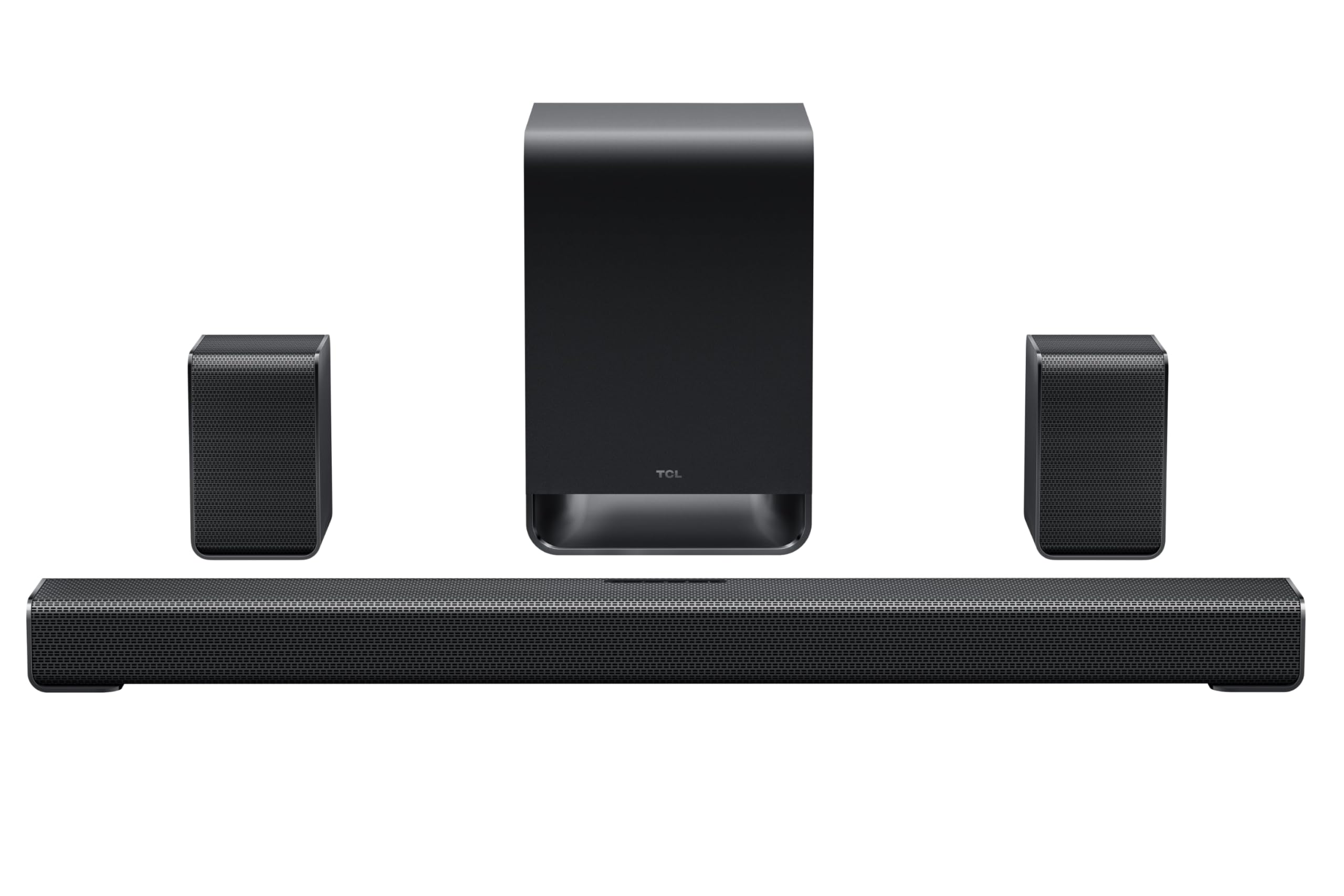
Dolby Atmos and DTS:X height effects at a price where you would not expect them.
TCL’s S65K brings spatial audio down into an affordable bracket. Dolby Atmos and DTS:X both decode here, which means sound designed to come from above and behind actually has somewhere to go. The system is a true 5.1 array: a bar with a built-in center channel and tweeter, a wireless subwoofer with a 6.5-inch driver and Bass Boost, and wireless surround speakers that pair themselves to the main bar. Ray Danz Technology widens the stage, and the built-in center channel exists specifically so voices stay clear during action scenes.
Ai Sonic Auto Room Calibration is the standout convenience — the system tailors its output to the acoustics of your specific room, which is the kind of adjustment that usually lives on much pricier gear. ChoruSound lets the TV’s own speakers work with the bar to widen the image, and Bluetooth streaming covers music from a phone or tablet. Everything connects through HDMI, Wi-Fi, USB, or Bluetooth, and the bar itself measures 33.46 inches wide and weighs 27 pounds.
The one thing to know is that this is a newer entry with a lighter review history than the household names, which is normal for a fresh Atmos model. What is there is consistently warm — the bass punch and the easy TV pairing come up repeatedly. The heavier weight also means you will want two hands and a solid shelf for the bar.
Where the money went: certified Atmos and DTS:X decoding (the two main surround-sound formats) plus a 6.5-inch wireless sub and self-pairing wireless surrounds — the full rich checklist.
Small print: a slim review trail compared to the legacy brands, so you are trusting the spec sheet more than a long track record.
Worth it when: you want overhead surround effects and a self-calibrating room tune without stretching to premium money.
Think twice if: you want decades of user reports before you commit — this one is newer to the shelf.
5. Amazon Fire TV Soundbar Plus

The system that finishes setting itself up while you are still reading the instructions.
For anyone already living inside the Fire TV world, this is the path of least resistance to 5.1 surround. You get a soundbar, a wireless subwoofer, and two wireless surround speakers, and they connect to the bar simply by being plugged into power. Dolby Atmos and DTS:X both decode, so you get the 3D audio tracking and the multi-dimensional mix. A dedicated center dialogue channel sharpens voices, which is the single most common reason people buy a soundbar in the first place.
Four content modes — Movie, Music, Sports, and Night — let you reshape the sound without digging into a menu. Movie mode opens things up, Night mode tames explosions so you do not wake the house, and Sports mode pushes the commentary forward. One remote controls both your TV and the bar on select Fire TV models, and Bluetooth streaming lets you play from a phone or tablet. Setup is the thing everyone mentions: plug the pieces in, let them pair, done.
The honest caveat is long-term dependability. A portion of buyers report reliability hiccups over time, so this is the pick for someone who values the easy Fire TV integration over a bulletproof decade of service. There is also no published spec sheet for driver sizes or power numbers, so you are buying the experience rather than a list of figures.
Why it clicks
- 5.1 surround with a wireless sub and two wireless surrounds that pair on plug-in
- Dedicated center dialogue channel for clear voices during action scenes
- Movie, Music, Sports, and Night modes for one-press reshaping of the sound
- One remote runs both TV and soundbar on select Fire TV models
Where it can stumble
- Long-term reliability draws mixed reports from some owners
- No published driver or power specs to compare against rivals
Matches best with: Fire TV households that want surround with the least possible fiddling.
Choose differently if: you want a long verified track record or specs you can line up against other bars.
6. Google Nest Audio (3-Pack) Smart Speakers

Three rooms, one voice command, and a stereo pair when you want to sit down and listen properly.
This bundle solves the whole-home audio problem in one box. Three Nest Audio speakers can each take a room — kitchen, living room, bedroom — or group together for playback that follows you through the house. Pair any two for stereo, and the 7.5-centimeter dynamic driver in each speaker does the work. Google Assistant is built in on every unit, so you can start music, set a timer, check the weather, or dim the lights without touching a phone.
Connection is dual-path: Wi-Fi for streaming from services like Spotify and YouTube Music, Bluetooth for a direct pairing from a device. It works with Android, iOS, and Chromecast-enabled apps, so the bundle is not locked to one phone brand. The smart-home reach is broad too — lights, thermostats, and locks are all controllable by voice if they are compatible.
The trade-off is that this is a lifestyle system, not a home theater. There is no subwoofer, no surround decoding, and no center channel, so it will not reproduce an Atmos movie mix. Reliability is the other mixed note — a slice of owners mention a unit that stops responding, which is worth knowing when you are buying three. For music, podcasts, and voice control spread across a home, it is a tidy way to cover three rooms at once.
What it does well: three speakers plus Google Assistant covers three rooms with music and voice control, and any two can pair for stereo.
What it will not do: no sub, no surround decode — this is music and smart-home audio, not movie audio.
The right fit: a home that wants voice-controlled music in three rooms and a stereo pair for focused listening.
Not built for: anyone shopping for a surround system to run a movie room.
7. ULTIMEA Skywave X50 5.1.4ch Wireless Surround Sound System
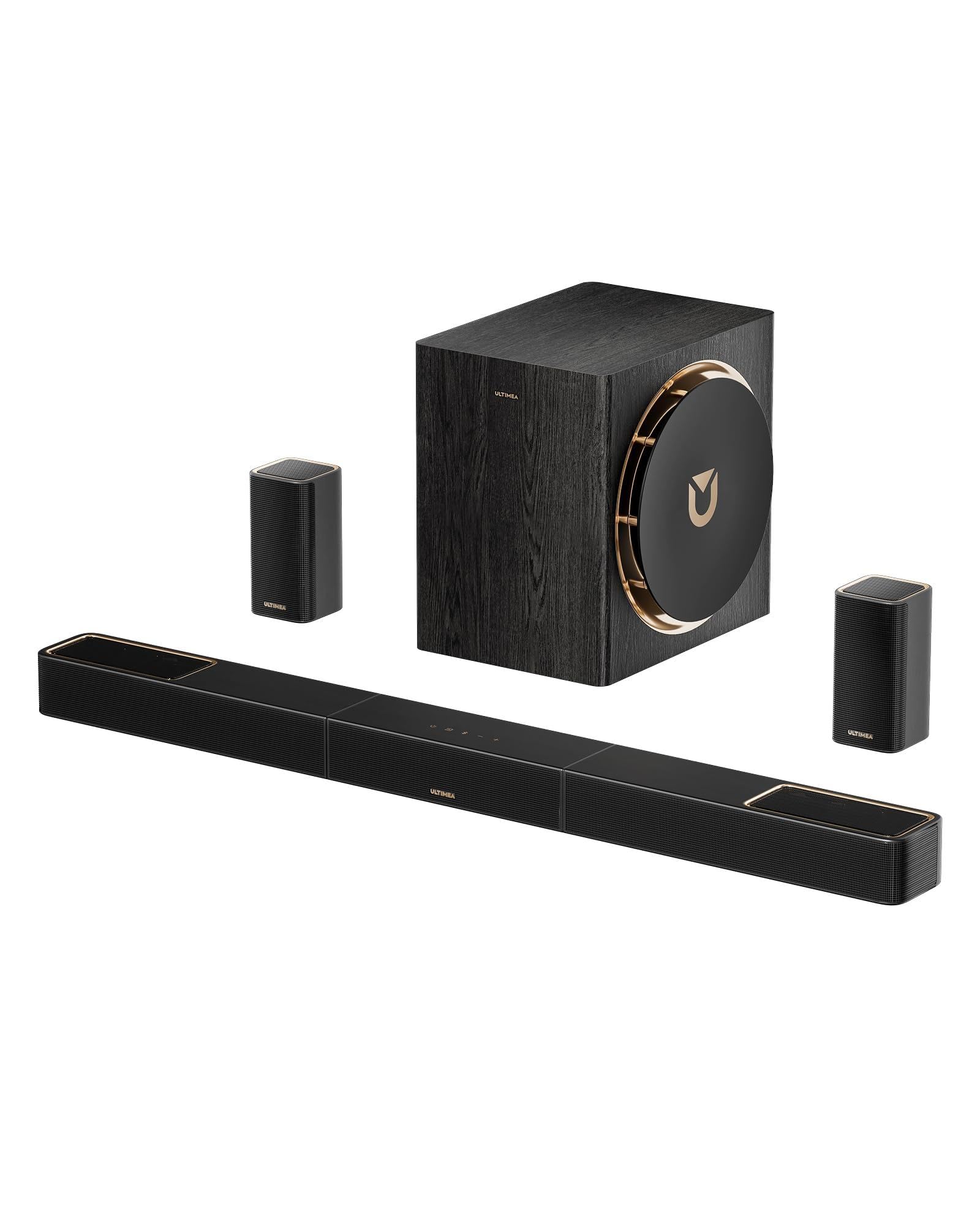
Four height channels, an eight-inch sub, and 760 watts of peak power that you feel in the floor.
Here is where the system stops being a soundbar and becomes home theater. The 5.1.4 channel count means four height channels are in play, so rain falls overhead and helicopters hover above instead of in front. Power peaks at 760W, and the 8-inch subwoofer uses Gravus Ultra-Linear Bass technology to reach down to 28Hz — that is the range where rumble lives, and it stays full at high volume rather than thinning out. The whole rig transmits over dual 5GHz wireless with RF and networking protocols designed to cut interference and eliminate dropouts.
The internals are unusually specific for this bracket. A GaN amplifier (gallium nitride, a semiconductor that runs cooler and responds faster than the older silicon type) claims up to 98% efficiency and 8x faster response, which means less heat and cleaner output at peak volume. The NEURACORE engine runs on a triple-core DSP and dual-core MCU to deliver 24-bit/192kHz audio with under 0.5% distortion. Passing 4K HDR through means the picture stays intact while the audio goes to the speakers.
Set expectations on the physical side. You still run power to the sub and to each of the two surround speakers, so wireless here means no signal cables, not no cords. Reviews single out the value — this is a 5.1.4 setup (five main speakers, one sub, four height channels) with a genuine 8-inch sub. Buyers describe the immersiveness most warmly.
The spec that sells it: 5.1.4 channels with four height drivers, a 760W peak amp, and 8-inch sub reaching 28Hz — the height effects are the reason to buy.
Plan the plugs: the surrounds and sub each need power, so map your outlets before you decide on speaker placement.
Best for: a movie and gaming room where you want sound overhead and a sub you can feel.
Skip if: outlet access behind the couch is tight — the wireless rears still need plugging in.
8. Sony BRAVIA Theater System 6 5.1ch Soundbar

Built to be the missing half of a Sony TV, right down to the on-screen menu control.
Sony’s Theater System 6 is a 5.1 array with three front-firing speakers in the bar, two rear speakers, and an included subwoofer. Dolby Atmos and DTS:X both decode, and a dedicated center channel speaker does the dialogue work so you catch every word. Multi Stereo mode plays the same signal from every speaker to fill a room, and DSEE upscaling restores acoustic detail in compressed music.
The Bravia tie-in is the real differentiator. Pair it with a compatible BRAVIA TV and you control the soundbar straight from the TV menu, plus you open up Voice Zoom 3 for enhanced dialogue. The BRAVIA Connect app puts volume, sound profiles, and advanced settings on your phone. Buy it with a Sony TV and the two feel like one device; buy it without and you lose some of the magic. Frequency response opens at 20 hertz, so bass goes deep on paper.
One design detail to understand: the subwoofer here is a wired unit, not a wireless one. That means a cable run to wherever the sub sits, which is a step behind the wireless-sub competition. Some owners also report popping and cracking from the rear speakers, so listen carefully in the first week while you can still exchange. The trade is that the core sound is confident and the dialogue tools are excellent.
Where it wins: the Sony ecosystem — TV menu control, Voice Zoom 3, and the Connect app make the system feel native to a BRAVIA set.
Two honest notes: the subwoofer is wired, and rear-speaker popping comes up in some reports.
Buy it if: you own a compatible BRAVIA TV and want the sound settings living inside your TV menu.
Look at the X50 instead if: you want a wireless sub and no cable run to the corner.
9. ULTIMEA Skywave X70
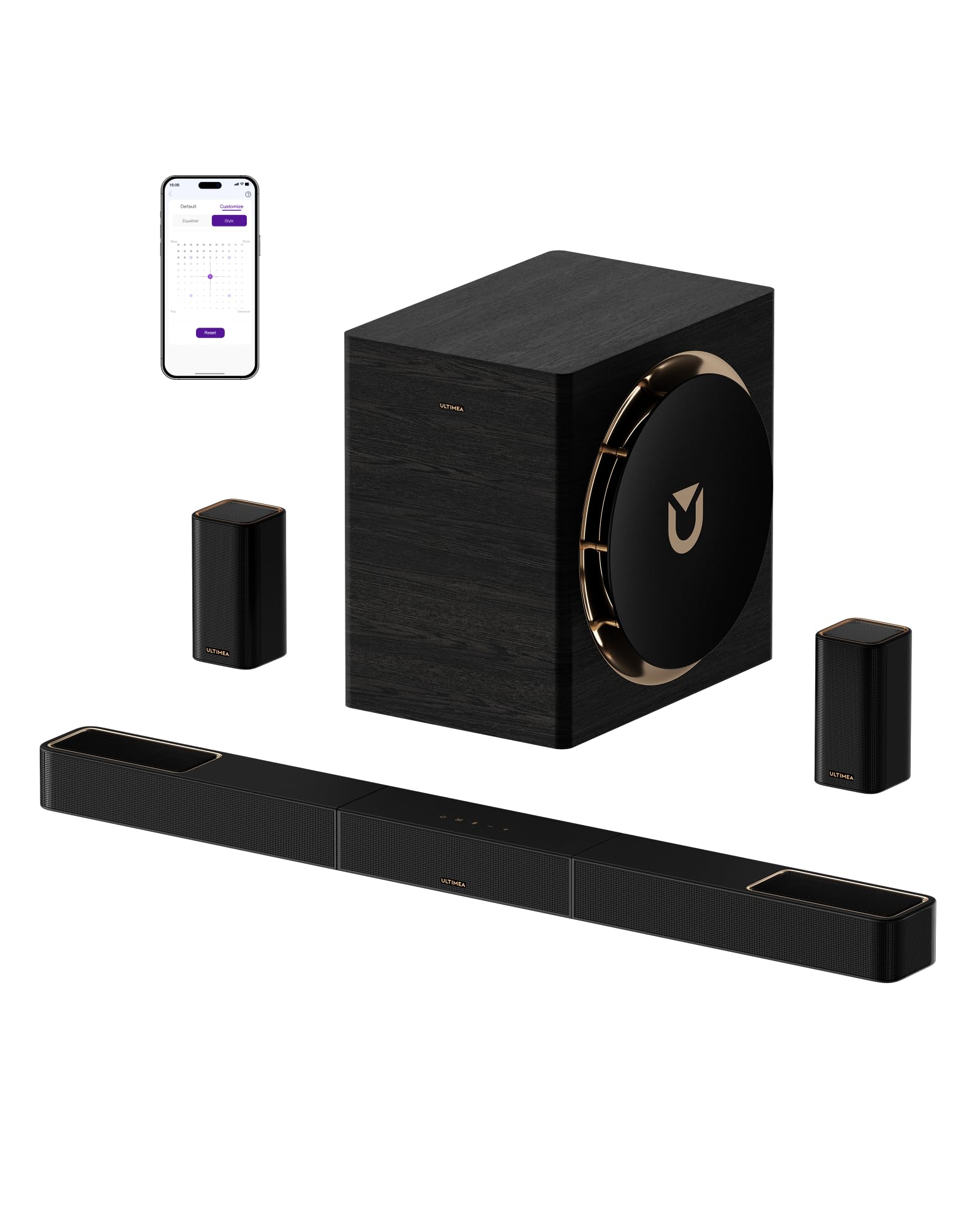
The 10-inch sub and 7.1.4 layout that turn a living room into a theater with a shaking floor.
Step up from the X50 and you pick up channels and low end. The X70 runs 7.1.4 with a genuine 10-inch wireless subwoofer, which digs down to 20Hz with 980W peak output. Two extra surround channels over the X50 give your sides more pinpoint placement, and its dual 5GHz wireless transmission again is designed to kill dropouts before they start. The subwoofer is wood-crafted with a metal grille and rose-gold accents, so it looks like furniture rather than a black box.
The engine room is the same NEURACORE platform: triple-core DSP and dual-core MCU, 24-bit/192kHz audio, under 0.5% distortion, and processing headroom for up to 17 channels. The GaN amplifier claims up to 98% efficiency and 8x faster response than silicon with 50% less heat. 4K HDR pass-through keeps the picture clean, and CEC syncs TV power, volume, and input. The ULTIMEA App adds 10-band EQ and 121 sound presets, so you can dial in a sound instead of living with a default.
Owners describe the 10-inch sub as the star, and setup with the picture-based instructions goes smoothly for most. The one spec note is that the sound settings divide opinion — plenty love the presets, others tweak. The sub is large and the surrounds need power, so clear floor space before it arrives.
The case for the X70
- 7.1.4 channels with a 10-inch sub reaching 20Hz and 980W peak output
- Dual 5GHz wireless transmission engineered to minimize dropouts
- NEURACORE 24-bit/192kHz processing with under 0.5% distortion
- App control with 10-band EQ and 121 sound presets
What to plan around
- Every surround speaker still needs its own power outlet
- The large sub takes real floor space, and sound settings split opinion
For the movie obsessive: 7.1.4 channels (seven main speakers, one sub, four height channels) plus a 10-inch sub is the most rich package here short of a dedicated theater.
Not for cramped rooms: the sub is big and the surrounds each want a plug — measure before you buy.
10. JBL Bar 700MK2 Soundbar with Subwoofer

The rears lift right off the bar ends, so surround goes wherever you want without a cable in sight.
JBL’s cleverest move here is the detachable surround speakers. They live docked on each end of the bar for normal listening, then lift off and sit behind you for true 7.1-channel wireless surround in seconds. That is the kind of flexibility a fixed system cannot offer — the bar is a clean two-piece rig for a movie night and a genuine surround setup for the big film. Power tops out at 780W max, and a 10-inch wireless subwoofer delivers the thundering low end the spec implies.
Dolby Atmos and DTS Virtual:X handle the 3D audio, so overhead effects and crowd noise move around the room. MultiBeam 3.0 projects a wide soundstage so the whole room hears the same mix, not just a single seat. PureVoice 2.0 automatically tune dialogue based on the scene and volume, which means you stop rewinding to catch whispered lines. It connects over Bluetooth, Wi-Fi, HDMI, Optical, and USB, and frequency response opens at 20 hertz.
The trade-off worth knowing: the detachable rears need their own power when you place them behind the couch, and battery life on the internals draws mixed notes. For a room where you want flexibility rather than a permanent install, the modular design earns its keep.
What makes it different: detachable rear speakers and a 10-inch wireless sub give real 7.1 surround with no cable run, in seconds.
Plan around this: the detached rears need power behind the couch, and internal battery life gets mixed feedback.
Its natural owner: someone who wants surround only when the movie matters and a clean bar the rest of the time.
Choose a fixed setup if: you would rather install once and never think about powering rears again.
11. Polk Audio MagniFi Max AX SR 7.1.2 Soundbar

Upfiring speakers, a 10-inch sub, and Polk’s dialogue fix that boosts voices without lifting the whole mix.
Polk’s flagship bundle is a full 7.1.2 system: the MagniFi Max AX soundbar, a 10-inch wireless subwoofer, and the SR2 surround speakers. The.2 in that number is two upfiring speakers, which bounce sound off your ceiling so overhead effects land above you. Certified Dolby Atmos and DTS:X both decode here, and Polk’s patented SDA 3D technology widens the image. The 10-inch sub connects the moment you power it on and delivers bass that is genuinely surprising for its size.
VoiceAdjust is the feature to understand. It works with the integrated center channel speaker to boost vocal levels without touching the rest of the soundtrack — so you raise dialogue, not the explosions. The connection list is the deepest here: HDMI eARC, an optical in, USB-A for firmware updates, and three 4K HDMI inputs. Wi-Fi, Bluetooth, Apple AirPlay 2, Chromecast, Spotify Connect, and Alexa MRM all appear, so it doubles as a whole-home music system. The 10-inch driver handles the low end, and the surround channels draw on the 2 upfiring drivers.
Sizing the downside honestly: this is the priciest system in the group and the largest in footprint, so it wants a proper media wall and a clear ceiling for the upfiring bounce. Reliability draws mixed notes from some owners, so buy it as a long-term fixture and verify everything works within the return window.
Why the flagship earns its price
- 7.1.2 channels with two upfiring speakers for ceiling-bound height effects
- VoiceAdjust boosts dialogue through the center channel without lifting the rest of the mix
- Three 4K HDMI inputs plus eARC, Wi-Fi, Bluetooth, AirPlay 2, Chromecast, and Spotify Connect
What it asks of your room
- Biggest footprint here and it needs a flat ceiling for the upfiring bounce
- Reliability draws mixed feedback, so test it fully inside the return window
The pick for: a dedicated movie wall with room for a 10-inch sub and a ceiling that can bounce height audio.
Overkill if: your living room is compact or your ceiling is angled — the upfiring trick needs a flat surface above.
Know the Specs
Channel counts (5.1, 7.1.2, 7.1.4)
The first number is how many main speakers the system uses, and the decimal is the subwoofer. So 5.1 means five speakers plus one sub. When a third number appears, like 7.1.4, that is the count of height channels — speakers aimed upward or mounted high to send sound over your head. More channels buy more precise placement of a sound effect, but they also demand more setup and more power outlets.
Peak power versus continuous power
Peak power is a brief burst; continuous or RMS power is what the amp can sustain. A 42W continuous rating, like the Edifier pair, tells you it holds that output without breaking up. A large peak figure like 760W or 980W describes the maximum momentary punch. Neither peak nor RMS wattage alone tells you how a system sounds, so weigh it alongside channel count and sub size.
Subwoofer driver size and low-frequency reach
Driver size is the diameter of the sub’s cone in inches. An 8-inch driver moves more air than a 6.5-inch, and a 10-inch moves more still, which generally means deeper, fuller bass. The frequency figure tells you the lowest note it can reach — 28Hz or 20Hz sits in the rumble range you feel more than hear. A big sub in a small room can overwhelm; match it to your space.
HDMI eARC, optical, and Bluetooth
HDMI eARC (the audio-return channel that sends TV sound down one cable) carries high-bandwidth audio including Dolby Atmos and DTS:X, and it can pass volume commands from your TV remote. Optical is a reliable older standard but cannot carry the height channels. Bluetooth streams music from a phone or tablet, and its stability varies by system — some pair smoothly and others drop. Wi-Fi streaming generally holds up better across a room than Bluetooth.
Room calibration and dialogue enhancement
Auto-calibration uses a microphone or app to measure your room’s acoustics and adjust the EQ to suit — so the same system sounds right in a glassy kitchen or a carpeted den. Dialogue tools like a dedicated center channel or a voice-boost feature raise vocal levels without lifting the explosions. If you struggle to hear what people are saying on screen, prioritize a system with a real center channel.
Wireless surrounds and what “wireless” really means
Wireless rear speakers connect to the soundbar over the air, so you skip the long signal cable run across the floor. They almost always still need a power outlet at each speaker. A wireless subwoofer works the same way — no signal cable, but a power cord. Before you buy, walk the room and confirm there are outlets near where the rears and sub will sit.
Common Questions
Do I need a receiver to run wireless rear speakers?
Will a soundbar with Dolby Atmos actually put sound above my head?
Is a 10-inch subwoofer too much for a small living room?
Does HDMI eARC sound better than optical?
Why does dialogue sound quiet while explosions are loud?
Can I add a subwoofer to a bookshelf speaker pair later?
Will these systems work with both a game console and a TV?
Do wireless surrounds work through walls?
Should I buy a soundbar system or a stereo pair for music?
How long does it take to set up a wireless surround system?
The Bottom Line
For most people building a first real system, the wireless audio systems winner is the Edifier R1280DBs — a 4.5+ star crowd favorite across 4,500+ owners. It gives you true two-box stereo separation, an optical input for your TV, and a subwoofer output for adding bass later. Buyers are overwhelmingly here for the sound, and it earns that with 42W of continuous power and a 13mm silk dome tweeter. If you want overhead immersion with a sub you feel in the floor, the ULTIMEA Skywave X70 adds 7.1.4 channels and a 10-inch sub. And for a compact single speaker that can grow into a whole-home setup, the Sonos Era 100 with its dual-tweeter stereo spread is the one to reach for.
Do the outlet math before you order — the wireless surrounds and subwoofers still need power where they sit. Get the outlets right, and any of these systems will beat your TV’s built-in speakers.
How we choose
We do not accept paid placement. Every pick is matched to a real buyer and a real use-case; we do not hands-on test units.
Sources
Specifications: manufacturer listings and product documentation. Review insights: verified customer reviews, as of November 2026. Pricing: not shown on this page (it changes often); check the current price via the retailer link.
As an Amazon Associate, Tactical Gear Guy earns from qualifying purchases. This does not affect which products we feature.