Specs are compiled from manufacturer listings and verified buyer reviews and can change over time — please confirm the key details on the product page before buying.
The glove that fails you on a winter jobsite almost never fails on warmth alone. It fails because you cannot pick up a screw, because the palm soaked through by mid-morning, or because the lining bunched up the moment your hand got damp. The right pair keeps your fingers working and your grip honest below freezing, and the picks below cover that range — leather palms for abrasion, waterproof shells for slush, and cut-resistant liners for metal or wire.
This guide is built by comparing the manufacturers’ published specifications and the patterns across verified customer reviews, so you get each pick’s real strengths and trade-offs instead of marketing spin.
Every pick here is insulated and built for cold-weather work, so the real differences come down to palm material, cuff coverage, and how much feeling you keep in your fingertips. Here is how the field sorts out when you are shopping for winter construction gloves that hold up to a full shift outdoors.
Top Picks


How To Choose The Best Winter Construction Gloves
What separates winter work gloves is whether you can still close your hand around a fastener at 7 a.m. and whether the palm is still dry at 3 p.m.
Insulation weight trades warmth against feeling
Insulation is measured in grams of 3M Thinsulate, and the number tells you the trade you are making. A 70-gram glove leaves more feeling in your fingertips; a 100-gram glove holds more heat but feels bulkier. Pick the lighter weight if you need to handle small parts and the heavier one if you mostly grip large tools and material.
Waterproof, water-resistant, or neither
These three words are not interchangeable. Water-resistant means the palm shrugs off a splash; waterproof means the shell is built to keep liquid out during real wet work. If you handle wet pipe, wash equipment, or shovel slush, read the listing for the word waterproof specifically.
Where the cuff ends matters in snow
A short knit wrist seals at the wrist. A safety cuff covers more of the forearm. A drawstring gaiter cinches tight against a jacket sleeve. The further up your arm the glove reaches, the less snow finds its way in — and the more you will notice the bulk under a jacket cuff.
Cut protection is a separate rating
If your work involves metal, wire, or sharp edges, look for an ANSI cut level. ANSI A9 is a high cut-resistance rating, and it comes from a liner inside the glove, not the leather shell on the outside. The two protections stack, but they answer different hazards.
Side-by-Side Comparison
| Model | Best For | Insulation | Palm Material | Weather Sealing | Amazon |
|---|---|---|---|---|---|
| Kinco 1927★ Best Overall | All-round cold work | Heatkeep thermal lining | Pigskin leather | Safety cuff | Amazon |
| Wells Lamont Heavy DutyHeaviest Insulation | Rough abrasion and grip | 100-gram 3M Thinsulate | Grain cowhide leather | Extra-long knit wrist | Amazon |
| toolant Insulated LeatherBest Leather Feel | Snow removal and riding | Insulated leather shell | Real leather | — | Amazon |
| Wells Lamont 7796L | Dexterity plus touchscreen | 70-gram 3M Thinsulate | Synthetic leather | Water-resistant palm | Amazon |
| SHOWA TEMRES 282-02 | Wet and deep snow | Acrylic fleece liner | Textured polyurethane | 100% liquid-proof, drawstring gaiter | Amazon |
| Schwer CR3308 | Wet work with long cuff | Imitation lamb wool lining | Textured PU grip | 100% waterproof, extended cuff | Amazon |
| Schwer PM3401-W | Cut and puncture hazards | Acrylic thermal liner | Premium grain cowhide | Not waterproof | Amazon |
| Carhartt Insulated Duck | Everyday work and wind | Insulated duck shell | Synthetic leather | Knit cuff, wind protection | Amazon |
| Vgo CA7722FW | Cold-weather impact work | Lined, rated to -4°F | Leather with impact guard | Waterproof | Amazon |
Detailed Reviews
1. Kinco Leather Work and Ski Gloves (1927)
Our pick — 4.5+★ from 550+ verified ratings; the strongest balance of quality and price.
The plain pigskin workhorse that keeps your wrists covered when the wind cuts sideways.
The reason this one takes the top spot is the shape of it, not a headline number. A pigskin palm gives you a surface that grips wet lumber and tools without turning slick, and the thermal lining sits behind it to hold heat in. Pigskin is also a soft leather, so it breaks in to your hand rather than staying stiff through the first week of a cold job.
Where it separates from most of the field is the cuff. The safety cuff runs past the wrist and the elasticized back cinches down, so a gust of cold air does not shoot straight up your sleeve. The wing thumb gives your thumb room to move sideways when you wrap a hand around a shovel handle or a framing hammer. What wins people over most is exactly that wind-blocking coverage — it is the single thing the review pages return to again and again, with value for money running a clear second.
The honest catch is sizing. This is a unisex glove and the fit splits the room: plenty of buyers find it spot on, and a fair share find it roomier than expected. If your hands sit between sizes or you like a snug working fit, size down rather than up — an oversized leather work glove turns into a floppy mitt once the lining packs down.
What earns its spot
- Pigskin palm holds grip on wet, cold tools
- Safety cuff and elasticized back block drafts at the wrist
- Wing thumb keeps your hand natural around a handle
- Heatkeep thermal lining for cold-weather work
What to plan around
- Unisex sizing runs generous for some buyers
- No touchscreen fingertips
- Pigskin needs drying out after a soaking
Go with it when: you want one leather pair that handles framing, shoveling, and cold-weather chores without fuss.
Think twice when: you need to tap a phone screen mid-task, since nothing here is touch-sensitive.
2. Wells Lamont Heavy Duty Leather Winter Work Gloves
Grain cowhide and the thickest insulation in this lineup, built for hands that grip rough material all day.
If you work mostly through the coldest stretch of the morning, the insulation number is the one to watch. This glove carries 100-gram 3M Thinsulate, and the Wells Lamont 7796L further down this list runs the same brand of insulation at 70 grams — so you are choosing between a warmer, bulkier build and a lighter, more nimble one. Here you get the warmer build.
The shell is abrasion-resistant grain cowhide, heavyweight by the manufacturer’s own fabric-weight class, with an ANSI abrasion level of 3. That leather is the whole point: it takes scuffs from brick, rebar, and shovel edges that would chew through a knit glove in a day. Inside, a fleece liner and a Gunn cut with a winged thumb keep your hand in a natural position so the leather does not fight you when you close your fist.
What buyers return to most is the leather itself — the quality of the build is the runaway talking point, with warmth right behind it. The extra-long knit wrist is the quiet hero of that warmth story, sealing the gap where cold usually sneaks in. The trade-off is straightforward: heavyweight leather plus 100-gram insulation means less feeling in your fingertips, so this is a poor fit for sorting small screws or working tiny fasteners in the cold.
Best at: brutal cold, rough material, and long shifts where abrasion resistance matters more than fingertip feel.
Weigh this: the fleece lining and heavyweight leather together make it the warmest but least nimble option here.
Pick this one if: your day is spent hauling rough stock, and you would rather have warm hands than fine dexterity.
Leave it for later if: the job needs you picking small parts out of a bin at freezing temperatures.
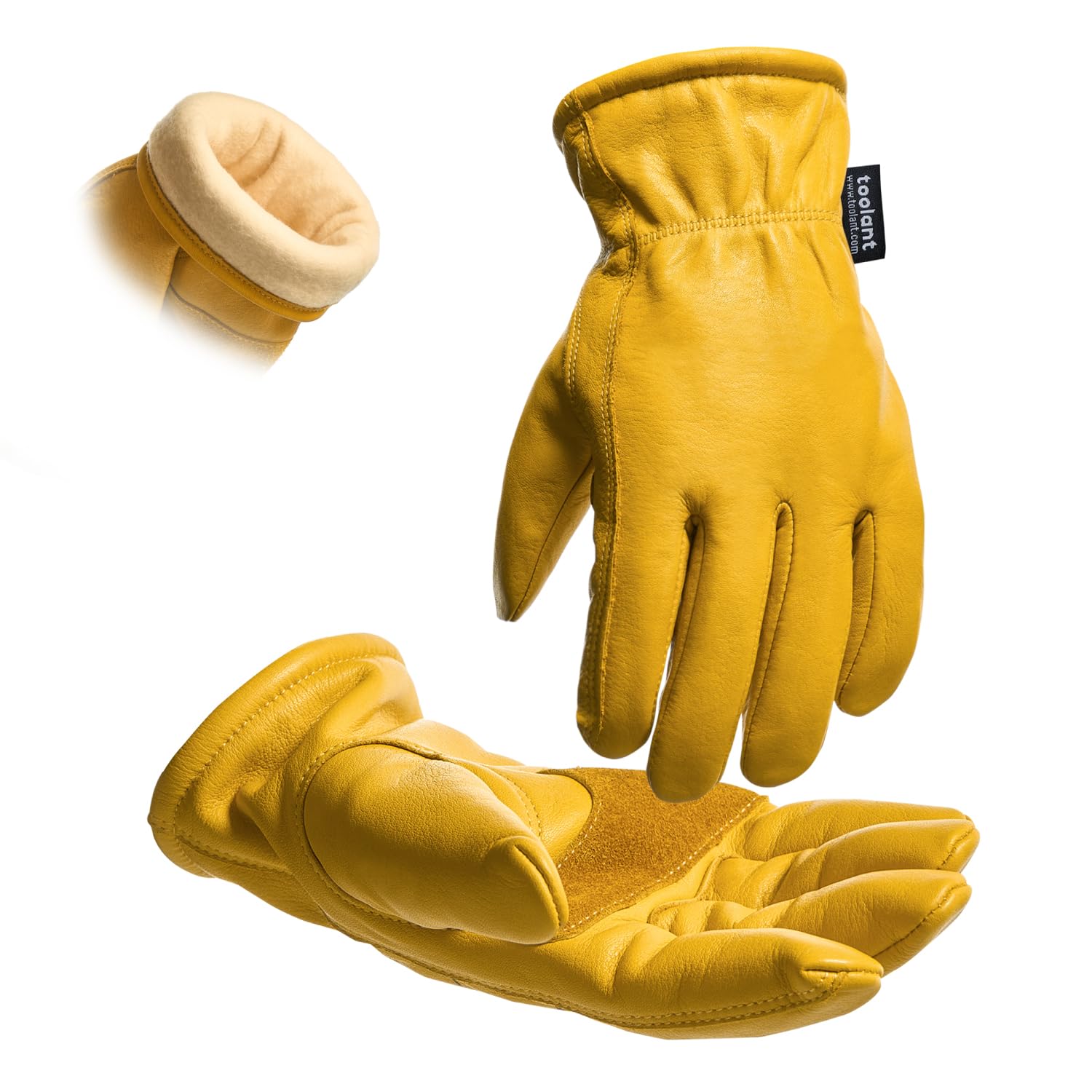
3. toolant Winter Work Gloves for Men, Insulated Leather
Soft leather that feels like leather the day it arrives, not after a week of breaking in.
The first thing anyone notices pulling these on is that the leather is soft straightaway. That texture is doing real work — a pliable palm wraps around a shovel handle or a bike grip without the stiff, boardy feel a new leather work glove often has. Owners describe the material as genuine leather in look and touch, and it is the quality of that material that drives the consensus.
Cold-weather coverage here stretches to tasks you might not expect from a work glove. It is described as a good fit for motorcycle riding in cold air, for shoveling snow, for driving, and for general outdoor work — the kind of mixed-use pair you keep by the door rather than in a toolbox. Warmth is the second thing the review pages fix on, and one buyer reports it holding up at 20°F.
Now the size warning. These run small, and that is the loudest complaint in the whole write-up. Order up a size if your hands sit near the top of a range or you plan to wear a liner underneath. Get the sizing right, though, and you have a soft, warm leather glove that looks as good as it feels — rare at this price.
The standout: genuinely soft, real leather that needs no break-in patience before it feels right on your hand.
Sizing reality: runs small, so treat the size chart as a starting point and size up.
Right for you when: you want a versatile leather glove for driving, snow removal, and cold outdoor chores.
Not your pair when: you are shopping a single size without room to go up.
4. Wells Lamont 7796L Winter Work Gloves

The pair for anyone who needs to work a phone or a control panel without peeling gloves off in the cold.
Touchscreen fingertips are the feature that changes daily habits here. You can answer a call, tap a job-site tablet, or check a work order without pulling a glove off and letting your hand go cold. For a foreman juggling calls on a freezing morning, that single detail earns its keep more than any warmth figure.
The build is set up for movement. A spandex back gives medium stretch so your hand flexes freely, and a neoprene knuckle strap adds some give over the joint that takes the most punishment. Insulation is 70-gram 3M Thinsulate — the lighter side, which is exactly how you keep feeling in your fingers. For comparison, the Wells Lamont Heavy Duty above runs 100-gram insulation, which is the warmer, bulkier side of the same brand’s lineup.
The palm is water-resistant synthetic leather, reinforced with a patch across the palm and a thumb saddle for grip and wear, and the manufacturer rates it at ANSI abrasion level 3. Where the consensus is strong is warmth and overall quality; the water resistance is thinner evidence, and a water-resistant palm is not a waterproof glove — treat it as splash protection, not something to dunk in a puddle. Fit is true to size per the maker, though some buyers still find it undersized, so try before committing to a final size.
Where it wins out
- Touchscreen fingertips keep you connected without removing the glove
- 70-gram 3M Thinsulate keeps dexterity alive in the cold
- Spandex back plus neoprene knuckle for free hand movement
- Reinforced palm patch and thumb saddle for grip and wear
What to keep in mind
- Water-resistant palm, not a waterproof shell
- Sizing feedback is split, with some finding it undersized
- Lighter insulation than the heavy-duty leather pick
Reach for these if: you work around screens and controls and need your hands to stay nimble and connected.
Look elsewhere if: the job is soaking wet rather than just cold.
5. SHOWA TEMRES 282-02 Waterproof Insulated Winter Work Gloves

A drawstring gaiter that cinches against your sleeve, so snow has nowhere to land.
Most winter work gloves stop at the wrist. This one keeps going. A built-in nylon sleeve with an adjustable drawstring toggle cinches the cuff tight against your arm or jacket sleeve, which is precisely the gap that fills with snow when you reach into a drift or lean over a snowblower chute. For deep-snow tasks it is the single most useful design choice in this whole comparison.
The shell is polyurethane, rated by the maker as a 100% liquid-proof seal, and the liner is acrylic fleece. Together they let your hands stay dry while moisture and heat escape, so an intense shift does not leave you with damp hands by noon. The polyurethane is designed to stay flexible in freezing temperatures rather than cracking, and a rough-textured finish gives you a non-slip hold on wet pipe, frozen tools, and oily surfaces.
What the buyer pages reinforce most is exactly that warmth-and-dry pairing, with quality running neck and neck behind it and waterproofing the third constant theme. The catch is the fit. Sizing runs small here — a recurring theme rather than a one-off — so measure your hand and size up if you sit on a boundary. Get past that, and this is the glove you want when the work is wet, not just cold.
Its real job: wet, snowy, high-intensity outdoor work where dry hands matter more than fine feel.
Before you order: sizing runs small, so a hand-measure beats guessing your usual size.
Suit it to: snow removal, ice fishing, wet-tool work, and anyone tired of snow creeping up the sleeve.
Skip the guesswork: do not assume your usual size fits — err toward one larger.
6. Schwer Long 100% Waterproof Winter Work Gloves (CR3308)

Reach into water without soaking your wrist — the cuff here covers most of the forearm.
For washing vehicles, handling wet equipment, or working in standing water, the question is how far the protection reaches. This glove answers it with an extended cuff that covers most of your wrist and forearm, backed by a 100% waterproof shell that holds up during short tasks in water up to 30 cm deep. That is a specific, useful limit to know before you dunk a hand in a wash bucket.
Warmth comes from a plush imitation lamb wool lining, and the shell is wind-resistant to trap heat and block cold air. The cuff adjusts one-handed, so you can snug it down while your other hand is busy, and it is built to keep drafts and snow out. The coating is a water-based PU, made with a lower-solvent formula, and the maker says it stays soft and flexible down to -22°F (-30°C).
Grip is where the design earns its keep in ice and wet conditions. Textured particles across the palm improve hold and slip resistance, which matters when you are grabbing wet pipe or icy equipment. The one thing to weigh is longevity — durability draws mixed feedback, with most finding them durable over time and a smaller share reporting punctures after about a week of hard use. If your work drags gloves across jagged metal daily, treat these as a seasonal pair rather than a permanent one.
Why it stands out: the rare winter glove that reaches up the forearm and keeps a wet jobsite off your skin.
Honest limit: durability is a coin-flip on the roughest surfaces, so expect replacement sooner if you work against sharp edges.
Best used for: car washing, wet equipment handling, cold storage, and ice fishing.
Look elsewhere for: rough demolition work where puncture resistance is the priority.
7. Schwer ANSI A9 Cut Resistant Winter Leather Work Gloves
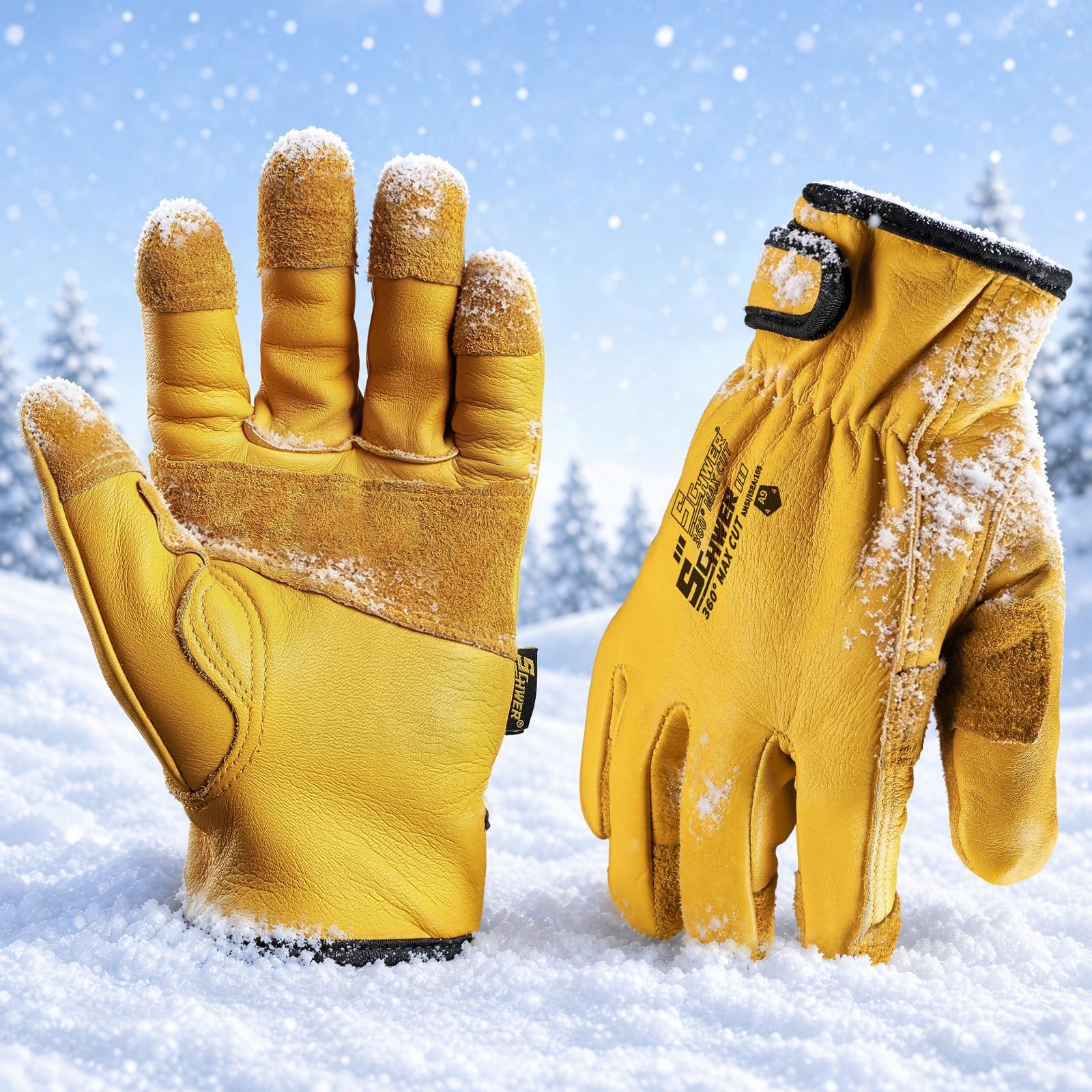
The only pair here with a real cut rating — for hands near sheet metal, wire, and sharp edges.
ANSI A9 is a high cut-resistance rating, and this glove carries it in an inner liner tested at an average cut force of 8,883 grams, well past the A9 threshold. Read the fine print: the outer leather shell is not itself cut-resistant — the protection comes from the liner underneath. That distinction matters if you are expecting the leather alone to save your fingers from a blade; the liner is what does the work.
That shell is 100% premium grain leather, offering abrasion and scratch resistance plus natural heat resistance, and it doubles as a wind block in the cold. Reinforced leather patches across the palm, fingers, and thumb crotch strengthen the spots that wear out first, and the manufacturer rates the build at ANSI abrasion level 4 and puncture level 4. A thermal liner of acrylic fiber keeps the warmth side of the equation honest, so you are not sacrificing comfort to get protection.
What buyers fix on most is the sheer toughness of the leather — thick, durable, and holding up against metal spikes and sharp edges — with durability and comfort as close followers. The supple feel of the leather surprises people who expect a cut glove to be stiff. Sizing runs slightly small, so size up if you are between sizes or plan to wear it over a thin liner. This is not a waterproof glove, so keep it for dry cold rather than wet slush.
The strong points
- ANSI A9 cut resistance from an inner liner, tested at 8,883 grams average cut force
- 100% premium grain leather shell resists abrasion and scratches
- ANSI level 4 abrasion and level 4 puncture protection
- Reinforced patches at palm, fingers, and thumb crotch
Point it out honestly
- Outer leather shell is not itself cut-resistant
- Not waterproof, so dry cold only
- Sizing runs slightly small
Made for: metal handling, material handling, welding-adjacent tasks, and any job with sharp edges in the cold.
Not built for: wet snow or slush, since there is no waterproof layer here.
8. Carhartt Insulated Duck Synthetic Leather Knit Cuff Glove

Duck and synthetic leather with touch-sensitive fingers — a work glove that doubles as a winter driver.
This is the pair you grab for the commute and keep on when you get to the site. Insulated duck and synthetic leather do the warmth-and-shield job, while touch-sensitive fingertips let you use a phone or a dashboard screen without taking them off. Wind protection is the second thing the review pages praise — the shell blocks cold air on gusty days, useful when a snowstorm rolls through mid-shift.
Carhartt built these around repeated use, with a knit cuff that seals at the wrist and a machine-washable care routine spelled out by the maker: cold water, gentle cycle, lay flat to dry, no bleach, no iron. That washability is a quiet advantage over pure-leather work gloves, which need gentle drying to avoid cracking. The synthetic leather also resists water better than raw hide on a wet hand-off.
The fair caveat is fit and long-term wear. Fit is the most-discussed aspect here and feedback is split, so try before you commit to a size for a full season. Durability also draws mixed notes — some buyers wear them for years, others find them wearing sooner. This is a glove for everyday cold-weather chores and light work, not a heavy-demolition replacement. For the mixed-use buyer who wants one glove for the truck, the driveway, and the phone, it earns its place.
Where it earns its keep: wind protection, touch-sensitive fingers, and a washable knit-cuff build for everyday cold.
The fair warning: fit divides buyers and long-term wear is inconsistent — a light-to-medium-duty glove, not a demolition tool.
Your match if: you want one glove for the truck console, the driveway, and quick outdoor chores.
Pass it by if: you need heavy leather for daily rough-material handling.
9. Vgo -4°F Men’s Lined Leather Impact Winter Gloves (CA7722FW)

Lined, waterproof, and built for impact — the heaviest-duty option for cold-condition power-tool work.
Rated to -4°F and waterproof, this is the pick for the coldest, hardest-hitting tasks in the lineup. The lining and leather shell are aimed at the trades the maker lists by name: power tools, utility work, construction, logistics, carpentry, ranching, and heavy DIY. Where the lighter gloves feel like work gloves you happen to wear in winter, this one is a winter glove first, with the protection to match.
The warmth and quality read is strong, and buyers confirm it does the core job in cold, rain, and snow. Waterproofing earns steady praise — this is a glove that keeps hands dry when the weather turns. For anyone running an impact driver or working in a wet, freezing environment, that combination of warmth and waterproofing is a serious advantage over a water-resistant-leather pick.
The trade-offs come on durability and fit, both of which draw mixed signals. Some long-term wearers report the gloves falling apart within a couple of months; others wear them for a full season without issue. Fit splits too, with some finding them true to size and some finding them large. If you are rough on gloves, go in knowing replacement may come sooner than you expect.
Why it belongs: the -4°F rating and waterproof shell together make it the toughest cold-weather glove here for power-tool work.
The real question: durability is uneven and fit runs large for some, so size down and inspect edges early.
Choose these if: you work in extreme cold with power tools and need waterproofing to back up the warmth.
Think again if: you want a pair to last several seasons on a rough site.
Know the Specs
Insulation weight (grams of 3M Thinsulate)
Insulation is measured in grams, and it is a direct trade between warmth and feeling. A 70-gram glove keeps more dexterity in your fingertips; a 100-gram glove holds more heat but feels bulkier. Pick the lighter number for fine work and the heavier for gripping large tools and rough material in the cold.
Waterproof versus water-resistant
A water-resistant palm shrugs off splashes. A waterproof shell is built to keep liquid out during real wet work, and it is the word to look for if you handle wet pipe, wash equipment, or shovel slush. That difference decides whether a wet job ends with dry hands or a soaked lining.
ANSI cut level
ANSI cut level rates how much a glove liner resists a slicing edge, and ANSI A9 is a high rating in that scale. The protection comes from the liner, not the leather shell on the outside. If your work involves sheet metal, wire, or blades, check the cut rating specifically.
Cuff style
A short knit wrist seals at the joint. A safety cuff covers more forearm. A drawstring gaiter cinches against a sleeve. The further up your arm the glove reaches, the less snow and draft gets in — and the more bulk you feel under a jacket cuff.
Common Questions
Will a 100-gram 3M Thinsulate glove be too bulky for handling screws?
What is the difference between waterproof and water-resistant in winter work gloves?
Does an ANSI A9 cut rating mean the whole glove is cut-proof?
Will these gloves fit under a jacket sleeve?
How do I dry leather winter work gloves without cracking them?
Can I use touchscreen gloves while they are wet?
Is a knit wrist or an extended cuff better for shoveling snow?
How long should a winter work glove last on a construction site?
Do winter construction gloves run small or true to size?
Can I wear a liner under these gloves for extra warmth?
The Bottom Line
For most buyers, the strongest pick for winter construction gloves is the Kinco 1927 — the pigskin palm grips wet tools, the safety cuff blocks wind at the wrist, and the range of tasks it covers makes it the easiest one-glove answer. It sits at 4.5+ stars across 500+ ratings, and it is the version most buyers settle on when they want a leather work glove that still feels like a work glove.
If the work is wet rather than just cold, reach for the SHOWA TEMRES 282-02 and its drawstring gaiter cuff. And if you handle sharp edges or wire, the Schwer PM3401-W is the only pick here with an ANSI A9 cut liner tucked under the leather.
One nudge before you decide: match the glove to the surface you actually touch. Warmth is easy to find; grip, dry hands, and fingertip feel are what separate a good shift from a miserable one on the cold site.
How we choose
We do not accept paid placement. Every pick is matched to a real buyer and a real use-case; we do not hands-on test units.
Sources
Specifications: manufacturer listings and product documentation. Review insights: verified customer reviews, as of November 2026. Pricing: not shown on this page (it changes often); check the current price via the retailer link.
As an Amazon Associate, Tactical Gear Guy earns from qualifying purchases. This does not affect which products we feature.