Specs are compiled from manufacturer listings and verified buyer reviews and can change over time — please confirm the key details on the product page before buying.
You want your Android phone to charge on a pad, but it didn’t ship with a wireless coil inside. A tiny receiver tag plugs into your USB-C port, sticks to the back of the phone, and turns any Qi pad into a charger for it. That is the whole promise. The catch is that these tags vary wildly in how much current they actually pass through, and a slow one turns a 30-minute top-up into an all-evening wait. Below you’ll find nine adapters sorted by what they actually do well, so you can pick the one that matches your phone, your case, and your patience.
This guide is built by comparing the manufacturers’ published specifications and the patterns across verified customer reviews, so you get each pick’s real strengths and trade-offs instead of marketing spin.
Some of these tags are faster than others, some fit under a thick case and some don’t, and a few are built around a specific Pixel or Galaxy model. Here is how to tell them apart before you stick one on a phone you plan to keep.
I’ve broken down each option by connector type, amperage, and case fit so you can find the right wireless charging adapter for Android without guessing.
Top Picks


How To Choose The Best Wireless Charging Adapter for Android
A receiver tag is a thin plastic strip with a copper coil inside and a plug on one end. The coil catches the magnetic field from a Qi charging pad and converts it back into power for your USB-C port. Your phone never knows the difference — it just sees power arriving. Three things decide whether the tag in your hand works: the connector shape, the current rating, and whether your case can sit over it.
Connector length and port placement
The plug has to reach from your phone’s charging port up to the middle of the back panel without bunching. Short versions suit compact phones where the port sits low. Long versions reach further up the back, which helps on taller handsets. If you pick the wrong length, the tag rides up over the camera bump or curls at the corner — and the coil ends up off-center on the pad, which weakens the charge.
Amperage: the number that sets your real charge rate
The tag’s amperage rating (the measure of how much electrical current it can pass through) is the ceiling on everything downstream. A 3 A tag moves noticeably more current than a 1 A tag. That gap is not cosmetic — it is the difference between a tag that holds its rate through light use and one that barely moves the battery icon. Match the tag’s rating to what your pad can output, or you’ll leave performance on the table.
Case thickness and the coil alignment problem
Every millimeter between the coil in the tag and the coil in the pad costs you charging efficiency. Most receivers are rated to work through a case, but thin cases are kinder than thick armored ones. If your phone lives in a heavy-duty case, expect to test the alignment before you trust it overnight. Some receivers also cover the fingerprint sensor on small phones, which is worth checking against your specific model.
Side-by-Side Comparison
| Model | Best For | Connector | Amperage | Version | Amazon |
|---|---|---|---|---|---|
| Ejoyous 2-Pack Type C Receiver★ Best Overall | Two phones, one pack | USB Type C | — | Sticker, 2-pack | Amazon |
| IVY QI Type-C ReceiverLong Galaxy List | Samsung Galaxy A-series owners | USB Type C | — | Type-C | Amazon |
| Nillkin Qi Receiver USB C (Long)Best Build | Case-friendly fit | USB Type C | 1 A | Long Version | Amazon |
| Nillkin Magic Tag USB C (Short) | Fingerprint-sensor-safe fit | USB Type C | 1 A | Short Version | Amazon |
| Nillkin Magic Tag USB C (Pixel 2 XL) | Pixel XL and OnePlus owners | USB Type C | 3 A | Type C | Amazon |
| MyMAX 1300mA Magic Tag | Highest current rating | USB Type C | 1300 milliamps | Long Version, Metal Toothpick | Amazon |
| TOVYS Wireless Receiver Module | Widest phone compatibility list | USB Type C | 1 A | Slim | Amazon |
| Dpofirs 10W Type C Receiver | Efficiency-focused charging | USB Type C | 1.5 A | 10W Qi Receiver USB C | Amazon |
| Nillkin Wireless Receiver (Type-C Long) | Thin case pairing | USB Type C | 1 A | Type-C Long | Amazon |
Detailed Reviews
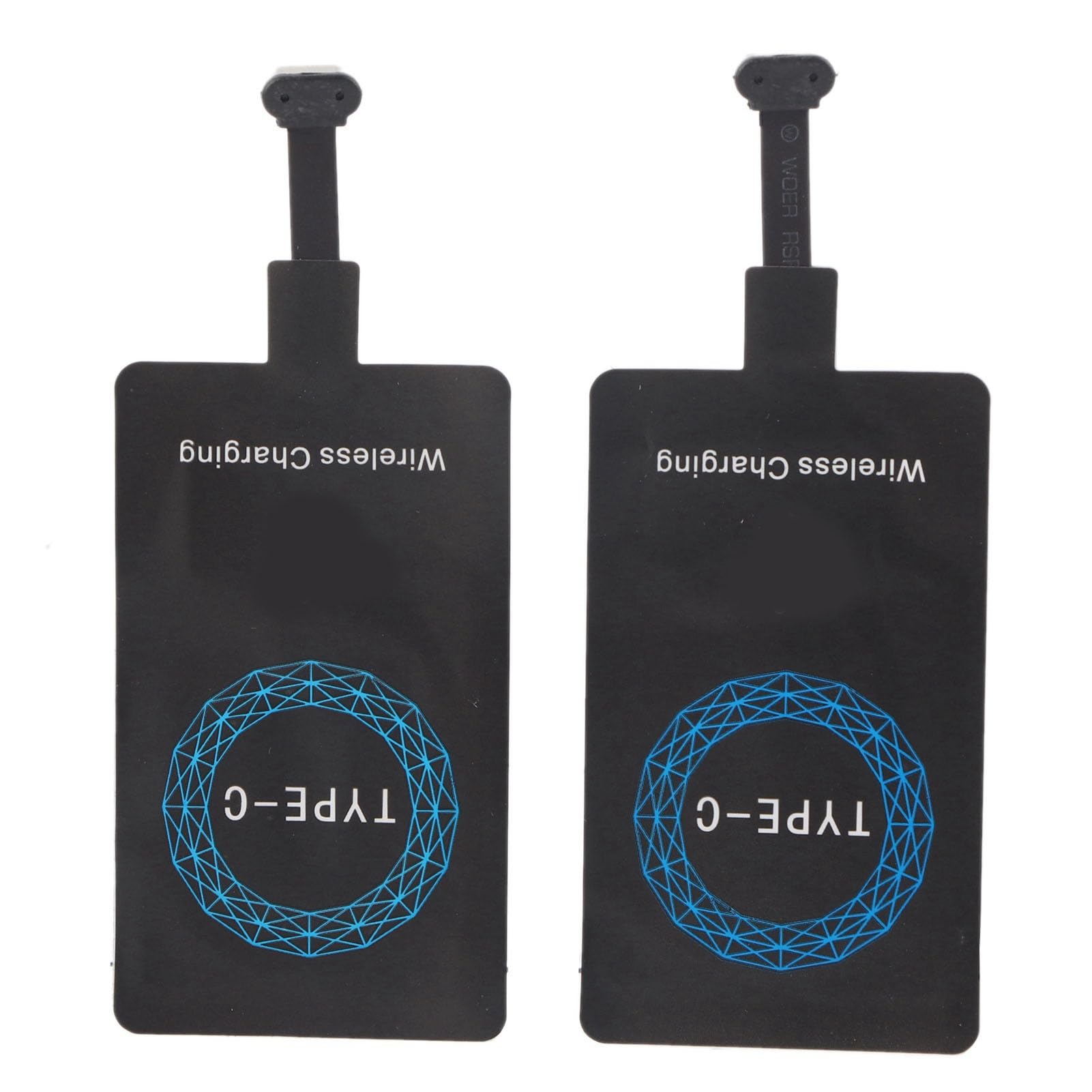
1. Wire Less Charging Receiver Type C 2PCS
Two receiver tags in one pack, so both the phone and the spare get wireless charging.
Two tags for the price of a single one is the reason this pack earns the top slot. You get two receiver Type C units in the box, each built on a self-adhesive silicone backing that sticks flat to the phone’s back panel — no cable, no clip, nothing to lose. If your household runs two Android handsets with USB-C ports, or you simply want a spare in case one tag’s adhesive gives out, this is the pack that covers it without a second order.
Each tag is designed around a Type-C interface, so it fits any Android phone with that port shape. The adhesive-backed form factor means the coil stays put on the back panel instead of sliding around while you set the phone down. That fixed position keeps the tag’s coil aligned with the pad’s coil — misalignment is the quiet reason most receiver tags underperform.
The honest trade-off: the tag has no published amperage rating in its spec sheet, so you cannot predict its charge rate the way you can with the Nillkin 3 A model further down. This pack is the practical choice if getting two phones onto a pad matters more than squeezing out top speed. Treat the adhesive surface as a one-shot application — once it’s on, it stays on.
Why this pack gets the nod
- Two Type-C receiver tags included, so two phones share one order
- Self-adhesive silicone backing holds the coil in place against the phone
- Small and portable — slips into a pocket or bag when unfitted
- Low-profile footprint doesn’t clutter a desktop or nightstand
Where it asks you to compromise
- No amperage figure published, so the charge ceiling is unknown
- Adhesive is a permanent fit — repositioning after install is awkward
- Type-C only, so micro-USB Android phones are out
Grab this one when: you have two USB-C Android phones to convert and want a spare tag sitting in a drawer.
Hold off if: you need a known current rating to plan around your charge time.
2. IVY QI Wireless Charging Receiver Adapter
Built for the Galaxy A-family owner who wants a tag that already lists their model.
If your phone is a Samsung Galaxy A-series handset, the IVY tag probably names it in the compatibility list. The list runs from A06 and A12 up through A55 and A56, covering the A13, A14, A15, A23, A24, A25, A32, A33, A34, A35, A42, A52, A53 and A54 in between. That matters because a receiver tag either fits your model’s port placement or it doesn’t — and with this one, you can check before ordering.
The internal chip is rated for charging efficiency above 72%, with a built-in IC protecting against current spikes and keeping radiation low. The tag itself is described as ultrathin and light enough not to add noticeable weight to the phone. In use, that thinness is what lets the back panel sit flat on a pad instead of rocking.
What wins people over is how little fuss the install takes — the tag seats easily and the process is straightforward enough that nobody needs instructions twice. The recurring gripe is pace: this is a trickle-charging tag, and buyers on the review pages talk about full charges stretching across a long stretch. Some also flag that it runs warm and that a few units stop working early. Fit it to a bedside pad where overnight charging is the plan, and the slow rate stops being a problem.
Pad-side reality: phone heat during a long charge is the pattern to know about — keep the pad in open air rather than under a pillow.
The case question: some buyers report it works through their case; others hit compatibility trouble, so test alignment with your case on before trusting it overnight.
Made for: Galaxy A-series owners who charge overnight and want a named-model match.
Look past it if: you expect cable-like speed from a pad.
3. Nillkin Qi Receiver USB C Long Version
The long-body tag built to sit flat under a case on a tall handset.
Construction is where this Nillkin long version earns its place. The tag uses a plastic housing rated as more waterproof and stain-resistant than an ordinary receiver, and the precise build keeps the copper coil stable enough for consistent transmission. The gold-plated plug resists scratching and fading. If you have ever had a cheap tag corrode at the connector, this is the antidote.
The amperage rating is 1 A, which sets the pace this tag can pass through to your phone. Nillkin recommends pairing it with a QC 2.0 or QC 3.0 fast-charge adapter (Quick Charge — a fast-charging standard for the wall plug, not the tag) to get the best result from it. Input voltage is 5 volts, and the operating frequency sits at 100kHz. In plain terms: pair it with a proper fast adapter or the tag is the bottleneck.
Buyers talk about fit more than anything else, and here it depends on the long body. That length suits phones where the port sits far enough from the coil center that a short tag would bunch up. The honest limitation is speed: 1 A (amp, a measure of current) is modest, and some owners mention slow charging, so plan around overnight rather than a quick top-up. The plastic tag also resists wear better than fabric-backed receivers, which helps if your phone lives in a pocket all day.
Build quality you can feel
- Plastic housing rated more waterproof and stain-resistant than ordinary tags
- Gold-plated plug resists scratching and fading
- Long version reaches further up the back panel on taller phones
- Fifth-generation coil design keeps transmission stable
What the spec sheet tells you honestly
- 1 A rating is a modest ceiling — no fast-charge territory here
- Needs a QC 2.0/3.0 adapter to reach its best result
- Type-C only, so no micro-USB phones
The right call for: a tall USB-C Android phone that needs a tag reaching further up the back.
Skip the long version if: your phone is compact and the port sits high — a short tag fits better.
4. Nillkin Magic Tag USB C Short Version

Short enough to leave a small phone’s fingerprint reader uncovered.
Small phones have a specific problem: the coil has to sit centered on the back panel, and on a compact handset that pushes the tag right over the fingerprint sensor. This short Nillkin version is cut to avoid that — it will not cover the sensor on phones like the Google Pixel, Pixel 2 and 3a. Drop it on a Pixel 3a XL or a Galaxy A50 and the reader stays clear.
The physical build is the same family as the long version: gold-plated plug, scratch-resistant and fade-resistant, a plastic tag rated more waterproof and stain-resistant than ordinary ones, and absorbing materials that handle heat, moisture, corrosion and UV exposure. Rated at 1 A of current on a Type-C connector. The compatibility list spans Pixel 2/2XL/3a, Galaxy A8 through A90, LG Stylo 4/5, Moto G7/X4, and OnePlus 6 through 7 Pro.
Functionality is what wins people over here — the tag reliably enables wireless charging, and the consensus on the review pages is that it does its job without drama. The mixed notes land on speed and fit: it doesn’t work with every case, and some complain the charge is slow and not worth the money. Neither is unique to this tag — it’s the nature of a 1 A receiver. Fit it under a thin case on a phone where the port sits near the coil center and it behaves.
Where it fits best: a compact USB-C phone with a fingerprint reader the tag would otherwise block — the short body is the whole point.
Know before you stick: thick cases can defeat the tag. Test on the pad with your case on before you commit to the adhesive position.
Pick this for: a Pixel or compact Galaxy where the fingerprint sensor needs to stay reachable.
Reach for the long version instead if: your phone is tall and the short body leaves a gap.
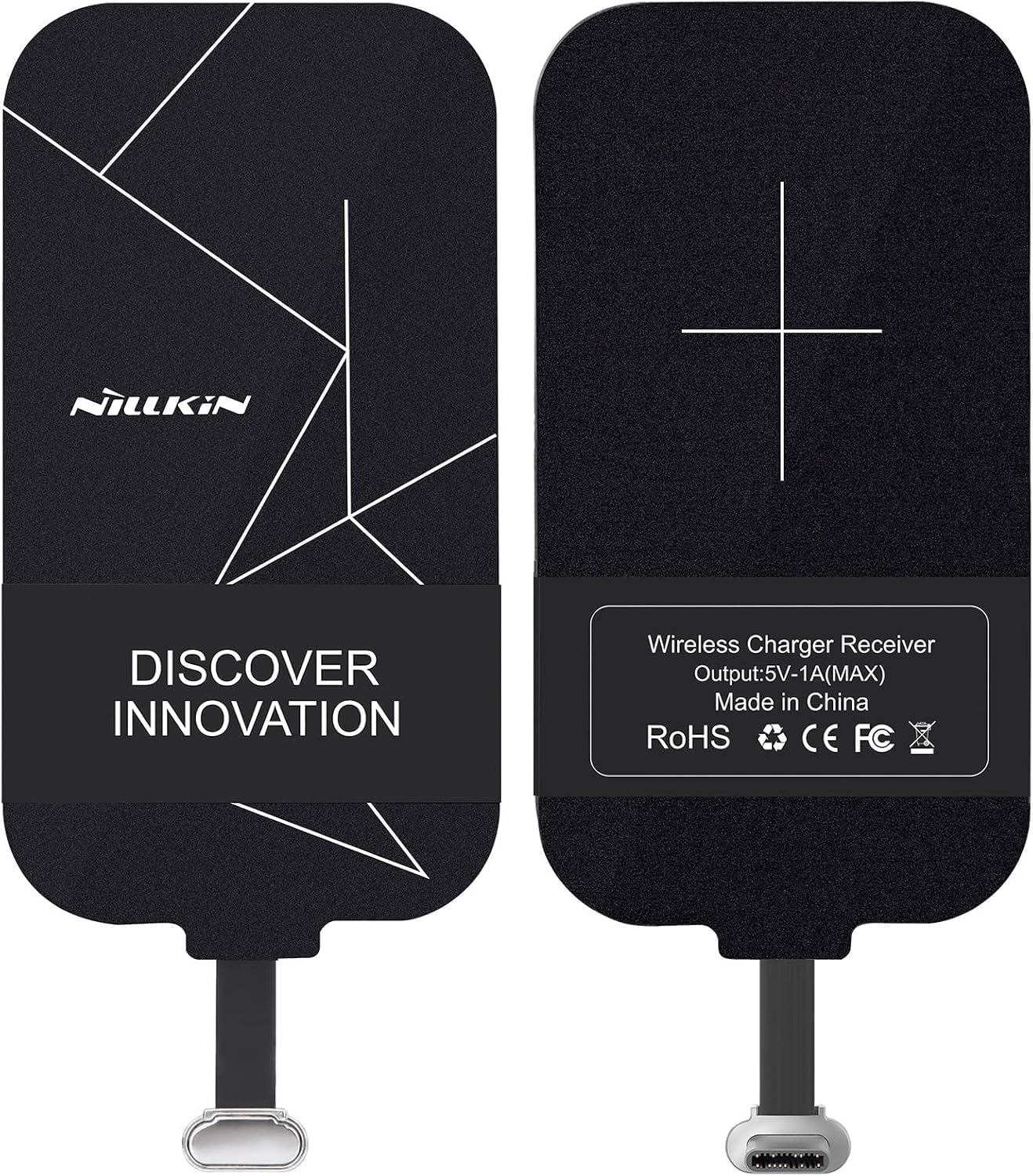
5. Nillkin Magic Tag USB C Qi Wireless Charger Receiver Chip
A 3 A rating that sits at the top of what these tags can pass through.
Amperage is the spec that decides your ceiling, and this Nillkin tag is rated at 3 A. That’s the highest figure in this lineup — three times the 1 A rating of the Nillkin long version two picks up. Whether your phone and pad can actually feed 3 A depends on what the pad outputs, but the tag itself won’t be the bottleneck. If speed from a pad matters to you, this is where the spec sheet points.
Fit gets the same care here. The tag is slim enough to use the phone’s available back-panel space without adding bulk, and it’s built for tall phones: Google Pixel 2 XL, LG V20, OnePlus 6, 6T, 7 and 7 Pro, plus the full Galaxy A30 through A71 and Xiaomi Redmi Note range. The gold-plated plug is rated scratch-resistant and fade-resistant, so the contact stays clean through daily plugging. The plastic housing resists water, stains and corrosion, and absorbing materials handle heat and moisture.
Installation is straightforward enough that setup takes minutes. The honest part: buyers on the review pages note that some cases defeat the tag’s alignment and charge rate, so the practical move is to test on the pad with your case on. A 3 A tag with a misaligned coil will still crawl, and no rating fixes that.
Why the rating is the headline
- 3 A rated — three times the 1 A of the Nillkin long version
- Suits tall phones: Pixel 2 XL, LG V20, OnePlus 7 Pro
- Gold-plated plug with scratch-resistant finish
- Absorbing materials resist heat, moisture, corrosion and UV
The limits worth knowing
- 3 A is only reached if your pad can supply it
- Case fit issues can drag the real-world rate well below the rating
- Type-C only, no micro-USB support
Worth it when: your phone is a tall USB-C handset and you want the highest current ceiling in the lineup.
The catch to plan around: a thick case can erase the speed advantage — test alignment before you trust it.
6. MyMAX Type C 1300mA Magic Tag Super-Fast Qi Wireless Charging Receiver

A larger copper coil and a smart chipset, aimed at turning up the charge rate.
MyMAX rates this tag at 1300 milliamps — that’s the reason it headlines the premium tier. The tag pairs a larger copper coil than a standard receiver with an intelligent chipset, and the manufacturer claims above 73% charge efficiency, a 30% speed boost, and operation under 45°C. Treat those last two figures as the maker’s claims rather than lab-verified facts. What is verifiable: the rating, the coil design, and the TI ferrite core used for heat control.
Heat is the real concern with any receiver tag, and this one leans into that with an intelligent control charging IC and a WPC ferrite from TI. The larger coil moves more current per cycle, which in theory leaves less of that energy to escape as waste heat. The absorbing materials also handle corrosion, moisture and UV. The frequency range is 100–250 kHz.
Here’s the honest caveat: the long version’s metal toothpick shape suits tall phones, but the whole assembly is thicker than a plain plastic tag. That extra bulk can tilt a phone slightly on a flat pad, and the narrower the pad’s balance, the more alignment matters. Reviews of this model split: some say it works well, others report it stopping after a day. Keep the packaging until you’ve tested it for a couple of charge cycles.
The pitch: 1300 milliamps, a larger copper coil, and a ferrite core aimed at keeping heat in check — the most current-focused tag in the lineup.
The caveat: mixed longevity reports on the review pages, so give it a few cycles before trusting it fully.
Hand this to: a tall USB-C Android phone owner chasing the highest current rating on the list.
Steer clear if: you need a proven track record of long-term reliability above all else.
7. Wireless Charging Receiver and Adapter Module

The compatibility list on this module reads like a phone catalog.
Most receiver tags name a dozen compatible phones. This one names dozens, so you’re more likely to find your model on the list. It covers Galaxy A15, A25, A33, A34, A35, A42, A53, A54, A55, plus the M and F series; Sony Xperia 10 III, 10 IV, 10 V, 5 II and 5 III; Google Pixel 6a, 5a and 4a; Xiaomi 13, 12, 11, 10, 9 SE, 8, 8 SE and 6; the Redmi K series, Note series and number series; and POCO F5, F4, F3, X6 and X5. It also says ASUS, Nokia, Motorola, vivo and OPPO phones with Type-C ports (the oval USB connector) are all compatible.
The build is centered on flexibility and a slim profile that fits snugly against the phone without interfering with most cases. Protection is built in against over-voltage, over-current and short-circuiting — three failure modes that can damage a phone’s charging circuit. Plug it into the port, align on the pad, and it starts charging. No app, no setup screen. The port is USB Type C, rated at 1 A on a 5-volt input.
That 1 A rating is the honest limit. This tag is about compatibility and safety, not raw speed. If your phone isn’t on the Nillkin or IVY lists, this is the one to check first. If your phone is on those lists and you care about current, look at the 3 A Nillkin instead.
Why the list is the draw
- Compatibility covers Pixel, Galaxy A/M/F, Sony, Xiaomi, Redmi, POCO plus ASUS, Nokia, Motorola, vivo and OPPO
- Built-in protection against over-voltage, over-current and short-circuiting
- Flexible and slim enough to fit under most cases
- Plug-and-play install with no app or setup
What it won’t do
- 1 A rating is a modest current ceiling
- No published efficiency figure to compare against the Dpofirs 85%
- Type-C only
Best for: an Android handset that doesn’t appear on the Nillkin or IVY compatibility lists.
Not the one if: your phone is a Pixel 3a XL or Galaxy A15 — the Nillkin Type-C Long already covers those with better current headroom.
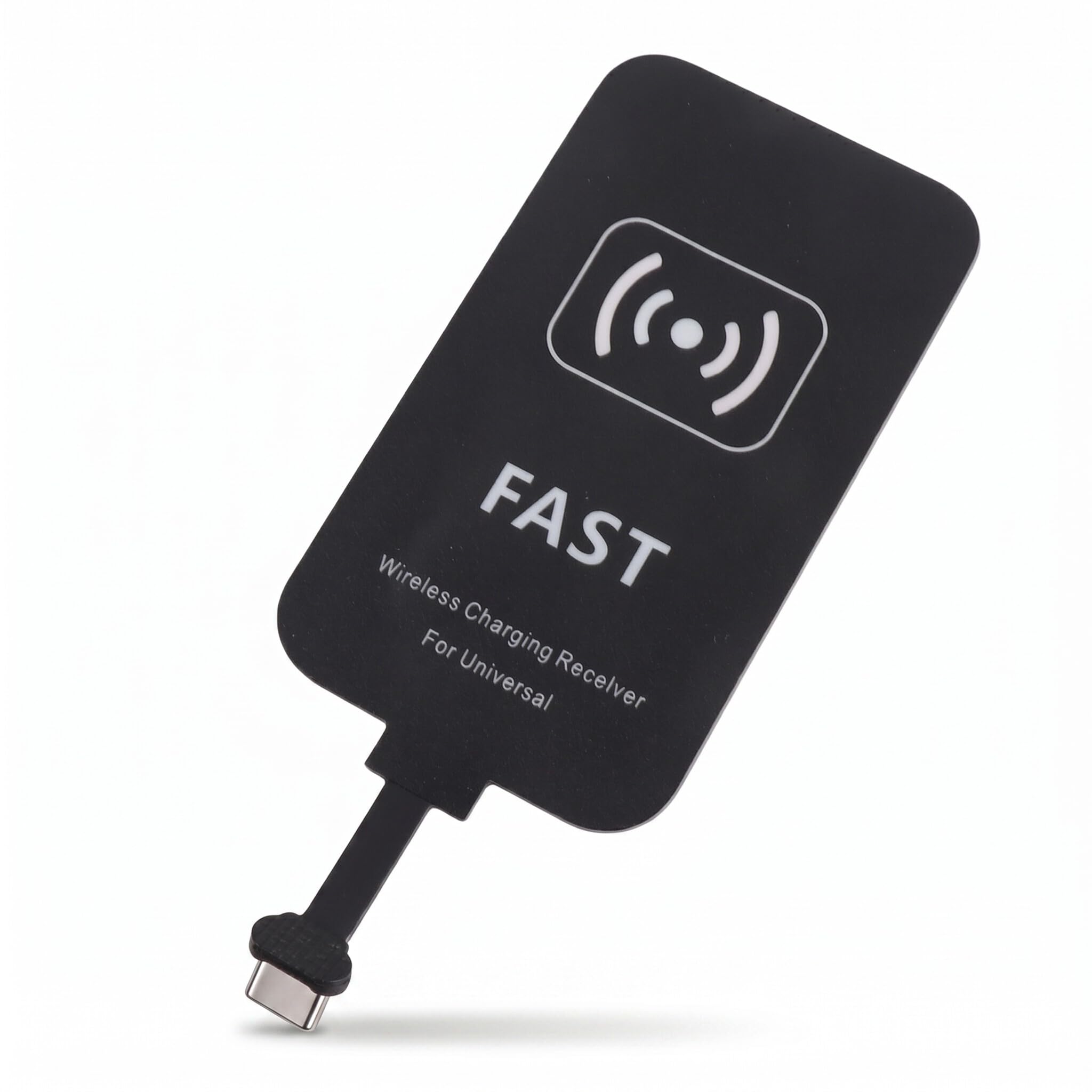
8. Dpofirs Wireless Charging Receiver, 10W Type C for Phone
Above 85 percent conversion efficiency, which is the number that keeps phone heat down.
Conversion efficiency is how much of the power the pad sends actually reaches your battery. Dpofirs rates this receiver above 85 percent. That gap matters on a phone that already runs warm — a low-efficiency receiver sheds a chunk of the pad’s power as heat, while 85 percent keeps more of it as charge. The tag itself is rated 10W, rated at 1.5 A on a 5-volt input.
Weight is the other number worth knowing: 14 grams. That’s light enough that the phone still sits flat on the pad instead of tilting — a heavy receiver can throw off alignment, and alignment is the quiet killer of charge rate. The plug is USB Type C, and the receiver is designed for any Type-C phone, so one tag serves a household with different Android models in use.
The trade-off: CE and ROHS safety certification sits on the spec sheet, but there’s no published compatibility list of specific phone models. You get “all Type C interface phones” and nothing narrower. Also worth planning: 1.5 A is mid-tier current, so this isn’t the fastest tag here — it’s the most efficient one.
The efficiency case: Above 85 percent conversion means less waste heat and more charge per hour, which is what you notice on a phone that runs warm.
The honest gap: no model-specific compatibility list, so verify your phone before ordering.
Reach for this if: efficiency and low heat matter more than raw speed to you.
Think twice if: you want a confirmed model match before you buy.
9. Nillkin Wireless Charging Receiver and Adapter Type C Long

Slim at 0.16cm, and built for a case no thicker than 3mm.
Your case decides whether this tag works, and the 0.16cm thickness is the spec that settles it. At that thinness, the coil sits close enough to the pad’s field to charge through a slim case. Nillkin is explicit about the ceiling: use a case under 3mm thick, or stick the tag directly to the case’s back. That’s a more honest instruction than most receiver tags give. It’s rated 1 A on a USB Type C connector and rated for 5-volt input.
Inside, a TI smart chip reduces heat during charging — that’s the safety and stability piece. The gold-plated plug is scratch-resistant and the absorbing materials resist heat, moisture and corrosion. The tag is designed for phones with no built-in wireless charging, and Nillkin is upfront that it’s a trickle-charge solution for daily use, not a fast-charging path. Pair it with a QC 3.0 or PD adapter for the best result.
Fit is the spec most buyers will care about. The long body suits tall phones like the Pixel 3a XL, Galaxy A13, A14, A15 and A42, and Moto G series. It functions reliably and matches the case snugly. The catch is the trade-off every receiver tag makes: speed is modest. Some say it charges fast enough, others call it slow and not worth it. Both are describing the same 1 A current ceiling, filtered by their pad and case.
The spec that earns its place
- 0.16cm thin — the spec that lets it charge through a slim case
- Case ceiling stated plainly: under 3mm thick or stick to the case back
- TI smart chip for reduced heat and stable delivery
- Long body suits Pixel 3a XL, Galaxy A13/A14/A15/A42, Moto G
What to plan around
- 1 A rating and a trickle-charge design — not a fast charger
- Thick armored cases will block the field
- Needs a QC 3.0 or PD adapter for best result
Right for you when: your case is slim and your phone is a tall USB-C handset needing a low-profile fit.
Look elsewhere if: you run a thick protective case or expect fast charging from a pad.
Know the Specs
Amperage and what it means in practice
Amperage is the measure of how much current a receiver tag can pass through to your phone. A 3 A tag has a higher ceiling than a 1 A tag — the Nillkin Type C tag and the Nillkin long version differ on exactly this, 3 A versus 1 A. Higher current doesn’t automatically mean faster charging, because your phone and pad both have their own limits. But if the tag is the lowest-rated piece in the chain, it’s the one dictating the pace. A 1300 milliamp tag sits between them.
Conversion efficiency and heat
Efficiency is the percentage of power from the pad that actually reaches your battery. Dpofirs rates its tag above 85 percent, and the IVY tag is rated above 72 percent. The gap that doesn’t reach the battery turns into waste heat, which is why efficiency matters on a phone that already runs warm. A higher-efficiency tag converts more of the pad’s power into charge and sheds less as heat. Most receiver tags also include an IC chip to guard against overheating, but efficiency sets the baseline.
Case thickness and coil alignment
Nillkin states its Type-C Long tag’s case limit clearly: under 3mm thick, or stick the tag to the case back. That 3mm ceiling exists because every millimeter between the tag’s coil and the pad’s coil weakens the field. A flexible, slim tag helps, but the tag’s thickness plus the case thickness together decide whether the phone sits flat on the pad or rocks. Any tilt can shift the coil out of alignment, which is why some tags work for one owner and fail for another.
Input voltage and pad matching
Every tag here lists a 5-volt input. That’s the standard USB voltage — the tag expects to receive 5 volts from the pad and passes it on to the phone. Several receivers recommend pairing with a QC 2.0, QC 3.0 or PD wall adapter (fast-charging standards for the wall plug), because the tag can only pass what the pad provides. If the pad output is low, the tag will pass a low rate no matter how high its own rating. Matching pad output to tag rating gets you the best result.
Common Questions
Will a wireless charging receiver work with my Android phone if it already has wireless charging built in?
How thick can my phone case be with a receiver tag installed?
Why does my receiver tag charge so slowly compared to a cable?
Is a higher amperage tag always better?
Does the receiver tag cover the fingerprint sensor on my phone?
Can I use a receiver tag with a micro-USB Android phone?
Will the tag make my phone overheat during charging?
Do I need a QC 2.0 or PD adapter for the tag to work?
How long do receiver tags tend to last?
Can I use one receiver tag on?
The Bottom Line
For most people, the wireless charging adapter for android that makes the most sense is the Ejoyous 2-Pack Type C Receiver, because two tags in one pack cover a household with two USB-C phones and leave a spare in the drawer. If raw current matters more, the Nillkin Magic Tag USB C carries a 3 A rating — three times the 1 A of the Nillkin long version — and suits tall phones like the Pixel 2 XL and OnePlus 7 Pro. And for a compact Pixel or small Galaxy where the fingerprint reader has to stay clear, the Nillkin Magic Tag Short Version is cut to fit without blocking the sensor.
The pattern across all nine is the same: a receiver tag is a convenience upgrade, not a fast-charging replacement. The 3 A Nillkin tag gives you the highest current ceiling in the lineup, the Dpofirs tag leads on conversion efficiency above 85 percent, and the IVY and Nillkin long versions make a point of matching named Galaxy and Pixel models. Pick the tag that fits your phone and case, put it on a pad where it can sit overnight, and the slow rate stops being a problem. Start with the one that matches your model and your case thickness — that’s the decision that actually matters.
How we choose
We do not accept paid placement. Every pick is matched to a real buyer and a real use-case; we do not hands-on test units.
Sources
Specifications: manufacturer listings and product documentation. Review insights: verified customer reviews, as of November 2026. Pricing: not shown on this page (it changes often); check the current price via the retailer link.
As an Amazon Associate, Tactical Gear Guy earns from qualifying purchases. This does not affect which products we feature.