Specs are compiled from manufacturer listings and verified buyer reviews and can change over time — please confirm the key details on the product page before buying.
Carbon monoxide gives you no warning — no smell, no color, no irritation — so the only thing standing between your family and a colorless gas is a detector that is actually powered, actually placed, and actually working. That is the whole buying decision in one line: pick a unit that runs on batteries you can trust and tells you loudly when something is wrong. Below you’ll find nine wireless carbon monoxide detectors, ranked and explained in plain terms, so you can buy once and stop worrying about whether the thing on your ceiling is alive.
This guide is built by comparing the manufacturers’ published specifications and the patterns across verified customer reviews, so you get each pick’s real strengths and trade-offs instead of marketing spin.
A wireless CO detector is really just a battery-powered sensor that never needs an electrician — and the differences between models come down to the sensor, the alarm volume, and how long the battery lasts. Here is the honest breakdown of the best wireless carbon monoxide detector for every kind of home.
Top Picks


How To Choose The Best Wireless Carbon Monoxide Detector
The mistake most first-time buyers make is treating a CO detector like a smoke alarm and grabbing whatever is on the shelf. They are different devices with different jobs. A smoke alarm watches for particles in the air; a CO detector watches for a gas your senses cannot detect at all. Buy for the gas, not the shelf label.
Start with the sensor, not the price tag
The sensor is the part that actually smells the carbon monoxide for you. Look for an electrochemical sensor (a small cell that reacts chemically to CO and produces a tiny electrical signal). Several picks here use exactly that type, and it is the reason they can react quickly at low levels. A listing that hides its sensor type is usually hiding a cheaper one.
Battery type decides your next ten years of annoyance
Swappable AA or 9V cells mean you replace batteries on a schedule — miss it and you get the 3 a.m. chirp, or worse, a dead unit. Sealed 10-year lithium batteries mean the alarm’s service life and the battery’s service life end at the same time, so you replace the whole device rather than the cells. For a hallway unit you will forget about, sealed is kinder. For a unit that travels to hotels with you, swappable AA is easier.
Decide whether “wireless” means standalone or connected
Most battery-operated CO detectors are standalone: they sound locally and nothing else happens. A few are app-connected and can push an alert to your phone or interconnect with other alarms in the house. The connected kind is genuinely useful in a large home. It also introduces setup steps, app accounts, and Wi-Fi that the standalone kind never asks for.
Match the alarm volume to where it lives
Look for an 85 dB alarm — loud enough to wake most adults through a closed bedroom door. If you are mounting in a basement or garage, volume and a visible LED warning light matter even more, because you may not hear it from upstairs.
Side-by-Side Comparison
| Model | Best For | Power | Alarm | Sensor | Amazon |
|---|---|---|---|---|---|
| Kidde COB★ Best Overall | Travel and renters | 2 × AA (included) | 85 dB audible + LED | — | Amazon |
| Kidde KN-COB-B-LP NighthawkBest Value | Long-life budget monitoring | 3 × AA (included) | Audible alarm | — | Amazon |
| First Alert FAT1039718Best Simple Install | Simple no-frills coverage | 9V battery | 85 dB audible | Electrochemical | Amazon |
| SITERWELL GS828A | Reading live CO levels | 2 × AA alkaline | ≥85 dB audible + 3-color LED | Electrochemical | Amazon |
| First Alert CO410A | Backlit display in dark halls | Battery | 85 dB audible | Electrochemical | Amazon |
| First Alert CO710A | Set-and-forget ten years | Sealed 10-year lithium | Audible | Electrochemical | Amazon |
| First Alert SC5 | App-connected smart home | 3V CR123A lithium | Audible + voice | — | Amazon |
| X-Sense SC06 (5-pack) | Whole-home coverage | 10-year built-in lithium | Audible | Photoelectric + electrochemical | Amazon |
Detailed Reviews
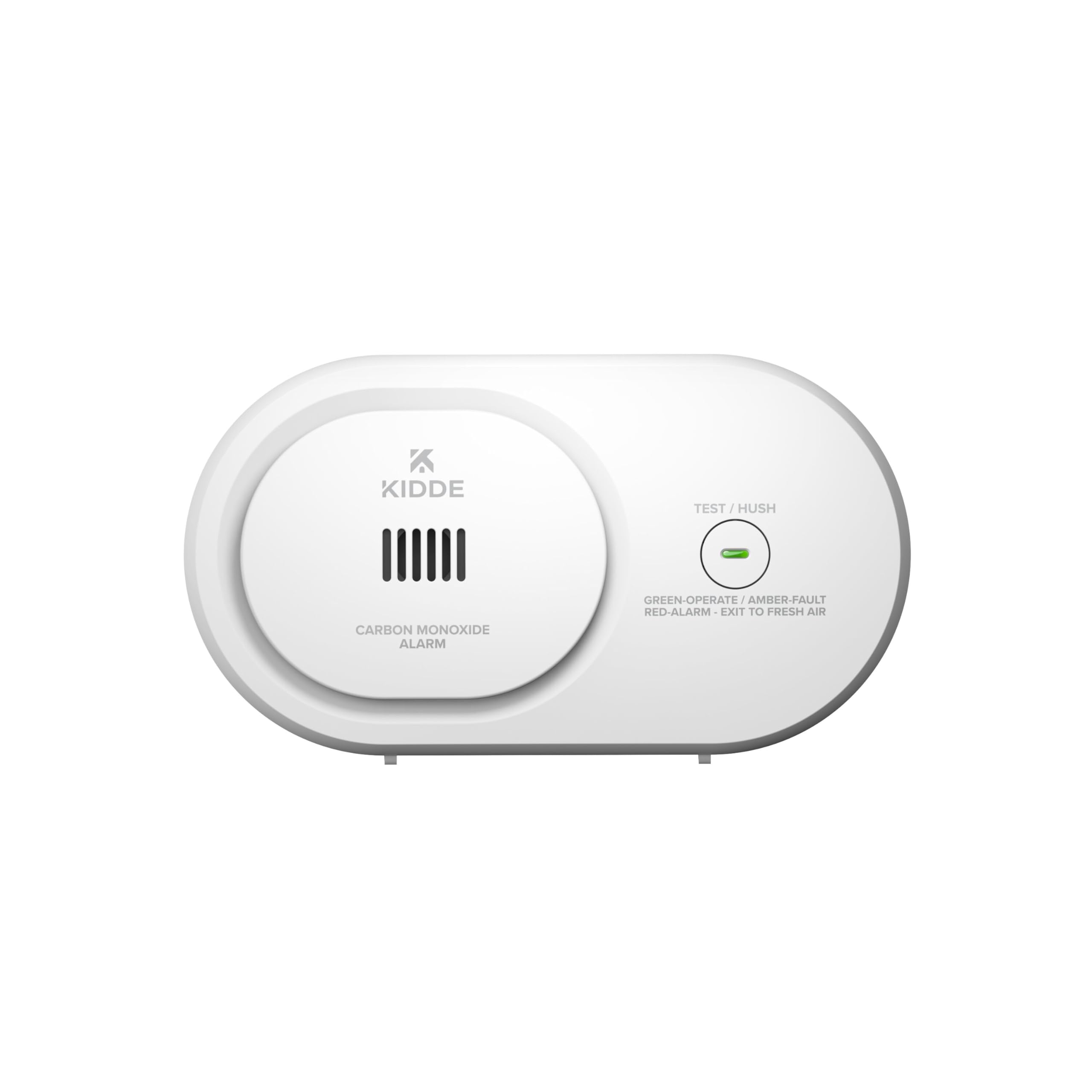
1. Kidde Carbon Monoxide Detector, AA Battery-Powered, COB
Our pick — 4.5+★ from 450+ verified ratings; the strongest balance of quality and price.
The pocket-sized CO alarm that goes from hallway to hotel room without a toolbox.
This is the one to buy first if you want a single detector that covers your home and your suitcase. The unit runs on two included AA batteries (standard household cells you can buy anywhere), so it installs without any wiring at all. Screw it to a wall or stand it on a table — both are supported. During a power cut it keeps working, which matters because generators and backup heat are exactly when CO risk climbs.
What wins people over is that it simply does its job without drama. Owners describe easy installation and a compact footprint, and the alarm side is serious: an 85 dB horn (roughly the loudness of a busy restaurant kitchen, compressed into your hallway) plus an LED warning light so you can see the hazard even with headphones on. It is tested to UL 2034 5th Edition standards and ETL Listed, and the alarm carries a 10-year limited warranty.
Its size is the quiet advantage. At 5.92 ounces and 1.52″D x 5.14″W x 2.83″H, it is the size of a paperback — where the SITERWELL below is 13.44 ounces at 3.3″D x 4.8″W x 1.7″H, noticeably bulkier on a shelf. The honest catch: this is a standalone alarm, so it sounds where it is and nowhere else — there is no app ping, no phone alert, no interconnection with other units. In a large multi-floor house you’d want one per floor rather than relying on the signal reaching you.
Why this earns the top slot
- Two AA batteries included — no wiring, no electrician, works through outages
- 85 dB alarm plus an LED warning light for audible and visual alerts
- Travel-friendly build at 5.92 ounces — hotel and rental use is written into the design intent
- Tested to UL 2034 5th Edition and ETL Listed, backed by a 10-year limited warranty
What to weigh before buying
- Standalone only — no app, no wireless interconnection to other alarms
- You manage the AA cells yourself; replace them on a schedule
Best first purchase: a renter, traveler, or single-floor homeowner who wants one reliable CO alarm from the start.
Look elsewhere if: you need phone alerts or linked alarms across a big property.
2. Kidde KN-COB-B-LP Nighthawk Carbon Monoxide Alarm
A seven-year workhorse that tells you when it’s time to retire itself.
The feature that matters here is the seven-year end-of-life warning. CO sensors degrade quietly as they age, and an alarm that never signals its own expiry can sit on a wall doing nothing while looking perfectly fine. This unit announces its retirement, so you replace the device instead of guessing. Kidde claims 40% longer life than other CO alarms — a manufacturer figure, not an independent test.
Power comes from three included AAs, which keeps protection running through a blackout. The single test-reset button handles both checks and silencing a triggered alarm. It meets Underwriters Laboratories (UL) requirements and carries a seven-year limited warranty that matches the sensor’s expected service window. The recurring gripe is battery life — some cells seem to run forever, some don’t — so buy a fresh set and mark a reminder on the calendar.
Compact and durable is the consensus here, and the unit has clearly been in people’s homes long enough to prove it — owners describe alarms that have lasted for years without fuss. It is a straightforward, inexpensive fix for a hallway you never think about, and that is exactly its appeal. Compared with the connected First Alert SC5 further down, you trade zero app features for zero setup headaches.
Where the value really sits: seven-year end-of-life signaling, UL compliance, and a warranty that matches the life of the sensor — all in a battery-only box.
The honest trade-off: no digital readout of live CO levels, and the battery story is inconsistent across units, so schedule your own replacement.
Reach for this if: you want a proven, no-frills alarm and you don’t mind a battery routine.
Think twice if: you want to watch live CO numbers on a screen.
3. First Alert FAT1039718 Carbon Monoxide Alarm
One button, one 9V, one job — with the sensor type that reacts fastest.
First Alert builds this one around an electrochemical CO sensor, the type the listing calls the most accurate for carbon monoxide. In plain terms, that is a cell that reacts chemically to the gas instead of waiting for heat or smoke — the right approach for a hazard you cannot see. The alarm sounds at 85 dB when levels rise, loud enough to carry through a closed bedroom door.
Battery-operated means it works almost anywhere, and the single test/silence button keeps operation to one control. Pop in a 9V cell and the install is done. At 7.36 ounces and 2″D x 5″W x 5″H it mounts flat and unobtrusive — noticeably slimmer in depth than the SITERWELL’s 3.3″ body. There is no display, no app, and no interconnection. What you get is a dedicated CO detector that does exactly what the label promises, and nothing you have to configure.
If your goal is a detector for a bedroom hallway that you will install in five minutes and never open an app for, this is the shape of that purchase. The catch is the 9V cell: nobody has one in a drawer, so buy a spare at the same time and you won’t be stuck.
Why it’s a safe pick: a real electrochemical sensor, an 85 dB alarm, and one-button operation with no account to create.
The one for you if: you want a dedicated CO alarm for a hallway or bedroom and zero smart-home strings attached.
Keep looking if: you expect live readings or phone notifications.
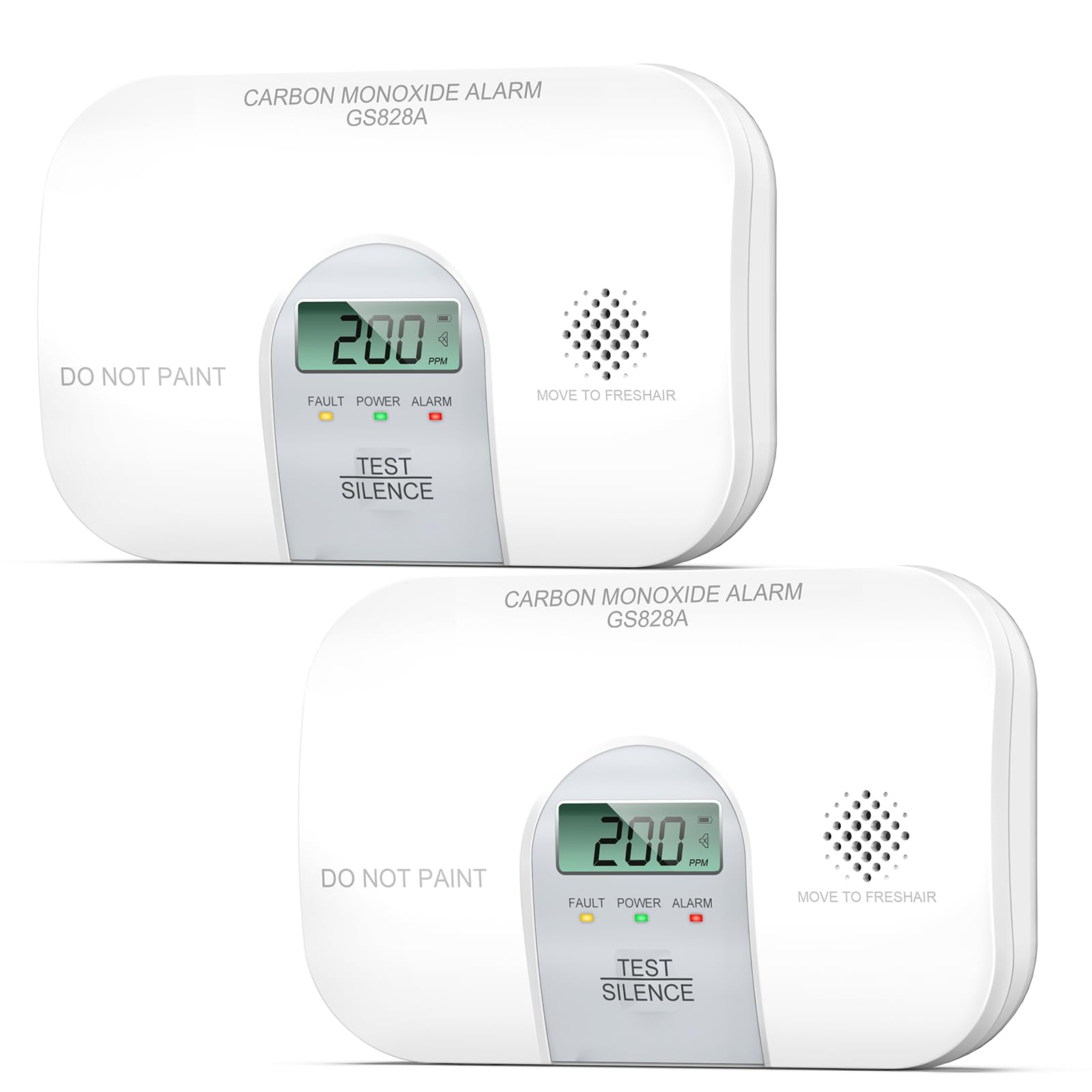
4. SITERWELL Carbon Monoxide Detector
The one that shows you the number instead of just shouting when it’s bad.
An LCD screen displaying real-time CO levels changes how you use a detector. Instead of a silent box you trust on faith, you get a visible reading you can glance at — useful when your furnace smells odd or you just moved in and want to know the baseline. Three colored LEDs back it up: red flashes for an alarm, green for power, yellow for a fault. You know the status at a glance, from across the room.
Around that display sits a serious alarm. The electrochemical sensor is built to ETL standards, and when it triggers the unit produces no less than 85 dB at 3 meters — the spec sheet’s own measurement. Two AA alkaline batteries supply power across the stated seven-year service life, and the model number is GS828A if you want to look up documentation. The warranty runs 36 months from purchase.
Here is the caveat you’ll find in the reviews: battery life is the mixed note, and no AA delivers ten years of continuous protection. That “seven year” figure is the sensor’s service life, not a decade of free power — you will replace the AAs along the way. The other surprising number is weight: 13.44 ounces, versus the Kidde COB’s 5.92 ounces. That is more than twice the heft, so this belongs on a wall, not in a travel bag.
What the screen buys you
- Real-time LCD readout of current CO levels, not just an alarm state
- Red, green, and yellow LEDs communicate alarm, power, and fault at a glance
- ETL-standard electrochemical sensing with an alarm of no less than 85 dB at 3 meters
- Wall-mounted or free-standing, with a 36-month limited warranty
Where it gets awkward
- Battery life is the recurring complaint, so plan your AA swaps
- At 13.44 ounces it’s a heavy unit compared to the Kidde COB
Pick this one: if you want to actually see CO numbers and status colors rather than trust a blinking light.
Pass on it: if the detector needs to travel in a suitcase.
5. First Alert 1039724 Carbon Monoxide Alarm

A lit-up CO readout that stays legible when the power doesn’t.
Most detectors go dark the moment the lights do — which is exactly when a backlit screen earns its place. This First Alert model lights its digital LED display, so the CO reading stays readable in a blacked-out hallway at 3 a.m. It runs on battery, which is the whole point: your furnace and water heater don’t stop running when the grid does.
Underneath the screen sits an advanced electrochemical sensor, the type that reacts directly to carbon monoxide rather than waiting for smoke particles. When levels climb, an 85-decibel alarm sounds — roughly the volume of a power lawn mower heard from the front yard. The model number is CO410A, and the unit carries a 7-year limited warranty. It’s a dedicated CO alarm, so there’s no smoke sensing here; this is the gas specialist for a hallway, bedroom, or boiler room.
The size is friendly: 3.4 inches long and 1.5 inches wide, so it tucks onto a wall without visual clutter. What it won’t do is interconnect with other alarms or ping your phone — that’s the SC5’s department, at a premium. If you want a straightforward lit readout in a dark spot, this does it without an app account.
Its niche in one line: a backlit CO display plus 85 dB and an electrochemical sensor, in a footprint small enough for any wall.
The gap to know: no smoke detection and no wireless linking — this is purchase-by-purpose, not all-in-one coverage.
Suits you when: the detector goes somewhere dim and you want to read the number without a flashlight.
Not your pick if: you need one device to cover smoke and CO together.
6. First Alert Carbon Monoxide Detector

Install it once, then forget batteries exist for a decade.
Sealed ten-year lithium batteries are the answer to the single most annoying failure mode in home safety: the middle-of-the-night low-battery chirp. This First Alert model is built to run for ten years without a battery replacement, which means no ladder in the hallway at 2 a.m. and no chance you accidentally leave it dead because you “meant to” swap the cells.
The display does double duty. It shows CO levels or ambient room temperature depending on what you want to see, and a peak-level feature retrieves the highest carbon monoxide concentration the unit has measured — genuinely useful if you suspect a problem was intermittent. A backlit digital display keeps those numbers readable in the dark. The sensor is electrochemical, the model number is CO710A, and the design is compact enough for either tabletop or wall placement.
Compare it with the Kidde COB up top: that unit gives you travel portability and swappable AAs; this one gives you a decade of sealed power and a temperature readout but stays in one place. If your CO alarm is a fixture you want to stop thinking about entirely, sealed is the calmer choice. If it needs to follow you to rentals, it isn’t.
The real benefit: ten years of sealed lithium power, a backlit CO-and-temperature display, and a peak-level recall that a plain alarm can’t offer.
Fit for: the homeowner who wants a fixture-grade detector and no battery chore list.
Wrong tool if: you want a travel unit or a swappable-battery design.
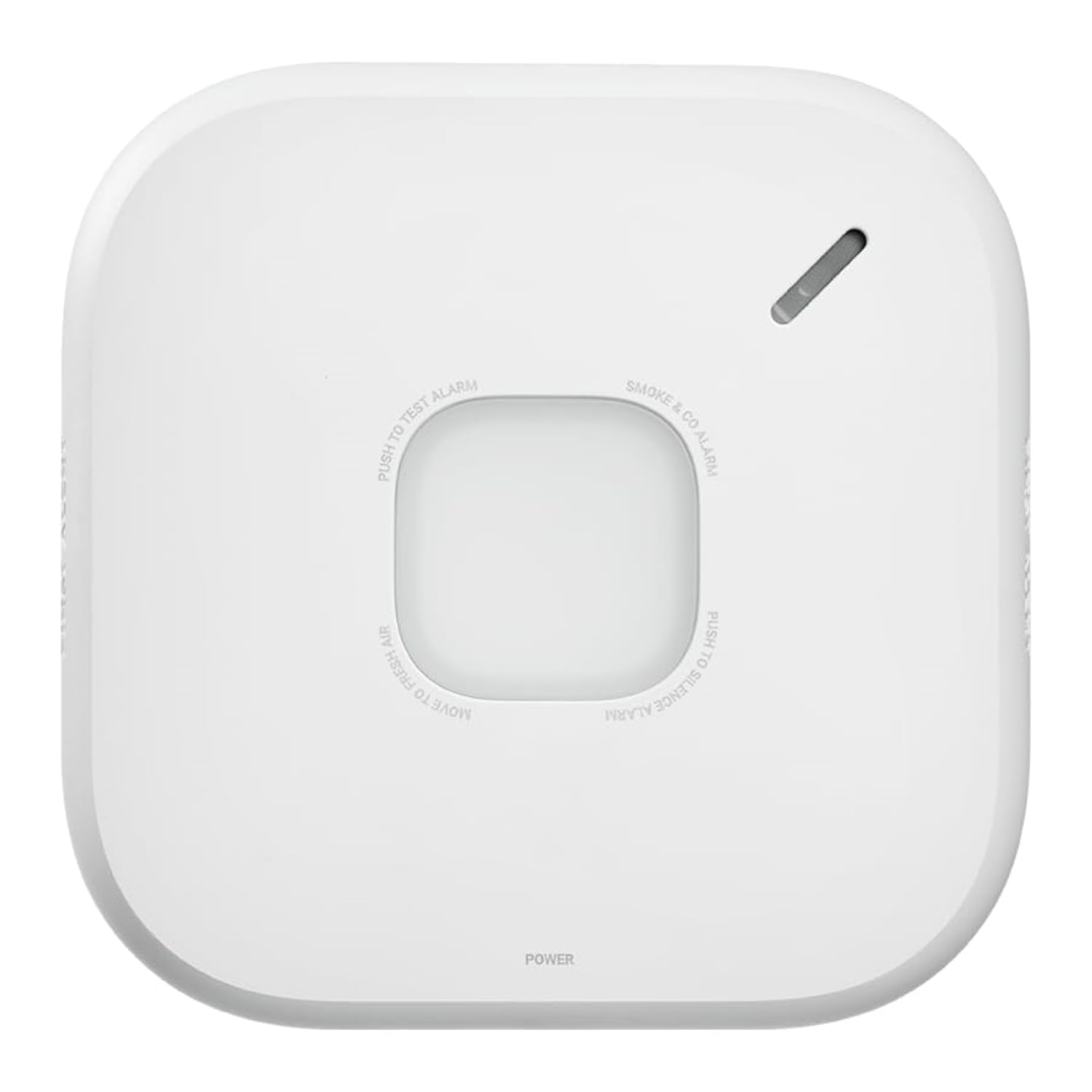
7. First Alert SC5 Battery Smart Smoke & Carbon Monoxide Alarm
The connected alarm that texts your phone when something is wrong at home.
Everything here is about reach. The SC5 pushes an alert to your phone through the First Alert app when smoke or CO is detected, so you know about a problem while you’re at work or on a trip. It also interconnects — when one compatible alarm sounds, the rest sound too. In a house with a basement and an upstairs bedroom, that linkage is the difference between hearing an alarm and not. Voice alerts with a Heads-Up warning tell you the type and location of the danger. It’s built to work alongside Google’s Nest Protect Alarm, and it carries Precision Detection Technology aimed at cutting nuisance alarms.
Power is a 3V CR123A lithium battery, and the alarm notifies you when it’s running low — no late-night chirp roulette. The design is rounded and modern at 5.75″D x 1.6″W x 5.75″H and 16 ounces.
Now the honest part, because you deserve it before you buy: this is the most-doubted unit on this list. The connectivity is the split opinion — some buyers find integration with Google Home straightforward, plenty find setup difficult. Reliability and false alarms are the loudest themes in the feedback, and quality complaints follow. It’s the priciest pick here too. If app connectivity and interconnection are genuinely must-haves for you, the feature set is real. If you just want a dependable detector on the wall, a standalone model like the Kidde COB delivers more certainty for less.
What it does that others can’t: phone alerts, whole-home interconnection, location-specific voice messages, and Google Nest Protect compatibility.
The risk you’re accepting: setup friction and reliability complaints are common enough that this is a pick for the committed smart-home buyer, not the cautious one.
Worth it for: a connected household where remote alerts and linked alarms genuinely change your safety picture.
Not worth the complexity if: you’d be happier with a detector that just beeps and never asks for Wi-Fi.
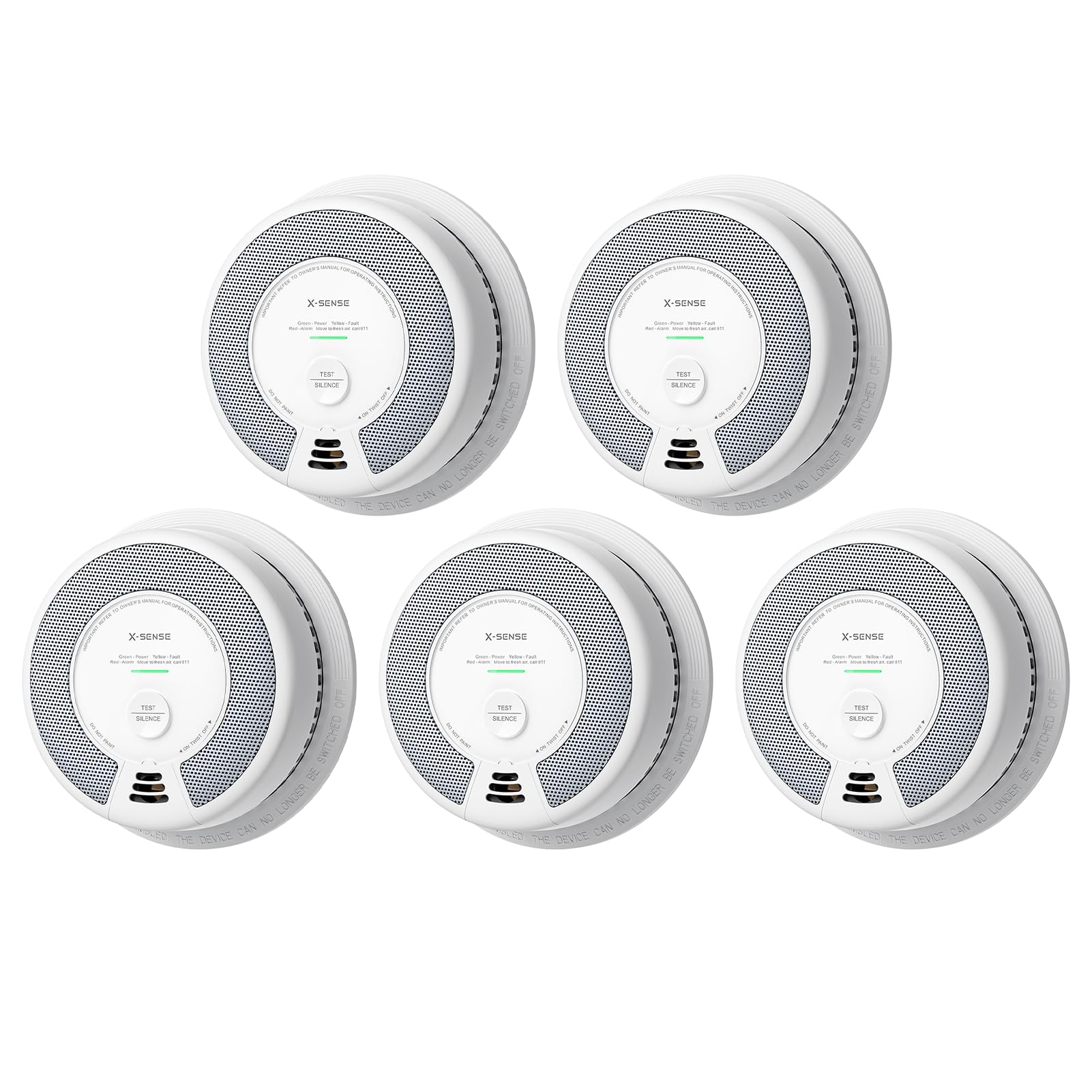
8. X-Sense Smoke & Carbon Monoxide Alarm, SC06, 5-Pack
Five detectors, one order — cover every floor in a single afternoon.
One unit per level is the real way to make a CO alarm useful, and this pack makes that affordable in one go. You get five SC06 alarms, each with a built-in lithium battery rated for 10 years — no swaps, no chips, no ladder. Each unit combines a photoelectric smoke sensor (the type that catches smoldering, smoky fires) with an electrochemical CO sensor, so you’re covering both hazards in every room you mount.
Installation is bracket-and-screw with the hardware included, and the units are independently tested to UL 217 and UL 2034 standards. Build quality and ease of install are what owners talk about most favorably — the alarms feel solid and go up without rewiring. Each unit weighs 11.04 ounces and measures 5.7″D x 5.7″W x 2″H, which is a fairly standard ceiling puck.
The critical thing to understand before you buy: the SC06 is a basic standalone unit. It does not support wireless interconnection, Wi-Fi, or a base station. If you want the five alarms to talk to each other, X-Sense directs you to the SC06-W. A few buyers report units failing early — a real caveat in a five-pack — so test each one after install rather than assuming all five fired up. What everyone agrees on is that the alarm is loud and the setup is quick, which is the two things that matter most.
Where the five-pack wins
- Five dual-sensor alarms — photoelectric smoke plus electrochemical CO — in one purchase
- 10-year built-in lithium battery on every unit, so no battery swaps for a decade
- UL 217 and UL 2034 tested, with bracket, screws, and anchors included
- Loud alarm and straightforward installation, the two most-praised traits
Where it stops short
- No wireless interconnection or Wi-Fi on the SC06 — that’s the separate SC06-W model
- A handful of early failures means you should test each of the five after mounting
Go here for: whole-home coverage on a single order, especially when you’re outfitting a new place from scratch.
Look at the SC06-W instead if: you want all five alarms to sound together.
Know the Specs
Electrochemical sensor
This is the part that actually reacts to carbon monoxide. Inside is a small cell that produces a tiny electrical signal when CO touches it, and that signal triggers the alarm. A listing that names an electrochemical sensor is telling you the detector reacts to the gas directly rather than waiting for heat or smoke. Several picks here — the First Alert FAT1039718, the SITERWELL, the CO410A, and the CO710A — all use this type.
Alarm volume in decibels (dB)
Decibels measure loudness. For a residential CO detector, 85 dB is the standard target — loud enough to wake most adults through a closed bedroom door. The Kidde COB, the First Alert FAT1039718, the SITERWELL, the CO410A, and the Kidde 30CUD10-V all list 85 dB. An alarm you can’t hear is useless, so check the dB rating before you buy.
Sealed vs swappable battery
A sealed 10-year lithium battery is permanently built into the alarm and meant to last the device’s service life, so you replace the whole unit rather than the cells. Swappable AA or 9V cells mean you own the maintenance — replace them on a schedule, or you will get a low-battery chirp, usually at the worst hour. Sealed is calmer for a fixture; swappable is better for a travel unit.
Standalone vs interconnected
Battery-powered standalone means the alarm sounds locally and nothing else happens — no app, no linked units. Interconnected means when one alarm sounds, compatible alarms in the home sound too, which is useful in a multi-floor house. The SC5 interconnects; the SC06 5-pack does not, and X-Sense points buyers to the separate SC06-W for that feature.
Common Questions
Do wireless carbon monoxide detectors need to be plugged in or hardwired?
How loud is an 85 dB carbon monoxide alarm in real life?
Does a 10-year battery really last ten years?
What is the difference between an electrochemical and a photoelectric sensor?
Can I use a smoke and CO combo alarm instead of two separate devices?
Will the First Alert SC5 work with my Google Nest Protect alarms?
Do I need one CO detector per floor?
Can I take a wireless CO detector to a hotel or rental?
How do I know when my CO detector has reached the end of its life?
Is a digital CO display worth the extra complexity?
The Bottom Line
If you buy one detector and want it done, the Kidde COB is the pick — a compact 85 dB alarm that runs on two AA batteries, tested to UL 2034 5th Edition, and light enough at 5.92 ounces to take to a rental. For the home fixture you never want to think about, the First Alert CO710A earns its place with a sealed ten-year battery and a peak-level CO readout. And if you are outfitting a whole house at once, the X-Sense SC06 five-pack covers every level in a single order — just remember it is standalone, not interconnected.
One nudge worth acting on: change your CO detector when it tells you to, not when it dies quietly. Whatever you pick from this list, mount it near sleeping areas and test it once a month — the sensor is only the half of the safety story you control.
How we choose
We do not accept paid placement. Every pick is matched to a real buyer and a real use-case; we do not hands-on test units.
Sources
Specifications: manufacturer listings and product documentation. Review insights: verified customer reviews, as of November 2026. Pricing: not shown on this page (it changes often); check the current price via the retailer link.
As an Amazon Associate, Tactical Gear Guy earns from qualifying purchases. This does not affect which products we feature.