Specs are compiled from manufacturer listings and verified buyer reviews and can change over time — please confirm the key details on the product page before buying.
If your video sounds hollow, echoey, or like it was shot in a bathroom, the fix is almost never the camera. It is the mic. A clip-on wireless system puts the mic inches from your mouth, so your voice arrives loud and clean while the room noise falls away. That one change improves a recording more than any editing trick.
This guide is built by comparing the manufacturers’ published specifications and the patterns across verified customer reviews, so you get each pick’s real strengths and trade-offs instead of marketing spin.
Below you will find picks grouped by what they actually do well, from a nine-gram clip that hides under a collar to a desktop mic that records two hosts at once. Every spec below comes straight from the maker’s sheet, so you can compare a wireless microphone for recording on the numbers that decide how your voice lands on tape.
Top Picks

How To Choose The Best Wireless Microphone for Recording
The most common beginner mistake is choosing a mic on range alone. A mic that transmits 1,000 feet does you no good if its audio sounds thin or its battery dies halfway through an interview. Start with sound quality, then work outward to battery, range, and the connectors your camera or phone actually accepts.
Start with the audio format, not the distance
Look for 48kHz/24-bit recording. The 48kHz figure is how many times per second the mic samples your voice, and 24-bit is how much detail it keeps in each sample. Together they capture the full warmth of a human voice rather than a compressed, tinny copy.
Then check signal-to-noise ratio, written in dB. That number measures the gap between your voice and the background hiss. A higher figure means a quieter floor, which matters most in a silent room where any hiss is obvious.
Match the connector to your gear
A Lightning receiver suits older iPhones, a USB-C receiver suits newer phones and laptops, and a 3.5mm jack suits DSLR and mirrorless cameras. Some kits ship with all three receivers in one box, which saves you buying adapters later. Check what is in the case before you commit.
Read the battery claim carefully
Battery life is usually quoted two ways: hours per transmitter, and total hours with the charging case. A transmitter rated at 9 hours plus a case that adds more is a very different day of shooting than 4 hours single-charge. Decide how long your longest shoot runs, then match it.
Side-by-Side Comparison
| Model | Best For | Audio Format | Range | Battery / Weight | Amazon |
|---|---|---|---|---|---|
| Hollyland Lark M2 (Combo)★ Best Overall | All-round video and podcasting | 48kHz/24-bit, 70dB SNR | 1,000 ft line-of-sight | 40H w/ case / 9 g | Amazon |
| 4 Packs Wireless LavalierBest Multi-Mic Value | Four-person shoots on a budget | 20kHz response, 90dB sensitivity | 164 ft | 6H / 18 g | Amazon |
| FIFINE M9 2 PackSolid Budget Duo | Budget dual-mic kit | 20Hz–20kHz, 90dB SPL | 164 ft | 30H w/ case / — | Amazon |
| DJI Mic Mini | Long shoots and travel | 48kHz, 120 dB SPL | 400 m | 48H w/ case / 10 g | Amazon |
| Hollyland Lark M2 (Camera + USB-C) | Camera-first creators | 48kHz/24-bit, 70dB SNR | 300 m (1,000 ft) | 40H w/ case / 9 g | Amazon |
| SmallRig S70 | Discreet on-camera interviews | 48kHz/24-bit, ATS3031 chip | — | 48H w/ case / 8.6 g | Amazon |
| MAONO PD200W | Two-person podcasts at a desk | 30mm dynamic, 82dB SNR | 60 m | 60H / 1.32 kg | Amazon |
| MAONO Wave T5 | Voice filters for solo creators | 48kHz/24-bit, 80dB SNR | 300 m open / 100 m behind | 40H w/ case / 9 g | Amazon |
| RØDE Wireless GO (Gen 3) | Backup recording and pro reliability | 32-bit float on-board | 260 m | 40H+ on-board / — | Amazon |
Detailed Reviews
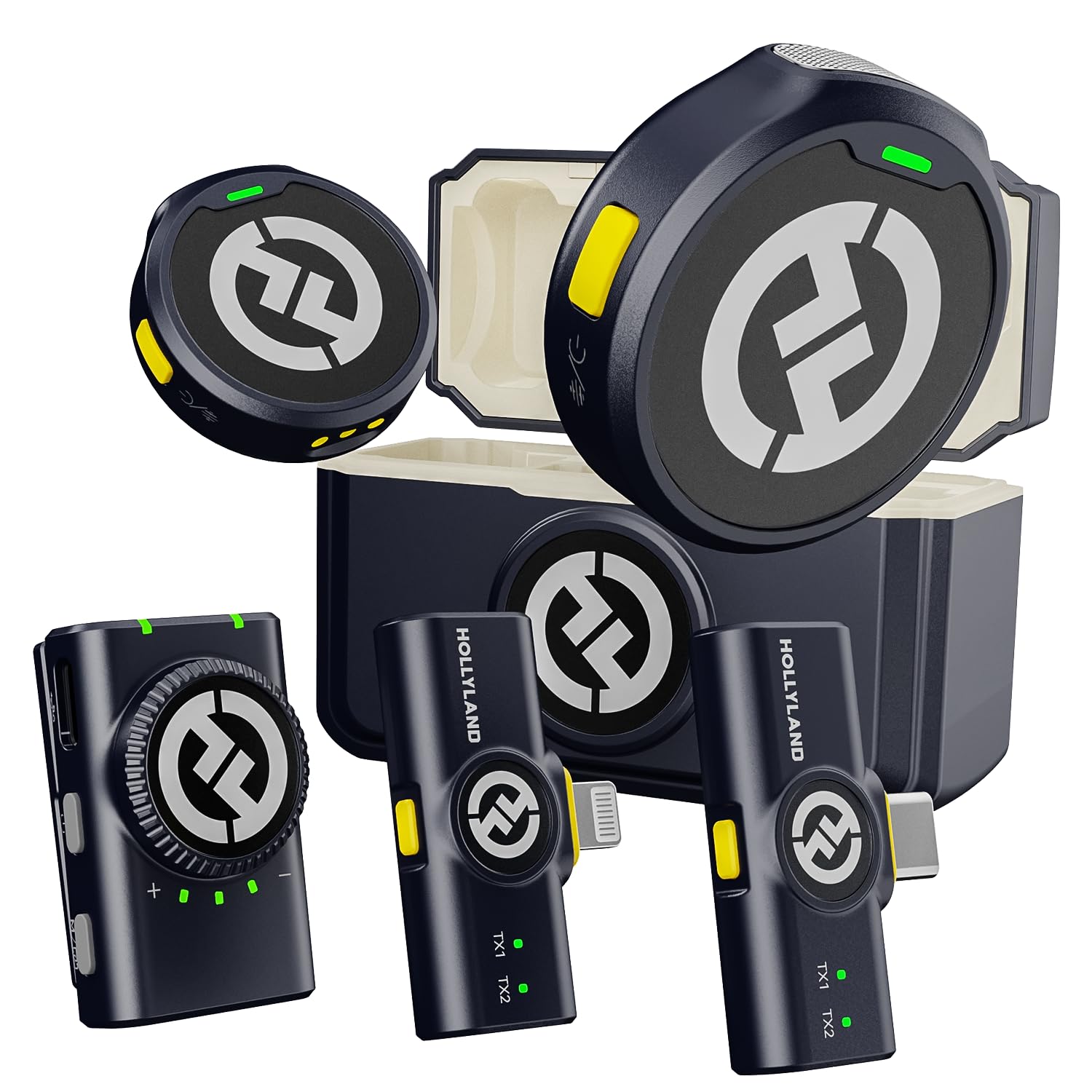
1. Hollyland Lark M2 Wireless Lavalier Microphone
Our pick — 4.5+★ from 750+ verified ratings; the strongest balance of quality and price.
Three receivers in one box, so any device you own plugs in without an adapter hunt.
The Combo version hands you a camera receiver, a USB-C receiver, and a Lightning receiver together, plus two transmitters and a charging case. That is the whole point: you can shoot on an iPhone one day, a mirrorless camera the next, and a laptop the day after without buying a single extra part. Each transmitter weighs 9 grams, light enough that it disappears under a shirt collar instead of dragging the fabric down.
Sound is the real reason this earns the crown. It records at 48kHz/24-bit with a 70dB signal-to-noise ratio, so your voice sits well above room hiss, and it tolerates a maximum 115dB sound pressure level. In plain terms, a loud stage or a shouted line will not crackle into distortion. The one-tap noise cancellation button on the transmitter does the rest when you are recording near traffic.
Where it pulls ahead of the value kits is range and endurance. You get a 1,000-foot line-of-sight transmission figure and up to 40 hours with the charging case, against the 4 Packs kit’s 164 feet and 6 hours. The catch is honest: the 1,000 feet is line-of-sight, so walls and bodies still cut it down, and each transmitter runs about 10 hours with noise cancel off before it needs the case. Owners rate it 4.5+ stars across 700+ reviews, citing clean audio and plug-and-play setup.
Where it wins out
- Three receivers (Lightning, USB-C, camera) cover phone, laptop, and DSLR in one kit.
- 48kHz/24-bit with 70dB SNR keeps voices clean and room noise low.
- 40 hours with the charging case and a 1,000-foot line-of-sight figure.
- 9-gram transmitters clip on and stay nearly invisible.
Weigh before you buy
- Mono/stereo switching only works when the receiver is wired to a camera via 3.5mm.
- Line-of-sight range drops behind walls and bodies.
- You will pay more than the budget kits for the extra receivers.
Reach for this if: you record on more than one device and want one kit that covers all of them.
Think twice if: you only ever shoot on a phone — a single-receiver kit gets the job done for less.
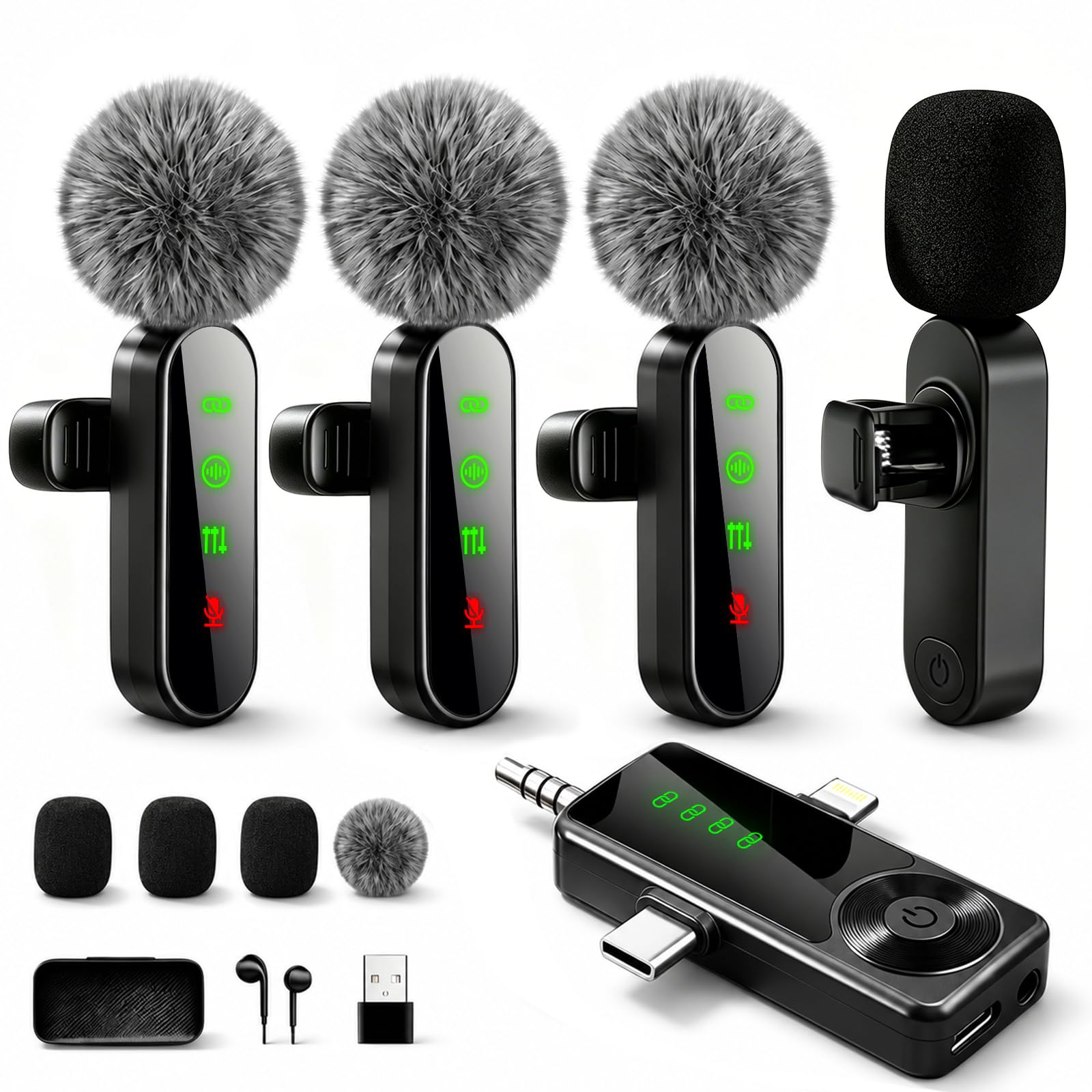
2. 4 Packs Wireless Lavalier Microphone
Four mics on one receiver means a whole panel records live without editing four files together.
If your shoot has four voices — a group interview, a multi-host stream, a band sit-down — most kits force you to splice audio later. This one pairs up to four transmitters to a single 3-in-1 receiver and records all of them at once. That feature alone is why group creators gravitate to it, and it is the rare budget kit that solves a real editing headache.
The trade-offs are written in the numbers. Sensitivity runs high at 90dB and each transmitter weighs 18 grams, so it is a heavier clip than the 9-gram Hollyland. Battery is the honest weak spot: rated up to 6 hours of continuous use after 1.5 hours of charging, though some owners report it not lasting more than 2 hours, and the sound signature splits opinion — some love the clarity, others find it thin. Where it earns its keep is convenience, with a Type-C port on the receiver so your phone can charge while it records.
Its 4.0+ star average from 150+ buyers reflects that people buy it for the four-mic recording and the price, not studio-grade tone. A 164-foot range is fine for a room or a small outdoor set, and the kit arrives complete — four mics, four clips, windproof covers, headphones, cables, and a storage case.
The four-way trick: real-time sync across four transmitters, no post-production splicing, so a group session is one clean recording.
The compromise: some owners report the battery not lasting more than 2 hours, and the sound character is divisive — great for reach, not for matching a studio mic.
Built for: group recordings where four people talk at once and budget matters.
Look elsewhere if: you need long battery or a consistent warm tone for solo voiceovers.
3. FIFINE M9 2 Pack Wireless Lavalier Microphone
A pocket-sized dual kit with a charging case rated to refill the mics nearly three times.
Two transmitters, one receiver, a charging case that tops the kit up about three times, and up to 30 hours of total use. For a two-person interview or a vlog with a co-host, that is a lot of kit for an entry-level tier. It covers 20Hz to 20kHz, so the full range of a human voice lands in the recording rather than a narrowed slice.
The fidelity ceiling is real, though. The 90dB SPL figure sits well below the 115dB the Hollyland Lark M2 handles, so a shout or a loud stage can clip sooner. Reception is rated to 164 feet, which covers a room but not a wide outdoor set. And the range figures only mean what the room allows — walls and bodies trim them back.
What buyers respond to most is the overall build and the money saved — quality and value dominate the feedback, though the sound itself splits opinion. There is a glassy, echoey tone some hear on their first take. The receiver’s display screen shows your level at a glance and lets you mute or switch noise cancellation from the unit, which is more control than most kits at this tier offer.
What wins people over: a complete two-person kit with a case that nearly triples the run time, at entry-level money.
The caveat that matters: mixed sound quality and a 90dB SPL ceiling mean loud sources can overwhelm it.
The right tool when: you shoot two-person interviews indoors and want a full kit that travels in a case.
Pass it over if: you record loud live audio or need a wall-to-wall outdoor range.
4. DJI Mic Mini (2 TX + 1 RX + Charging Case)

Forty-eight hours in the case means a multi-day trip with no charger anxiety.
Pack two ten-gram transmitters, a receiver, and a charging case, and you get up to 48 hours of combined recording without a wall outlet. That is 48 hours with the charging case, versus the Hollyland Lark M2’s 40 hours and the 4 Packs kit’s 6 hours. For a travel documentary or a stacked interview day, the case simply keeps topping the units up.
Fidelity holds up under pressure too. It samples at 48kHz and handles up to 120 dB SPL, so a loud moment does not distort. Automatic limiting pulls the volume down when your input is too high, which protects a take you cannot re-shoot.
Two levels of noise cancellation let you dial it in — Basic for a quiet room, Strong for a noisy street. Transmission reaches 400 meters line-of-sight, and connectivity is Bluetooth plus DJI OsmoAudio plus USB. The one thing to note: content is tuned for DJI’s own world, so if you shoot on a non-DJI camera or an older phone, double-check the adapter in the box fits.
Why it earns its spot
- 48 hours with the charging case outlasts every other kit here.
- 48kHz sampling and 120 dB SPL handle loud, quiet, and everything between.
- Automatic limiting prevents a clipped take.
- Two noise-cancellation levels for rooms versus streets.
Things to know first
- Only one receiver in the box, versus three in the Hollyland Combo.
- 400 meters is line-of-sight, not through walls.
- Best matched to DJI’s own camera ecosystem.
It fits: long-form shooters who need the battery to outlast the day.
Reconsider if: you want one receiver that swaps between phone, laptop, and camera.
5. Hollyland Lark M2 Wireless Microphone (Camera RX + USB-C RX)
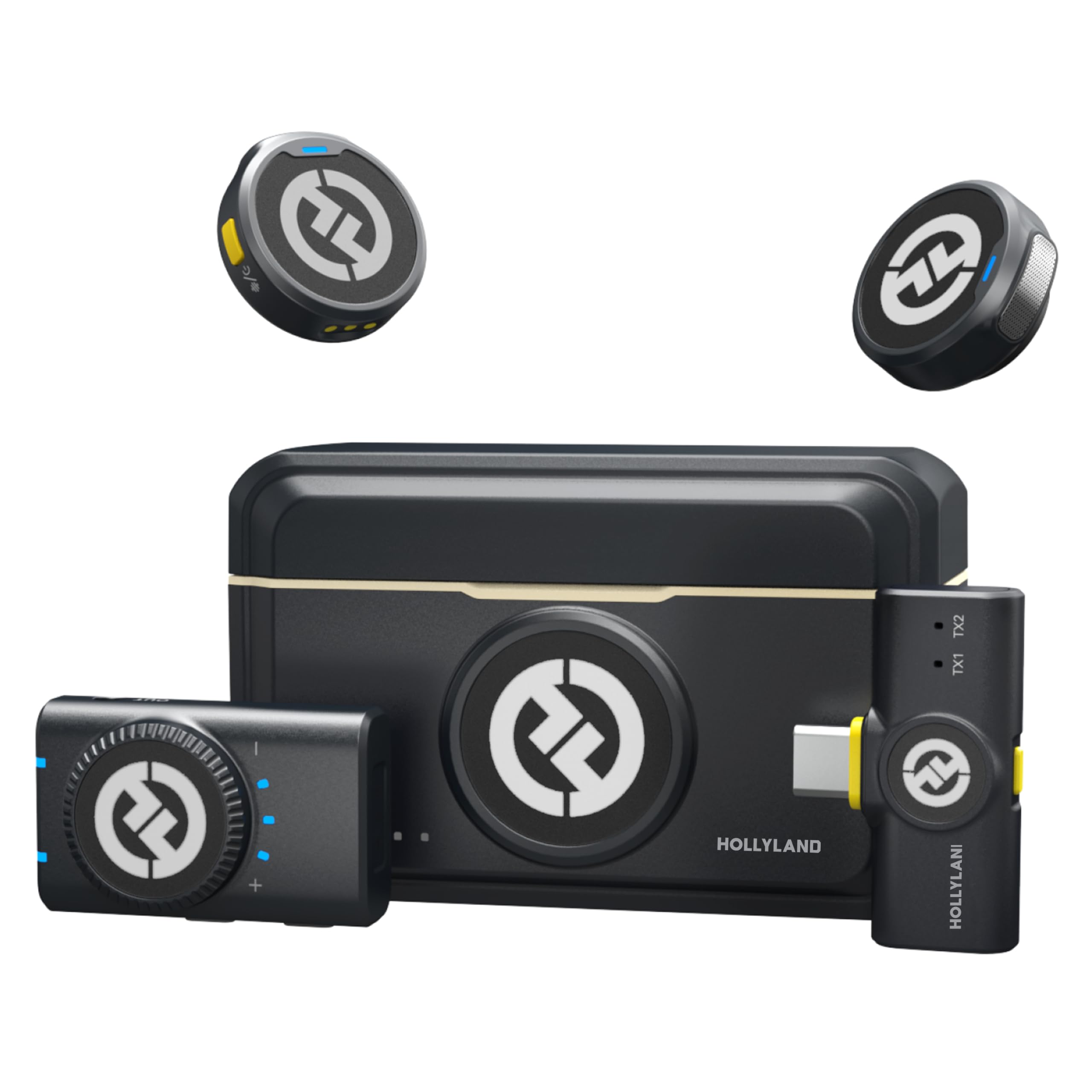
The same nine-gram clip and 48kHz engine as the top pick, trimmed to a camera and USB-C setup.
This is the Lark M2 tuned for camera shooters. It swaps the Lightning receiver for a camera receiver plus USB-C, so it plugs into a DSLR via 3.5mm and into a newer phone or laptop directly. The transmitters still weigh 9 grams and still record at 48kHz/24-bit with a 70dB signal-to-noise ratio.
Range runs up to 300 meters, or 1,000 feet line-of-sight, thanks to a high-gain LDS antenna designed to shrug off interference from the body. That matters when a subject walks off and you need the audio to keep hold of them.
The mono/stereo switch on the receiver works only when it is wired to a camera through the 3.5mm jack — that is where this version earns its place, and where it differs from the Combo. It also holds 4.5+ stars from a large pool of owners, who praise its clean sound and value at its price. Battery reaches 40 hours with the case, matching the Combo exactly.
What stands out: a 300-meter transmission figure and 115dB SPL handling, so loud sources and long walks both keep clean audio.
The catch: no Lightning receiver, so an older iPhone owner needs the Combo instead.
Buy this one if: your primary rig is a camera and you occasionally plug into USB-C.
Skip it for: iPhone shoots that rely on a Lightning port.
6. SmallRig S70 Wireless Mic (2 TX + 2 RX + Charging Case)
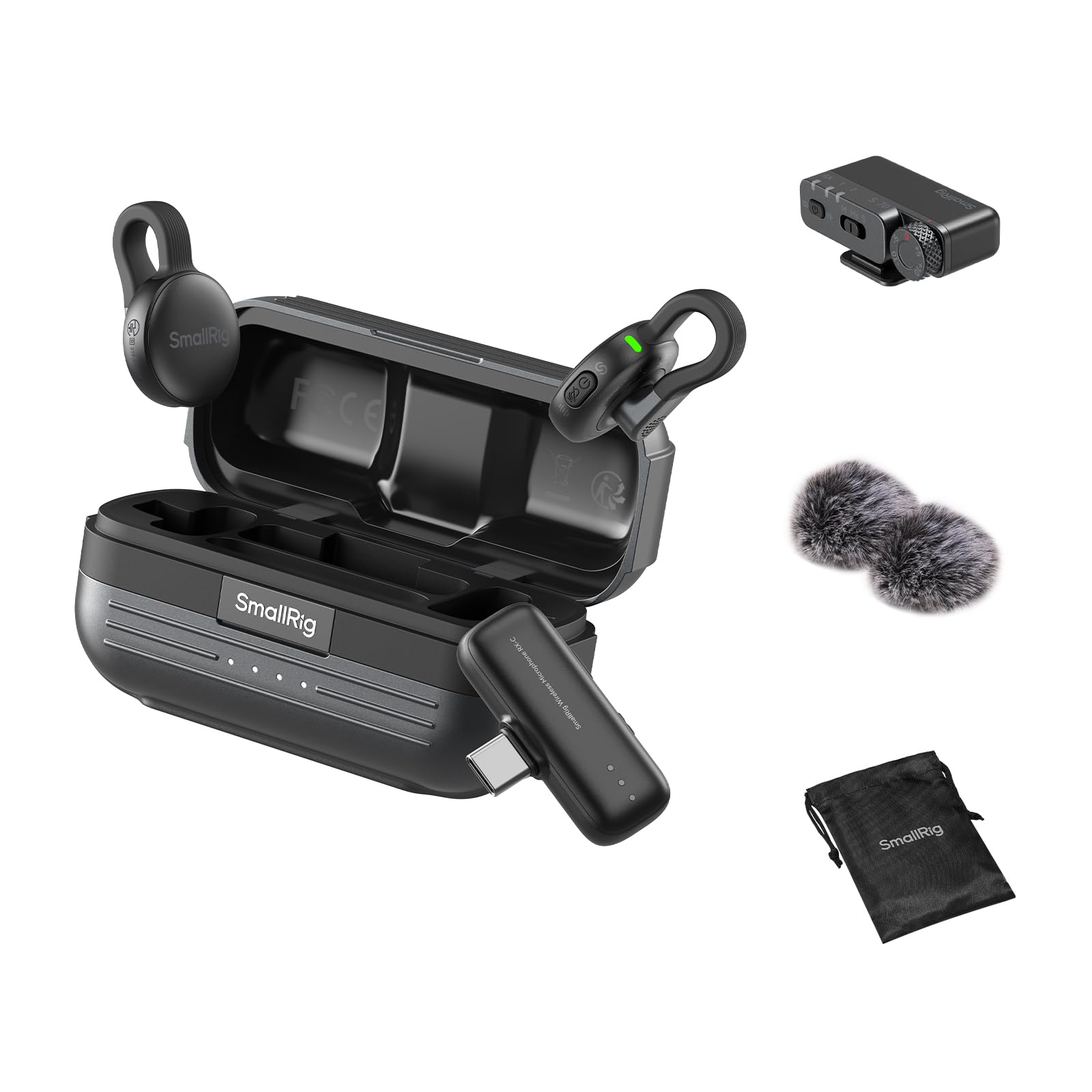
At 8.6 grams the clip vanishes on a lapel, which is exactly what on-camera interviews need.
Two receivers, not one — a USB-C receiver and a 3.5mm camera receiver — so the S70 talks to a phone and a camera without swapping parts. That combination is what makes it a natural fit for event videographers moving between setups. The transmitters use a nickel-titanium memory metal clamp that holds a collar without chewing it.
Under the hood is an ATS3031 chip delivering 48kHz/24-bit audio, plus three noise-reduction modes, five gain levels, and three mixing options. A Grammy-winning engineer tuned it, and it includes 9 preset EQ equalizers — unusually deep tone shaping for a clip-on this small. Battery runs 8 hours per charge and up to 48 hours with the case.
Sound quality is what draws praise — it picks up voices cleanly for podcasts and weddings, and the discreet footprint gets its own share of appreciation. Connectivity is the honest wrinkle: some connections snap instantly and others drop mid-session, so keeping the receiver close and re-pairing calmly helps. Its 4.5+ star average from a few hundred buyers reflects that strong audio core.
The quiet advantage: 8.6 grams and a memory-metal clamp, so it stays put and stays unseen.
Worth knowing: mixed connectivity reports mean you should pair carefully before a live event.
Best for: wedding and event shooters who need a hidden clip and two receivers.
Not ideal for: creators who want a fire-and-forget connection every single take.
7. MAONO PD200W Hybrid Wireless Podcast Microphone
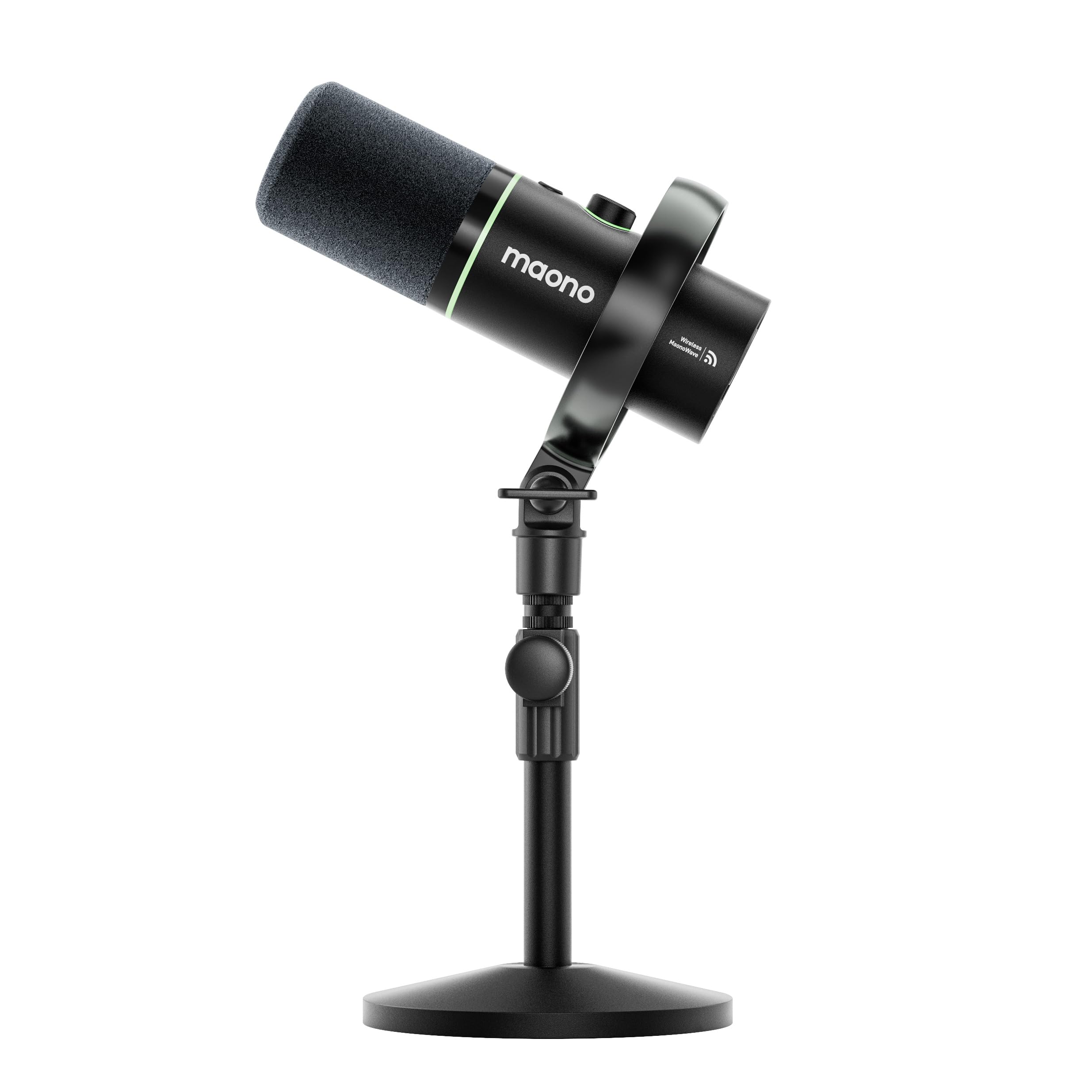
A desktop mic that goes wireless, USB, or XLR — three ways to get the same warm voice.
Here is the pick that is not a lavalier at all. The PD200W is a stand-mounted dynamic microphone with a 30mm capsule and cardioid pickup, aimed at podcasters who want one mic that can go wireless for freedom, USB for plug-and-play, or XLR for a professional interface. That flexibility is the whole reason it sits on this list.
A single receiver can host two of these desktop mics for a duo show, and each voice records to its own track so you can edit them apart later. The 82dB signal-to-noise ratio and 128dB SPL ceiling mean a lively conversation stays clean and never clips. Battery stretches to 60 hours with RGB off, and the wireless range sits at 60 meters.
What earns approval is the sound — clear, warm voice transmission with a quick setup. The MaonoLink app adds 4 master-tuned presets plus EQ and reverb control. The trade-off is weight and form: at 1.32 kg this is a desk mic on a stand, not a clip you tuck under a collar, so it suits a studio or a fixed interview setup rather than run-and-gun shooting.
The three-way flexibility: wireless, USB-C, and XLR in one body, so it grows with your rig.
The honest limit: 1.32 kg on a stand — it records where it sits, not on the move.
Choose it when: you want one desk mic that can host a two-person podcast across three connection types.
Keep looking if: you shoot on the move and need a clip-on lavalier.
8. MAONO Wave T5 Wireless Lavalier Microphone

Four one-tap voice filters, so you can sound like a broadcaster without opening an editor.
Rather than making you learn EQ, the Wave T5 gives you four preset voices: Vocal Enhancer for everyday clarity, Brightness for vlogs, Warmth for storytelling and teaching, and Magnetic Radio for that deep broadcaster tone. For a solo creator who records, uploads, and moves on, that is the most practical feature on the page.
Underneath it records true 48kHz/24-bit with an 80dB signal-to-noise ratio, and tolerates 120dB SPL without distortion. Its dedicated ENC chip handles noise cancellation across 3 modes and 14 levels through the Maono Link app. Three receivers ship in the box — USB-C, Lightning, and camera — so phone, laptop, and DSLR are all covered.
Battery reads 9 hours per transmitter and 40 hours with the case, and the receiver needs no charging at all. Transmission holds up to 300 meters in the open and 100 meters behind your back, which is genuinely useful when you spin or walk away on camera. As owners tell it, clean audio for voiceover and interview is the core strength. Reliability splits opinion, though, so pair both units carefully before a shoot and verify the blue light.
The standout: 48kHz/24-bit plus four tap-through voice presets and 3-mode noise cancellation — studio features without a studio learning curve.
Size the caveat: mixed reliability reports make a five-minute pairing check before every shoot worth the effort.
It suits: solo creators who want shaped, broadcast-style voice without touching an editor.
Think twice if: you need rock-solid wireless at every take and cannot troubleshoot mid-shoot.
9. RØDE Wireless GO (Gen 3)

A backup recording inside the mic itself, so a lost signal never loses the take.
Over 40 hours of 32-bit float on-board recording is the headline. 32-bit float is a recording format with so much headroom that a clipped or too-quiet file can still be rescued in post. Even if the wireless link drops, the transmitter has kept a copy on its own memory, so one bad take does not ruin the shoot.
The rest is built for reliability. Series IV 2.4 GHz transmission with 128-bit encryption keeps the link stable, and a 260-meter range figure gives room to move. GainAssist automatically levels your input and a safety channel backs it up, so sudden volume swings stay controlled. Universal compatibility covers USB-C phones, laptops, and cameras with a locking 3.5mm output.
The kit arrives ready to record — furry windshields, a charging hub to fill all units at once, a 3.5mm TRS cable, and a carry pouch. What buyers praise most is the sound, especially for phone recording, and the sense that it simply works. The trade-off is the premium tier: you are paying for the on-board backup and the encryption, not for a screen or preset voice filters.
Why it can justify the tier
- Over 40 hours of 32-bit float on-board recording rescues clipped or quiet audio.
- Series IV 2.4 GHz with 128-bit encryption keeps the link stable.
- GainAssist and a safety channel guard against volume spikes.
- 260-meter rated range and a charging hub for all units at once.
Trade-offs of going premium
- You pay more than the mid-tier kits for the backup recording.
- Some report flaky connections across certain devices.
- No touchscreen or tap-through voice presets.
Worth it for: paid shoots where a lost take costs real money and the on-board backup is insurance.
Harder to justify if: you record casual content and can tolerate an occasional re-take.
Know the Specs
48kHz/24-bit Audio
The 48kHz figure is how many times per second the mic samples your voice. The 24-bit figure is how much detail it keeps per sample. Higher rates capture more of the natural warmth and subtlety in a voice, which is why the better kits list 48kHz/24-bit on the box and budget kits sometimes skip it.
Signal-to-Noise Ratio (dB)
This measures the gap between your voice and the hiss of the electronics, in decibels. A higher figure like 82dB means less background noise in quiet rooms. A lower figure lets more hiss creep into a silent passage, which editing cannot remove.
SPL and Transmission Range
SPL, or sound pressure level, is how loud a source the mic can take before distorting. A 115dB figure handles a shout, while a 90dB figure is fine indoors but caps sooner. Range is usually quoted line-of-sight, meaning a clear, unobstructed path — walls and bodies shorten it fast.
Battery and Weight
A transmitter’s battery is usually quoted per charge, but many kits add total hours with a charging case. Match that to your longest shoot. Weight matters because a lighter transmitter, like a 9-gram clip, sits comfortably on a thin collar, while heavier units pull at the fabric.
Common Questions
Will a USB-C wireless mic work with an older iPhone that uses Lightning?
What does line-of-sight range actually mean for recording?
Is a higher SPL number better for a wireless lavalier?
Can I record four people at once with one wireless kit?
How much better is 32-bit float than a standard recording?
Do these wireless mics work with Android phones?
Should I buy a lavalier or a desktop dynamic mic for podcasting?
Can I charge my phone while the receiver is plugged in?
What do the noise cancellation modes change?
Why does my wireless mic sometimes fail to pair?
The Bottom Line
The safest starting point for most creators is the Hollyland Lark M2 Combo. Three receivers cover a phone, a laptop, and a camera in one case, and its 48kHz/24-bit audio with a 70dB signal-to-noise ratio is genuinely clean. Buyers back it too, at 4.5+ stars across 700+ ratings, making it the pick when you want one kit to cover every device. If you shoot long days and battery is the worry, the DJI Mic Mini stretches to 48 hours with its case. And if you record to a desk and want a warm dynamic voice for two hosts, the MAONO PD200W is the one to reach for.
How we choose
We do not accept paid placement. Every pick is matched to a real buyer and a real use-case; we do not hands-on test units.
Sources
Specifications: manufacturer listings and product documentation. Review insights: verified customer reviews, as of November 2026. Pricing: not shown on this page (it changes often); check the current price via the retailer link.
As an Amazon Associate, Tactical Gear Guy earns from qualifying purchases. This does not affect which products we feature.