Specs are compiled from manufacturer listings and verified buyer reviews and can change over time — please confirm the key details on the product page before buying.
If you are building wooden arrows by hand, the decision that actually matters is whether the shafts arrive straight and stay straight after you cut, taper, and finish them. Everything else — finish, colour, fletching — you can fix at the workbench. A bent shaft or the wrong spine weight you cannot. This guide sorts three wooden shaft options by what they are genuinely good at, so you know which bundle to open for your draw weight and which to leave for the next project.
This guide is built by comparing the manufacturers’ published specifications and the patterns across verified customer reviews, so you get each pick’s real strengths and trade-offs instead of marketing spin.
The three options below split cleanly into bare shafts you finish yourself and pre-fletched arrows ready to shoot, and the spine numbers tell you which bow each one suits before you spend a single evening sanding. Read on for the sharpest picks among wood arrow shafts.
Top Picks

How To Choose The Best Wood Arrow Shafts
The mistake most first-time builders make is buying the cheapest bundle of wooden dowels and assuming a shaft is a shaft. It is not. Wood varies in density from one stick to the next, so two shafts from the same bundle can flex differently, and that flex is what your bow punishes you for. Match the spine number to your bow first, then worry about everything else.
Start With Spine Weight, Not Looks
Spine weight measures how much a shaft bends under a set load, expressed in pounds. A shaft rated for a 45-50 pound draw is built to flex just enough for a bow pulling in that range. Shoot a shaft too stiff for your bow and it drifts away from the shelf; too weak and it whips. Buy the spine band that brackets your actual draw weight at your actual draw length, not the bow’s marked maximum.
Decide How Much Work You Want
Bare shafts arrive as unfinished wooden dowels — no nock, no point, no fletching, no finish. You cut to length, taper the nock and point ends, stain or seal, then glue everything on. Pre-fletched arrows arrive with turkey feather vanes already attached and tips fitted, so they are shootable soon after unboxing.
Check Diameter Before You Buy Nocks
Shaft diameter is quoted in fractions of an inch or in millimetres, and it governs which nocks, points, and tapering tools will fit. An 11/32-inch shaft takes standard 11/32 hardware; a 0.28-inch shaft is closer to a 9/32 fit. Buy your nocks after you have the shafts in hand, or at least confirm the diameter first — mismatched tapers are the most common reason a build stalls halfway.
Side-by-Side Comparison
| Model | Best For | Shaft Length | Spine Rating | Shaft Diameter | Amazon |
|---|---|---|---|---|---|
| Port Orford Cedar Premium Bare Shafts (12-Pack)★ Best Overall | Building matched arrows for a 45-50# bow | 32.0″ | 45-50 lb | 11/32″ | Amazon |
| Arrow Shaft for DIY Arrow with Nocks | Budget DIY builds across a wide draw range | 33.5″ | 30-70 lb | 0.28″ | Amazon |
| 31″ Archery Traditional Wooden Arrows | Shooting straight away from a traditional bow | 31.5″ | 30-80 lb | 8 mm | Amazon |
Detailed Reviews
1. Port Orford Cedar Premium Bare Shafts (12-Pack)
Our pick — 4.5+★ from 60+ verified ratings; the strongest balance of quality and price.
Cedar dowels cut to a 45-50 pound spine, for builders who want a matched dozen.
This is the pick for the archer who intends to finish arrows properly rather than shoot them the day they land. The twelve shafts arrive bare — untapered, unfletched, unfinished — at 32.0 inches long and 11/32-inch diameter, and the spine is stated for a 45-50 pound draw at 28 inches of pull. That is a narrow, specific band, and it is a feature rather than a limitation: if your bow sits inside it, you get a dozen shafts tuned to the same flex, which is exactly what tight groups depend on.
Length is where this bundle earns its place. That extra cedar lets you cut to your own draw length and still taper both ends, so a taller archer with a long pull is not squeezing every millimetre out of a short blank. Port Orford cedar is the traditional arrow wood, and it holds a taper well and takes a stain evenly.
The honest catch is straightness, and it is worth saying plainly. The shafts are described as very straight by most buyers, but straightness is the one point where sentiment splits — one owner found the shafts not worth the time it takes to straighten them. That is the nature of natural wood: density varies between shafts, so you should expect to check each one by eye and roll it before committing to your best cedar. Budget an hour of sorting into the project and the finished dozen will reward it.
What works in your favour
- 32.0-inch blanks leave room to cut to your own draw length and still taper both ends.
- Spine stated for 45-50 lb at 28 inches — a genuine matched set, not a lucky dip.
- 11/32-inch diameter is the common size, so standard nocks and points drop straight on.
- Port Orford cedar takes stain and sealer evenly for a clean finished arrow.
Where you do the work
- Bare means bare — you supply nocks, points, fletching, finish, and the time.
- Wood density varies, so expect to roll and sort each shaft before building.
- The 45-50 lb spine band will not suit a light youth bow or a heavy hunting draw.
Reach for this if: you shoot a bow pulling 45-50 pounds at 28 inches and you would rather build a matched dozen than buy one.
Think twice if: your draw weight sits outside that band — the spine is fixed, and no amount of sanding changes it.
2. Arrow Shaft for DIY Arrow with Nocks

A twelve-pack of long white shafts that covers almost any bow in the house.
Where the cedar bundle above commits to one draw weight, this pack spreads its bets. The spine is quoted at 30-70 pounds, which is a huge range — wide enough that a household with a light recurve, a mid-weight longbow, and a mate’s heavier bow can all pull shafts from the same box. At 33.5 inches these are also the longest blanks on this list, so anyone with a long draw gets plenty of material to trim down.
The white finish changes how you work. A painted shaft hides grain and takes marker lines cleanly, which makes length marking and taper work easier to see than on bare cedar. The diameter is quoted at 0.7 cm, or 0.28 inches, so source nocks to match that dimension before you start gluing. Straightness is the thing buyers talk about most with these, and it is the point the praise centres on — they arrive straight, which is the single most useful quality a DIY shaft can have.
Set your expectations on the spine figure honestly. A 30-70 pound range describes the whole pack, not each individual shaft within it, so two shafts in the same bundle may flex differently. That is fine for plinking and club practice, and less fine if you are chasing matched groups at distance. Value is the other split point — plenty of buyers call it excellent, several are less convinced — so treat this as the bundle you learn on rather than the one you trust for a scored round.
The fit argument: a 30-70 pound spine band and 33.5 inches of length mean one box covers a light recurve and a heavier traditional bow without a second order. That is a lot of spine coverage for a DIY starter.
The honest limit: a broad spine range is a range across the pack, so if you need every shaft flexing identically, the tighter 45-50 lb cedar set is the better build.
Who it beats: this one wins for a beginner with more than one bow weight in the house or a long draw to accommodate.
Who it does not: the archer building a matched competition dozen should look at the fixed-spine cedar instead.
3. 31″ Archery Traditional Wooden Arrows
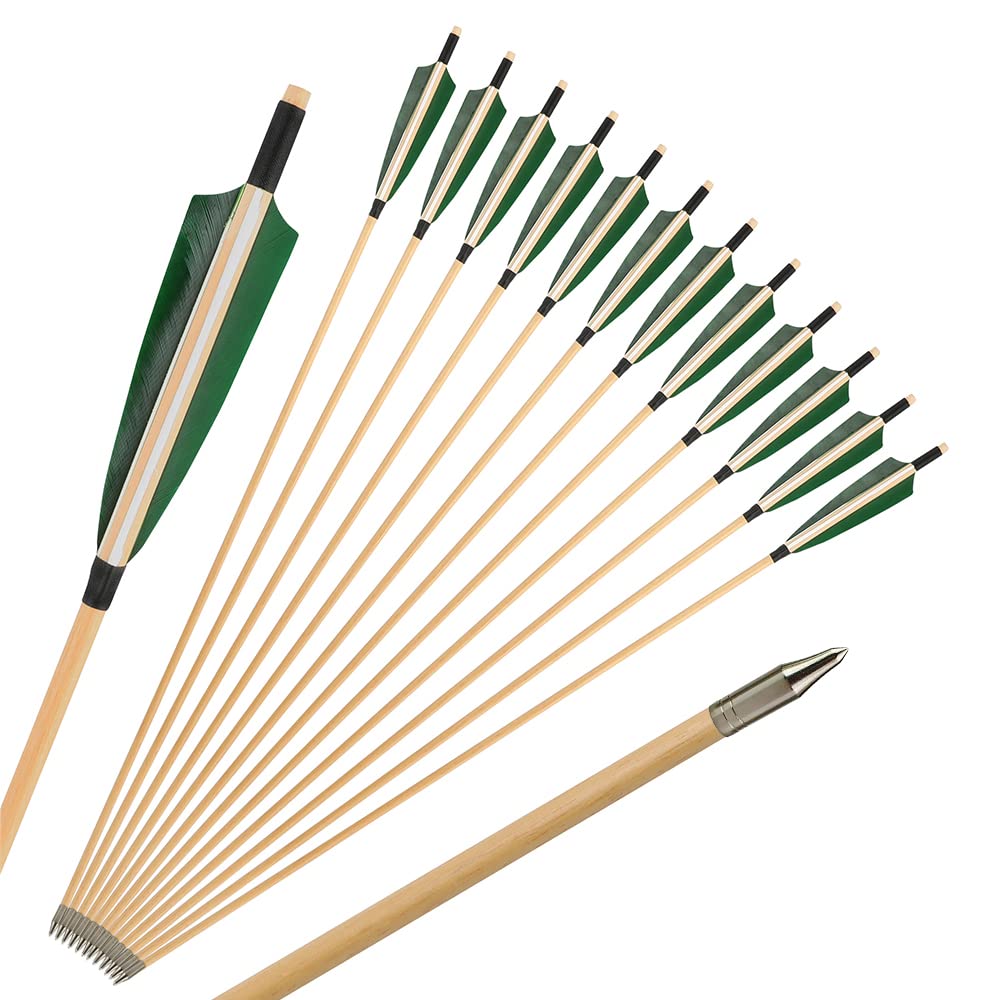
Feather-fletched and tipped from the start — the bundle for shooting, not sanding.
Here is the one that skips the workbench entirely. Each arrow in this twelve-pack arrives with a 5-inch natural turkey feather fletching already bound on and a tip fitted, built on an Indonesian white wood shaft 31.5 inches long. The 5-inch natural turkey feathers are the standout detail: they stabilize flight for traditional bows, which the maker credits for tighter shooting. If you have a recurve or an English longbow and want to be on the line this weekend, this is the pick.
Draw weight is where this bundle is generous. It is rated for 30-80 pound recurve bows, longbows, and traditional bows — the widest band of the three, and wide enough to cover a first bow and a heavier hunting bow from the same box. The shaft measures 8 mm across the outside, which is a hair thinner than the 11/32-inch cedar when you convert it, so check that your nocks and points suit an 8 mm shaft before you order replacements. Individual arrows run 20-28 g each, and the maker states outright that weight varies because wood varies.
Two things to know going in. Natural feathers get crushed in transit — the maker says so and recommends holding them over the steam from boiling water to bring them back into shape, which works and takes a minute per arrow. Weight tolerance is the other: 20-28 g across a set is a real spread, so don’t expect these to group like a matched dozen you built yourself. They are for hunting, stump shooting, and practice, not for the scoreboard.
Straight to the line: fletched, tipped, and finished at 31.5 inches — the only pick here you can shoot the day it arrives, rated across 30-80 pounds of draw.
What you trade: a stated 20-28 g weight tolerance per arrow means this set is built for practice and hunting, not matched-group shooting.
The short version: buy this if you want arrows flying today from a traditional bow and you are not chasing a matched dozen.
The caveat worth knowing: the feathers will need steaming after shipping, and the per-arrow weight spread rules it out for scored shooting.
Know the Specs
Spine Weight (and Why the Number Is a Band)
Spine weight tells you how much a wooden shaft bends under load, written in pounds. Match it to your bow’s draw weight: a shaft rated 45-50 lb is built for a bow pulling in that window. When a listing quotes a wide band like 30-70 lb, that describes the pack as a whole rather than every single shaft inside it, because wood density varies stick to stick. A tight band means a more closely matched set; a wide band means more bows covered but more variation to sort through.
Shaft Diameter and Hardware Fit
Diameter decides which nocks, points, and tapering tools will physically go on your arrow. Shafts turn up quoted either in fractions of an inch, like 11/32 inch, or in metric, like 0.28 inches and 8 mm. These are close but not identical, so confirm the figure before you buy hardware in bulk. A mismatched taper is the fastest way to stall a build halfway through with a dozen half-finished arrows on the bench.
Bare Shaft Versus Finished Arrow
A bare shaft is a plain wooden dowel — no nock, no point, no fletching, no sealer. You supply all four, plus the time. A finished arrow arrives with feathers bound on and a tip fitted, ready to shoot once any shipping damage to the feathers is steamed out. Choose bare for control over spine, taper, and finish; choose finished to be shooting this week.
Wood Type and Weight Tolerance
Port Orford cedar is the traditional pick and takes a taper and a stain well. Indonesian white wood is the other type named here, and the maker of the white wood arrows states a 20-28 g per-arrow weight tolerance outright because natural wood varies. Weight spread across a set affects how consistently arrows group, which is why matched bare shafts command more care — and more work — than a finished bundle.
Common Questions
What spine weight do I need for my bow?
What does bare shaft actually mean?
Will an 11/32 inch nock fit a 0.28 inch shaft?
Why are my turkey feathers crushed when they arrive?
Can I use these wooden shafts on a compound bow?
How much does arrow weight vary in a wooden set?
How long should my shafts be for my draw length?
Do I need to straighten wooden shafts before building?
Are wooden arrows harder to maintain than carbon?
Which bundle should a beginner buy?
The Bottom Line
For most builders, the winner among these wood arrow shafts is the Port Orford Cedar Premium Bare Shafts, because a 32.0-inch cedar blank with a stated 45-50 pound spine gives you length to trim and a matched dozen to build on — the crowd favourite of the three, holding a 4.5+ rating across 60+ owners. If your household runs several bow weights and you want one box to cover them, the Arrow Shaft for DIY Arrow with Nocks spans 30-70 pounds and reaches 33.5 inches. And if you would rather be on the line than at the workbench, the 31″ Archery Traditional Wooden Arrows arrive fletched with 5-inch turkey feathers and rated to 80 pounds — reach for those the day you want arrows flying.
How we choose
We do not accept paid placement. Every pick is matched to a real buyer and a real use-case; we do not hands-on test units.
Sources
Specifications: manufacturer listings and product documentation. Review insights: verified customer reviews, as of November 2026. Pricing: not shown on this page (it changes often); check the current price via the retailer link.
As an Amazon Associate, Tactical Gear Guy earns from qualifying purchases. This does not affect which products we feature.