Specs are compiled from manufacturer listings and verified buyer reviews and can change over time — please confirm the key details on the product page before buying.
Here is the short answer most shoppers need: if you want one appliance that removes the widest range of nasties with zero plumbing, the Ninja HydraSense is the safest all-round buy. If your priority is fitting under a crowded sink cabinet or stretching a filter across a whole year, the SimPure V7 is the smarter pick. Everything below is about matching the machine to your kitchen and your water, not about chasing the biggest number on the box.
This guide is built by comparing the manufacturers’ published specifications and the patterns across verified customer reviews, so you get each pick’s real strengths and trade-offs instead of marketing spin.
Water filters hide their real costs in the replacement cartridges, and their real headaches in the installation. This breakdown separates countertop plug-ins from under-sink systems so you can pick the one that fits your cabinet, your tap and your patience level.
You will finish with a clear shortlist of the water purifier that suits your kitchen, your water source and the way you actually drink.
Top Picks


How To Choose The Best Water Purifier
Start with the one question that eliminates half the field: can you drill a hole in your counter? An under-sink reverse osmosis system needs a faucet hole and a drain saddle. A countertop unit plugs into the wall and sits beside your coffee machine. Renters usually want the second type; homeowners with cabinet space usually want the first.
Understand the technology before the specs
Carbon block filtration traps chlorine, sediment and taste compounds. Reverse osmosis pushes water through a membrane so fine that dissolved solids, lead and fluoride cannot pass. Many countertop units combine both, plus a remineralization stage that adds calcium, magnesium, sodium and potassium back after RO strips them out. If your water tastes flat after filtering, that missing-minerals stage is usually why.
Check the micron rating, then check the flow
A micron is one thousandth of a millimeter, and the smaller the pore, the more it catches. A 0.5-micron cartridge catches sediment and some cysts. A 0.01-micron hollow-fiber membrane goes finer. A 0.0001-micron RO membrane is the tightest of the three and removes the most dissolved material. That tightness has a cost — water moves through it slowly, which is why RO systems quote flow in gallons per day rather than gallons per minute.
Work out the true cost of cartridges
A cheap unit with a cartridge that needs swapping every few months can cost more over two years than a pricier unit with a yearly filter. Look at two numbers together: filter life cycle and capacity. A cartridge rated at 12 months and one rated at 6 months differ significantly in how often you are reordering.
Match capacity to your household
A gravity countertop system holding 2.25 gallons suits one or two people. A tankless RO rated at 500 to 600 gallons per day suits a busy family filling bottles, pots and coffee reservoirs all morning. Size for your busiest morning, not your quietest one.
Do not confuse TDS reduction with purification
TDS (total dissolved solids) is the mineral content left in your water. Some good carbon filters keep those minerals on purpose, so TDS stays the same. Reverse osmosis units lower TDS as a side effect. Neither result is automatically better — it depends on if you want the minerals kept.
Side-by-Side Comparison
| Model | Best For | Installation | Filtration | Filter Life | Amazon |
|---|---|---|---|---|---|
| Ninja HydraSense WF1001★ Best Overall | Widest contaminant coverage, no plumbing | Countertop | Certified to NSF/ANSI 42, 53, 401 | 6 months / 120 gallons | Amazon |
| SimPure V7Best Capacity | Tight cabinet space and big capacity | Under Sink | 5-stage, 0.5 micron | 12 months / 20,000 gallons | Amazon |
| Purewell PW-KSBest No-Power Option | Power outages and off-grid kitchens | Countertop | 3-stage, 0.01μm UF | 6 months / 6,000 gallons (pair) | Amazon |
| APEC ROES-50X | Whole-home RO on a budget | Under Sink | 5-stage RO, 50 GPD | 2 years (system rating) | Amazon |
| Waterdrop G5P500A | Alkaline water without a tank | Under Sink | 8-stage RO + alkaline | — | Amazon |
| DREO WF511 | Plugin RO with a grab-and-go pitcher | Countertop | 7-stage RO, 0.0001μm | 1,050 gallons (combined filters) | Amazon |
| Bluevua RO100ROPOT-Lite | Glass carafe and fruit infusing | Countertop | 7-stage RO + UV + minerals | 1 year | Amazon |
| AquaTru Glass Carafe | Certified removal, small counter footprint | Countertop | 4-stage RO, 84 contaminants | 6 months pre-filter / 1 year RO | Amazon |
| Waterdrop KJ600 | Instant hot water at the tap | Under Sink | 5-stage RO, 600 GPD | 12 months | Amazon |
Detailed Reviews
1. Ninja HydraSense WF1001
Our pick — 4.5+★ from 950+ verified ratings; the strongest balance of quality and price.
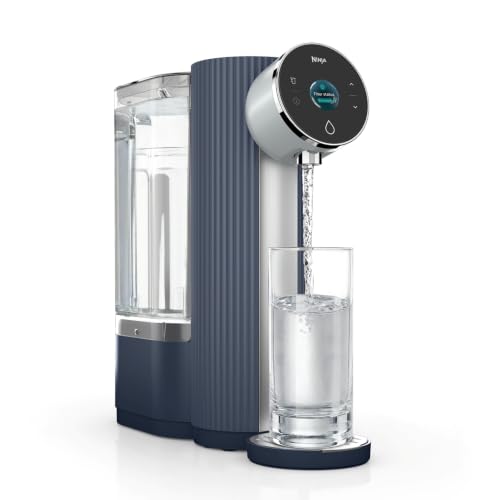
The plug-in countertop unit that removes 80-plus contaminants without touching a single pipe.
What makes the HydraSense worth the top spot is the certification, not the marketing copy. It is independently certified by IAPMO R&T to NSF/ANSI 42, 53 and 401 standards — three separate testing benchmarks covering taste and chlorine, health-related contaminants, and emerging compounds. That trio is what lets Ninja claim removal of microplastics, forever chemicals, pharmaceuticals and 80-plus contaminants in total. You pour tap water into the 3L reservoir and the machine handles the rest.
The usage tracking is the part owners actually lean on. A touchscreen monitors your water use in real time and sets your replacement timing from that, instead of a blunt calendar countdown. The filter is rated at 6 months or every 120 gallons — 3X the filter life of the leading pitcher filter, per the maker. Dispensing also runs 6X faster than a Brita standard filter, so filling a coffee reservoir takes seconds instead of a slow drip.
The honest catch is the reservoir size versus the footprint. The body measures 14.37″ long, 5.07″ wide and 5.07″ tall, and at 6.6 pounds it is heavier than the SimPure V7 below at 5.2 pounds — most of that is the base and the water you just added. It is a counter hog, not a cabinet dweller. The 3L reservoir also means refilling on a busy morning with a full family, where an under-sink system never runs dry.
Where it earns its keep
- Certified to NSF/ANSI 42, 53 and 401 by an independent lab, covering taste, health contaminants and emerging compounds in one unit
- Removes 80+ contaminants including microplastics, forever chemicals and pharmaceuticals
- One-touch dispensing you can set by volume, filling bottles and coffee reservoirs without holding a button
- Touchscreen tracks real usage and adjusts filter replacement timing instead of a fixed reminder
- Zero water waste and no plumbing — plug in, fill, drink
What to weigh first
- Occupies real counter space at 14.37″ long, so a cramped kitchen will feel it
- The 3L reservoir needs refilling more often in a large household
- Filter rated at 6 months or 120 gallons, so you are reordering twice a year
The verdict: The strongest all-round buy if you cannot drill, cannot plumb, or simply want certified contaminant coverage sitting on the worktop.
Think twice: A family of five filling bottles all morning will tire of topping up the 3L reservoir.
2. SimPure V7 Under Sink Water Filter System, Stainless Steel
Twenty thousand gallons from one cartridge, in a housing slimmer than a bottle of wine.
The number that reframes this whole list is the SimPure V7’s capacity. It is rated for 20,000 gallons across a 12-month filter life cycle, against the Purewell gravity system’s 2.25 gallons — the two are not remotely in the same class of throughput. Flow rate tells the same story: 1.6 gallons per minute here versus 0.06 gallons per minute on the Purewell. That 1.6 gpm fills a standard 8-oz glass in roughly three seconds, so you never stand waiting at the tap.
Installation is the other headline, and it is where this unit wins people over. It connects directly to your kitchen cold line in about three minutes with no drilling, and the box includes 3/8″ to 1/2″ converter fittings for standard and non-standard US lines. That makes it a realistic option for renters and condo owners who cannot touch the plumbing permanently. The five-stage composite runs double sediment membranes, KDF-55 and double activated carbon blocks down to 0.5 microns, reducing lead, chlorine, bad taste and odour while keeping beneficial minerals.
The build separates it from the plastic crowd. The housing is entirely 304 food-grade stainless steel and BPA-free, which resists the pressure cracking and chemical ageing that plastic housings are known for. At 3.6″ by 3.6″ by 12″ it tucks into a crowded cabinet and leaves room for the disposal. One trade-off to know up front: this system does not lower TDS, so if a low TDS reading is your goal you need a reverse osmosis unit instead. A few buyers also hit leaks at the fittings, so tape the threads properly on day one.
The value read: A 12-month cartridge at this capacity is the cheapest per-gallon proposition on the page, and the stainless housing means you are not babysitting a plastic shell.
Know before you buy: It filters, it does not demineralise — TDS stays where it was, which is fine for taste but wrong if you specifically want dissolved solids stripped.
Reach for this if: You want set-and-forget filtration under the sink with the fewest cartridge changes and the least cabinet clutter.
Look elsewhere if: You need low TDS or fluoride removal — that requires the RO machines further down this list.
3. Purewell 2.25G Gravity Water Filter System
Gravity does the work here, so a power cut never stops the water.
Two chambers, a spigot and a stand — that is the entire machine. You fill the upper chamber with tap water and gravity pulls it through the filter into the lower one. No pump, no cord, no outlet. That makes it the one pick on this list that keeps working when the electricity does not, which is why it earns a place for cabins, RVs and anyone who has watched a storm take the grid down.
The filtration is finer than the price suggests. The black carbon filter uses a 0.01μm hollow fiber UF membrane paired with a silver ion membrane and an activated carbon block, reducing chlorine and intercepting rust, sediment, organic matter and heavy metals. Purewell points out that many competing brands run a 0.2-micron pore, and smaller pores mean finer sieving. The pair of filters delivers up to 6,000 gallons total, with each element rated at 3,000 gallons and a recommended swap every 6 months. A transparent window lets you watch the water level without lifting the lid.
Here is the reality check. Gravity is slow — the rated maximum flow is 0.06 gallons per minute, so this is a fill-it-and-come-back system, not a dispense-on-demand one. The 2.25-gallon capacity suits one or two people comfortably and gets strained by a full family. Purewell also warns against topping up the upper chamber while the lower one is already full, which can cause leakage. Taste is the thing that wins people over here, and it is the most-praised quality in the feedback.
Why it stands out: A 0.01-micron membrane in a unit that needs no electricity is a rare combination, and the glass-clear level window is genuinely useful day to day.
The honest limit: At 0.06 gpm you plan around it. Fill it in the evening, drink through the next day.
Best suited to: Off-grid setups, power-cut country, and single-person kitchens where slow but steady is perfectly fine.
The single caveat: Do not fill the top chamber while the bottom is full, or you will be mopping.
4. APEC ROES-50X RO System
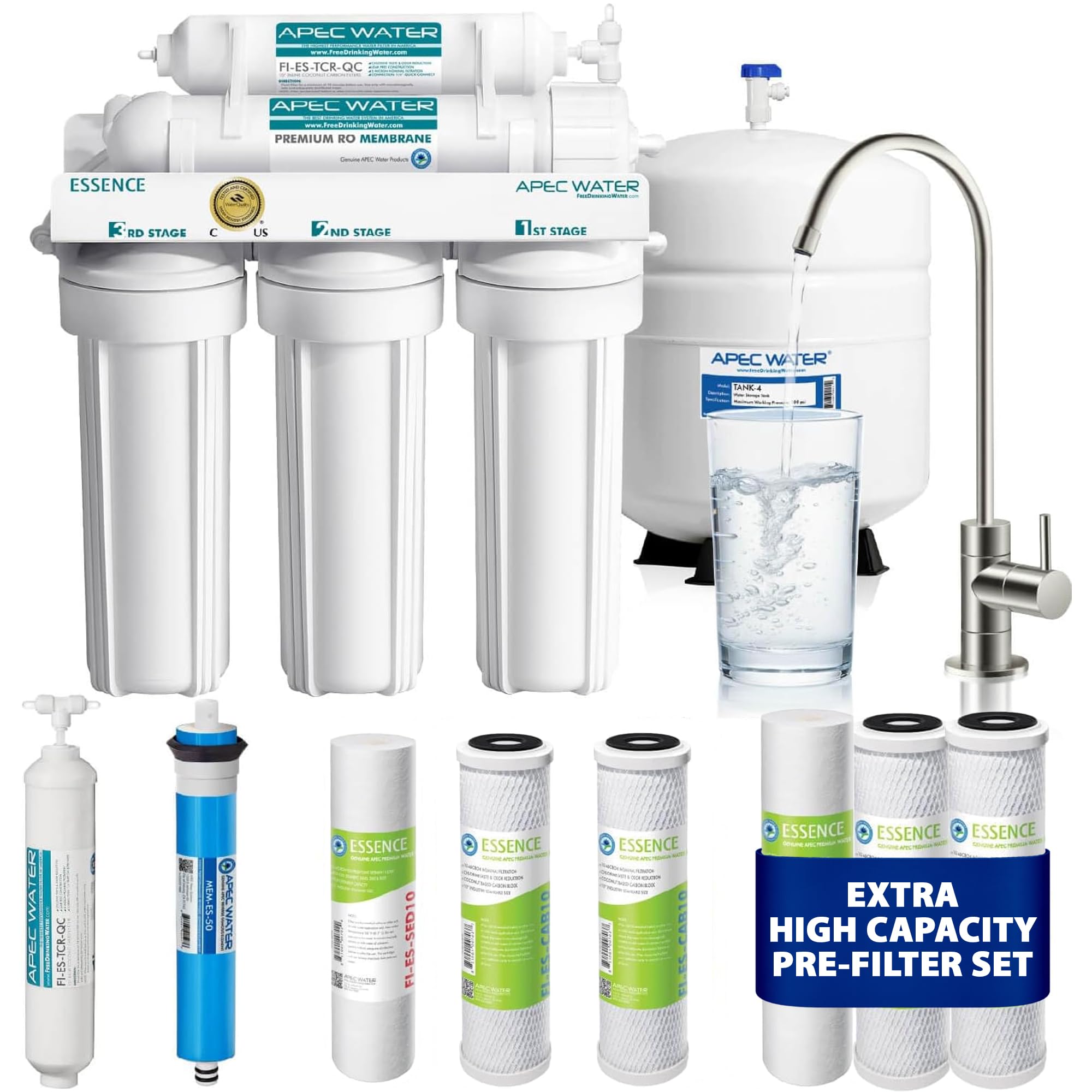
A five-stage reverse osmosis rig that arrives with a spare filter set already in the box.
Reverse osmosis is the technology that goes after dissolved contaminants, and the ROES-50X does it at 50 gallons per day. Per APEC, that rating removes up to 99.99% of more than 1,000 impurities, including arsenic, chlorine, lead, fluoride, heavy metals, PFOA and microplastics. It is certified to NSF 372 and 58, which covers lead-free materials and the RO process itself.
The convenience angle is the included FILTER-MAX-ES50 set plus a spare pre-filter set, a brushed nickel faucet, a water tank and the full installation kit. Quick-connect fittings and colour-coded tubing mean you are not hunting for a plumber on day one. APEC recommends replacing filters every 6 to 24 months depending on incoming water quality, and the system’s own filter life cycle is listed at 2 years. Set against the Ninja HydraSense’s 6-month cycle, that is a meaningfully longer stretch between reorders.
Two things a buyer should plan around. First, this is a 25-pound system with a tank, and the dimensions run 15.5″ by 5.25″ by 17″ — it needs genuine cabinet real estate under the sink. Second, RO is slow by nature, and the maximum flow rate here is 0.03 gallons per minute, so you are filling a glass and walking away rather than standing there. Leakage comes up in the feedback more than any other issue, so take the time to seat every quick-connect fully and check the joints after the first hour.
The trade-off that matters: You get deep dissolved-solid removal and a spare filter set up front, and in exchange you give up cabinet space and a fast pour.
Who it fits: Homeowners with a reasonable cabinet and a family to supply, who want certified RO without climbing into the premium tier.
Choose this one when: Fluoride, lead and dissolved solids are your actual concern and you have the cabinet depth to house a tank.
The thing to watch: 0.03 gpm is a trickle, so this is a fill-the-pitcher system, not a fill-the-pot-at-speed one.
5. Waterdrop G5P500A Reverse Osmosis System

Tankless RO that frees the cabinet and puts minerals back into every glass.
Most under-sink RO systems arrive with a pressure tank — a bulky metal cylinder that eats the back half of your cabinet. The G5P500A does not. Waterdrop says the tankless layout frees up to 70% of your under-sink space, and the main body measures a slim 16.69″ by 5.69″ by 13.9″.
The filtration runs eight stages through a 0.0001μm RO membrane, reducing PFOA, PFOS, chlorine, lead, fluoride and heavy metals. Then comes the part that separates it from a plain RO unit: alkaline mineralization adds calcium, magnesium, sodium and potassium back in. If you have ever tasted RO water and found it flat, that stage is the fix. Output is rated at 500 gallons per day, with a 2:1 pure-to-drain ratio, and Waterdrop notes it fills a 6-ounce cup in about 8 seconds.
Two practical notes. Some buyers report persistent beeping, so it is worth knowing that noise is part of the experience for a subset of units rather than a silent appliance. And the faucet installation requires drilling a hole in your countertop — this is not a renter-friendly install, unlike the SimPure V7 above. Set against the APEC’s 50 GPD, the 500 GPD rating here is a different order of output for a household that drinks a lot.
The case for it: Tankless space savings plus a remineralization stage means you get RO purity without the flat taste that puts people off the technology.
The real compromise: Drilling is mandatory, and a faucet that beeps at you is not everyone’s idea of a calm kitchen.
This suits: A household that wants minerals retained, cabinet space back, and enough daily output to supply cooking and bottles.
skip it if: You rent, or your countertop is not yours to drill into.
6. DREO WF511 Reverse Osmosis Water Filter
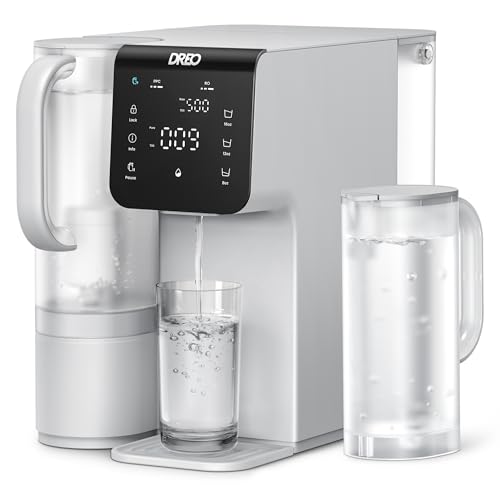
Reverse osmosis without plumbing, with a second pitcher so one keeps refilling while you pour.
RO usually means drilling and a drain line. The DREO WF511 skips both — you plug it in, flush it twice, and it is running. That makes it the pick for an office, a rental, or a kitchen where the sink is simply not up for modification. Its seven-layer system uses a 0.0001μm RO membrane, SGS-certified to remove 99.99% of over 1,000 contaminants including PFAS, PFOS, lead, nitrates, arsenic, fluoride and chlorine.
The two-pitcher setup is the clever bit. One BPA-free pitcher is the pour-and-carry one; the second auto-refills in the background so the machine is never idle. A real-time TDS readout shows you water purity at a glance, and filter life tracking tells you when to reorder. Auto-flushing and a child lock round out the daily handling. The 3:1 pure-to-drain ratio keeps waste water down, and the included filters are rated to purify up to 1,050 gallons.
This is a newer model with a smaller track record than the established picks, and the feedback reflects that mix. Effectiveness and taste are the standout positives, while reliability and refill time show up as uneven. The unit stands 15.91″ by 9.06″ by 13.07″ at 14.6 pounds, so it wants a genuine slice of counter. If you want the proven, weathered option, the AquaTru below has more history behind it.
What makes it different: Two pitchers plus real-time TDS monitoring in a unit that needs zero installation is a genuinely useful combination for a shared kitchen.
The caution: Refill speed is inconsistent between units, so treat the fill rate as a variable rather than a promise.
Pick this for: An office or rental where nobody is drilling anything, and a carry-away pitcher matters more than a permanent faucet.
The honest caveat: It is a young model, and reliability feedback is not yet uniform.
7. Bluevua RO100ROPOT-Lite Countertop Reverse Osmosis Water Filter
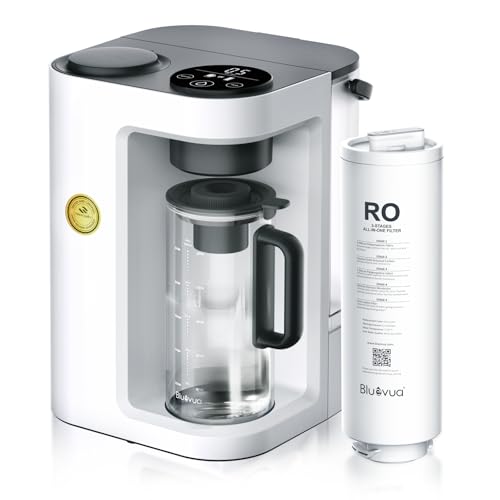
A glass carafe, a UV stage and a fruit infuser — the one built to sit on the table, not hide in a cabinet.
Most purifiers are appliances you tolerate. This one is designed to be looked at. The storage vessel is high borosilicate glass rather than plastic, which means your filtered water sits in something inert while it waits for you. The seven-stage system pairs a 5-in-1 filter with a UV light and a remineralization stage, so water comes out purified and then gets essential minerals added back for a balanced taste.
Capacity is 1200 ml, which squarely frames this as a one-to-two-person machine. The smart LED panel lets you select the volume you want and dispenses it automatically, with real-time water quality shown on screen and filter alerts when it is time to reorder. Replacement is a once-a-year job via a 3-second twist installation — a longer cycle than either the Ninja or the SimPure. The 3:1 pure-to-waste ratio keeps the drain low, and the unit is certified by WQA against NSF/ANSI/CAN 372 for lead-free construction, tested by SGS.
The infuser is the detail that splits opinion in the best way. A glass insert fits into the carafe so you can drop fruit in and make infused water without a second vessel, and the carafe carries a timeline feature to nudge your daily intake. Quality and taste are what this machine is known for. Leakage is the recurring gripe, and durability splits opinion, so seat the carafe carefully and avoid knocking it. At 0.26 litres per minute it dispenses at a measured pace rather than a rush.
Where it shines: A borosilicate glass carafe and a once-yearly filter twist make this the most pleasant unit to live with on a daily basis.
Where it asks patience: 1200 ml capacity and 0.26 L/min output mean you refill it as part of a routine, not in a hurry.
Best enjoyed by: One or two people who want filtered water served from glass and flavoured with fruit, without a plumber in sight.
Worth knowing: Glass is glass — a firm knock is a genuine risk, so give it a stable spot on the counter.
8. AquaTru Glass Carafe Countertop Reverse Osmosis Water Filter
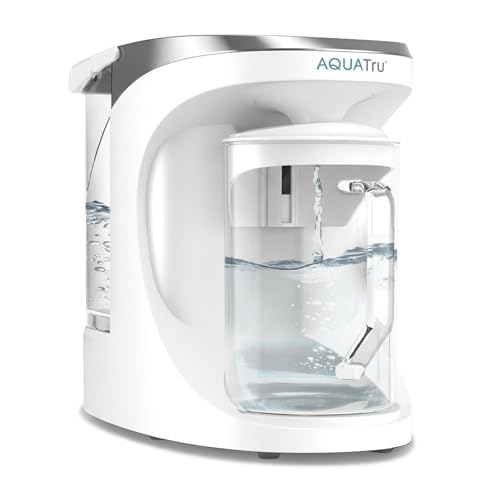
The countertop RO with a long track record and a glass carafe instead of a plastic jug.
Where a basic carbon pitcher stops at chlorine and sediment, this goes after the things that actually worry people — microplastics, fluoride, chromium-6, arsenic, PFOA and PFOS. The four-stage system is tested and certified to NSF standards by IAPMO, and AquaTru puts the contaminant count at 84. No plumbing, no drilling: it plugs into any standard outlet, you fill the tank with tap water, and purified water dispenses into the glass carafe with its lid.
Budgeting is easier once you know the filter schedule. The pre-carbon filter lasts 6 months or 300 gallons, the RO (reverse osmosis) filter lasts 1 year or 600 gallons, and the VOC (volatile organic compound) carbon filter lasts 1 year or 300 gallons. So most of your cartridge cost lands once a year, not every quarter. A one-year warranty and a 30-day money-back guarantee back it up. At 14″ by 7.5″ by 13″, it takes up less counter space than the tank systems.
Taste and ease of use are what carry this unit in the feedback, and refilling the tank and cleaning it are repeatedly described as simple. The honest trade-off is throughput: filtration speed divides opinion, so this is not the machine for filling a stock pot in a hurry. Reliability and value also split, which is worth knowing when you compare it with the cheaper per-gallon SimPure V7. For everyday drinking, coffee and ice cubes, it holds up well.
The strongest argument: Certified removal of 84 contaminants including PFOA, PFOS and chromium-6, in a countertop unit that needs no installation.
The fair warning: Filtration speed is not its strength, so plan around a steady trickle into the carafe.
Reach for this if: You want certified contaminant removal from a countertop unit and a glass carafe to serve from.
Consider the alternative if: You need high volume fast — the under-sink RO units move water quicker.
9. Waterdrop KJ600 Instant Hot Reverse Osmosis System

Purified water and near-boiling water from the same faucet, seconds apart.
This is the one machine here that solves two jobs at once. The KJ600 integrates reverse osmosis purification with a heating element, dispensing cold water and hot water from a single smart faucet. You set the temperature anywhere between 104°F and 203°F, which covers instant coffee, tea, oatmeal and cooking water without a kettle on the counter.
The five-stage filter uses an RO membrane, carbon block and PP cotton to reduce TDS, PFOA, PFOS, fluoride, arsenic, nitrate, lead and mercury. Output is rated at 600 gallons per day with a high hot-water flow of 0.4 gallons per minute, and the drain ratio is 2:1. The smart display faucet shows TDS level and filter condition at a glance, includes a child lock to guard against scalding, and indicates the dispensing temperature. A flow meter, NTC sensor and heating overtime protection guard against the element running dry.
Two things to plan for. Installation is under-sink, which means a faucet hole and a drain line — this is not the plug-in-and-go option that the Ninja or Bluevua offer. And Waterdrop notes that the weather and the temperature of your cup can affect the final water temperature, so a hot pour in a cold mug lands cooler than the setting. The tankless body at 17.5″ by 6.7″ by 16.6″ still needs cabinet depth. For anyone who drinks tea or coffee all day, the convenience of skipping the kettle is the whole case.
what separates it: One faucet covers drinking, cooking and hot drinks, because it gives you purified water at 104°F to 203°F.
The catch: Under-sink fitting plus a drilled faucet hole rules out renters, and a cold cup pulls the dispensed temperature down.
The ideal owner: A tea-and-coffee household that wants purified water and instant hot water without a kettle cluttering the counter.
Not for you if: You cannot drill a faucet hole or only ever need cold water.
Know the Specs
Micron rating and membrane type
A micron is one thousandth of a millimeter, and the number tells you the size of particle a filter blocks. A 0.5-micron carbon cartridge handles sediment, chlorine and taste. A 0.01-micron hollow-fiber UF membrane goes finer, catching more organic matter and heavy metals. A 0.0001-micron RO membrane is the tightest and removes dissolved material that the others let through. Tight membranes slow the water down, which is why RO systems quote output in gallons per day.
Filter life cycle and capacity
These two numbers work together and neither means much alone. Filter life cycle tells you the calendar interval before a swap; capacity tells you the total gallons it will treat. A cartridge rated at 12 months and 20,000 gallons is a very different ownership proposition from one rated at 6 months and 120 gallons. Multiply the number of swaps by the cartridge cost to see true annual running cost.
Pure-to-drain ratio
Reverse osmosis pushes water across a membrane and sends some down the drain to carry away the concentrated contaminants. A 2:1 ratio means two parts purified water for every one part wasted. A 3:1 ratio wastes less. This is inherent to how RO works, not a defect, and it is the reason RO systems use more supply water than carbon filters do.
TDS and what “reduces” really means
TDS stands for total dissolved solids, the mineral content in your water. Carbon systems like the SimPure V7 deliberately do not lower it, keeping beneficial minerals in place. RO systems lower it as a by-product of the membrane, then some add minerals back. Neither reading is a purity score on its own — it tells you what kind of filtration you are getting.
Common Questions
Does a countertop water purifier need plumbing or a drain line?
Will reverse osmosis remove fluoride from my tap water?
Why does my filtered water taste flat or empty?
How often do I actually replace the filter?
Can an under-sink RO system go in a rental apartment?
Is a water purifier with 0.01 microns better than one with 0.5 microns?
How much space does an under-sink purifier take up?
Do these purifiers waste a lot of water?
Can I use a water purifier during a power cut?
Does a purifier lower TDS and does that matter?
The Bottom Line
Want the most contaminant removal without touching your plumbing? The Ninja HydraSense WF1001 is the pick. Its IAPMO certification to NSF/ANSI 42, 53 and 401 (independent standards for taste, health and emerging contaminants) covers more ground than anything else on the counter. A 4.5+ star average across 900+ ratings backs it up. Renters with a crowded cabinet should look at the SimPure V7 instead. Its 20,000-gallon capacity and 3.6″ by 3.6″ by 12″ frame suit a home where you cannot drill a hole. And if hot drinks are a daily ritual, the Waterdrop KJ600 turns your tap into both a purifier and a kettle, with temperature adjustable from 104°F to 203°F.
Here is the one nudge worth making: think about the cartridge, not the sticker. Whichever unit you pick, the number that follows you home is the filter life cycle — 6 months on the Ninja and AquaTru pre-filter, 12 months on the SimPure and KJ600, a full year on the Bluevua. Match that rhythm to your household’s daily water use and the purifier fades into the background.
How we choose
We do not accept paid placement. Every pick is matched to a real buyer and a real use-case; we do not hands-on test units.
Sources
Specifications: manufacturer listings and product documentation. Review insights: verified customer reviews, as of November 2026. Pricing: not shown on this page (it changes often); check the current price via the retailer link.
As an Amazon Associate, Tactical Gear Guy earns from qualifying purchases. This does not affect which products we feature.