Specs are compiled from manufacturer listings and verified buyer reviews and can change over time — please confirm the key details on the product page before buying.
If your tap ever stops running, the gear in your bag decides whether you drink or go dry. That is the whole point of this list: nine water purification and storage tools, each one good at a different job. Some turn a scummy creek into a swallow. Some sit on a shelf for years and wait. A few let you store dozens of gallons before anything goes wrong. The quick answer: buy a filter for water you can find, and a storage kit for the water you already have. Most people need both, just not the same version of both.
This guide is built by comparing the manufacturers’ published specifications and the patterns across verified customer reviews, so you get each pick’s real strengths and trade-offs instead of marketing spin.
Below you will find pumps, squeeze filters, tablets, foil sachets, and stackable jugs, sorted by what each one actually does when the water gets questionable. My picks for the best water survival gear start with the tiny filter that weighs almost nothing.
Top Picks


How To Choose The Best Water Survival Gear
Water gear splits into two camps, and confusing them is the mistake most beginners make. One camp cleans water you find outdoors — filters, pumps, tablets. The other camp holds water you already stored — jugs, packets, treated containers. Buying a filter when your real worry is a two-week outage leaves you with nothing to drink on day three.
Start with the water source, not the gear
If you will be near rivers, lakes, or streams, a filter or pump makes sense because there is water to clean. If you live in a city apartment with no stream nearby, sealed packets and storage jugs do more for you. Ask yourself where the water will come from before you spend anything.
Know the micron number on the label
The micron rating (how small a particle the filter blocks) is the single number that tells you what gets through. A 0.3 micron filter stops bacteria and protozoa. A 0.3 micron filter goes finer still. Smaller is not automatically better for every trip — tighter membranes tend to need more push or more time.
Do the math on how much you drink
A common preparedness guideline is half a gallon of water per person per day. A 5-gallon container therefore covers one person for roughly ten days of basic use. Map that against how many people are in your household and how long you want to be covered.
Check the shelf life date before you store it
Sealed emergency water commonly carries a 5-year shelf life. Treated containers can stretch stored water out to similar lengths with a preserver added. Write the expiry on the box in marker so you actually rotate it instead of discovering a dead kit years later.
Side-by-Side Comparison
| Model | Best For | Type | Capacity | Weight | Amazon |
|---|---|---|---|---|---|
| Sawyer SP128 Mini★ Best Overall | Pocket-sized backup filtration | Inline squeeze filter | 100,000 gallons | 41 g | Amazon |
| Potable Aqua TabletsTiniest Option | Ultralight chemical treatment | Purification tablets | 25 quarts | 1.4 ounces | Amazon |
| Datrex 18-PackTruck-Kit Staple | Car and bug-out kits | Sealed water sachets | 18 packets, 4.227 oz each | 5 pounds | Amazon |
| S.O.S 62-Pack | Long-term home stockpile | Sealed water pouches | 62 pouches, 125 ml each | 122 g per pouch | Amazon |
| Sawyer SP129 Squeeze | Multi-day backcountry trips | Squeeze filter + 2 pouches | 100,000 gallons | 71 g | Amazon |
| Purewell Hand Pump | Basecamp and family groups | Hand pump purifier | 793 gallons | 1 pound | Amazon |
| OTS Osmo Seal 8-Pack | Saltwater and coastal survival | Forward-osmosis pouch | 120 fluid ounces | 11.2 ounces | Amazon |
| GRAYL GeoPress | Travel and fast purification | Press bottle purifier | 24 fluid ounces | 15.9 ounces | Amazon |
| Saratoga Farms Jugs | Household outage storage | Stackable 5-gallon containers | 5 gallons each, 6 count | 12 pounds | Amazon |
Detailed Reviews
1. Sawyer Products SP128 Mini Water Filtration System
Our pick — 4.5+★ from 41,000+ verified ratings; the strongest balance of quality and price.
Weighs 41 grams and still cleans a creek down to 0.3 microns.
It weighs 41 grams, which is the whole argument in one number. That is lighter than most car keys, so this filter disappears into a jacket pocket and you forget it is there until you need it. Its 100,000-gallon element rating means you will replace pouches long before you wear out the filter. For scale, the S.O.S water pouches weigh 122 g each, and three of those outweigh this entire filter.
What you can attach it to is the part buyers underestimate. It screws onto standard 28 mm disposable water bottles, clips into hydration packs, or drinks straight from the source through the included 7-inch straw. It comes with a 16-ounce reusable squeeze pouch and a cleaning plunger. Sawyer rates it at 99.99999% for bacteria such as Salmonella, Cholera and E. coli, 99.9999% for protozoa such as Giardia and Cryptosporidium, and 100% for microplastics. Compare that to a tablet, which is a chemical reaction you wait on rather than a barrier you push water through.
pocket-size filter
- 41 g in a pocket — no pack space sacrificed
- 0.3 micron absolute rating with an enormous 100,000-gallon service life
- Fits standard 28 mm bottles, hydration packs, and the included 16-ounce pouch
- No batteries, no chemicals, no waiting period
slow squeeze flow
- A single inline unit means one user drinks at a time
- Turbid, silty water means more plunger-cleaning sessions
- You supply the squeeze — the pressure comes from your hands
hiking solo: a stay-in-the-bag filter that covers one person on hikes, travel, and the first 24 hours of an outage.
group trips: you need to serve a family at a table — that is a pump or jug job.
2. Potable Aqua Water Purification Treatment (50 Tablets)
A bottle the size of a thumb that treats 25 quarts and weighs 1.4 ounces.
One bottle of 50 tablets treats 25 quarts, and the whole thing weighs 1.4 ounces. That ratio is why it lives in a pants pocket and gets forgotten until the moment you need it. Used as directed, the tablets are rated effective against Giardia lamblia and make questionable water bacteriologically suitable to drink. There is a 30-minute filter life cycle on the treatment, so you drop, wait, and drink — no pumping, no plunger, no moving parts to fail.
Where this beats the Sawyer Mini is pure logistics. No filter body, no pouch, no straw, no chance of a clogged membrane on a silt-heavy river. Where it loses is speed and taste: you wait out the clock rather than drinking in seconds, and treated water carries a chemical note. Campers pair it with a hydration bladder for exactly this reason — dose the bladder before bed, drink in the morning.
tiny tablet pack: this is the backup, not the primary. It shines as the second layer in a kit, or as the only layer in a pack where every gram is counted.
four-hour wait: the 30-minute wait is a real planning constraint, so fill up before you are thirsty rather than after.
travel light: your kit is weight-critical and you want a chemical layer that never clogs.
taste matters: you cannot stand tainted-tasting water — a carbon filter handles flavour better.
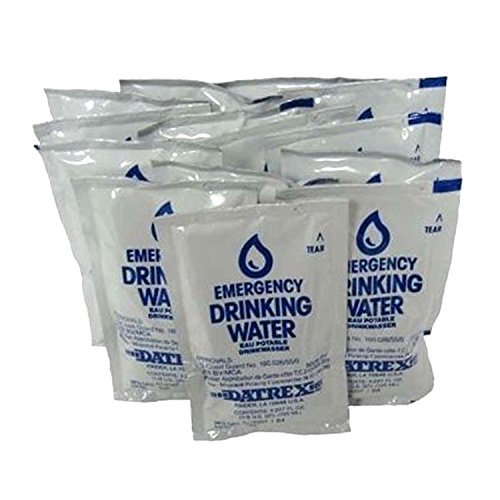
3. Datrex Emergency Water Packet 4.227 oz (18 Pack)
Eighteen sealed sachets that ride out freeze-thaw cycles and a 5-year shelf life.
Here is water that needs no source, no filter, and no decision — you tear a 4.227 oz packet and drink. The case runs 7 x 5 x 5 inches, so it tucks into a trunk or a closet shelf without a thought. The packet format is the quiet genius: lose one sachet and the other seventeen are untouched. That is the phrase the listing uses, loss potential minimized due to individual sachets, and it is the right way to think about an emergency kit.
Durability is what wins people over here. These hold up to freeze-thaw cycles, which matters enormously if the kit lives in a vehicle through winter. The packaging carries Canadian Coast Guard, EC, and NZ approval marks, which is rare for a sealed-water sachet. Compared with the S.O.S pack, the math is 7 x 5 x 5 inches versus 6.69 x 3.14 x 1.96 inches for the Purewell pump, so the Datrex box takes noticeably more shelf footprint but asks nothing of you at the moment of use.
sealed ration packets: sealed water is the only water that works when there is no water source at all. Filters clean water you find; this replaces water you cannot find.
plain flat taste: 18 packets is a finite count, so count heads and days before you call the kit complete.
car kits: your kit lives in a car, a boat, or a garage that sees hard temperature swings.
daily drinking: you want a bulk reserve for a whole household — a container kit covers far more ground.
4. S.O.S Emergency Drinking Water 62 Packets

Sixty-two sealed pouches, each 125 ml, so your whole shelf is a water supply.
Each pouch holds 125 ml and weighs 122 g, and the box carries 62 of them. That is what turns a hallway closet into an actual water plan. The construction is the same logic Datrex uses — individual sachets, minimal loss if one is damaged, superior packaging materials for durability. Five years of shelf life on a sealed pouch means you buy once and check the date a few times a decade.
What people actually notice first is quality, according to the consensus in the reviews — the water is clean-tasting rather than flat or metallic, which is not a given with long-stored emergency packets. The small pouch size gets called out as easy to pack and carry. One comparison worth stating plainly: the S.O.S pouch weighs 122 g while the Sawyer SP128 filter comes in at 41 g, a 3.0x gap in favour of the filter — but the filter needs a water source and the pouch does not.
The real pitch is scale: 62 pouches covers more ground than the 18-packet Datrex case without a second purchase.
five-year shelf life: the sealed-water layer for a house, a cabin, or a rental that needs something that just sits there.
bulky box storage: pouch count is your drinking budget, so plan for how many people drink from the box.
long-term stash: you want the largest sealed-water reserve in a single order without buying jugs.
small spaces: you need water for washing and cooking too — that takes containers, not sachets.
5. Sawyer Products SP129 Squeeze Water Filtration System

Two 32-ounce pouches and a 1.7 liter-per-minute flow for multi-day trips.
The step up from the Mini is capacity, and it shows. You get two reusable 32-ounce BPA-free collapsible pouches that roll up tight when empty, plus a drinking straw and a set of inline hydration pack adapters. The filter itself weighs 71 g and runs a maximum flow rate of 1.7 liters per minute. For backpackers that flow rate is the difference between a chore and a habit — fill, squeeze, drink, keep walking.
As owners put it: “The product is fantastic for backpacking, particularly in wilderness areas, and features a strong flow rate, taking about 30-60 seconds to filter 32 ounces.” That 30 to 60 seconds for 32 ounces lines up with the 1.7 L/min figure and tells you what a rest stop actually costs you. The filter body shares the same 0.3 micron absolute rating and 100,000-gallon service life as the Mini, and each squeeze unit is individually tested three times to performance standards by Sawyer.
The removable cap and 28 mm thread compatibility mean it works with disposable bottles and gravity setups too. The recurring gripe in the reviews is durability of the pouches themselves, so treat the seams kindly and do not over-squeeze. Weight and portability are what get praised most — one common note is that the swap saves about 3 liters of weight from a pack compared with carrying water in.
backpacking trips: anyone whose trips last more than a day and who wants water on demand without a pump.
basecamp use: the pouches are the wear item — a slow-handed squeeze keeps them alive longer.
6. Purewell Water Hand Purifier Pump with Replaceable Carbon
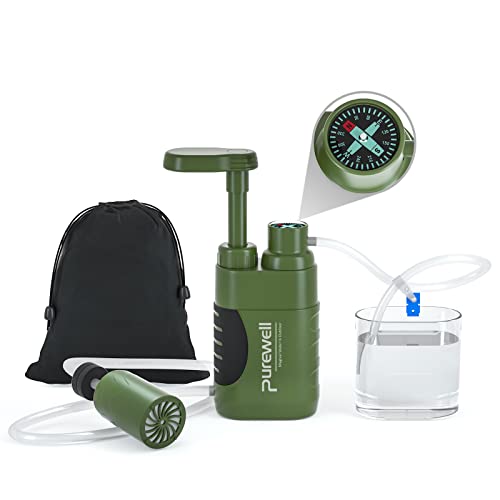
A four-stage pump with a 0.3 micron membrane and no electricity needed.
This is a different animal from a squeeze filter, and the 0.3 micron rating is the tell. The pump stacks four layers: a medical Grade hollow fiber UF membrane, activated carbon fiber, a coconut shell activated carbon rod, and medical Grade PP cotton. It delivers up to 793 gallons before the cartridge is spent. It measures 6.69 x 3.14 x 1.96 inches, which puts it in a day pack with room left over, and it works without electricity at all.
The design details are thoughtful in a way that shows up after hours at camp. Rubber pads on the sides and bottom keep the pump steady on a rock while you work the handle. The handle diameter runs up to 15mm. The transparent lid doubles as a drinking cup, and there is a compass on top. A carry bag and hose clip come in the box.
Here is the honest part: effort is the dividing line in the reviews. Some find the action easy and quick, others find it hard to push or pull once the membrane is wet and the water is cold. If your hands are strong and your group is large, the pump shines. If you want one-handed sipping on the move, a squeeze filter wins. The pull-to-drink flow is also a touch slower than the 1.7 L/min a Sawyer SP129 delivers, but the pump gives you the finer 0.3 micron stage in return.
cabin trips: you are outfitting a basecamp or a family group and want a fine-stage pump with no battery dependency.
fast travel: pumping for one person feels like work — a squeeze filter is the lighter task.
7. OTS Osmo Seal 8-Pack Emergency Desalination Kit

The only pick here that can turn seawater into something you drink.
Every other product on this list needs fresh or at least non-saline water. The Osmo Seal does not. It uses forward osmosis through a high purity 0.0007 micron membrane, and the spec line is blunt: 93% salt removed. It also pulls out brackish impurities and heavy sediment. If your survival scenario involves an ocean, a bay, or a boat, this is the one piece of gear that has no substitute in the rest of the list.
The mechanism is deliberately passive — no pumping, no sucking, no batteries, no complex parts. You place the pouch in the water source and wait. Freshwater takes 4-6 hours and saltwater takes 6-8 hours, during which the pouch inflates as it fills. The capacity runs 120 fluid ounces. It also adds electrolytes, potassium, and Vitamin C to the output, so the water tastes like a recovery drink rather than a treated pouch. Eight pouches ship as a pack, and the current expiration is December 2032.
saltwater desalination: a 0.0007 micron membrane is the finest figure in this entire article, and it is the only stage here rated to strip salt.
slow output rate: 6-8 hours for saltwater means you start this pouch well before you are thirsty, not when you are.
coastal survival: coastal boaters, sailors, and anyone whose go-bag sits near an ocean instead of a stream.
fresh water nearby: inland hikers who will only ever meet fresh water — a filter covers that ground better.
8. GRAYL GeoPress 24 oz Water Purifier & Filter Bottle

Fill, press, drink — 24 ounces purified in 8 seconds with no pumping.
The spec sheet says 8 seconds, and that is genuinely what separates this bottle from everything else here. It purifies 24 oz (710 ml) per press with no setup time, no hoses, no straws, no batteries, and no chemicals. You fill from a spigot, a hotel sink, a murky river, a lake, or a well, and press. The one-way drink mix valve in the cap lets you add a flavour packet without contaminating the cartridge. It measures 3.4 x 3.4 x 10.4 inches and weighs 15.9 ounces.
What it removes is the broadest list of any pick. Its pathogen list covers rotavirus, norovirus, hepatitis A, E. Coli, salmonella, dysentery, giardia, cryptosporidium, and amoebae. Beyond pathogens, it filters sediment and microplastics and adsorbs VOCs, PFAS, pesticides, herbicides, heavy metals, and odours. The replaceable cartridge is rated for 65 gallons (250L).
Against the Sawyer SP129 above, the GeoPress is heavier at 15.9 ounces versus 71 g and uses a 65-gallon cartridge instead of a 100,000-gallon filter. The trade is speed and scope for weight and service life. What buyers praise most is the portability — it is the bottle people actually carry through airports, on treks, and into a camp, rather than the one they leave in the bag.
urban travel: travel and fast turnaround — the bottle you press at a foreign hotel sink and drink from in seconds.
ultralight hikes: 65 gallons per cartridge means a long trip will eventually need a replacement, so budget for it.
9. Saratoga Farms Stackable Water Containers 5-Gallon

Six 5-gallon jugs, two spigots, and a preserver that stretches water to five years.
Six containers at 5 gallons each is 30 gallons of stored water. Against the half-gallon-per-person-per-day guideline, that kit is built to cover a household for about 60 days of washing, cooking, or drinking. Each jug is made from BPA-free HDPE — high-density polyethylene, a food-grade plastic that takes a knock. It is the only pick on the list that stores water at scale instead of purifying it on demand.
The included accessories matter more than you might expect. You get six lids, two no-drip spigots that thread onto the lids, a 70mm cap wrench, and a bottle of water preserver that can treat up to 110 gallons. That preserver is what pushes stored water out to up to 5 years instead of the traditional 6-12 months. The twist breathing ports let you pour without the jug air-locking, and the built-in handles make carrying a full 5 gallons manageable. Flat bottoms and flat tops mean you can stack them in a garage or the back of a truck.
Stackability is the standout — 40 owners mention it, the most-counted point in the data, and it is why these work in a limited space. Sturdy build trails just behind. The recurring gripe is sealing: a few complain about leak points and cap threads, so tighten the spigots before you fill and do not over-crank the lids. Weighing 12 pounds shipped, the kit is manageable, though a full 5-gallon jug is heavy by nature.
home reserves: a family that wants a real reserve in the garage and the accessories to use it without a second trip.
apartment closets: check the spigot and cap threads before filling — a slow drip over months adds up.
Know the Specs
Micron Rating and What It Blocks
The micron rating is how small a particle a filter will stop, so a 0.3 micron membrane blocks anything bigger than 0.1 of a micron. Bacteria and protozoa are caught at that level; a 0.3 micron stage goes finer still. A 0.0007 micron membrane is the finest figure here and is the only one rated to strip salt. Smaller is not automatically better — tighter membranes often need more push or more time to move the same water.
Flow Rate and Effort
Flow rate is how much water moves through per minute, and it tells you how much work a fill will be. A squeeze filter rated at 1.7 liters per minute can fill a 32-ounce pouch in the time it takes to read a text. A hand pump trades some of that speed for a finer membrane and a steady surface to work on. Passive systems like the forward-osmosis pouch are the slowest — measured in hours — but they ask nothing of you at all.
Shelf Life and Stored Water
Sealed emergency water commonly carries a 5-year shelf life, and treated containers can be pushed to up to 5 years with a water preserver added. Untreated stored water is the weak link, sitting at a traditional 6-12 months. Write the expiry on the container so you actually rotate it. The clock on a filter is different — a 100,000-gallon service life is measured in use, not in time on the shelf.
Capacity and Household Math
A common preparedness guideline is half a gallon of water per person per day. From there, the arithmetic is simple and worth doing once: six 5-gallon containers hold 30 gallons, which runs a household for about 60 days of basic use at that rate. A sealed pouch system like the 62-packet S.O.S case covers a smaller count but needs no prep. Stored capacity answers the outage; purification answers the trip.
Common Questions
Can a 0.3 micron filter remove viruses from water?
How long does a Sawyer Mini filter actually last?
Do water purification tablets kill Giardia and Cryptosporidium?
Can the OTS Osmo Seal really make seawater drinkable?
How much water should a household store for an emergency?
Is a hand pump better than a squeeze filter?
Do emergency water packets expire if they sit in a hot car?
Can I stack full 5-gallon water containers in a garage?
How long does purified water stay safe in a storage container?
The Bottom Line
Most readers are best served by two pieces, not one. Start with the Sawyer SP128 Mini — 41 grams, a 0.3 micron rating, and a 100,000-gallon service life cover a trip and the first day of an outage from a pocket. Add the Saratoga Farms container kit if your real worry is a household with no running water, because 30 gallons stored beats any filter when there is nothing to filter. For travel and speed, the GRAYL GeoPress presses 24 ounces in 8 seconds with the broadest removal list here. And if salt water is in your picture, the OTS Osmo Seal is the only thing on this page that can handle it. Buy the one that matches your water source, then add the sealed packets when you want a supply that asks nothing at the moment you need it most.
How we choose
We do not accept paid placement. Every pick is matched to a real buyer and a real use-case; we do not hands-on test units.
Sources
Specifications: manufacturer listings and product documentation. Review insights: verified customer reviews, as of November 2026. Pricing: not shown on this page (it changes often); check the current price via the retailer link.
As an Amazon Associate, Tactical Gear Guy earns from qualifying purchases. This does not affect which products we feature.