Specs are compiled from manufacturer listings and verified buyer reviews and can change over time — please confirm the key details on the product page before buying.
Buying a bandsaw blade is really a matching job, not a shopping job. The blade has to match your saw’s wheel size, its length in inches, and the job you actually do — resawing thick boards, cutting curves, or slicing thin stock. Match all three and the blade tracks straight through the cut. Miss any one and the blade wanders, binds, or will not tension.
This guide is built by comparing the manufacturers’ published specifications and the patterns across verified customer reviews, so you get each pick’s real strengths and trade-offs instead of marketing spin.
You get the blade lengths, widths, and tooth counts below, so you can check them against your own machine before you order. For the widest range of shop work, reach for the Timber Wolf 1/2″ x 93-1/2″: a low-tension resaw blade (it runs on less tension, so a small motor is not strained) with 4 TPI (teeth per inch, the tooth spacing) that owners lean on for thick stock. It is among the most trusted picks among wood bandsaw blades.
Top Picks


How To Choose The Best Wood Bandsaw Blades
The single most common mistake is ordering a blade that is the wrong length for the saw. A bandsaw blade is a closed loop, and the loop has to fit around both wheels with just enough room for the tensioner to work. If it is even half an inch short or long, the saw will not tension it and the blade will wander in the cut.
Match the length to your wheel size first
Blade length follows wheel size, not brand. A 9-inch benchtop saw typically takes a 59-1/2 inch or 62 inch blade. A 14-inch floor saw usually takes 93-1/2 inches. Big resaw machines run longer — up to 116 inches on a JET JWBS-14SFX. Look up your model in the owner’s manual before anything else, then match the listing’s length exactly.
Then pick tooth count for the job
Tooth count per inch, written as TPI, decides how the blade behaves. A low count like 3 TPI clears sawdust fast out of a deep cut, so it resaws thick boards without bogging down. A high count like 14 TPI leaves a cleaner edge on thin stock, plastic, and non-ferrous metal. Six to 12 TPI sits in the middle for general curve and straight work. Pick the TPI for the cut you make most often, not the occasional one.
Blade width sets how tight a curve you can cut
A wide blade resists twisting, so it cuts straighter through long rips and resaw. A narrow blade flexes around tight radii, which is what scroll and contour cutting needs. That is why many small saws are best served by an assortment pack — one narrow blade for curves, one medium blade for general work.
Side-by-Side Comparison
| Model | Best For | Length | Width | TPI | Amazon |
|---|---|---|---|---|---|
| Timber Wolf 1/2″ x 93-1/2″, 4 TPI★ Best Overall | All-round resaw work | 93.5 in | 1/2 in | 4 | Amazon |
| 3423VPC Timber Wolf 93.5″ x 3/4″Resaw Specialist | Resawing hard stock | 93.5 in | 3/4 in | 9 | Amazon |
| Jet 116″ x 1/2″ x 4 TPIDedicated Fit | JET JWBS-14SFX owners | 116 in | 1/2 in | 4 | Amazon |
| AYAO 93-1/2″ x 1/4″ x 12 TPI (2-Pack) | 14″ saws, general cutting | 93.5 in | 1/4 in | 12 | Amazon |
| AYAO 80″ x 1/4″ x 14 TPI (3-Pack) | Craftsman 12″ band saws | 80 in | 1/4 in | 14 | Amazon |
| FOXBC 93-1/2″ x 3/4″ x 3 TPI | Ripping and deep resaw | 93.5 in | 3/4 in | 3 | Amazon |
| POWERTEC 59-1/2″ Assortment (3PK) | 9″ saws, scroll and rip | 59.5 in | 1/8, 3/8, 1/4 in | 14, 6, 6 | Amazon |
| POWERTEC 62″ x 1/8″ x 14 TPI (2-Pack) | 9″ saws, fine detail cuts | 62 in | 1/8 in | 14 | Amazon |
Detailed Reviews
1. Timber Wolf Bandsaw Blade 1/2″ X 93-1/2″, 4 Tpi
Our pick — 4.5+★ from 550+ verified ratings; the strongest balance of quality and price.
The resaw blade that lets a modest motor chew through thick stock.
Here is the number that decides your resaw day: 4 TPI. That low tooth count scoops sawdust out of a deep cut instead of packing it in, which is exactly what you need when you split a thick board into two thinner ones. The blade runs 93.5 inches long, 1/2 inch wide, and 0.03 inches thick, so it fits the 14-inch class of floor saws.
What makes it unusual is the low-tension design. Timber Wolf builds it from high silicon, low carbide steel that runs under low tension, which the maker says requires less horsepower from your saw. In practice that means a saw that would strain on a stiff blade can keep a steady cut. It is also a thin-kerf blade, so you lose less wood to the cut itself.
The cutting performance is what carries this blade — it is the trait owners bring up more than any other, and by a wide margin. Hardwood, softwood, and the odd chunk of teak all go through cleanly. The value side is nearly as strong: folks keep pointing out how much blade you get for what you spend. Weld quality is the one recurring gripe, so if a band ever lets go, that is a manufacturing miss rather than a wear-out.
What earns it first place
- 4 TPI clears dust fast on deep resaw cuts
- Low-tension steel asks less of a small motor
- Thin kerf wastes less of your board
- At 5.6 ounces it is easy to swap and tension
Where it can let you down
- Weld quality is the weakest reported point
- 4 TPI leaves a rougher edge than a fine-tooth blade
- 93.5-inch length will not fit a benchtop 9-inch saw
Grab this one if: you run a 14-inch floor saw and spend most of your time resawing thick boards.
Think again if: your saw takes a 59.5-inch or 62-inch blade, or you need a fine finish straight off the saw.
2. 3423VPC 93.5″ Timber Wolf Bandsaw Blade
A milled-tooth resaw blade built to hold its edge through hard maple.
Wider is stiffer, and that is the whole point here. At 3/4 inch wide, this blade will not wander the way the 1/2-inch Timber Wolf does, so long straight resaw cuts track true. It runs 93.5 inches with 9 teeth, which sits between a pure ripping blade and a general-purpose one — aggressive enough to move through stock, fine enough to leave a reasonable face.
The manufacturing detail is what you are paying for. Timber Wolf mills these teeth, and Timber Wolf claims a milled tooth is 50 percent sharper than a stamped or crush-ground one.. The same claim sheet rates the teeth 20 percent harder than high carbon steel and the steel more ductile, which Timber Wolf says extends flex life and runs the blade cooler. Those percentages are the maker’s figures, not lab results I can verify — but they line up with why resaw hands reach for this blade.
Owners put it through maple and walnut and boards up to 6 inches by 3 feet, and it holds up to daily use. Quality and performance are the two things that keep coming up. The honest catch is blade stability and sharpness — those draw genuinely split opinions, so on some saws it tracks beautifully and on others it needs more careful setup.
For the resaw bench: if your day is thick hardwood and you want a wide, stiff blade with milled teeth, this is the upgrade over the 1/2-inch version.
The setup tax: it rewards a well-tuned saw — tension it properly and it sings; rush it and the mixed reports on stability will find you.
Reach for this if: resawing is your main job and you work hard domestic lumber.
Look elsewhere if: you cut tight curves, where a 3/4-inch blade simply will not turn.
3. Jet 116″ Bandsaw Blade WBSB-116124
The one blade here cut for a single saw — the JET JWBS-14SFX.
This is a fit-first purchase. It measures 116 inches long and 1/2 inch wide with 4 TPI, and JET builds it specifically for the JWBS-14SFX woodworking bandsaw. If that is your machine, the length question is already answered — no measuring, no guessing. Every other blade on this list is a generic fit by length; this one is model-locked.
JET mills the teeth for aggressive cutting and match-welds and induction-hardens the band. The maker also notes an excellent fatigue factor, which matters on a saw used for contour cutting — a blade that shrugs off the stress of repeated curves keeps going longer. High carbon steel construction, 9.6 ounces on the scale.
The trade-off is obvious and worth saying plainly: this blade does one job for one saw. Own a different 14-inch machine and it will not fit, no matter how good it is. That is not a flaw, it is a fit mismatch — and it is why this pick sits behind the universal 93.5-inch blades for most buyers.
Made for: JWBS-14SFX owners who want a blade JET sized and spec’d for their exact machine.
Not your blade if: you run any other saw — the 116-inch length is locked to that one model.
4. AYAO Pack of 2 Band Saw Blades 93-1/2 Inch X 1/4 Inch X 12TPI
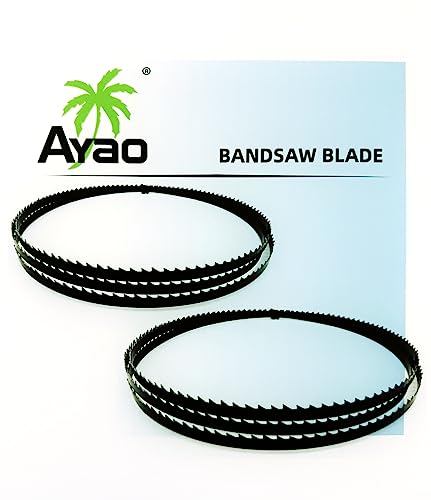
Two spare blades in the 14-inch length most home shops actually own.
Order a blade, get two. That is the appeal of this AYAO pair — 93.5 inches long, 1/4 inch wide, 12 TPI, two to a pack. The 12 TPI covers a clean general cut, and the 1/4-inch width is narrow enough for gentle curves while still tracking a straight line. These fit the whole 14-inch class: Delta/Rockwell, Jet, Rikon, Steel City, General, Ridgid, and older Sears Craftsman and Grizzly saws.
Where the value lands is on the spare-on-the-wall factor. A dull blade mid-project stops everything, and having a second one in the cabinet keeps you cutting. The welding is done with a technique AYAO says gives a strong, smooth joint, and the raker set has all teeth arranged evenly for steady cutting. High carbon steel, 0.02 inches thick.
Quality is the thing people keep coming back to — it sits well above any other trait on this blade — and owners call these sharp and straight-cutting, which is the whole ballgame for a general blade.
Why it fits a working shop: the second blade is the feature — you are never down a blade in the middle of a cut.
What to know: 1/4-inch width and 12 TPI make it a good all-rounder, not a resaw blade — for thick stock, step up to a 3 or 4 TPI.
Best for: anyone with a 14-inch saw who wants a solid general blade plus a spare on hand.
Pass on it if: your work is heavy resawing, where the finer 12 TPI will slow you down.
5. AYAO Pack of 3 Band Saw Blades 80 Inch X 1/4 Inch X 14TPI Fit Craftsman 12″ Band Saw

A three-blade pack sized for the 12-inch Craftsman many beginners start on.
Eighty inches is the length for a 12-inch Craftsman band saw, and this pack hands you three of them. Each blade is 1/4 inch wide with 14 TPI and 0.017 inches thick — a fine-tooth configuration that leaves a clean cut on wood, PVC, and thin aluminium.
Compare the tooth count to the FOXBC resaw blade and the difference is stark: 14 TPI here against 3 TPI there. The FOXBC is built to chew through thick stock; this AYAO is built to cut neat edges and gentle curves. Neither is better — you are just picking the tooth count for the cut you do.
Three blades in one pack also means a dull edge never ends your session. The raker set keeps teeth evenly spaced, the weld is done for a smooth joint, and the steel is high carbon. Sharpness that hangs on longer than you might expect is the standout owner note — that, and the price-to-value read, are the two things people keep mentioning.
Pick it up if: you run a 12-inch Craftsman and want a stack of fine-cutting spares.
Leave it if: your saw takes 93.5 inches — this 80-inch blade will not tension on it.
6. FOXBC 93-1/2 Inch Bandsaw Blades

Three teeth per inch for the fastest, deepest cut of the 14-inch blades here.
Three TPI is as coarse as it gets on this list, and it is aimed squarely at one thing: moving fast through thick and green timber. That is 4.7 times fewer teeth per inch than the 14 TPI AYAO., so while the AYAO leaves a neat edge, this FOXBC powers through a cut that would bog a fine blade. Two blades come in the pack, each 93.5 inches long, 3/4 inch wide, 0.025 inches thick.
FOXBC builds these from Japan SK8 high-grade carbon steel with hardened, tempered teeth that are induction hardened and milled for true tracking. Milled teeth cut more precisely than stamped ones, and the hardened edge holds sharpness through the cut. It handles hard and soft wood, plastic, mild steel, and non-ferrous metal, and it fits the standard 14-inch roster — Delta/Rockwell, Jet, Rikon, Steel City, General, Ridgid, and older Craftsman and Grizzly saws.
What wins people over is how it behaves on real stock — green logs slide through, and rip cuts come up easy. Blade quality and sharpness are the two strengths buyers lean on. Bear in mind a 3 TPI blade leaves a rougher face, so plan a pass on the planer or jointer if the finish matters.
Rip and resaw speed: 3 TPI clears even green, wet stock without clogging — this is the blade for breaking down logs and thick boards.
The rougher trade-off: coarse teeth mean a coarser cut surface; that is the cost of the speed.
Go for it if: you want maximum cutting speed through thick, green, or rough stock on a 14-inch saw.
Steer clear if: you need a glue-ready finish straight off the blade.
7. POWERTEC 59-1/2 Inch Bandsaw Blades Assortment, 3PK (13604)

A three-blade set for 9-inch saws, covering scroll work and straight cuts alike.
This POWERTEC set puts three different jobs in one box. There is a 59.5 x 1/8-inch blade at 14 TPI for fine detail, a 59.5 x 3/8-inch at 6 TPI flagged for scroll cutting, and a 59.5 x 1/4-inch at 6 TPI for general work. Three lengths of 59.5 inches, one for each of the 9-inch saws that want that size: Sears Craftsman, B&D, Ryobi, Delta, and Skil.
Premium high-grade carbon steel with heat resistance and a welded band forms the base. The teeth are arranged in what POWERTEC calls an optimal geometric pattern for smooth high-speed cuts, and the flexible carbon hard-edge blade works on hard and soft woods, plastic, and non-ferrous metals. Total weight is 0.14 kg for the set.
Smooth, sharp cutting is what the buyers report, and the blade stands up well across long stretches of occasional use — the review pages even put it around 30 months of intermittent cutting. It drops straight into older Delta saws and holds a straight track as it goes. The one thing to get right before you press buy is the blade size — check your manual, since this 59.5-inch set is strictly a 9-inch-saw length.
Choose this if: you own a 9-inch saw and want a scroll blade, a detail blade, and a general blade in a single purchase.
Not your set if: your saw is a 14-inch floor model — the length is wrong.
8. POWERTEC 62 Inch Bandsaw Blades 13132-P2

A skinny 1/8-inch blade for tight turns, in a two-pack for 9-inch saws.
Narrow blades turn tight, and 1/8 inch is the narrowest here. That width is what lets a small saw trace a real curve or cut a scroll pattern, where a wide blade would just bind. At 62 inches long with 14 TPI and 0.025 inches thick, it fits the 9-inch roster: POWERTEC, Ryobi, WEN, Grizzly, Skil, and Sears Craftsman. Two to a pack, so a dull edge never stalls you.
Compare the width to a resaw blade and the gap is obvious — At 1/8 inch it is 5.8 times narrower than a 3/4-inch resaw blade., and that is exactly why it curves where a resaw blade cannot. The mechanics support the job: POWERTEC builds it from premium carbon steel with heat resistance, a welded band, and an even raker-set tooth profile for a regular cut. It handles hard and soft wood, plastic, and non-ferrous metals.
Owners mention it cutting straighter than they expected for so fine a blade, which is the reassuring part — a 1/8-inch blade that tracks is worth having. Durability splits opinions and sharpness is the weak spot, with a few noting these go dull faster than a heavier blade. Treat them as consumables for detail work rather than a do-everything blade.
Built for curves: the 1/8-inch width is the spec that matters — it is the only blade here that will follow a tight radius.
Finish expectations: the fine 14 TPI and narrow body are for clean detail cuts, and the trade-off is faster dulling compared to a wider resaw blade.
Made for: 9-inch-saw owners who cut curves, scrolls, and fine shapes rather than thick stock.
Not the one if: resawing or heavy ripping is your job — a 1/8-inch blade is too flexible for it.
Know the Specs
Blade Length and Wheel Size
Length is a closed loop around both wheels, so it must match your saw’s wheel size. A 9-inch benchtop saw commonly takes 59.5 or 62 inches; a 14-inch floor saw usually takes 93.5 inches; larger resaw machines run longer, up to 116 inches. Check your owner’s manual before ordering — too short and it will not tension, too long and it slips.
Teeth Per Inch (TPI)
TPI is how many teeth sit in one inch of blade. A low count like 3 or 4 clears sawdust out of a deep cut fast, so it resaws thick stock without clogging. A high count like 12 or 14 leaves a cleaner edge on thin stock, plastic, and thin metal. Pick the count for the cut you do most, because no single blade excels at both.
Blade Width and Curve Radius
Width controls stiffness. A 3/4-inch blade resists twisting, so it tracks a long straight resaw cut. A 1/8-inch blade flexes around tight radii, which is what scroll and contour work needs. That is why assortment packs give you more than one width — a single saw can then handle both curves and straight work by swapping blades.
Raker Set and Weld Quality
Raker set means the teeth are arranged in an even repeating pattern, which helps the blade cut smoothly and clear chips. The weld is the joint that closes the loop — a smooth, strong weld tracks true; a poor one causes a wobble or a break. Weld quality is worth watching, since it is the point where the occasional blade lets go.
Common Questions
How do I work out the right length for my bandsaw blade?
What TPI should I choose for resawing thick boards?
Will a 93-1/2 inch blade fit a 14-inch bandsaw?
Is a 1/8-inch blade good for anything besides curves?
What is the difference between a 3 TPI and a 14 TPI blade?
Do I need a different blade for cutting plastic or thin aluminium?
Why do some packs include three different widths?
How long should a wood bandsaw blade last?
Is a wider blade always better for straight cuts?
Do these blades fit WEN and Skil 9-inch saws?
The Bottom Line
On most 14-inch shop saws, the blade to reach for is the Timber Wolf 1/2″ X 93-1/2″, 4 TPI. Its low-tension 4 TPI build resaws thick stock without choking a small motor, so you can slice thick boards on a modest saw. It is the blade owners trust for the widest spread of work. If resawing hard hardwood is your main job, the wider Timber Wolf 3423VPC 3/4-inch gives you a stiffer blade with milled teeth (cut teeth, not punched), so it holds a straighter line through dense wood. For a 9-inch benchtop saw, the POWERTEC 59-1/2-inch assortment puts a scroll, a detail, and a general blade in one box, so you can switch cuts without buying three blades. Match your length first, pick the TPI for the cut you do most, and the rest falls into place.
How we choose
We do not accept paid placement. Every pick is matched to a real buyer and a real use-case; we do not hands-on test units.
Sources
Specifications: manufacturer listings and product documentation. Review insights: verified customer reviews, as of November 2026. Pricing: not shown on this page (it changes often); check the current price via the retailer link.
As an Amazon Associate, Tactical Gear Guy earns from qualifying purchases. This does not affect which products we feature.