Specs are compiled from manufacturer listings and verified buyer reviews and can change over time — please confirm the key details on the product page before buying.
If a pipe starts leaking behind a wall while you are at work, nothing in your house tells you until the ceiling stains. A water flow alarm fixes that specific problem: it meters the water moving through your main line and shuts the supply off, or alerts your phone, when flow exceeds the limits you set. Two strong candidates dominate this small category right now, and which one fits you depends almost entirely on whether your home already has reliable Wi-Fi at the meter.
This guide is built by comparing the manufacturers’ published specifications and the patterns across verified customer reviews, so you get each pick’s real strengths and trade-offs instead of marketing spin.
The short answer: the YoLink kit wins on range and battery life, the Frizzlife wins on leak-detection sensitivity and app depth, and both protect a whole house. Below you will find how each one actually behaves day to day, so you can pick the right water flow alarm for your own plumbing and your own phone.
Quick Picks
- YoLink FlowSmart All-in-One Kit: 0.75″ Water — Best Overall
- Frizzlife LP365 Smart Water Monitor — Sharpest Detection
How To Choose The Best Water Flow Alarm
You are buying three things bundled into one box: a sensor that measures water moving through your pipe, a valve that can close that pipe, and a radio that carries the message to your phone. Get any one of those wrong and the alarm either misses the leak or cannot stop it. The good news is that pipe diameter and detection threshold (gpm) tell you most of what you need to know.
Match the pipe size before anything else
A flow alarm sits inline with your main water line, so the fittings have to match the pipe you actually have. The YoLink FlowSmart comes in 1/2″, 3/4″, 1″, 1-3/4″, 1-1/2″, or 2″ — six options, because whole-house mains vary widely. The Frizzlife LP365 fits 1-inch and 3/4-inch pipes and ships with the 3/4″ adapters in the box. Measure your main line at the point where you plan to cut it in, then order against that measurement rather than guessing.
Decide if you want an alert or a shutoff
An alert-only alarm buzzes your phone and lets the water keep running. A unit with a motorized shutoff valve actually closes the line. Both picks here include the valve, which is the version worth having — a notification you read forty minutes later on a train does not stop a flooded floor. The Frizzlife can close the valve remotely from the app; the YoLink closes automatically when a limit you set is exceeded.
Check how the device talks to your phone
This is where the two devices genuinely split. The YoLink uses LoRa, a low-power long-range radio purpose-built for whole-home and building coverage, rated up to 2034 feet, and it keeps working when your internet drops through device-to-device rules. The Frizzlife runs over your Wi-Fi network and needs to be plugged in to be networked, though it carries battery backup for outages. If your meter lives in a basement corner far from the router, that difference decides the purchase.
Side-by-Side Comparison
| Model | Best For | Pipe Fit | Detection Sensitivity | Power / Range | Amazon |
|---|---|---|---|---|---|
| YoLink FlowSmart All-in-One Kit | Whole-home coverage where Wi-Fi is weak | 1/2″ to 2″ (six sizes) | Ultrasonic flow measurement | Up to 10-year battery, LoRa up to 2034 feet | Amazon |
| Frizzlife LP365 | Fine leak detection with app control | 3/4″ and 1″ | Down to 0.01 gpm | Plug-in with battery backup | Amazon |
Detailed Reviews
1. YoLink FlowSmart All-in-One Kit: 0.75″ Water Meter + Hub
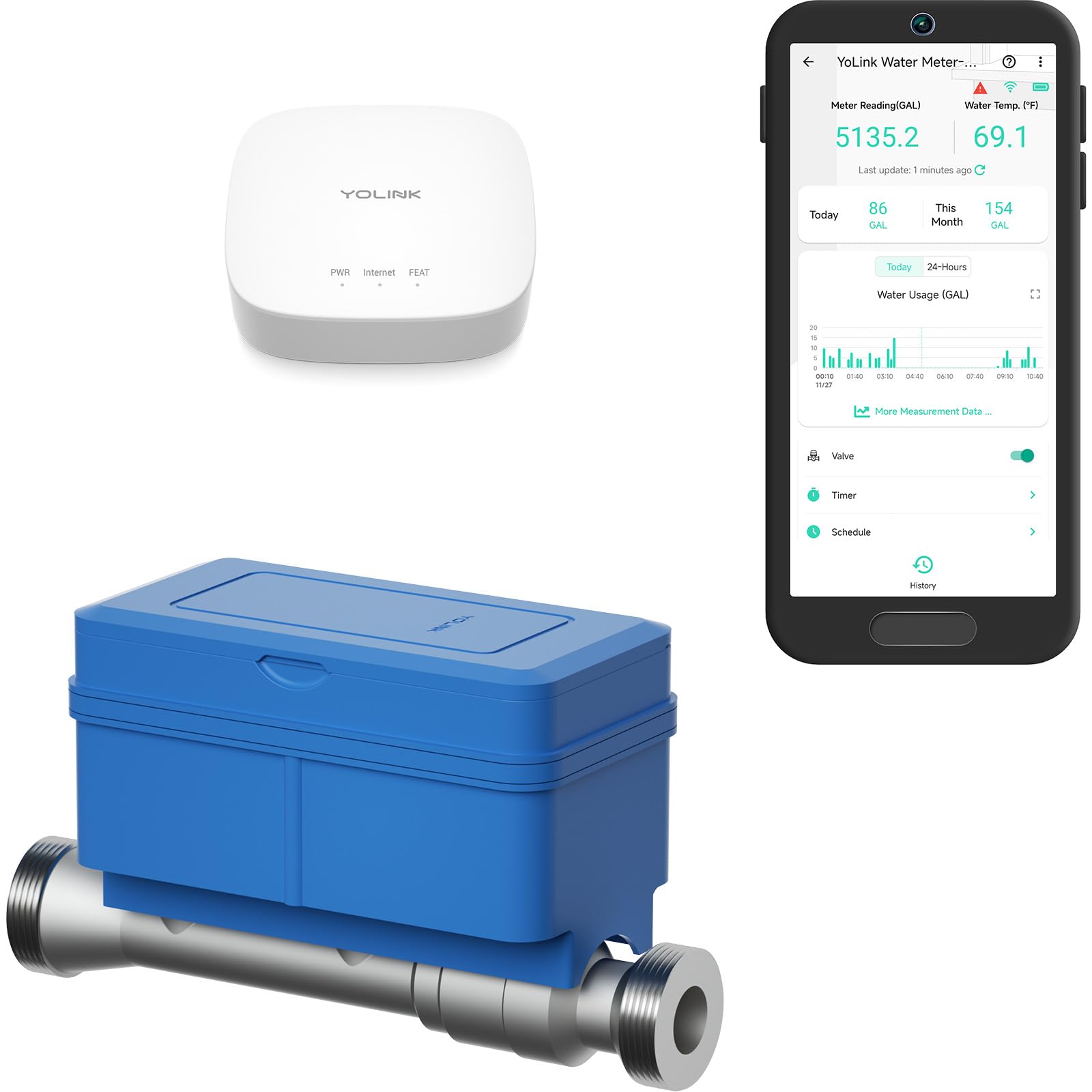
A flow meter that keeps talking to your phone from two thousand feet away and never asks for a new battery.
The number that decides this one is 2034 feet — the maximum reach of YoLink’s LoRa radio (a low-power long-range signal built for whole-home and building coverage). That matters because water mains usually live in the worst possible spot for a router: a basement corner, a crawlspace, a detached garage. Wi-Fi drops to nothing back there. This signal does not. If your meter is anywhere awkward, the range alone makes the case.
The power system is the second reason it takes the top spot. It runs on one included lithium battery in a design built for multi-year operation, up to 10 years by YoLink’s own spec. Practically, that means the device is still armed during the kind of storm that knocks your power and internet out — which is exactly when a burst pipe happens. The included hub ties it into Alexa, IFTTT, and Home Assistant, and device-to-device rules keep critical shutoff actions running offline.
You set the rules yourself: in the app you enter a maximum water volume and a maximum continuous running time, and the motorized valve (a valve that closes itself) shuts off when either limit is passed. FlowSmart does not learn your habits or work out what looks abnormal on its own — you teach it what normal looks like. Buyers consistently cite build quality and long-term reliability as the reason it earns its place. The box holds one hub and one water meter; the “2 Pack” label counts those two items, not two meters.
Where the FlowSmart pulls ahead
- LoRa radio rated up to 2034 feet, so distance from the router stops being a problem
- Up to 10-year battery design keeps protection alive through outages
- Six pipe sizes from 1/2″ to 2″, so most whole-house mains can be fitted
- Integrated ultrasonic meter and motorized shutoff valve in one NSF-certified unit
What you should know going in
- You must set your own volume and run-time limits; it will not figure out your usage on its own
- Needs the included YoLink Hub, so it is a two-piece install rather than a standalone gadget
Reach for this if: your main line sits far from your router, or you want a device that keeps guarding the house for years on one battery.
Look elsewhere if: you would rather the alarm learn your household’s habits than program the limits yourself.
2. Frizzlife LP365 Smart Water Monitor
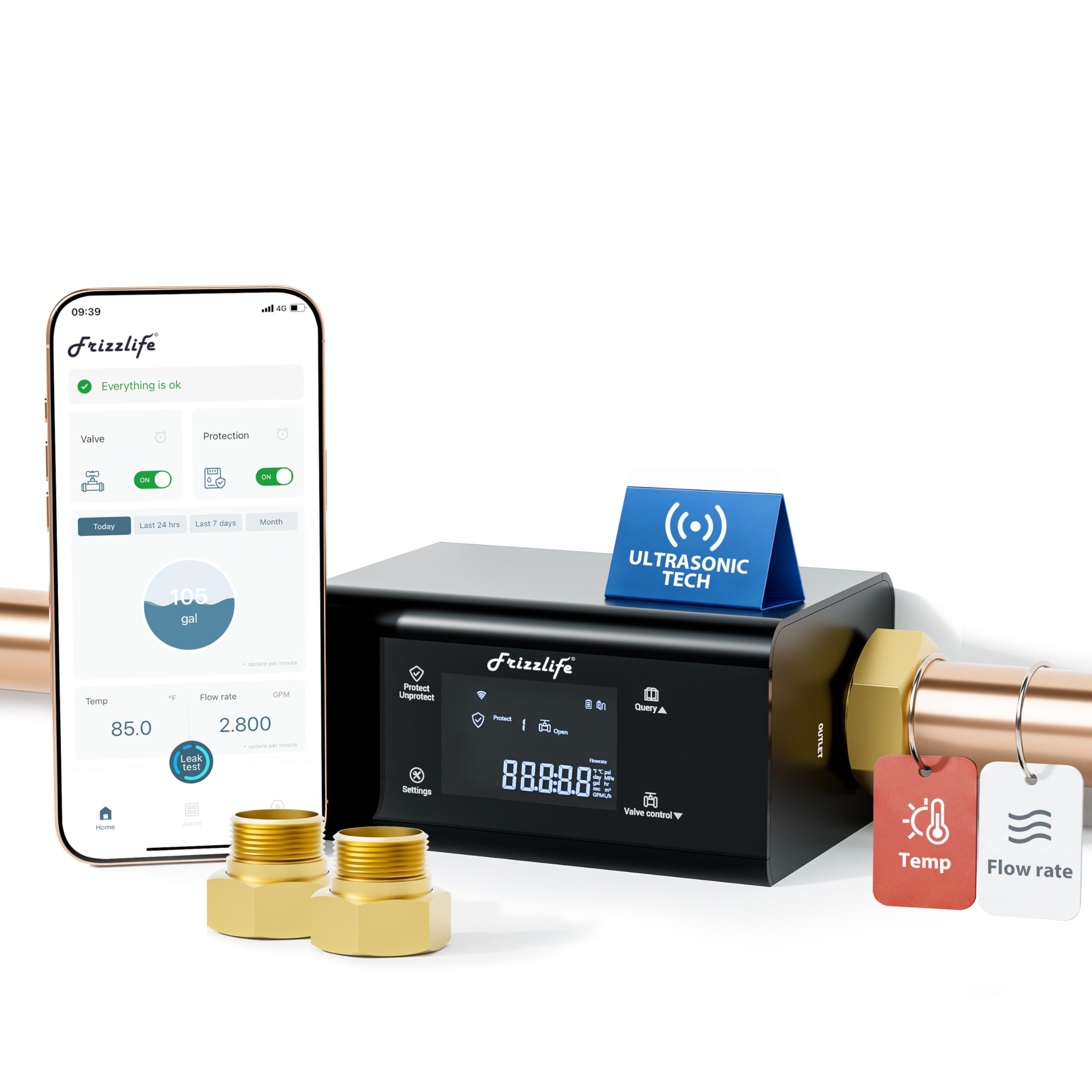
Built to feel a trickle of 0.01 gallons a minute — the slow drip that quietly rots a cabinet floor.
The LP365 earns its spot with ultrasonic sensing (it listens to sound waves in the water instead of just checking flow or no-flow). It reads down to 0.01 gpm (gallons per minute — a slow, steady trickle, not an open burst). A leaking toilet flapper never floods anything, but it shows up on your water bill month after month. This device is built to notice that size of loss and flag it.
Then it goes further than most: alarm and notifications arrive by SMS, phone call, and app, and it closes the valve rather than waiting for you to act. You can also close that valve yourself from the “Smart Life” app while on vacation or at work, with live flow rate, temperature, and pressure on screen. Daily and monthly usage reports are there too, along with the option to link it to other smart devices. It fits 1-inch and 3/4-inch pipes, comes with the adapters, plumbing tape, plug, and a 6.6-foot power cable, and it is NSF/ANSI 61 & 372 certified for potable water.
Installation is the spot where owners get split. The device needs to be plugged in to be networked, and professional installation is recommended for best results, though the app and setup are widely described as clear and straightforward. Connectivity and app usability are the mixed notes in owner feedback, so plan for a plug-in install near your main if you are not comfortable working around a water line. Run the built-in “LEAK TEST” function in the app to confirm the valve and alerts trigger properly before you rely on it.
Why it earns a second look: the 0.01 gpm sensing floor is the finest leak detection on this page, and valve closure happens on its own rather than waiting on you. Combine that with 24/7 reports and a phone that can shut the main from anywhere, and it covers both the slow drip and the sudden burst.
The honest catch: it is the fussier install of the two, it needs mains power to stay connected, and its overall footprint is larger than the YoLink assembly. Plan for a permanent spot near a socket.
The right call for: households who want to catch slow, bill-inflating drips and have someone comfortable with a plug-in install near the main.
Think twice if: your meter sits far from a power outlet or deep in a basement corner where Wi-Fi already struggles — the YoLink’s radio carries further.
Know the Specs
Flow Sensitivity (gpm)
GPM stands for gallons per minute and tells you how much water is moving past the sensor. A lower detection threshold means the alarm notices smaller leaks — a leaking toilet flapper or a pinhole in a supply line — instead of only reacting to an open burst. The Frizzlife reads down to 0.01 gpm, which is why it can catch a drip most sensors ignore entirely. If you mainly worry about a burst pipe, a 0.01 gpm threshold matters less; if you worry about a climbing bill from slow drips, it matters a lot.
Shutoff Valve vs. Alert Only
An alarm that only notifies you is a warning. An alarm with a motorized valve is a solution. Both picks here pair ultrasonic flow sensing with a valve that closes the line automatically or on command from the app. The YoLink closes when a limit you set is exceeded; the Frizzlife closes when it detects a problem and you can also close it yourself remotely. If you travel or leave the house for long stretches, choose a motorized shutoff valve, not an alert-only notifier.
Radio Reach and Battery Life
Wi-Fi is designed for rooms with a router in them, not for a meter in a basement corner. LoRa is a low-power long-range radio built for exactly that problem — the YoLink rates up to 2034 feet of reach, versus the Frizzlife’s Wi-Fi link that requires the device to be plugged in. Battery design also matters: the YoLink is built around a multi-year battery, the Frizzlife carries battery backup for outages but runs on mains power. Choose the technology that fits where your main line actually lives.
Pipe Fit and Certification
The device goes inline with your main, so pipe diameter decides whether it installs at all. The YoLink offers six sizes from 1/2″ to 2″; the Frizzlife covers 3/4″ and 1″. Both are certified for potable water — the YoLink is NSF certified and the Frizzlife holds NSF/ANSI 61 & 372 certification. Measure your main before ordering, and if your pipe is an unusual diameter, confirm the fit rather than assuming.
Common Questions
Will a water flow alarm work with my pipe size?
What is the difference between an alert-only alarm and an automatic shutoff valve?
How does ultrasonic flow detection differ from a standard leak sensor?
Does the Frizzlife LP365 still protect the house during a power outage?
How far can the YoLink FlowSmart signal reach?
Do I have to set the YoLink shutoff limits myself?
Is the Frizzlife LP365 certified for drinking water?
How do I test that my flow alarm actually works?
Can I close the water remotely while I am away?
What is included in the YoLink kit — one meter or two?
The Bottom Line
For most homes, the water flow alarm worth installing first is the YoLink FlowSmart All-in-One Kit. Its LoRa radio (a long-range, low-power wireless signal) reaches up to 2034 feet, and its up-to-10-year battery design keeps the valve armed through power outages. Those are the two things that most often decide whether a flow alarm still works when a pipe finally gives. If fine leak detection is what you are after, the Frizzlife LP365 reads flow down to 0.01 gpm and lets you close the main from your phone, which catches the slow drips the YoLink’s limit-based logic could miss. And if your main line sits a short cable run from an outlet in a well-covered Wi-Fi zone, the Frizzlife fits that setup neatly. Either way, buy the valve model, not the notifier — a closed pipe is the only alarm that actually stops a flood.
How we choose
We do not accept paid placement. Every pick is matched to a real buyer and a real use-case; we do not hands-on test units.
Sources
Specifications: manufacturer listings and product documentation. Review insights: verified customer reviews, as of November 2026. Pricing: not shown on this page (it changes often); check the current price via the retailer link.
As an Amazon Associate, Tactical Gear Guy earns from qualifying purchases. This does not affect which products we feature.