Specs are compiled from manufacturer listings and verified buyer reviews and can change over time — please confirm the key details on the product page before buying.
You put the tip near the wire, and a red glow plus a beep tells you whether it is live before your fingers go anywhere near it. That is the whole job of a non-contact voltage tester (a pen that senses live voltage without touching metal), and the difference between a good one and a bad one is simple: it should beep on the live wire and stay quiet on the dead one, every single time. Below you get nine picks, sorted by what they actually do best, so you can choose the one that matches your work rather than the loudest box on the shelf.
This guide is built by comparing the manufacturers’ published specifications and the patterns across verified customer reviews, so you get each pick’s real strengths and trade-offs instead of marketing spin.
Some of these pens read AC mains voltage (the 120/240-volt household current), while a few are built for the 3 to 28 volt DC wiring in a car or truck (the low-voltage battery current). Knowing which side of that line your job sits on is most of the decision. The rest is if you want adjustable sensitivity, a flashlight, or a silent mode for quiet rooms — the details this wireless test light breakdown spells out pick by pick.
Top Picks

How To Choose The Best Wireless Test Light
The first question is not which brand — it is AC or DC. An AC tester is built to sense household and commercial mains power, so it lights up near a live outlet, switch leg, or breaker feed. A DC cordless tester is built for battery-powered circuits in cars, trucks, and motorcycles, where the voltage is far lower and the tester clips or probes a wire instead of hovering near it. Buy the wrong one and it will either never beep or give you answers you cannot trust on the job you are doing.
Match the voltage range to the work in front of you
Each tester only reacts inside a stated band. A tester rated 90 to 1000 volts AC will not help you on a 24 volt control circuit, and one rated 24 to 600 volts AC has its own ceiling. Read the range printed on the body and check it covers the lowest voltage you actually work with, not just the highest. If you bounce between automotive 12 volt wiring and household AC, you genuinely need two different tools rather than one pen stretched across both.
Adjustable sensitivity earns its keep in crowded boxes
A fixed-sensitivity pen beeps at anything nearby, which is fine on a single loose wire and frustrating inside a junction box packed with neutrals and grounds. An adjustable dial lets you turn the sensitivity down until only the wire you are chasing triggers it. That dial is the difference between pinpointing one wire and beeping at every neutral in the box.
CAT ratings and self-test tell you how much to trust it
The CAT number on the body tells you what electrical environment the tester was built and rated for — CAT IV sits at the highest category listed here. Just as important is a continuous self-test: the better pens check their own circuitry while they sit in your pocket, so a dead unit cannot quietly tell you a live wire is safe. Never treat a silent tester as proof unless you have confirmed it works on a known live source first.
Silent mode, flashlight, and the small stuff
If you work in an office, hospital, or school, a beeper is a nuisance, so a silent or vibrating alert matters. In a dim basement or under a dashboard, a built-in flashlight earns its place. A pocket clip and a slim profile decide whether the tester is actually on your belt when you need it — and the tester you carry is worth more than the better one left in the truck.
Side-by-Side Comparison
| Model | Best For | Voltage Range | Type | Alert Style | Amazon |
|---|---|---|---|---|---|
| Fluke 1AC II VoltAlert★ Best Overall | Overall AC safety pen | 90–1000V AC | Non-contact AC | Red glow + beeper | Amazon |
| Santronics 3115Best for Quiet Rooms | Quiet rooms, slim carry | 50–1000V AC | Non-contact AC | Silent visual | Amazon |
| Southwire 40126NBest Low-Voltage Reach | Low-voltage AC hunting | 24–600V AC | Non-contact AC | Audible + visual + flashlight | Amazon |
| Santronics 3000 | No-button always-on | 50–1000V AC | Non-contact AC | LED + loud beep | Amazon |
| Sperry VD6505 | Adjustable sensitivity | 12–1000V AC | Non-contact AC | 360° visual + beep | Amazon |
| GTC CT8002 | Computer-safe DC testing | 3–28V DC | Cordless DC | LED + audio + vibration | Amazon |
| Wiha 25506 | Wide-range AC with light | 12–1000V AC | Non-contact AC | LED + audible | Amazon |
| K Tool XDCHT504 | Auto and truck DC circuits | 3V DC and up | Cordless DC | Dual-colour LED + beep | Amazon |
| ATD 55033 | Heavy-duty DC shop use | 3–30V DC | Cordless DC | Visual + audible | Amazon |
Detailed Reviews
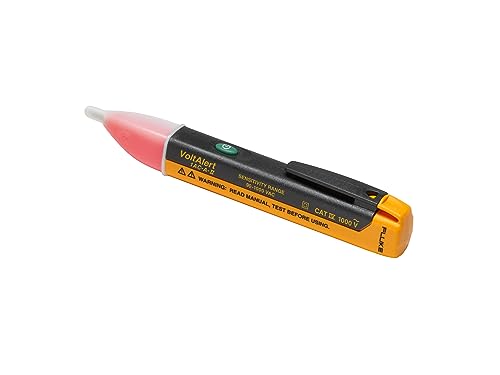
1. Fluke 1AC II VoltAlert Non-Contact Voltage Tester
Our pick — 4.5+★ from 15,500+ verified ratings; the strongest balance of quality and price.
The pen that glows red and beeps before you ever touch a wire — and checks itself while it waits in your pocket.
This is the pick for someone who wants one AC tester to trust for years: the tip lights red and a beeper sounds the moment it senses voltage between 90 and 1000 volts AC. The range is the story — it reaches from ordinary household outlets all the way up to 1000 volts, so the same pen you use on a light switch also covers commercial panels. And it runs a continuous self-test the whole time, so the unit is verifying its own circuitry rather than quietly going dead on you.
You also get a genuine choice of alert, not just one. Audible mode gives you the beep when you want it; silent mode leaves you with the glowing tip alone for a quiet room or a client’s office. The CAT IV rating on the body tells you what environment it was built for — the highest safety category in this lineup — and that is exactly the number a working electrician checks first.
Here is the honest catch: the review pages show accuracy is the one split topic, with a share of owners reporting it will not pick up live 110 volt current in their situation. Sizing that fairly, the tool carries a 4.5+ star score from 15,000+ ratings, so the overwhelming read is positive — but the practical habit it teaches is real. Prove the tester on a known live circuit before you trust a quiet reading on a wire you are about to cut. If you want a tester whose range starts far lower and costs less, the Southwire below is the other direction to look.
What the Fluke does well
- Detects 90 to 1000 volts AC, so one pen covers household and commercial work.
- Continuous self-test runs on its own, catching a failing unit before it misleads you.
- Switchable audible or silent alert suits both a loud panel room and a quiet office.
- CAT IV rating puts it in the top safety category of this group.
Where it asks more of you
- Its 90 volt floor means it will not help on low-voltage control circuits.
- Accuracy draws some disagreement on the review pages; verify on a live source first.
Pick this for: household and commercial AC troubleshooting where a self-testing CAT IV pen is the whole point.
Look elsewhere if: your work lives below 90 volts — the Southwire’s lower floor fits that better.
2. Santronics 3115 AC Voltage Sensor
A silent, slim AC detector that slides into a tool belt and never beeps in a hospital corridor.
Picture the job where a beeping pen is a problem: an office, a hospital ward, a school at assembly. This Santronics answers with light only — no beeper at all — and still reads voltage across a 50 to 1000 volt AC band. That range starts at 50 volts, lower than the Fluke’s 90 volt floor, which means it will respond on the lower AC circuits the Fluke stays quiet on.
It fits most tool belts without bulk, and at 39.7 grams it barely registers on your hip. The body is high-impact, non-flammable polycarbonate (a tough plastic that resists drops and won’t catch fire), so it is a tool meant to be carried and knocked around rather than stored in a drawer. Buyers report quality as the trait that wins them over most, with accuracy right behind — the pattern across feedback is a pen that reads true and does not cry wolf on a dead wire.
Two fit notes to weigh. First, the battery compartment draws some mixed feedback, so treat the hatch gently when you swap cells rather than cranking it down. Second, durability was the one topic that ran negative in the feedback, which is worth knowing if your tester lives loose in a bag with wrenches. Mount it on a belt or clip it, and the electronics that owners rate so highly are the part you will actually notice day to day.
Why it earns its slot: the silent operation plus the 50 volt floor is a combination none of the other AC pens here offer together.
Pair it with care: a belt clip keeps it off the bottom of a tool bag, where the mixed durability feedback says it should not live.
Your pick if: you need voltage detection that will not disturb a quiet room and will still catch lower AC circuits.
Think twice if: your tester gets thrown loose into a packed bag every day.
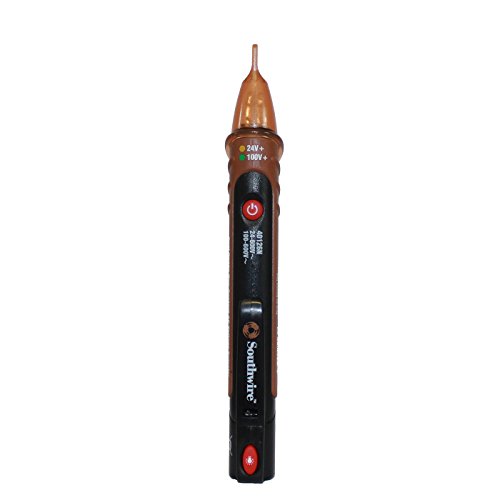
3. Southwire 40126N NCV Non-Contact Voltage Detector
The low-voltage hunter with a flashlight built into the tip for dim panels.
The number to start with on the Southwire is 24. That is the bottom of its detection band — 24 to 600 volts AC — against the Fluke’s 90 volt floor. If your work includes low-voltage AC control circuits, that lower start is the reason to choose this pen over the best overall pick. It also packs dual flashlights and a visual and audible alert, so a dark basement or a shadowed panel is not a problem.
It slips into a pocket and goes anywhere: the Southwire lists at 1 x 1 x 1 inches versus the Fluke’s 10.24 x 7.5 x 1.46 inches. Buyers talk about functionality almost as much as quality, and the built-in flashlight earns its own quiet following for checking outlets in tight corners. Auto shut-off also protects the battery, so a pen left on in a pouch is not a pen that is dead next week.
The trade-off is the ceiling. At 600 volts AC this is not the tester for industrial panels that run higher, and the Fluke’s 1000 volt top end covers that territory instead. For home wiring, GFCI outlets, and controls, the range is more than enough. That is a fit question, not a flaw — pick by the highest AC voltage you expect to meet on the job.
The right call when: your circuits run low and you want a torch built into the tester.
Step up instead if: you work near industrial voltages above 600 volts AC.
4. Santronics 3000 Non-Contact Voltage Tester

No switch to forget, no button to break — it is ready the moment you pull it from your pocket.
The whole idea here is that there is no on or off switch at all. You cannot grab a dead tester because there is nothing to leave off — it checks the instant you draw it, and it reads voltage from 50 to 1000 volts AC. A bright LED and a clear beep confirm what you found, so you get sight and sound together in a dim basement or a noisy site.
There is nothing to forget or fumble because the pen has no buttons, and buyers discuss that simplicity more than almost anything else. It is calibrated to pick the right wire out of a crowded junction box without false positives from a nearby neutral or ground (the return and safety wires). The body is non-flammable high-impact polycarbonate rated to CAT IV (a safety rating for high-voltage work), built for drops and rough tool bags rather than a drawer. And it is designed and made in the USA by a company that has been engineering non-contact testers in the States for over 30 years, according to the maker.
Two fit notes. The beep is genuinely loud — owners split on whether that is a help or a nuisance, so it is not the pen for a whisper-quiet room. Sensitivity also drew some mixed notes, so prove it on a known live wire before trusting a quiet read. Neither dents the case: at 4.5+ stars from 500+ ratings, this is a tester most buyers keep and keep using.
The design win: no button means no dead tester, which is the single most common way a voltage pen lets you down.
The loud side: the alert is meant to be heard on a job site, so a quiet office is not its home.
Go for it if: you want a CAT IV AC pen you cannot accidentally leave switched off.
Choose differently if: a loud beep is a problem where you work.
5. Sperry Instruments VD6505 Voltage Sensor

A dial you can turn down until only the wire you are chasing trips the alarm.
If you have ever stood over a junction box stuffed with neutrals and grounds, watching a fixed tester beep at every one of them, the Sperry dial is your answer. It detects 12 to 1000 volts AC, and the adjustable non-contact sensitivity lets you tune it to the wire you actually care about. The band starts at 12 volts, the lowest AC floor on this list, so it reaches into control work the others skip.
The build is meant for a working bag: hi-impact ABS housing with soft over-molded rubber grips, a pocket clip, and ratings of 250 lb crush and a 10 ft drop. It also has a patented battery self-test, which is the feature that stops a dead battery from quietly feeding you a false all-clear. Functionality is the thing that wins people over most, and value for money follows it — this is a tester that earns its place by doing the everyday job well.
Where it asks patience is the sensitivity dial itself. Feedback is divided — some find it genuinely useful, others find it finicky — and a handful note the button can be sluggish. It still holds 4.0+ stars from a large owner base, so treat the dial as a learning curve rather than a fault. Learn where the dial likes to sit, and it picks the right wire out of a crowded box.
What earns it a slot
- Adjustable sensitivity keeps nearby neutrals from crying wolf in a crowded box.
- 12 volt floor reaches into low AC control work.
- Rated to 250 lb crush and a 10 ft drop for a life in a tool bag.
- Patented battery self-test guards against a dead-cell false all-clear.
What to expect
- The sensitivity dial has a learning curve and draws divided feedback.
- The button can feel slow to some hands.
Tailored for: chasing one specific wire through crowded, low-voltage AC work.
Not the fit if: you want a zero-learning-curve beep-and-go pen.
6. General Technologies Corp GTC CT8002 Cordless Circuit Tester

Built for car wiring — cordless, no ground clip, and gentle on sensitive control modules.
This is not an AC pen. The GTC reads DC voltage from 3 to 28 volts, the range where car, truck, and motorcycle wiring lives. You do not need a ground wire or a clip, so you probe a single point and get your answer — no wrestling with a second lead under a dashboard. When it finds a positive voltage it alerts three ways: a light, a sound, and a vibration, so a noisy shop bay or a dark footwell will not hide the answer.
The feature that matters most on modern vehicles is the current draw: 20 micro-amps. Stainless steel construction and a safety V-groove tip accessory back it up. Functionality is the whole story here — this pen does its one job and does it — and owners clearly rate it on that basis.
The honest limit is scope. If you also need to check household AC outlets, this tester will not do it; you would be pairing it with an AC pen like the Fluke above. It runs on a single included AA alkaline battery, so a dead cell is fixed at any counter. Buy it for 3 to 28 volt DC vehicle circuits, not as a cheap substitute for an AC pen.
Why it is different: 20 micro-amps of draw is what makes it safe around a car’s electronic control modules.
The scope limit: DC only — this is a vehicle tool, not a household AC tester.
For the auto bay: probing 3 to 28 volt DC circuits in cars, trucks, and bikes without a ground clip.
Not for the house: it will not read AC mains at all.
7. Wiha Non-Contact Voltage Tester 25506

A wide 12–1000 volt AC band with a flashlight and a universal measurement tip.
The Wiha covers a lot of ground: 12 to 1000 volts AC, CAT IV rated, with the LED in the plastic tip glowing red as it sounds its warning. That 12 volt floor matches the Sperry’s for the lowest reach on this list, while the 1000 volt ceiling matches the Fluke’s. In one pen, it spans everything from low AC control circuits to the top of the household and commercial range.
It also has a built-in light for dim work and a universal measurement tip for use abroad. Ease of use is what owners talk about most, and on paper it is a do-a-lot pen for the price. The build quality is where the honest note lands — the quality and reliability feedback is genuinely mixed, and there are reports of units that stop working. It is not a brand-level verdict, just a pen where consistency is the one question mark.
So run it the way you should run any tester: prove it on a known live circuit before you trust a silent read, and keep the receipt. The score sits at 4.0+ stars from a few hundred owners, so most get on fine — but this is a pen best treated as a working tool that earns trust each day rather than a set-and-forget guarantee.
Worth a look if: you want a 12–1000 volt AC pen with a light and a travel-friendly tip in one tool.
Bear in mind: mixed reliability feedback means you should confirm it on a live source regularly.
8. K Tool International XDCHT504 Cordless Circuit Tester
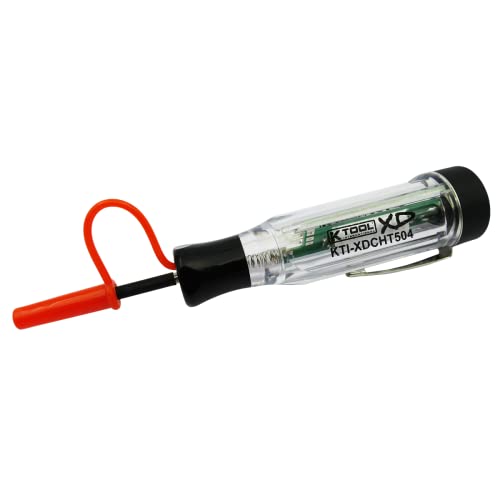
Red and green LEDs tell you power from ground at a glance on a car circuit.
This one is built for automotive work: quick DC voltage detection on cars, trucks, and motorcycles, with red and green LEDs telling you power versus ground. That polarity read is the part worth owning it for — it sorts a reversed circuit out on sight instead of making you reason through it. A beep backs up the light so you can keep your eyes on the probe, and it runs cordless on a built-in 3.6 volt lithium battery with no external power needed.
The handle has a pocket clip and a hi-vis orange safety tip protector, so it stays visible and close in a busy bay. Owners rate its functionality as the clear standout — it does the everyday probing job, and that is the job it was made for. The value question draws some mixed notes, so weigh it on the tool it is rather than on cost alone.
Keep the scope in mind. This is a DC tester for vehicle circuits, not an AC outlet pen — if your work is household wiring, look to the Fluke or the Santronics 3000 instead. If your shop hours are spent under a dash, the dual-colour polarity read makes this a sensible day-to-day tool.
Reach for it when: you want a fast red-and-green power-and-ground read on vehicle circuits.
Pass if: you need to test AC mains outlets.
9. ATD Tools Cordless Circuit Tester ATD-55033

A rugged shop-floor DC tester for the 3 to 30 volt circuits under a hood.
ATD’s cordless tester is aimed at the working shop. It reads DC from 3 to 30 volts — a band that reaches a touch higher than the GTC’s 28 volt top end — and runs on a battery without the hassle of a ground lead. It is a sturdy, no-frills DC probe for quick checks on a battery, a light, or a relay feed.
It holds a 4.0+ star score from several hundred owners, and the role it fills is clear: a heavy-duty DC probe for the vehicle bay. What you get is a cordless tester for the low DC voltages in cars and trucks. If your day is spent under a hood, this is the DC tester to keep on your hip.
The honest note is scope, the same one that applies to every DC pick here: this will not read household AC, and its 30 volt ceiling caps it at vehicle and low-voltage DC work. If you split your time between a truck and a house, you will want an AC pen alongside it. For automotive DC checking at 3 to 30 volts, it probes a single point with no ground lead and nothing to learn.
The role it fills: a rugged cordless DC tester for 3 to 30 volt vehicle circuits, no ground lead required.
One scope note: 30 volts is the ceiling, so this is an under-the-hood tool only.
Best matched to: shop-floor DC testing on cars and trucks at 3 to 30 volts.
Look on if: you want one tester that also handles AC outlets.
Know the Specs
Voltage range and why the low end rules
The range printed on a tester is two numbers: the lowest and highest voltage it will react to. A pen rated 90 to 1000 volts AC simply will not trigger on a lower circuit, so the bottom number decides whether a tester can see your work at all. Match that low end to the smallest voltage you handle — the Sperry and Wiha start at 12 volts AC, the Santronics pens at 50, and the Fluke at 90 — and remember the DC tools sit far lower, at 3 to 28 or 30 volts DC (car and truck battery levels).
CAT ratings and self-test
The CAT number is the safety category a tester was built and rated for — CAT IV is the highest listed here, which is why it appears on the Fluke, Santronics 3000, Wiha, and Sperry bodies. A continuous or patented battery self-test is the other half of trust: it verifies the unit’s own circuitry so a dead tool cannot quietly tell you a live wire is safe. Combine both with the old habit of proving the pen on a known live source, and a silent reading means something.
Common Questions
Will a non-contact voltage tester work on a car’s 12 volt wiring?
What does the CAT rating on the body actually mean?
Why do some testers start at 90 volts and others at 12 volts?
How do I know my tester is actually working?
Is an adjustable-sensitivity tester worth it over a fixed one?
What is the difference between the GTC CT8002 and the K Tool tester?
Can I use a voltage pen to find a live wire behind drywall?
Does a silent voltage detector work in a hospital or office?
Will a non-contact tester detect voltage through insulation?
Should I carry one tester or a DC and an AC pen?
The Bottom Line
For most household and commercial work, the wireless test light to reach for is the Fluke 1AC II VoltAlert — a 90 to 1000 volt AC pen with a continuous self-test (it checks itself while on), CAT IV rating (a safety rating for high-voltage work), and switchable audible or silent mode. It is the one that makes a quiet reading mean something. If quiet rooms and lower AC circuits matter more, the Santronics 3115 gives you silent light-only detection starting at 50 volts. And if your work is under a hood, not in a panel, the GTC CT8002 is the computer-safe DC pick for 3 to 28 volt circuits. Whatever you choose, prove it on a known live source before you trust a silent beep.
How we choose
We do not accept paid placement. Every pick is matched to a real buyer and a real use-case; we do not hands-on test units.
Sources
Specifications: manufacturer listings and product documentation. Review insights: verified customer reviews, as of November 2026. Pricing: not shown on this page (it changes often); check the current price via the retailer link.
As an Amazon Associate, Tactical Gear Guy earns from qualifying purchases. This does not affect which products we feature.