Specs are compiled from manufacturer listings and verified buyer reviews and can change over time — please confirm the key details on the product page before buying.
You want a blood pressure number you can trust without wrestling a stiff upper-arm band every morning. A wearable blood pressure cuff wraps around your wrist instead, inflates on one button press, and stores your readings so you can spot a trend before your next appointment. The catch: wrist monitors are far more sensitive to arm position, so a poor fit or sloppy posture hands you numbers that jump around. This guide sorts the current wrist units by what actually matters — cuff fit, memory, and how well each one holds a steady reading.
This guide is built by comparing the manufacturers’ published specifications and the patterns across verified customer reviews, so you get each pick’s real strengths and trade-offs instead of marketing spin.
Below you’ll find nine wrist-worn monitors ranked by accuracy signals, cuff range, and everyday usability, with a full breakdown of how each one handles a reading. Here is the honest shortlist of the best wearable blood pressure cuff options you can strap on today.
Top Picks

How To Choose The Best Wearable Blood Pressure Cuff
A wrist monitor is only as good as its cuff fit and your posture when you take the reading. Nail cuff fit and heart-level posture and a wrist unit tracks close to an arm cuff. Get them wrong and even a well-built device throws numbers that drift. Here’s what to check before you buy.
Measure your wrist before anything else
Every wrist monitor lists a fit range in inches, usually something like 5.3″ to 8.5″. A cuff that’s too loose lets air escape unevenly, and one that’s too tight pinches the artery. Both distort the reading. Measure the circumference of your wrist with a tape before you shop, then only consider monitors whose range covers it.
Heart-level positioning is not optional
On an arm cuff, height matters less. On a wrist cuff, your wrist has to sit at the same level as your heart or gravity shifts the pressure the sensor reads. Most good monitors either remind you or show a resting indicator before they’ll take the measurement. Take the reading seated, back supported, feet flat, and wrist resting at chest height.
Memory banks keep a real record
One reading is a snapshot; a week of timestamped readings gives your doctor a trend to work with. Look at how many readings each user can store and whether there’s a date and time stamp. Dual-user support matters in a shared household so two people’s histories don’t blend into one confusing log.
Bluetooth is a bonus, not a must
An app that logs unlimited readings helps you share reports with your doctor. But pairing problems are among the most common gripes on wrist monitors, so treat Bluetooth (a short-range wireless link to your phone) as a nice extra rather than the reason to buy. A monitor that stores and averages readings on-device needs no phone at all.
Side-by-Side Comparison
| Model | Best For | Cuff Fit Range | Stored Readings | Weight | Amazon |
|---|---|---|---|---|---|
| Smartheart Adult Cuff Wrist Digital BP Monitor★ Best Overall | Budget one-button checks | 5.5″ – 7.6″ | 60 per user (2 users) | 4 oz | Amazon |
| A&D Medical UB-543Travel Ready | Travel and quick self-checks | 5.3″ – 8.5″ | 60 per user (2 users) | 3.6 oz | Amazon |
| iHealth Pulse Bluetooth Wrist MonitorLongest Memory | Long memory history on-device | 5.5″ – 7.7″ | 199 per user (2 users) | 7.05 oz | Amazon |
| Beurer BC57 Bluetooth Wrist Monitor | Lightweight daily tracking | 5.3″ – 7.7″ | 60 per user (2 users) | 3.39 oz | Amazon |
| FDA Cleared Wrist BP Cuff Machine | Dual power and backlit display | 5.3″ – 7.7″ | 99 per user (2 users) | 7.41 oz | Amazon |
| Portable Wrist Monitor with Voice Readings | Older adults who prefer audio | — | 120 per user (2 users) | 3.6 oz | Amazon |
| Herz P1 Wrist Blood Pressure Monitor | Big numeral display for seniors | 5.3″ – 8.5″ | 120 per user (2 users) | 8.82 oz | Amazon |
| Digital Wrist BP Monitor (DR. VALERE) | Voice guidance and motion filtering | — | 120 per user (2 users) | 3.6 oz | Amazon |
| OMRON Gold Wireless Wrist Monitor | Most-reviewed, app-connected tracking | 5.3″ – 8.5″ | 200 per user (2 users) | 3.17 oz | Amazon |
Detailed Reviews
1. Smartheart Adult Cuff Wrist Digital Blood Pressure Monitor
Our pick — 4.0+★ from 250+ verified ratings; the strongest balance of quality and price.
The wrist monitor that takes the reading while the cuff is still filling, so you spend less time squeezed.
What wins people over here is how little effort a reading takes. Press one button and the Smartheart inflates and deflates entirely on its own, then flashes your numbers on a backlit LED screen you can read in a dim bedroom. Each of two users gets a memory bank holding up to 60 measurements, complete with a date and time stamp so you can see when each reading was taken, plus a last-reading average that smooths out one-off spikes.
The clever bit is the inflation method. This monitor measures your blood pressure while the cuff is filling rather than after it peaks, which shortens the time your wrist sits under pressure. That’s a small comfort win on every single check, and it matters if you find the squeeze unpleasant.
Now the honest catch, and it’s a real one. Accuracy is the split opinion in this unit’s feedback, and the quality picture is genuinely mixed — some buyers report readings that land far off. Cuff fit is narrow too, rated for wrists from 5.5″ to 7.6″, and the maker itself notes that anyone outside that band should look at an arm monitor instead. The packaging includes the monitor with its cuff attached, a storage case, batteries, English and Spanish instructions, a results log, and a 3-year limited warranty.
What earns it the top spot
- Automated inflation and deflation from a single button press
- Two memory banks with 60 measurements each plus date and time stamps
- Reads during inflation, cutting the time your wrist is compressed
- Complete kit with case, batteries, log, and a 3-year limited warranty
Where it asks you to be careful
- Accuracy feedback is genuinely mixed, so treat it as a trend tool
- Cuff covers 5.5″ to 7.6″ only — measure before you buy
- No Bluetooth, so your log lives on the device itself
Straight answer: The pick for a two-person household that wants a fuss-free wrist reading and a long warranty without app setup.
Think twice if: Your wrist falls outside 5.5″ to 7.6″ or you want your numbers auto-synced to a phone.
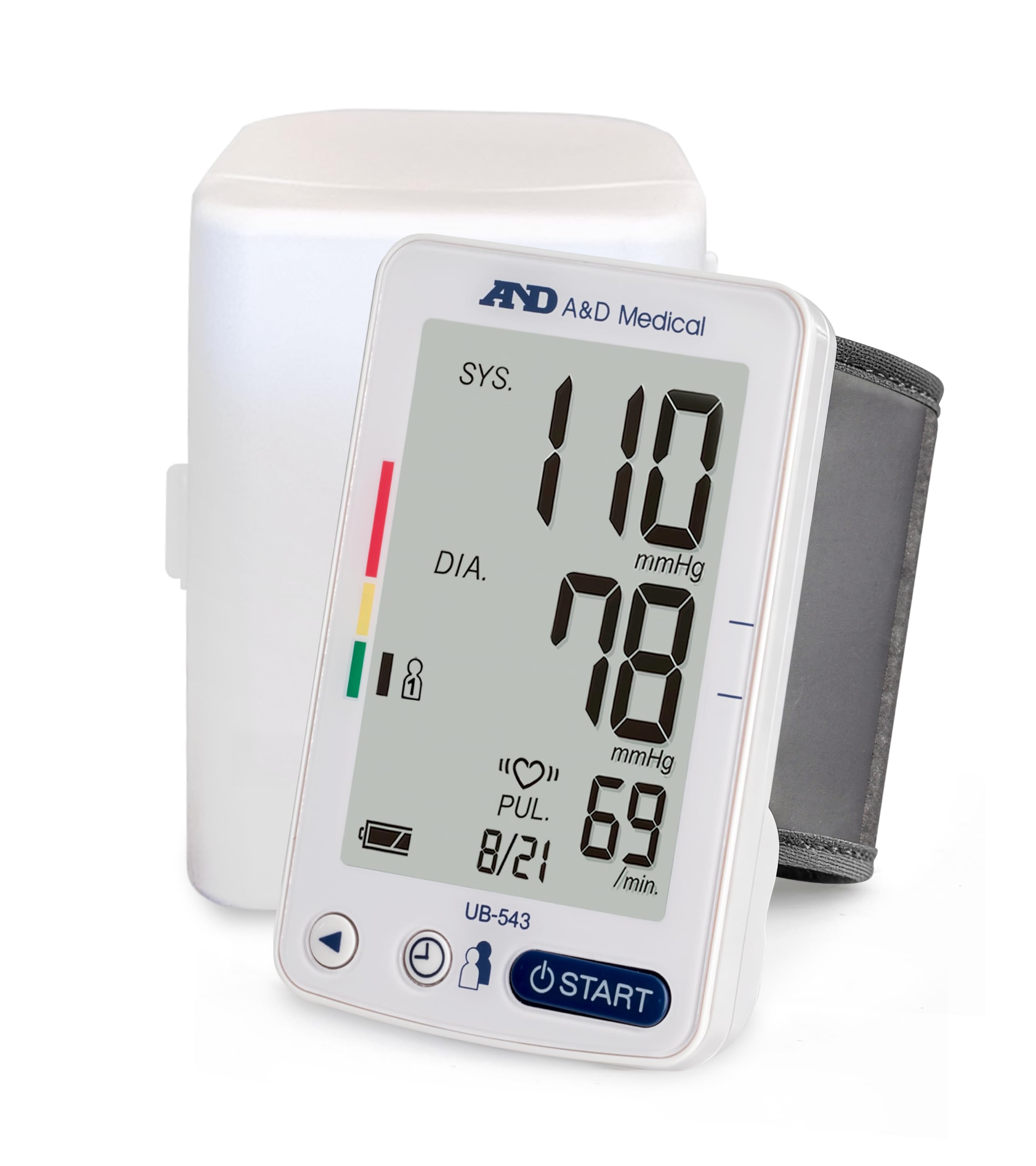
2. A&D Medical UB-543 Wrist Blood Pressure Monitor
A cuff that opens up to 8.5 inches, so bigger wrists finally get a monitor that fits properly.
Larger wrists are the number-one reason people get bad wrist readings, and this one stretches to cover wrists from 5.3″ up to 8.5″ (13.5 to 21.5 cm). It holds 60 readings per user for two users, and each memory entry carries a pulse reading alongside systolic and diastolic numbers. The oversized LCD uses big numerals, which makes reading pulse rate and both pressure figures easy without hunting for glasses. It ships with two AAA batteries, a carrying case, and quick-start instructions.
Portability is where this earns its place. At 3.6 ounces it disappears into a bag, and the brand’s own reviewers point to it as good for travel. It also pairs with the free A&D Heart Track app on iOS and Android to manually log unlimited readings — note that “manually,” because the device itself doesn’t auto-sync.
Here’s the trade-off a buyer should weigh: accuracy feedback splits between owners who find it spot-on and those who get readings that are way off. So it works best as a consistent trend tool used the same way every time, not as a one-off number you hang everything on.
Who it fits: Anyone whose wrist is at the larger end of the range and who wants a light monitor to carry for on-the-road checks. The wide 5.3″ to 8.5″ cuff is the real draw here.
Reach for this one: If your wrist runs wide and you want a light travel monitor with a manual app log.
Look elsewhere: If you expect readings to beam to your phone automatically — this one wants you to type them in.
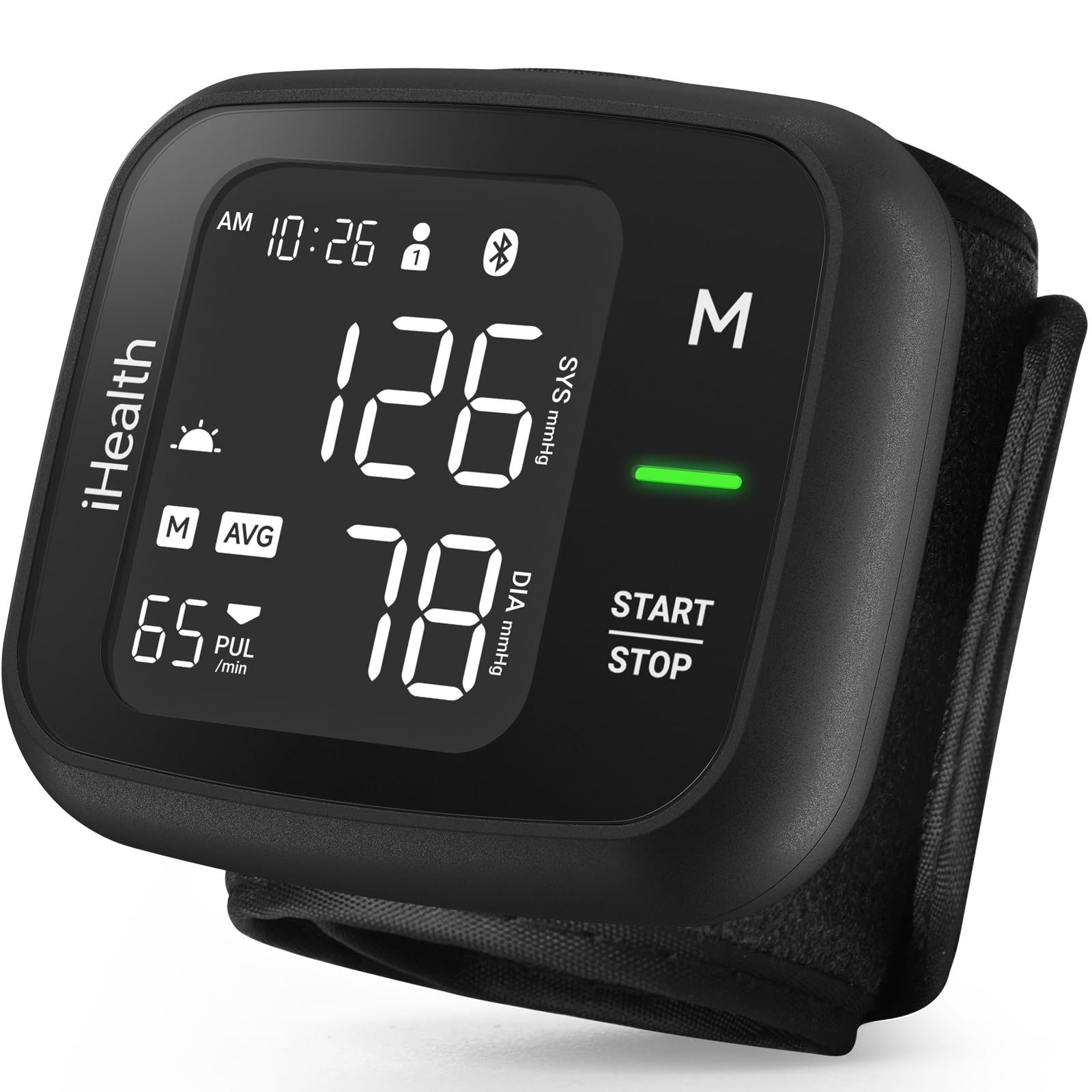
3. iHealth Pulse Bluetooth Wrist Blood Pressure Monitor
Stores 199 readings per user right on the device, so your history survives without any phone at all.
You get months of history without a phone, because this iHealth stores 199 readings for each of two users. That is more than three times the 60-reading banks on the A&D UB-543, so a daily check lasts far longer before you run out of room. You can flip back through that history on the monitor itself, even with no app and no pairing. That on-device depth is the standout for anyone who wants a paperless log without trusting a phone.
When you do want the app, built-in Bluetooth syncs to the free iHealth MyVitals app on iOS and Android, and it connects with Apple Health. It also layers colour-coded blood-pressure indicators, irregular-heartbeat detection, and a recent 3-reading average plus a morning average so you compare like with like.
The downside is weight and reliability. At 7.05 ounces it’s heavy for a wrist device — more than double the Beurer below, which sits at 3.39 ounces — so it feels bulkier on the arm. Reviews also split on reliability and accuracy, and connectivity is a recurring sore point for people who expect the app to just work. The cuff fits wrists from 5.5″ to 7.7″, so check that range too.
Why the history kings pick it
- 199 readings per user stored on-device for two users
- History viewable on the monitor without any app
- Syncs to iHealth MyVitals and Apple Health over Bluetooth
- Morning average and 3-reading average for cleaner comparison
What to keep in mind
- Heavier at 7.05 ounces than most wrist units here
- Reliability and accuracy feedback is split
- Bluetooth pairing frustrates some buyers
Best used by: The dedicated tracker who wants a deep on-device log and a clean app handoff.
Skip if: A feather-light wrist feel matters more to you than storage depth.
4. Beurer BC57 Bluetooth Wrist Blood Pressure Monitor

A wrist monitor that tells you to settle down before it reads — at only 3.39 ounces.
The resting indicator is the feature that earns this Beurer its spot. It lights up when you’re actually in a rested position, and you wait for that icon before recording. It also shoots an alarm when it detects an irregular heartbeat during the measurement.
On size it’s the lightest pick that keeps a full feature set here: 3.39 ounces, making it the one you forget is strapped on. The cuff adjusts from 5.3″ to 7.7″, and it stores 60 readings for each of two users — 120 total slots — or you can push them to the HealthCoach app over Bluetooth instead of writing them down.
What to weigh honestly: accuracy and quality are the two most-discussed topics in its feedback and both land as mixed, and Bluetooth connectivity is a genuine pain point for some. Value for money also draws grumbles. Buy it for the resting indicator and the 3.39-ounce feel, and treat Bluetooth sync as a bonus that may test your patience.
The light build: 3.39 ounces means near-zero wrist fatigue, and the 5.3″ to 7.7″ cuff covers most adults comfortably.
Buyer’s note: The resting indicator is the feature to lean on — it nudges you into the right posture, which is exactly where wrist monitors go wrong.
Pick it when: You want the lightest-feeling cuff and a built-in posture check for steady readings.
Not the one if: You rely on Bluetooth and need it to connect without fuss.
5. FDA Cleared Wrist Blood Pressure Cuff Machine
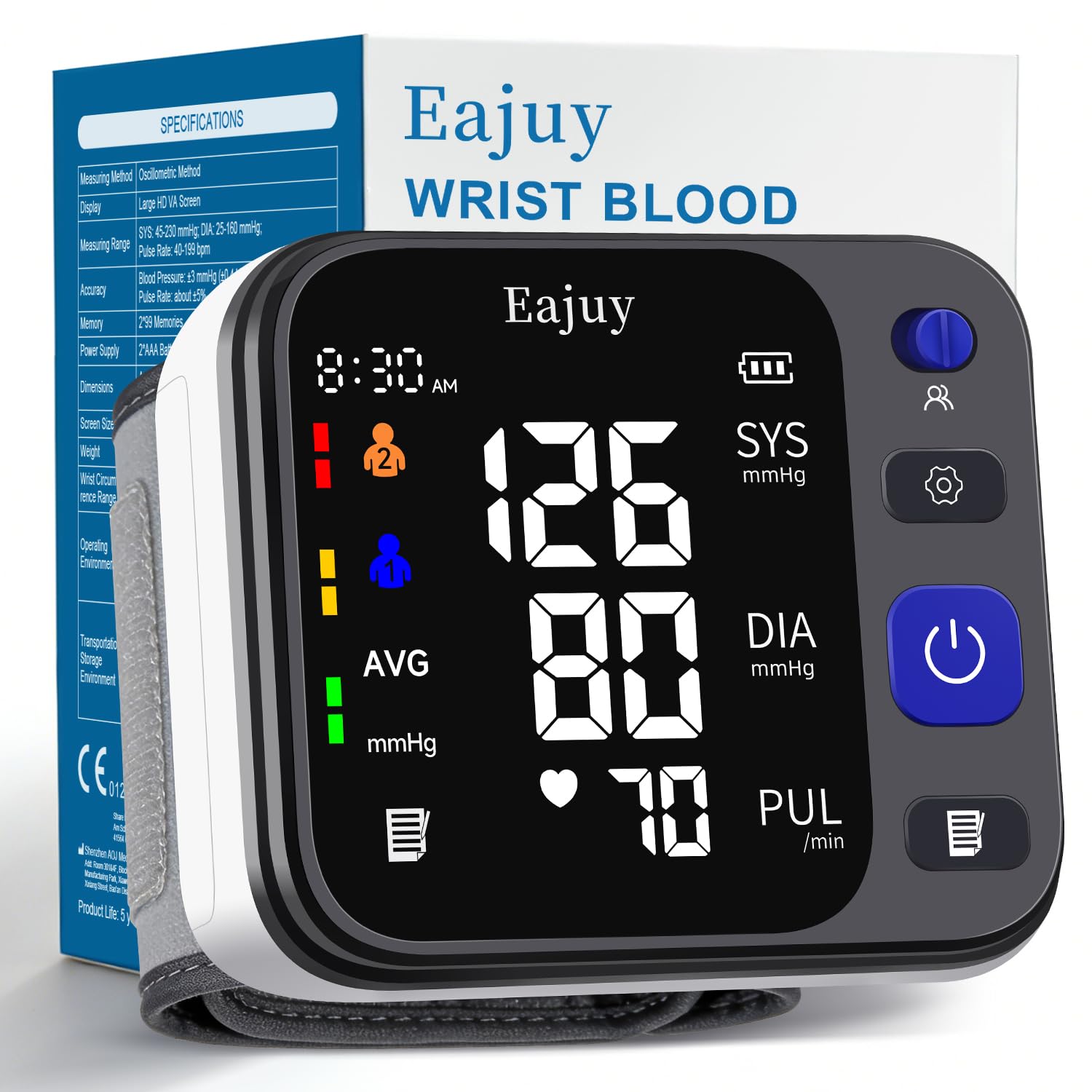
Two ways to power it — two AAA batteries or a USB-C cable — so a dead battery never stalls a check.
Most wrist monitors run on batteries alone. This one adds a USB-C port, so you can plug it in when the AAAs run dry instead of hunting for replacements. That dual-power setup is the practical highlight, and it comes with a Type-C cable, the batteries, a storage pouch, and a quick-start guide all in the box.
The screen earns its keep too. It’s a large high-definition LED with big fonts and a backlight that auto-adjusts to the room, plus anti-glare so it stays legible day or night. After measuring, a three-colour indicator tells you where your result sits. For shared homes, dual-user mode stores 2×99 readings, and you can tag checks as morning or evening and before or after medication to keep the trend readable. The cuff fits wrists from 5.3″ to 7.7″.
Accuracy is the honest sticking point — it’s the most-discussed topic in the feedback and opinions split hard, with some calling it spot-on and others getting readings that jump. It’s also the heaviest-feeling build for its size at 7.41 ounces. Take readings the same way at the same time each day and treat it as a trend companion, not a single verdict.
What you’ll like
- Runs on two AAA batteries or a USB-C cable
- Auto-adjusting backlit LED with anti-glare and large fonts
- Dual-user memory of 2×99 readings with morning/evening tagging
- Ready to use from the start with cable, batteries, and pouch
What to plan around
- Accuracy feedback is split, so consistency matters
- Heavier at 7.41 ounces than slimmer picks here
- Cuff tops out at 7.7″ — wider wrists need another model
The fit for: A shared home that wants a plug-in option and a bright, easy-to-read screen.
Only if: You’re comfortable treating the numbers as a trend rather than a single verdict.
6. Portable Wrist Blood Pressure Monitor with Voice Readings
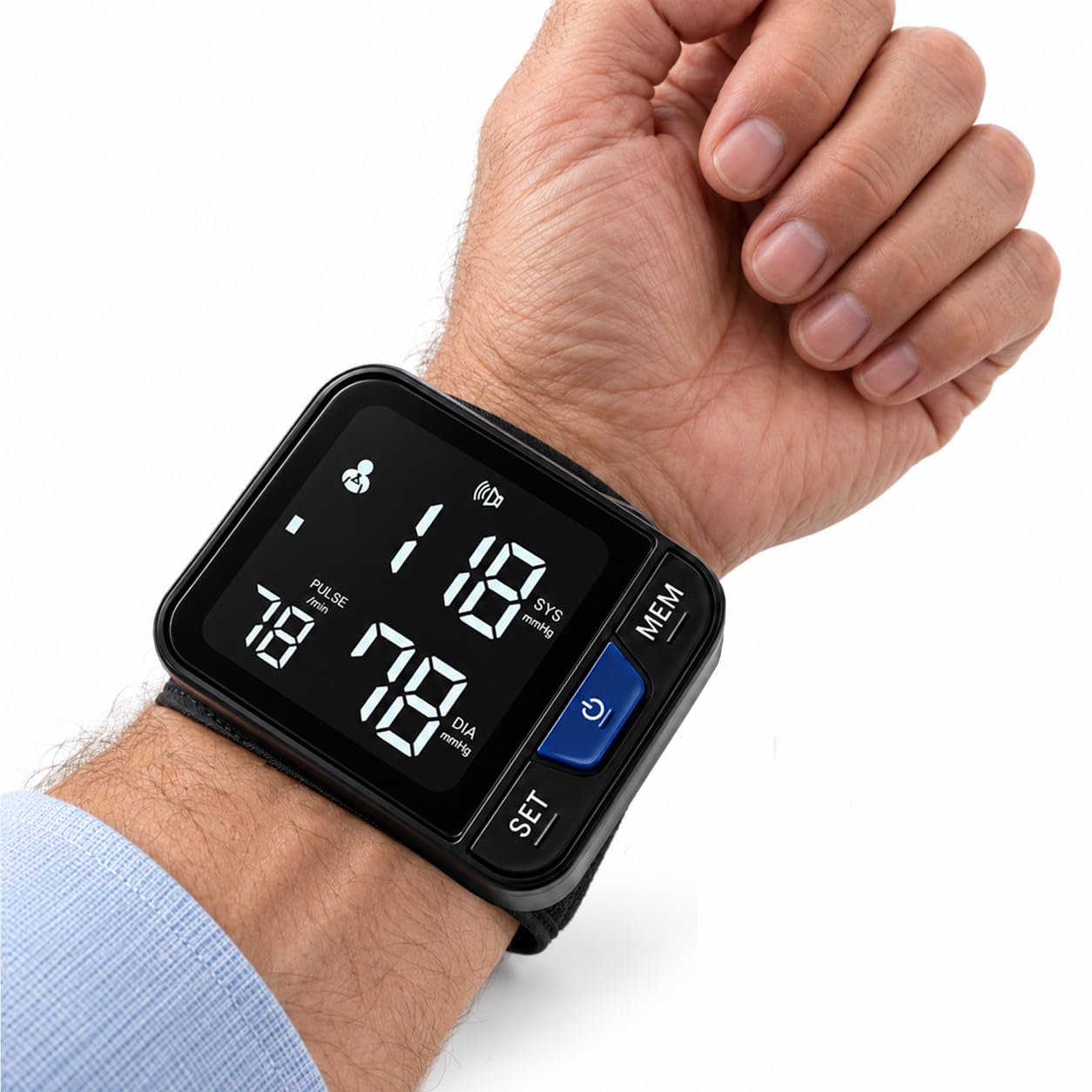
Reads your numbers out loud in 25 seconds, which is a gift for anyone who can’t see the screen well.
This DR. VALERE wrist monitor pairs a bright LED display with voice broadcast, so you hear your reading instead of squinting at it. For an older parent or anyone with limited vision, that spoken result removes the most annoying step of a daily check. It claims a reading in 25 seconds, and the build runs light enough for on-the-go use.
Two people can share it, with dual-user memory totalling 240 readings across both. It also uses movement-error blocking and flags irregular heartbeats during the measurement, which helps keep a wobbly hand from spoiling the number. The cuff is described as skin-friendly and breathable for regular wear.
One thing to know: this is a newer listing with a smaller track record than the established brands here, so long-term feedback is thin. If spoken results are the feature that matters to you, it delivers that directly; if you want a long history of owners backing it, look at the higher-review models.
The audio angle: Voice broadcast plus a bright LED screen makes it one of the friendliest options for eyes that tire easily.
Worth knowing: Its review base is still small, so you’re trusting the spec sheet and a shorter record than the OMRON or Beurer picks.
Reach for it if: Heard results and a big bright screen beat a long review history for your household.
Hold off if: You want a monitor with years of owner feedback behind it.
7. Herz P1 Wrist Blood Pressure Monitor
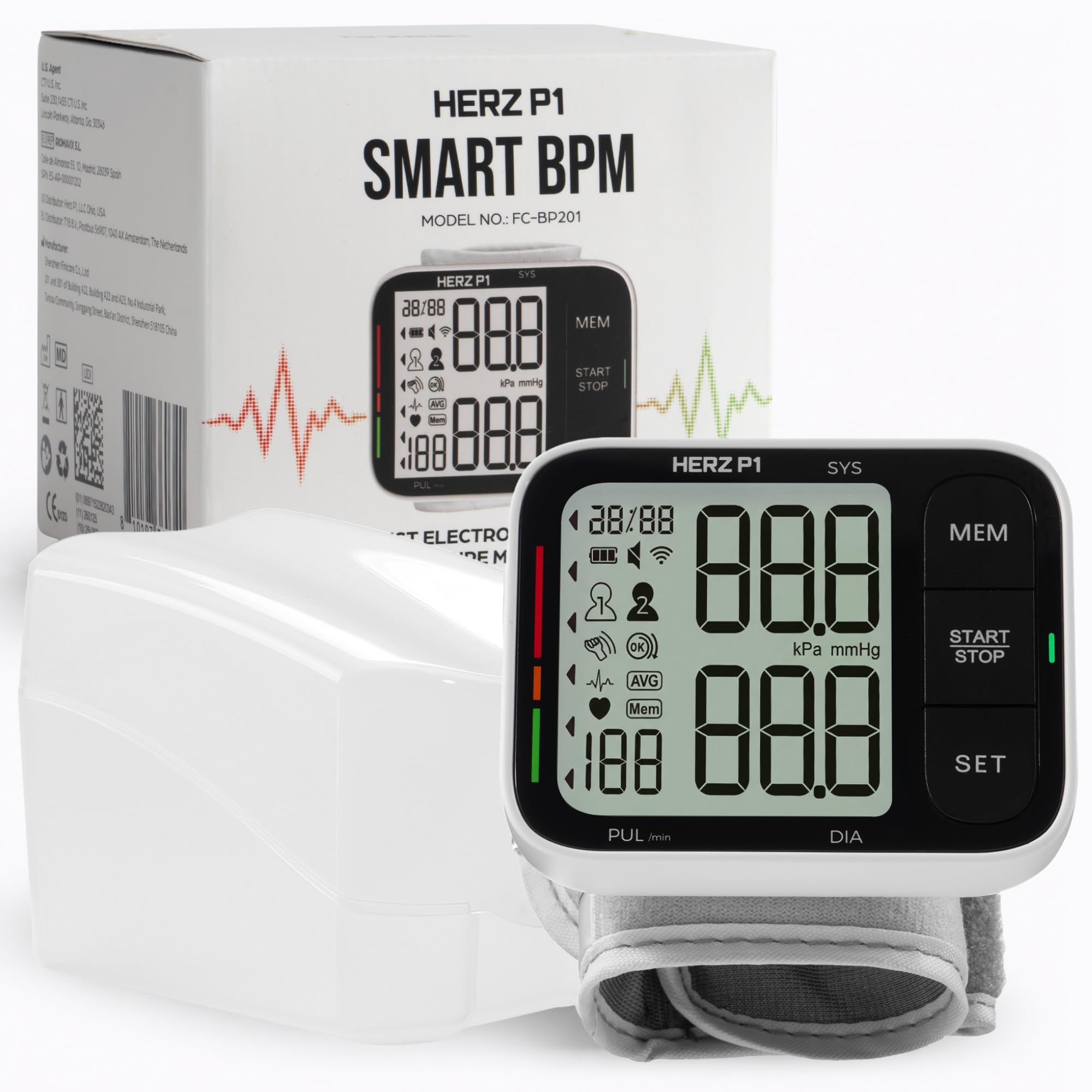
A large 51 x 46.68 mm screen that shows all three numbers at once in big, clear numerals.
The display is the reason to look here. Herz fits a 51 x 46.68 mm LCD that lays out systolic, diastolic, and pulse together in large figures with both mmHg and kPa units shown. For a first-time user or an older parent, that means no cycling through screens to find your reading — it’s all right there. It finishes a check in about a minute.
Bigger wrists get a comfortable fit, because the soft adjustable cuff spans 5.3″ to 8.5″ (13.5 to 21.5 cm). Memory holds 120 reading sets for each of two users, viewable over time with no app, phone, or subscription needed. A cuff self-check and movement detection (a sensor that flags body motion) run before and during each reading to keep conditions consistent. An irregular-pattern indicator shows a symbol if it catches an irregular rhythm — for informational awareness only, since Herz states this is not a medical device.
Accuracy is where the picture divides, with feedback split between very accurate and less reliable. It also tips the scales at 8.82 ounces, the heaviest pick in this lineup, so it’s not the one to wave around for a featherlight feel.
The case for it
- Large 51 x 46.68 mm LCD shows SYS, DIA, and PUL at once
- Wide 5.3″ to 8.5″ cuff covers larger wrists
- 2 x 120 reading memory with no app or subscription
- Cuff self-check and movement detection for steadier readings
The case against
- Heaviest unit here at 8.82 ounces
- Accuracy feedback splits between very accurate and misleading
- Herz calls it not a medical device — treat results as awareness only
Suits you if: Your wrist is wide and you want every number on one big screen without an app.
skip it if: Weight on the wrist is a concern or you need a medical-grade label.
8. Digital Wrist Blood Pressure Monitor (DR. VALERE)
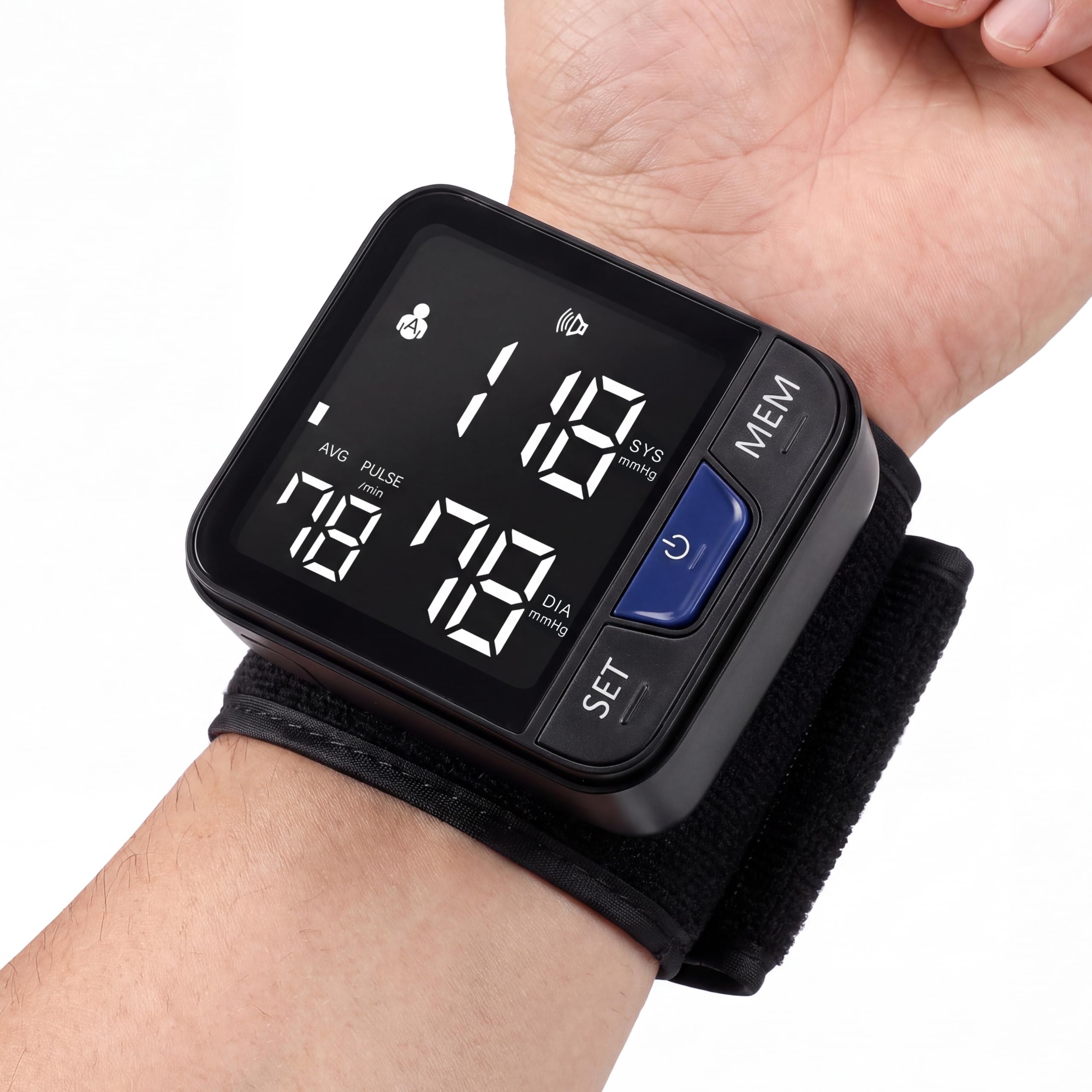
An upgraded chipset built to cancel hand-shake errors before they spoil the reading.
Shaky hands are why wrist readings wander, and this DR. VALERE unit attacks that directly. It uses a one-touch inflation system and an “upgraded chipset” that filters movement interference to steady the numbers, claiming a reading in 25 seconds. That focus on motion is the most useful part of the spec sheet for anyone who finds it hard to hold still.
Like its sibling above, it pairs a clear audio voice broadcast with the display, aimed squarely at older users with limited vision. Two users each get 120 historical records, so couples keep separate logs. The build uses aviation-grade materials with a breathable, skin-friendly cuff, and at 3.6 ounces it packs small for travel.
The trade-off worth flagging: this is a fresh listing, so there’s little owner history to judge long-term accuracy against. The claims are strong on paper, but you’re buying early. If a steady hand and spoken results are what you need, the feature set points the right way — just weigh that against the established models.
What it leans on: Movement filtering plus voice broadcast make it an approachable pick for a first wrist monitor.
The honest gap: A small review base means the accuracy record isn’t proven the way it is on the OMRON pick.
Worth a look if: Hand-shake has wrecked your readings before and you want voice results too.
Wait if: You’d rather buy a monitor with a mountain of real-world feedback.
9. OMRON Gold Wireless Wrist Blood Pressure Monitor
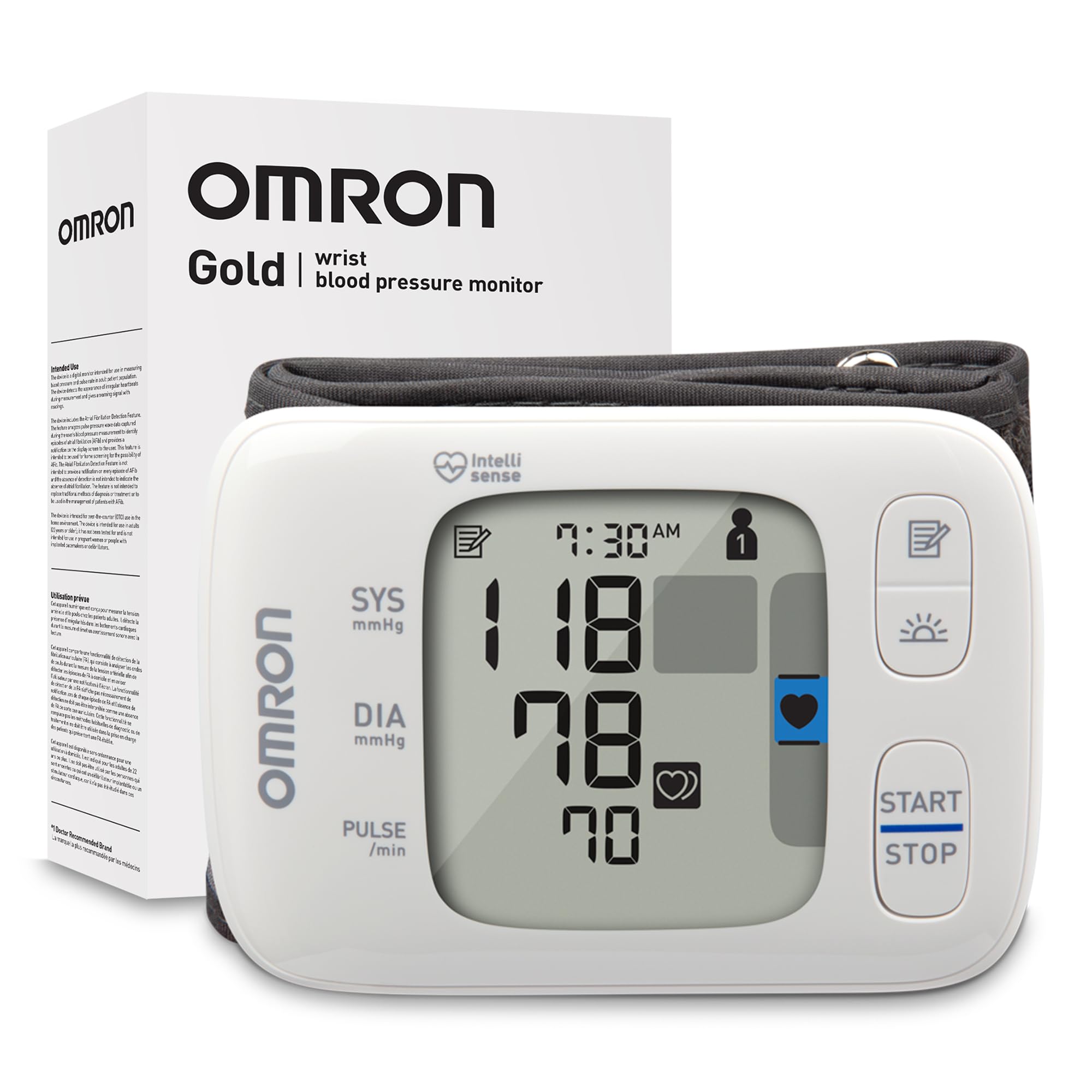
The most-reviewed wrist monitor here, at 4.0+ stars across thousands of owners, with 200 readings per user.
The OMRON Gold carries the longest track record in this lineup by a wide margin — 4.0+ stars across 13,000+ ratings, making it the monitor most owners here have actually lived with. It stores 200 readings for each of two users and adds a High Morning Average Indicator that checks for morning spikes. Doctors watch morning readings closely, so an automatic morning average saves you the math.
The app side is the most complete of the bunch. It connects to the free OMRON connect app over Bluetooth to store unlimited readings, track trends, and share reports with your doctor, and it works with Apple Health and Google Fit. The cuff fits wrists from 5.3″ to 8.5″, and it ships with a storage case, manual, quick-start guide, and two AAA batteries. At 3.17 ounces it’s the lightest pick in this article.
Honest caveat: accuracy and reliability still split in its feedback, with some owners getting readings they trust and others hitting errors. No wrist monitor is immune to that — posture is everything. But if you want the model with the deepest owner history and the widest app support, this is the safest long-term bet.
Why it’s the safe default: 200 readings per user, a High Morning Average Indicator, and full Apple Health and Google Fit support in a 3.17-ounce build.
Where it can stumble: Same wrist-accuracy variance as the rest — treat every reading as one data point, not a diagnosis.
The confident buy: For anyone who wants the most battle-tested wrist monitor with the best app ecosystem.
The caveat: Its accuracy feedback isn’t spotless, so take consistent readings at the same time each day.
Know the Specs
Cuff fit range in inches
Each monitor lists the wrist circumference it can measure, like 5.3″ to 8.5″ or 5.5″ to 7.7″. This is the spec that decides whether the device reads you at all. A cuff that’s too loose or too tight distorts the pressure signal, so measure your wrist first and buy only within range.
Readings per user (memory)
Memory is quoted as how many measurements each of two users can store — 60, 99, 120, 199, or 200. More slots mean a longer unbroken history for spotting trends. A date and time stamp matters as much as the count, because a log without timestamps is hard to hand to a doctor.
Weight in ounces
Wrist monitors range from about 3.17 ounces to nearly 9 ounces. Lighter units are easier to wear for a quick check and to pack, while heavier ones can feel bulky. Weight doesn’t affect accuracy, but a 3-ounce cuff gets worn daily while a 9-ounce one gets skipped.
Bluetooth and app sync
Some monitors push readings to a phone app over Bluetooth; others store only on the device. App sync helps share reports and build unlimited logs, but pairing issues are a common frustration. On-device memory is the reliable fallback if the app won’t cooperate.
Common Questions
Is a wrist blood pressure monitor as accurate as an upper-arm cuff?
How do I know if a cuff will fit my wrist?
Do wrist monitors work without a phone or app?
How do I position my wrist for a correct reading?
What does the irregular heartbeat icon actually mean?
How many readings can these monitors store?
Can two people share one wrist monitor?
Do these wrist monitors run on batteries or a cable?
Why do my readings jump around from one check to the next?
Is the OMRON Gold worth choosing over a lighter model?
The Bottom Line
The best wearable blood pressure cuff for most people is the Smartheart Adult Cuff Wrist Monitor, because its one-button inflation, two 60-reading memory banks, and 3-year limited warranty make daily checks simple for a couple. If you want the deepest owner history and app ecosystem, grab the OMRON Gold Wireless Wrist Monitor — the 4.0+ star, 13,000-plus-rating crowd favorite. And for a wide-wrist household that needs a cuff up to 8.5″, the A&D Medical UB-543 is the one to reach for. Whichever you pick, take your reading seated with your wrist at heart level, and let a week of consistent checks guide you rather than any single number.
How we choose
We do not accept paid placement. Every pick is matched to a real buyer and a real use-case; we do not hands-on test units.
Sources
Specifications: manufacturer listings and product documentation. Review insights: verified customer reviews, as of November 2026. Pricing: not shown on this page (it changes often); check the current price via the retailer link.
As an Amazon Associate, Tactical Gear Guy earns from qualifying purchases. This does not affect which products we feature.