Specs are compiled from manufacturer listings and verified buyer reviews and can change over time — please confirm the key details on the product page before buying.
You want sound that circles behind your head and rumbles under the couch, but you do not want to pull up carpet or fish speaker wire through a wall. That is the promise of a wireless home theater system, so know what “wireless” covers before you buy. The short answer: the rear speakers and the subwoofer talk to the main bar over a radio link, so the only cable you truly need is power to each speaker and one HDMI cable from the bar to your TV. This guide covers which systems do that best, which ones lock you into a matching brand, and which ones simply sound bigger than your TV’s built-in speakers ever will.
This guide is built by comparing the manufacturers’ published specifications and the patterns across verified customer reviews, so you get each pick’s real strengths and trade-offs instead of marketing spin.
One fair warning before the list: the picks below match on the practical goal — rear speakers that work without a wire run — rather than on one exact channel count, so channel layouts and driver sizes vary from pick to pick. Every spec is listed plainly so you can compare like for like. Read on for the picks that fit your room and your TV.
Top Picks


How To Choose The Best Wireless Home Theater System
The first thing to settle is what you want the system to do in your room. A bar with a subwoofer alone gives you punch and clearer voices. Adding wireless rear speakers is what finally puts sound behind your shoulders, which is the difference between “louder TV” and “movie theater.” Settle that first, because it sets your channel count and budget.
Read the channel count as a map of your room
A channel number like 5.1 tells you how many separate speakers are doing the work. The first digit is the main speakers and surrounds, the “.1” is the subwoofer, and a third digit such as the “.4” in a 7.1.4 setup counts speakers that fire upward so sound seems to come from the ceiling. More channels means more precise placement of a helicopter or a rainstorm. More channels also mean more speakers to power and position, so match the count to your room size.
Confirm the rears are truly wireless
This is where listings get slippery. Many systems advertise wireless rear speakers, yet each rear still needs its own wall outlet. That is normal and fine — it just means you are avoiding speaker cable, not avoiding power cables. What you want to verify is that the rear speakers pair to the main bar over a radio link with no receiver box and no wire running back to the front of the room. The Sony pick on this list, for example, uses a wireless rear amp box, while the JBL pick goes one step further with battery-powered detachable rears.
Plan your connections before you unbox
Look for an HDMI eARC port on your TV. eARC (Enhanced Audio Return Channel) is a single-cable hookup that carries high-quality surround audio from the TV back to the bar, and it removes the tangle of optical and auxiliary cables. Systems that pass 4K HDR through the bar let you route a game console or streamer into the bar and out to the TV without losing picture quality. Bluetooth and Wi-Fi streaming are separate conveniences for music from your phone.
Decide whether matching your TV brand matters
Several picks here open up extra features only when paired with a TV from the same brand. Samsung’s Q-Symphony runs the TV speakers and the bar together, and LG’s WOW Orchestra does the same for LG TVs. That is useful only if you already own a matching TV. If you do not, weigh room calibration, subwoofer size, and genuinely cable-free rears instead.
Side-by-Side Comparison
| Model | Best For | Channels | Subwoofer | Peak Power | Amazon |
|---|---|---|---|---|---|
| Samsung HW-Q990C★ Best Overall | Best Overall | 11.1.4 | Included | — | Amazon |
| LG S40TRBudget Entry | Budget Entry | 4.1 | Wireless | — | Amazon |
| TCL S65K S SeriesAtmos on a Budget | Atmos on a Budget | 5.1 | 6.5″ driver | — | Amazon |
| Amazon Fire TV Soundbar Plus | Fire TV Owners | 5.1 | Included | — | Amazon |
| ULTIMEA Skywave X50 | Best Value Immersion | 5.1.4 | 8″ driver | 760W | Amazon |
| Sony BRAVIA Theater System 6 | BRAVIA TV Pairing | 5.1 | Wired | — | Amazon |
| LG S90TR | LG OLED Matching | 7.1.3 | Included | — | Amazon |
| ULTIMEA Skywave X70 | Top Performer | 7.1.4 | 10″ driver | 980W | Amazon |
| Polk MagniFi Max AX SR | Most Versatile | 7.1.2 | 10″ driver | — | Amazon |
| JBL Bar 1000 | Detachable Rears | 7.1.4 | 10″ driver | 880W | Amazon |
Detailed Reviews
1. Samsung HW-Q990C 11.1.4ch Soundbar
Our pick — 4.5+★ from 500+ verified ratings; the strongest balance of quality and price.
Eleven channels in the bar, four firing at the ceiling, and rear speakers already in the box.
This is the pick for the person who wants the ceiling in on the action. The count is 11.1.4 channels — eleven main speakers, one subwoofer, and four up-firing drivers angled at your ceiling so sound appears to fall from above. Rain scenes, helicopters, and overhead dialogue all land where the director put them. The rear speaker kit is included and works wirelessly, so nothing has to run back to the front of the room except a power cord for each rear.
That channel count is the widest here by a clear margin. Compare it with the LG S40TR at 4.1 channels and the gap in raw surround coverage is obvious — 11.1.4 versus 4.1 — so the Samsung spreads effects across far more distinct speaker positions. If you have a medium-to-large room and want an Atmos mix to feel three-dimensional rather than just loud, this is the shape you are after.
What wins people over is simply how it sounds. Owners describe a movie-theater-in-the-living-room effect, and the setup is widely called straightforward for a system this complex. SpaceFit Sound Pro analyzes your room and tunes itself, and Adaptive Sound pulls voices forward even at low volume — a real help for late-night viewing. AVA (Active Voice Analyzer) works the same job from another angle, keeping dialogue from drowning in background noise. The honest catch is connectivity: hookup is smooth for most, but a share of owners hit pairing trouble, so budget ten quiet minutes with the app rather than rushing it. Game Mode Pro and AirPlay 2 round out the picture for console nights and iPhone streaming.
Where it pulls ahead
- 11.1.4 channels is the most expansive layout in this list, with four height drivers aimed at the ceiling
- Rear speaker kit included and wireless, so no speaker cable crosses your floor
- SpaceFit Sound Pro calibrates itself to the room, and Adaptive Sound lifts dialogue at low volume
- Q-Symphony runs Samsung TV speakers and the bar together as one system
Worth knowing before you buy
- Connectivity is the split opinion here — most hookups go smoothly, a few fight the pairing
- You get the most from it with a Samsung TV for Q-Symphony
- Four height channels and two rears mean a lot of speakers to place and power
Buy this for: a big-room Atmos setup where you want the ceiling and the rear corners fully covered without running speaker wire.
Think twice if: your TV is not a Samsung and you were counting on Q-Symphony as the reason to buy — the bar still stands on its own sound, but that pairing perk goes unused.
2. LG S40TR 4.1 ch. Soundbar with Rear Surround Speakers
The cheapest honest route to sound behind your shoulders — four channels, wireless rears, no receiver box.
If your budget is the tightest on this list, this is where surround starts. The S40TR runs 4.1 channels: a main bar, a wireless subwoofer, and two rear speakers that connect to the bar wirelessly with no special receiver. That last part is the whole point of this guide — the rears sit behind you without a cable snaking to the front. Dolby Digital and DTS Digital decoding handle the everyday surround from shows, movies, and games.
What it does not have is height. This is a 4.1 layout, so there are no up-firing drivers and no Dolby Atmos object placement. Set against the Samsung’s 11.1.4 channels, the LG is a much simpler map — 4.1 versus 11.1.4 — and that is the honest trade you make at entry level. You get real rear-channel surround; you do not get sound from the ceiling.
Owners consistently point to clear dialogue, and Clear Voice Plus backs that up by working the center speaker to pull conversation forward. The Smart Up-Mixer widens two-channel audio into a fuller spread, and the 3-band equalizer in the LG Soundbar App lets you nudge bass, treble, and mid-range to taste. Where it gets sticky is the wireless link itself: pairing is flawless for plenty of owners and fussy for others, and the rear speaker cable in the box is the one wire some buyers end up noticing. Match it to an LG TV and WOW Orchestra runs both sets of speakers as one, with a single remote for the pair.
Why it earns the slot: it is the least complicated way to get genuine rear-channel sound in a small room, and the metal grille keeps dust out of the bar itself.
The honest limit: no Atmos and no height drivers — this is surround around you, not above you.
Reach for this if: you are furnishing a first apartment or a bedroom and want real surround without stretching the budget.
Look elsewhere if: ceiling-height effects are the reason you are shopping — you need an up-firing layout for that.
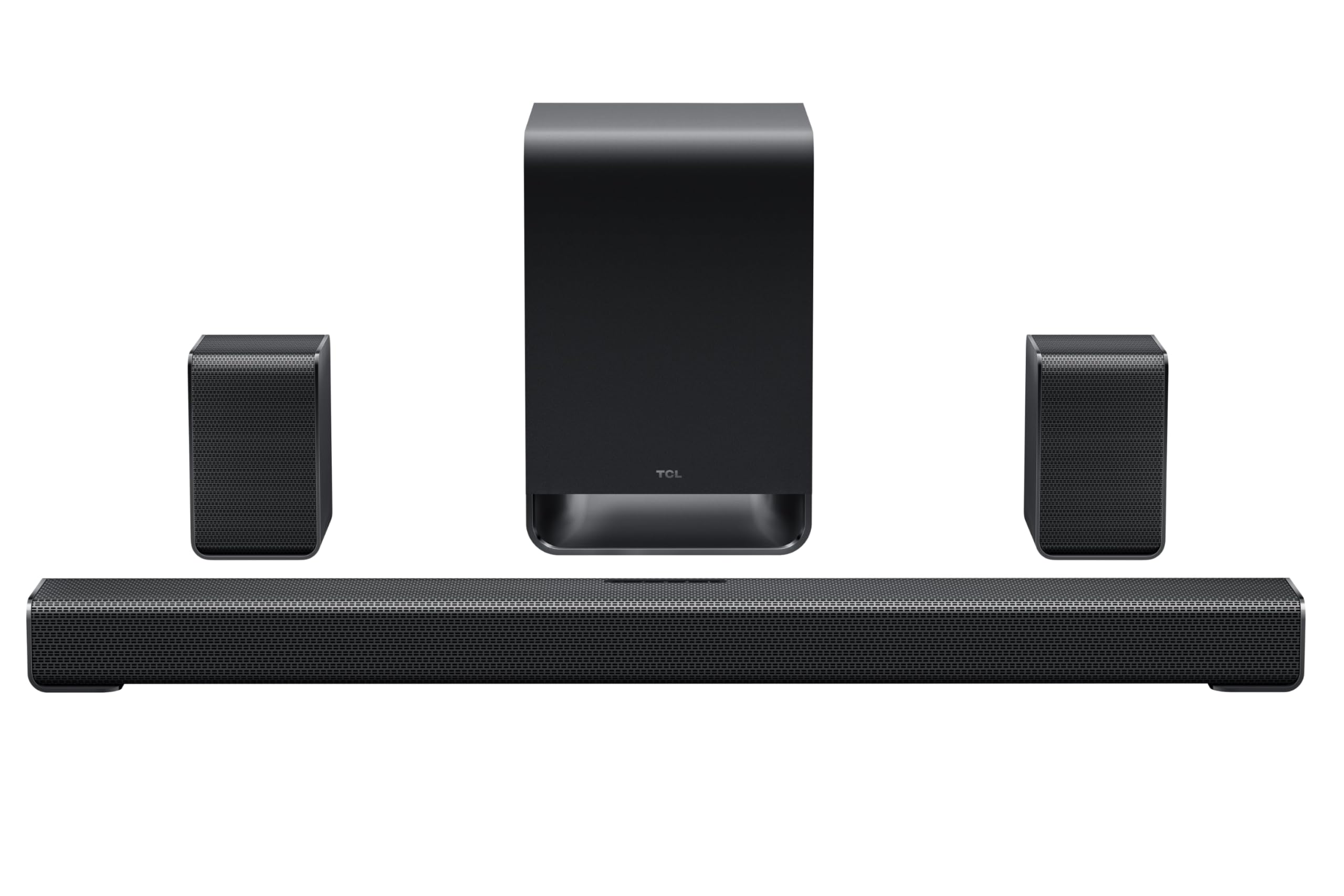
3. TCL S65K S Series 5.1 Channel Soundbar System
Five channels, a 6.5-inch sub, and Dolby Atmos for a room that is not a dedicated cinema.
Here is the step up that matters: Atmos at a modest outlay. The S65K is a 5.1 system — a main bar, a wireless subwoofer, and wireless surround speakers — and it decodes both Dolby Atmos and DTS:X, so height and rear cues are part of the mix. Ray Danz technology spreads the soundstage wider than the bar’s own footprint suggests. A built-in center channel and dedicated tweeter keep dialogue crisp even when the soundtrack is doing its loudest work.
The wireless subwoofer uses a 6.5-inch driver with Bass Boost, so the low end has real weight without a huge cabinet on your floor. The whole system weighs 27 pounds, which means one person can carry the boxes in and set up without help. Ai Sonic Auto Room Calibration measures your space and tailors the output, so a bar dropped into an awkward corner still sounds tuned rather than boomy.
The bass is what people talk about first, and it earns the attention — punchy rather than muddy. Setup draws the second round of praise, with the satellite speakers pairing to the main bar on their own. ChoruSound lets a TCL TV’s speakers join in for a wider stage if you own one. Worth flagging: 8 up-firing drivers this does not have — the Atmos effect comes from processing and the surround spread rather than a row of ceiling-aimed speakers, so the overhead illusion is subtler than on the pricier 7.1.4 systems here.
The value read: Atmos decoding, a 6.5-inch wireless sub, and auto room calibration at an entry-level position is a lot of capability for the tier.
Set expectations on height: overhead effects are present but gentle; this is a strong surround upgrade, not a ceiling-filling one.
Best fit for: a TCL TV owner or anyone who wants Atmos and a real subwoofer without jumping to premium tier.
Pass on it if: you want pronounced height effects — the up-firing designs further down this page do that more convincingly.
4. Amazon Fire TV Soundbar Plus

Built to disappear into a Fire TV setup — one remote, a subwoofer, and two surround speakers.
For a household already living inside the Fire TV interface, this removes a layer of friction. The Soundbar Plus is a 5.1 system with a subwoofer and two surround speakers, and it handles both Dolby Atmos and DTS:X. Plug the sub and the rears into power, and they connect to the bar on their own — the setup is genuinely plug-and-play rather than a manual to work through.
The dedicated center dialogue channel is the underrated part. It sharpens conversation so you can follow a quiet drama without riding the volume button, and Night mode keeps the loud scenes from waking the house. Movie, Music, Sports, and Night modes each reshape the output for what is on screen. A single remote controls both the TV and the bar when paired with a Fire TV device.
Quality is what wins people over here — the phrase that keeps surfacing is that it exceeds expectations for the tier, and the easy setup draws just as much goodwill. Bluetooth lets you throw a playlist from your phone when the TV is off. Where the noise creeps in is long-term reliability, which is the split opinion on this one, so it is worth reading the warranty terms rather than assuming years of trouble-free service. It also works with any smart TV or streaming player, not only Fire TV hardware.
One-remote simplicity: Fire TV integration plus Movie, Music, Sports, and Night modes means fewer remotes and less menu-diving.
Fair caution: durability is the mixed note in owner feedback, so treat it as a solid lifestyle system rather than a decade-long investment.
Pick this when: your living room already runs on Fire TV and you want surround with minimal setup fuss.
Consider a different pick if: you want the widest possible channel layout — this is a 5.1 build, not a 7.1.4 one.
5. ULTIMEA Skywave X50 5.1.4ch Wireless Surround Sound System
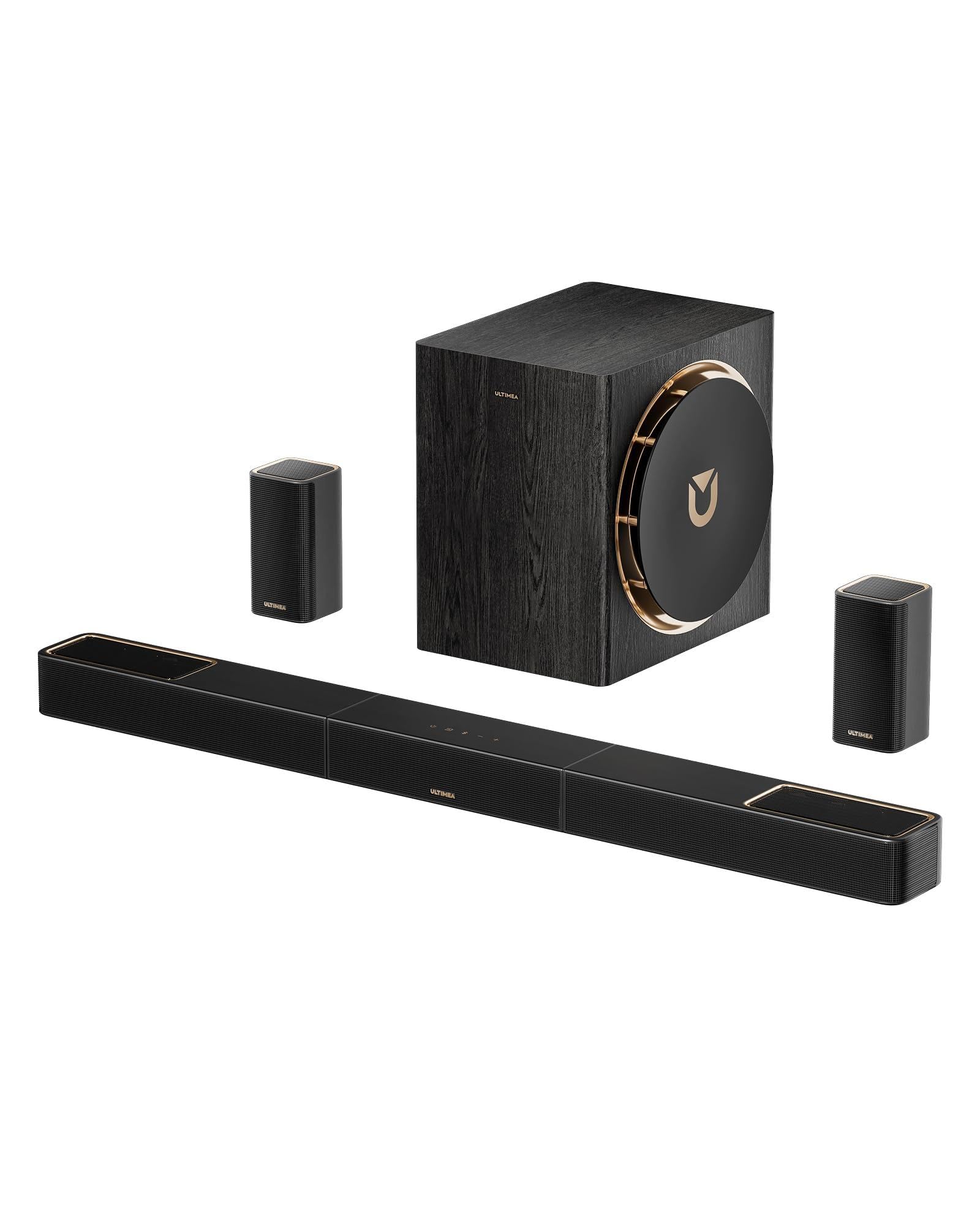
Height channels and an eight-inch sub for less than most Atmos bars ask on their own.
This is where the value argument gets loud. The X50 is a 5.1.4 layout — five main and surround channels plus four height drivers — so sound genuinely moves above you, not just behind. The wireless link runs on dual 5GHz transmission, which is the design choice aimed at keeping the rears and sub stable when your Wi-Fi is busy. In a crowded wireless household, that is a real practical advantage.
Power is quoted at 760W peak, and the subwoofer is an 8-inch driver using Gravus Ultra-Linear Bass, tuned down to 28Hz. In plain terms, the low end reaches deep enough for explosions to feel physical rather than just loud. A GaN amplifier — gallium nitride, a more efficient semiconductor that wastes less energy as heat — is the reason this much output fits in a fairly slim box without cooking itself.
The bass and immersion are the standout themes in owner feedback, with the house-shaking quality coming up repeatedly, and gaming on a PS5 gets singled out as a showcase. Setup and device pairing are called easy, and the EQ is adjustable if the stock balance is not to your taste. 4K HDR pass-through means you can run a console through the bar and keep full picture quality. The metal grille, rose gold accents, and wood-crafted subwoofer make it a piece you will not want to hide.
The standout: a 5.1.4 arrangement with four height drivers and an 8-inch sub is uncommon at this position in the market.
Real-world note: the 8-inch sub is deep but smaller than the 10-inch units further up this page, so the very lowest rumble has a little less headroom.
Worth it for: a gamer or movie fan who wants height effects and strong bass without stepping into premium territory.
Not the one for: someone who needs the absolute deepest sub-bass — the 10-inch drivers later in this list go lower.
6. Sony BRAVIA Theater System 6 5.1ch Soundbar

A 5.1 layout that reads your BRAVIA TV’s menu and lifts dialogue with Voice Zoom 3.
Sony owners get a shortcut the others cannot offer. This is a 5.1 system — three front-firing speakers, two rear speakers, and a subwoofer — decoding Dolby Atmos and DTS:X. Pair it with a compatible BRAVIA TV and Voice Zoom 3 (a Sony dialogue-boosting feature) sharpens voices from the TV menu itself, with no separate app to open. The rear speakers connect through a wireless rear amp box, so no cable runs to the front of the room, though that box does need power.
The honest detail in the spec sheet: the subwoofer is wired. That is unusual at this price and level, and it means one cable from the bar area to the sub. It is worth knowing before you plan the layout, because every other pick on this page runs its sub wirelessly. Multi Stereo spreads the same signal across every speaker for a bigger, more ambient fill when you want background music through the house.
Owners describe a small living room turning into a movie theater, and the plug-in-and-play setup gets repeated credit. Sound quality and overall build quality are the two things people are happiest with. The mixed note is reliable operation — rear speakers occasionally pop or crackle — and HDMI cable connectivity draws some debate, so use a good cable and a firm seat in the port. Frequency response is stated from 20 hertz, so the low end reaches well down. The BRAVIA Connect app handles volume and sound profiles from your phone.
Its edge: deep integration with a Sony BRAVIA TV, including Voice Zoom 3 dialogue control straight from the TV’s own menu.
The trade-off: a wired subwoofer plus a rear amp box that needs power — less cable-free than the wireless-sub rivals here.
Made for: a BRAVIA TV owner who wants a matched Sony system and dialogue that cuts through heavy soundtracks.
Otherwise look at: a wireless-subwoofer system if running a cable to the sub is a problem in your room.
7. LG S90TR 7.1.3 ch OLED evo TV Matching Soundbar

Built to sit under an OLED evo TV, with an up-firing center channel aimed squarely at dialogue.
This one is designed as a visual and functional partner for LG’s higher-end sets. It runs 7.1.3 channels with Dolby Atmos and DTS:X, and the rear speakers are wireless, so no receiver box and no speaker cable to the back of the room. The unusual piece is the center up-firing speaker — a driver angled up specifically to push dialogue out with extra detail. In a living room where voices get buried, that is the feature that earns its place.
WOWCAST built-in handles wireless Dolby Atmos with no visible wires, and Advanced Room Calibration uses a built-in microphone to measure the room and tune the output to it. For gaming, VRR and ALLM support a passthrough refresh rate up to 120Hz — refresh rate being how many times per second the picture updates, so fast motion stays smooth and input lag stays low. Multi-platform support covers Google Assistant, Alexa, Chromecast, and AirPlay 2.
Sound quality carries this pick — owners describe realistic, live-event-grade audio, and setup and everyday function are called straightforward. Connectivity is the split opinion: pairing with an LG TV draws praise, while a share of owners run into connection trouble, so confirm your TV model’s compatibility before committing. WOW Orchestra runs the LG TV and bar speakers together if you own a matching set. The metal enclosure gives it a solid, TV-adjacent look rather than a plastic bar.
The centerpiece: an exclusive up-firing center channel focused on dialogue clarity, plus self-calibration by built-in microphone.
Honest note: the pairing experience is uneven outside LG’s own TVs, and value opinions split — it is at its best inside the LG ecosystem.
Fits best with: an LG OLED evo set, where WOW Orchestra and WOWCAST deliver the full intended experience.
Might disappoint if: you own another brand’s TV and want the wireless Atmos feature to work exactly as advertised.
8. ULTIMEA Skywave X70

The big-sub version of the Skywave formula — ten inches of driver and 980 watts behind it.
This is what happens when the same 7.1.4 platform gets a bigger engine. The X70 keeps the four height drivers, two wireless rear surrounds, and dual 5GHz wireless link, and upgrades the subwoofer to a 10-inch driver with Gravus Ultra-Linear Bass reaching down to 20Hz at 980W peak. Compared with the X60’s 8-inch sub, the larger driver moves more air — which is what makes the deepest rumbles feel like pressure in the room rather than just sound.
The subwoofer is the headline, and it is the thing owners bring up unprompted, describing the sensation of being inside a movie theater. Setup earns its own praise, with picture-based instructions that make the wireless pairing obvious, and the HDMI eARC route draws specific credit for being clean and stable. The metal grille, rose gold trim, and wood-crafted subwoofer give it a look that stands up in a furnished room.
The GaN amplifier is rated up to 98% efficiency with 8x faster response than silicon, which is the technical reason it can push this much power while running cooler than a conventional amp. NEURACORE handles 24-bit/192kHz processing with under 0.5% distortion across up to 17 channels. The ULTIMEA App gives you a 10-band EQ and 121 presets, and the manufacturer quotes 12 months of after-sales service, 24/7 online support, and a 60-day replacement policy. One honest note: sound settings are the mixed aspect in owner feedback, so plan on spending a little time in the EQ rather than accepting the default.
Why it takes the top performance slot
- 10-inch subwoofer reaching down to 20Hz at 980W peak — the deepest and most powerful bass here
- 7.1.4 channels with four up-firing height drivers for a full Atmos layer
- Dual 5GHz wireless keeps rears and sub stable without a cable run
- HDMI eARC, 4K HDR pass-through, and app-based 10-band EQ with 121 presets
What to plan around
- Default tuning is the split note in feedback — the EQ and presets are there because you may want to use them
- A 10-inch sub hits harder than the smaller units, so thin walls and close neighbors need volume discipline
- It is the most expensive tier here, so the case rests on the bass and channel count
Go here for: maximum low-end impact and a full 7.1.4 height layer in a dedicated media room.
Hold off if: your space is small or your walls are shared — this is a system that wants room to breathe.
9. Polk Audio MagniFi Max AX SR 7.1.2 Soundbar

Three 4K HDMI inputs, AirPlay 2, Chromecast, and a 10-inch sub — a hub as much as a soundbar.
Most soundbars give you one or two HDMI ports and call it done. The MagniFi Max AX SR is a 7.1.2 system with three 4K HDMI inputs, one HDMI eARC, an optical input, and a USB-A port, which turns it into the switching hub for a console, a streamer, and a disc player at once. That single spec separates it from everything else here for anyone with a small stack of devices to connect.
The bundle pairs Polk’s flagship bar and 10-inch wireless subwoofer with SR2 surround speakers, and the sub connects the moment you power it on. SDA 3D technology and two up-firing speakers deliver certified Dolby Atmos and DTS:X, so height cues are part of the mix. VoiceAdjust works the integrated center channel to lift vocal levels without pulling the rest of the soundtrack with it — a targeted fix rather than a blanket volume boost.
What people notice is the surround and height channels doing their job — the spatial effect reads as genuinely cinematic. Setup is faster than you would expect for a system this full of ports, and Polk’s own voice-adjust control is the feature most worth playing with on night one. Wi-Fi, Bluetooth, AirPlay 2, Chromecast, Spotify Connect, and Alexa multi-room music cover music streaming across the house. Reliability is the mixed aspect in feedback, so it is fair to keep the warranty handy and give the wireless sub a clear line to the bar.
The differentiator: three 4K HDMI inputs plus eARC make it the only switching hub on this list, with AirPlay 2 and Chromecast for multi-room audio.
Fair caveat: reliability draws a split verdict, so buy from a seller with a clean return path.
Ideal for: a household with several 4K devices that wants one bar to switch between them and stream music everywhere.
Not necessary if: you have a single source and just want the simplest surround hookup — the port count would go unused.
10. JBL Bar 1000

The rear speakers lift off the bar itself and run on their own batteries — no outlet hunt at all.
Every other system here needs a power cord at each rear speaker. The JBL Bar 1000 does not — the two surround speakers detach from the ends of the main bar, and you place them behind you on their own rechargeable batteries. For a rental where you cannot add outlets along the back wall, that is the whole decision made. The layout is 7.1.4, with two up-firing drivers in the main bar and two more in the detachable speakers for true Dolby Atmos and DTS:X, plus MultiBeam for a wider spread.
System power is rated at 880W, and the wireless subwoofer uses a 10-inch driver for precise, deep bass. Wi-Fi is built in with AirPlay, Alexa Multi-Room Music, and Chromecast, opening access to more than 300 online music streaming services, and the Wi-Fi link also handles automatic software updates so the feature set keeps current. The JBL One app is the control center for setup and everyday tuning.
Sound quality and easy setup are the consistent themes, and the detachable rears are the design detail people come back to talk about. Bluetooth streaming from a phone works well for music between shows. The charge cycle on the battery rears is the trade-off in the split column — you will be docking them back on the bar to top up, so plan that as a routine rather than a once-a-year chore. Reliability also draws a mixed note, worth a look at the warranty before you commit.
Why it stands out: battery-powered detachable rear speakers mean no power outlet behind the couch — the only system here that pulls that off.
What you accept: those rears need recharging, and the recharge routine is the recurring trade-off in feedback.
Pick it for: a room where running power to the rear corners is not possible, and you still want a full 7.1.4 Atmos layout.
Look elsewhere if: you would rather never think about a battery — a mains-powered wireless rear is simpler to live with long term.
Know the Specs
Channel layout explained
The first number is how many main and surround speakers are doing the work. The “.1” is the subwoofer — the box that handles the low rumble. A third number, like the “.4” in a 7.1.4 system, counts speakers that fire upward so sound can seem to come from the ceiling. More channels spread the mix across more distinct positions, which is what makes an object fly from the front left to behind your head. For most living rooms, a 5.1 or 5.1.4 layout is plenty; a 7.1.4 system pays off in larger, dedicated spaces.
Subwowoofer size and low-frequency reach
The subwoofer is the driver that handles bass, and its size is the clearest shorthand for how deep it can go. An 8-inch driver moves less air than a 10-inch one, so it tends to sound tight and punchy rather than physically heavy. A 10-inch unit pushes more air and reaches lower, which is why action scenes feel like pressure in the room. The quoted Hertz figure is the lowest frequency the sub is tuned to reproduce — a lower number means deeper bass. Match the sub to your space: a small apartment rarely needs a 10-inch sub, and a large open room will make an 8-inch sub work harder.
Dolby Atmos and DTS:X
These are surround formats that place individual sounds at specific points in three-dimensional space, including overhead. Dolby Atmos and DTS:X both need height information to work fully, which is why systems with up-firing drivers deliver a more convincing ceiling effect. A bar that decodes Atmos but has no height drivers can still process the format, but the overhead illusion relies on processing rather than real ceiling-aimed speakers. Look for both format logos if you want the widest compatibility with streaming services and discs.
HDMI eARC and 4K pass-through
HDMI eARC is a single-cable connection that carries high-quality surround audio from your TV back to the soundbar. It replaces the older optical and auxiliary tangle with one lead. 4K HDR pass-through means the bar can sit between a source and the TV and hand the picture through without degrading it — HDR being the high-dynamic-range picture that keeps bright and dark detail intact. If you plug a console or streamer into the bar, pass-through support matters. If everything already runs through your TV, one eARC cable is all you need.
Wireless transmission and room calibration
Wireless rear speakers and subwoofers talk to the main bar over a radio link, most often in the 5GHz band, which is less crowded than the 2.4GHz band your Wi-Fi router and doorbell share. Fewer interruptions means fewer dropouts. Room calibration is the other quiet hero: a system with a microphone measures the shape of your room and adjusts the output so a bar shoved into a corner does not sound boomy. Auto-calibration like SpaceFit Sound Pro or Ai Sonic does this for you; manual EQ controls let you refine the result afterward.
Common Questions
Do wireless home theater systems need power outlets for the rear speakers?
Will a wireless soundbar system work with any TV brand?
Is 5.1 enough, or should I go for 7.1.4?
What is the difference between Dolby Atmos and DTS:X?
How big a subwoofer do I need for a living room?
Can I use a wireless home theater system for music streaming from my phone?
Do I need an HDMI eARC port on my TV to use one of these?
How far can the wireless rear speakers sit from the soundbar?
Can I add rear speakers to a soundbar later?
Will these systems work in an apartment without disturbing neighbors?
The Bottom Line
For most rooms, the wireless home theater system winner is the Samsung HW-Q990C because its 11.1.4 channel layout puts sound above and behind you without a speaker cable crossing the floor, and the rear kit is already in the box. If you want the deepest bass without stretching to the top tier, grab the ULTIMEA Skywave X70 and its 10-inch, 980W-peak subwoofer. And for a room where you cannot run power to the back corners at all, the JBL Bar 1000 is the one to reach for, thanks to its battery-powered detachable rears.
Across this category, the wire you remove is the speaker cable to the rear, not the power cord. That means the first question to answer is what your room allows — outlets in the back corners or not — and the second is how much height you want overhead. Answer those two and the channel count follows. Every pick here beats stock TV speakers; choose by your rear-wall outlets and your TV brand.
How we choose
We do not accept paid placement. Every pick is matched to a real buyer and a real use-case; we do not hands-on test units.
Sources
Specifications: manufacturer listings and product documentation. Review insights: verified customer reviews, as of November 2026. Pricing: not shown on this page (it changes often); check the current price via the retailer link.
As an Amazon Associate, Tactical Gear Guy earns from qualifying purchases. This does not affect which products we feature.