Specs are compiled from manufacturer listings and verified buyer reviews and can change over time — please confirm the key details on the product page before buying.
You need boots that keep your socks dry through a wet morning of chores — not just for the first ten minutes. The real question is which rubber boot keeps water out all day without turning your feet into a sweaty, blistered mess. Below you will find nine waterproof rubber boots that owners actually trust, sorted by what each one does best: mud work, cold-weather hunting, farm chores, or all-day farm and garden duty.
This guide is built by comparing the manufacturers’ published specifications and the patterns across verified customer reviews, so you get each pick’s real strengths and trade-offs instead of marketing spin.
Every pick here has a rubber or rubberized waterproof shell, so the only deciding factor left is thickness, warmth, and how the sole grips a wet slope. Stick with me and you will know exactly which pair gets you through mud season without a soggy sock — these are the waterproof rubber boots worth pulling on.
Top Picks


How To Choose The Best Waterproof Rubber Boots
Rubber boots usually fail in one of three ways: the seam splits, the neoprene (the soft rubber-foam lining that holds warmth) is too thin to keep you warm, or the sole is smooth enough to slide on wet grass. Choose a boot with a smooth rubber shell and a sole with real tread depth, and you dodge two of those problems right away. The third problem, warmth, depends on neoprene thickness and how much insulation sits inside, so match that to your climate and how hard you work.
Neoprene thickness: the warmth dial
Neoprene is the soft, spongy layer bonded under the rubber, and it is the main thing that keeps your feet warm. Thicker neoprene traps more heat but can feel hot on a warm summer workday. A 5mm shell is a common middle-ground for chores in cool weather. If you stand still in a hunting blind through freezing mornings, a thicker 6mm to 7mm layer with added insulation is the more comfortable pick.
Steel shank versus plain sole
A steel shank is a stiff strip of steel built between the insole and outsole. It holds your arch up so your feet don’t ache after hours on a shovel, and it adds a barrier against nails and sharp debris. Plain-sole boots feel lighter and more flexible, but a shank gives you support that matters on a construction site, a farm, or rocky ground.
Calf fit and getting them off
Knee-high rubber boots need enough room at the calf to slide on over jeans or thick socks. Look for adjustable gussets or stretch tops if your calves run wide. Pull tabs and a rear kick tab are small details that make a big difference — they let you wrench the boots off hands-free after a muddy day instead of fighting them.
Side-by-Side Comparison
| Model | Best For | Shaft Height | Neoprene / Insulation | Footbed Support | Amazon |
|---|---|---|---|---|---|
| Edgewater Original Men’s 15″ Field Boot★ Best Overall | All-day outdoor work and mud season | 15 in | — | Slip-resistant outsole | Amazon |
| Tingley Airgo Ultralight Knee BootBudget Champion | Cold-weather chores on a budget | 15 inch | — | Cleated outsole | Amazon |
| HISEA Men’s Rain Boots with Steel ShankTop Performer | Hunting, farming, and heavy digging | Knee-high | 5mm | Steel shank | Amazon |
| Trudave Rubber Boots for Women | Farm and garden work for women | Mid calf | 6mm | Steel shank | Amazon |
| Trudave Rubber Boots for Men | Flooded areas, mud, and outdoor work | — | 5mm | Steel shank | Amazon |
| TIDEWE Rubber Work Boots with Puncture Resistant | Job sites and puncture protection | — | 6mm | Steel toe & shank | Amazon |
| Hunthor Hunting Boots for Men (Camo) | Hunting and cold outdoor days | — | 6mm | EVA midsole | Amazon |
| Hunthor 800g Insulated Hunting Boots | Freezing-weather hunting | — | 800g 3M Thinsulate | EVA midsole | Amazon |
| TIDEWE Rubber Hunting Boots | Deep cold and long sits outdoors | — | 7mm & 800g insulation | Thick cushioned footbed | Amazon |
Detailed Reviews
1. Edgewater Original Men’s 15″ Field Boot
Our pick — 4.5+★ from 900+ verified ratings; the strongest balance of quality and price.
A 15-inch waterproof field boot built to keep socks dry above the mud line on flooded ground.
A 15-inch shaft is the headliner here. That height matters because it puts the waterproof shell well above the mud line — a boggy path, a flooded low spot, or a stream crossing won’t creep over the top and soak your socks. The boot pairs that protective waterproof shell with a soft, flexible shaft, so it bends with your leg rather than fighting it while you walk.
What makes this one easy to live with is the comfort. It earns more praise than any other trait, and the easy slip-on, slip-off design keeps up. A breachable airmesh lining (a mesh inner layer that lets moisture escape) works to cut that clammy rubber-boot feeling. The slip-resistant rubber outsole handles wet ground, and the whole package weighs 4.5 pounds, so it is not a featherweight but is manageable for a tall field boot.
You also get flexibility that tall rubber boots often lack. The soft shaft flexes as you work, which helps on uneven ground and long walks. The trade-off to weigh honestly is sizing and long-term durability — both come in mixed in owner feedback. Buyers suggest ordering carefully and expecting the rubber to show wear over seasons of hard use rather than lasting indefinitely.
What earns the top spot
- 15-inch shaft keeps water well below the knee on flooded ground
- Soft, flexible shaft and airmesh lining make tall boots feel less stiff
- Traction and warmth both hold up on wet grass, mud, and snow
Where to think twice
- Sizing is mixed — confirm your fit before you pull the trigger
- Durability feedback is split, so expect honest wear over heavy seasons
The all-rounder: choose this if you want one boot for chores, mud hikes, and stream crossings with real shaft height.
Narrow feet or a slim calf: try it on with the socks you will actually wear, since the fit runs mixed.
2. Tingley Airgo Ultralight Knee Boot
A 15-inch knee boot that Tingley says is 70% lighter than other rubber and PVC knee boots.
Here is the number that sells this boot: Tingley says it is 70% lighter than other waterproof rubber and PVC knee boots. That lightness is the whole point, and it is also the trait owners talk about more than anything else. If heavy knee boots leave your legs dragging by midday, this is the pair that changes the math — a 15-inch knee boot that feels closer to a sneaker than a work boot.
This boot stays light because the maker builds it from tiny air bubbles that self-insulate — the trapped air keeps feet warmer when it is cold and cooler when it is hot. It is 100% waterproof with a smooth build, so water has no seam to work through. The removable polyurethane contour insole (a shaped, cushioned footbed you can pull out and replace) lets you swap in your own orthotic. The cleated outsole (a sole with raised rubber ridges) gives you grip on soft ground.
The honest catch is the fit. Sizing comes in mixed, so a low-cut, lightweight boot like this may need a half-size down for some wearers and not for others. Because it is light and thin, it also trades away the stiff armored feel of a heavy work boot. Durability, though, has proven solid for owners who put it through daily mud and snow — the weight you save doesn’t come out of the lifespan.
The lightness payoff: a 70% weight saving versus heavier rubber and PVC knee boots means less leg fatigue on long days of chores and yard work.
Who it fits: buyers stepping into their first pair of waterproof rubber boots, or anyone who wants cold-weather warmth without the heft of an insulated hunting boot.
Buy it if lightness is your priority: the 70%-lighter build and removable insole suit long days of walking and chores.
Size with care: fit is the one thing to double-check, because it runs mixed for wearers.
3. HISEA Men’s Rain Boots
A 5mm neoprene work boot with a steel shank, rated warm and dry down to 14°F (-10°C).
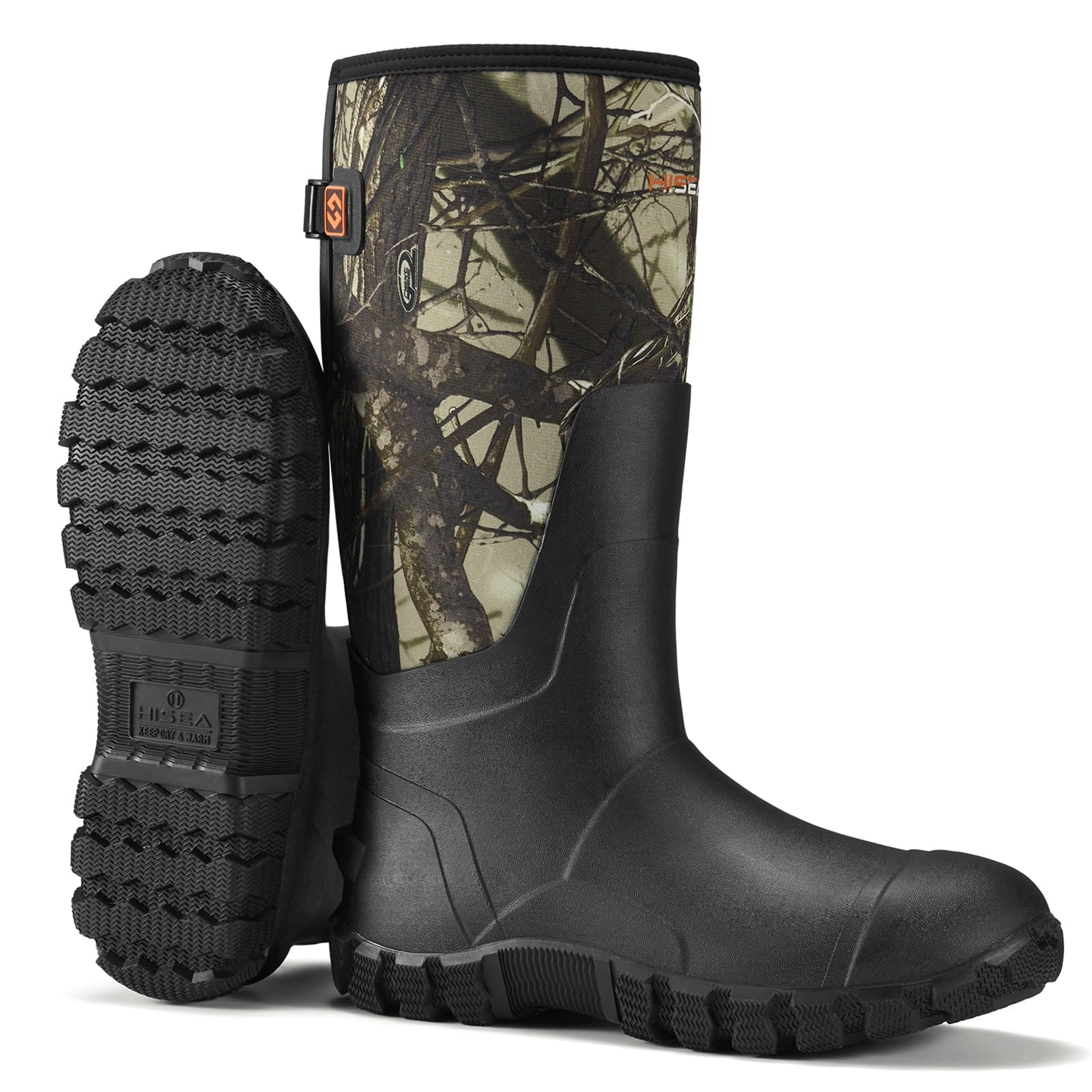
This is the workhorse of the group, and the steel shank is why. A steel shank is a rigid plate tucked between the insole and outsole, and here it does three jobs — it supports your arch, cuts foot fatigue, and adds puncture resistance against nails and sharp debris. Shovel through a long day of digging and it keeps your feet from aching. The 5mm insulating neoprene shell adds warmth and waterproofing together, keeping feet dry and warm down to 14°F (-10°C).
Compared with the Trudave women’s boot below, this HISEA runs 5mm neoprene against that model’s 6mm — the Trudave packs the thicker insulating layer. HISEA answers back with adjustability: the expandable back gussets and cinch buckles open wide for large calves and thick overalls, then cinch down for a sealed fit. A hands-free rear kick tab lets you step out without touching the muddy shaft with your hands.
Quality is what wins people over here, and it sits well ahead of the second-place trait. Be aware of the honest split on lifespan — some pairs hold up for years, while a minority wear out within a few months of hard use. That range is the reality of natural rubber under daily friction, so alternate pairs if you work eight-plus hours on abrasive asphalt or gravel. Also skip the heavy labor in summer heat above 86°F (30°C), where 5mm insulation runs too warm.
Reasons this earns the work-boot pick
- Steel shank supports the arch and resists punctures underfoot
- Adjustable back gussets open for large calves and thick trousers
- Rated warm and dry down to 14°F (-10°C)
The honest limits
- Durability is mixed — heavy abrasive use can wear the rubber faster
- 5mm insulation is not built for hot-weather physical labor
For the serious user: the steel shank and adjustable calf make this a work boot for farming, hunting, and heavy digging.
Not for warm-weather effort: look elsewhere if you need to work hard in summer heat.
4. Trudave Rubber Boots for Women
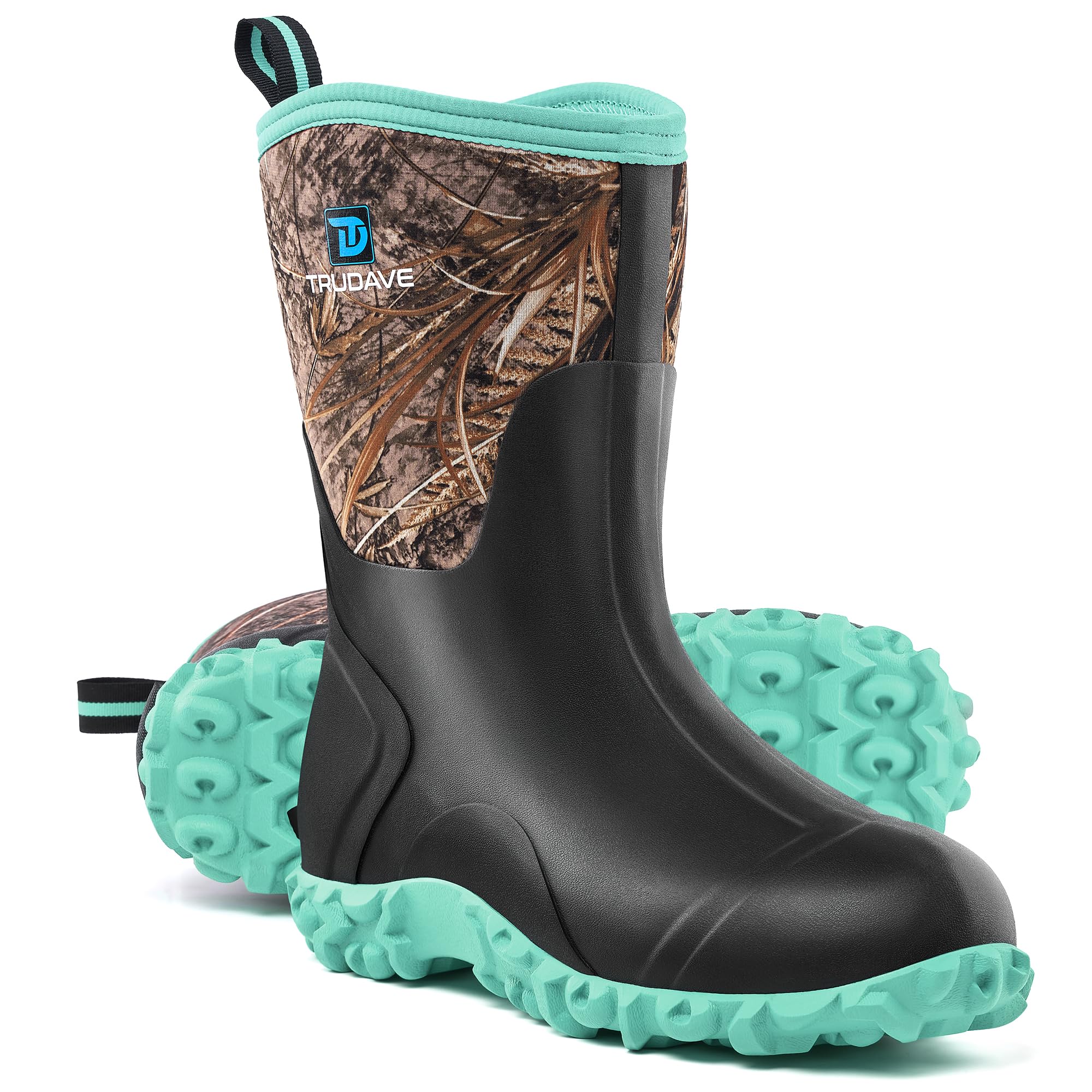
A mid-calf women’s boot with 6mm neoprene, a steel shank, and a deep-tread sole for muddy, sloped ground.
The standout spec is the 6mm neoprene shell — a full millimetre thicker than the HISEA men’s boot above. That extra cushioning is why this pair stays soft and breathable while it insulates, and it is why the fit flexes to accommodate both thin and thick socks. The built-in steel shank and deep-tread sole do the heavy lifting on uneven ground, so muddy paths and sloped work areas don’t slide out from under you.
Owners describe these as better than the boots they find in a farm store, and the numbers back a wide satisfaction spread. Quality leads by a wide margin, with fit close behind — the two traits owners bring up most. Warmth, traction, and ease of use all land solidly too, so the boots cover the full farm-and-garden day: put them on fast, stay warm, kick them off with the pull tabs.
The mid-calf cut is the choice that runs through everything. It stops above the muck and slush without climbing to the knee, so you get movement and a lighter feel for planting, feeding animals, and walking the fence line. It is not a deep-water or knee-high boot, so a flooded ditch will be over the top. For the actual farm and garden work these were built around, the mid-calf height is the right trade.
The thicker-neoprene edge: 6mm insulation against the HISEA’s 5mm gives this boot more warmth for cold-weather chores on the farm and around the garden.
Where it tops out: mid-calf height means standing water over the shin is outside what this boot handles.
The women’s work pick: go for this if you want 6mm warmth, a steel shank, and a mid-calf cut for farm and garden tasks.
Deep-water needs belong elsewhere: this boot stops at mid-calf, so knee-high water is not its job.
5. Trudave Rubber Boots for Men with Steel Shank, 5mm Neoprene

A 5mm neoprene men’s boot with a reinforced toe cap and an anti-slip outsole for flooded ground, snow, and mud.
This is the men’s counterpart to the women’s Trudave above, and the spec shift is notable: this one uses 5mm neoprene, while the women’s version uses 6mm. That half-step thinner shell keeps the boot a touch more flexible and less bulky for general wear, while a reinforced hard-plastic toe cap guards your toes against kicks and scrapes on the job.
What buyers rave about is how warm the boot runs — the insulation wraps your feet like a wet suit and keeps them dry and warm all day. The anti-slip outsole gives secure footing on flooded ground, snow, and mud, and the pull tabs make it fast to yank the boots on when you are heading out the door. Quality leads the feedback by a mile, with value coming in right behind it.
The one thing to factor in is durability. Some pairs hold up through months of hard use, and others rip within a month — a mixed result that depends on how you treat them. The sizing also runs mixed, so check the fit. These are built for flooded areas, snow, mud, hunting, fishing, camping, and rain, which is a wide enough use list to call them the most flexible men’s pick here.
Why this one flexes to fit more jobs
- 5mm neoprene keeps feet warm and dry like a wet suit
- Reinforced hard-plastic toe guards against kicks and scrapes
- Anti-slip outsole holds on flooded ground, snow, and mud
What to keep in mind
- Durability is mixed — treat the rubber well and expect honest wear
- Sizing runs mixed, so verify the fit before a big job
The do-everything men’s boot: reach for this if you need one pair for flooded areas, snow, mud, and outdoor work.
Eyes open on lifespan: the durability record is split, so buy with care and store the rubber out of the sun.
6. TIDEWE Rubber Work Boots
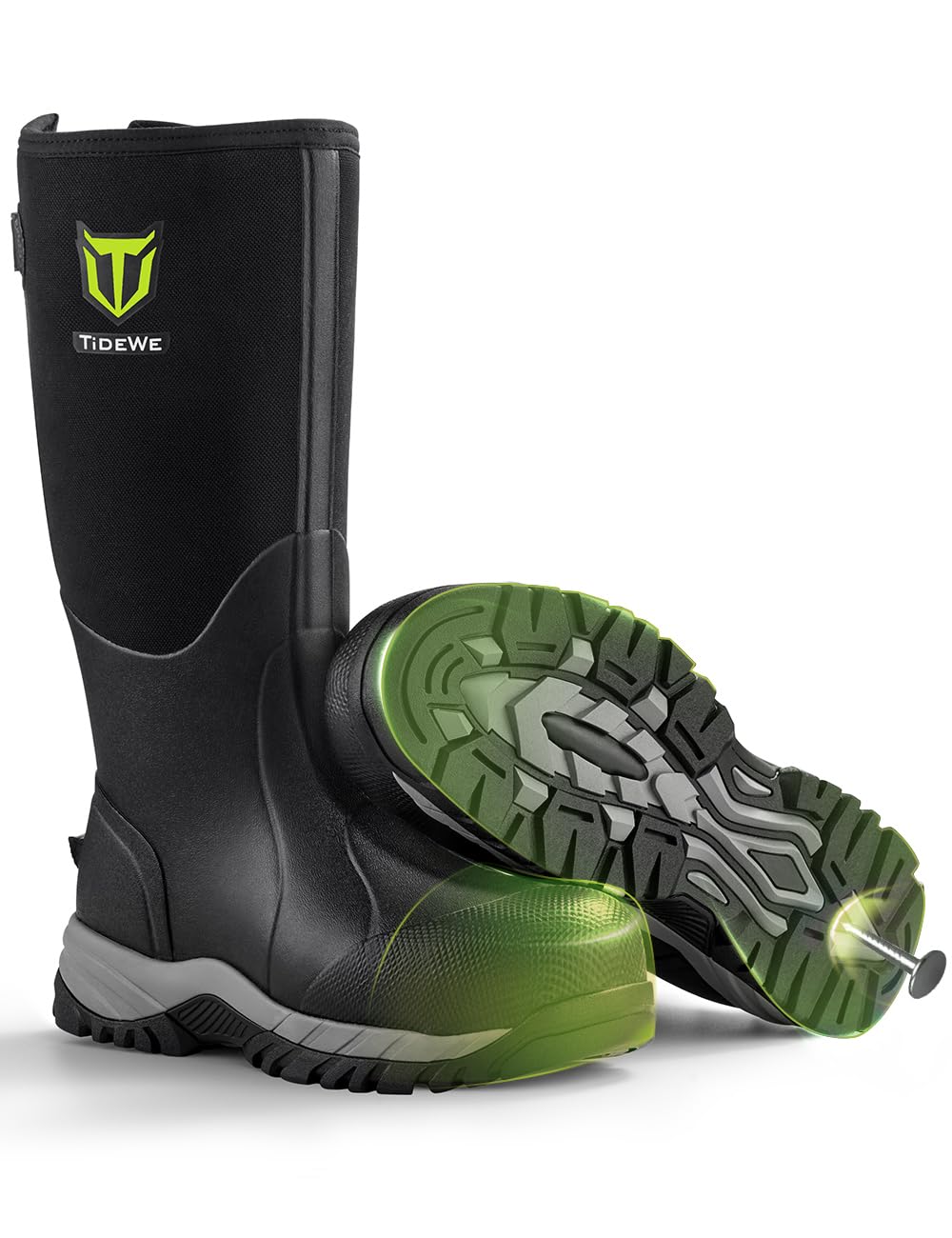
A rubber work boot with a steel toe, steel shank, and puncture-resistant underfoot layer.
Protection is the headline, and it comes in layers. A steel toe shields your foot from falling or rolling objects on a job site. A steel shank between the insole and outsole adds a barrier under your arch against sharp debris, so nails and scrap iron have less chance of reaching your foot. The maker even adds a puncture-resistant underfoot layer for a second line of defense.
Rubber and neoprene make up the shell, keeping feet dry on wet ground while the breathable inner lining keeps air moving when the work heats up. The sole has deep tread for grip on workplace terrain, and a shaft circumference of 10 inches gives the boot its shape around the lower leg. A pull-on design and kick tab mean you can get them on and off without sitting down.
The honest note is water resistance — it is mixed in owner feedback. Some wearers stay dry all day, while a few find their feet get wet quickly, which points to proper fit and shaft sealing mattering here. Otherwise, owners rate quality and value high, and the practicality of the pull-on design shows up as a real strength for people working in muddy boots every week.
The protection story: steel toe plus steel shank plus an underfoot puncture layer make this the most safety-focused boot in the lineup for construction, farm, and plant work.
Fit note: TIDEWE asks you to measure your foot and pick a size about 0.16 inches longer than your actual measurement for a proper fit.
For the safety-conscious worker: choose this if steel toe and puncture resistance matter more than a soft, flexible feel.
Seal the shaft: if you plan to wade deep, check the fit and tuck in your trousers, since water-resistance feedback varies.
7. Hunthor Hunting Boots for Men

A 6mm neoprene camo hunting boot with an EVA midsole and anti-slip outsole for mud, muck, and deep snow.
Hunters who wade into a wet field need more than waterproof — they need warmth that lasts through a long sit. The 6mm neoprene shell handles that, and the rubberized build keeps feet dry where the ground gives way. The Next Camo G2 pattern blends in with the surroundings, and the EVA midsole (a lightweight foam layer that cushions each step) keeps the boot comfortable on long hikes in.
Owners are clear about where this boot earns its keep: it handles mud, muck, 12-inch water, and deep snow. The anti-slip grip on the sole works well on muddy days. Quality leads the praise, and the durability of the build has been proven enough to call it a reliable hunting partner. Getting them on and off is simple too, which you appreciate when your hands are full in the field.
The catch is the fit. Sizing runs mixed for a fair number of wearers, so measure before you buy rather than assuming your usual size. It is also a boot built around hunting and cold outdoor work rather than a summer chore boot — the 6mm shell and insulated warmth would feel heavy on a hot day. Buy it for the blind and the muddy trail, not the summer garden.
What hunters get here
- 6mm neoprene keeps feet warm and dry in deep cold
- Anti-slip outsole grips muddy ground and wet grass
- Next Camo G2 pattern and EVA midsole cushion long hikes
Before you buy
- Fit runs mixed, so check your size against the chart
- Built for cold-weather use — heavy for a warm summer day
The camo-cold specialist: this is your pick if you hunt in muck and snow and want 6mm warmth with a subdued pattern.
Skip it for summer: the insulated shell is more boot than warm-weather chores call for.
8. Hunthor 800g Insulated Hunting Boots
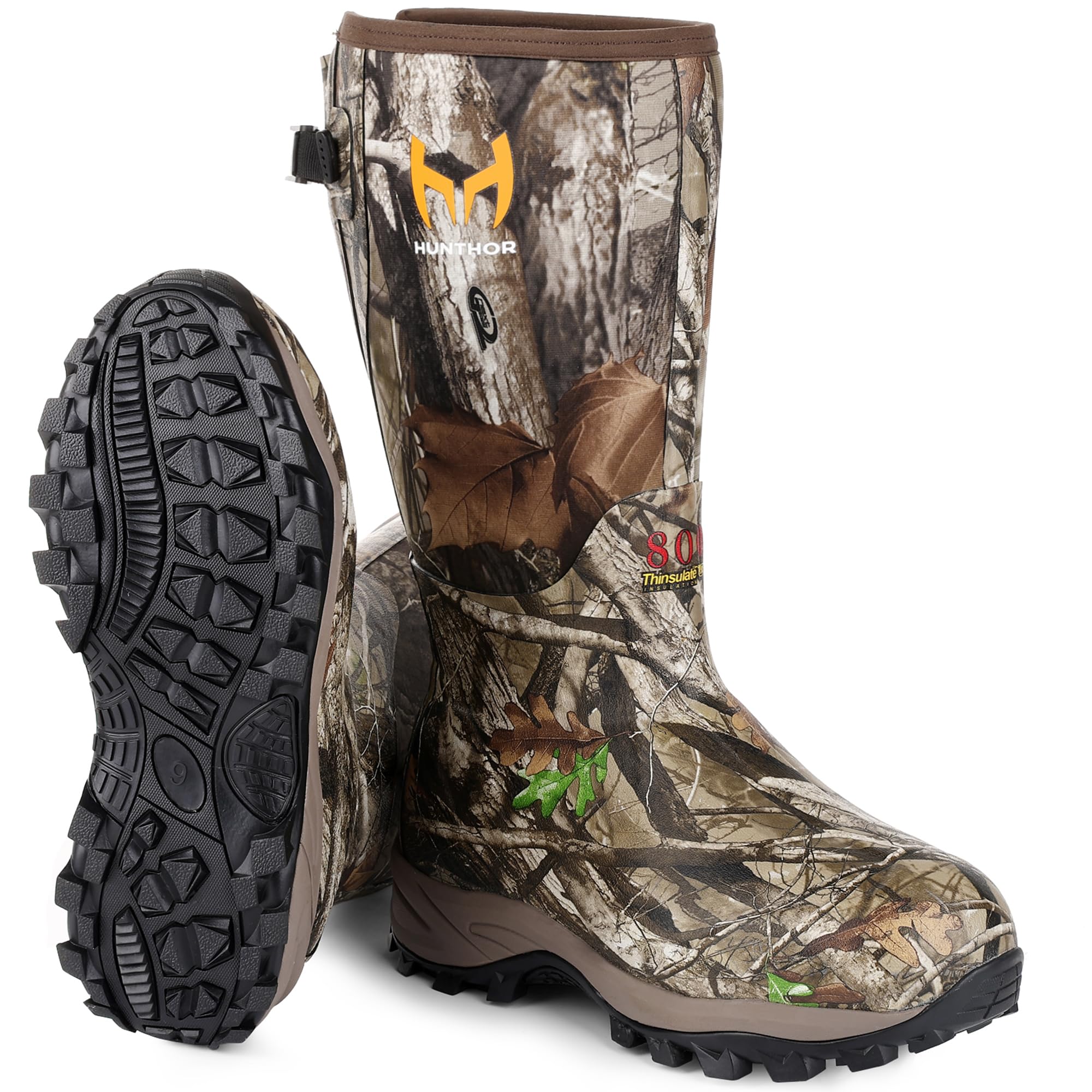
A waterproof rubber hunting boot with 800g 3M Thinsulate and an Ice-Grip outsole for frozen trails.
This boot dials up the warm-weather weakness of a hunting boot in the other direction. It uses 800g 3M Thinsulate — a measured weight of synthetic insulation — so the shell is built for cold stands where the temperature stays low and you sit still. The rubber and neoprene outer keeps water out, and the EVA midsole and Ice-Grip outsole (a sole made to bite into slick ground) work together on frozen trails.
Owners say the boot does its job: it keeps feet warm, fits comfortably, and holds water out on wet ground. Quality sits at the top of the feedback and warmth comes second, which tells you where the boot’s value actually lives — the insulation is the point. Long waits in cold conditions are exactly what this build was made for, and the warmth holds.
The trade-offs are weight and fit. Some find the boot runs too big and others find the size just right, so check the chart carefully before you commit. Weight is also mixed — a heavier insulated boot is not the easiest thing to walk miles in, which is fair for 800g of insulation. This is the boot for the cold-weather hunt, not a light chore boot.
Where it wins: 800g 3M Thinsulate and a waterproof rubber shell make this the warmest-focused pick for freezing conditions and long sits in the cold.
Sizing heads-up: some find the fit too big and others spot on, so go by the size chart rather than habit.
Built for the freeze: buy this if you need serious insulation for cold-weather hunting and long, still sits outdoors.
Watch the size: the fit is the one variable to check, since it runs big for some and true for others.
9. TIDEWE Rubber Hunting Boots

The thickest, warmest shell in the lineup — 7mm neoprene for the deep cold.
This is the maximum-warmth option, and the spec stack shows it: 7mm neoprene, the thickest in this lineup, plus 800g insulation packed inside. It is the boot you reach for when the temperature drops and you still need to be outdoors for hours. Rubber and neoprene flex as you walk so your legs move naturally, which owners contrast favorably with stiffer boots that feel locked in place.
Comfort shows up in the details — a thick cushioned footbed and generous toe room give you space to move. The Next Camo G2 pattern keeps you subtle in the field. Quality is what buyers prize most, and a full season of hard hunting use has been part of the durability story. Cold weather, wet ground, and long days are where this shell proves its worth.
The honest limits are sizing and bulk. Some buyers find the boot true to size and not too heavy, while others find the sizing chart inaccurate and the boot bulky. With 7mm of neoprene and 800g of insulation, it is inherently a substantial boot, so anyone wanting a light chore boot should look elsewhere. For the cold-weather hunter, that heft is the price of warmth.
The warmth-maxing features
- 7mm neoprene — the thickest shell reviewed here
- 800g insulation with a thick cushioned footbed and roomy toe
- Flexible rubber and neoprene that moves with your walk
What to weigh
- Sizing feedback is mixed — some report the chart runs inaccurate
- Bulky and heavy for a light-use buyer, which is expected at 7mm
The deep-cold choice: pick this if you want the maximum 7mm shell and 800g insulation for serious cold-weather hunting.
Buyers wanting light weight: look to the Tingley instead, since this boot is built substantial on purpose.
Know the Specs
Neoprene Thickness (mm)
Neoprene is the soft, spongy layer under the rubber, and its thickness decides how warm the boot runs. A thicker shell like 7mm traps more heat for deep cold but adds bulk. A thinner 5mm shell flexes more and suits cool-weather work rather than a freezing blind.
Insulation Weight (grams)
Insulation weights like 800g describe how much synthetic fill sits inside the boot. Higher grams generally mean more warmth for standing in cold conditions. If you work hard and stay moving, heavy insulation can be too warm, so match the grams to how much you plan to sit still.
Steel Shank and Steel Toe
A steel shank is a stiff plate under the arch that supports your foot and resists sharp debris. A steel toe is a metal cap over the front of the foot that shields you from falling objects. Both add weight but deliver support and protection plain-sole boots don’t offer.
Shaft Height and Calf Fit
Shaft height — mid-calf, knee-high, or 15 inches — decides how deep a puddle you can stand in. Taller shafts keep water out but need more calf room. Adjustable gussets and pull tabs help you get a taller boot on over thick socks and off again without a struggle.
Common Questions
Do waterproof rubber boots keep feet dry all day?
What is the difference between 5mm and 6mm neoprene boots?
Do I need a steel shank in rubber boots?
How should rubber boots fit over thick socks?
Can I wear insulated rubber boots in summer?
What does 800g insulation mean on a hunting boot?
How do I stop rubber boots from cracking?
Are knee-high boots better than mid-calf boots for mud?
Is a steel toe rubber boot safe near nails and sharp debris?
The Bottom Line
For one pair that covers mud, rain, snow, and chores with real shaft height, start with the Edgewater Original Men’s 15″ Field Boot — it earns the top spot on comfort and a 15-inch waterproof shell that keeps water well below the knee. If lightness and cold-weather warmth top your list, the Tingley Airgo Ultralight Knee Boot is 70% lighter than heavier rubber and PVC boots, according to the maker, and still keeps feet warm in subzero temperatures. For heavy digging and hunting in wet ground, reach for the HISEA Men’s Rain Boots with Steel Shank — the steel shank (a metal strip inside the sole that supports the arch) holds up through long shifts, and the adjustable calf cinches to a sealed fit.
How we choose
We do not accept paid placement. Every pick is matched to a real buyer and a real use-case; we do not hands-on test units.
Sources
Specifications: manufacturer listings and product documentation. Review insights: verified customer reviews, as of November 2026. Pricing: not shown on this page (it changes often); check the current price via the retailer link.
As an Amazon Associate, Tactical Gear Guy earns from qualifying purchases. This does not affect which products we feature.