Specs are compiled from manufacturer listings and verified buyer reviews and can change over time — please confirm the key details on the product page before buying.
You want a phone that rings over Wi-Fi instead of a wall jack — either a desk handset for a home office or a pocket phone that switches between cell towers and your router. That is the whole split in this category, and it decides your pick before any spec does. Below you get both kinds: dedicated VoIP desk sets built to sit on a desk all day, and open up smartphones that handle Wi-Fi calling on your carrier’s network.
This guide is built by comparing the manufacturers’ published specifications and the patterns across verified customer reviews, so you get each pick’s real strengths and trade-offs instead of marketing spin.
The desk sets live or die on PoE (Power over Ethernet, which feeds power and data through one cable) and account limits, while pocket phones hinge on battery and carrier lock. Here is how each Wi-Fi phone earns its place on your desk or in your bag.
Top Picks


How To Choose The Best Wi-Fi Phone
Start by deciding which job the phone has to do. A desk handset plugs into your router or a PoE switch and runs a business phone service. An open up smartphone runs your carrier’s Wi-Fi calling plus apps. Those are two different machines, and mixing the requirements is the most common buying mistake here.
SIP accounts and how many lines you really need
A SIP account is one line registered to a calling service. A desk phone that offers 4 accounts can juggle four separate lines or providers at once. If you run one office line, a single account is plenty. If you answer a main number plus two department lines, the account ceiling becomes the deciding spec.
PoE versus a power adapter in the box
PoE feeds power and network data through one Ethernet cable, so the phone needs no wall outlet of its own. That is genuinely useful when the desk sits away from a socket. The catch is that PoE only works if your switch or injector supplies it — otherwise you need the power adapter, and some desk sets ship without one.
Wireless range and roaming for the cordless models
Cordless Wi-Fi handsets depend on dual-band radios (2.4GHz and 5GHz) and roaming support to stay connected as you walk. If you plan to take calls between rooms, check that the handset names dual-band support and that your access points cover the space before you buy.
Side-by-Side Comparison
| Model | Best For | Display | Wi-Fi / Power | Lines | Amazon |
|---|---|---|---|---|---|
| Yealink T57W★ Best Overall | Heavy call load on one desk | 7 in, 800×480 color touch | 802.11ac Wi-Fi, 802.3af PoE | 16 SIP accounts | Amazon |
| Tracfone Galaxy A16 5GBudget Calling | Wi-Fi calling on a tight budget | 6.5 in FHD+ AMOLED | Wi-Fi, 5000mAh battery | Single carrier (Tracfone) | Amazon |
| Grandstream WP826Room Roamer | Walking around the office | 4 in color LCD | Wi-Fi, charging base included | Multi-line | Amazon |
| Grandstream WP820 | Portable handset on Wi-Fi | — | Dual-band Wi-Fi, 1500mAh battery | Multi-line | Amazon |
| Yealink SIP-T34W | Adapter-included desk set | 2.4 in, 320×240 color | Dual-band Wi-Fi, PoE + adapter | 4 SIP accounts | Amazon |
| Ooma Telo Air + HD3 | Whole-home service, one bill | 2 in color on HD3 handset | Wireless connectivity to router | Single-line | Amazon |
| Motorola Moto G Power | All-day open up smartphone | 6.8 in OLED, 120Hz | Wi-Fi, 5000mAh battery | Single carrier (open up) | Amazon |
| TCL 60 XE NXTPAPER 5G | Long reading sessions on a phone | 6.8 in FHD+, 120Hz | Wi-Fi, 5010mAh battery | Single carrier (open up) | Amazon |
Detailed Reviews
1. Yealink T57W IP Phone
Our pick — 4.0+★ from 100+ verified ratings; the strongest balance of quality and price.
A desk console that treats sixteen separate lines as routine rather than a stretch.
If your desk phone is the front door to a business, this is the one that holds up under the traffic. It carries 16 SIP accounts — sixteen separate lines or providers registered at once — and 29 touch keys for them. The 7-inch 800×480-pixel color touch display is fully adjustable, so you can tilt it to whatever angle your eyes land at. Set against the Yealink SIP-T34W’s 2.4-inch screen, that is roughly three times the panel width, which turns a cramped menu into a set of keys you can actually hit.
What wins people over is the sound quality on the other end of the call. HD Voice with Yealink Acoustic Shield, the maker’s noise-handling name, keeps your voice readable in a busy room. Owners read this model as easy to live with day to day, menus included, and the call quality is the part that gets talked up most.
The plate that catches buyers is power. PoE support at 802.3af is here, and a USB 2.0 port handles call recording or a wireless USB headset, but there is no power adapter in the box. If your switch or injector does not push PoE, budget for the adapter separately. It also pairs with Yealink DECT dongles and up to 4 compatible cordless handsets, so a cordless add-on is possible later.
Where the T57W Pulls Ahead
- 16 SIP accounts and 29 touch keys give a heavy-call desk room to breathe
- 7-inch 800×480 adjustable touch panel is the roomiest screen among the desk sets here
- 802.11ac Wi-Fi plus dual-port gigabit Ethernet and 802.3af PoE
- HD Voice with Acoustic Shield keeps the call readable in a noisy office
What You Should Plan Around
- Power adapter is not included — you need PoE at the desk or a separate adapter
- Console footprint is larger than a basic handset
Worth the desk space for: reception, sales, or a manager juggling several lines who wants a big adjustable touch panel.
Plan ahead on: power — confirm your PoE switch first, because there is no adapter in the box.
2. Tracfone Samsung Galaxy A16 5G
A pocket phone that makes Wi-Fi calls without asking much of your wallet.
Here is the display story in hard numbers: this screen resolves 2340×1080 pixels against the Yealink SIP-T34W’s 320×240. That gap is the whole point of a smartphone over a desk handset — text, photos, and video calls all land with room to spare. The 6.5-inch FHD+ Super AMOLED panel runs at 403 pixels per inch and a 90Hz refresh rate, so scrolling stays smooth.
Performance is where the phone settles in — it handles normal use without fuss, and the 5000mAh battery covers a full day on a charge. At 5000mAh, that cell dwarfs the 1500mAh pack in the Grandstream WP820. You get 25W Super Fast Charging to refill, and 128GB of storage expandable up to 1TB with a microSD card (sold separately). The 50MP triple-lens camera handles landscapes through the ultrawide and detail through the macro.
The catch is the word locked in the title. This handset is tied to Tracfone and needs a Tracfone plan to activate, so it is not a bring-your-own-carrier phone. Speed draws mixed reactions once downloads start buffering, too. If you are already on Tracfone or adding a cheap dedicated calling line, carry on — otherwise look at the open up picks.
Why it earns a slot: the 6.5-inch AMOLED at 2340×1080 and the 5000mAh battery are the two specs that make this feel far above its tier.
The honest limit: carrier lock is the deal-decider here — it works on Tracfone’s network only.
Reach for this if: you’re already on Tracfone or want a second cheap line for Wi-Fi calling and light use.
Look elsewhere if: you need to pop in a SIM from another carrier — this phone won’t take one.
3. Grandstream Cordless WiFi IP Phone WP826 SIP Phone
The handset that walks with you instead of chaining you to a base.
For anyone whose calls happen while moving — warehouse aisles, a shop floor, a big house — the cordless frame is the whole argument. This is a Wi-Fi handset with a 4-inch color LCD, a screen large enough to read caller names and menus without squinting. Its dual keypad and navigation buttons are laid out for plain operation rather than menu diving.
Connectivity is the strength that shows up most in owner experience, with functionality close behind. It works cleanly with service platforms including UniFi Talk and 8×8 PBX — worth knowing if your office already runs one of those. Sound comes through clearly and the build feels solid in the hand. It weighs 0.4 kg, heavy enough to feel planted but not a burden to carry room to room.
Setup splits the room. Some find configuration simple; others hit friction getting it onto the network the first time. Both are reported, so plan on a little patience if you are not comfortable with VoIP settings. The box includes the charging base, handset, and power adapter, so you can drop it on the cradle between calls.
Standout Strengths
- Cordless freedom from the base station while staying on Wi-Fi
- 4-inch color LCD makes caller info easy to read at a glance
- Works with UniFi Talk and 8×8 PBX per owner reports
- Charging base and power adapter included in the box
Worth Weighing First
- Setup divides opinion — some find it easy, some hit snags
- Plastic enclosure, so treat it as an office tool rather than a tank
The right call for: anyone who answers while walking and already runs a VoIP service like UniFi Talk.
Think twice if: you want zero-setup simplicity — this one may need a patient first configuration.
4. Grandstream WP820 Wireless Wi-Fi Phone

A Wi-Fi handset small enough for a belt clip and smart enough for Bluetooth.
The defining number is the 1500mAh battery: 7.5 hours of talk time and 150 hours of standby. That is a work shift of continuous calling before you head back to the cradle, and a week of idling between charges. The unit weighs 161 g and carries a belt clip, so it rides on your hip rather than tying up a desk.
Dual-band Wi-Fi with an efficient antenna design and advanced roaming support means it can hand off between access points as you move through a building. Bluetooth lets you sync a headset or a mobile device for contacts and call transferring. HD voice with a dual-mic design, AEC (echo cancellation) and Noise Shield keeps conversations clean. There’s a micro USB port and a 3.5mm headset jack if wired is more your speed.
Owner opinion is split on the practical stuff. Sound is consistently described as high-definition, and the value reads as fair. Where it wobbles is connectivity, functionality, and ease of use — some find it straightforward, others find it too complicated. If you have a VoIP administrator or patience with network settings, that is manageable. If you want it working in five minutes flat, set expectations.
What clicks: the 1500mAh cell delivers 7.5 hours of talk time, enough for a shift without a recharge.
The honest trade-off: setup and connection behavior divide buyers — some find it easy, others find it complicated.
Suits you if: you need a clip-on Wi-Fi handset for a warehouse, hospital floor, or shop where you move constantly.
Not for everyone: the setup leans technical, so it wants someone comfortable with VoIP configuration.
5. Yealink SIP-T34W WiFi IP Phone

The one plain desk set that ships with the power brick already in the box.
That single detail settles a lot of purchases. If you have no PoE switch at the desk, this phone powers up from the start — the adapter is included, unlike the T57W above. It runs dual-band 2.4G/5G Wi-Fi (802.11a/b/g/n/ac) and supports 802.3af PoE if you do have a powered switch.
The 2.4-inch 320×240-pixel color display with backlight is far smaller than the T57W’s 7-inch touch panel — roughly a third of the width — but it covers four SIP accounts and 5-way conference calling. A USB 2.0 port handles a wired USB or Bluetooth headset. If you want a simple four-line desk phone and nothing more, this delivers exactly that.
Owner reports split on overall quality. Some find it great, others report poor quality, and setup is what most agree on as straightforward. That mixture is worth taking seriously: this is a plain tool, not a flagship, so match it to a light-call desk rather than a mission-critical reception line.
Where it earns its keep: the included power adapter plus 802.3af PoE support means it works whether or not your switch pushes power.
The caveat: quality is the most-debated point, so treat it as a solid light-duty phone and not a premium console.
Pick this if: you want a 4-account desk phone with the wall adapter sorted so setup is genuinely plug-and-go.
skip it if: your desk handles heavy, multi-line traffic — the T57W above covers that better.
6. Ooma Telo Air VoIP
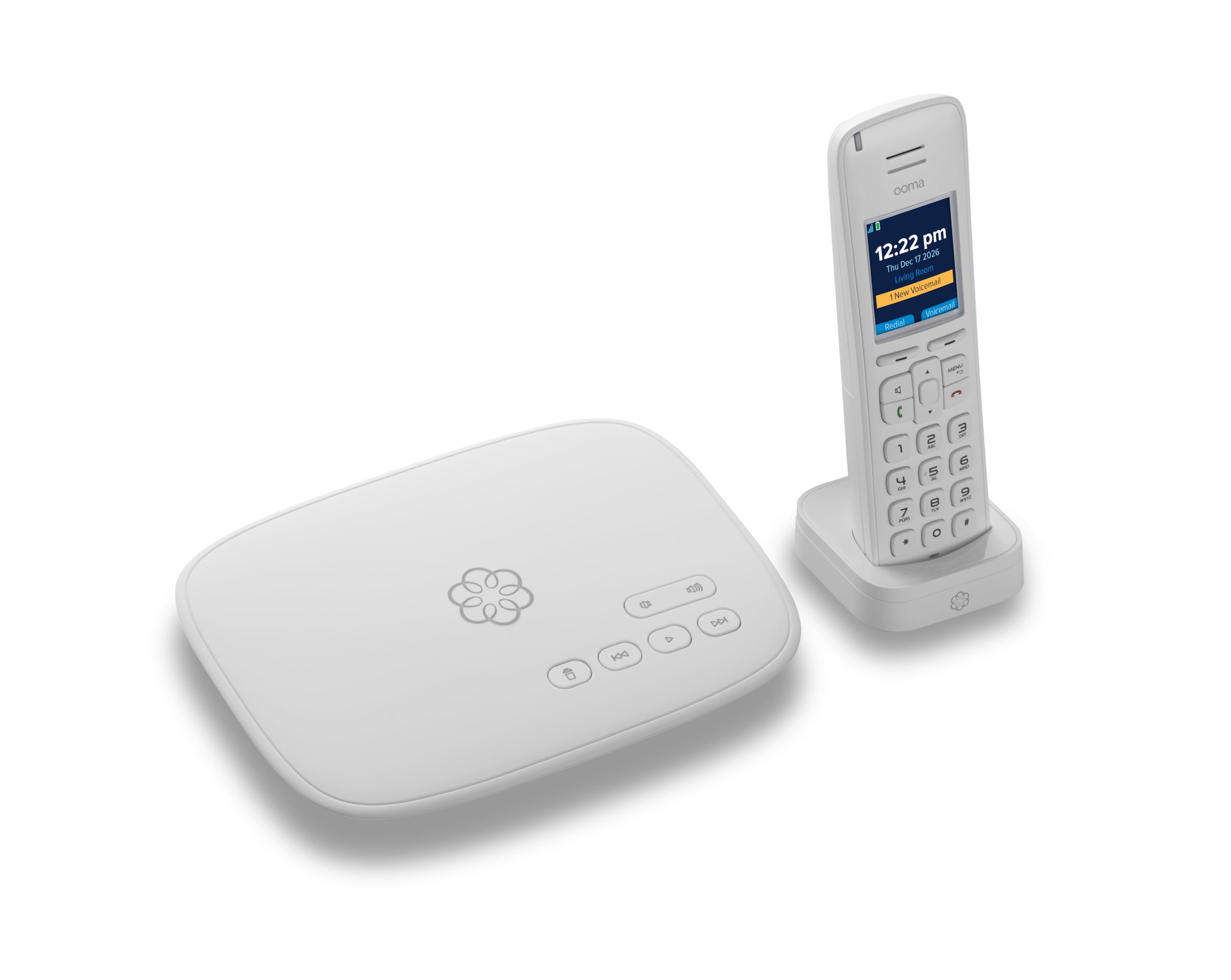
Not just a phone — a whole-home calling service you place anywhere near Wi-Fi.
This is the pick to think about differently. You aren’t buying a handset, you’re buying a service bundle: the Telo Air base plus one HD3 handset with a 2-inch color screen. Built-in wireless connectivity lets you place the base anywhere in the house near your router, no Ethernet run required. It works only in the US.
What you get is unlimited calling in the US, voicemail, caller-ID, call-waiting, 911 calling, and text alerts. Long distance international rates are billed at low rates, and the Ooma mobile app lets you take the home line on the go. Owners single out the savings, with many reporting a noticeably lower bill than a traditional landline. The single-line operation is deliberate: one home number, done well.
Where the bundle needs reading is scope. It is a single-line system, so it is not a multi-line office setup. It also locks you into Ooma’s service, with monthly taxes and fees on top. Setup tends to be quick, and support gets generally good marks. If you want a landline replacement with no per-minute countdown, this fits.
The pitch in one line: a 2-inch color HD3 handset plus a wireless base that frees your home number from the wall jack.
Read the fine print on: it’s a service bundle, so ongoing fees and a US-only footprint come with it.
Ideal for: households replacing a landline with one clean home number and a handset in the kitchen or hallway.
Not the tool for: a multi-line office — the Telo Air is single-line by design.
7. Motorola Moto G Power – 2025

The open up smartphone that keeps Wi-Fi calling and stays on past dinner.
This is the pick for anyone who wants a full smartphone without the carrier lock the Tracfone above carries. It is open up and built for US networks — Verizon, AT&T, T-Mobile and other major carriers. Motorola rates talk time at 24 hours per charge.
The display is a 6.8-inch OLED running at 120Hz, which means scrolling and video feel smooth. Resolution tops out at 2388×1080. Stereo speakers with bass boost round out the media side. The 50MP camera adds Optical Image Stabilization for steadier low-light shots, and the vegan leather back with Corning Gorilla Glass feels better in hand than plastic. A MediaTek Dimensity 6300 chipset handles 5G, and RAM Boost extends memory to 24GB.
Storage is 128GB built-in, expandable up to 1TB with a microSD card. Two things to note: the charger that open up the 30W TurboPower speed is sold separately, and RAM Boost borrows from storage rather than adding real memory. At 8GB physical RAM, the real-world multitasking sits below the biggest spec sheets. Still, for Wi-Fi calling, apps, and streaming, this is a capable open up phone.
What stands out: a 6.8-inch 120Hz OLED, 5000mAh battery, and 50MP OIS camera in one open up package.
The separate purchase: the 30W TurboPower charger is not included, so fast charging is an add-on.
Reach for this if: you want an open up 5G phone with a big 120Hz screen and a battery that lasts past a full day.
Be ready for: buying the fast charger separately if quick top-ups matter to you.
8. TCL 60 XE NXTPAPER 5G

A phone designed to read like paper, with storage enough to keep everything.
The distinctive spec here is the NXTPAPER 3.0 panel: a paper-like, anti-glare view that reduces blue light by up to 61%. A dedicated button flips between Standard, Ink Paper, Color Paper, and Max Ink modes, so e-book reading softens the glare while apps and video stay crisp. That makes it a fit for commuters, students, and anyone glued to a screen for hours.
Storage is the other draw. You get 8GB of RAM plus 8GB of virtual RAM, and 256GB of storage expandable to 2TB via microSD. The MediaTek Dimensity 6300 octa-core processor runs it, and the 6.8-inch FHD+ display keeps the 120Hz refresh rate with dual DTS-enhanced speakers. The 5010mAh battery supports 18W fast charging and 5W reverse charging for topping up other devices. The 50MP main camera sits alongside a 32MP front camera for video calls.
The 50MP camera and the battery land in mixed territory — usable, not class-leading. Functionality also splits: some find it performs like much pricier Android phones, others report it stops working. It is open up for AT&T, T-Mobile, and Verizon, with compatibility varying by SIM and plan. Its real home is reading and browsing, where that glare-resistant panel does the work.
Where it shines: NXTPAPER 3.0 and the four display modes reduce glare for long reading sessions while the 6.8-inch 120Hz panel stays smooth.
The realistic limit: camera and battery results are mixed, so buy for the screen and storage, not outright camera dominance.
Made for: heavy readers and note-takers who want a matte, eye-easier screen and 256GB of built-in room.
Look past it if: you need the sharpest camera or bulletproof reliability — those areas are a mixed bag here.
Know the Specs
SIP accounts and multi-line operation
SIP stands for Session Initiation Protocol, the standard that registers a phone to a calling service. Each SIP account is one line or provider. A phone with 16 accounts can sit on many lines at once, which is useful for reception or sales; a 4-account phone covers a simple desk. Multi-line operation just means the display and keys are built to switch between those lines quickly.
PoE and power adapters
PoE (Power over Ethernet) sends electricity and network data through one cable, so a desk phone needs no wall outlet. It only works if your switch or an injector supplies it. When it does not, you need a power adapter — and not every phone includes one in the box, so check that before you order.
Battery talk time versus standby
Talk time counts active calling hours; standby counts hours idling on the charger’s edge. A cordless handset with 10 hours of talk time lasts a full shift, while 150 hours of standby covers days between charges. Match the talk-time figure to your longest shift rather than the standby headline.
Wi-Fi bands and roaming
Dual-band means the phone uses both 2.4GHz and 5GHz networks — 2.4GHz reaches farther, 5GHz moves data faster. Roaming support lets it hand off between access points as you walk through a building. For a cordless Wi-Fi phone, that pairing keeps a call alive as you move.
Common Questions
Can a Wi-Fi phone work without a landline or internet service?
Do I need PoE for the Yealink T57W, or is a power adapter included?
What does a SIP account actually let me do?
Will a cordless Wi-Fi handset stay connected as I walk around the building?
How long does a cordless Wi-Fi phone battery last between charges?
Is the Tracfone Galaxy A16 5G locked to Tracfone?
Can I use a Bluetooth headset with these Wi-Fi phones?
What’s the real difference between a VoIP desk phone and an open up smartphone for Wi-Fi calling?
Will an IP67-rated phone survive being dropped or rained on?
The Bottom Line
For most desk buyers, the Yealink T57W is the clear winner: 16 SIP accounts, a 7-inch adjustable touch screen, and HD Voice that reads as easy to live with. If you need a rug-and-dust partner for shift work, the WP836 brings IP67, Wi-Fi 6, and 10 hours of talk time. And if a whole-home number without a wall jack is the goal, the Ooma Telo Air bundle delivers one clean line and an HD3 handset.
How we choose
We do not accept paid placement. Every pick is matched to a real buyer and a real use-case; we do not hands-on test units.
Sources
Specifications: manufacturer listings and product documentation. Review insights: verified customer reviews, as of November 2026. Pricing: not shown on this page (it changes often); check the current price via the retailer link.
As an Amazon Associate, Tactical Gear Guy earns from qualifying purchases. This does not affect which products we feature.