Specs are compiled from manufacturer listings and verified buyer reviews and can change over time — please confirm the key details on the product page before buying.
Your chest tracker is the one your avatar’s torso and head tilt depend on, and it is the tracker most people mount worst. Too loose and every bow, lean and dance step reads as a rubbery wobble. This guide covers seven chest-mount setups, sorted by what each does best, so you can match hardware to your headset before you spend anything.
This guide is built by comparing the manufacturers’ published specifications and the patterns across verified customer reviews, so you get each pick’s real strengths and trade-offs instead of marketing spin.
The biggest trap is buying a tracker without checking whether it needs base stations, a wireless dongle or a PC. Below are the practical differences between base-station, camera-based and IMU strap-based chest setups. Each option is broken down by what it needs before it will track your torso.
Top Picks


How To Choose The Best VR Chest Tracker
The chest tracker is the sensor your avatar’s whole upper body hangs off. It tells the game which way your torso is facing and how far you are leaning. If it slips or drifts, your shoulders and head rotate wrong even when your feet are perfect. So the first question is not which tracker is fastest. It is which mount keeps the sensor locked to your sternum while you breathe, twist and bend.
Base stations, cameras or motion chips: pick your tracking system first
Base-station trackers need external lighthouses (the small boxes that flood the room with tracking signals) mounted around your play space. They give precise room-scale tracking but you must own or buy those base stations, and they stay fixed to one room. Inside-out trackers use cameras built into the tracker itself, so they need no lighthouses at all but they do need a wireless dongle plugged into your headset. IMU trackers use motion chips (tiny sensors that measure rotation and acceleration) and straps, which makes them the cheapest route to a full six-point body rig — but they estimate position from movement, so a loose strap hurts them more than any other type.
How the chest mount stays on
A chest tracker is usually held by a belt or a torso strap, and that strap is where most rigs fail. Elastic neoprene with a broad contact patch holds a sensor against your ribs better than a thin band that rolls up when you bend. Look for a buckle you can tighten one-handed, because you will adjust it after the first five minutes of moving. If the strap stretches out, the tracker swings and your avatar’s torso lags behind your real body.
How many trackers you actually need
Full-body tracking with base stations can run on as few as three trackers, with one of them on the chest or waist. Camera-based systems want three trackers for body tracking and up to five for controller-free hands and feet. Six-point IMU kits cover feet, knees, hips and chest in one box. Count the trackers in the box before you compare anything else, because a single tracker will not give you a chest mount on its own.
Side-by-Side Comparison
| Model | Best For | Tracking Type | Battery | Weight | Amazon |
|---|---|---|---|---|---|
| HTC VIVE Tracker (3.0)★ Best Overall | Most buyers building a base-station rig | SteamVR base station (BS1.0 / BS2.0) | 7.5 hours | 75 g | Amazon |
| VIVE Ultimate Tracker Strap + Dance Dash KeyStrap Add-On | Chest and body mounting for Ultimate Tracker owners | Strap accessory for SteamVR-compatible headsets | — | — | Amazon |
| VIVE Tracker (3.0) – Go Beyond Controllers | Buyers who want the compact version of the 3.0 | SteamVR base station (BS1.0 / BS2.0) | 7.5 hours | 75 g | Amazon |
| Full Body Trackers FBT Kit (6-Pack) | Dancers and streamers on a tight full-rig budget | IMU motion sensors, SlimeVR-compatible | 9 hours | 30 g | Amazon |
| Rebuff Reality Trackstrap Plus | Long sessions and marathon dance nights | Strap plus built-in power for Vive and Tundra trackers | 20 hours | 1.2 lb | Amazon |
| HTC 3 Pack VIVE Tracker (3.0) with TrackBelt + TrackStraps | A complete three-tracker rig in one order | SteamVR base station (BS1.0 / BS2.0) | 7.5 hours | 2.3 lb (kit) | Amazon |
Detailed Reviews
1. HTC VIVE Tracker (3.0)
Our pick — 4.5+★ from 2,000+ verified ratings; the strongest balance of quality and price.
The tracker most chest rigs are built around, and the one with the track record to back it.
This is the default chest and body sensor for a SteamVR setup, and the reason is coverage. A 240° field of view (the spread of tracking volume the sensor can see) means the base stations keep it in view through big torso twists and overhead reaches, so your avatar’s shoulders follow you instead of snapping late. You only need three trackers to capture full-body motion when your base stations are SteamVR BS1.0 or BS2.0, which keeps the chest sensor affordable to add.
Owners describe quality as the thing that wins them over, and the tracking itself as perfect in daily use — this is the tracker people keep for years rather than swap. It is also 15% lighter than the 2018 version, at 75 g on this listing, so a chest belt does not drag forward when you lean. Battery lands at up to 7.5 hours, up to 75% longer than the older model, which comfortably covers an evening session without a mid-session charge. The included dongle and USB-C cradle mean the box is ready to pair the moment it arrives.
The honest limits are the ones HTC prints on the box: you need base stations and software sold separately, plus a free USB connector on your PC for each tracker in use. Cost is the other recurring note — the value lands where you already own lighthouses, and stings if you are starting from nothing. Connecting it is also a step some buyers find fiddly, so budget a little setup patience.
Where it pulls ahead
- 240° field of view holds the chest sensor through twists and leans
- Full body from as few as 3 trackers on BS1.0 or BS2.0 base stations
- 75 g and 7.5 hours — a chest belt stays comfortable through a session
- Dongle and USB-C cradle included so it pairs straight away
What you sign up for
- Base stations and software are sold separately
- Each tracker needs a free USB port on your PC
- Setup is fiddly for some buyers
Go for it: the right call if you already run SteamVR base stations and want a chest sensor that covers big torso movement.
Think first: if you own no lighthouses, price the base stations into the purchase before you commit.
2. VIVE Tracker (Ultimate) Strap + Dance Dash Game Key
The mount, not the sensor — for buyers who already own an Ultimate Tracker.
Read this one carefully before buying: it is a strap for the VIVE Ultimate Tracker, not a tracker. The listing lists a strap as the built-in media and names a SteamVR-compatible VR headset as the compatible device, alongside a Dance Dash game key. That means it solves the chest-mount problem for hardware you already have — how the sensor stays against your torso while you move — rather than adding tracking of its own.
The material is breathable elastic neoprene, and that choice matters for a chest position specifically. A torso sensor sits against your ribs where breathing and bending move fabric constantly, so a strap that vents heat and still holds firm beats a rigid plate you end up repositioning every few minutes. Adult sizing and a Windows operating system requirement round out the spec sheet, so a Windows-based SteamVR setup is the target here.
What the listing tells you: breathable elastic neoprene, one strap, adult fit, SteamVR headset compatibility and a bundled game key — clean, focused and honest about being an accessory.
The question to ask first: if you do not already own a VIVE Ultimate Tracker, this strap has nothing to hold, so check your hardware before you add it to a cart.
Best paired with: an Ultimate Tracker you already own and want strapped to a chest or torso position.
Not a starter kit: it adds no sensor of its own, so treat it as the finishing piece rather than the foundation.
3. VIVE Tracker (3.0) – Go Beyond Controllers
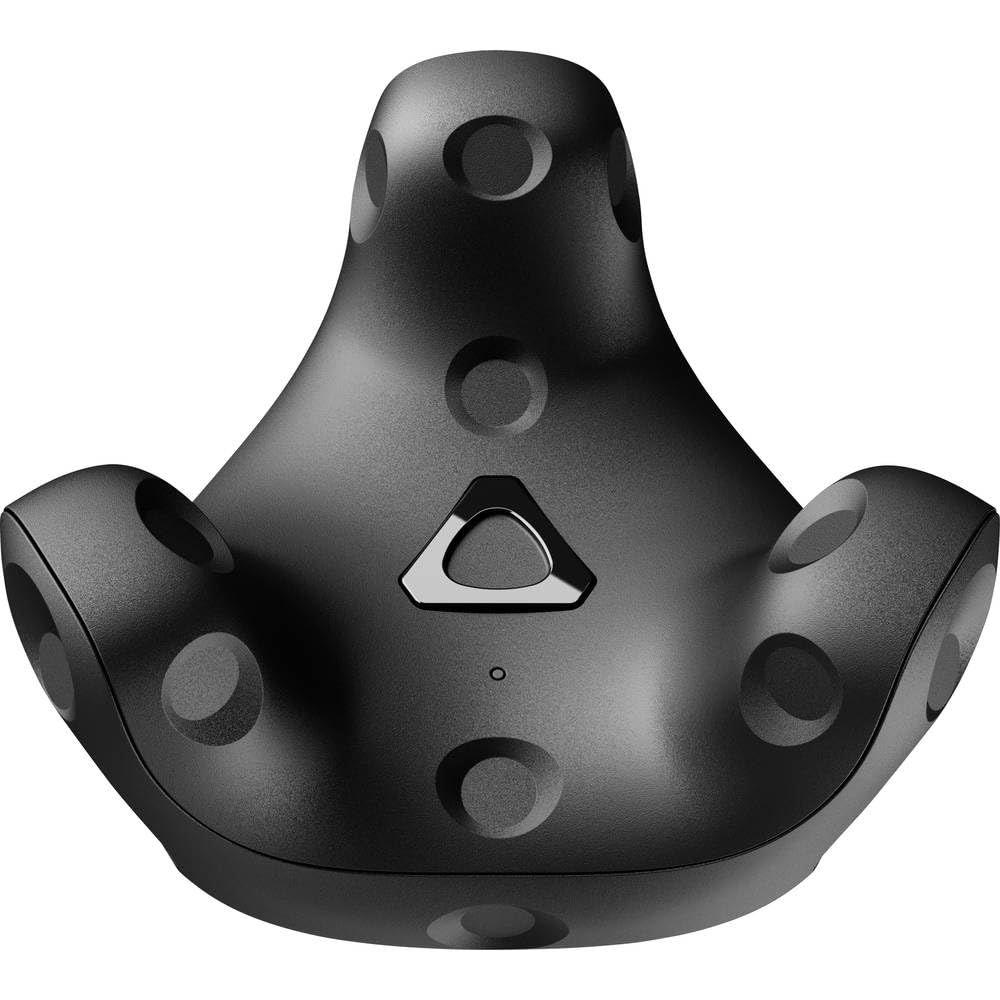
Same 240° tracking view and 7.5 hours, in a body built to disappear on a chest belt.
If a sensor on your sternum has ever felt like a brick swinging under a hoodie, this is the spec that answers it. The tracker weighs 75 g, and the body is 33% smaller than the 2018 model, so it sits closer against the ribcage instead of cantilevering off your chest. That matters on a chest mount more than anywhere else, because a smaller box has less leverage to pull the strap loose when you bend forward.
Tracking coverage runs to 240° with support for SteamVR BS1.0 and BS2.0 base stations, and the battery is rated at 7.5 hours — up to 75% longer than the older tracker. For a chest sensor in a long VRChat night, that spread means you can leave it strapped in and put the headset on without a first-move recharge.
Practically, it is the same tracking platform as the top pick in a tighter shell, so the same base-station requirement applies. If you have lighthouses, this is the version to wear on your chest where every gram shows. The field of view is rated at 240° here, the same figure the 3.0 range is built around, so coverage does not shrink with the smaller body.
The compact argument: 75 g and a body 33% smaller than the 2018 tracker, with 240° coverage and 7.5 hours unchanged — less mass on your chest, same tracking reach.
The fine print: still needs SteamVR base stations, and the listing notes batteries are included rather than a dongle kit, so confirm your pairing hardware.
Pick this if: you want the smallest footprint strapped to a torso and have base stations ready.
Check the box: verify you have a dongle and base stations to pair it, since the bundle content here is leaner.
4. Full Body Trackers FBT Kit, Compatible with SlimeVR, 6-Pack
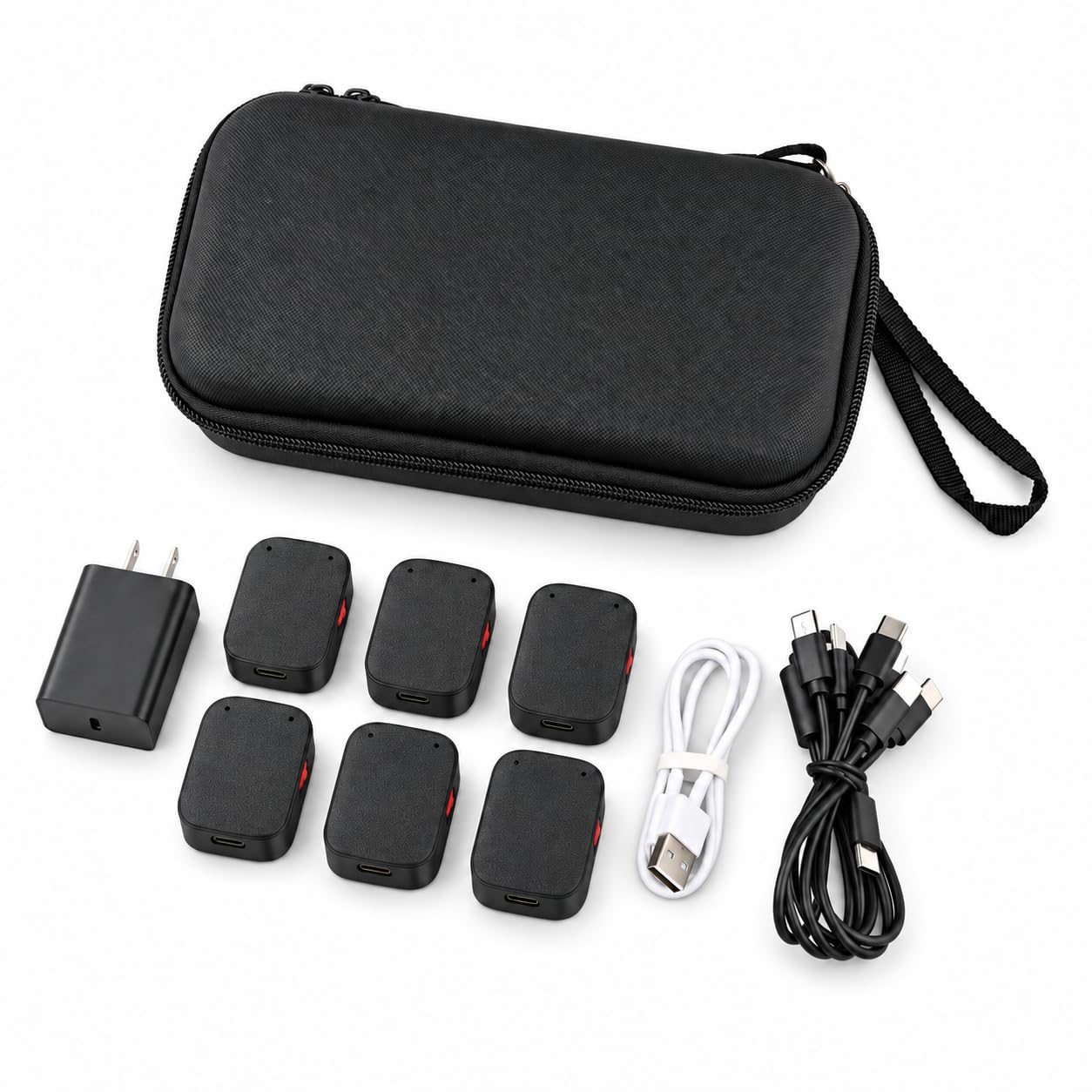
Six motion-chip trackers and the straps to mount every one of them, no base stations involved.
Here is the setup that skips lighthouses entirely. Each tracker runs an LSM6DSV IMU (a motion chip that reads rotation and acceleration to estimate where your body is), which is how a SlimeVR-compatible system builds a body rig without external base stations. You get six points in one box, so your chest is covered alongside thighs, calves and feet. The straps are sized for their positions — longer ones for the torso, medium for thighs, short for lower legs, ankles or feet — with quick-release buckles so you can get in and out without wrestling.
Battery life is rated up to 9 hours from a built-in 800 mAh rechargeable cell, charged over USB-C. That is longer than the 7.5 hours the base-station trackers here list, which is a real advantage for a sensor-free-from-lighthouses rig you wear through a whole evening. Each tracker weighs 30 g, which is the lightest in this lineup and why a six-point chest-and-legs setup does not feel like wearing a climbing harness. The whole kit comes with a carrying case, so it packs down between sessions instead of living scattered on a desk.
What owners value most here is the money-to-quality ratio, and the tracking holds up without much drift in play. Being motion-chip based rather than camera or base-station based, it rewards a tight strap: a loose chest belt reads as wobble because the chip is estimating from movement rather than seeing you. The recurring note is worth hearing — treat straps gently and retighten them before a session.
Why the value lands
- Six trackers and position-matched straps in one box
- Up to 9 hours from an 800 mAh battery, USB-C charged
- 30 g per tracker — the lightest here, so a chest mount stays easy
- No base stations needed; SlimeVR-compatible for VRChat and SteamVR
Where care is needed
- Motion-chip tracking drifts more than base-station tracking if straps loosen
- Straps need retightening between sessions to hold the chest sensor steady
Suits: a dancer or streamer who wants a full six-point rig without buying lighthouses.
Weigh up: accept that a motion-chip body needs snug straps, or step up to base-station tracking.
5. Rebuff Reality Trackstrap Plus Vive Ultimate Tracker Straps
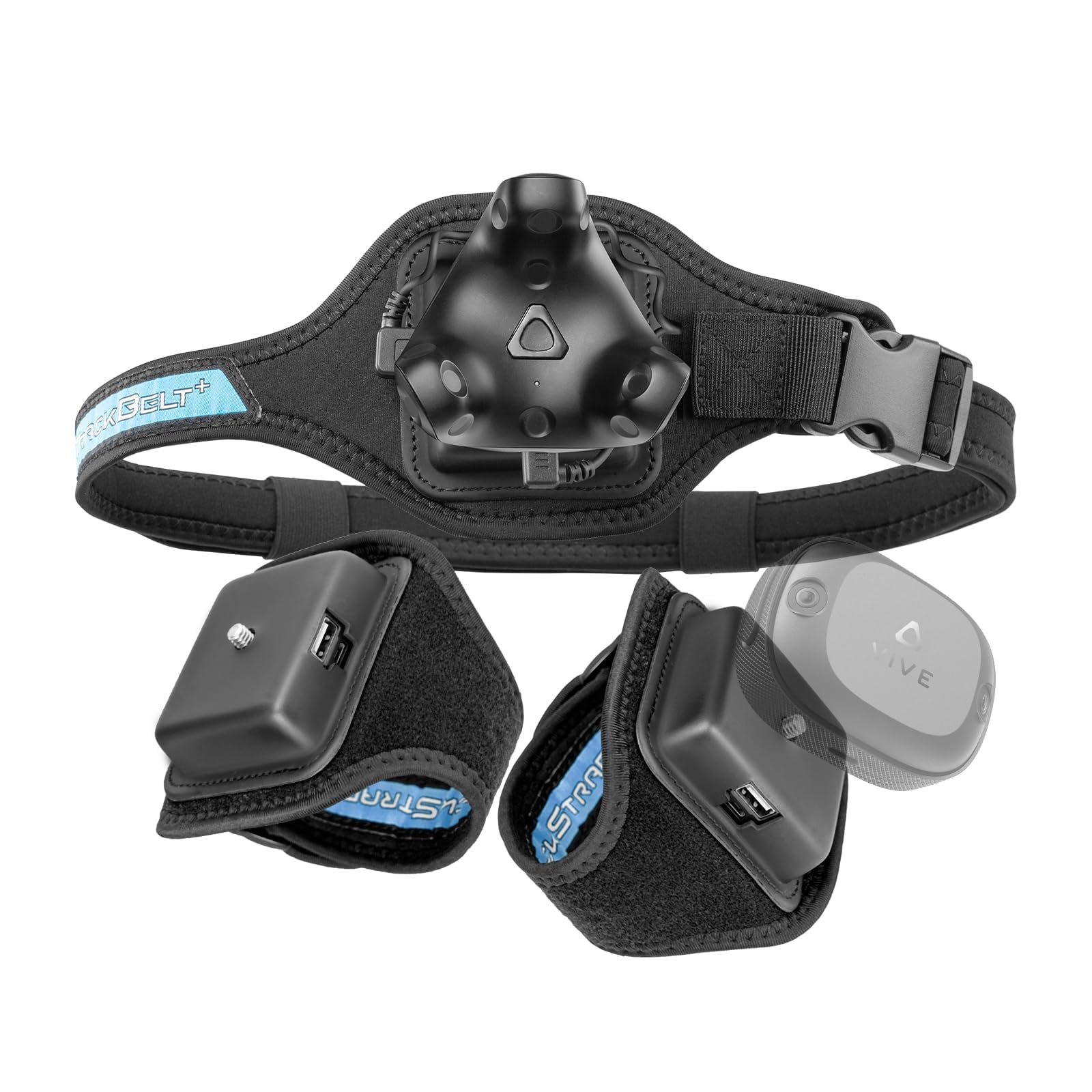
The strap kit that keeps your chest sensor powered through a whole night of dancing.
Twenty hours. That is the number this kit is built around, and it is why it tops the endurance list — a built-in power source keeps your trackers and full-body setup running long past the 7.5 hours the base-station trackers list here. For a chest belt specifically, that means you charge once and forget, rather than fishing a dead sensor out from under a hoodie halfway through a session.
The box covers a full body mount: two Trackstrap Plus foot straps, one Trackbelt Plus waist strap, three micro-USB cables and three USB-C cables. Compatibility is broad — the Vive 3.0 Tracker, Vive Tracker 2.0, Vive Ultimate Tracker and Tundra Tracker all work with it — so it doubles as a chest and waist mount across hardware brands. Fabric is breathable elastic neoprene with an upgraded Velcro closure, and buyers describe wearing them for hours without discomfort.
Durability is the split in the feedback, and it is worth taking seriously for a kit you will pull on and off constantly. Some users get more than 10 hours of use out of theirs and praise the build; others find the straps give out quickly and call the Velcro cheap. Treat the closures gently, keep the loops clean of lint and do not yank them tight, and the fit side of the picture stays good — buyers describe a secure hold through gaming, dancing and long full-body sessions with a dance belt.
The endurance headline: a 20-hour built-in power source and cables for a full body mount, compatible with Vive 3.0, 2.0, Ultimate and Tundra trackers.
The durability caveat: closures are the weak point in reports, so handle the Velcro with care and expect to tidy the loops.
Right for: long VRChat dance nights where charging mid-session is not an option.
Go easy: the fasteners reward gentle handling, so do not test them with a hard yank.
6. HTC 3 Pack VIVE Tracker (3.0)

A single order that lands a whole chest-and-body rig on your doorstep.
Three VIVE Tracker (3.0) units, three USB-C cables, three USB dongles, three dongle cradles, the Rebuff Reality TrackBelt Plus and two TrackStraps, all in one box. That is the shortest path to a working full-body setup with a chest sensor, because you are not buying trackers and then hunting for straps and dongles separately. The trackers pair over USB, and the TrackBelt and TrackStraps hold them in a stable, low-latency position for SteamVR games.
One honest catch is printed in the spec sheet: the field of view is listed at 110 degrees on this bundle rather than the 240° the standalone 3.0 trackers carry. That does not stop it tracking a chest and feet, but if you planned to twist hard or reach overhead, the standalone tracker’s wider coverage is the safer spec to chase. Weight lands at 2.3 pounds for the whole kit — that is the shipping weight of three trackers plus belt and straps, not what you wear.
The TrackBelt and TrackStraps are described as sweatproof, which suits a chest mount you will wear through hot dance sessions. Fit is the one thing to plan for: a belt-adjusted chest sensor needs to sit snug at the ribcage, so expect a minute of adjustment when you first put it on. Buyers in the market for a complete kit get three trackers and the mounting hardware together, which is why it earns a place as the one-box rig here.
The one-box advantage: three trackers, three dongles and cradles, the TrackBelt Plus and two TrackStraps, bundled with an Adorama 1 year warranty.
The spec to note: field of view is listed at 110 degrees here, so check it against a standalone 3.0 if wide coverage is your priority.
The shortcut: ideal when you want three trackers and the chest-and-body straps settled in a single purchase.
Spec check: confirm the 110-degree field of view suits your play style before you go all-in on the bundle.
Know the Specs
Field of View in Degrees
Field of view is the spread of tracking volume a sensor can see, measured in degrees. A wider figure means the sensor keeps its fix on your chest through twists and overhead reaches, so your avatar’s torso follows you without a snapping lag. The base-station VIVE 3.0 trackers list 240°; the bundled three-pack kit here lists 110°, which is fine for steady body tracking but has less margin for hard twisting.
Battery Life in Hours
This is how long the tracker runs before it needs a charge. Chest tracking sessions in VRChat run long, so hours matter more on a chest sensor than a hand sensor you swap out. Base-station trackers here list 7.5 hours, the inside-out Ultimate Tracker lists 7 hours, the six-point IMU kit lists 9 hours, and the Rebuff strap kit runs 20 hours thanks to its built-in power source. Longer battery means fewer mid-session charges and less fumbling under your clothes to swap a sensor.
Common Questions
Do I need base stations for the VIVE Tracker (3.0)?
How many trackers do I need for chest tracking?
Will the VIVE Ultimate Tracker work with my headset?
Is a motion-chip tracker as accurate as a base-station tracker?
Does the Rebuff Reality Trackstrap Plus work with my tracker?
How long do the straps on a full-body tracker last?
Can I use these trackers with VRChat on Quest PCVR?
Does the HTC 3 Pack bundle include everything I need?
How much does a chest tracker weigh and does it matter?
Can I wear a chest tracker under my clothes?
The Bottom Line
For most people building a vr chest tracker setup, the HTC VIVE Tracker (3.0) is the pick because its 240° field of view and 7.5-hour battery hold a chest sensor through real torso movement, and it runs on as few as three trackers if you own base stations. If you want the sensor to find the room on its own without lighthouses, the HTC VIVE Ultimate Tracker adds the dongle-based inside-out route. And for long dance sessions where charging must not interrupt, the Rebuff Reality Trackstrap Plus runs 20 hours with a full body mount in the box.
How we choose
We do not accept paid placement. Every pick is matched to a real buyer and a real use-case; we do not hands-on test units.
Sources
Specifications: manufacturer listings and product documentation. Review insights: verified customer reviews, as of November 2026. Pricing: not shown on this page (it changes often); check the current price via the retailer link.
As an Amazon Associate, Tactical Gear Guy earns from qualifying purchases. This does not affect which products we feature.