Specs are compiled from manufacturer listings and verified buyer reviews and can change over time — please confirm the key details on the product page before buying.
You want water that stops tasting like a swimming pool. There are really only three honest ways to get there: refill a tank with loose carbon media, drop a carbon cartridge into a housing you already own, or replace the whole softener with a two-in-one unit. This guide covers one of each, with the real specs and the real trade-offs spelled out.
This guide is built by comparing the manufacturers’ published specifications and the patterns across verified customer reviews, so you get each pick’s real strengths and trade-offs instead of marketing spin.
The difference between these three depends on whether you repack a tank, drop in a cartridge, or install a full softener. The loose-media pick is the one to study first when you are shopping for a water softener charcoal filter.
Top Picks
How To Choose The Best Water Softener Charcoal Filter
The mistake most people make is buying charcoal filtration for hard water, which carbon cannot fix. A carbon filter removes the chlorine taste and the smell. It does not pull calcium and magnesium out of the water, so your soap still will not lather properly. Test for hardness first, then buy the filter that matches what you find.
Match the media type to the housing you already own
Loose granular carbon is a refill product. It goes into a tank or a refillable cartridge you open up and top off yourself. A carbon block is a sealed pressed cartridge that drops into a standard housing. If you cannot open your housing and repack it, you need a block, not a sack of granules.
Read the micron number before anything else
The micron rating is the size of particle the filter catches, and a smaller number means a finer catch. A 5 micron block holds back particles down to 5 microns, which is finer than what a loose granule bed typically traps. That finer catch usually comes with a flow cost, so a tighter filter is not automatically the better one for a whole house.
Check the flow rate against your household demand
Flow rate is measured in GPM, or gallons per minute, and it decides whether two showers running at once still feel normal. A cartridge rated for low flow can strangle pressure in a busy house. A high-flow softener valve keeps pressure up but costs far more upfront. Count how many taps run at once in your home, then pick a GPM rating that covers that load.
Side-by-Side Comparison
| Model | Best For | Media Type | Flow Rate | Footprint | Amazon |
|---|---|---|---|---|---|
| IPW Industries Bulk Activated Carbon★ Best Overall | Refilling an existing carbon tank | Coconut shell granular carbon | — | 10″D x 6″W x 3″H | Amazon |
| Geekpure 10 Inch Whole House Carbon Filters | Drop-in whole house protection | Coconut carbon block, 5 micron | 5-15 GPM | 4.5″D x 4.5″W x 10″H | Amazon |
| Kenmore Elite 520 Hybrid | Softening and filtering in one unit | Self-cleaning carbon media plus softening resin | 8 gpm | 20.5″L x 15″W x 48″H | Amazon |
Detailed Reviews
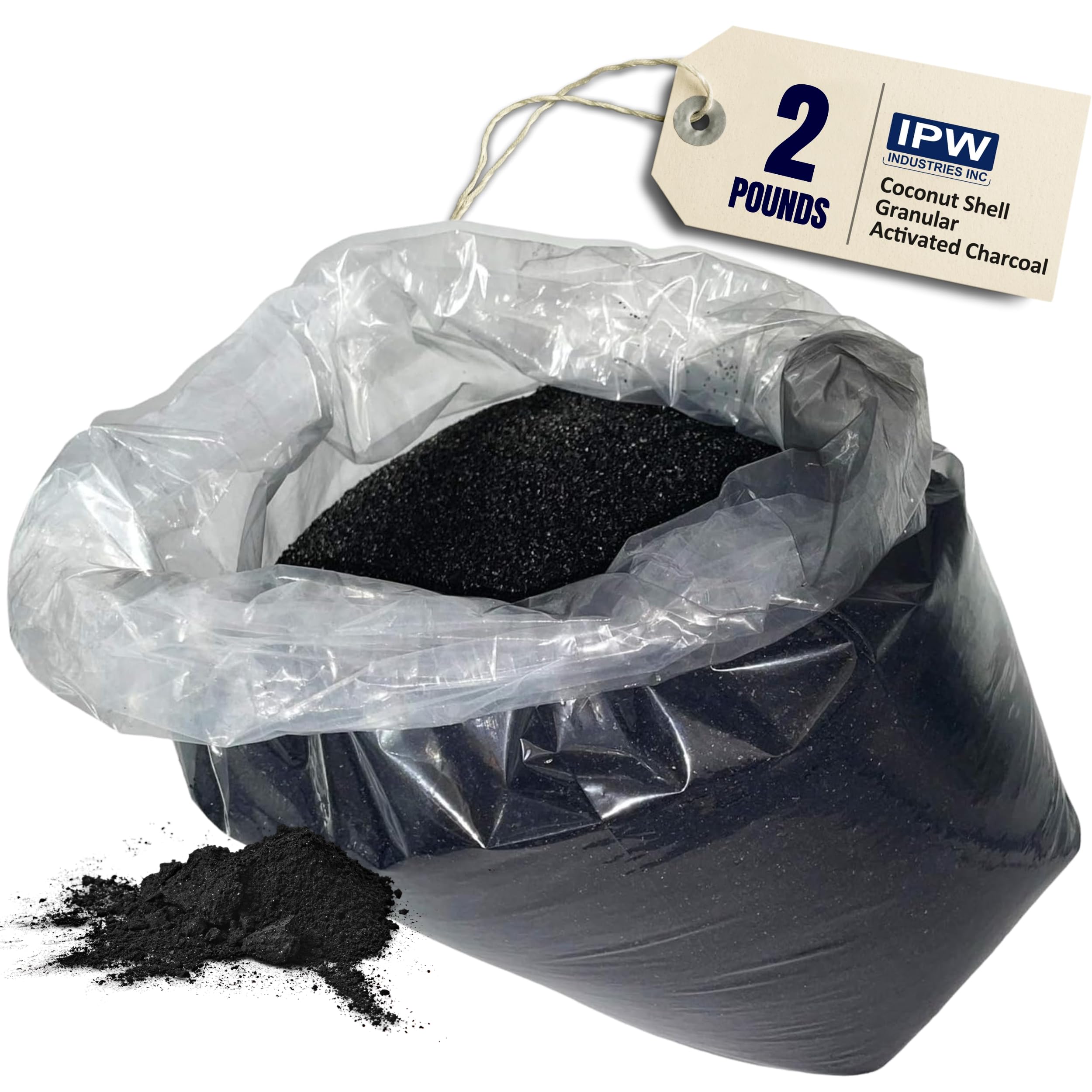
1. IPW Industries Coconut Shell Granular Activated Charcoal 2 lbs
Our pick — 4.5+★ from 250+ verified ratings; the strongest balance of quality and price.
The refill sack that keeps an existing carbon tank alive for the price of a takeout dinner.
This is not a cartridge. It is 2 pounds of loose coconut shell granular activated carbon, and that distinction is the whole buying decision. If your softener or whole house filter has a tank you can open and repack with a backwashable carbon bed, this sack is the refill. If your housing is sealed, this product is not for you, no matter how good the water report looks.
The numbers are modest and honest: 2 pounds of media in a sack measuring 10 inches deep by 6 wide by 3 high, which is small enough to sit on a shelf until you need it. For reference, the sealed Geekpure cartridge below measures 4.5 by 4.5 by 10 inches, and storage here is a non-issue. Coconut shell carbon is the grade that carries the reputation for pulling chlorine and volatile organic compounds (VOCs — the chemical vapors that give water a plastic or chemical smell) out of a residential supply.
What wins people over is that the sack arrives as advertised — 2 pounds of coconut shell carbon that does the job once it is rinsed and packed. The recurring gripe is dust. Eight reviewers land on this and the feedback splits both ways, with plenty calling it not too dusty and others finding charcoal dust and fine grit in the sack. Treat that as a handling note rather than a defect: rinse the media before it goes into the tank and the fine particles wash away.
Why it earns the top slot
- 2 pounds of coconut shell granular activated carbon, the refill grade for a repackable tank.
- Backwashable media, so you clean the bed instead of replacing it every few months.
- Targets chlorine, bad taste, odor, pesticides, and Trihalomethanes in a residential supply.
- Derived from renewable coconut shells and carries a sustainability certification.
The part to plan around
- Loose media means you repack the tank yourself, which is real work.
- Fine charcoal dust and grit show up in the sack and need rinsing off.
- No flow rating and no micron rating published, so you cannot predict catch size.
Reach for this if: you already own a carbon tank with a removable lid and want to refill rather than replace it.
Look elsewhere if: your housing is a sealed cartridge body, because granules cannot go in one.
2. Geekpure 10 Inch Whole House Carbon Filters Pack of 4

Four sealed carbon blocks that slide into a standard whole house housing with no repacking at all.
If the repacking job on the IPW sack sounds like a Saturday you would rather not spend, this is the alternative. You get four individually wrapped and sealed 5 micron coconut carbon block cartridges, sized at 4.5 inches across and 10 inches tall, built for a standard big whole house housing. Each one drops in, and when it is spent you pull it out and drop in the next.
The 5 micron rating is the number that matters here — these cartridges catch particles down to 5 microns, which is fine enough to reduce chlorine, iron, color, taste, and odor across every tap in the house. Flow runs 5 to 15 GPM depending on your incoming feed pressure, and the manufacturer states you get continuous flow without an obvious pressure drop. Compare that with the Kenmore hybrid below at 8 gpm and the Geekpure pack covers the higher end of the range when your pressure supports it. The 8 gpm figure in that comparison is the softener’s cap, not a reason the cartridge is worse.
Two things to hear before you buy. First, the seller is blunt about limits: this filter will not reduce heavy metals, lead, fluoride, or total dissolved solids (TDS — everything dissolved in the water, including minerals the filter cannot touch). So it is a chlorine and taste filter, not a purifier. Second, the pack is not meant for every water source. On well water you will be swapping filters every 3 months or more often, against a 6 to 12 month life on treated tap water.
Service life reality: the stated window is 6 to 12 months or 100,000 gallons, whichever lands first, and that depends on how much water you use and how dirty the feed is. These cannot be reused, so budget for the refill cycle rather than expecting a one-time buy.
The flush step matters: flush a new cartridge for 15 minutes before you trust the water. A little charcoal dust and black specks during that rinse is normal, not a faulty filter.
The confident call: this is the pack for a household with a standard 10 inch housing that wants chlorine gone from every tap without touching a tank.
One caution: if you are on well water or you need lead and fluoride removed, this cartridge does not do that job — look at a reverse osmosis system for dissolved solids instead.
3. Kenmore Elite 520 Hybrid Water Softener

Softening and charcoal filtration in a single tank — the one that solves both water problems at once.
Here is the honest limit of the two carbon options above: neither of them makes hard water soft. This unit does. The Kenmore Elite 520 pairs a 31,000 grain softening bed with built-in carbon media, so it pulls out the calcium and magnesium that kill soap lather and simultaneously reduces chlorine taste and odor. There is no separate pre-filter to buy, and the carbon media is self-cleaning, which means no cartridge swap cycle at all.
The engineering numbers are worth reading carefully. Capacity is listed at 0.98 cubic feet, the valve is a 1 inch high-flow design rated at 8 gpm, and the tank runs a 40 degree Fahrenheit lower temperature limit with a programmable controller. It stands freestanding at 20.5 inches long, 15 wide, and 48 tall, which the maker describes as compact enough for a tight basement corner. The IntelliSoft controller learns your household’s water use pattern and regenerates only when it needs to, which the maker says uses less salt.
Where this falls short of expectations is repairs and support, and that is the honest trade-off on a whole-house appliance rather than a plug-in cartridge. It is the priciest route by a wide margin, it needs real installation work, and the 4.0+ star figure tells you a slice of buyers hit snags that the simpler filters never see. None of that changes the fact that it is the only pick here that actually softens. As one plumbing-minded buyer summarized after living with a hybrid: soft water plus better tasting water from one box, no separate filter to remember.
What only this unit delivers
- 31,000 grain softening plus carbon filtration in one NSF-certified system.
- Self-cleaning carbon media, so there is no filter replacement schedule.
- 1 inch high-flow valve pushing 8 gpm to showers, laundry, and every tap.
- IntelliSoft controller regenerates on learned usage, using less salt.
Where it asks more of you
- The highest upfront cost of the three by a wide margin.
- Freestanding install at 48 inches tall needs a real utility space.
- Appliance-level complexity means appliance-level troubleshooting.
Buy this when: hardness is the actual problem and you want the chlorine handled in the same box.
Think twice when: your water is already soft and only smells of chlorine — the cartridge pack does that for a fraction of the work.
Know the Specs
Granular versus block carbon
Granular activated carbon is loose media you pour into a tank and repack when it is spent. A carbon block is the same coconut carbon pressed into a sealed cartridge you drop into a housing. Granules let you refill cheaply but need manual repacking; blocks cost more per change but install in seconds. Neither is better in the abstract — the housing you own decides which one you can use.
Micron rating and what it catches
The micron rating describes the largest particle the filter lets through, so 5 micron means particles down to 5 microns get caught. A tighter number catches finer sediment and usually reduces flow. On a whole house carbon block, the micron rating is the spec that tells you how clean the water gets before it reaches a tap.
Flow rate in gallons per minute
Flow rate, written as GPM, is how much water moves through the filter each minute. The Geekpure pack is rated 5 to 15 GPM depending on feed pressure, while the Kenmore valve caps at 8 gpm. Lower available flow shows up as weak showers when several taps run together. Check your peak household demand against the GPM rating before you commit.
Water temperature and pressure limits
Carbon cartridges are built for cold feed lines only — the Geekpure pack is rated for 40 to 110 degrees Fahrenheit and 10 to 60 psi working pressure, and it is not suitable for hot water filtration. Running hot water through a carbon block can damage the media. The Kenmore softener lists a 40 degree Fahrenheit lower temperature limit for the same reason.
Common Questions
Will a carbon filter actually soften my hard water?
Can I put the IPW granular carbon into a sealed cartridge housing?
What does 5 micron mean on the Geekpure cartridges?
How often do I change the Geekpure carbon block filters?
Do I need to flush a new carbon filter before drinking the water?
Will the Geekpure filter remove lead or fluoride?
What flow rate do I need for a whole house carbon filter?
Does the Kenmore Elite 520 need replacement carbon filters?
Can either carbon option run on hot water?
Is a hybrid softener worth it over a drop-in carbon cartridge?
The Bottom Line
For most households chasing better tasting water without a plumbing project, the IPW Industries Bulk Activated Carbon is the sensible starting point if you already own a repackable carbon tank. It gives you 2 pounds of backwashable coconut shell granular carbon that pulls chlorine, taste, and odor out of a repackable tank. If your housing is sealed, grab the Geekpure 10 Inch Carbon Filter 4-pack for the 5 micron catch and the 5 to 15 GPM flow. And when hard water is the real culprit, the Kenmore Elite 520 Hybrid is the one to reach for, because it softens and filters in one box. Read the listing twice before you order — loose granules need a tank you can open, and a sealed housing only takes a drop-in block.
How we choose
We do not accept paid placement. Every pick is matched to a real buyer and a real use-case; we do not hands-on test units.
Sources
Specifications: manufacturer listings and product documentation. Review insights: verified customer reviews, as of November 2026. Pricing: not shown on this page (it changes often); check the current price via the retailer link.
As an Amazon Associate, Tactical Gear Guy earns from qualifying purchases. This does not affect which products we feature.