Specs are compiled from manufacturer listings and verified buyer reviews and can change over time — please confirm the key details on the product page before buying.
You want a walking pad that slides under the bed when you are done, but most folding models slide under there with a wobble, a whine, or a belt that wanders off centre. For most people, the HomeTro Walking Pad with 9% Incline and Dual LED Display is the one to beat. It folds to 5 inches tall, so it tucks away easily, and it holds a 4.5+ star owner record. Owners also report the belt tracks straight at top speed. A shortlist of foldables worth your floor space follows.
This guide is built by comparing the manufacturers’ published specifications and the patterns across verified customer reviews, so you get each pick’s real strengths and trade-offs instead of marketing spin.
Below you will find how incline and fold height trade off against running surface, which specs actually change your daily walk, and the honest weak points of each machine. Every pick here has been checked against its own listing data so the numbers you read are the numbers the maker publishes, which is exactly what makes a folding walking pad comparison worth reading before you buy one.
Top Picks

How To Choose The Best Folding Walking Pad
The folding part is the whole point of this category, so start with the number that governs it: folded height. A pad that folds to something like 5 inches slips under a bed frame or sofa without you lifting furniture. A pad that folds to 5.5 inches is close enough to the same job. Anything that stands 20 inches or more when folded is a vertical-fold design, which saves floor area but needs a corner or a closet wall rather than a gap under the bed. Decide which of those two you have room for before anything else.
Incline: manual, auto, or none
An incline turns a flat stroll into something that works your legs harder, and the slope is written as a percentage. A 9% or 10% manual incline means you set the slope yourself before you start walking. A 12% automatic incline means the machine changes the slope for you mid-session, which matters if you want to alternate flat and uphill without stopping. Manual is simpler and there is less to break; auto is the one you will actually vary day to day. Several owners of manual-incline machines note the slope adjustment is a hands-on job, so pick according to how much fiddling you tolerate.
Motor power and what it does to noise
Horsepower here is a measure of how much work the motor can do without straining. A 2.5HP motor comfortably carries a walking pace under a desk. A 3.0HP or 3.5HP motor holds speed better when you raise the handlebar and push into a jog, and it tends to run quieter because it is not working near its limit. If you live above someone or share a room, horsepower is the spec that quietly protects your relationship with your neighbours.
Belt size, capacity, and handrails
The running belt is given as length by width in inches, and width is the number that decides whether you feel boxed in. A 15-inch belt suits a relaxed walk; a 16-inch or 16.5-inch belt gives your feet room to land naturally. Weight capacity tells you the honest ceiling for the frame, and it should sit well above the heaviest person who will use it. Handrails matter more than buyers expect: upright handles help you balance when you raise the speed, and some designs let you drop the handles flat for pure under-desk walking.
Side-by-Side Comparison
| Model | Best For | Folded Height/Space | Incline | Top Speed | Amazon |
|---|---|---|---|---|---|
| HomeTro Walking Pad with 9% Incline★ Best Overall | Most buyers | 5.0 in | 9% | 7.5 MPH | Amazon |
| ApexNexus 3.0HP Foldable TreadmillBest Value | Tight budgets, small flats | 5.5 in | 12% manual | 6.2 MPH | Amazon |
| YPOO 16% Incline Walking PadSteepest Climb | Steepest slope on a budget | 4.9 in | 16% | 5.0 MPH | Amazon |
| KALWOL 6-in-1 with Speaker | Music and HIIT sessions | 5.04 in | 10% manual | 7.5 MPH | Amazon |
| TOPUTURE 4-in-1 Walking Pad | Runners who fold it away | 5.1 in | 1–12% | 10 MPH | Amazon |
| WELLFIT 12% Auto Incline | Set-and-go incline | 5.5 in | 0–12% auto | 7.6 MPH | Amazon |
| Acezoe 10% Incline Folding | Under-desk plus incline | 5.12 in | 2% / 10% | 10 MPH | Amazon |
| Acezoe 15% Auto Incline | Hill simulation at home | — | 15% auto, 9 levels | 7.5 MPH | Amazon |
| WELLFIT Adjustable Height 400 LBS | Shared household use | 5.7 in | 0–10% auto | 8.6 MPH | Amazon |
| WalkingPad MX8 | Vertical corner storage | ~3 sq. ft. upright | — | 5 MPH | Amazon |
| WalkingPad C2 | 180° fold under a bed | 5.4 in | — | 4 MPH | Amazon |
Detailed Reviews
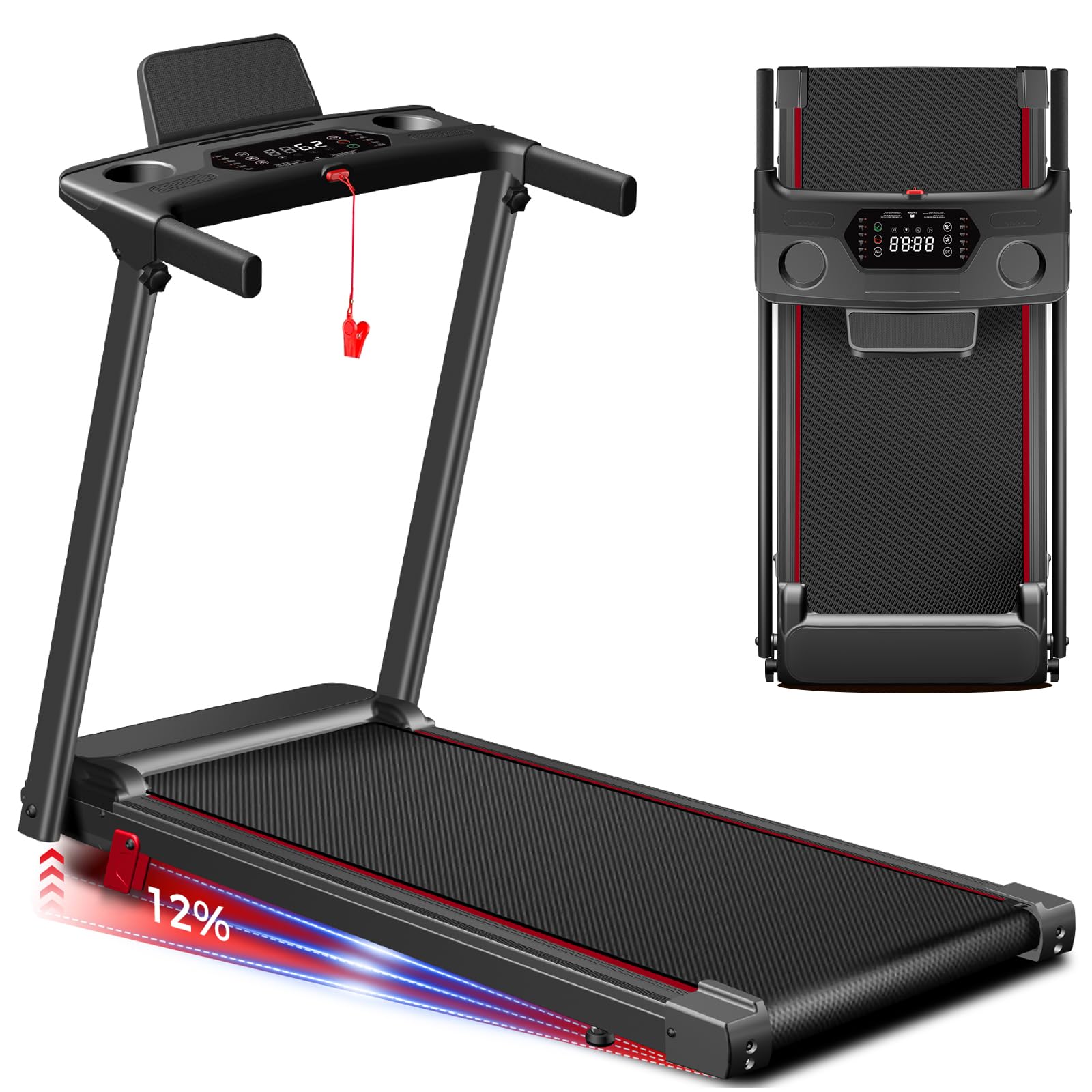
1. HomeTro Walking Pad Treadmill
Our pick — 4.5+★ from 350+ verified ratings; the strongest balance of quality and price.
A 55-inch machine that flattens to 5 inches and still gives you a 9% hill.
This is the pick that gets the boring things right. It folds down to 55.0 x 20.0 x 5.0 inches, so it genuinely disappears under a bed rather than mocking you from the corner. For reference, the YPOO further down folds to 44.9 x 4.9 x 21.5 inches — shorter, but it stands tall enough that it wants a wall instead of a gap. The HomeTro’s folded profile is the low, flat kind that actually stores.
Comfort is what wins people over. The belt has 5 layers and absorbs shock, and it sits on a 39-inch by 16-inch deck (the walking surface). Owners consistently call the 5-layer belt cushioned rather than jarring. Two LED screens handle the rest. A 2.5-inch RGB display on the deck lights up as you progress. A second readout on the handrail shows speed, time, distance and calories, so you are not craning down mid-stride. A built-in phone or tablet holder and a safety key that cuts power on a pull round out the practical side.
Speed runs 0.6–7.5 MPH with the handle raised and 0.6–5 MPH with it lowered, which covers under-desk working and a genuine jog. The 300-watt motor carries users up to 300 lbs. The trade-off is honest: a 16-inch deck is fine for walking and light jogging, but if you want to sprint, the TOPUTURE’s 41 x 16.5-inch belt gives you more room. And that 5-inch fold comes with a long 55-inch body, so measure your under-bed clearance first.
What earns its place
- Folds to 5.0 inches, so it hides under low furniture
- 9% incline adjusts without tools for uphill sessions
- 5-layer shock-absorbing belt under a 39″ x 16″ deck
- Two displays, so data stays visible in walking and running modes
- Safety key cuts the motor instantly on a pull
Where it gives ground
- 16-inch belt is snug for fast running
- 55-inch folded length needs real clearance under the bed
- Incline is set by hand, not automatic
Made for: anyone who wants one machine for desk walking and an evening incline session, then wants the floor back.
Think twice: if you mostly run at speed, the wider belt on the TOPUTURE suits you better.
2. ApexNexus Foldable Treadmill
A steeper hill than the top pick, a quieter motor, and a price tier that undercuts everything above it.
If the incline percentage is what sold you on a walking pad, this one goes further than the HomeTro: 12% manual slope versus 9%. That is a real difference in effort per step, and it is set by hand before you start rather than adjusted mid-walk. The 3.0HP brushless motor pushes speed from 0.6 to 6.2 MPH while running below 50 dB, which is the kind of noise level that lets a podcast play at normal volume without you turning it up.
ApexNexus’ wider speed window is note against the YPOO below: 6.2 MPH versus 5.0 MPH at the top end. Neither is a sprint machine, but the extra reach covers a steady jog. Quality is what the owner base talks about most, with value close behind, and the setup is simple enough that the manual answers most first-day questions. The 38″ x 15″ running surface sits on a six-layer non-slip belt with shock absorption aimed at your knees.
Here is the catch, and it is a real one: the walking area feels small to a slice of buyers, and that 15-inch width is the narrowest in this article. If you have wide feet or you like to swing your arms out, you will notice it. Storage is honest, though — 46.5″L x 22.8″W x 5.5″H folded, on wheels, at 41 pounds, so one person can slide it under a bed without a second set of hands.
The value read: you are trading belt width and incline automation for a steeper manual slope, a quiet 3.0HP motor, and a fold that one person can manage alone. For desk walking at 2 to 3 MPH, that trade lands well.
The honest ceiling: 300 lbs capacity and a 15-inch deck mean this is a walking machine first and a jogging machine second.
Reach for this if: you want maximum slope per tier and you walk more than you run.
Look elsewhere if: a narrow deck makes you feel hemmed in — the 16.5-inch belts further up suit broader strides.
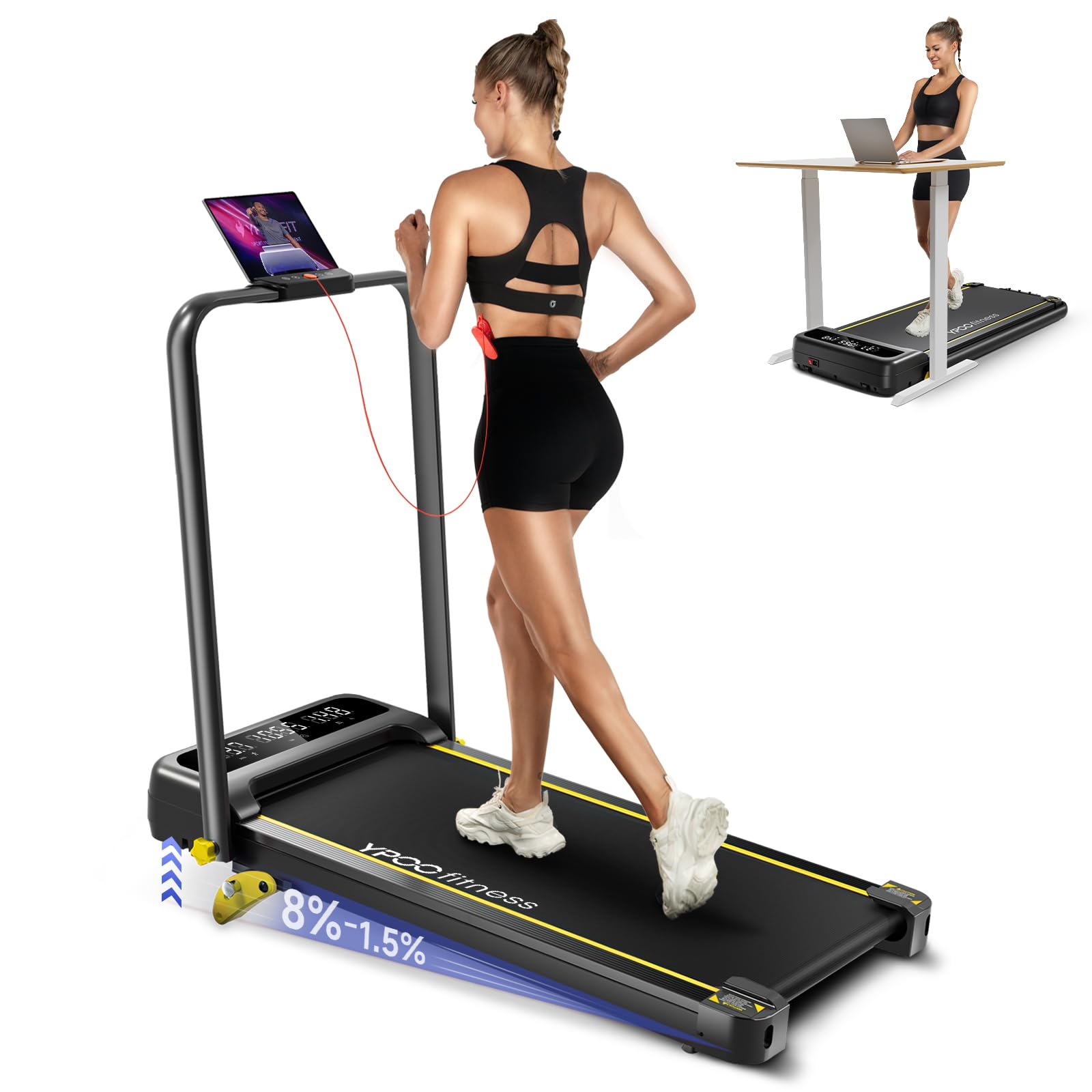
3. YPOO 16% Walking Pad Incline with Handle Bar
Sixteen percent is the steepest slope in this roundup, and it folds to 4.9 inches.
Nothing else here climbs like this. The YPOO’s 16% incline beats the HomeTro’s 9% by a wide margin, and it beats the Acezoe’s 10% too. If you want the closest thing to a hill walk inside a flat, this is the machine that delivers it. The 5-layer non-slip running belt measures 36.6″ x 15″, and the shock-absorbing frame keeps the whole thing stable enough to store upright against a wall at 44.9 x 4.9 x 21.5 inches folded.
Functionality is the thing that carries this pick — owners describe it as a machine that simply does its job, with easy setup and quiet running close behind. The 2-in-1 design is the practical heart of it: drop the handlebar and you have a walking pad for 0.5–3.7 MPH desk sessions; raise it and running speeds climb to 5.0 MPH. A remote control comes in the box, along with a tool kit and safety key, and the whole unit weighs 40 pounds.
The compromise sits in that 5.0 MPH ceiling, which is below the 6.2 MPH the ApexNexus offers and well below what the TOPUTURE reaches. The slope is also a manual set, and owners note it does not adjust itself, so you plan your incline before you start rather than changing it mid-session. For walking-focused routines, neither is a problem. For interval training where you want the machine to shift slope for you, look at the WELLFIT auto-incline models instead.
Why it stands out: there is no other foldable here that asks your legs for a 16% grade, and it does it in a package that folds to under 5 inches and weighs 40 pounds.
Suits you if: incline is the feature you came for and you walk rather than run.
Not for you if: you want the machine to change slope automatically while you move.
4. KALWOL 6-in-1 Foldable Treadmill
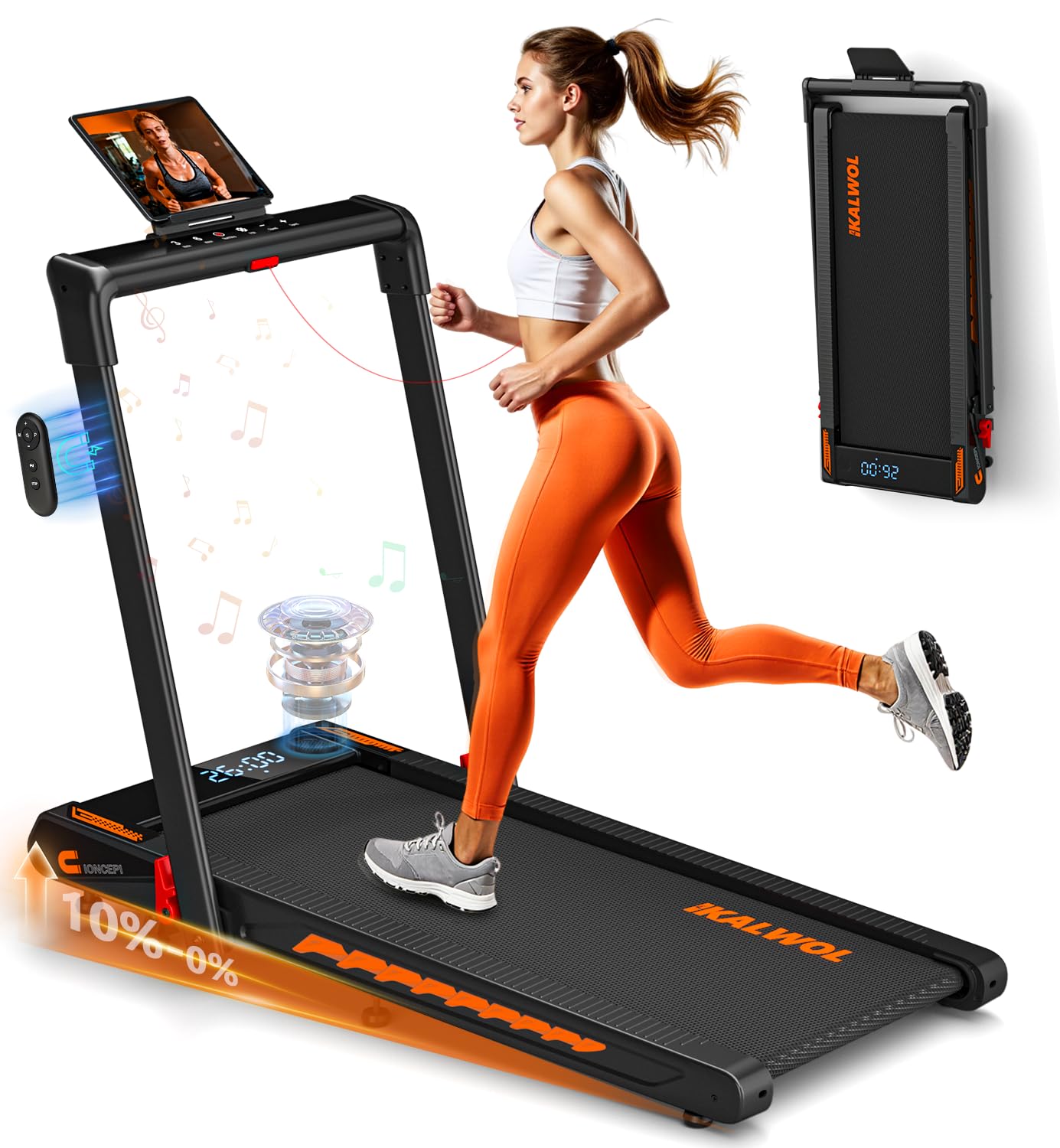
The only pad here with a speaker built in, plus twelve preset HIIT programs.
Most walking pads assume you will bring your own audio. This one brings its own. The built-in speaker pairs with FITSHOW, KINOMAP and ZWIFT, so your workout app and your music come out of the machine rather than a phone on the floor. Add 12 pre-set HIIT programs with time, distance and calorie countdown modes, and you have the most structured training setup in the mid tier.
The frame carries a 350-lb weight capacity, which tops the 300 lbs on the HomeTro and the YPOO, and it is the highest ceiling among the mid-range picks here. A 3.0HP brushless motor keeps the noise at or under 40 dB, so an early walk does not travel through walls. Speed runs 0.6–7.5 MPH across six modes — city walk, working, walking, jogging, running and climbing — and the 10% manual incline adjusts in a second with no screws to hunt for.
Owners rate performance highest, with the 10% incline close behind. The 40″ x 16″ belt sits on 10 shock-absorbing columns and a phone or tablet stand holds your screen at eye level. Folded, it measures 50.59″D x 22.59″W x 5.04″H on transport wheels. The catch is weight: at 22.3 kg the KALWOL is a two-hand lift if you are moving it between rooms, and the manual incline still needs you to set the slope yourself.
The case for it
- Built-in speaker for music and app audio
- 12 HIIT programs plus three countdown modes
- 350-lb capacity, the highest in the mid tier
- Runs at or under 40 dB
- Magnetic remote stores on the frame so it does not go missing
What you live with
- Heavier than most at 22.3 kg
- 10% incline is set by hand
- Speaker is a bonus, not a hi-fi system
Pick this one when: your workout is a program you follow, not a free-form stroll, and you want audio from the machine.
Pass on it when: you move the pad between rooms daily and want the lightest frame available.
5. TOPUTURE 4-in-1 Walking Pad

Ten miles per hour from a machine that still folds down to sit under a sofa.
Speed is where this one separates itself. The TOPUTURE’s 2.5HP motor reaches 10 MPH, which is well beyond the 7.5 MPH ceiling on the HomeTro and the 6.2 MPH the ApexNexus tops out at. Only the Acezoe 10% model matches it. That reach matters if you want to alternate a slow desk walk with an actual run, because you are not swapping machines halfway through the day.
The belt backs up the speed: 41″ x 16.5″ with eight built-in shock-absorbing cushions, which is wider than the HomeTro’s 16-inch and considerably roomier than the ApexNexus’s 15-inch deck. The incline is adjustable in steps of 1%, 6% and 12%, so you can pick a flat session or a proper climb without tools. Dual LED screens, remote and touch controls, a built-in Bluetooth speaker and hand-grip heart rate sensors round out a package that feels built for people who track their sessions.
Assembly is the thing buyers talk about most here, and in a good way — it arrives ready to use, per the listing. It converts between the flat 52.3″ x 28.2″ x 5.1″ walking position and the raised 49.2″ x 28.2″ x 47.5″ running position in seconds, and built-in transport wheels help you move it. The honest trade-off is mass: at 78 pounds it is not a one-hand lift, and 300 lbs capacity is a step below the KALWOL’s 350 lbs.
Where it leads: nothing in this article combines a 10 MPH top speed with a 16.5-inch belt and a 5.1-inch fold.
The cost of that speed: 78 pounds of machine to shift when you want it out of the way.
Built for: someone who wants one folding machine that handles both 2 MPH desk walking and a real run.
Not built for: anyone who needs to lift the pad up stairs or hang it on a wall between uses.
6. WELLFIT Walking Pad with 12% Auto Incline and Handle Bar

You never touch the slope — 0% to 12% moves while you keep walking.
Auto incline is the feature that changes how you use a walking pad. On the manual machines above, changing the hill means stopping and adjusting. Here, the 0%–12% incline shifts at the press of a button, a voice command, the remote, or through the Wellfit app. That is the difference between a hill workout you plan once and one you actually vary through the week.
The frame underneath is the strongest support here: a 3.5HP brushless motor carrying up to 375 lbs, which beats the 300 lbs on the HomeTro, the YPOO and the TOPUTURE. Extended dual handrails run the length of the machine, and that extra bracing is aimed squarely at beginners and older users who want something to hold. Noise sits under 40 dB, so the motor stays quiet in a shared flat or an early-morning session. The belt is 40″ x 16″ with seven anti-slip layers and eight silicone shock absorbers.
Owners praise build quality and quick assembly, with the handles and guardrail attaching in minutes. There is one fit issue worth knowing: the arm bars sit low for taller users, so if you are well above average height, the handrails may land below a comfortable grip. The machine folds to 50.4 x 18.5 x 5.5 inches and stands against a wall, and an easy-access lubrication port makes belt upkeep a quicker job.
The reasons it earns a slot
- Automatic 0–12% incline across four control methods
- 3.5HP motor with a 375-lb capacity
- Extended dual handrails for balance and support
- Under 40 dB for shared spaces
- Lubrication port speeds up belt maintenance
Where it asks you to adapt
- Handrails ride low for taller walkers
- 5.5-inch fold is slightly taller than the flattest picks
- Max 7.6 MPH keeps it a walking and jogging machine
The right fit: a household where the slope changes every session and someone wants a rail to hold.
The wrong fit: tall users who plan to lean on the handrails for balance.
7. Acezoe Folding Treadmill with 10% Incline and Handle Bar
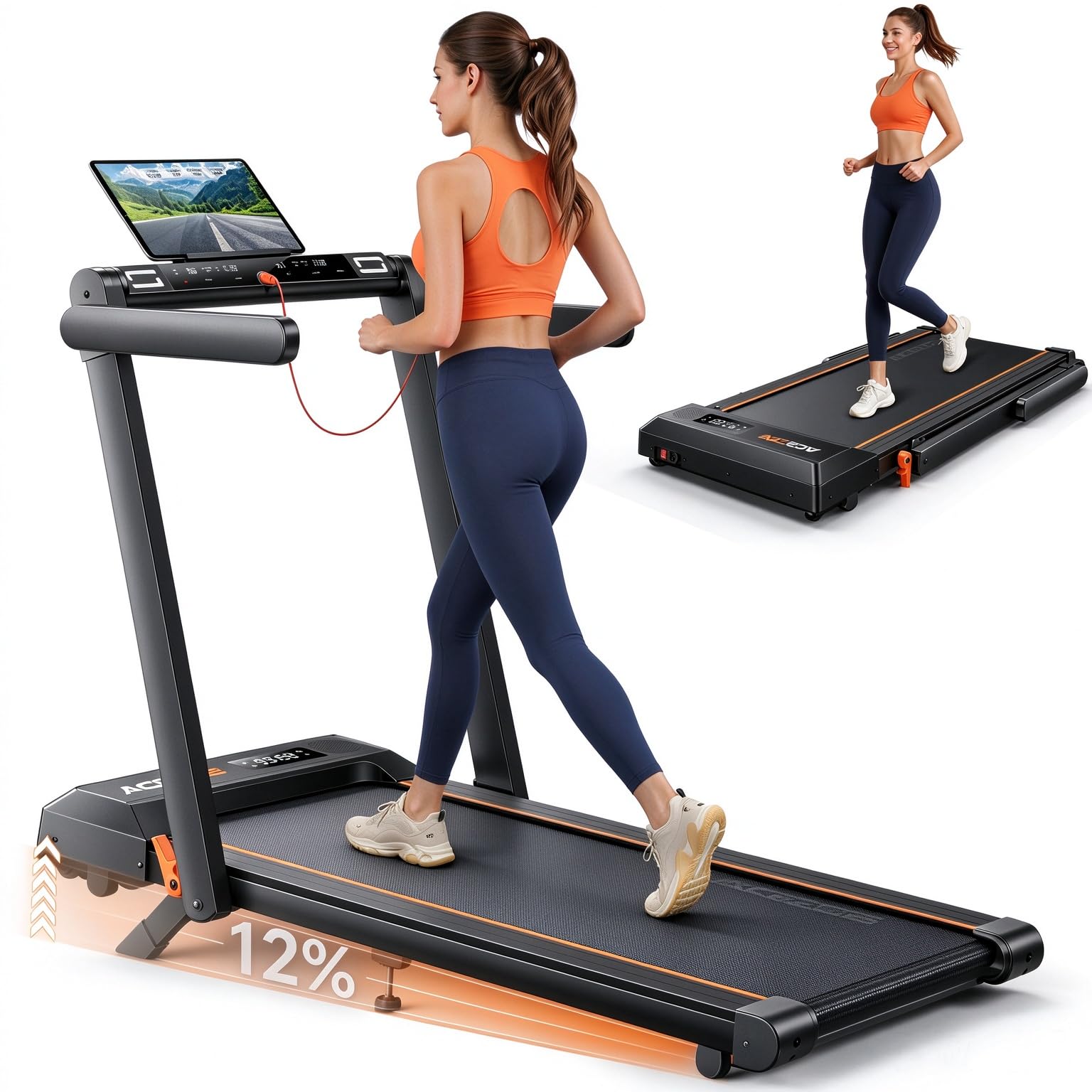
Two slope settings instead of a dial — a gentle 2% for desk work, a 10% for climbing.
Most manual inclines give you one slope and a lot of fiddling. This Acezoe gives you two clean choices: a 2% setting and a 10% setting. That is a small design decision with a big effect on daily use, because you can leave it flat-ish for under-desk walking and lift it for a climbing session without hunting for a mid-point.
Speed is where this one pulls ahead. Its 2.5HP motor (the engine that drives the belt) reaches 10 MPH, matching the TOPUTURE and well past the 7.5 MPH ceiling on the HomeTro. A 41″ x 16.5″ belt with eight shock-absorbing pads gives your stride room. The machine arrives ready to use with no assembly. Transport wheels let you slide it under a bed, sofa or desk at 53.94″D x 28.27″W x 5.12″H. Dual LED displays, remote and app control, a speaker, and heart rate sensors on the handles handle the tracking.
Buyers praise build quality and out-of-box setup most, with durability close behind. At 78 pounds the frame feels like it will hold up. That weight is also the compromise. The incline adjustment draws mixed views, because the two-position slope is manual (you set it by hand). If you want the grade to change while you keep walking, the WELLFIT auto-incline model is the one that does that.
The smart detail: two fixed slope positions beat a single manual one for anyone who alternates desk walking with a climb.
Worth it for: a walker who wants an incline choice without paying for automation.
Skip it for: interval climbing where the slope needs to move mid-session.
8. Acezoe Folding Treadmill

Nine automatic slope steps up to 15% — the most adjustable climbing here.
Where the other Acezoe gives you two slope positions, this one gives you nine, running automatically up to a 15% grade. That 15% figure beats the 12% on both WELLFIT models and the 10% on the KALWOL, and with nine steps between flat and steep you can build a session that changes grade the way a real hill does. For anyone who measures a workout in effort rather than distance, this is the machine built around that.
Under it sits a 3.0HP motor pushing 0.6–7.5 MPH and supporting up to 300 lbs, with a low-noise motor and a dual shock absorption system made for apartments and offices. The running belt measures 40.16″ x 15.75″ across eight cushioning points. A 5.23-inch LED readout tracks speed, time, distance and calories, and the ACEZOE app layers in scenic routes, coaching and multiplayer challenges if you want the screen to lead the session.
Assembly is quick — the listing describes securing the handrails as the whole job — and owners say it exceeds expectations, with no creaking or shaking and the 15% auto incline shifting smoothly. The one thing to plan for is automation you can feel: the grade moves under you, so start at a low level until you know your footing. Storage suits small flats, with transport wheels and a fold that tucks under a bed, sofa or desk.
What it does that others cannot: nine auto incline levels reaching 15%, so the hill changes while you keep pace.
Who it asks more of: anyone new to a moving deck should start at the bottom level and build up.
Choose it for: guided hill sessions and app-led routes where the grade changes on its own.
Leave it for: someone who wants the widest belt and the highest capacity in the premium tier.
9. WELLFIT Foldable Treadmill
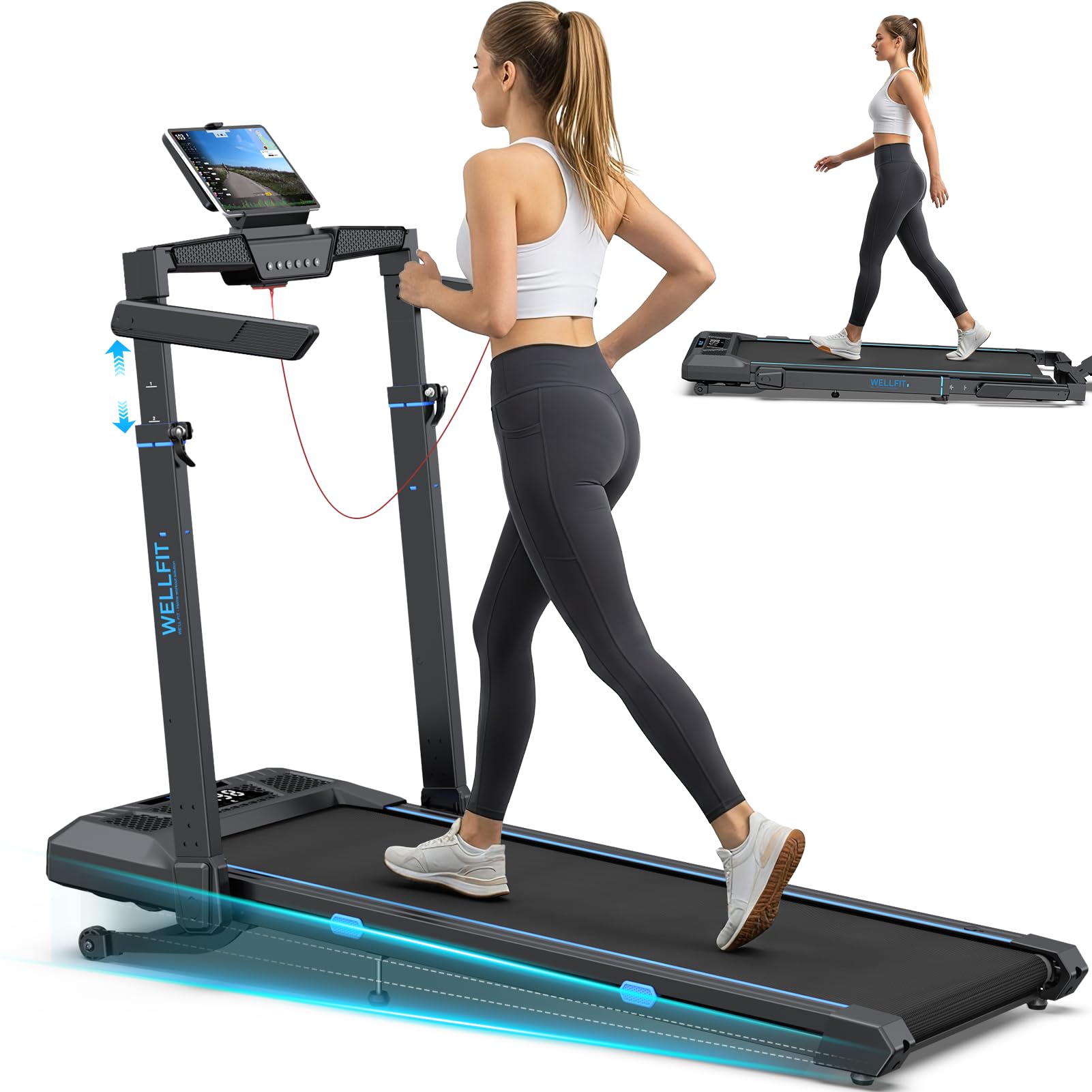
One machine that adjusts to a teenager, an adult, and a grandparent without a fight.
Shared treadmills usually fail on one point: the handrail is at one height and suits one person. This WELLFIT solves that with handrails that move through 5 positions between 30.5″ and 41″, so whoever steps on can set the grip where it belongs. It is the only adjustable-height rail in this article, and it is why this picks up where a single-user pad leaves off.
The capacity matches the intent: 400 lbs, the highest here, well above the 375 lbs on the other WELLFIT and the 300 lbs on several mid-tier picks. A 3.5HP motor runs a 0.6–8.6 MPH range, and the 0–10% automatic incline shifts by itself so nobody has to stop to change the hill. The running area is 44″ x 17″ — the largest belt in this article — laid over seven anti-slip layers and eight silicone shock absorbers. It runs under 45 dB.
Owners consistently praise speed, incline and build quality, and it folds flat to 5.7 inches in one motion. The trade-offs are weight and footprint: at 80.5 pounds it stays put once you place it, and at 52.8″D x 21.1″W it takes real floor space while it is out. For a family machine that lives in one room and serves several people, neither is a deal you regret.
Why a family would choose it
- Handrails adjust through 5 heights from 30.5″ to 41″
- 400-lb capacity, the highest in this roundup
- 44″ x 17″ belt, the largest running area here
- 0–10% auto incline plus 0.6–8.6 MPH speed
- Folds to 5.7 inches for under-bed storage
The practical limits
- 80.5 pounds makes it a two-person move
- Wider footprint than the compact picks
- App and voice control add steps if you only want a dial
Made for: a household where more than one body type uses the same machine.
Not made for: a one-room flat where every inch of floor is spoken for.
10. WalkingPad MX8 Foldable Treadmill with Handles
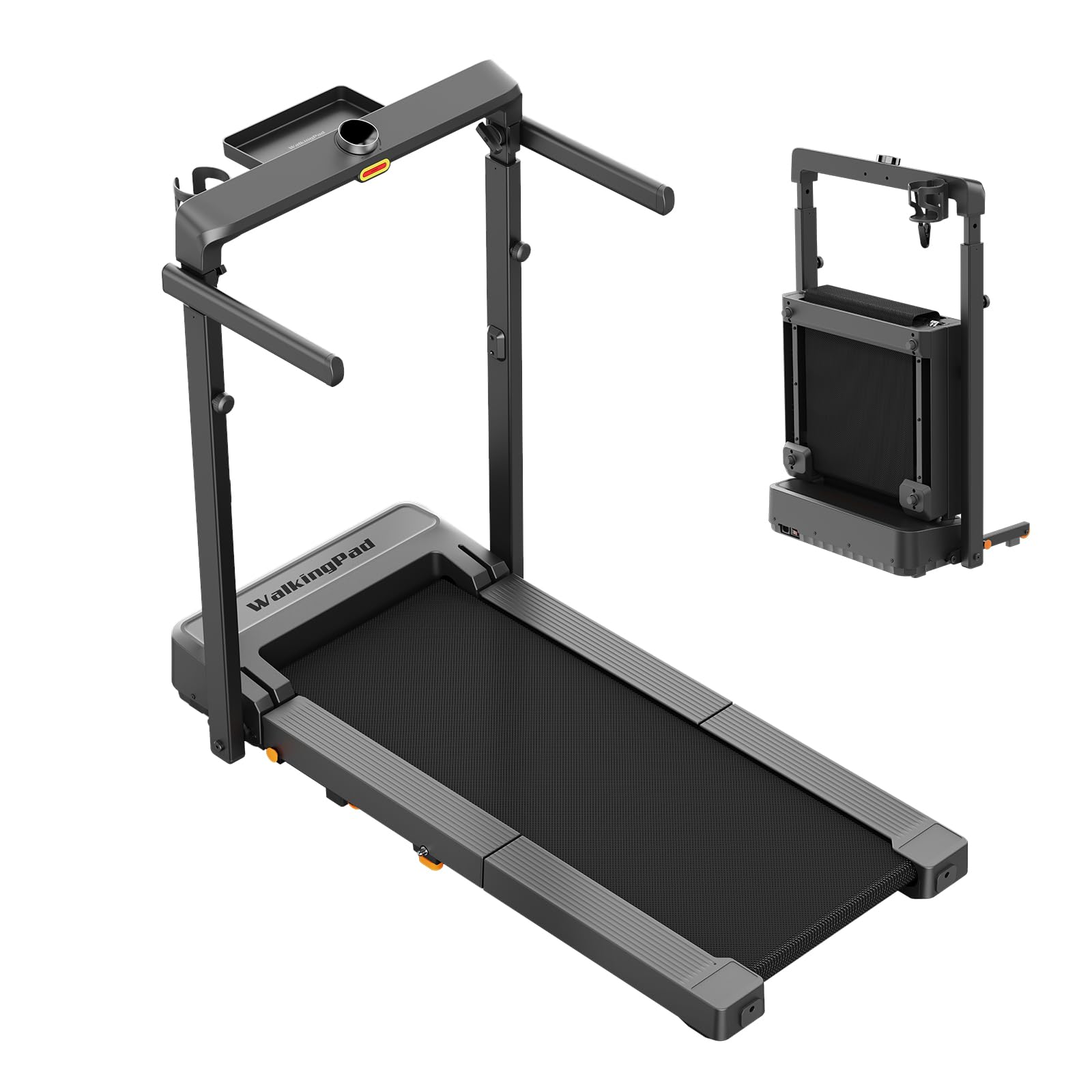
It folds upright into about three square feet, so storage is a corner not a gap.
Every other pad here slides under something. The MX8 stands up. Folded, it takes up roughly 3 sq. ft., which is a different kind of storage — you claim a corner or a stretch of wall rather than crawling under the bed frame. If your bed sits too low or your under-sofa gap is already full, that vertical fold is the reason to look here.
The handles are the other draw. Upright handles and side grips give you something to hold, and the handle height adjusts to a reach that works for you. Speed runs 1–5 MPH through a rotary dial, which suits walking, brisk walking and light jogging rather than running. A brushless motor keeps it quiet, and the LED display shows speed, time, distance and calories. The 330-lb user capacity sits above the 300 lbs on several picks here.
It is built from stainless steel and ABS, weighs 73.9 pounds, and comes with a cup holder, phone holder, tray, silicone oil and a safety key in the box. The honest limit is the pace: a 5 MPH ceiling rules out proper running, and unlike the TOPUTURE’s 10 MPH or the Acezoe’s 10 MPH, there is no fast lane here. Treat it as an everyday walking machine that happens to store upright, and it fits.
The storage angle: about 3 sq. ft. folded upright changes where a treadmill can live in a small flat.
The pace ceiling: 1–5 MPH keeps this a walking machine, and the listing says so plainly.
Reach for it if: under-bed clearance is your blocker and you want handles to hold.
Leave it if: you plan to jog or run, where 5 MPH runs out fast.
11. WalkingPad C2 Foldable Walking Pad Treadmill
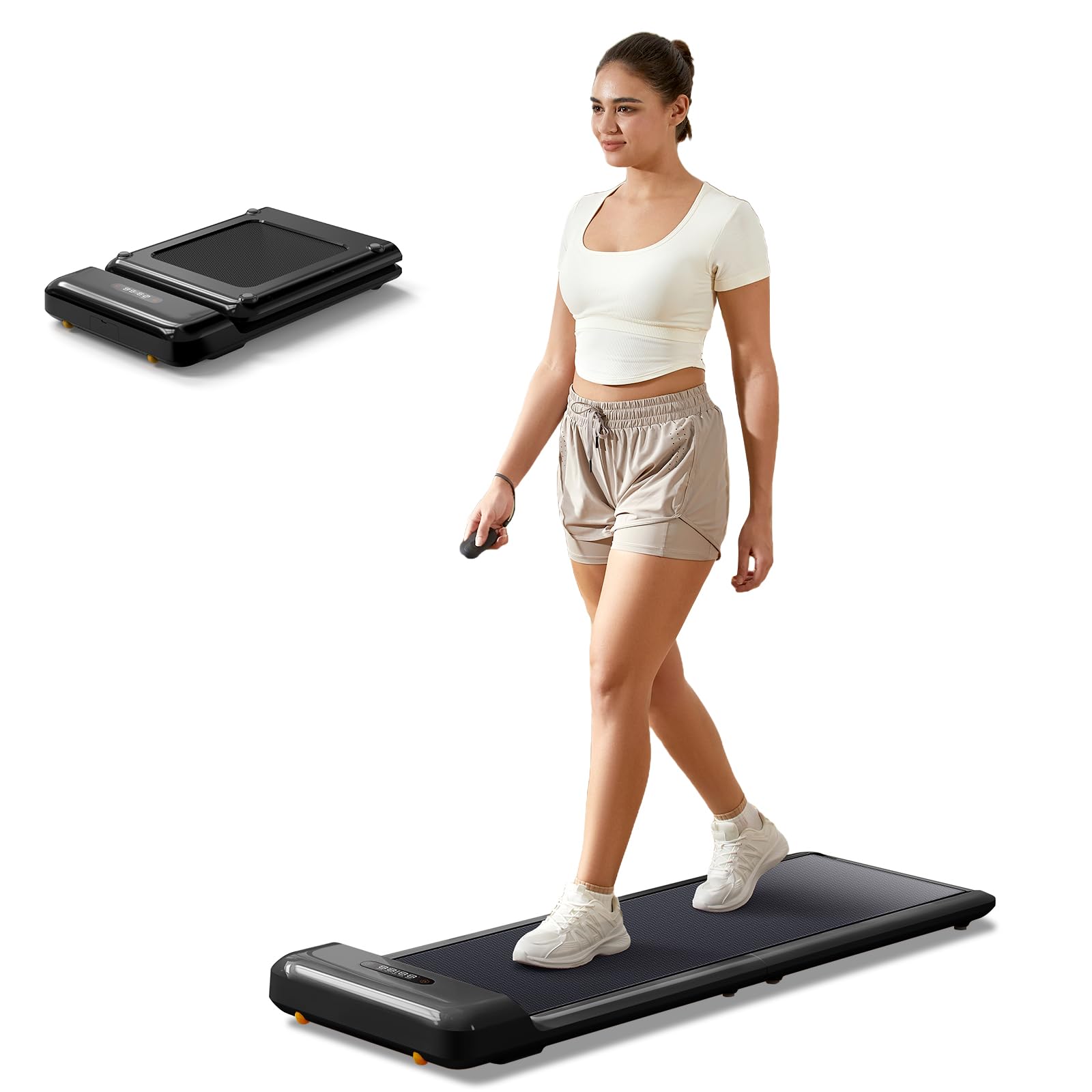
The platform folds in half at 180°, and folded it is only 5.4 inches tall.
This is the purest folding design of the eleven. The C2 folds the running platform on itself through 180°, which brings the whole thing down to 32.5 x 20.4 x 5.4 inches. That is flat and short enough to go under a bed or sofa without measuring twice, and it is a design choice the other machines here do not make.
It is also the lightest way in: 25 kg, on two wheels, with no assembly needed — unfold, plug in, walk. The 2.0HP motor supports up to 220 lbs and carries you from 1 to 4 MPH, which is desk-pace walking rather than training. You pick the speed from the remote or the app, and the LED display shows steps, time, speed, calories and distance. It comes in five colourways, which is rare in a category where most machines are black.
The recurring note is noise: it is quiet by treadmill standards but some find it louder than expected. The 220-lb capacity is also the lowest here, so a heavier walker should look at the WELLFIT models up the page. Where it wins is foldability and function — owners describe it as a pad that folds away in seconds and keeps working, which covers under-desk walking cleanly.
What sells it: a 180° fold, a 5.4-inch folded height, and a 25 kg frame you can wheel aside.
Good match for: desk workers who need a pad out of sight in seconds and walk at a steady pace.
Poor match for: heavier users or anyone who wants to jog, given the 220-lb cap and 4 MPH ceiling.
Know the Specs
Horsepower and Noise
Horsepower is how much work the motor can do, and it decides both your top speed and how loud the machine runs. A 2.5HP motor handles walking comfortably; a 3.0HP or 3.5HP motor holds pace better under a heavier user and usually runs quieter because it is not straining. Noise is quoted in dB, and under 40 dB is the level that will not travel through a floor into a downstairs flat.
Incline Percentage
The incline is written as a percentage of slope, so 12% is steeper than 9%. Manual incline means you set it before you walk; automatic incline means the machine adjusts it for you. Higher numbers give more effort per step, but a manual 16% slope you never change is worth less than an automatic 10% you actually vary.
Folded Size and Clearance
Folded size is written three ways across these listings — some quote a flat profile with a low height like 5.0 inches, others quote a vertical fold with a footprint in squarefeet like 3 sq. ft., and some quote a length-by-width-by-height figure. Compare the folded height against your actual under-bed or under-sofa gap, and compare the folded footprint against the floor you are willing to give up. A 5-inch flat fold needs clearance under furniture; an upright fold needs a wall or a corner.
Weight Capacity and Belt Width
Weight capacity is the heaviest user the frame is rated for, and it should sit comfortably above the person who will actually walk on it. Belt width is how much side-to-side room your feet get — a 15-inch belt feels tight, a 16-inch belt suits a relaxed stride, and a 16.5-inch or 17-inch belt gives you room to land naturally. Belt length matters for stride; most foldables here land between 36.6 and 44 inches.
Speed Range and Use Mode
The speed range tells you what the machine is designed to do. A 1–4 MPH range is desk walking only. A 0.6–7.5 MPH range covers walking, jogging and light running. A 10 MPH ceiling means the machine can genuinely run. Match the range to how you will actually use it, because a machine that tops out below your pace becomes a clothes rack.
Handrails and Support
Handrails are the part buyers underestimate. Upright handles give you balance when you raise the speed, and some designs let you drop them flat for pure under-desk walking. Adjustable-height rails let a single machine serve several people of different sizes. Dual extended handrails give more support than a single bar for beginners and older users.
Common Questions
How much clearance do I need under my bed for a folding walking pad?
Is a manual incline or an auto incline better for daily walking?
Can I use a folding walking pad under a standing desk?
How much noise does a folding walking pad make in an apartment?
What weight capacity should I look for in a foldable treadmill?
Do folding walking pads need assembly?
What is the difference between a walking pad and a folding treadmill?
How fast can a folding walking pad actually go?
Can two people of different heights share one folding treadmill?
Which folding walking pad is easiest to move between rooms?
The Bottom Line
For most buyers, the folding walking pad winner is the HomeTro Walking Pad with 9% Incline. It folds to 5.0 inches, gives you a 9% hill without tools, and pairs a 39″ x 16″ cushioned deck with a handrail display that stays readable in both walking and running modes. If you want the steepest slope in a small package, the YPOO 16% Incline Walking Pad climbs harder than anything else here. And for a family machine that adjusts to different bodies, the WELLFIT 400 LBS with Adjustable Height is the one to reach for.
The honest nudge: the HomeTro pairs its 4.5+ star owner record with a 350+ rating history that has kept climbing, and a fold this flat at this incline level is still the hardest balance to find in one machine. Whichever you choose, measure the gap under your bed and your own walking width first — those two numbers decide more about daily happiness than any spec sheet headline.
How we choose
We do not accept paid placement. Every pick is matched to a real buyer and a real use-case; we do not hands-on test units.
Sources
Specifications: manufacturer listings and product documentation. Review insights: verified customer reviews, as of November 2026. Pricing: not shown on this page (it changes often); check the current price via the retailer link.
As an Amazon Associate, Tactical Gear Guy earns from qualifying purchases. This does not affect which products we feature.