Specs are compiled from manufacturer listings and verified buyer reviews and can change over time — please confirm the key details on the product page before buying.
You do not need twelve pairs of work boots to find one that keeps your socks dry and your toes intact. You need to know which boots actually seal water out at the seam, which toe caps meet a real safety standard, and which soles survive a wet concrete floor. That is what this shortlist answers, pick by pick, with the exact spec that makes each one worth lacing up.
This guide is built by comparing the manufacturers’ published specifications and the patterns across verified customer reviews, so you get each pick’s real strengths and trade-offs instead of marketing spin.
Below you will find a nine-boot field guide split by how you actually work, from a warehouse floor to a muddy jobsite, plus the waterproofing and toe-protection terms that decide whether a boot holds up. Picking waterproof and steel toe work boots depends on two specs: the seam or shell that keeps water out, and the ASTM-rated cap over your toes.
Top Picks

How To Choose The Best Waterproof and Steel Toe Work Boots
Two things decide whether a work boot is worth your money: does it keep water out at every seam, and does the toe cap meet a published safety standard. Everything else — insulation, shaft height, outsole compound — is about matching the boot to your shift.
Waterproof means a membrane or a sealed shell, not a spray-on coating
A water-resistant finish sheds light rain for an hour or two. A truly waterproof boot either carries a seam-sealed leather upper with a gusseted tongue, or it is built from a molded rubber and neoprene shell. Ask which one you are buying. Leather boots breathe better on a warm indoor floor; rubber shells shrug off standing water and mud.
The steel toe standard is what protects your toes
A steel safety toe is tested to resist impact from a falling object and compression from a rolling load. Look for the ASTM F2413 label on the boot, because that is the published proof the cap was tested. A toe cap with no standard behind it is just a heavy front end.
Underfoot protection: steel shank and puncture plate
A steel shank is a stiff strip layered between the insole and the outsole. It supports your arch and stiffens the boot so a sharp edge underneath cannot fold the sole into your foot. A puncture-resistant plate adds a separate barrier underfoot for nails and wire. On a site scattered with debris, that layer matters.
Electrical hazard rating and slip resistance
An EH rating means the boot is built to reduce the risk of completing a circuit through your body when you touch a live wire. A slip-resistant outsole is a separate spec, usually stamped with a compound name and a tread pattern. Both should be printed on the boot or the listing, not implied.
Match the shaft height and weight to your day
A 6-inch boot laces up fast and feels lighter around the ankle. An 8-inch boot supports more of the lower leg and keeps splash and mud out. Rubber boots climb higher still. Weight follows construction: a molded rubber shell runs heavy, a leather boot runs lighter. Pick by how many hours you stand and how deep the water gets.
Side-by-Side Comparison
| Model | Best For | Upper / Shell | Safety Features | Height / Weight | Amazon |
|---|---|---|---|---|---|
| Timberland PRO Direct Attach 6″★ Best Overall | Cold-weather warehouse and outdoor shifts | Seam-sealed waterproof leather | Steel toe, EH rated, 200g insulation | 6-inch | Amazon |
| NINGO Waterproof Steel ToeBest Value | Long shifts on your feet | Full-grain leather, direct attach | Steel toe (ASTM F2413-24, I-75/C-75), EH rated, TPU SR outsole | — | Amazon |
| Thorogood 1957 Series 8″Most Watertight | Serious jobsite durability | Full-grain saddle leather, gusseted tongue | Steel toe (ASTM F2413-18), EH rated, MaxWear 90 outsole | 8-inch / 4.9 pounds | Amazon |
| Hunthor Steel Toe Rubber (RWB) | Wet, muddy work sites | Molded rubber shell | Steel toe, steel shank, puncture proof | 4.41 pounds | Amazon |
| Trudave Steel Toe Rubber | Farming, hunting, wet terrain | Waterproof rubber and neoprene | Steel toe, steel shank, anti-slip | 3.5 pounds | Amazon |
| TIDEWE Rubber Work Boots | All-day waterproof protection | 100% waterproof rubber and neoprene | Steel toe, steel shank, puncture proof | 10-inch shaft | Amazon |
| Square Toe Cowboy Work Boots | Ranch and construction style | Full-grain leather | Steel toe, EH protection, oil and slip resistant | — | Amazon |
| Hunthor Steel Toe Hunting Boot | Lightweight rubber protection | Rubber shell | Steel toe, waterproof | — | Amazon |
| Wolverine Floorhand 6″ Steel Toe | Ten-hour workdays indoors and out | Waterproof leather with mesh lining | Steel toe | 6-inch / 4 pounds | Amazon |
Detailed Reviews
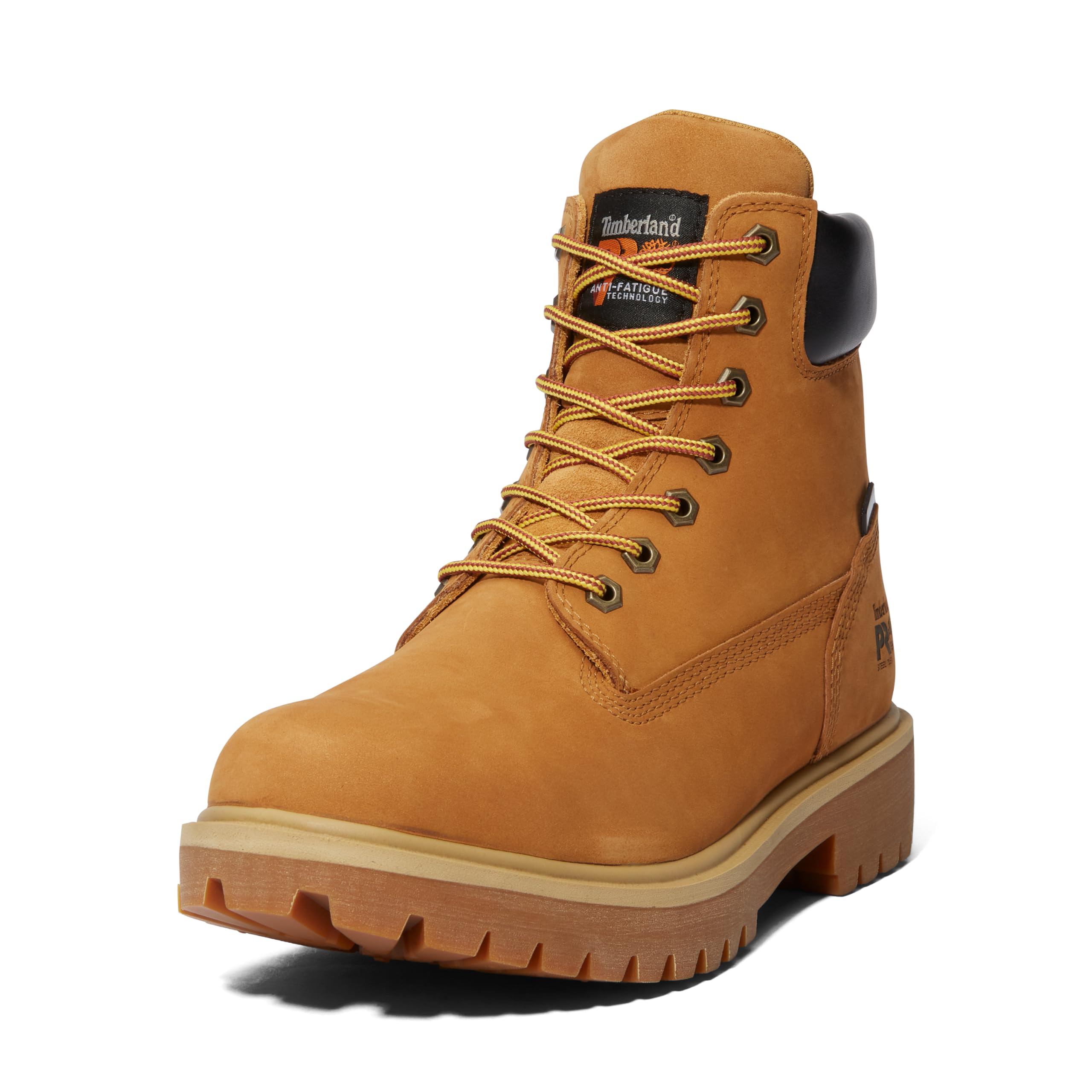
1. Timberland PRO Direct Attach 6 Inch Steel Safety Toe
Our pick — 4.5+★ from 400+ verified ratings; the strongest balance of quality and price.
The cold-weather boot that keeps ankle-deep water on the outside where it belongs.
If your shift runs from a wet loading dock into a cold warehouse, start with this pair. It stands out from every other leather boot on this list because of its 200 grams of insulation (a layer of synthetic fill that holds warmth around your foot). That means you get a waterproof boot that stays warm when the temperature drops, instead of going cold.
The waterproofing comes from a seam-sealed leather upper rather than a rubber shell. That means the boot breathes through a moisture-wicking ReBOTL fabric lining, so sweat moves out while rain stays out. A padded collar and an Anti-Fatigue Technology polyurethane footbed handle shock absorption across a long shift, and the rubber lug outsole is built to resist heat, oil, slip, and abrasion. Electrical hazard protection is built in as well.
Two things to plan around. The leather runs about half a size large, so size down if you are ordering your usual number. And this is a leather boot, not a molded rubber shell — it is the better choice for a wet concrete floor and cold air than for standing in a flooded trench all day. The 200g insulation and seam-sealed leather handle cold and wet together, and the rubber lug outsole grips slick pavement.
Why it earns the top slot
- 200 grams of insulation keeps feet warm in cold work areas
- Seam-sealed waterproof leather holds up in ankle-deep water
- Anti-Fatigue Technology footbed and padded collar for long shifts
- Rubber lug outsole resists heat, oil, slip, and abrasion
What to know before you order
- Runs about half a size large, so size down
- Leather construction rather than a full rubber shell
Made for: the worker who splits time between cold and wet, and wants a break-in-free boot that breathes.
Think twice if: you need to stand in standing water for hours — a molded rubber boot serves that better.
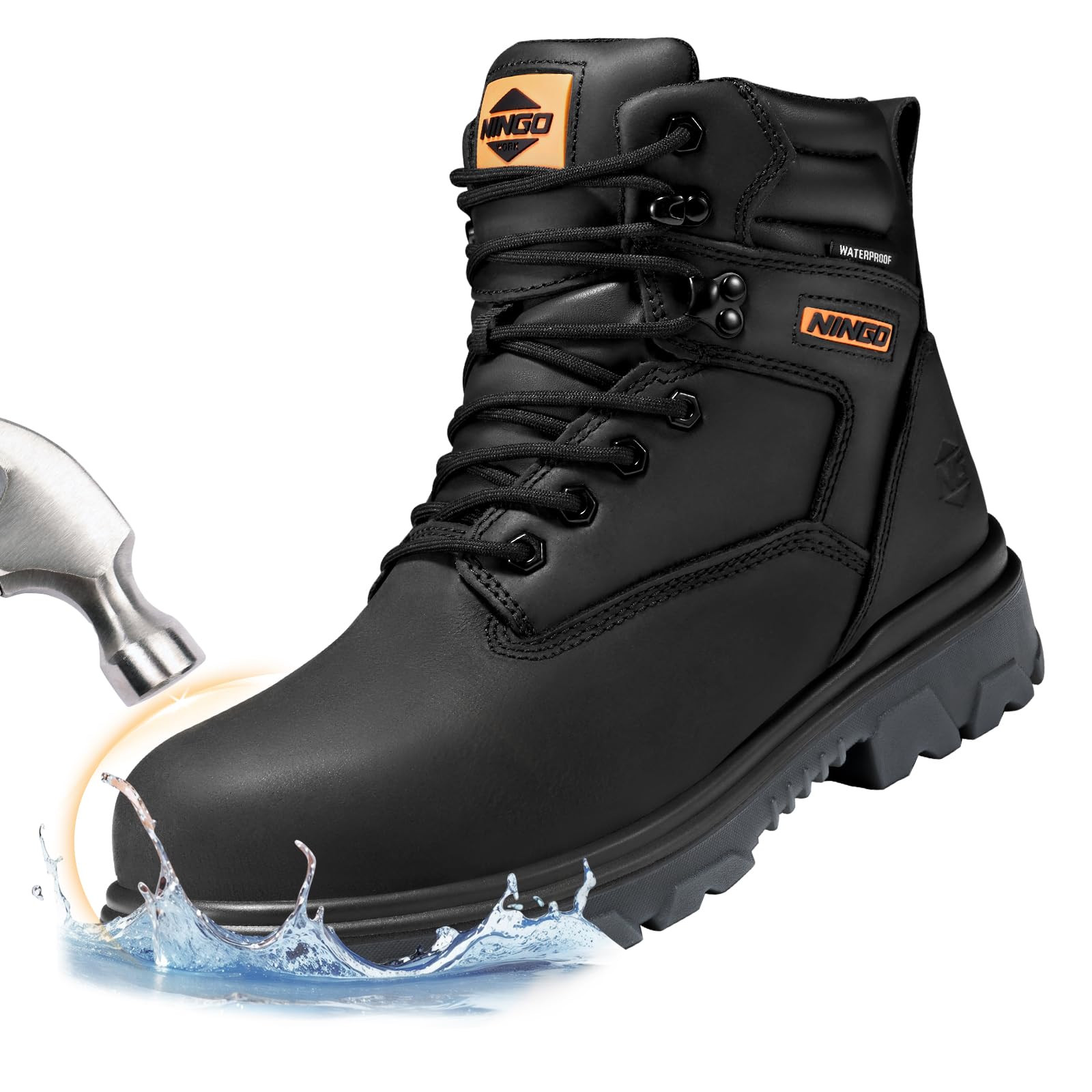
2. Waterproof Steel Toe Work Boots for Men
The quiet workhorse that laces up from the start and never makes you think about it again.
Start with the number that matters most here: the steel safety toe meets or exceeds ASTM F2413-24 standards for impact (I-75) and compression (C-75). That is the published proof your toes are protected in the test that matters, not just in the marketing copy. Electrical hazard protection is certified too.
The upper is full-grain leather, joined to the outsole by direct attach construction — a molded bond rather than a glued seam, which is what keeps the upper and sole from separating over months of daily wear. Underneath, a TPU SR lug outsole (a thermoplastic polyurethane compound that the listing says offers up to three times the abrasion resistance of traditional rubber) handles wet, oily, and uneven floor surfaces.
Comfort earns the most mentions here, and it shows in the build: a removable high-rebound insole with gel heel padding absorbs shock on long shifts. On weight, opinions split — some like the heft, others find it noticeable. That is the honest trade-off you accept for the durability. The gel heel insole and high-rebound footbed mean no break-in period before a full shift.
The durability bet: direct attach construction and a TPU outsole give you a boot built to stay together, and the certified toe means the safety spec is real rather than assumed.
Who this fits: construction, oil and gas, warehouse, and general outdoor work where you want certified protection without stepping into premium territory.
Strongest case: certified impact and compression protection with a gel insole for all-day standing.
Where it could bite: the weight is a matter of opinion — try it if heft helps you feel grounded, skip it if a long walk is part of your day.
3. Thorogood 1957 Series 8” Waterproof Steel Toe
American-made saddle leather, an 8-inch shaft, and a Moc toe that takes a beating.
This is the premium pick, and the spec that justifies it is a pair of published standards: ASTM F2413-18 for the steel safety toe and ASTM F3445-21 for slip resistance on the MaxWear 90 outsole. Those are actual test standards printed on the boot, not adjectives.
What you get around them is full-grain saddle leather in Thorogood’s Trail Crazyhorse finish with a wax treatment for a vintage look. A gusseted tongue keeps water and liquids at bay while the moisture-wicking lining pulls sweat away. The 8-inch shaft supports more of your lower leg, and the Moc-toe design flexes better than a stiffer work boot outsole, absorbing impacts on loose gravel and wet or oily surfaces. A memory foam insole handles the cushioning.
It is a heavy boot at 4.9 pounds, so expect a real break-in. The full-grain saddle leather is the part that lasts, which is what justifies the premium price for daily jobsite abuse. At nearly a thousand reviews and a 4.0+ star score, the crowd is clearly on board.
Where the money goes
- Meets ASTM F2413-18 toe and ASTM F3445-21 slip standards
- Full-grain saddle leather with a gusseted tongue that seals water out
- 8-inch shaft for lower-leg support in mud and gravel
- MaxWear 90 outsole flexes to absorb impacts
The real trade-offs
- 4.9 pounds, so break-in takes patience
- Premium tier, so it is the biggest spend on the list
The verdict: the boot you buy when the job site is genuinely punishing and you want American-made leather behind you.
Stand down if: you want a featherweight boot or you are not ready to work in a new pair for a while.
4. Wolverine Men’s Floorhand Waterproof 6” Steel-Toe Work Boot

A six-inch leather boot built for ten-hour days without the premium price tag.
The Floorhand is a waterproof leather work boot with a steel toe and a moisture-wicking mesh lining. The 6-inch shaft laces up quickly, and the whole boot comes in at 4 pounds — noticeably lighter than a molded rubber shell but still substantial underfoot. Wolverine has been building boots since its Rockford, Michigan founding, and this model leans on that experience with a straightforward no-nonsense build.
Comfort is the headline. The boots are liked for being wearable through long shifts, and the mesh lining keeps the inside from getting clammy. If you have wide feet, the 9 extra-wide size works for a roomy fit. A lot of the appeal is simply value — you get quality construction without stepping into the premium tier.
The recurring gripe is that some units start to separate after months of use, which is the honest durability caveat for a boot in this price band. At 4 pounds with a 6-inch shaft, the Floorhand is built for ten-hour shifts rather than weekend wear.
The value read: 4 pounds, a 6-inch shaft, and waterproof leather add up to a boot light enough for a long shift and sealed enough for a wet one.
A word of care: watch the seams over time — that is the one part of the boot that asks for upkeep.
Reach for this if: you want a light leather boot for ten-hour days, including wide sizes.
Look elsewhere if: you need a boot that shrugs off standing water for years — that is rubber-boot territory.
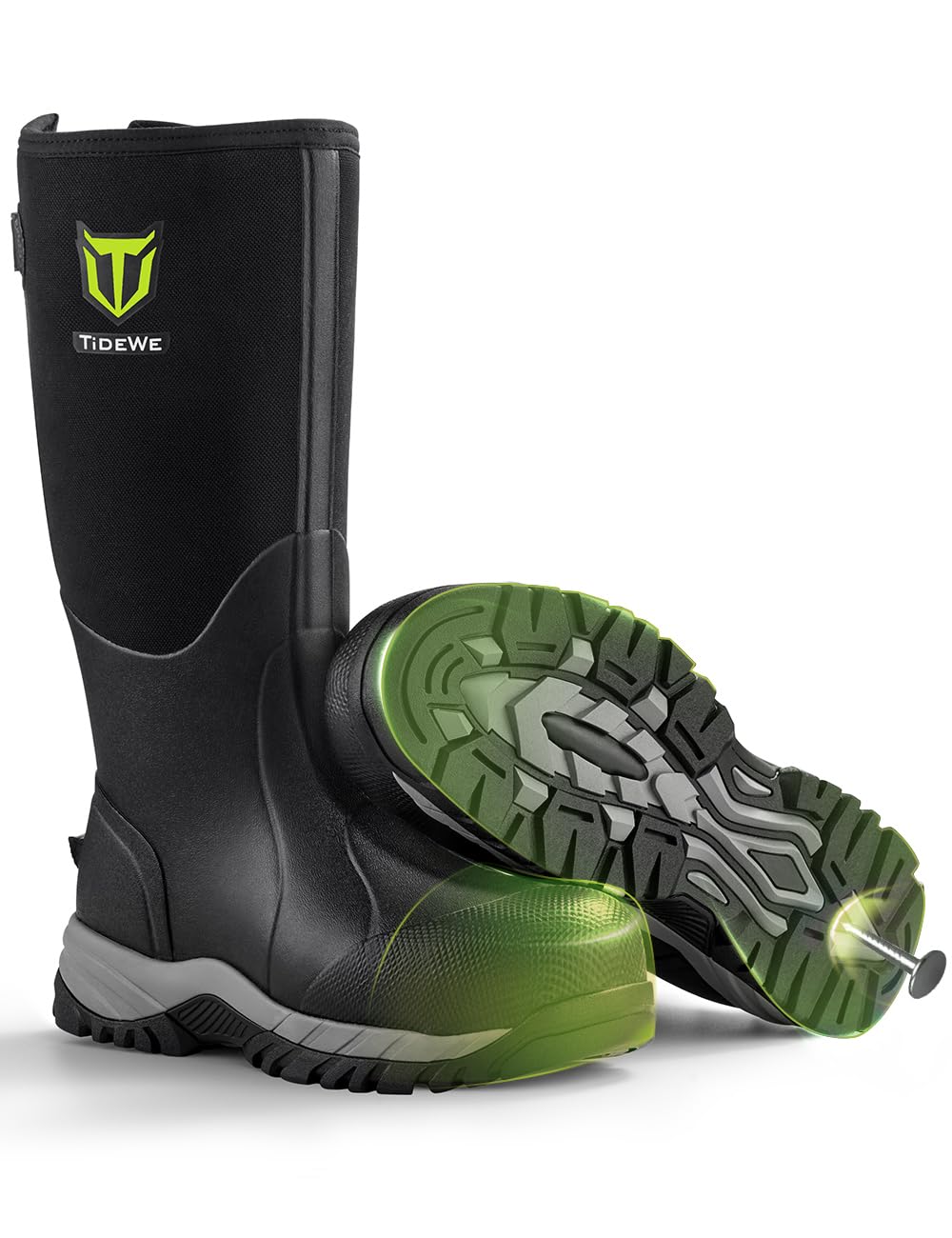
5. TIDEWE Rubber Work Boots Steel Toe & Shank
The molded rubber boot that lives for flooded trenches, farms, and cold wet mornings.
If the water is coming over your ankle, this is the shape you want. TIDEWE builds the boot from 100% waterproof rubber and neoprene, and layers in 6mm of neoprene for comfort and warmth when the temperature drops — that neoprene thickness is the number that makes cold-water work tolerable. A breathable inner lining keeps your feet cool when it warms up instead.
Your foot gets three layers of protection. A steel toe (a metal cap over your toes) takes the hit from falling or rolling objects, so a dropped crate does not land on your foot. A steel shank (a metal strip between the insole and outsole) adds arch support and stiffness. A puncture-proof layer gives secondary underfoot protection, so a nail on the floor is less likely to reach your foot. The rubber sole has a deep tread for workplace terrain, so you keep grip on wet or uneven ground. A 10-inch shaft and a pull-on kick tab make it quick to put on and take off at the end of a shift.
The one sizing move to know: measure your foot and choose a size about 0.16 inches longer than your actual measurement. That half-step of extra room is how TIDEWE intends the boot to fit. Get that right and this is a workhorse for farms, gardens, fisheries, construction, and manufacturing.
What holds up in the wet
- 100% waterproof rubber and neoprene shell
- 6mm neoprene for warmth on cold, wet mornings
- Steel toe, steel shank, and puncture-proof layer combined
- Pull-on kick tab for fast on and off
What to watch
- Sizing needs the 0.16-inch allowance to fit right
- Molded rubber adds bulk and heft versus leather
Best fit: anyone standing in water, mud, or slush who needs toes and soles protected at once.
Less ideal: a dry indoor floor where a lighter leather boot makes more sense.
6. Mens Steel Toe Cowboy Boots Waterproof Square Toe

A cowboy silhouette that hides a serious steel toe and a 100% waterproof build.
Not everyone wants a lace-up. This square-toe cowboy boot puts a steel safety toe inside a full-grain leather upper and rates the whole thing 100% waterproof, with oil- and slip-resistant tread underfoot and electrical hazard protection built in. For ranches, farms, and construction crews who wear a Western boot to work, that is the spec sheet you want.
Comfort is where this boot earns its keep — buyers like that it does not punish their feet, and the full-grain leather is the material driving the quality impression. The steel-toed design under the Western shape keeps the safety spec without the work-boot look.
The honest caveat is sizing. Some buyers find the fit off, so check the size chart before ordering rather than assuming your usual number. Durability and water resistance get a mixed read too, which is fair for a leather boot in this tier. Still, for the cowhand or jobsite worker who wants a square toe and a steel cap, few options combine the two as cleanly.
Where it shines: a full-grain leather cowboy boot with a 100% waterproof rating and a steel toe you cannot see from across the yard.
The caution: sizing is the one thing to verify before you buy — check the chart, not your usual number.
Go for it: if a Western square toe is your style and you still need a steel cap and waterproof leather.
pass on it if: you want a predictable off-the-shelf fit without measuring first.
7. Hunthor Rubber Work Boots Steel Toe

The rubber boot that keeps the price down without dropping the steel toe.
Hunthor’s second entry on this list takes a different route: a molded rubber shell with a steel toe, pitched as a lightweight waterproof boot for hunting and wet work. The build quality is what buyers respond to most, with comfort and true-to-size fit close behind. The waterproofing holds up in the wet, and the value is a big part of the draw.
What makes it stand apart from leather boots is the shell. A rubber boot climbs higher, wipes clean in seconds, and does not care about mud. That makes it a natural for hunting season, farm work, and anything where the ground gets soft.
The trade-off to know: durability reads mixed. A few units wear out faster than the rest, which is the honest risk on a rubber boot in this tier. If you want a shell that lives in the back of the truck and gets dunked in puddles, this is a smart pick. If you need it to survive a construction site day after day, look at the stiffer rubber options above.
Why it keeps up
- Steel toe in a lightweight rubber shell
- True-to-size fit from the start
- Waterproof build that handles mud and puddles
- Budget-friendly for a safety-toe rubber boot
Where to be careful
- Durability is a mixed read — some units wear faster
- Rubber shell is warmer and bulkier than leather
The fit: hunters, farmers, and weekend wet-work who want a steel toe without a heavy spend.
Not the one for: a full-time construction shift where the shell takes constant abuse.
8. Hunthor Steel Toe Rubber Work Boots

A proper rubber boot — 4.41 pounds of shell, shank, and sole that takes the muck.
Weigh the two Hunthor boots side by side and the difference is immediate: this one runs 4.41 pounds, against 1 pound for the leather NINGO boot above. That heft is the point. A molded rubber shell with a steel toe, a steel shank, and a puncture-proof sole is built to wade, not to tiptoe.
Quality is the thing buyers talk about most here, and the details back it up. The back kick tab makes the boot easy to get off after a muddy shift. The anti-slip outsole wipes clean, and the back gusset design adjusts to different calf sizes so the shaft fits without pinching. Warmth comes from the rubber shell, with a Thinsulate-insulated version in the same line for cold weather.
The honest catch is two-sided: the weight reads mixed, and a few buyers report cracks developing over time. Neither is a dealbreaker for a boot in this tier, but if you want a long-term construction boot, the thicker-shelled options or the premium leather picks make more sense.
The build: rubber shell, steel toe, steel shank, and a puncture-proof sole in one wading boot.
The honest limit: at 4.41 pounds it is a heavy boot, and the rubber can crack over years of hard use.
Pick this: for hunting, farm, and wet outdoor work where the boot gets muddy and hosed off.
Look past it: if you need a light boot for an indoor concrete floor.
9. Trudave Steel Toe Rubber Boots for Men

The entry-level rubber boot that fits, fights slips, and keeps the price honest.
If you need a steel-toe rubber boot and want to keep the spend down, this is the one to look at first. Trudave sizes from 6 to 14 and builds the boot from 100% waterproof rubber and neoprene, with a steel toe in the front and a steel shank between the insole and outsole for arch support and foot protection. The sole has a deep tread for the worst terrain.
Comfort is handled with a 4mm SBR and 2mm sandwich breathable layer, plus an airy inner lining and an ergonomic arch at the top of the boot. An adjustable buckle strap lets you dial in the calf fit. For hunting, fishing, farming, and construction, that combination is enough to get through the day.
Fit is the top strength here — owners mention the boots fit well. Durability and water resistance are the mixed notes, so treat this as the budget wading boot rather than a forever pair. At 3.5 pounds it is the lightest rubber boot here, well under the 4.41-pound Hunthor.
The budget case: steel toe, steel shank, and 100% waterproof rubber at the lowest spend here, in sizes 6 to 14.
The honest trade: durability and water resistance are mixed — great for weekend wet work, less so for daily site abuse.
Best for: budget-minded buyers doing seasonal or weekend wet work who want steel underfoot.
Choose another: if you need a boot built to survive daily construction use for years.
Know the Specs
ASTM F2413 impact and compression ratings
These are the test standards behind a steel toe. The impact number (I-75) measures how much a falling object the boot resists; the compression number (C-75) measures how much rolling load the toe cap survives. A boot marked ASTM F2413 has been tested to those levels, so you know the toe cap is real protection rather than a heavy front end.
Steel shank vs puncture-resistant plate
A steel shank is a stiff strip between the insole and outsole that supports your arch and keeps the sole from folding under a sharp edge. A puncture-resistant plate is a separate barrier underfoot that stops a nail or wire from pushing up into your foot. Some boots carry one, some carry both. On debris-scattered sites, both is better.
Waterproof leather vs molded rubber shell
A seam-sealed leather upper with a gusseted tongue breathes and flexes, which suits cold or mixed indoor-outdoor work. A molded rubber and neoprene shell seals water out completely and wipes clean, which suits mud, puddles, and wading. Leather is lighter and more flexible; rubber is more watertight and heavier. Match the shell to your wet.
Insulation and neoprene thickness
Insulation is measured in grams (Timberland’s 200 grams, for example), and neoprene thickness in millimeters (TIDEWE’s 6mm). Both hold warmth around your foot. More grams or more millimeters means a warmer boot for cold weather, but also a bulkier one. If you work in a heated shop, you can skip the insulation entirely.
Common Questions
Will a steel toe boot fit the same as my regular work boots?
What does ASTM F2413 actually mean on a work boot?
Can I wear waterproof steel toe boots on an electrical job?
What is the difference between a steel shank and a puncture-resistant plate?
How long do waterproof steel toe work boots last?
Are rubber work boots heavier than leather work boots?
Do I need insulated work boots for cold weather?
Can I wear waterproof steel toe boots for hunting and farming?
Would a steel toe boot work on a construction site with wet, oily floors?
How do I take care of waterproof steel toe work boots?
The Bottom Line
For most workers, the waterproof and steel toe work boots winner is the Timberland PRO Direct Attach because the 200 grams of insulation and seam-sealed waterproof leather cover both the cold and the wet in one break-in-free boot. If you want certified protection without the premium price, grab the NINGO Waterproof Steel Toe with its ASTM F2413-24 toe. And for standing water and mud, the TIDEWE Rubber Work Boots is the one to reach for.
The Timberland PRO wins on a 4.5+ star score from a smaller pool of ratings, with 200g insulation no other leather pick here offers. Match the shell to your wet — sealed leather for splash and cold, molded rubber for standing water — and confirm the ASTM F2413 label before you buy.
How we choose
We do not accept paid placement. Every pick is matched to a real buyer and a real use-case; we do not hands-on test units.
Sources
Specifications: manufacturer listings and product documentation. Review insights: verified customer reviews, as of November 2026. Pricing: not shown on this page (it changes often); check the current price via the retailer link.
As an Amazon Associate, Tactical Gear Guy earns from qualifying purchases. This does not affect which products we feature.